Check out this new documentary about how indigenous blockades in Quebec defeated a project of law that would’ve handed over the remaining forests of the province to the logging industry. The media is obscuring the fact that direct action got the goods, so we’re trying to get this out fast – boosts appreciated!
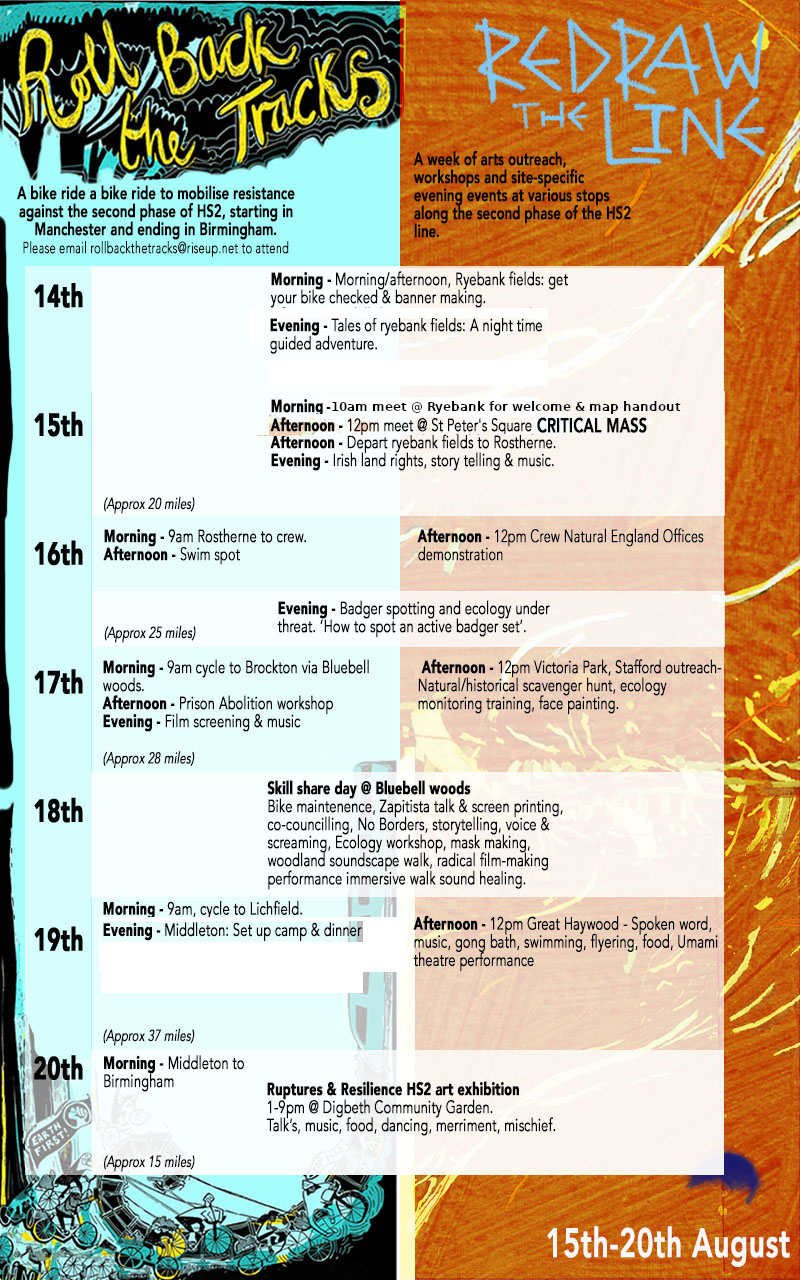
– bicycle 🙂
– bicycle panniers
– tent, sleeping mat and sleeping bag
– headlamp/flashlight
– power bank for charging electronics
– bottles for carrying drinking water
– a sealable tupperware for carrying food and eating out of, mug and cutlery
– toiletries and medication
– clothes to stay warm and dry
– first aid kit
– a basic cycle repair kit if you have one
– banners and flags to attach to your bike! (no XR banners please)
– cash for donations for food.
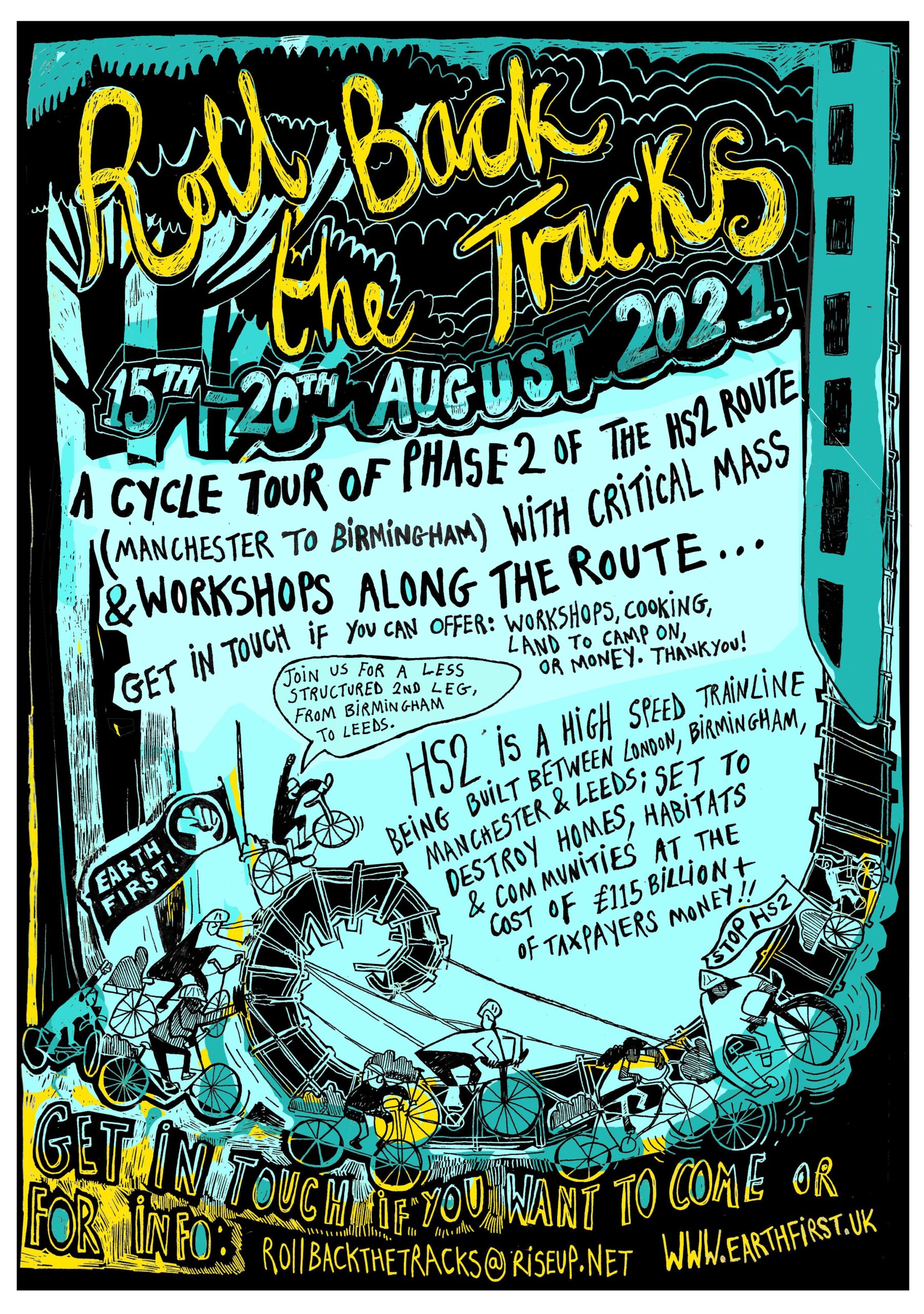
We are looking into continuing the bike ride along the second leg of the proposed route from Birmingham to Leeds from the 20th to roughly the 27th of August. For this leg, you will also need:
– camping stove & gas
– cooking equipment
Camping Sites
We have tried where possible to get permission to use camping sites. However, in some places we will be trespassing, and as such, facilities will be minimal. We have selected places that we feel are suitable to camp for the nights of the 15th-19th.
On the night of the 20th, we will be wild camping in a park in Brum centre, and from then on, wild camping in locations that we have not yet visited, and therefore we can’t guarantee they will be brilliant places to camp.
Food & water
On the first leg of the ride from Manchester to Birmingham, we will have a catering team following us in a vehicle. With volunteer support from us, they will provide one cooked, vegan, evening meal each day, and provide the ingredients for us to make our own breakfast and packed lunches.
Volunteers in the kitchen will need to wear a face mask and observe physical distancing.
Donations for food are greatly appreciated, though no-one will be turned away for lack of funds.
On the second leg, we will NOT be catered for, so if you are cycling from Brum to Leeds, you will need to buy your own food and cook for yourself.
Most of the camping sites have running water nearby. However, you need to have at least 2 1L drinking bottles with you on the ride, and to fill them up whenever possible on route to campsites. Stay hydrated!
Toilets
At some of the campsites, there are toilets. Where there are not toilets, we will have a bike trailer toilet cubicle in tow, and a spade. Collectively, we will have to dig a pit for everyone to poo in. If the idea of pooping in a pit grosses you out, then make sure you use public toilets on route.
Checking your bike is ready to join Roll Back the Tracks
Lots of different bikes can make this trip, but it needs to be in good working order.
Please make sure you have at least one water bottle holder on your bike. You also need to think about how you will carry your luggage. You need either a pannier rack bolted to your bike frame to carry pannier bags with your belongings, or you’ll need to bring bike packing bags to carry luggage directly on the frame. Please don’t come with a backpack of all your stuff, you will be sweaty and uncomfortable quickly. Full suspension mountain bikes are not recommended.
If you don’t cycle regularly, or you are borrowing a bike for the trip check that the bike fits – take it for a test ride of a few hours to see how comfortable it is. You need to be able to stand over the frame without it touching you between your legs and be able to comfortable reach the handlebars and brakes.
Check your brakes
Rim brakes (the brakes act on the metal circular part of your wheel)
• pull on the brakes one at a time to ensure that they can stop the bike
• check there is plenty of rubber across the whole of all the pads (especially if your brakes are noisy)
• check that the brakes just touch onto metal and not onto the rubber of the tyre
• check that when you pull the brake lever (the part in your hand when riding) the lever doesn’t touch the handlebars.
Disk brakes
• Check that the front and the back brake stops your bike (rather than when both are pressed at the same time).
• Check the rotary wheel is straight and firmly attached.
• If the brakes are ringing you need to get them adjusted.
Wheels
• Check that quick release wheels are properly tightened. You should be able to read the word ‘closed’ when they are;
• otherwise, check that wheel nuts are tight, especially if you remove your front wheel.
• Clean the braking surface if you have rim brakes – use washing up liquid in water and a rag.
• Check the tyres are fully inflated. The pressure is written on the side of your tyre.
• Check the tyres still have a pattern across the surface and do not bulge.
• Check that the brakes haven’t rubbed a grove in the rubber of the tyre.
• Check that the wheel runs in a straight line – do this by lifting one end of your bike and pushing the wheel round fast, it should move smoothly and not rub.
• Look at your wheels to ensure all the spokes are there and squeeze them in pairs to check they are of a similar tightness.
Frame
• Make sure there are no cracks or big dents in the frame.
• Check the bolts attaching mud guards, water bottles and the pannier rack are all tight.
• Can you move the handlebars fluidly?
• Could they be too loose? Put the front brake on, turn the front wheel 90 degrees and then see if the front of the bike rocks if you push forward on the turned handlebar. If so, it needs tightened.
Gears
• Look at your chain and everything it touches. Dirty? It really is worthwhile using an old tooth brush to clean each link and contact point before re-applying oil to each link and then removing any excess with a rag.
• Move the pedals and ensure they can freely turn round completely.
• Check that the bike can go into all of its gears. There are going to be hills, so you’ll need a range of gears.
Got a creaking bike?
Can you work out where it is coming from? If standing up to pedal makes it stop check your saddle, if it is worse when you peddle hard it is likely your bottom bracket.
Got a problem with one or more of these areas? If yo don’t know how to fix it find a friend who does or take it to an independent bike shop – but watch out they may not be able to do this at short notice.
Please bring a spare inner tube with you in case you get a puncture, the size is written on the side of your tyre. If you don’t know how to change a flat tyre still bring a spare inner tube and we can fix it together.
Having a fully working bike is your responsibility.
We are meeting together on the 14th at Ryebank Fields Protest Camp in Manchester to check bikes. Please bring a bike which is in full working order as we may sadly have to ask you not to come if you’re bike isn’t up to the job and we can’t get parts to fix it.
How can you help?
• Know of anywhere we (max 50 riders) could sleep in the following areas?
◦ North Cheshire
◦ Birmingham Centre (ideally near Digbeth)
◦ West Leicestershire
◦ Sheffield
◦ Leeds
• Involved in a critical Mass or cycling group in Brum, Nottingham, Sheffield or Leeds? Help us organise some cyclists into a critical mass!
• Have you got a bike sound system you could bring on part of the ride?
• Do a workshop on route. Sing a song round the campfire.
• Get creative and make some flags or banners for our bikes!
• Volunteer in the kitchen.
• Tow the bike trailer toilet for a few hours.
• Spare some change? We are trying to raise 2000 pounds to fund the project. can you help either by donating or sharing? Here´s the link to the crowdfunder: https://www.crowdfunder.co.uk/roll-back-the-tracks
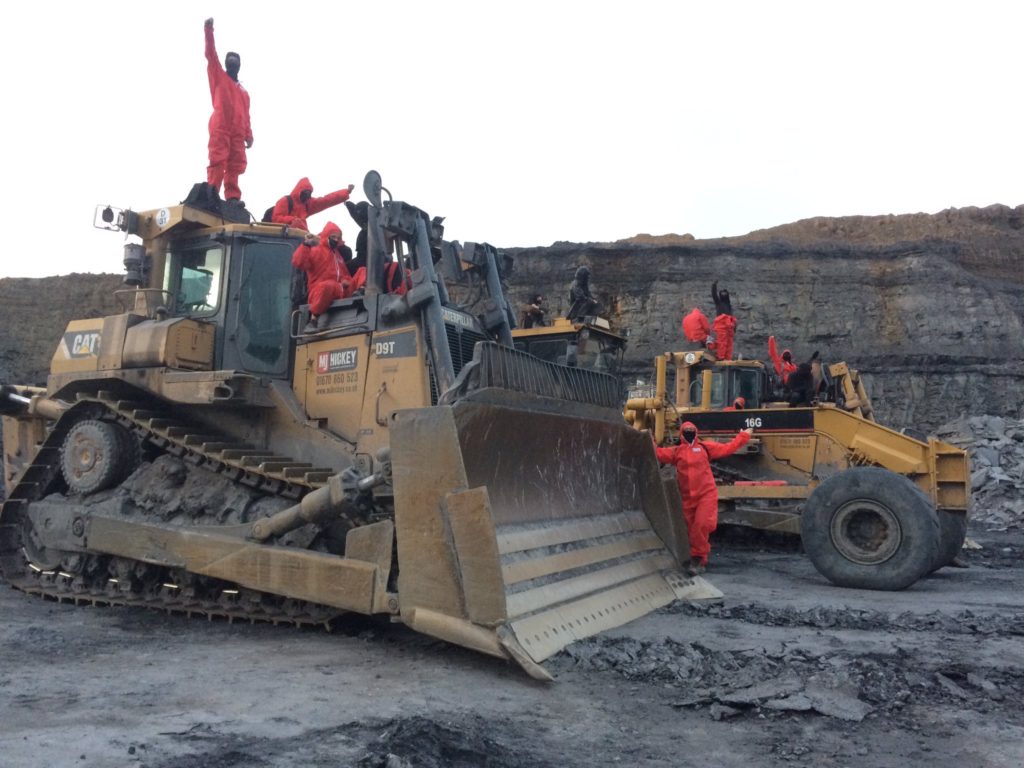
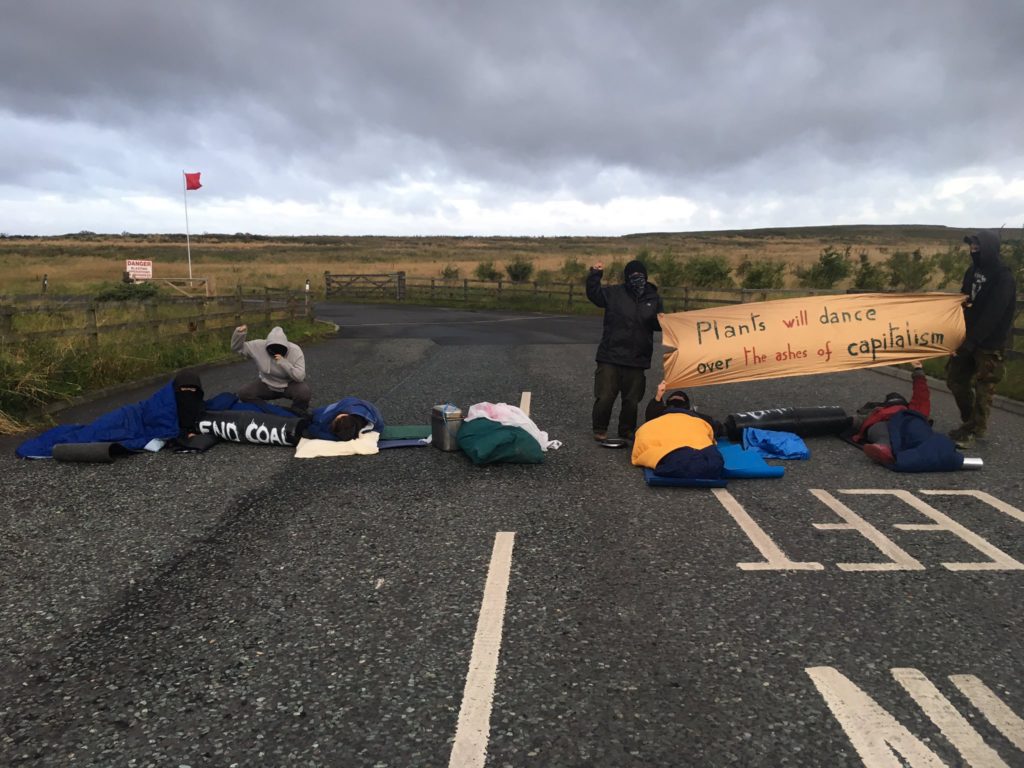
Protesters occupping equipment at the Hargreaves open cast coal mine at Field House, County Durham
ACTIVISTS UNDER THE BANNER OF EARTH FIRST! TAKE ON COAL MINING IN THE NORTH EAST OF ENGLAND. TWO COAL MINES SHUT DOWN!
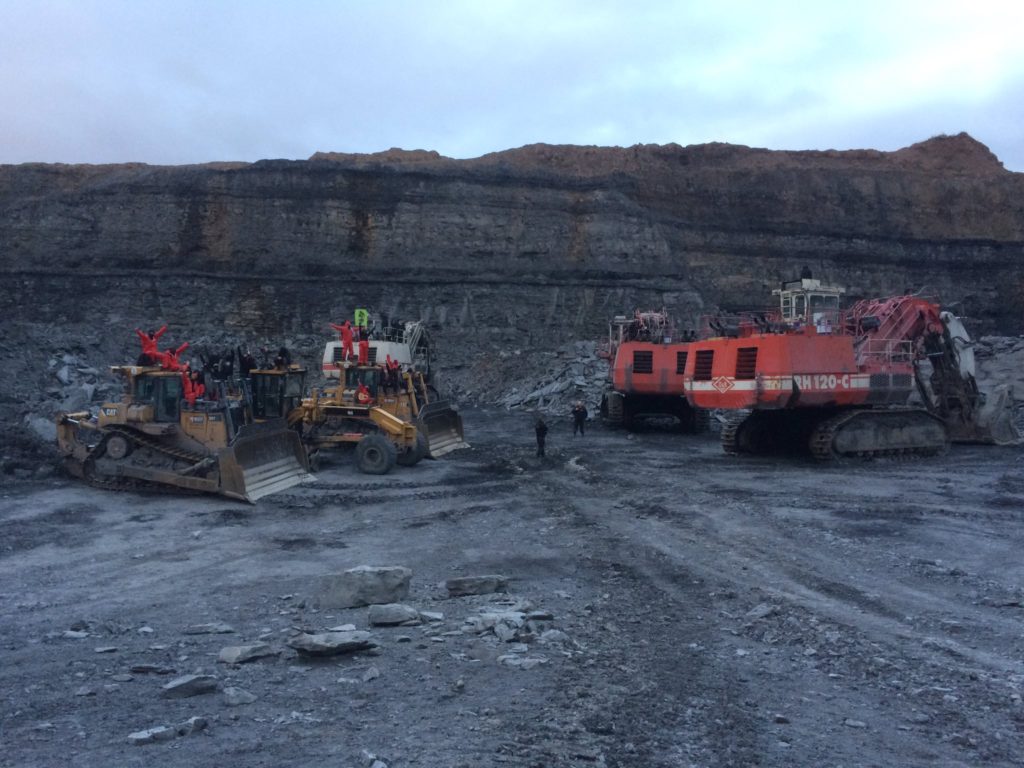
In the early hours of this morning, activists from the North East, around the UK and abroad entered and occupied machinery in Field House mine and blockaded Schotton mine to stop them from continuing to dig up coal, destroying the surrounding environment and contributing to the climate catastrophe.
Opencast coal mining is strongly resisted in the “desolate North”, an area that has become a sacrifice zone for continued economic growth at the cost of the global climate, local environment and community health. It supplies the UK’s dirty power stations, leading CO2 emitters, while people in the global South are suffering the consequences. Even in the UK we are starting to see the impacts of climate change such as flooding and the expected sea level rise will affect coastal areas around the country.
Protesters occupping equipment at the Hargreaves open cast coal mine at Field House, County Durham
Field House opencast started in 2018 and is operated by Hargreaves. The exact destination or power stations that the coal is being transported to is unknown. Machinery inside the mine is occupied.
Coal provided just 5.3% of the electricity generated in the UK in 2018. Recent research by Friends of the Earth has shown that already, enough coal is held in stockpiles in the UK to last until 2025, the date by which the UK government has committed to phasing out coal.
Yet, it allows for continued extraction, expansion and even proposals for 2 new coal mines to go ahead.
Protesters blockade entrance to Shotton open cast coal mine, Blagdon Hall, Northumberland
Coal burning is not only one of the main contributors to climate change, but also destroys valuable habitat and impacts air quality where it is dug and where it is burnt. The Bradley mine in the Pont Valley, Durham for instance, violated European and UK nature conservation legislation by destroying Great Crested Newt habitat.
We need to stop importing coal, and we need to stop digging it up in the UK now. Fracking, biomass, gas and nuclear are not solutions either. Neither do we want large-scale, corporate-controlled renewable energy installations that rely on the mining of rare metals elsewhere to power industrial so-called “development”. Green capitalism is not the answer.
Instead, we have to work towards radically different, locally and communally controlled, off-grid solutions that involve the use of DIY technologies made with recycled materials. These solutions need to be coupled with a drastic reduction in energy consumption, and a wider, radical opposition to our capitalist plutocracy. Such systems can then be embedded in non-hierarchically organised sharing economies that operate according to principles of mutual aid and solidarity.
EarthFirst! is a platform for people to take direct action against the destruction of the earth. We adhere to principles of non-hierarchical organisation and the use of direct action to confront, stop and reverse the destruction of the earth.
No compromise in defence of the earth!
@earthfirst_uk
Background info
The Durham coalfield has been a work place and source of energy since Roman times. At its height, this coalfield employed almost 250,000 mineworkers and their union was the lifeblood of their communities. Durham miners participated in the national strike for a year from March 1984 resisting the government’s plan to close more than 70 underground mines, (but only 20 closures were acknowledged at the time) in an effort to increase electricity production from imported coal, nuclear and gas and try to smash the power of the unions. Miners came together to fight against the pit closures and to support the families left in poverty as wages stopped coming in.
The last underground mine in the Durham closed in 1993, but the community culture born of the industry and collective resilience carries on. Now members of the same communities are fighting to stop the total ecological obliteration, noise, dust, heavy traffic, denial of access to natural spaces and community disempowerment that are opencast coal extraction.
Also nearby lies a site of continued strong opposition to coal by the Campaign to Protect Pont Valley who battle against Banks Group in their valley. Banks Group’s the only English company submitting plans to expand its coal extraction venture, with applications awaiting decisions to opencast Dewley Hill (outskirts of Newcastle) and at Druridge Bay (a stunning beach north of Newcastle). Banks wants to extend the opencast in the Pont Valley and could put in further extension applications at its two existing opencast sites in Northumberland.
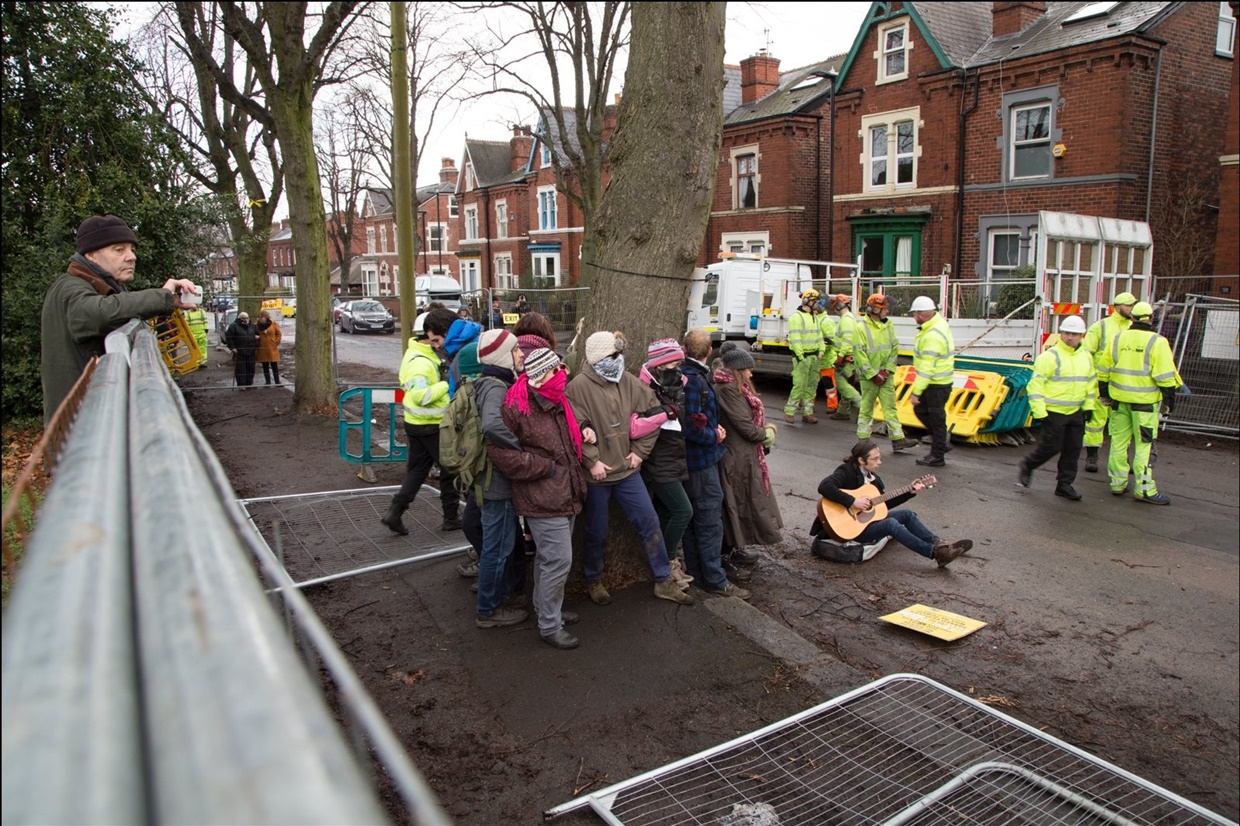
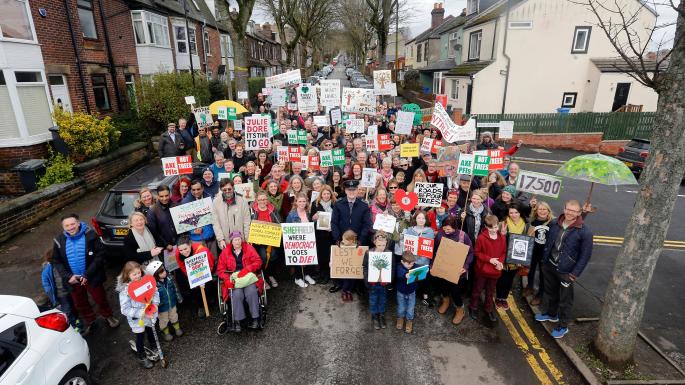
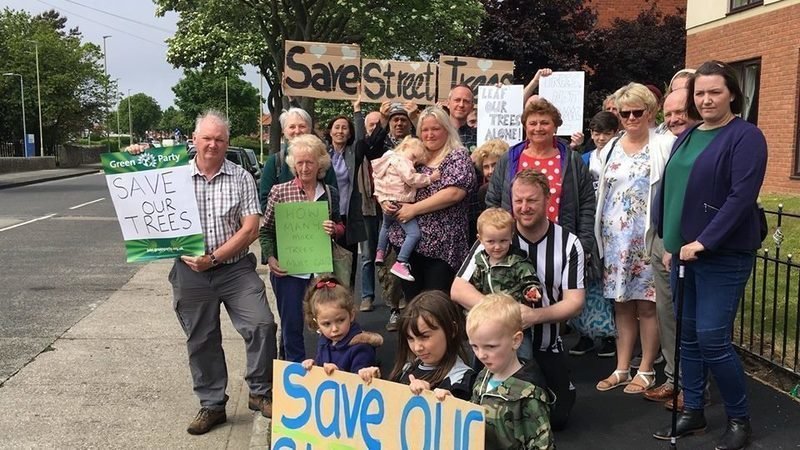
This year has seen an huge intensification in the battle to save Sheffield’s trees as the council pushes forward with a plan to fell 17,500 out of 36,000 trees on Sheffield’s streets by 2037. The programme is part of a Private Finance (PFI) contract with private firm Amey PLC. The resulting residents led campaign, which has included a significant amount of direct action, has temporarily halted felling but the council seems hell bent on restarting as soon as they can get away with it. The battle to save Sheffield’s trees appears to be the tip of a very large iceberg. More than 110,000 trees have been chopped down in three years by councils across the UK, with Sheffield only coming in at third place behind Newcastle (8,414 trees in 3 years) and Edinburgh (4,435 trees). Felling of trees on private land is certainly an even larger problem but there are no statistics and very little scrutiny.
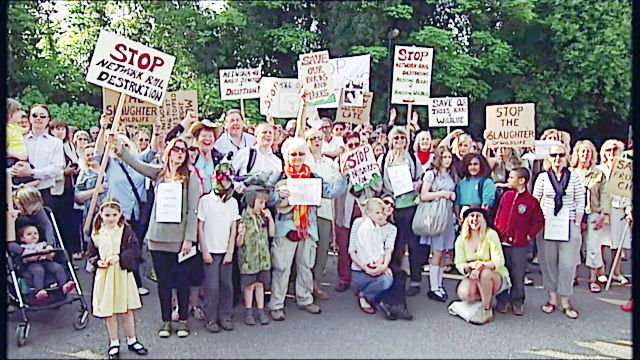
There are reports that Network Rail is planning an “enhanced level of clearance” of trees from 2019 to 2024, threatening the 13 million trees along 20,000 miles of railway track, in a ‘scorched earth’ policy. There are fears that an Oxford to Bicester line upgraded in 2015/2016, which has been described as ‘ecological disaster’ and ‘barren wasteland’, is a ‘pathfinder’ for this aggressive future policy to be rolled out across the country. The High Speed 2 (HS2) planned new ultra-high speed rail line would also result in the felling of a significant but undisclosed number of trees, as would the government new road building drive (see New Roads Threat: The Expressway To Hell)
This comes at a time when the country’s trees are already threatened with being devastated by a wave of new diseases brought by climate change and the global trade in plants. Diseases such as “ash dieback” are already killing significant numbers of trees and are also being used to justify even more tree felling. This short-sighted war on trees is being prosecuted in the face growing evidence of the direct positive impact of trees, including removal of pollution which saves 27,000 life years and the NHS around £1 billion in medical costs in a year.
Tree Campaigns
A small selection of prominent tree campaigns across the country includes:
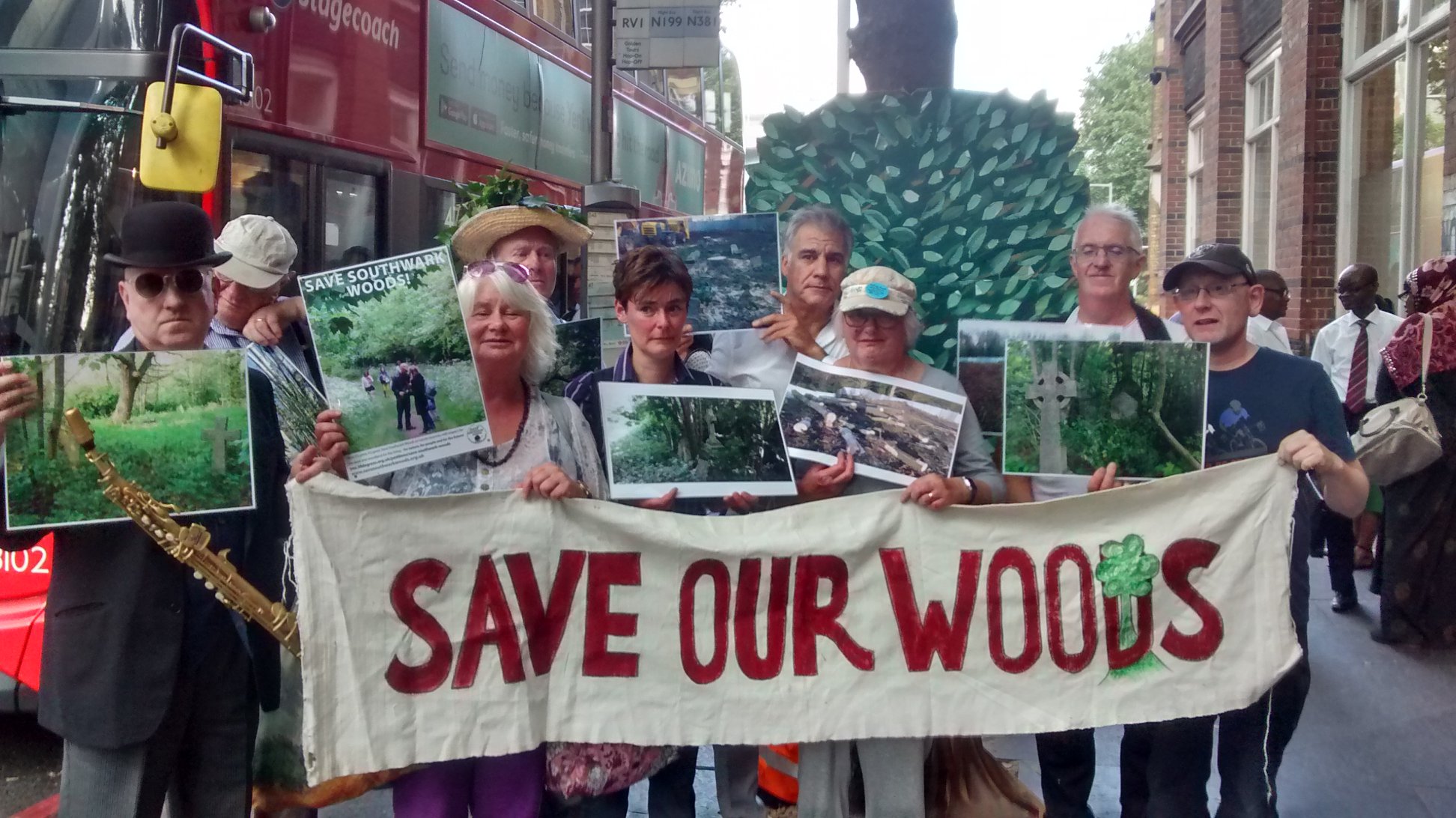
Southwark Council is pushing forward with plans to bulldoze the woodland in its cemeteries and and excavate all graves over 75 years old, to create new burial space. 2.5 acres of woods have already cleared, and another 10 acres is threatened with destruction of beautiful inner-city woods and heritage. Campaigns: Save Southwark Woods, Save Southwark Woods
Stoke Park Woods, Bristol
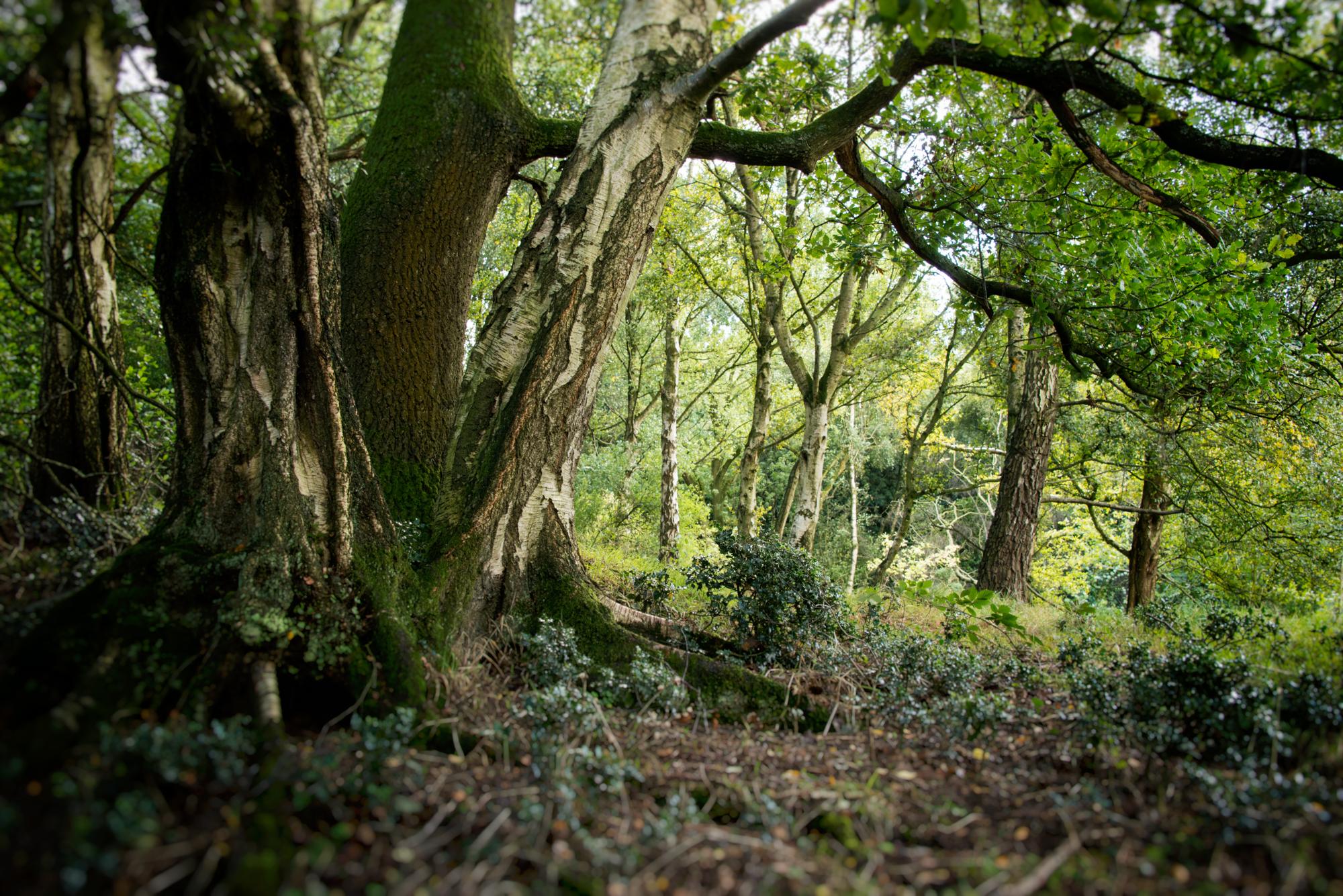
Bristol City Council has plans for cutting down parts of the beautiful and wild Stoke Park Wood in Bristol and replacing it with cattle and grazing areas, destroying important habitat and deprive people who live in the city access to a beautiful, natural woodland. Tree felling could begin as soon as September. Campaigns:Save Stoke Park Woods
Whitmore Wood, Staffordshire
Whitmore Wood faces the single largest amount of loss to ancient woodland across the entire High Speed 2 (HS2) route. The HS2 line will plough straight through the middle of the wood resulting in the destruction of six hectares of this precious ancient woodland.
While “nuclear” feels so last century the reality could easily be the other way round, the with the 21st century seeing a whole phase of even more risky nuclear development, if a new wave of nuclear reactors is not stopped. With dwindling fossil fuel reserves and capital’s demand for unending economic growth, it is all hands on deck to plug the growing gap between current energy sources and the exponential energy demands of the industrial system. Fracking, biomass and new nuclear are all being driven by the same underlying dynamic, which could easily see a proliferation of new reactors if there is no resistance.
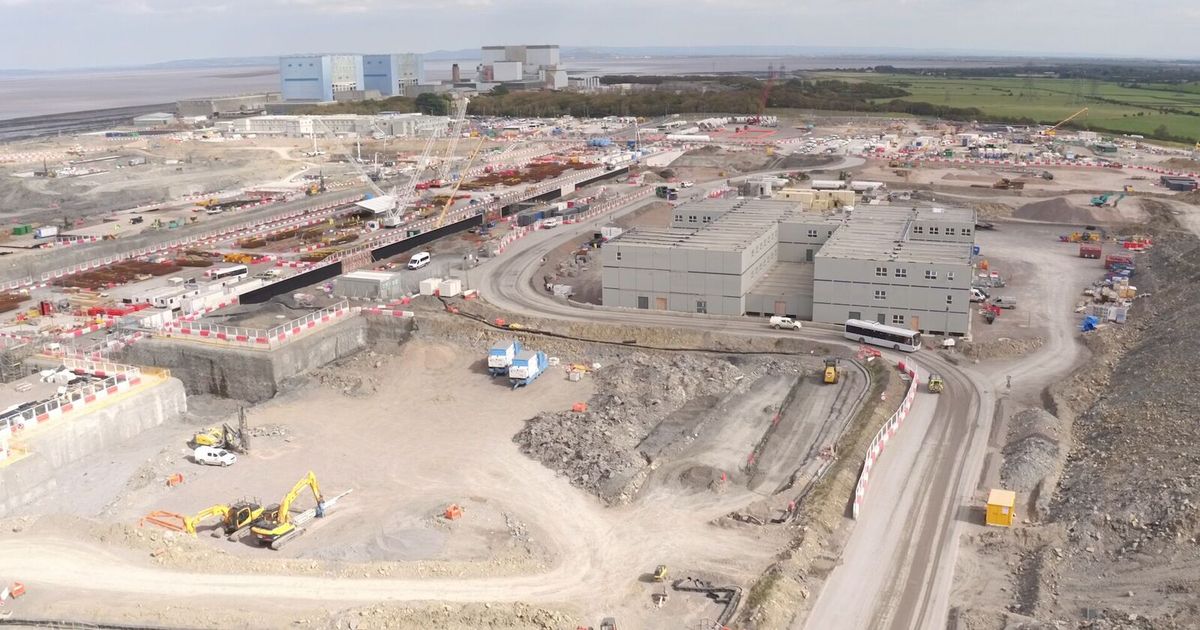
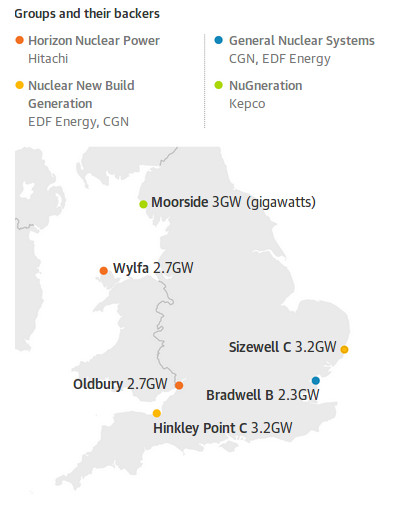
Ground has already been broken at Hinkley Point in Somerset and plans are pushing forward at Wylfa on Angelsey, as well a number of other sites (see below for details). Beyond the russian roulette being play with the lives of people living anywhere near these new reactors, as amply demonstrated by accidents such as Fukashima and Chernobyl, the long term ecological threat posed by the continual production of even more radioactive waste to which there is no practical long term solution to contain it, when it will remain deadly for hundreds of thousands of years.
New Nuclear Threat
The UK’s current fleet of nuclear reactors is ageing fast with the last new reactor built in 1987 and most reactors are either already shut down (Magnox) or well past their design life (AGR). The nuclear industry needs new reactors soon or it will cease to exist. While nuclear power has never made any sense from an economic perspective, and the unknown eventual cost of dealing with the waste make that even worse, its links to nuclear weapons production have so far sustained it. Current plans call for new reactors at 6 sites: Hinkley Point in Somerset, Wylfa in Anglesey, Sizewell in Suffolk, Moorside in Cumbria, Oldbury in Gloucestershire and Bradwell in Essex (see below for details).
These planned new reactors are in general more dangerous than previous ones, due to the lower level (though still large) of government subsidies available in the current climate requiring them to be more commercial. These more “efficient” reactors have higher burn up rates (amount of energy produced per ton of uranium), up to 65 GWd/tU for planned EPR and AP-1000 reactors, compared to 4.1-33 GWd/tU for previous Magnox and AGR reactors. This will produce hotter, more radioactive spend fuel (high level waste) and make accidents such as Fukashima and Three Mile Island, which involved loss of cooling to fuel in the reactor or in cooling ponds, more likely and more dangerous.
Attempts to make nuclear reactors even more commercial (i.e. dangerous) are also on the cards. The extremely high capital costs of existing and planned reactors is driving a push towards exploring ways of creating smaller reactors which could be produced in large numbers in factories and installed wherever. While these reactor are likely to be much less efficient in operation than larger reactors, massive cost savings are envisaged in the permitting and construction of these reactors. There is also an existing industry making small nuclear reactors for military submarines which can see an opportunity to expand. Obviously the dangers posed by producing large numbers of small nuclear reactors and scattering them across the country wherever they can be forced on communities, are too numerous to mention.
Hinkley Point, Somerset EDF Energy has begun construction of Britain’s first new nuclear plant in a generation in Somerset and aims to start up the reactors from the £20 billion project in 2025. The new power station would would be powered by 2 x 1,630 MW European Pressurised Reactors (EPR), a new untested design, whose primary aims is to provide enhanced economic competitiveness through design changes like higher fuel burnup rates. The first EPR reactor was brought online on the 29th June 2018 at the Taishan plant in China, despite reports of numerous serious problems with the reactor. Two other plants are under construction at Olkiluoto in Finland and Flamanville in France, and are both facing costly delays due to severe problems. Campaigns:Stop Hinkley, South West Against Nuclear (Facebook)
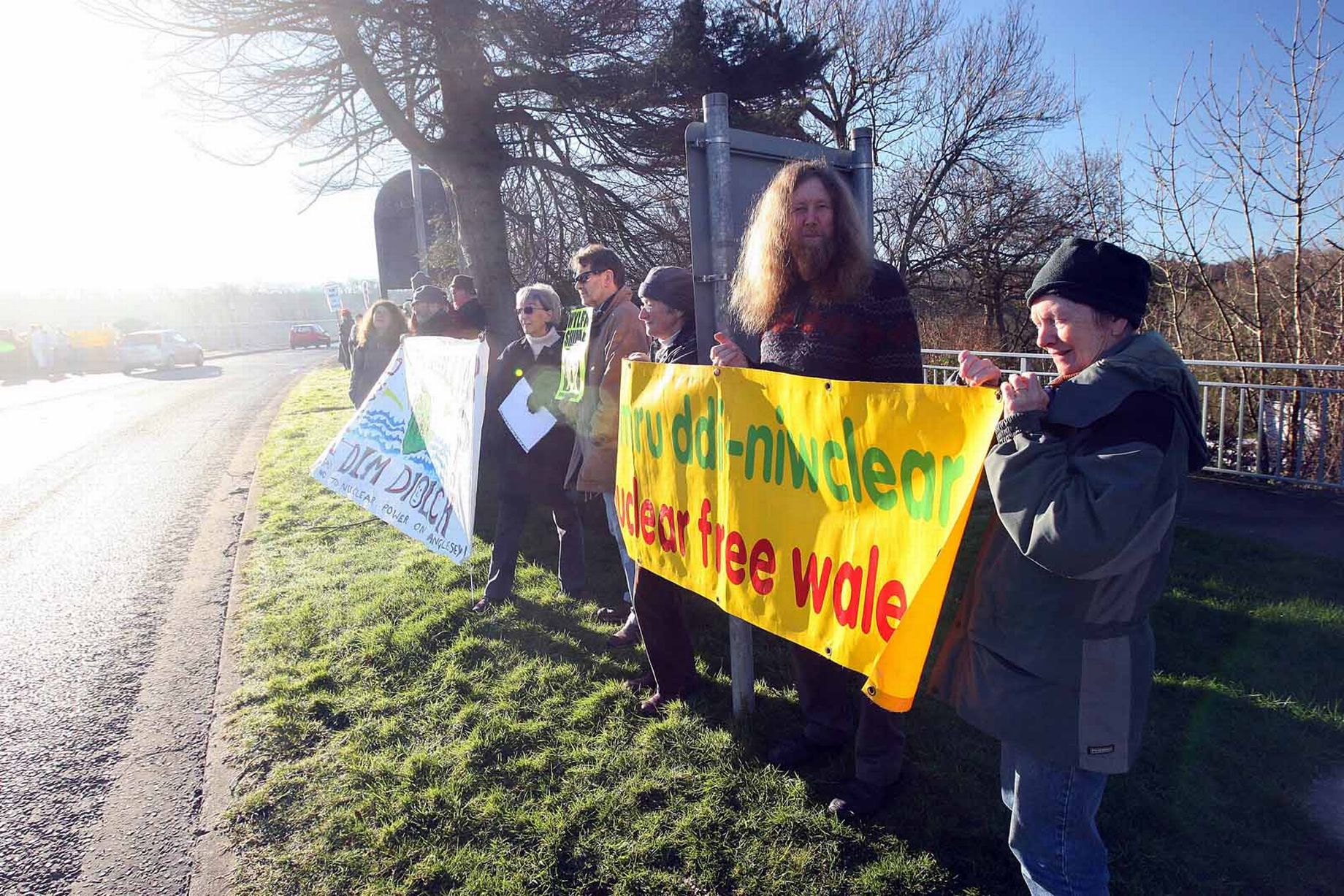
Wylfa, Angelsey Horizon Nuclear Power (Hitachi) is planning to construct 2 x 1,350 MW Advanced Boiling Water Reactors (ABWR) at Wylfa on Angelsey. As with the EPR reactors planned at Hinkley these ABWR reactors would have a high burnup rate up to 65 GWd/tU. The reactors are planned to be online by 2026-27 but the project needs to get over a number of hurdles first. Campaigns:People Against Wylfa-B (PAWB), Stop Wylfa – No Nuclear in Wales (Facebook)
Moorside,Cumbria The developer NuGeneration is in process of begin bought by South Korea’s Kepco, and the reactor design (APR1400) Kepco would want to use is not approved in the UK at present. The expected completion date of this £15-20 billion project has been pushed back to “later in the 2020s”. Campaigns:Stop Moorside and Nuclear Dumping in the Lake District (Facebook)
As for where all the radioactive waste produced by these new reactors would go, given that no solution exists to this problem, that is anyone’s guess. Geological Disposal, burying waste in the ground and hoping for the best, is the leading contender but will require forcing some region to take this waste. And apparently no where is safe with even National Parks and areas of outstanding natural beauty (AONBs) in the firing line. In fact given that National Parks tend to have lower population densities than other areas, they are a likely target.
While geological disposal may sound like the best of a bad set of options, the reality is that these projects are more about public relations than a real solution. As long as some geological disposal project is being discussed, the fiction that there will be a solution at some point in the future can be maintained and some objections to nuclear “business as usual” can be avoided. Cut price geological disposal in the form of deep borehole disposal, which would involved injecting waste down deep boreholes, is also being discussed. As with the disposal of fracking waste by this method in the US, earthquakes are one likely result and the probability of the waste remaining contained for hundreds of thousands of years is pretty low.
The only geological disposal facility in existence, on the uninhabited island of Onkalo in Finland, is planned to start burying nuclear waste in 2020 and continue until 2120, when the facility is supposed to be sealed and abandoned. The probability that this 100 year long project will be carried through to completion and sealed to plan in the face of a declining resource base, austerity, recessions, wars, bankruptcies and other unforeseen events bound to take place in the next 100 years, seems slim to non-existent. Even if you were optimistic enough believe in the generally promise of geological disposal, successfully implementing it would demand stopping the tidal wave of new waste from existing and new reactors as soon as possible, so disposal could be completed on realistic timescales.
While anyone who is aware of the destructive nature of some of the worlds largest mines may think that mining is pretty extreme already, it seems that as with many other components of industrial civilisation, the only way is down. Fracking and other unconventional energy extraction methods are being driven by a process, extreme energy, which is far from unique. Industrial civilisation has preferentially targeted the easiest to extract energy resources first, but as those have been successively exhausted the system has blindly moved on to target increasingly more difficult to extract resources. A similar process has been playing out within the mining sector more generally where the continuous depletion of various metal ores and minerals is pushing the industry towards more extreme extraction.
Small Deposit Mining
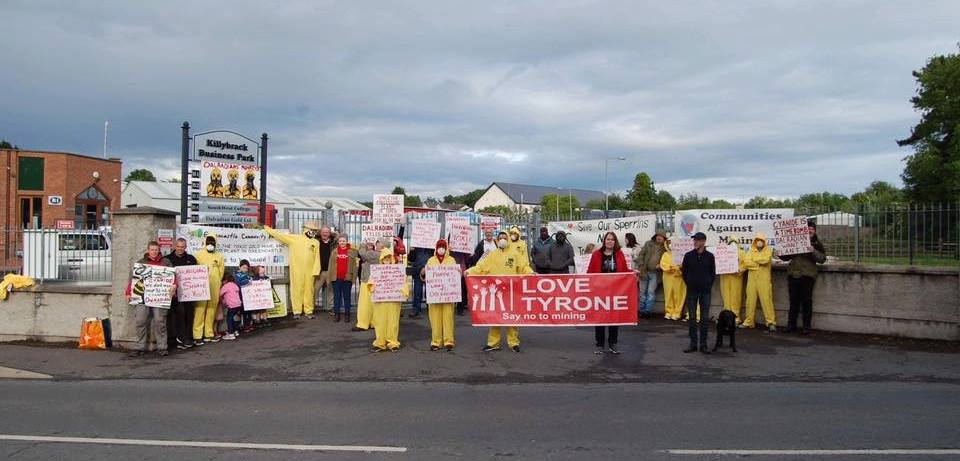
Community Demonstration Against Plans For Gold Mine And Cyanide Processing Plant In Sperrin Mountains, County Tyrone (Click To Enlarge)
At present in the Britain and Ireland the new mining threat which is emerging does not have the obvious threat of these vast open cast mines in other parts of the world. But it is being driven by the same underlying processes and heading in the same general direction. As prices have risen and larger deposits depleted, the industry is turning eyes to much smaller ones, or even looking to re-exploit old mines for their remaining deposits. This is so called “Small Deposit” mining, targeting numerous small, low quality mineral deposits in an attempt to replace more convention production from larger mines. In some ways this has many parallels with fracking where one individual oil or gas well has a limited impact, but the cumulative impact of the hundreds or thousands of wells required for fracking is another matter. Even more so that fracking, small deposit mining has the potential to sneak in under the radar, one mine at a time.
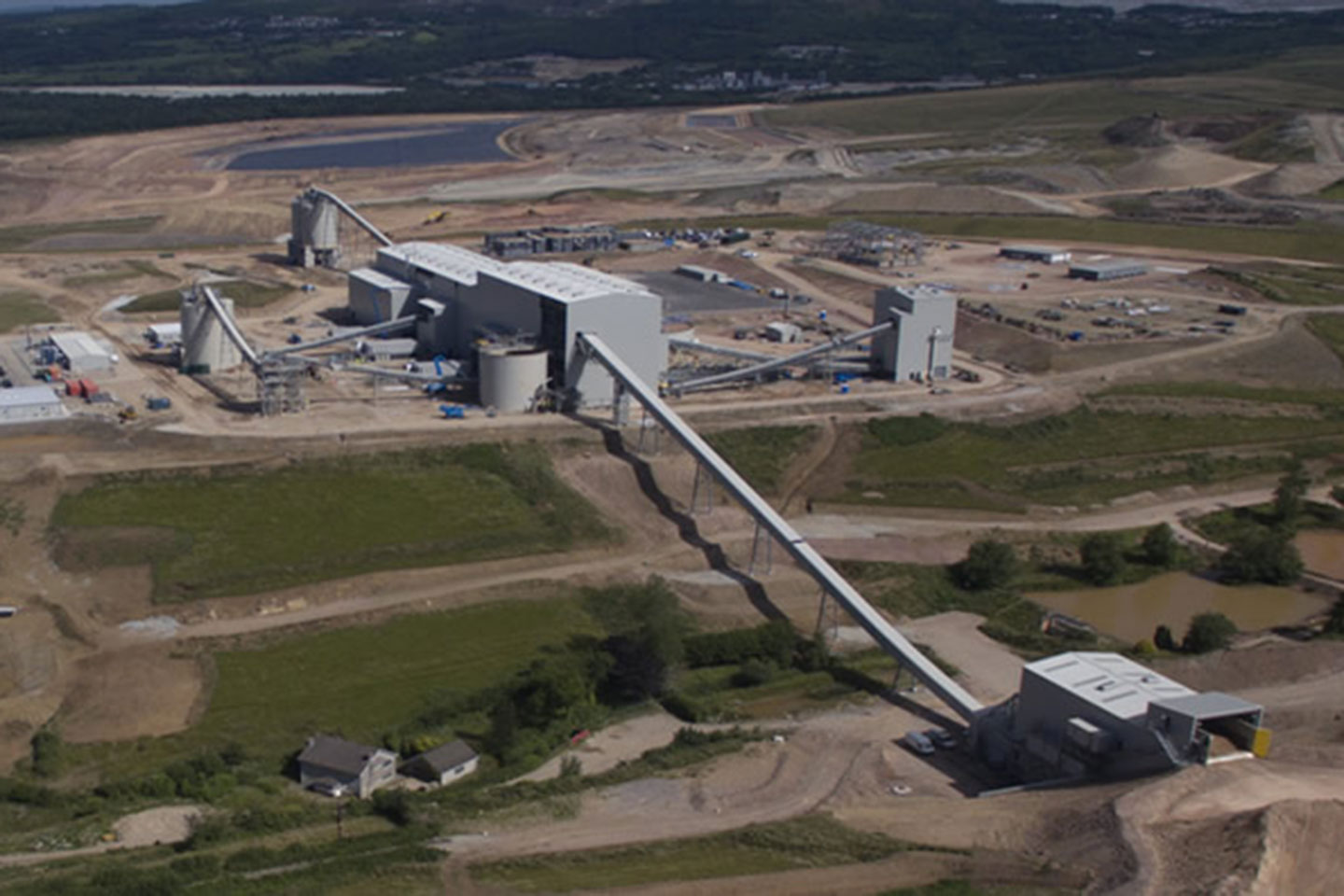
In 2015 Wolf Minerals opened the first new metals mine in the UK for nearly half a century, after a wave of closures up and down the country in recent decades. Drakelands in Devon is one of the world’s top five producers of tungsten. But this is just part of a much wider trend. Sirius Minerals has recently begun construction of a polyhalite mine on the North York moors. the deepest mine in the UK (and the second deepest in Europe). The Woodsmith Mine will target largest and highest grade deposit of polyhalite in the world. Meanwhile the Cononish gold mine in Scotland has been reopened by Australian firm ScotGold in the last year.
These projects are just the tip of a looming iceberg, with a whole raft of mining plans at various stages of development. Canadian company, Strongbow Exploration, has announced plans to acquire 26 old tins mines in Cornwall and has plans to reopen the South Crofty tin mine in the near Redruth in the future. Meanwhile Strategic Minerals and New Age Exploration have begun test drilling in preparation for mining tin and tungsten in Redmoor near Bodmin in Cornwall.
Wolf Minerals Drakelands Tungsten Mine In Devon, The First New Metals Mine In The UK In Half A Century (Click To Enlarge)
While a poliferation of new, more extreme, tin and tungsten mining is one threat to Cornwall, a potentially even larger one is posed by mining for lithium. Extraction operations would be more akin to fracking than mining; wells would tap hot brine from a depth of between 400m and 800m, before being sent to a processing plant to extract the lithium. Extraction usually involves evaporation in very large ponds, thousands of acres in size, which can have significant impact on water resources and ecology. A joint venture between Cornish Lithium and Strongbow Exploration is the main player at present, with it being touted as Europe’s largest source of lithium.
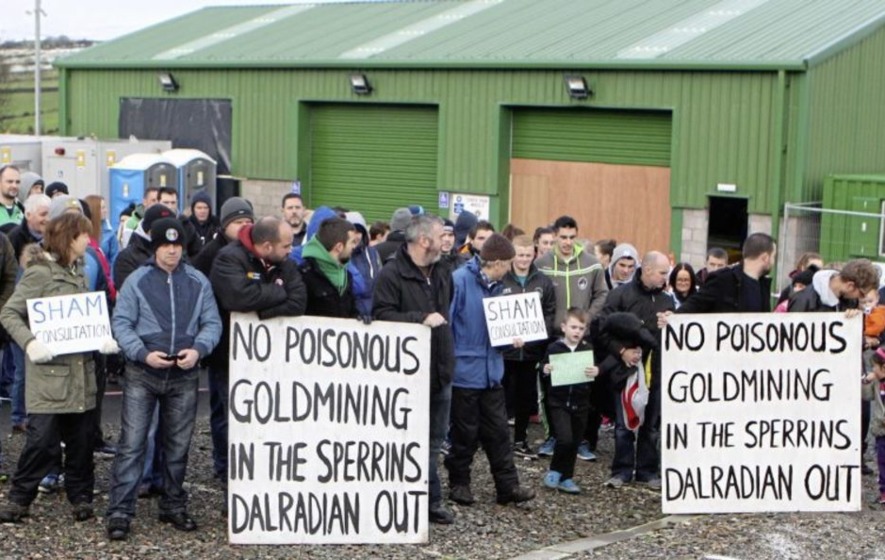
Gold mining, the ultimate is wasteful excess, also has massive expansion plans with Ireland and Scotland in the firing line. Northern Ireland is claimed to have the seventh richest undeveloped seam of gold in the world. At present there is only active gold mine in the whole of Ireland, run by Galantas Gold in Omagh, but it has permission to expand and many other plans are on the table. For instance rural communities in the Greencastle area of Co Tyrone are currently fighting plans by a Canadian company, Dalradian Gold Ltd, for a gold mine and cyanide processing plant to separate the gold from ore. Meanwhile south of the border Irish gold mining firm Conroy Gold and Natural Resources is targeting four new gold zones in County Monaghan.
Other threats include zinc-copper-lead mining at Parys Mountain in Anglesey, zinc mining near Tara in County Meath, Ireland and mining for coking coal (distinct from thermal coal which is in a price slump at present) near Whitehaven in Cumbria, as well as on the Scottish border around Gretna and Canonbie. These are not isolated, one off, projects, but just the most attractive of large numbers of small/low quality deposits which the mining industry will be looking to exploit as larger/higher quality deposits around the world are depleted. While industrial civilisation continues on its destructive path, the pressure for more extreme mining is only going to grow.
Seabed Mining
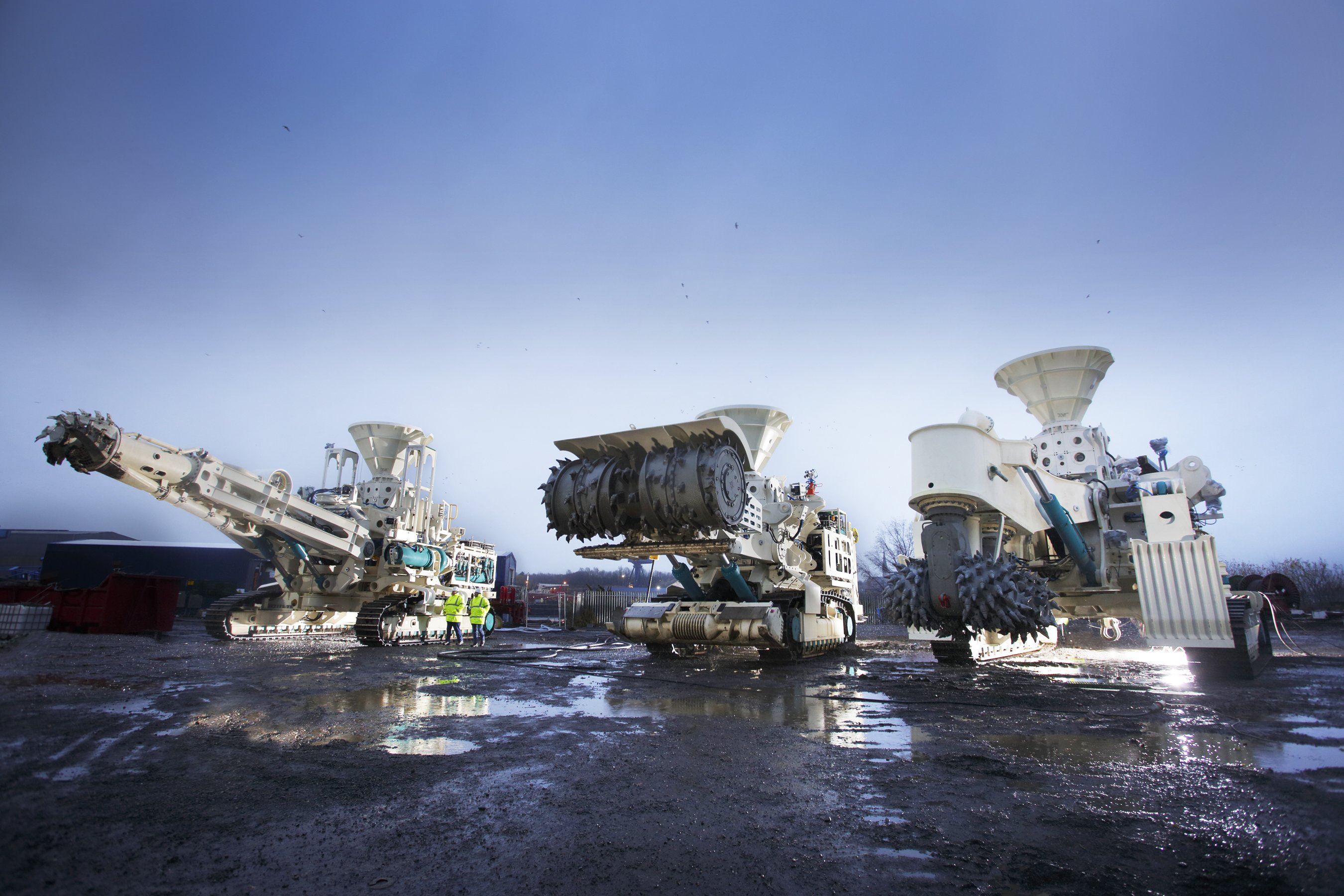
Mining machines built at Soil Machine Dynamic’s facility in Newcastle Upon Tyne for the first attempt a deep seabed mining by Canadian company in the Bismarck Sea near Papua New Guinea (Click To Enlarge)
Energy resource extraction (i.e. oil drilling) started on land but has move off shore, and is now moving into deeper and deeper water. For similar reasons, until now mining has been mostly confined to the land. Exceptions have included tunnel mining for coal which began straying out under the sea from the 18th century and dredging for sand/gravel in shallow water, which relatively easy to target and extract. With prices rising and better option depleting fast, the mining industry is turning its attention to mineral deposits on the ocean floor.
Some seabed mining is already underway in shallow water, for instance De Beers is souring the seabed for diamonds at depths of around 150 meters in a 2,300 square mile licence area off the Namibian coast. The first serious deep sea mining effort is expected to begin in 2019, in the Bismarck Sea near Papua New Guinea. Canadian firm Nautilus Minerals plans to use three giant robots crawling machines (each the size of a house) to grind up rocks rich in copper, zinc and gold at a depth of 1,600 metres and pump the slurry up to a custom-built surface ship at a rate of over 3,000 tonnes a day.
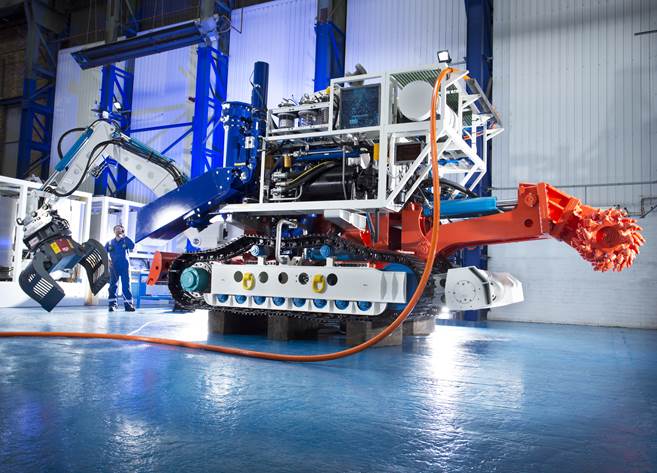
Viable Alternative Mine Operating System (VAMOS) seabed crawlers which Marine Minerals plans to use to mine tin off the northern coast of Cornwall (Click To Enlarge)
Seabed mining would certainly kill off most organisms living on seabed that would be excavated, but will create sediment plumes disrupting the natural movement of ocean water, and potentially smother entire ecological communities on the seabed, introducing nutrient-rich deep water into surface waters causing algae blooms and dead zones and releasing heavy metals once out of reach to shallow-water organisms, which can accumulate up the food chain – potentially harming the health of humans consuming fish as well.
The UK is heavily involved in the seabed mining push. UK Seabed Resources Ltd, a subsidiary of US defence contractor Lockheed Martin, is one of the main companies exploring for polymedtallic nodules in the central Pacific Clarion-Clipperton Fracture Zone. Meanwhile the mining machines for the first attempt a deep seabed mining by Canadian company in the Bismarck Sea near Papua New Guinea, have been built a Soil Machine Dynamic’s facility in Newcastle Upon Tyne. Closer to home Marine Minerals is even considering seabed mining for tin off St Ives, Perranporth, Portreath and St Agnes, while Treliver Minerals is planning to mine St Austell Bay for tin.
As the fracking industry marshals its forces for intensified assault on communities across the British Isles, here is a look at the current state of the threat across the country and what the industry is planning in the coming months.
How we got here
The last decade has seen an explosion in oil and gas drilling as conventional, easy to extract, hydrocarbons have become harder to find and the system has been forced to resort to new more aggressive extraction techniques. While oil prices are currently well below their 2008 peak, and new drilling has been stalled in many places, this hasn’t stopped preparations for continued expansion once prices rise again. The industry is busy gathering geological data with the intention of securing further investment, and with oil prices now creeping upwards are preparing for another boom period, with its attendant wave of ecological destruction.
Serious attempts to push fracking in this country began (mostly under the radar) around the 2007/2008 peak in oil prices, as various companies saw a chance for a quick buck. The fallout of Cuadrilla’s infamous earthquakes at Preese Hall in Lancashire in 2011, and the community resistance which has mobilised since then, has seriously affected the fracking industry’s prospects. Since 2011 drilling of onshore exploration wells in the UK has fallen by two thirds and that shows no sign of changing in the near future. However, while many companies have pulled out, and others taking a back seat for now, a hard core are slogging forward.
Unconventional oil and gas extraction, colloquially referred to as fracking, covers a broad range of more extreme hydrocarbon extraction methods targeting relatively impermeable rock formations. This includes shale gas, tight/shale oil, tight gas, coalbed methane (CBM) and underground coal gasification (UCG). While these methods differ greatly in technical details, they are all driven by similar pressures and have similarly intense impacts. Over the last decade or so we have seen significant attempts to push forward all these methods, but in the face of growing resistance and unstable prices the more speculative or less profitable methods, UCG and CBM, have been deprioritised.
But a new 14th onshore licensing round in 2014/2015 saw whole new swathes of the country licensed, with Ineos alone acquiring over a 1 million acres. With around 10 million of acres of the UK now licensed, communities are under threat from the industry like never before. Full-scale fracking in these areas would mean the drilling of many thousands of wells, at densities of eight wells per square mile or more, plus other fracking infrastructure like pipelines, compressor stations, processing plants and waste disposal facilities carving up the countryside. This would result in a host of severe impacts including water contamination, air pollution, massive amounts of toxic/radioactive waste and carnage on rural roads from the massive amounts of truck traffic.
Fracking Frontlines
While every area which has been licensed is under some sort of threat and many unlicensed areas could be licensed in the future, the threat is more immediate in some areas than others. Even people not living in these areas should be extremely concerned, as any new fracking foothold provides a spring board from which it could spread to other areas. These are some of the most important current front lines in the fight against fracking:
Lancashire – Cuadrilla Resources
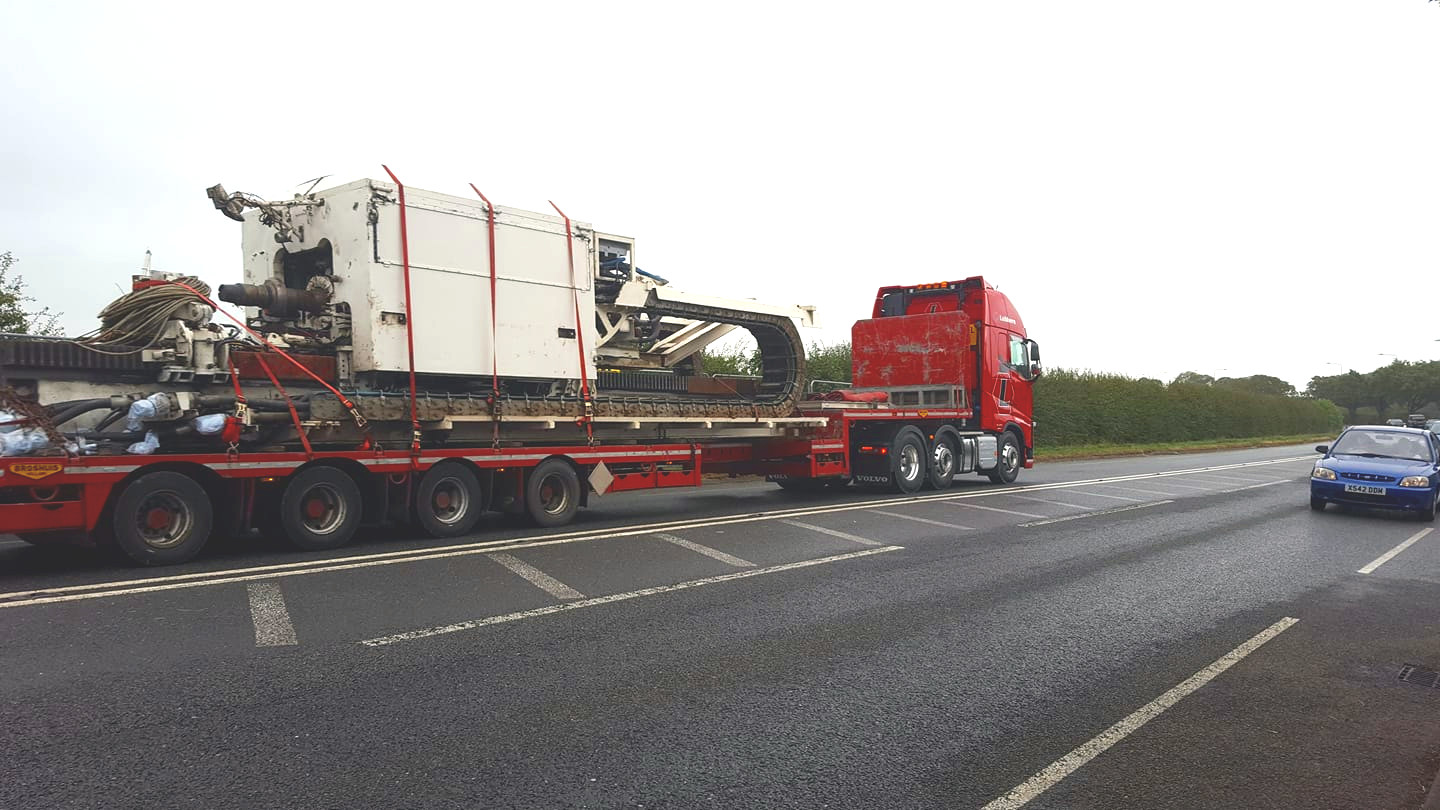
Drilling Rig Leaving PNR After Spending A Year Drilling 2 Wells As Focus Turns To Resisting Hydraulic Fracturing (Click To Enlage)
(Shale Gas) Fracking company Cuadrilla has taken the best part of 7 years to get back to where it was, following the 2011 earthquakes it caused in Lanacshire and the subsequent explosion of resistance to fracking. It has know drilled 2 of an orignally 4 planned wells at its Preston New Road (PNR) appraisal site, while its other new site at Roseacre Wood is having its planning refusal appealed in central government. A year and a half into activity at PNR the ongoing resistance is clearly taking its toll. Cuadrilla appears to be about 6 months behind its original timeline, even after having quietly scaled back its plans to two instead of the initial four wells. Numerous contractors have dropped out of the project as resistance has spread to various support sites. Cuadrilla is currently winding down its drilling operation and planning to remove the drilling rig from the site and bring on its frac pump set, and start hydraulic fracturing of the 2 wells. This new phase of activity, with increased flows of trucks equipment, chemicals, frac sand and waste, presents an opportunity to inflict further delays to the project, at great additional cost to Cuadrilla.
Sussex/Surrey – UKOG, Angus etc.
Angus Energy’s Brockham Site In Surrey, One Several In Region Where Renewed Testing Is Expected (Click To Enlage)
(Tight/Shale Oil) The threat of tight (shale) oil extraction in the Weald (between the South and North Downs) in Sussex and Surrey is now becoming critical. With fracking companies UK Oil & Gas Investments (UKOG) and Angus Energy acting as its main cheerleader, a series of wells have been drilled and tested at Horse Hill and Brockham in Surrey and Broadford Bridge in West Sussex. More tight oil tests are planned at these sites over the coming months, as well as at Balcombe where Angus has taken over as operator of the site from Cuadrilla. New wells are also planned at Leith Hill and at 2 undisclosed sites in Surrey/West Sussex. All this is targeting tight oil in limestone (micrite) layers within the Kimmeridge Clay shale, which would require
drilling thousands of wells to exploit. The Brockham site which has an existing planning permission for production is particularly worrying.
North Yorkshire – Third Energy, Ineos etc.
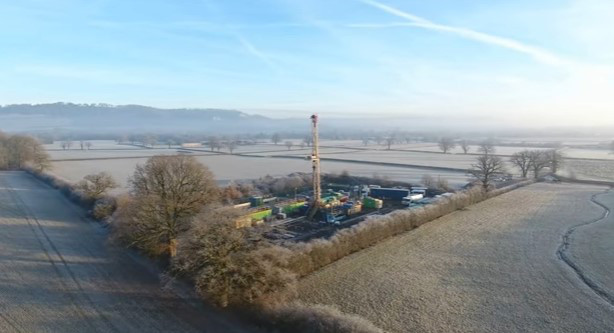
Third Energy’s Kirby Misperton Site In North Yorkshire, Where Hydraulic Fracturing Is Planned (Click To Enlage)
(Tight/Shale Gas) In North Yorkshire, as in Lancashire, the Bowland Shale (or tight sandstone formations within it) are the primary target, and companies are scrambling to try to exploit it. Cuadrilla and INEOS have recently acquired licences in the area, but an existing licence holder Third Energy has a head start, with planning permission for a hydraulic fracturing test on its Kirby Misperton well. However, the company is in some finacial difficulties and this has so far stopped it from satisfying certain financial conditions attached to get the final hydraulic fracturing permissions from the Oil & Gas Authority. Ineos are also busy trying to organise a seismic survey in their North Yorkshire licence areas, but are running into significant resistance from local people.
East Midlands – Ineos & IGas Energy
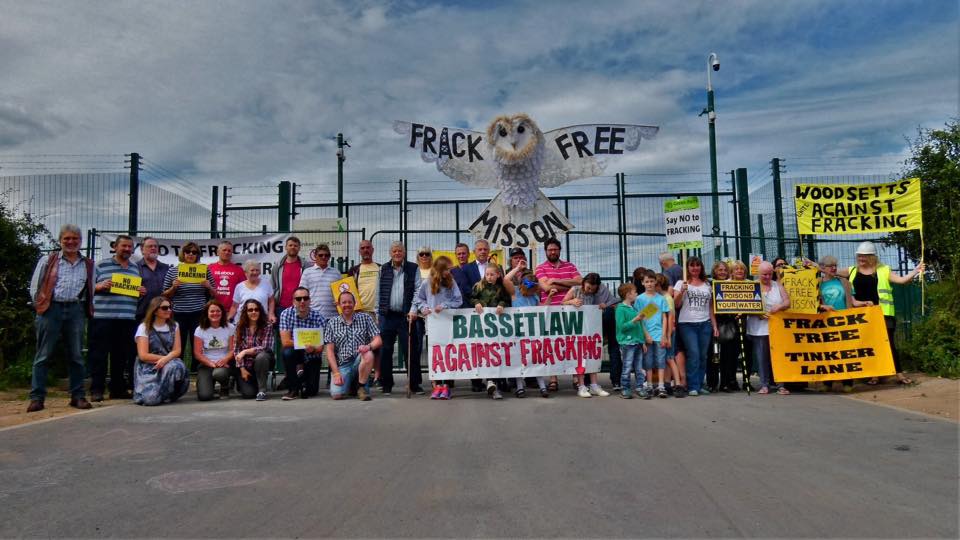
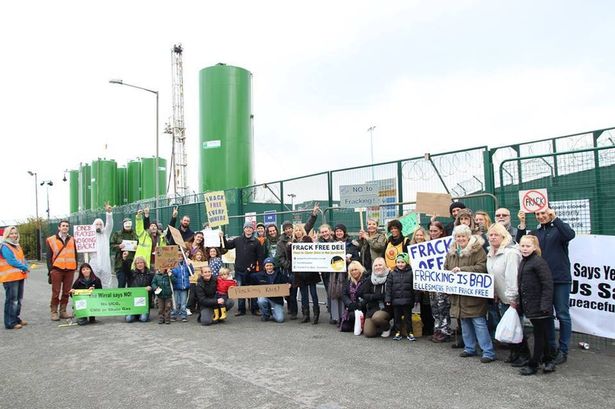
Community Blockade IGas Energy’s Tinker Lane In Nottinghamshire Site Where Drilling Is Imminent (Click To Enlage)
(Shale Gas) A major fracking push is also underway in North Nottinghamshire where IGas Energy (with the financial backing of Ineos) is threatening communities in Bassetlaw, and has constructed 2 sites at Springs Road in Misson and Tinker Lane near Blyth, and has plans to start drilling in the coming months. Meanwhile, Ineos has also has licences in the area and has identified 3 test site (Marsh Lane, Harthill and Woddsetts), although only Harthill has managed to obtain planning permission so far and a legal challenge may delay the start of work there.
Cheshire – Ineos & IGas Energy
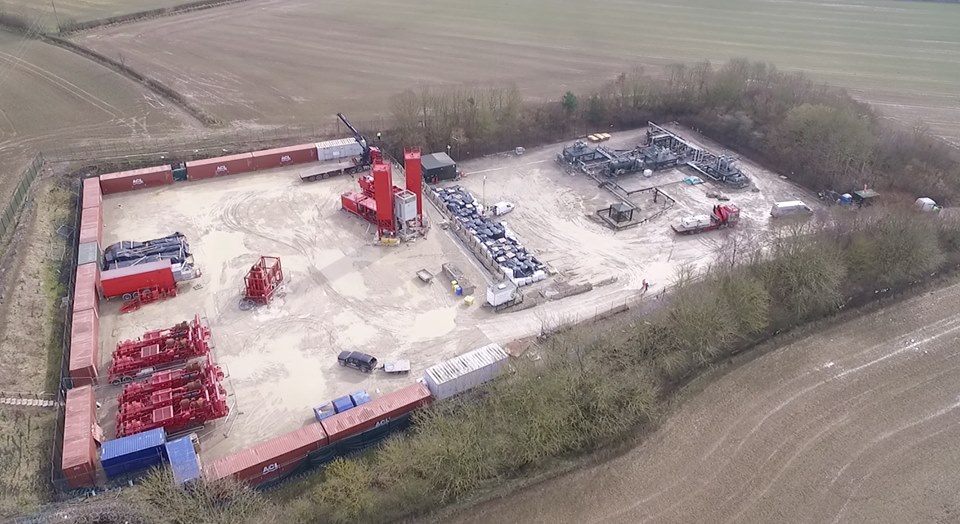
IGas Energy’s Ellesmere Port Site In Cheshire, To Which The Company Wants To Return For Further Testing (Click To Enlage)
(Shale Gas) – As with the East Midlands, IGas and Ineos are the main players at present. IGas has plans to return and carry out additional testing on the well it previously drilled at Ellesmere Port and drill a new well on its Ince Marshes site, but ha so far been refused planning permission as both. As with the East Midlands, Ineos has plans for seismic surveying across its new licence areas and this will reach Cheshire at some point. Ineos has also acquired a substantial quantity of fracking equipment (including five times as many frac pumps as Cuadrilla), asset-stripped from a Polish fracking company and is storing them at its Rocksavage chemical works in Runcorn.
Fracking Timeline
In the second half of 2018 the fracking industry is planning a blitzkrieg of drilling and testing. Cuardilla’s much delayed and scaled-back plans at Preston New Road (PNR) in Lancashire are just the most high-profile, and advanced, of these projects. Hydraulic fracturing on the wells at PNR could begin in September, but tight oil testing in Sussex/Surrey at Brockham, Horse Hill and Balcombe over next few month could prove even more threatening. Tight oil has the potential to move from exploration to production much more quickly if not stopped, due to the lower cost of the shallower wells and ability to tanker oil off site to a refinary without building pipelines. The Brockham site which already has planning permission for production, is particularly worrying.
Attempts to start drilling at a number of sites including Springs Road and Tinker Lane in Nottinghamshire, and Leith Hill in Surrey seem imminent, and Ineos’s site at Harthill in Rotherham may not be far behind. Third Energy’s fracturing tests at Kirby Misperton are on hold for the moment, but a solution to Third Energy’s financial problems could change that very quickly. A number of other area of the country are under less immediate levels of threat from plans for drilling and testing. Finally Ineos is pushing hard to start its second round of seismic testing (after the East Midlands), in North Yorkshire, though it is increasingly having to resort to court action (including against the National Trust) in order to gain access to land.
Fracking Resistance
It’s not just geological information that the fracking industry is interested in, “social data” on the economic risks associated with community resistance is needed just as much. This is where the anti-fracking movement has been extremely effective up until now. The fracking industry is responding by working with government to dismantle some of the tools communities have used to delay these projects. There are plans to allow test wells to be drilled without planning permission and decisions on larger projects to be taken by central government, bypassing more influenceable county councils.
The fracking fight is now moving into a new phase where causing physical delays and ramping up costs will hold the key to deterring future investment in the industry. Fighting on numerous small fronts, the currently 300+ local anti-fracking groups have been delaying and ramping up the costs of fracking projects, wearing down the opposition and deterring the investment on which the industry relies. After all these communities have little choice but to stand and fight. In the end this is a fight to the death, either the fracking companies get to coat the country in tens of thousands of wells or we drive them in to bankruptcy. There are no other options.
Plans for the largest road-building programme in a generation, since the 1990s road protests killed off the last one, are quietly gathering steam and widespread resistance is sorely needed to stem this tide. To the extent that this new attack on our countryside differs from previous incarnations, it is mostly in being more specifically linked to other forms of destructive development along the targeted routes. As such these new road pose an even greater threat per mile than the usual carving up more countryside, increased traffic and air pollution etc.
Hundreds of miles of new roads, costing billions of pounds, are being planned across the country, including new Expressways (motorway-style A roads). These plans include the A303, A358 and A30 corridor from Cornwall to Hampshire, Oxford-Cambridge Expressway, A417 from M5 Gloucester to M4 Swindon through Cotswolds, A1 Northumberland north of Newcastle, the A556 in Cheshire and the A14 in Cambridgeshire. There are also similar threats in Scotland and Wales.
While there is significant resistance from many community campaigns in various places, there is also a worrying trend of pro-road building campaigns popping up to lobby for these roads. The small number of media conglomerates who own the majority local newspapers appear to be particularly active in initiating these campaigns, but regardless of the extent to which these local pro-campaigns have been astro-turfed into existence, the fact that they have so far getting away with doing so shows how much work there is to do in fighting this assault.
While the usual justifications of the “need” for growth and solving the housing crisis are being trotted out, naked greed is a far better characterisation of the driving force behind these schemes. Just the million new houses which would be facilitated be the Oxford-Cambridge Expressway (see below) represents an eye watering £150 billion in pure profit for the developers involved, while driving even more housing market speculation and making housing even more unaffordable for the average person.
Threats Across The Country
Below are listed some of the more high profile and urgent threats, but see the map (right) for a representation of the scale of the threat:
Oxford-Cambridge Expressway – New £3.5 billion expressway plan between A34 south of Oxford and Milton Keynes, to support a “Growth Corridor” aimed at facilitating the building of a million new houses along the route. Would Otmoor nature reserve – a unique habitat of rare wetland Campaigns:Save Otmoor, Expressway Action Group
A417 (Gloustershire) – £485 million plan 5km stretch of dual carriageway, between the M4 at Swindon and M5 at Gloucester in Cotswold Area of Outstanding Natural Beauty (AONB), crossing the geologically important and visually stunning Cotswolds Escarpment at Crickley Hill
Hereford Bypass – A £200m bypass threatening parts the Wye Valley around Hereford, such as Grafton Wood, an ancient wood pasture Campaigns:Wye Ruin It
A12 (Suffolk) – £133m proposals to reroute the A12 with severe impacts on the Alde and Ore valley, ancient woodlands, historic churches and listed buildings Campaigns:Say No To The Four Village Bypass (Facebook)
A57/A628 Trans-Pennine Upgrade Dual carriageway through the Peak District National Park, linking up the M60 in the south east of Manchester to the M1 north of Sheffield, including bypass through Mottram Moor
A303, A358 and A30 Corridor – Planned £2bn Expressway route through South West, including a 4-lane expressway and 2.9 km tunnel through Stonehenge UNESCO World Heritage Site (WHS) Campaigns:Stonehenge Alliance
M4 Relief Road (Newport) – Plan for new 14-mile stretch of motorway south of Newport, which would cause irreparable damage to the Gwent Levels, including 5 wetland Sites of Special Scientific Interest where Common Cranes have been spotted for the first time in 400 years Campaigns:Save The Levels, Campaign Against the Levels Motorway (Facebook)
A5036 Liverpool Port Access Road – Dual carriageway through Rimrose Valley Country Park, large green space in otherwise urban area, in Litherland, south Sefton, accessing the expanding Port of Liverpool. Campaign:Save Rimrose Valley (Facebook)
A6-M60 Link Road (Stockport) – 9 km dual carriageway is planned through Goyt Valley countryside and Poise Brook Valley nature reserve and ancient woodland Campaigns:Goyt Valley SOS (Facebook)
A96 (Aberdeenshire) – Plan to upgrade the A96 between Aberdeen and Inverness to dual carriageway, threatening the Bennachie Hills Save Bennachie Alliance
A5 Western Transport Corridor (Tyrone/Derry) – Planned dual carriageway all the way from Derry past Strabane and Omagh to the Monaghan border at Aughnacloy Campaigns:Alternative A5 Alliance
A6 Upgrade (Derry/Antrim) – £400m development of A6 road between Belfast and Derry, including dual carriageway between Toome and Castledawson, near the edge of Lough Beg – an internationally recognised Ramsar-designated wetland, bird sanctuary and National Nature Reserve
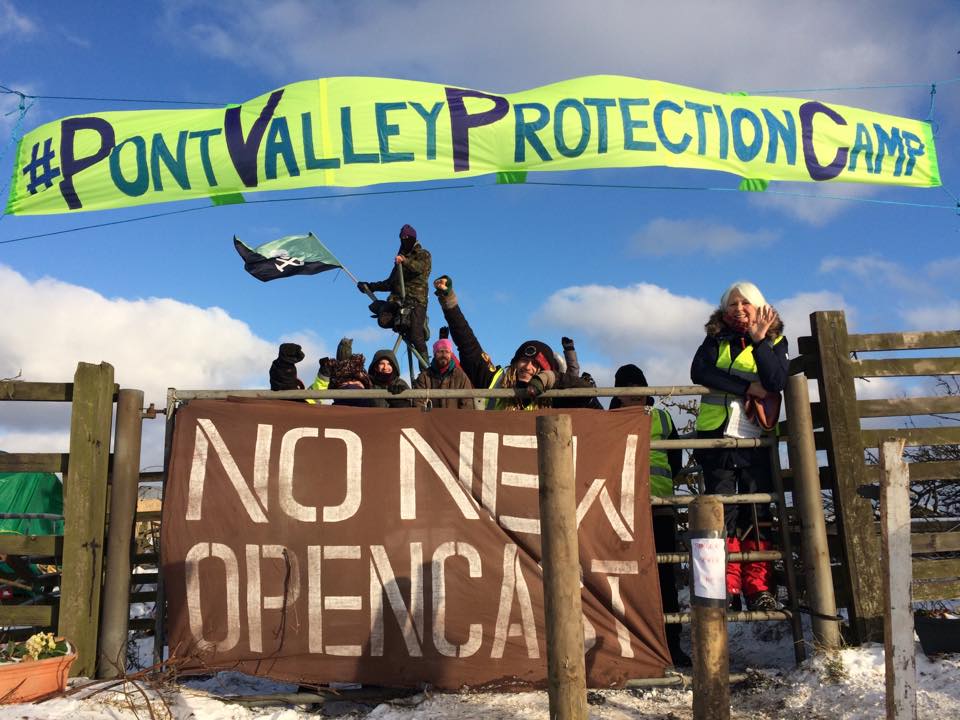
Time is running out for Banks Group to build an access road to the site of it planned opencast coal mine in County Durham, before their planning permission expires on 3rd June. Local people and their supporters have left to stop the first spade going into the ground on 71 hectares of grassland, fields and woods in the Pont Valley, Co Durham. Under planning permission, the mining company Banks Group has to start work by 3 June or their licence to start mining the site will expire.
The site is in the Pont Valley off the A692 between the villages of Leadgate and Dipton, where the Banks Group plans to extract around 500,000 tonnes of coal over two to three years. A camp was setup on 2nd March at the entrance to the proposed mine. Several Local Groups, the Coal Action Network and campaingers from Hambach Forest have been instrumental in getting the camp going. Between 19th and 21st April, the camp was evicted by bailiffs and seven campaigners were arrested, but a new camp has been re-established at a new location. All are invited to come and stay and protect the beautiful Pont Valley. There is local bus connections to Dipton from Durham and New Castle.
There are plans for a series of public demonstrations in the days leading up to the deadline, including:
For over thirty years, UK Coal and now Banks Group have wanted to start an open cast coal mine in the Pont Valley, between Dipton and Leadgate, at a site known as ‘Bradley’, in County Durham. The community won 3 high court battles against UK Coal. But they lost on the fourth despite presenting even stronger evidence than the previous 3. UK coal got the permit, but they were bankrupt and they liquidated in 2015. Everyone thought that was the end of it and there would be no mine. This January, Banks Group announced they’d bought the land and the permit off UK Coal and intend to work the mine.
If you would like to put an event anywhere in UK or in other parts of Europe to spread the word of the struggle please get in touch with: protectpontvalley@gmail.com
In the Rhineland in Germany, the company RWE is running 3 lignite mines where they extract around 100 Mio. t of lignite each year. They are extending the mines and the plan of the company is to completely clearcut the forest until 2018. help is needed now.
In the Rhineland in Germany, the company RWE is running 3 lignite mines where they extract around 100 Mio. t of lignite each year. They are extending the mines and the plan of the company is to completely clearcut the forest until 2018. help is needed now.
This year especially is an important time for the Defense of the Hambacher Forest as the new wave of deforestation is about to ensue during this winters cutting season. October 1st would have been the official start of this years cutting season which has just been postponed to October 25 as RWE is forced to appear in Administrative Court in Cologne on October 17 by a law suit initiated by Bund fur Natur as a response to the company’s lack of enviromental assesment studies, its lack of studies of costs of post extraction clean up and last but definitevely not least: two colonies of endangered bats being discovered in this year’s cutting zone.
Climate Justice Struggle in Hambacher Forest and in countless other locations around the world is a response to the Neo-Liberal Extractionist Agenda of Disaster Capitalism and a call to preserve every community every organism being paramount to protecting Planet as a whole.