An aerial view of Clayoquot Sound, just north of Tofino, B.C., is shown in this handout photo. The Ahousaht First Nation are protesting an open-net salmon farm in the area.
September 11th, 2015
TOFINO, B.C. — Members of a Vancouver Island First Nation are vowing to risk arrest rather than allow an international fish farming company to anchor an open-net salmon farm north of Tofino.
Members of the Ahousaht First Nation say they set up a boat blockade Wednesday at the site of the new farm, owned by Norwegian-based Cermaq.
The Ahousaht say the company holds 17 salmon farm tenures in Clayoquot Sound and applied for two new tenures in the same area last year.
The First Nation believes the applications signal a new round of fish farm expansion on the West Coast, with the Ahousaht Fish Farm Committee predicting a four-fold increase in the industry over the next 15 years.
Protesters oppose any new fish farms in the area.
They fear possible diseases bred in fish within the open nets could be passed to clam beds or wild salmon travelling to and from nearby spawning grounds.
First Nations blockade Clayoquot Sound salmon farm
This is a media release from UBCIC.
Members of Ahousaht First Nations are currently blockading the attempts of Cermaq to install a new open-net salmon farm at Yaakswiis, north of Tofino BC.
On Wednesday Ahousaht members took boats out to the site and prevented Cermaq from anchoring the controversial new farm, which was assembled off-site and towed to Yaakswiis.
“Wild salmon are in decline everywhere salmon feedlots are in operation around the world. We will stop any future activity at this location”, said Tom Paul, an Ahousaht member. “We will stay out there until we are moved—we will be arrested if need be” he added.
The Ahousaht Fish Farm Committee strongly opposed any fish farms at the Yaakswiis location, due to concerns about proximity to rich seafood resources such as clam beds and wild salmon rivers.
Cermaq is a Norwegian-based corporation recently acquired by Mitsubishi. They currently hold 17 salmon farm tenures in Clayoquot Sound, which was the site of major logging confrontations in 1993.
Cermaq applied in 2014 for two new tenures in Ahousaht First Nations territories. The Department of Fisheries and Oceans approved one application in late July this year, and one was refused.
The salmon farming industry is poised to increase four-fold on the BC coast by 2030. These new applications are the first round of this major expansion.
President Museveni of Uganda has joined his support to Bidco and Wilmar. calling for Bullets to be used against those who protest the Palm Oil development on the islands of Kalangala.
President Museveni of Uganda has joined his support to Bidco and Wilmar. calling for Bullets to be used against those who protest the Palm Oil development on the islands of Kalangala. The development has meant that 10,000 hecatres of virgin forest has been destroyed leaving environmental damage and economic hardhsip for the people. The words from Museveni come after a renewed protest against Bidco began earlier this year through twitter and Youtube. Further direct action against Vimal Shah the owner of Bidco is expected soon.
With bows, arrows, GPS trackers and camera traps, an indigenous community in northern Brazil is fighting to achieve what the government has long failed to do: halt illegal logging in their corner of the Amazon.
September 10th, 2015
With bows, arrows, GPS trackers and camera traps, an indigenous community in northern Brazil is fighting to achieve what the government has long failed to do: halt illegal logging in their corner of the Amazon.
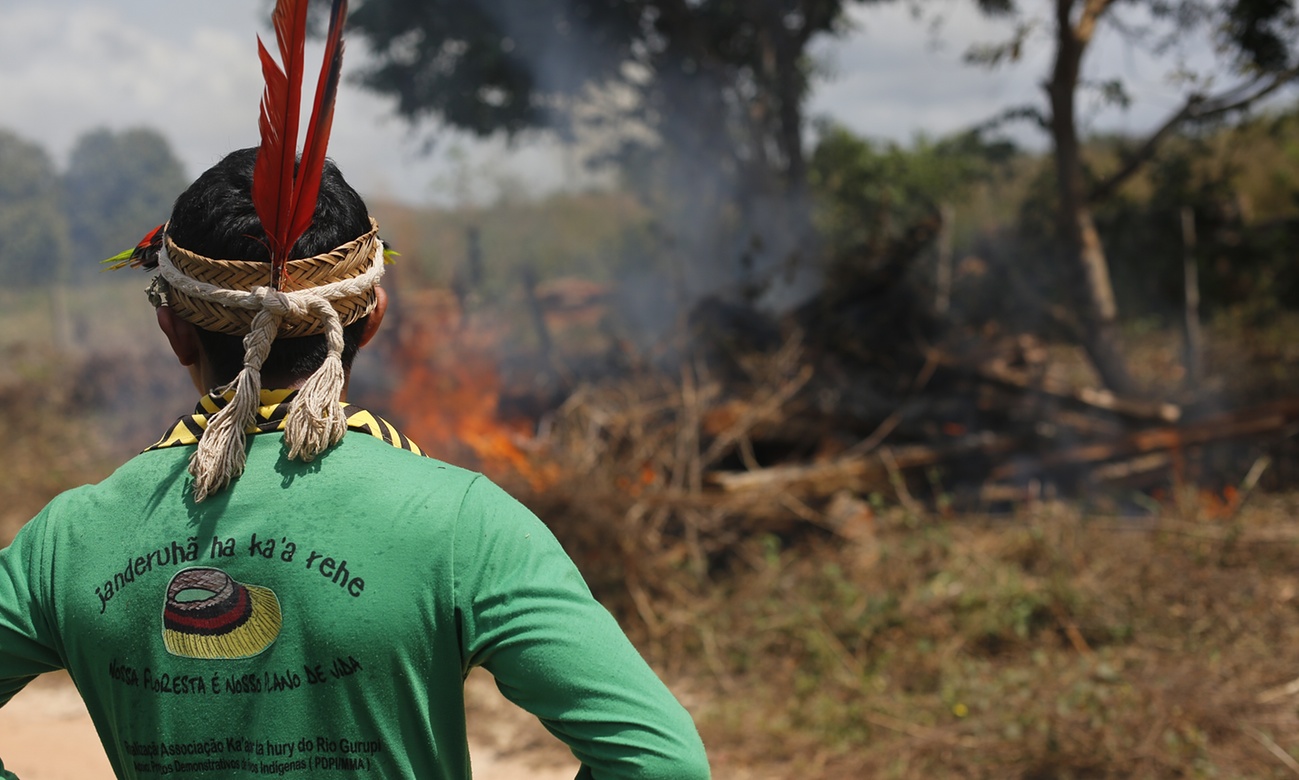
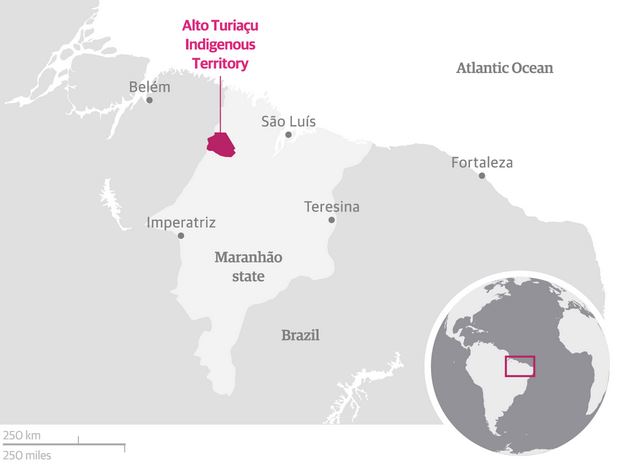
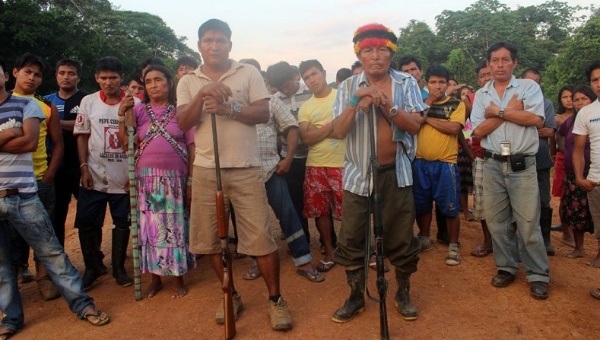
The Ka’apor – a tribe of about 2,200 people in Maranhão state – have organised a militia of “forest guardians” who follow a strategy of nature conservation through aggressive confrontation.
Logging trucks and tractors that encroach upon their territory – the 530,000-hectare Alto Turiaçu Indigenous Land – are intercepted and burned. Drivers and chainsaw operators are warned never to return. Those that fail to heed the advice are stripped and beaten.
It is dangerous work. Since the tribe decided to manage their own protection in 2011, they say the theft of timber has been reduced, but four Ka’apor have been murdered and more than a dozen others have received death threats.
Now the Ka’apor are seeking support through NGOs and the media. Earlier this month, the Guardian was among a first group of foreign journalists and Greenpeace activists who were invited to see how they live and operate.
Reaching their land was a long haul. After flying to São Luis, the capital of Maranhão state, it took more than eight hours to drive along a potholed highway flanked by cattle farms and palm plantations before turning off on to a bumpy dirt track through tracts of deforested land, until a dense thicket of jungle marked the limit of Ka’apor territory.
The path was so close to the foliage here that branches constantly scratched and scraped the sides of our 4×4 until finally, just a few minutes before midnight, we emerged into a clearing bathed in moonlight.
This was Jaxipuxirenda, one of eight former logging camps that have been taken over by the Ka’apor and settled by a handful of families so the timber thieves cannot return. It was very simple; six thatched roofs under which families slept in hammocks.
Living in such outposts is a sacrifice. Longer-established villages have electricity, health centres, football pitches and satellite dishes. Jaxipuxirenda is bereft of such creature comforts.
But it is a key part of a drive to regain territory, independence and respect – all of which have been steadily eroded by loggers for more than two decades. Alto Turiaçu, which covers an area equal to Delaware or three times that of Greater London, is a vulnerable and lucrative target. Although 8% has already been cleared, the indigenous land contains about half of the Amazon forest left in Maranhão state. This includes much sought-after trees, like ipê (Brazilian walnut), which can fetch almost £1,000 ($1,500) per cubic metre after processing and export.
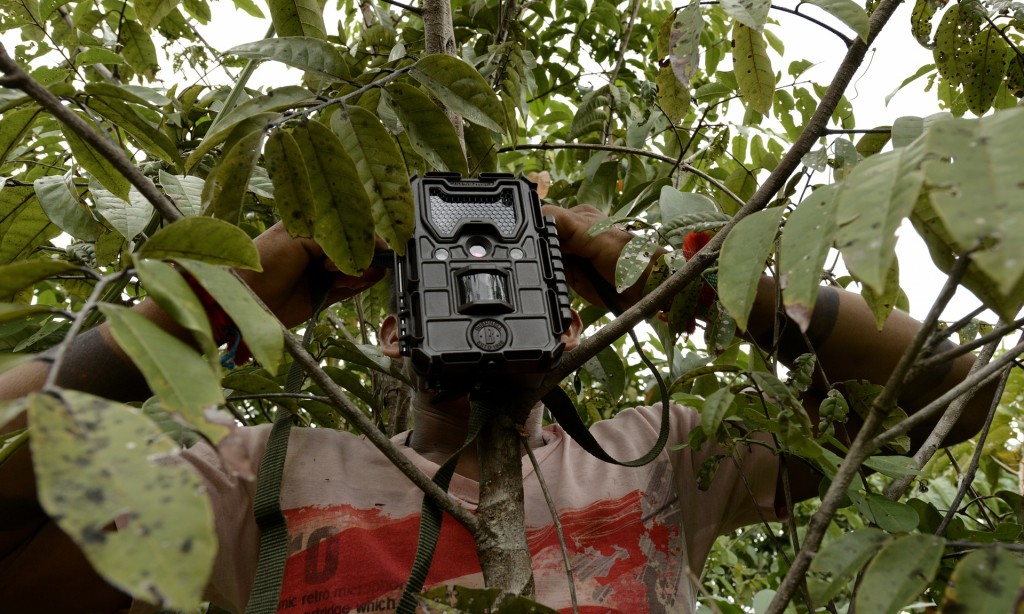
Ka’apor Indians setting up trap cameras in areas used by illegal loggers to invade the indigenous territory. Photograph: Lunae Parracho/Greenpeace
The Ka’apor asked the government to protect their borders, which were recognised in 1982. Last year, a federal court ordered the authorities to set up security posts. But nothing has been done, prompting the community to organise self-defence missions.
In the morning, one of the forest guardians, Tidiun Ka’apor (who, like all of the leaders of the group, asked to have his name changed to avoid being targeted by loggers) explains what happens when they encounter loggers.
“Sometimes, it’s like a film. They fight us with machetes, but we always drive them off,” he says. “We tell them, ‘We’re not like you. We don’t steal your cows so don’t steal our trees.”
The main weapons used by the Ka’apor are bows and arrows and borduna – a heavy sword-shaped baton. One of the group also owns a rusty old rifle. Mostly though, they depend on greater numbers.
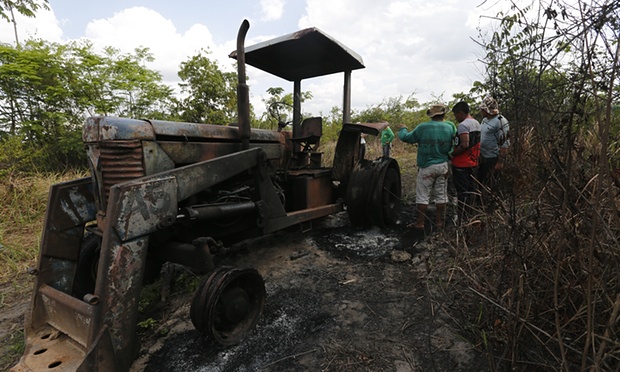
Tidiun Ka’apor takes us to a charred truck and tractor that the group burned in a confrontation a little over a week earlier and uses the ashes to paint his face. “This gives us strength,” one of his associates says. The Ka’apor are thought to have set fire to about a dozen loggers’ vehicles. Further along the road, they build a pyre of planks seized inside their land, douse it with gasoline and then watch it burn.
Another of the group’s leaders Miraté Ka’apor says the use of violence – which has resulted in some broken bones but no deaths among the loggers – is justified. “The loggers come here to steal from us. So, they deserve what they get. We have to make them feel our loss – the loss of our timber, the destruction of our forest.”
Compared with the past, he said the missions were effective. “Our struggle is having results because the loggers respect us now.”
But the loggers also appear to be responding with lethal force. On 26 April, a former chieftain, Eusébio Ka’apor was murdered by gunmen on his way back from a visit to his brother. Like most killings of indigenous people and environmental activists in Brazil, the crime has not been solved, but the dead man’s son has little doubt who is responsible and what they were trying to achieve.
Ka’apor Indians stand next to a logging tractor that they discovered and set on fire inside the indigenous territory one month before. Photograph: Lunae Parracho/Greenpeace
“He was a target because [the loggers] thought he was the main leader of the group,” said Iraun Ka’apor. “They thought the Ka’apor would stop if they killed him. But we will continue with our work of protection. I’m not afraid. This is my home, my land, my forest.”
Ten days before we arrived, Iraun received a death threat and was told that the bullet that killed his father had been meant for him.
The authorities in Maranhão – the poorest state in Brazil – warn the Ka’apor that although they are within their rights to protect their land, it is ultimately up to the state to resolve disputes over territory.
“The involvement of the Ka’apor in the defence of their territory against the loggers should be understood as legitimate defence, since the action of the loggers puts their survival at risk,” said Alexandre Silva Saraiva, regional superintendent of the federal police. “But the presence of the state is the only way to diminish the agrarian conflicts and reduce homicides.”
Inside Alto Turiaçu, people are sceptical that the police and government are willing to look after indigenous interests. Last year 70 Indians were murdered in Brazil, a 32% increase on 2013, according to the Missionary Indigenous Council. In many cases the killings were related to land disputes with loggers or ranchers. In their community gathering, many Ka’apor expressed the belief that the authorities were colluding in the sell-off of the forest.
“We are very concerned,” Miraté says. “Even the local authorities are involved. They grant licences to the sawmills and that encourages the loggers. The way the brancos [white or non-indigenous people] are organised also promotes death. They make a profit from this.”
Government officials prefer to focus on the positives: the slowdown in Amazonian deforestation rates over the past 10 years (though in Maranhão’s case this is largely because there is so little forest left) and the progress made in bringing culprits to justice. This year, prosecutors in neighbouring Pará state have broken up an illegal land-clearance ring and arrested corrupt officials in timber-laundering syndicates that supply fake certification to loggers. Elsewhere, satellite monitoring has helped to identify which landowners are tearing down or burning the most trees, though this approach is of less use when it comes to the steady degrading of the forests by invasive loggers.
Pedro Leão, superintendent for Ibama (Brazilian Institute of the Environment and Renewable Natural Resources) insists his agency is already combating the criminal organisations behind illegal logging and cautions that it is “extremely risky” for the Ka’apor to do the same. He said he hoped Ibama could make greater strides in the future by focusing on sawmills and possibly using GPS trackers.
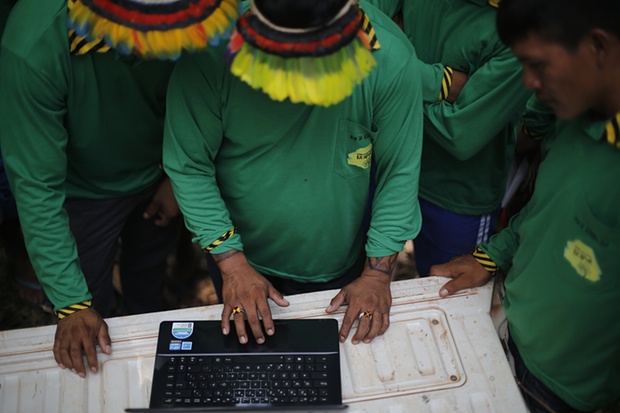
These are already areas where the Ka’apor are active. During this month’s visit, Greenpeace – which also helped the Guardian to reach the area – provided the community with 11 camera traps, 11 GPS trackers and two computers, worth a total of 20,000 reais (£3,480/$5,260).
A Ka’apor Indian sets up a trap camera in an area used by illegal loggers. Photograph: Lunae Parracho/Greenpeace
Marina Lacorte, a forest campaigner with Greenpeace Brazil, said the devices – which are usually used to capture wild animals on film – were intended to enhance the Ka’apor’s success in diminishing illegal logging. “With the cameras, we hope to prove that at a certain time and date in a certain place, the trucks arrived empty and left with timber. We hope the devices can produce more evidence to persuade the authorities to do something to stop the logging and the conflict and the murder.”
For many conservationists, the significance of the Ka’apor’s actions goes beyond their particular case and puts them on the frontline of the battle against climate change. Brazil, like other Amazonian countries, has struggled to tackle deforestation partly because environmental authorities are constantly outnumbered and outgunned by loggers, ranchers and farmers.
Ibama – the main agency dedicated to protecting the forest – has about 1,500 rangers to monitor the Brazilian Amazon, an area that is more than half the size of the US. Many of them have mixed feelings about land clearance. Some are even in the pay of loggers, as recent scandals have revealed.
By contrast, indigenous groups like the Ka’apor have the incentive and the manpower on the ground to resist the decimation of their forests. For them, this is not just a job, but a matter of identity and survival. The benefits can be global. In a recent report, the World Resources Institute noted that when indigenous people have weak legal rights, their forests tend to become the source of carbon dioxide emissions, while those in a strong position are more likely to maintain or even improve their forests’ carbon storage. Underlining this, a research paper published last month in Science, notes that forest dwellers are the best defence against logging and land clearance.
The danger is that such groups might become involved in a proxy war against emissions without the technology, the firepower or the legal authority to overcome more powerful opponents. But Miraté said the community would pick and choose how and when to get involved.
“It’s not that we don’t understand technology. We can drive cars and motorbikes and we can use computers. But we want to do things our way, the Ka’apor way,” he said.
Ka’apor Indians have occupied a site formerly used by illegal loggers. Photograph: Jonathan Watts for the Guardian
The loggers are not the only threat to the tribe’s survival. Previous battles with the authorities and the spread of diseases brought in by outsiders reduced the population – which once stood at several thousand – to little more than 500 at the low point in 1982. The community has since rebounded – largely thanks to the recognition of its territory – and it continues to assert its cultural identity on a variety of fronts.
While many other indigenous groups are plagued by alcoholism, the Ka’apor recently introduced a ban on consumption of beer and spirits (as well as visits by Christian evangelists and political campaigners). If a member violates the rule once, he gets a warning; twice, he must face a full meeting of the tribe; three times and he is sentenced to work in the nearby town. In their relations with the government, the tribe insisted last year on being represented by a member of their own community rather than a bureaucrat from Funai (the National Indian Foundation). They have also moved away from what they say is a Funai-led system of having a single village chief and instead reverted towards collective leadership.
In education, they have ensured that their children are taught entirely in Ka’apor rather than Portuguese until the age of 10. Most creatively, they also recently codified their own calendar, which prioritises planting, harvesting and mating seasons, as an alternative to the solar-based Gregorian system. While they occasionally shop for rice, the Ka’apor says they are largely self-sufficient with crops of manioc, bananas, pumpkin and watermelon. They also raise chickens, and hunt wild boar, deer, capybara and parrots – though only in certain seasons to ensure wild populations remain strong.
But Miraté fears the authorities in Brasília are more concerned about the country’s non-indigenous population and the pressure of a global economy.
“We believe that what the Brazilian government is doing now is wrong. They are following a policy to finish off the indigenous people,” he warns. But “we want to do things our own way, to respect our own culture. That’s the only way to survive.”
Seven women and one man were arrested early on Wednesday in the latest round of arrests in the ongoing battle against building a giant telescope atop a mountain many native Hawaiians consider sacred.
The state department of land and natural resources said 20 of its officers arrested the protesters on Mauna Kea at about 1am. They were enforcing an emergency rule created to stop people from camping on Mauna Kea. The land board approved the rule in July, which restricts access to the mountain during certain nighttime hours and prohibits certain camping gear. It was prompted by protesters’ around-the-clock presence to prevent construction of the Thirty Meter Telescope.
Protesters say officers hauled them away while they were praying. In video footage provided by the state, officers are seen walking toward a group of people huddled in a circle and chanting. A man’s voice is heard saying: “Eh, they’re praying you guys, they’re praying.”
The footage shows officers putting plastic handcuffs on women and putting them into the back of a vehicle. “Why do I have to have my hands behind my back,” a woman asked. “Because you’ll be placed in restraints, ma’am,” an officer responded.
The emergency rule, in place for 120 days, is intended to make the mountain safe for protesters, visitors and workers of the 13 telescopes already on the mountain, the state said. Attorney general Doug Chin told the land board that even though camping is already prohibited on the mountain, a targeted rule is necessary because of bad behavior by some protesters – ranging from putting boulders in the road to threats and harassment – created unsafe conditions.
The nonprofit company building the Thirty Meter Telescope hasn’t indicated when there will be another attempt to resume construction. Workers weren’t able reach the site during two previous attempts when they were blocked by hundreds of protesters, including dozens who were arrested.
This was the fourth time telescope opponents have been arrested on the mountain.
University of Hawaii law school professor Williamson Chang has filed a lawsuit seeking to repeal the rule, arguing it prevents telescope opponents from legally exercising their rights to peacefully protest.
The infrastructures of State and capital continue to spread their tentacles, seeking to accelerate the extraction and transportation of resources to the market.
The infrastructures of State and capital continue to spread their tentacles, seeking to accelerate the extraction and transportation of resources to the market. The vast territory that is the Canadian North, often sparsely populated due in large part to the displacement, isolation, and genocide of indigenous peoples, is an immense source of profit; oil, gas, forestry, hydro-dams, uranium mines, etc. Various monstrous infrastructural expansion projects are currently trying to connect the Alberta Tar Sands through pipelines along the St. Lawrence river to the Atlantic. These projects entail expanding and constructing new infrastructure such as ports, rail lines, and highways all along this route on colonized territories.
We placed a copper wire connecting both sides of the tracks, thus sending a signal indicating a blockage on the tracks and disrupting circulation until the tracks were checked and cleared. This train line in particular is being worked on in order to facilitate the transport of oil eastward to the port of Belledune in New Brunswick.
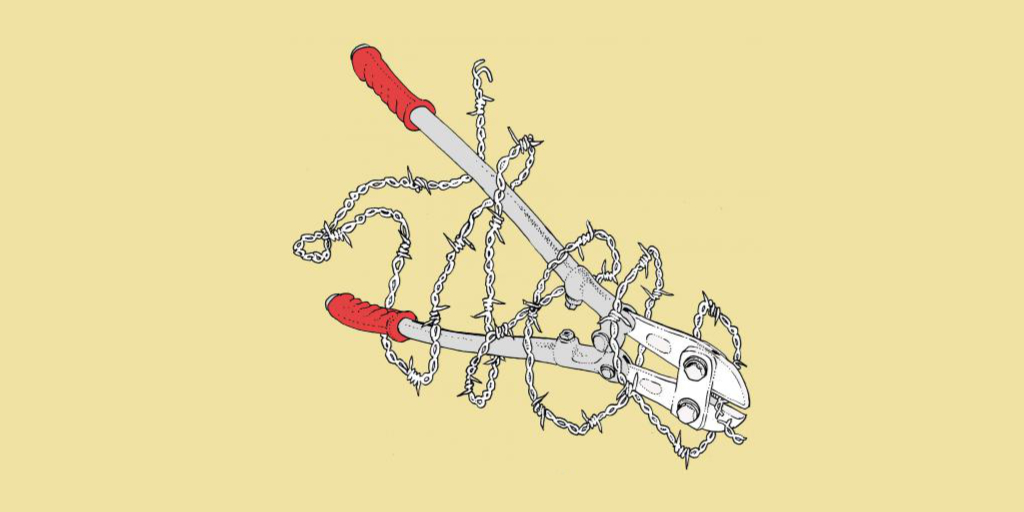
To block train lines, one can :
1. Obtain at least 8 feet of uninsulated 3AWG copper ground wire (the kind that is used for wiring main service panels in a house).
2. Wrap the wire around each rail of the track, connecting both sides, and ensure good contact.
3. Cover the wire between the tracks so that it is more difficult to detect.
4. Smile at the possibility of causing thousands of tonnes of train traffic to be disrupted.
This simple act is easily reproducible, and demonstrates the vulnerability of their infrastructure despite their surveillance technologies and legal apparatus intent on dulling our teeth. The recent strengthening of the Canadian State’s capacity for repression through Bill C‑51, now law, includes legislation requiring a mandatory minimum sentencing of five years for those convicted of tampering with capitalist infrastructure. For us, this legislation further emphasizes how integral the functioning of ‘critical’ infrastructure is to projects of ecological devastation (and the society that needs them), and how powerfully the simple act of sabotage can contribute to struggles against them.
We conceive of our struggle as against civilization and the totalizing domestication it entails; we seek nothing less than the destruction of all forms of domination. As a step in this direction, we hope to contribute to the formation of a specific struggle against these projects of industrial expansion. We want to organize to combat these projects in ways that are decentralized and autonomous, including with consistent and widespread railroad blockades. Autonomous self-organizing escapes a mass movement logic (to impose an agenda through ‘mobilizing’ others while waiting for the ‘right’ conditions to act) and the political recuperation imposed by reformist environmental activism. Convergences can play a crucial role in initiatives flourishing, but it is equally crucial that the struggle against these projects does not start and end there. Let’s up the tension against this world, let’s proliferate the attacks.
The Achuar communities say foreign oil companies pollute their lands and clean water and are demanding compensation.
The Achuar Indigenous people are fed up with the pollution left behind by
foreign oil companies.
September 9th, 2015
The Achuar communities say foreign oil companies pollute their lands and clean water and are demanding compensation.
Peruvian Indigenous protesters seized oil wells in an Amazonian oil block Tuesday to press the government to respond to demands for compensation due to the pollution caused by the petroleum operations. The protesters from the Achuar Indigenous communities said they also plan to halt output in a nearby concession.
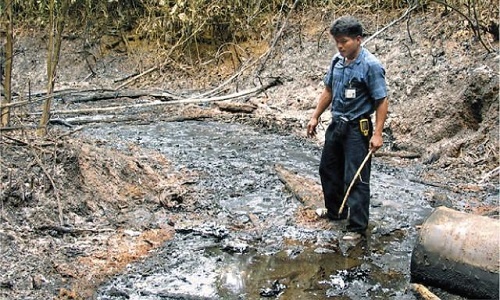
The Indigenous demonstrators shut down 11 wells and took control of an airdrome in oil block 8 to demand clean water, reparations for oil pollution and more pay for the use of native land, said Carlos Sandi, chief of the Indigenous federation Feconaco. Achuar leader Carlos Sandi observes the damage left behind by extractionist oil companies.
Photo: Renato Pita/ PUINAMUDT Argentine energy company Pluspetrol operates block 8 and said daily output of about 8,500 barrels per day had stopped.
The firm called on protesters in block 8 to seek dialogue. “So far, however, they insist on holding control of installations,” Pluspetrol said in a statement.
Sandi said the Achuar in oil block 192 would also soon seize wells there following a dispute with the government over proceeds for communities in a new contract awarded to the Canadian company Pacific Exploration and Production Corporation. Both oil blocks are in Peru’s northern region of Loreto.
“The decision (to seize wells) has been made, we just need to wrap up some coordination,” Sandi said.
Peru signed a last-minute deal with Pacific for the rights to tap oil block 192 for the next two years after an open auction for a 30-year contract failed to draw any bids last month.
The government included benefits for some Indigenous communities in the new contract but a stalemate with others over their share of oil profits left many out. Representatives of Pacific could not be reached outside of regular business hours.
Block 192’s operations have been halted on various occasions in recent years. The protesters have demanded the government clean up oil spills and give them more compensation.
Peru has declared several environmental emergencies there because of oil pollution. The Latin American country is rife with conflicts over mining and energy projects.
Earlier on Tuesday, an assembly of social organizations in the Amazonian region of Loreto voted to carry out another 48-hour strike starting Friday to protest the government’s privatization move to allocate an oil lot to the Canadian company for two years instead of the country’s state-owned company.
Lot 192 is the source of 17 percent of the national crude production. The region’s president of Patriotic Front Americo Menendez said the Canadian oil firm is a “mafia company,” saying that for example in Colombia they hire gunmen to deal with social leaders who oppose exploitation.
Nevertheless, he added, the assembly also voted in favor of maintaining the talks with the government, in order to negotiate various demands, including the creation of a compensation fund of about US$112 million, in addition to an inversion of around US$625 million in the area.
In Colombia, Pacific Stratus Energy allegedly hires killers against social leaders who oppose the exploitation, claimed President of Federation of Native Communities from the River Tigre Fernando Chuje.
Minister of Mining and Energy Rosa Maria Ortiz has indicated that the state company PetroPeru will start a process of restructuring and modernization in the next 270 days to prepare it to compete against the Canadian company in two years, when the concession ends.
Lot 192 is comprised of areas inhabited by the communities of the river basins of Pastaza, Tigre, and Corrientes.
The leaders of the Apus Indigenous people in the area have been protesting for years, demanding respect for their people and reparations for environmental destruction caused by oil companies.
As anyone with experience of them knows, prisons are abusive places used to control and threaten people, particularly those of us who are working class, people of colour, or disobedient. We need justice processes based on strong, vibrant communities, not more prisons and cops harming our communities.
The new prison would be the biggest in the UK, and the second biggest in Europe. It aims to open in 2017 and would give the State enough cages to lock up an extra 2100 people.
Award giving in recognition of services to landlords and their rights. We proudly presented bricks through windows of CJA estate agents in Southville on the night of 31st August. All windows smashed and the international squatter symbol painted on their wall. Because despite the ban on squatting houses everyone should have a decent home.
Award giving in recognition of services to landlords and their rights. We proudly presented bricks through windows of CJA estate agents in Southville on the night of 31st August. All windows smashed and the international squatter symbol painted on their wall. Because despite the ban on squatting houses everyone should have a decent home. CJA have showed real resilience and single mindedness to make a stand for maximum profit regardless of the tough conditions faced by tenants everywhere. In a letter to Bristol landlords in March this year they encouraged landlords to hike their rents and cynically take advantage of the housing crisis. Because the crisis is for landlords and property developers another business opportunity. They then arrogantly ignored a campaign by a local community union to hold them to account. So we found another way to encourage them to see the costs of their actions. Thousands of us are trapped in overcrowded, over priced and chronically undermaintained and decaying rented houses. We constantly struggle to pay the rent under the ever present threat of eviction and homelessness. Gentrification and colonisation of our areas pushes rents ever higher and forces us further out. This is social cleansing and it is a very profitable business. For greedy landlords and estate agents like CJA, decent, affordable homes don’t come into their sums. It’s all about investment opportunities and ruthless profiteering. Meanwhile, there is a huge increase in homelessness and the hostels are full to bursting. We don’t have to take this. Let’s fight for a world without landlords, where people’s homes are not for the profit of the rich.
Early this morning two people occupied the main conveyor belt, close to the coal bunk at Hambach. This conveyor belt transports coal from all over the mine to the coal bunker, and from there, to the coal trains.
This action is against this system in which big companies are allowed to destroy our earth.
Also in solidarity with our comrade Jus, who is in prison for 6 weeks now. We encourage everyone to show support for Jus in anyway that they see fit. Freedom for Jus!
The people in the blockade decided to focus on their action and not so much on media, if media has questions they can call the meadow phone: 0157 – 54 136 100
For one hour the workers sprinkled them with cold water. After 6,5 hours the people were removed by police and have been released at 1 pm.
On Sunday, the August 2015, about 2000 people attended on a demonstration in the mountains of Skouries.
August 27th, 2015
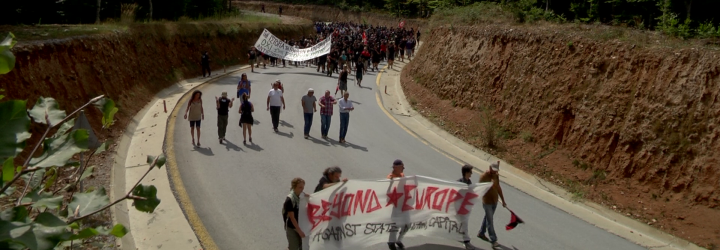
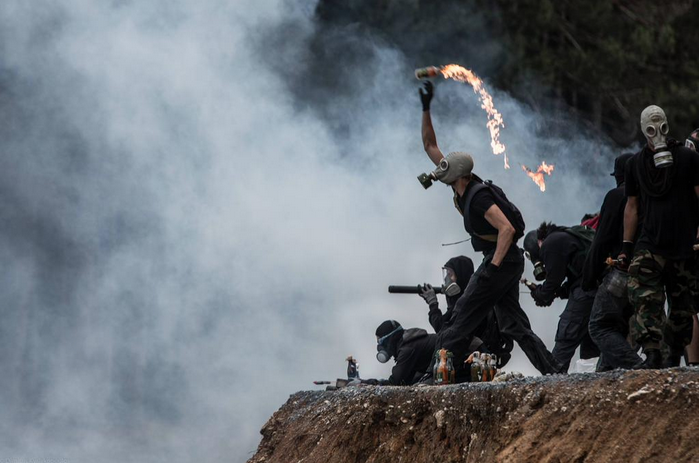
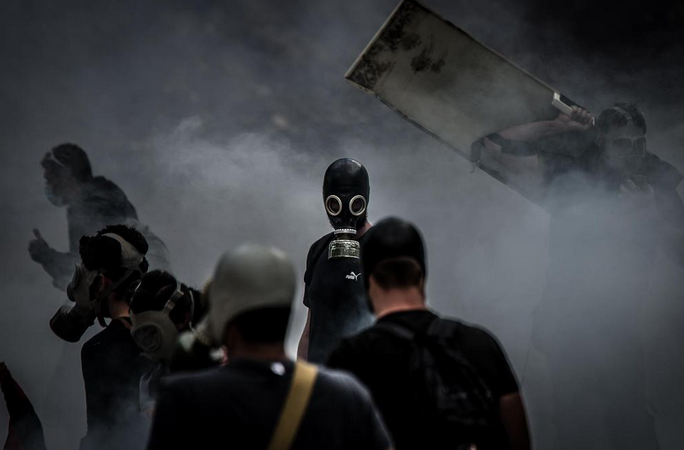
On Sunday, the 23rd August 2015, about 2000 people attended on a demonstration in the mountains of Skouries. During this heavy clashes between demonstrators and the police took place, with police making massive use of teargas and shock grenades. 78 persons were detained, of which four are still being held in custody.
The demonstration was organised by the anti-authoritarian platform against capitalism, Beyond Europe, together with activist committees of the local villages in the area of Skouries. This protest march was the practical culmination of the international Beyond Europe camp, which has been taking place at the beach of Ierissos close to the area of Skouries. At this camp, 400–500 anti-authoritarians from all over Europe came together in order to exchange ideas with each other and discuss political analyses and practices. The location was chosen very consciously in order to support the ongoing ecological-social struggles against the extraction of gold and other heavy metals in Skouries. and of course we are not only active on behalf of but alongside the local activists. For a long time now, Beyond Europe activists have been engaged in practical solidarity and support for this struggle. It has a strong impact for social movements in Greece and the whole of Europe as an important frontline in the struggle against the reconfiguration of European capitalism through the Troika on the back of the many.
For us, the camp and especially the demonstration is a political success, by being set in the right place at the right time. In January 2015 the left party Syriza took over power and evoked hope in many Leftists. Concerning the issue of Skouries, Syriza played the role of the party of the movement during opposition, but has acted very different since it has been in power. Shortly before the march the Alexis Tsipras’ government resigned, only two days after the start of the Beyond Europe camp and since Syriza had learned about our demonstration. Meanwhile the energy minister Panos Skourletis ordered to suspend the mining operations in Chalkidiki on 19th August, claiming the company violated environmentalcontract terms. We attribute the announcement to close the mine as a result of us choosing to organise a camp here, but we did not rely on the government’s announcement as being the end of the struggle– which we have seen to be justified. One day after the announcement, during our walk from the camp to the mountain by the village Megali Panagia we could see that the works at the mines were continuing. This was just one more expression of the most basic but important lesson in the questions of relation between parties and the movements: although they may improve tiny things within their limited capacity, the possibility to create real progress and emancipation lies in our hands. Delegating desires for change towards parties will always be a dead end, since parties in power will always need to work to enact national interest. We agree with Syriza that the mines in Skouries need to be closed, but it is up to us to fulfill this task. Our action sent this message to any party which will take power in the Greek re-elections in September.
Sunday’s demonstration put the important and vital struggle of Skouries back on the table. Its impact was felt deeply all over Greece and beyond. We see this as a political success as now, since the first time after the huge general strike of 2012, a new political dynamic from below is being created in Greece. After a droughtof social movements since that year, Syriza’s seizure of power seemed to have paralyzed large parts of it due to a position of granting the Tsipras’ government time. Our camp and demonstration was an effort to put an end to this drought and rely on our strongest weapon – self-organisation and social struggles.
As always when social struggles are effective, the state’s repression also continued yesterday. In the several years in the ongoing issue of Skouries, police and secret services have been heavily trying to oppress the local movement by harassment, arrests and juridical prosecution. Yesterday again, the police violently dispersed the demonstration, arrested 78 people and injured several. One person suffered a broken leg while being arrested by the cops. Our wishes for a quick recovery are with her and with everyone else suffering beating or gas injuries. And of course we are in solidarity with the four still detained, as well as all the other activists being prosecuted in the last years. This might only have been a small step towards an anti-authoritarian organisation beyond borders and against the sadness of real existing capitalism, but it was a step nonetheless. And there is more to come.