
September 10th, 2015
With bows, arrows, GPS trackers and camera traps, an indigenous community in northern Brazil is fighting to achieve what the government has long failed to do: halt illegal logging in their corner of the Amazon.
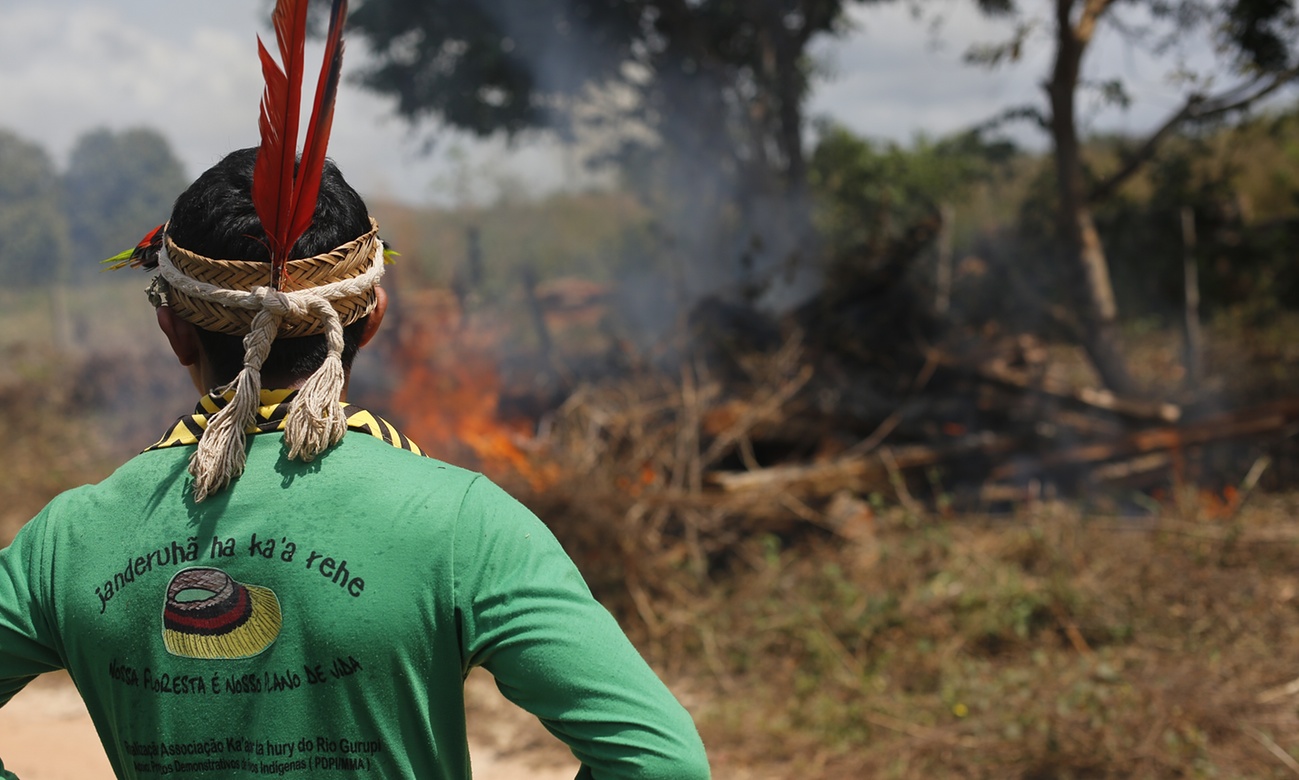
The Ka’apor – a tribe of about 2,200 people in Maranhão state – have organised a militia of “forest guardians” who follow a strategy of nature conservation through aggressive confrontation.
Logging trucks and tractors that encroach upon their territory – the 530,000-hectare Alto Turiaçu Indigenous Land – are intercepted and burned. Drivers and chainsaw operators are warned never to return. Those that fail to heed the advice are stripped and beaten.
It is dangerous work. Since the tribe decided to manage their own protection in 2011, they say the theft of timber has been reduced, but four Ka’apor have been murdered and more than a dozen others have received death threats.
Now the Ka’apor are seeking support through NGOs and the media. Earlier this month, the Guardian was among a first group of foreign journalists and Greenpeace activists who were invited to see how they live and operate.
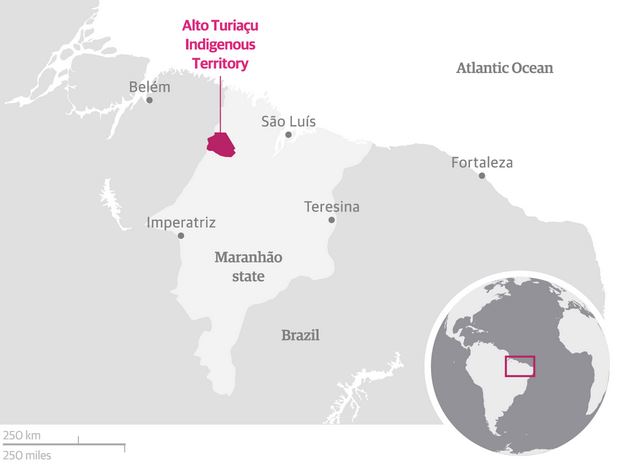
Reaching their land was a long haul. After flying to São Luis, the capital of Maranhão state, it took more than eight hours to drive along a potholed highway flanked by cattle farms and palm plantations before turning off on to a bumpy dirt track through tracts of deforested land, until a dense thicket of jungle marked the limit of Ka’apor territory.
The path was so close to the foliage here that branches constantly scratched and scraped the sides of our 4×4 until finally, just a few minutes before midnight, we emerged into a clearing bathed in moonlight.
This was Jaxipuxirenda, one of eight former logging camps that have been taken over by the Ka’apor and settled by a handful of families so the timber thieves cannot return. It was very simple; six thatched roofs under which families slept in hammocks.
Living in such outposts is a sacrifice. Longer-established villages have electricity, health centres, football pitches and satellite dishes. Jaxipuxirenda is bereft of such creature comforts.
But it is a key part of a drive to regain territory, independence and respect – all of which have been steadily eroded by loggers for more than two decades. Alto Turiaçu, which covers an area equal to Delaware or three times that of Greater London, is a vulnerable and lucrative target. Although 8% has already been cleared, the indigenous land contains about half of the Amazon forest left in Maranhão state. This includes much sought-after trees, like ipê (Brazilian walnut), which can fetch almost £1,000 ($1,500) per cubic metre after processing and export.
The Ka’apor asked the government to protect their borders, which were recognised in 1982. Last year, a federal court ordered the authorities to set up security posts. But nothing has been done, prompting the community to organise self-defence missions.
In the morning, one of the forest guardians, Tidiun Ka’apor (who, like all of the leaders of the group, asked to have his name changed to avoid being targeted by loggers) explains what happens when they encounter loggers.
“Sometimes, it’s like a film. They fight us with machetes, but we always drive them off,” he says. “We tell them, ‘We’re not like you. We don’t steal your cows so don’t steal our trees.”
The main weapons used by the Ka’apor are bows and arrows and borduna – a heavy sword-shaped baton. One of the group also owns a rusty old rifle. Mostly though, they depend on greater numbers.
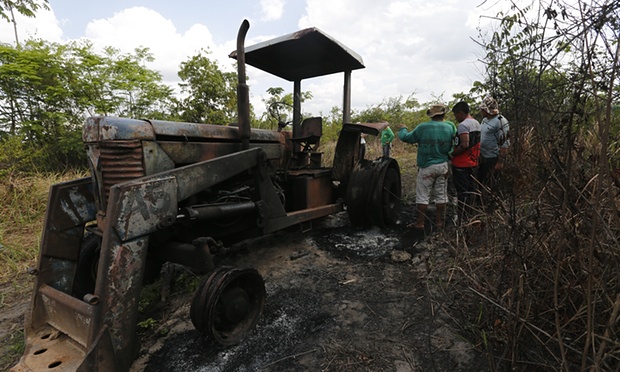
Tidiun Ka’apor takes us to a charred truck and tractor that the group burned in a confrontation a little over a week earlier and uses the ashes to paint his face. “This gives us strength,” one of his associates says. The Ka’apor are thought to have set fire to about a dozen loggers’ vehicles. Further along the road, they build a pyre of planks seized inside their land, douse it with gasoline and then watch it burn.
Another of the group’s leaders Miraté Ka’apor says the use of violence – which has resulted in some broken bones but no deaths among the loggers – is justified. “The loggers come here to steal from us. So, they deserve what they get. We have to make them feel our loss – the loss of our timber, the destruction of our forest.”
Compared with the past, he said the missions were effective. “Our struggle is having results because the loggers respect us now.”
But the loggers also appear to be responding with lethal force. On 26 April, a former chieftain, Eusébio Ka’apor was murdered by gunmen on his way back from a visit to his brother. Like most killings of indigenous people and environmental activists in Brazil, the crime has not been solved, but the dead man’s son has little doubt who is responsible and what they were trying to achieve.
“He was a target because [the loggers] thought he was the main leader of the group,” said Iraun Ka’apor. “They thought the Ka’apor would stop if they killed him. But we will continue with our work of protection. I’m not afraid. This is my home, my land, my forest.”
Ten days before we arrived, Iraun received a death threat and was told that the bullet that killed his father had been meant for him.
The authorities in Maranhão – the poorest state in Brazil – warn the Ka’apor that although they are within their rights to protect their land, it is ultimately up to the state to resolve disputes over territory.
“The involvement of the Ka’apor in the defence of their territory against the loggers should be understood as legitimate defence, since the action of the loggers puts their survival at risk,” said Alexandre Silva Saraiva, regional superintendent of the federal police. “But the presence of the state is the only way to diminish the agrarian conflicts and reduce homicides.”
Inside Alto Turiaçu, people are sceptical that the police and government are willing to look after indigenous interests. Last year 70 Indians were murdered in Brazil, a 32% increase on 2013, according to the Missionary Indigenous Council. In many cases the killings were related to land disputes with loggers or ranchers. In their community gathering, many Ka’apor expressed the belief that the authorities were colluding in the sell-off of the forest.
“We are very concerned,” Miraté says. “Even the local authorities are involved. They grant licences to the sawmills and that encourages the loggers. The way the brancos [white or non-indigenous people] are organised also promotes death. They make a profit from this.”
Government officials prefer to focus on the positives: the slowdown in Amazonian deforestation rates over the past 10 years (though in Maranhão’s case this is largely because there is so little forest left) and the progress made in bringing culprits to justice. This year, prosecutors in neighbouring Pará state have broken up an illegal land-clearance ring and arrested corrupt officials in timber-laundering syndicates that supply fake certification to loggers. Elsewhere, satellite monitoring has helped to identify which landowners are tearing down or burning the most trees, though this approach is of less use when it comes to the steady degrading of the forests by invasive loggers.
Pedro Leão, superintendent for Ibama (Brazilian Institute of the Environment and Renewable Natural Resources) insists his agency is already combating the criminal organisations behind illegal logging and cautions that it is “extremely risky” for the Ka’apor to do the same. He said he hoped Ibama could make greater strides in the future by focusing on sawmills and possibly using GPS trackers.
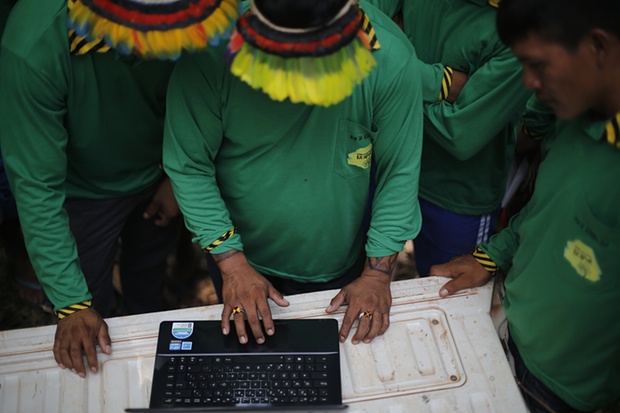
These are already areas where the Ka’apor are active. During this month’s visit, Greenpeace – which also helped the Guardian to reach the area – provided the community with 11 camera traps, 11 GPS trackers and two computers, worth a total of 20,000 reais (£3,480/$5,260).
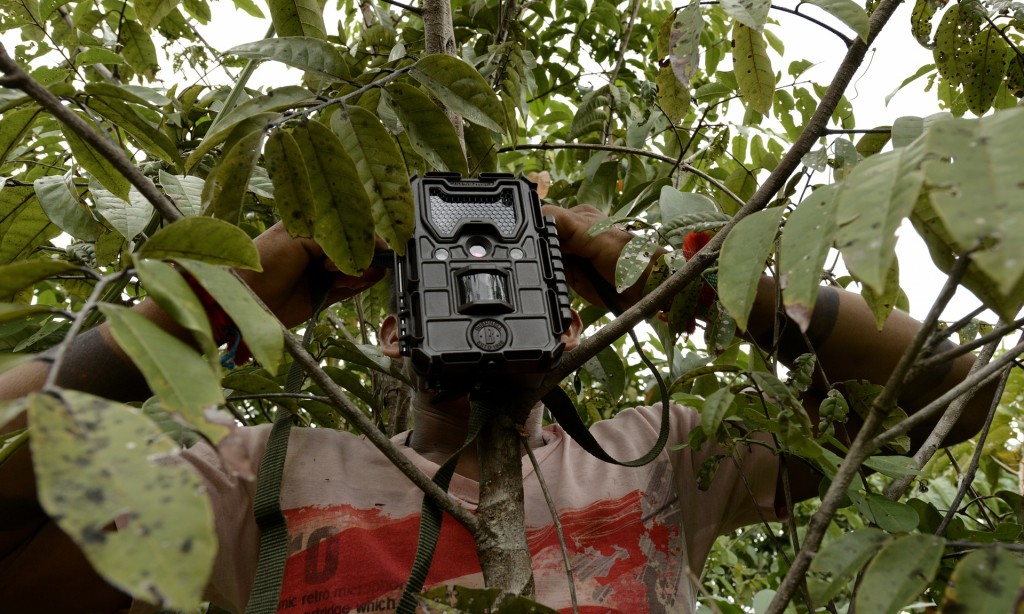
Marina Lacorte, a forest campaigner with Greenpeace Brazil, said the devices – which are usually used to capture wild animals on film – were intended to enhance the Ka’apor’s success in diminishing illegal logging. “With the cameras, we hope to prove that at a certain time and date in a certain place, the trucks arrived empty and left with timber. We hope the devices can produce more evidence to persuade the authorities to do something to stop the logging and the conflict and the murder.”
For many conservationists, the significance of the Ka’apor’s actions goes beyond their particular case and puts them on the frontline of the battle against climate change. Brazil, like other Amazonian countries, has struggled to tackle deforestation partly because environmental authorities are constantly outnumbered and outgunned by loggers, ranchers and farmers.
Ibama – the main agency dedicated to protecting the forest – has about 1,500 rangers to monitor the Brazilian Amazon, an area that is more than half the size of the US. Many of them have mixed feelings about land clearance. Some are even in the pay of loggers, as recent scandals have revealed.
By contrast, indigenous groups like the Ka’apor have the incentive and the manpower on the ground to resist the decimation of their forests. For them, this is not just a job, but a matter of identity and survival. The benefits can be global. In a recent report, the World Resources Institute noted that when indigenous people have weak legal rights, their forests tend to become the source of carbon dioxide emissions, while those in a strong position are more likely to maintain or even improve their forests’ carbon storage. Underlining this, a research paper published last month in Science, notes that forest dwellers are the best defence against logging and land clearance.
The danger is that such groups might become involved in a proxy war against emissions without the technology, the firepower or the legal authority to overcome more powerful opponents. But Miraté said the community would pick and choose how and when to get involved.
“It’s not that we don’t understand technology. We can drive cars and motorbikes and we can use computers. But we want to do things our way, the Ka’apor way,” he said.
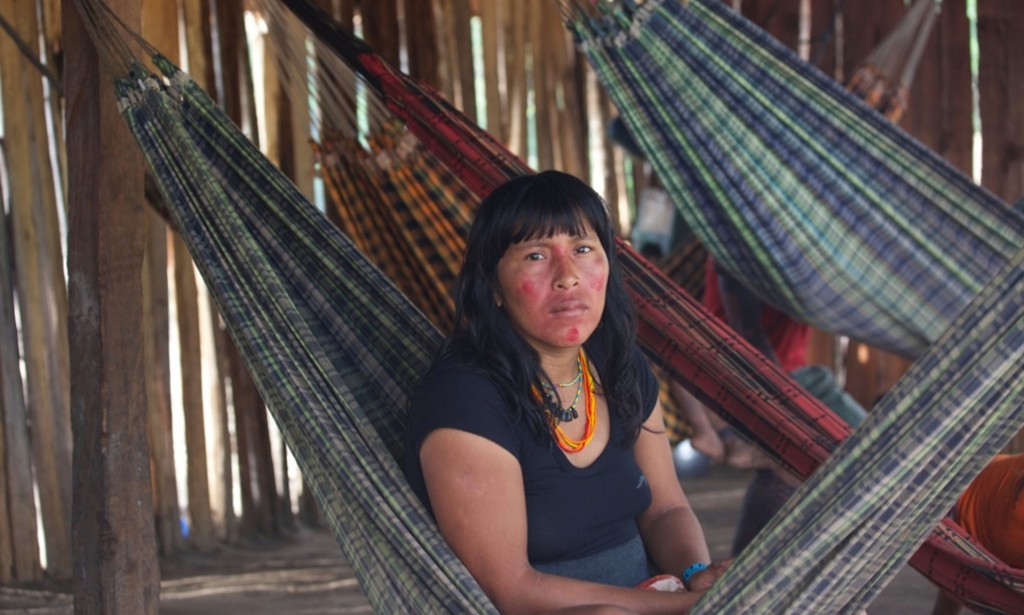
The loggers are not the only threat to the tribe’s survival. Previous battles with the authorities and the spread of diseases brought in by outsiders reduced the population – which once stood at several thousand – to little more than 500 at the low point in 1982. The community has since rebounded – largely thanks to the recognition of its territory – and it continues to assert its cultural identity on a variety of fronts.
While many other indigenous groups are plagued by alcoholism, the Ka’apor recently introduced a ban on consumption of beer and spirits (as well as visits by Christian evangelists and political campaigners). If a member violates the rule once, he gets a warning; twice, he must face a full meeting of the tribe; three times and he is sentenced to work in the nearby town. In their relations with the government, the tribe insisted last year on being represented by a member of their own community rather than a bureaucrat from Funai (the National Indian Foundation). They have also moved away from what they say is a Funai-led system of having a single village chief and instead reverted towards collective leadership.
In education, they have ensured that their children are taught entirely in Ka’apor rather than Portuguese until the age of 10. Most creatively, they also recently codified their own calendar, which prioritises planting, harvesting and mating seasons, as an alternative to the solar-based Gregorian system. While they occasionally shop for rice, the Ka’apor says they are largely self-sufficient with crops of manioc, bananas, pumpkin and watermelon. They also raise chickens, and hunt wild boar, deer, capybara and parrots – though only in certain seasons to ensure wild populations remain strong.
But Miraté fears the authorities in Brasília are more concerned about the country’s non-indigenous population and the pressure of a global economy.
“We believe that what the Brazilian government is doing now is wrong. They are following a policy to finish off the indigenous people,” he warns. But “we want to do things our own way, to respect our own culture. That’s the only way to survive.”
by Jonathan Watts / The Guardian