Extra gardai on duty at Shell pipeline after €150,000 damage to machinery

30 June 2013 Extra gardai are on duty in Co Mayo this weekend after violence broke out at a protest against the Shell gas pipeline last Sunday when a security guard had his arm badly injured and €150,000 worth of damage was done to machinery, writes Jim Cusack.

30 June 2013 Extra gardai are on duty in Co Mayo this weekend after violence broke out at a protest against the Shell gas pipeline last Sunday when a security guard had his arm badly injured and €150,000 worth of damage was done to machinery, writes Jim Cusack.

Sixty protesters, mostly local people but including anarchists who travelled to Ireland for the G8 summit protest, were said to have been involved. Gardai made six arrests last Wednesday and Thursday after examining CCTV images and are preparing prosecutions files.

The protesters targeted a construction site at Aughoose last weekend as part of an annual protest campaign, and security guards at the scene were assaulted.

Gardaí frustrated as protests in Mayo continue

30 June 2013 This week has seen large numbers of people continually walking down to Shell's tunneling compound, disrupting work and blocking Shell traffic, and man
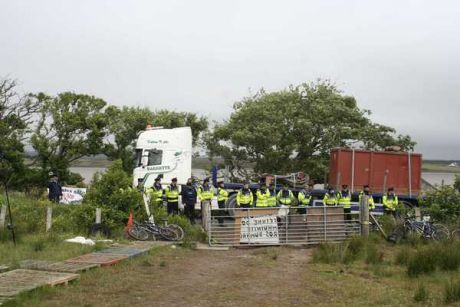
30 June 2013 This week has seen large numbers of people continually walking down to Shell's tunneling compound, disrupting work and blocking Shell traffic, and many people from the camp have taken advantage of the sunny weather to spend the days helping locals with turf collecting- many hands make light work! Meanwhile the guards have spent their time patrolling around harassing people on the roads.
 

A Brief blow by blow

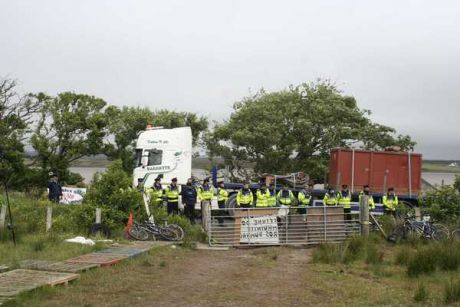
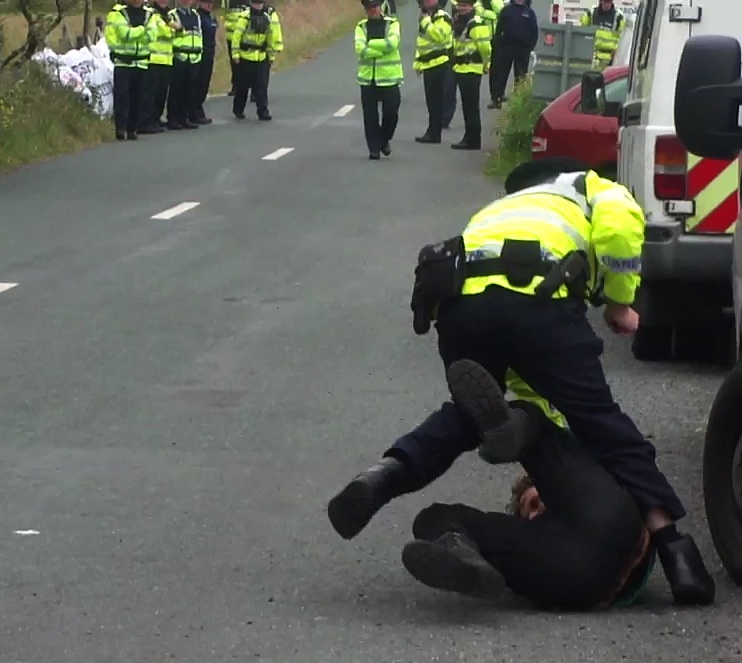
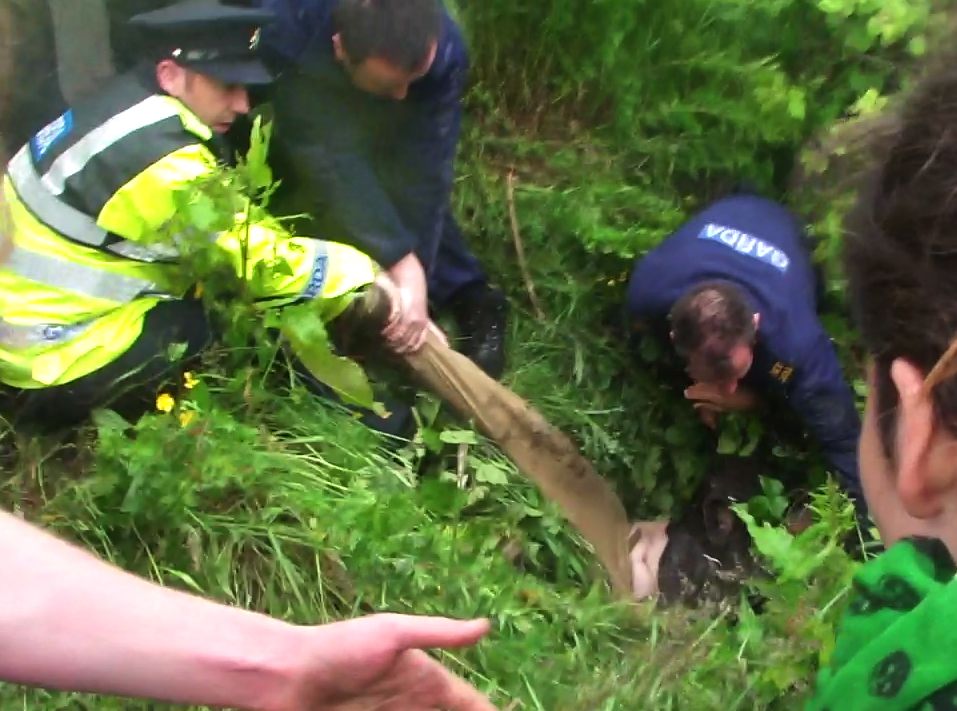
Thursday morning as a convoy passed the camp, 20 Gardaí tried to block the gate to the camp and threw people into ditches, pushing one person's head into the water in the ditch and generally being a bit violent. Two people were arrested. One was let out with a caution and the other was held in custody, brought to court in Castlebar Friday morning and denied bail, so he is now in Castlerea Prison awaiting a court appearance 5th July.

Later on Thursday morning a small group went to Belmullet Garda station to collect their friends and one person was dragged outside the copshop, pushed to the ground and arrested for alleged criminal damage on Sunday 23rd June. He was held overnight and brought to court in Castlebar on Friday morning. He has been granted bail and released on the condition he not enter or interfere with Shell property or traffic, and signs on once a week at Belmullet Garda Station. He will be up in court on 10th July.

Thursday afternoon a large group of 30 or so people walked down to the Shell compound in Aughoose, stopping work inside the compound and stopping any Shell traffic from entering or exiting the compound for over 3 hours. Once again IRMS (Shell private security) was policing the public road, pushing people and holding people until the guards arrived. Two people were arrested on the road. One person was released and will appear in Belmullet Court on 10th July, the other was arrested for outstanding fines and brought to Mountjoy women's prison in Dublin. She was held overnight and released Friday morning.

Thursday finished off at 6pm when the guards finally attempted to clear the road, everyone left and no one else was arrested. A long queue of 20 vehicles and lorries which had been stuck inside finally were able to leave the compound.

Friday 28th June at 7am one person climbed a tripod erected in the road between Bellanaboy refinery and the Aughoose tunneling compound, stopping all traffic going into the compound until 11.30am when the road was cleared and the person was arrested. That person is being charged with Sections 8 and 9 of the public order act and will be up in Belmullet court on 10th July.

Three people walking back to camp from the tripod on Friday were followed by guards, and an attempt was made to arrest one of them but they jumped into a field and got away. This isn't the first time that people have been harassed on the roads this week by Gardaí. Tuesday night as people were walking back from the pub the guards were stopping people who were walking in twos or alone, asking for names addresses and even emails. One person refused to give his details, saying he hadn't done anything out of the ordinary and was only walking home, and he was arrested and brought to Belmullet garda station. He was released in the early hours of the morning with no charges.

Other things that have happened this week: Windows of a Shell house were broken, graffiti appeared on the main gates of the tunneling compound, and a Shell truck ran into problems with spuds up the exhaust and someone doing in its tyres. Who knows what else the pixies have gotten up to….

Cops assaulting people on the road

Pushing people into ditches then arresting them

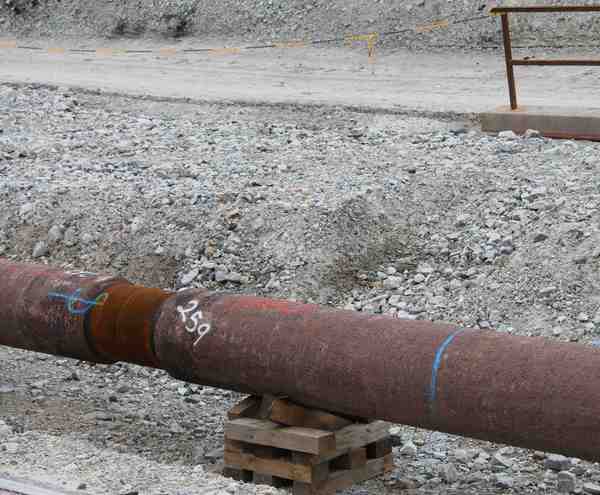
This is the pipe being laid between the refinery and the tunneling compound

Paddlers Charge Silver River, Protesting Expected Cattle Ranch

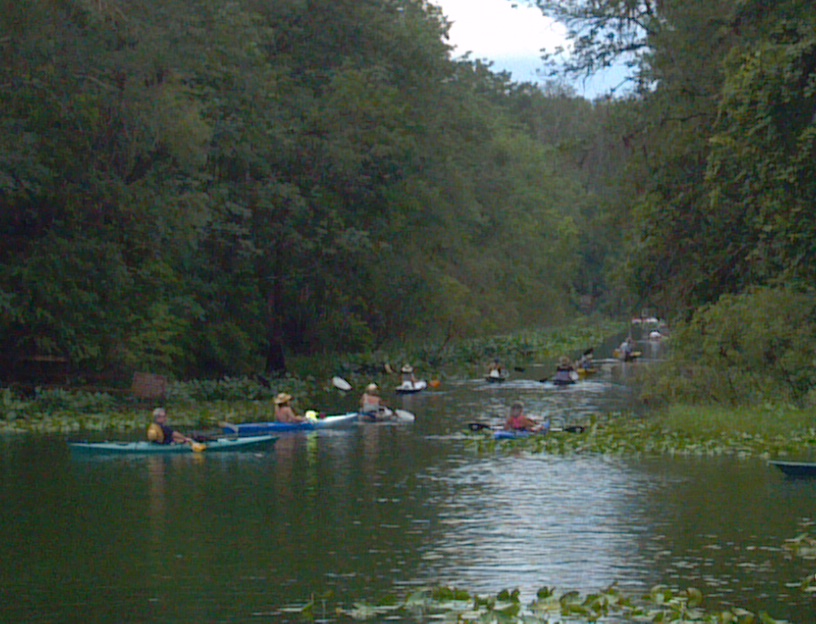
Paddlers charge the iconic Silver River, protesting Adena Springs Ranch

30 June 2013 Grassfed beef ain’t all it’s cracked up to be.

Paddlers charge the iconic Silver River, protesting Adena Springs Ranch

30 June 2013 Grassfed beef ain’t all it’s cracked up to be.

Take Adena Springs Ranch, a proposed cattle ranch being developed by billionaire Frank Stronach in Florida. The beef project is expected to span 10,000 acres and, according to their website, hold up to 15,000 cattle. Adena Springs Ranch plans to raise the cattle on a grassfed diet, calling their industrial farming practices “healthier” and “better for the environment.”

This past Saturday, individuals concerned with the proposed ranch gathered alongside the iconic Silver River, a river formed from the discharge of Silver Springs, one of the largest natural artesian wells in the world. Silver Springs historically discharged over 550 million gallons of water per day. In recent years, though, its flow has decreased significantly. According to the New York Times, the “flow rate has dropped by a third over 10 years.” If Adena Springs Ranch gets the go ahead from state officials, its farming practices will have a direct impact on the flow and water quality of Silver Springs.

A flyover by the Putnam County Environmental Council showing the Adena Springs Ranch property

A flyover by the Putnam County Environmental Council showing the Adena Springs Ranch property. Photo: PCEC

Adena Springs Ranch is currently applying for a consumptive use permit that will allow them to draw 5.3 million gallons of water per day from the Floridan Aquifer, the underground reservoir of water that provides drinking water to Florida residents, draws tourism money to the state and encourages residents and visitors to get out into the wilds of Florida and experience its natural beauty.

The permit, if approved, will allow the ranch to draw water from the area surrounding Silver Springs, impacting the entire springshed, all for the purpose of watering the grass that will feed the cattle. When asked about the impact their water withdrawals would have, Adena engineer – and Frank Stronach puppet – William Dunn said that “they do not consider current hydrological conditions when they do their calculations.”

About the only thing natural in this intensive cattle operation will be the release of cow shit and urine into the 130-acre grazing lots. Adena Springs Ranch says they will complete regular soil tests to ensure that they’re “not sending runoff downstream to neighbors or nearby waterbodies.”

The Floridan Aquifer, however, can be thought of as a giant limestone sponge forming the foundation of the state. Rainwater and runoff seeps through topsoil and permeable limestone and slowly flows through the Aquifer until it rushes out through natural springs or is drawn up for drinking or irrigation purposes. If cow manure – a nitrogen-rich fertilizer sold in garden shops everywhere – coming from Stronach’s cows somehow manages to have a neutral effect on the environment, and on the nutrient levels of the surrounding area, than the makeup of that cowshit would defy vegetable gardeners everywhere.

A paddler on the spring-fed Silver River.

A paddler on the spring-fed Silver River. Photo: Matt Keene

Find out more information about the protest and the issues surrounding Adena Springs by checking out the Water Action Team website.

Notes from White Castle

 
29 June 2013
 
Last night I slept in a warm, soft, bed, my housemates murmuring and playing music a floor below; tonight I lay on the cold, damp, ground a Yew Tree right above me, with cinnamon red bark and a trun

 
29 June 2013
 
Last night I slept in a warm, soft, bed, my housemates murmuring and playing music a floor below; tonight I lay on the cold, damp, ground a Yew Tree right above me, with cinnamon red bark and a trunk that twists and curves, an old gnarled body reaching for the sky.
 I hear the Yew Tree grows quite slowly, curving and bending its way toward the much taller, Douglas Firs. Swaths of pale-green lichen hang from the branches and blanket the trunks of these giants, a sign that the air is clean and moist. I look down. I am stepping on  decaying logs, turning into fecund soil, right below my feet. There is a mass of life and death out here, feeding into itself, again and again: a perfect, waste-less, system.
To remove any part of this forest would be an injustice to what is truly wild: the self-containing, self-informed, ecosystems that make up the biosphere. To think that humans could come into a place, so perfectly, and delicately balanced, with trucks and machinery, destroying the undergrowth, the trees, the canopy,  to think that they would do this place a favor, creating “early seral habitat.” It is not just a ridiculous idea: it is utterly dangerous and ecocidal.
We are talking about laying a pristine forest, never before logged, on the cruel alter of industry and human experimentation, and justifying it by saying that it is for the butterflies. Well, I’ve seen the butterflies here, and I’ve seen the birds and the trees and the deer, and they seem quite content with the way the forest is, as it stands. They have the sense that exists before defined ideas and suppositions that tells them how to be in this place: no heavy machinery need interject.
Tomorrow, I will wake up to the morning chorus. It starts with a few distant chirps and builds and eventually crescendos: hundreds of birds singing their love of this place and the day that has arrived.  And I will get up with them and I will climb up into a tree and I wont leave, to protect the day, and days to come, here at White Castle.
 

Cardiff Shell petrol station rooftop occupation

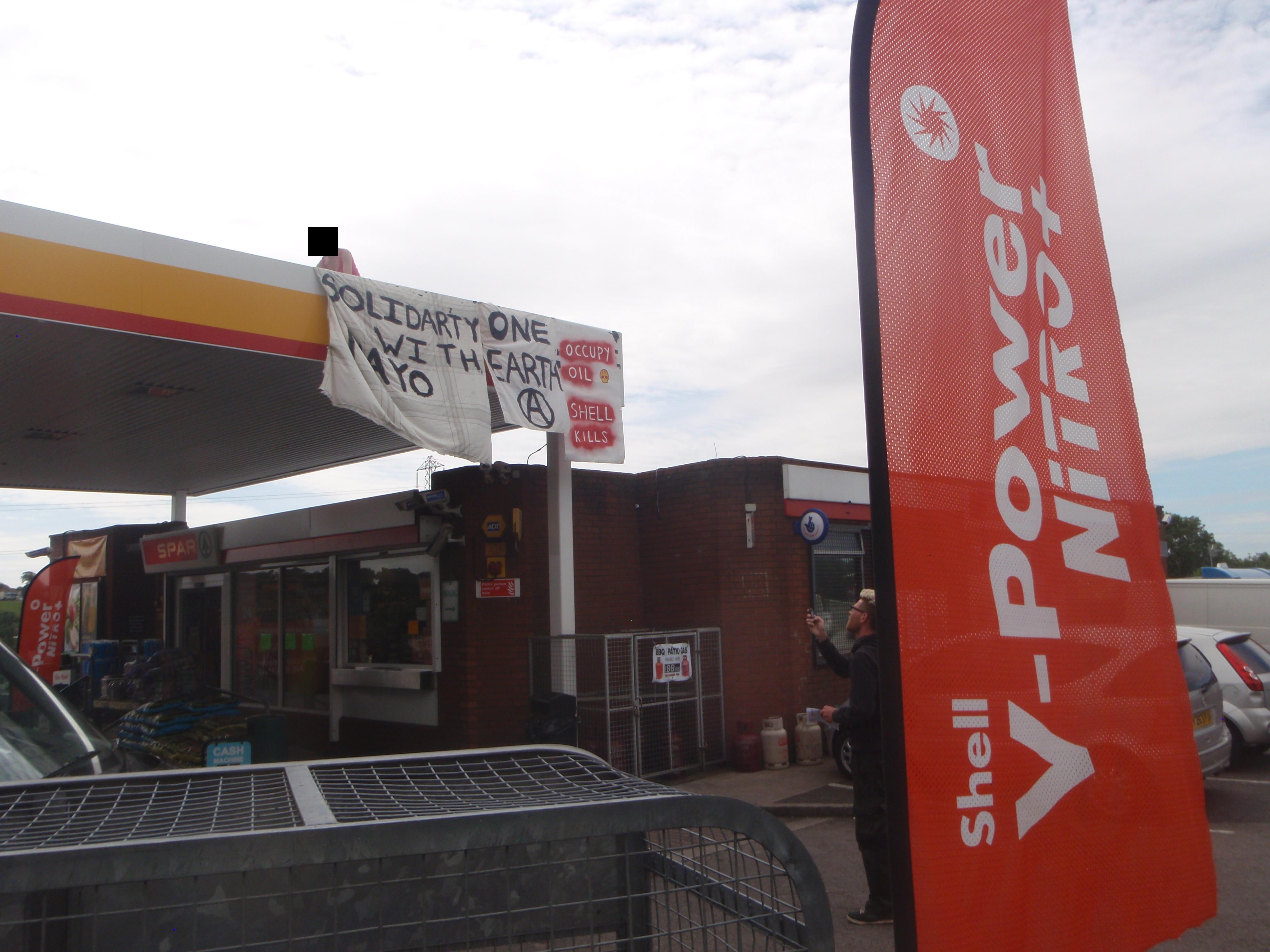
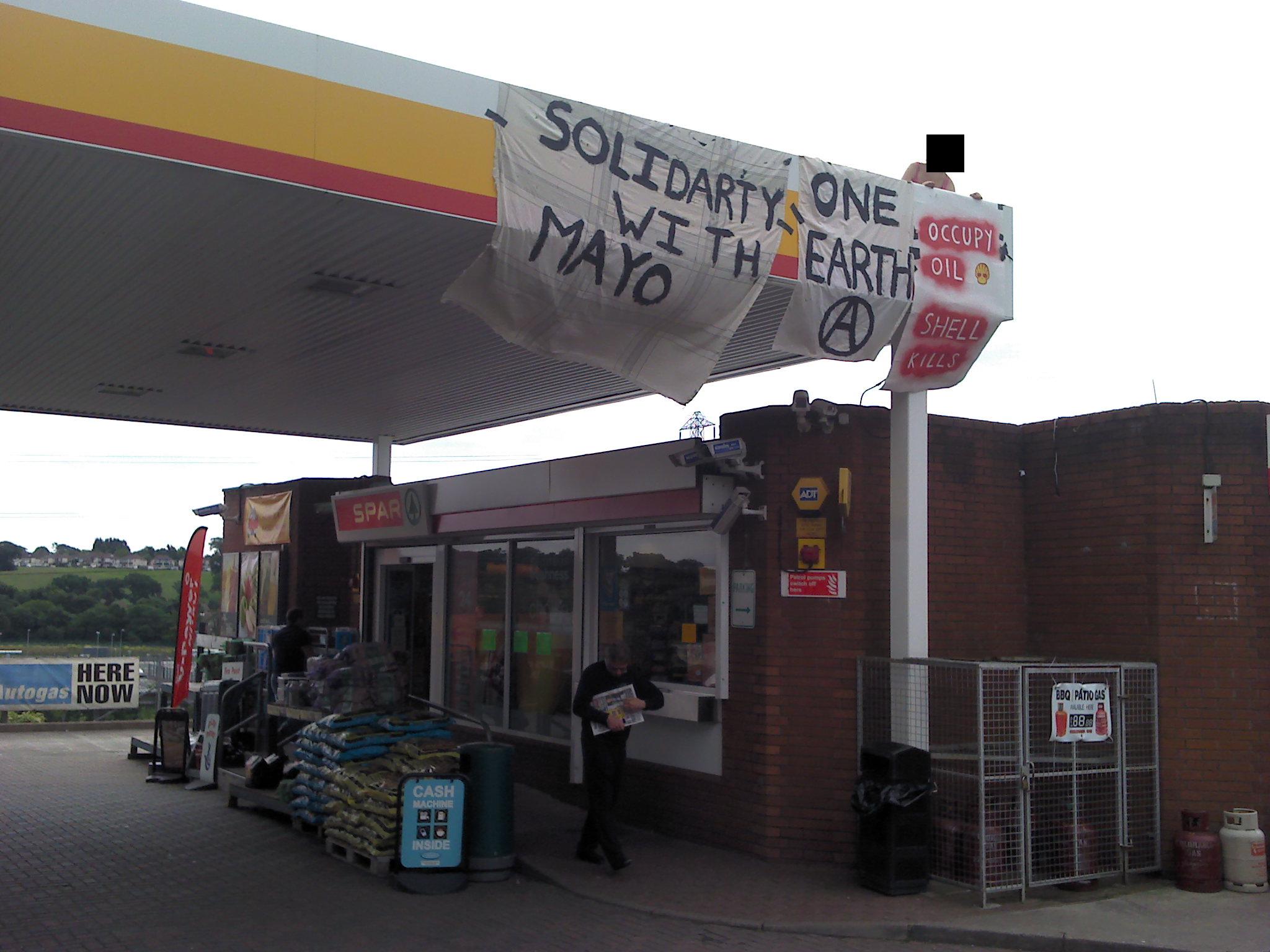
A report of the rooftop occupation of the Shell petrol station in Pontprennau, Cardiff on 29th June 2013.

A report of the rooftop occupation of the Shell petrol station in Pontprennau, Cardiff on 29th June 2013.


In solidarity with the protest camp in County Mayo Ireland, as part of their anti-Shell week of action, on Saturday morning a group of individuals from South Wales dropped banners and held a rooftop occupation of a Shell petrol station on the outskirts of Cardiff. The activists handed out leaflets to motorists and passers by, explaining the issues, and had some in depth conversations with passers by. There were no arrests.

The occupation started at 9:50 and protestors distributed leaflets and informed local consumers of Shell's actions internationally and in County Mayo, until they ran out of flyers. The occupier came down in their own time at 11.30, due to the fact that business continued operating as usual, and the point had been made. 3 banners were left on the roof of the garage, reading "Solidarity with Mayo", "One Earth (A)", and "Occupy Oil- Shell Kills". Comrades from Italy, London and Brighton sent messages of solidarity, along with local comrades.

Solidarity with all peoples and communities affected and dispersed by Shell's (and other profiteers') despicable greed and profit-driven ecocide. From Alaska to Ireland, from Japan to Nigeria, and here in Cardiff also, the struggle against the suicidal convenience culture continues.

Fuck fracking! South Wales will resist!

Love and Rage
Some Anarchists

49 Acts of Powerline Sabotage, 19 Acts of Oil Pipeline Sabotage in Last Six Months

Smoke rises over a recent pipeline attack in Marib governorate, a tribal region in Yemen.

Smoke rises over a recent pipeline attack in Marib governorate, a tribal region in Yemen.

28 June 2013

According to compiled reports from the Yemen Times  over 60 acts of industrial sabotage have taken place since January within the tribal area of the Marib governorate in Yemen, cutting power to Sana’a, the nation’s capital 170 miles to the east, and crippling the government’s oil and gas infrastructure. Oil and gas revenue provides 70 percent of the state’s budget.    

Media sources have not been able to explain the reason behind the attacks, but Yemeni sources all point to armed tribespeople in Marib. Attacks on Yemen’s oil and gas pipelines and electric grid greatly escalated following the eruption of protests against former president Ali Abdullah Saleh in 2011. Officials in Yemen have argued that the tribes are loyalists of the former president while other, unnamed sources, have proclaimed the tribes to be separatists from the concept of central government all together, functioning in a power vacuum.

get_img_powerlines

This infographic offers some detail on the attacks on Yemen’s electrical grid.

According to the Yemen Post, “Residents in the capital Sana’a have had to endure long spells of darkness over the past couple of weeks as power lines were attacked within hours of their repair, leaving people no respite what so ever. While Yemenis are accustomed to blackouts, never before did the capital face so many and lengthy power outages.”

In mid June, the Public Electricity Corporation in Yemen issued a statement requesting more government and military support to suppress the attacks, warning that the power station could collapse completely if attacks continued.

get_img

An infographic on pipeline attacks in Yemen since January 2013.

Between January 1 and June 24, there have been 18 attacks on Yemen’s main pipeline, which runs through Marib to the coast for export. Another attack struck the pipeline on June 27th.  According to Yemeni officials, armed members of tribes blocked the road leading to the area of the pipeline that had been attacked, preventing technical crews from making repairs. Yemeni troops were sent to reopen the road. Clashes between government forces and the tribes are expected.

Back in December of 2012, the Yemeni army launched an offensive against suspected groups of saboteurs. Twenty people were killed but infrastructure attacks only increased.

It remains unclear which tribes, or which groups within the region’s tribes, are carrying out the attacks. Earlier in June, the largest tribes in Marib, the Al Hutaik and Al Jardan tribes signed, according to the Yemen Times, “a tribal order declaring the legality of executing those behind oil and gas pipeline attacks.” Similar decrees were signed last year as well without results.

Yemen’s oil production has declined from more than 400,000 barrels per day at the beginning of 2000 to the current 270,000 barrels per day when the pipeline actually flows.

Willits Bypass “Crane-Sitter” Resupplied in Stealth Climb

A protester perched atop a wick drain stitcher being used to build the US 101 highyway bypass in Willits, CA, 28 June 2013

A protester perched atop a wick drain stitcher being used to build the US 101 highyway bypass in Willits, CA, 28 June 2013

A mysterious climber ascended Caltrans equipment on the Willits Bypass Project Wednesday evening in order to resupply a protester who has been perched 50 feet up in the air on a construction tower for a week.

Last week, 31-year-old Ukiah resident Will Parrish climbed one of the two pieces of Caltrans equipment used to install wick drains at the site in order to stall work in the Mendocino County highway construction zone.

Fellow activists argue that Parrish has been denied food and water, while authorities state that Parrish is free to leave the tower for food and water and that protesters attempting to bring him supplies are trespassing on Caltrans property.

On Saturday evening, 45 protesters attempted to send supplies up to Parrish in a bucket. According to Earth First!, CHP officers cut the rope and arrested six individuals. According to CHP, four individuals were arrested.

On Wednesday, a second person climbed the second wick drain tower. Jamie Chevalier, a spokeswoman with Redwood Nation Earth First!, said the mystery climber was “like a ninja.”

”He climbed the tower in full daylight with CHP everywhere,” she said. “Then after around six hours he managed to traverse a line over to the other tower 60 feet away for supplies and vanished into the night.”

Chevelier estimated that the entire event took place between 5 p.m. and midnight. She said the supply line is still in place and has a 5,000 pound breaking

strength.

District 1 Caltrans Public Information Officer Phil Frisbie Jr. confirmed that Parrish had been resupplied and said Caltrans personnel are not at the site that late at night.

”He was gone by the morning,” Frisbie said of the resupplier.

Frisbie said the machinery cannot operate with the protesters on it and that protests over four months have directly cost taxpayers $1.2 million by causing delays.

No Shale by Rail: Maine Activists Block Fracked-Oil Train

(Maine Media Today photo by Michael G. Seamans)

28 June 2013 A great two-for-one action against fracking and oil-by-rail transport!

From Common Dreams:

Six Maine residents were arrested late Thursday night after a larger group of climate activists blockaded a set of tracks passing through the small town of Fairfield in order to prevent a train carrying 70,000 barrels of “fracked” oil headed to a refinery in neighboring New Brunswick, Canada.

Associating themselves with a growing national campaign of direct action against the fossil fuel industry called “Fearless Summer,” the protesters at the scene erected a large scaffold over the tracks and held signs reading “Trains for people, not for oil” and “This train’s bound for Gory” (pun intended).

Police arrived, and after several warnings for the protesters to disperse, the six who refused were arrested as the scaffolding was destroyed with a chain saw.

Local media reported a surprisingly large law enforcement response with police from numerous towns showing up at the scene, including troopers from the State Police.

350 Maine*, the statewide group associated but independent from international organization 350.org that led the action, said the goal was to draw attention to the “fracked oil” that is quietly passing through the state on a regular basis. Local members of Earth First also participated in the action.

The groups say that the trains running through Maine carry crude from the Bakken oil fields of North Dakota and are especially toxic because “fracked oil” is extracted by blasting a high pressure toxic cocktail deep into the ground to release the oil from shale rock, polluting air and water in surrounding communities.


“People say that this new oil boom in the US will make us energy secure,” said Meaghan LaSala, student at University of Southern Maine and an organzier with 350 Maine. “But there is nothing secure about runaway climate change. This is our moment to change our trajectory before it’s too late.”

One of those arrested, 63-year old Read Brugger from the town of Freedom, was clear about his motivations.

“We feel there has not been enough awareness about the millions of gallons of crude shell oil that shipped across Maine each month,” Brugger told the local Bangor Daily News. “We feel need to move beyond fossil fuels and get away from the poisonous ways oil is being extracted.”

The BDN, which reported that many at the scene “said they did not know that fracked oil was being transported through Maine,” made it seem like the action, at least on local level, may have had the desired result.

But the campaigners acknowledged their concerns go beyond even the dire threats faced by Maine communities if one of these trains rerails or a spill occurs.

“We believe the moment we’re in, in terms of climate change, is a dramatic one and it calls for dramatic action,” said LaSala in an interview with the Morning Sentinel.

“We oppose the continued extraction of fossil fuels, but we also oppose its transportation over thousands of miles of environmentally sensitive areas,” added Sarah Linnekin, a student at Maine’s Unity College. “Since my number one job is to protect my children, I feel an obligation to take action.”

[*Full disclosure: This writer is a sometimes volunteer for 350 Maine, though had no involvement with this action.]


Garda violence retaliation against week of action

28th June Garda violence breaks out again in mayo directed by sgt. Butler Gill and Murphy. 5 arrests today, 2 are being held till court in Castlebar tomorrow at 10.30 one has been sent to mountjoy.This was an attempt of retaliation by the garda to break the high spirits at camp.These attempts to wreck the campaign's collective buzz have resolutely failed and spirits on the camp remain high. Actions and protest against the project will continue, unrestrained and unbroken by the violence and scare tactics of the Gardaí.


Navajos Launch Direct Action Against Big Coal

Photo by Black Mesa Water Coalition

Photo by Black Mesa Water Coalition

Photo by Black Mesa Water Coalition

27 June 2013 Navajo Nation members launched a creative direct action Tuesday to protest the massive coal-fueled power plant that cuts through their Scottsdale, Arizona land.

After a winding march, approximately 60 demonstrators used a massive solar-powered truck to pump water from the critical Central Arizona Project (CAP) canal into barrels for delivery to the reservation.

Flanked by supporters from across the United States, tribe members created a living example of what a Navajo-led transition away from coal toward solar power in the region could look like.  

Participants waved colorful banners and signs declaring ‘Power Without Pollution, Energy Without Injustice’.

“We were a small group moving a small amount of water with solar today,” declared Wahleah Johns with Black Mesa Water Coalition. “However if the political will power of the Obama Administration and SRP were to follow and transition NGS to solar all Arizonans could have reliable water and power without pollution and without injustice.”

The demonstration was not only symbolic: the reservation needs the water they were collecting.

While this Navajo community lives in the shadow of the Navajo Generating Station—the largest coal-powered plant in the Western United States—many on the reservation do not have running water and electricity themselves and are forced to make the drive to the canal to gather water for cooking and cleaning.

This is despite the fact that the plant—owned by Salt River Project and the U.S. Department of Interior—pumps electricity throughout Arizona, Nevada, and California.

Yet, the reservation does get one thing from the plant: pollution.

The plant is “one of the largest sources of harmful nitrogen oxide (NOx) emissions in the country,” according to the Environmental Protection Agency.

While plant profiteers argue it brings jobs to the area, plant workers describe harrowing work conditions. “We are the sweatshop workers for the state of AZ, declared Navajo tribe member Marshall Johnson. “We are the mine workers, and we are the ones that must work even harder so the rest don’t have to.”

These problems are not limited to this Navajo community. Krystal Two Bulls from Lame Deer, Missouri—who came to Arizona to participate in the action—explained, “We’re also fighting coal extraction that is right next to our reservation, which is directly depleting our water source.”

The action marked the kickoff to the national Our Power Campaign, under the banner of Climate Justice Alliance, that unites almost 40 U.S.-based organizations rooted in Indigenous, African American, Latino, Asian Pacific Islander, and working-class white communities to fight for a transition to just, climate friendly economies.