Climate Camp Invades Lewes Tesco

28.02.2010

Lewes Tesco protest28.02.2010
Climate change activists teamed up with local residents to invade the Tesco superstore in Lewes, East Sussex on Saturday in protest at plans to increase the size of the supermarket by 50%. More than 80 protesters took part, entering the store and embarking on a game of Tesco Whirl. The idea is to grab a trolley keep it empty and form up with others to create a giant conga chain.

The point of not actually shopping was to highlight that for every £3.00 spent on retail in Lewes, £2.00 is spent in Tesco.

By increasing the size of the store, money will be drained from the independent shops, harming the town’s local economy. But police had received a tip off about the action and were on hand to prevent some protesters entering the shop while ejecting those who attempted to form a chain. Still a chain of 10 trolleys at a time did form.

As activists were thrown out of the store a party formed at the entrance with music and dancing from activists in endangered animal masks.

Climate Camp activist and Lewes resident Marina Pepper said: “Tesco is more expensive than people realise, thanks to their misleading advertising campaigns. They also rip off farmers and destroy local communities by undercutting and bankrupting competition leading to high unemployment and boarded up town centres.

“Tesco has a strong foothold in Lewes. It’s only the robustness of the local economy that has saved it so far. But these expansion plans are madness and could spell the end, destroying so much that our town holds dear – namely our independent shops which provide us with choices as to how we shop and what we buy.

“This action today was only the launch of a campaign that will see Climate Camp working side by side with community groups to ensure one way or another Tesco’s growth plans are thwarted. We implore people to contact their local councilors, especially those on the planning committee and tell them a bigger Tesco is unwelcome here. Ever y little extra will hurt.”

The activities of massive supermarkets like Tesco involve scandalous waste, pollution and environmental degradation.

Supermarket food travels vast distances, products are over packaged and customers travel ever greater distances once local shops are driven out of business. This leads to an increase in road congestion, accidents, noise, air pollution and CO2 emissions which contribute to climate change.

Supermarket demands are also behind the continuing industrialisation of agriculture. Big farmers are getting bigger to survive while small farmers are going bust. This leads to increased disease among livestock and cruel factory farm practices.

Further information.

Tesco stores erode local choice as smaller, independent shops struggle to compete. Independent stores in the UK shut at the rate of 2,000 a year in recent years. Over 17,000 independent shops closed in England and Wales last year.

Large supermarkets like Tesco also:
• Siphon money away from local communities and towards distant corporations
• Increase traffic and congestion from lorry movements and customers
• Destroy local jobs and undermine local job markets
• Every large outlet causes the net loss of 276 local jobs on average
• Generate waste and over-package their products
• Exploit suppliers and damage the environment
• Cynically manipulate prices to fleece shoppers

Tesco is the largest retailer in the UK:
• Over £1 in every £7 (14.3%) of UK retail sales is spent at Tesco
• It has takings of more than £1 billion a week
• It made profits of over £3 billion last year
• It has £30 million turnover in Lewes compared to £17m for all other shops

southcoast@climatecamp.org.uk
http://climatecamp.org.uk/get-involved/local-groups/south-coast

EARTH FIRST! ITALY GATHERING, 1-4 APRIL 2010

(soon it’ll be translated in english)
EARTH FIRST! ITALIA GATHERING
Narni (Umbria), 1-4 Aprile 2010

TRE GIORNI AD ALTA SOSTENIBILITA’ CONDIVIDENDO ESPERIENZE, IDEE ED EMOZIONI.

(soon it’ll be translated in english)
EARTH FIRST! ITALIA GATHERING
Narni (Umbria), 1-4 Aprile 2010

TRE GIORNI AD ALTA SOSTENIBILITA’ CONDIVIDENDO ESPERIENZE, IDEE ED EMOZIONI.

Alloggio: L’evento si terrà all’interno di una grande fattoria con animali, orto biologico, fiumiciattolo e bosco. All’interno del bosco verrà allestito lo spazio tende che dovranno quindi essere portate da casa.
Alimentazione: Il cibo (pranzo e cena) verrà cucinato dalla fattoria e sarà vegetariano ed il più possibile biologico e a km0.
Workshop e attività: Verranno organizzati workshop e attività a partecipazione volontaria. Tra questi: escursioni nei boschi, tree climbing, mountain bike, azioni di disturbo alla caccia e altro ancora. (a presto il programma dettagliato).
Programma serale e musica: La sera ci sarà occasione di cantare, suonare e ballare. Se sei un musicista/artista e vuoi proporti all’interno del programma serale puoi mandarci una email già da ora.
Prendi parte all’azione: Ci saranno anche momenti più pratici in cui pianificare campagne e azioni a livello locale. Se sei interessato ad entrare in EF! sei già dei nostri!.

TU!
Siamo tutti parte dello staff. Il successo dell’evento dipenderà anche da te. Ogni mattina ci sarà un breve meeting in cui discutere e gestire la giornata. Se hai dei consigli o vuoi proporre un’attività puoi mandarci una mail da subito o proporla direttamente al raduno.

PORTA CON TE…Porta con te tenda e sacco a pelo invernale. Ti ricordiamo che la temperatura all’interno del bosco potrà scendere durante la notte motivo per cui è bene portarsi vestiti e maglioni pesanti. Ricordati delle scarpe da trekking ed un coltellino svizzero. Se hai la possibilità di portarti la tua mountain bike fallo!

DOVE
Il posto è vicino a Narni, in provincia di Terni, Umbria. Alta sostenibilità significa anche evitare di prendere
l’auto se non necessaria, motivo per cui ti consigliamo di raggiungere il posto
con altri mezzi (treno o pullman).

CANI
I cani sono bene accetti. Nonostante ciò chi li porta avrà la responsabilità di
far si che i nostri amici non disturbino né compromettano le attività o il momento dei pasti. Essendo il posto all’aperto c’è il rischio che il cane si possa allontanare.

COSTI
La quota richiesta è di 45 euro (15 euro al giorno) per l’intero gathering e comprende:
– posto tenda (3 notti)
– pasti (6 pasti)
– attività
– bevande calde

ALTRE:
I fondi verranno destinati esclusivamente all’organizzazione del gathering stesso. Il luogo preciso del gathering verrà annunciato una settimana prima dell’evento. Chiunque fosse interessato a prendere parte al gathering è pregato di confermare la propria partecipazione (mandando una mail con nome, cognome e data di arrivo) una settimana prima al fine di coordinare al meglio l’evento stesso.

Maggiori informazioni:

Earth First! Italia blog:
http://earthfirstitalia.blogspot.com

Earth First! Roma:
earthfirstroma@autistici.org

Camp Bling back up and awaiting chainsaws – chopping on Sunday?

27.2.2010
Important Update

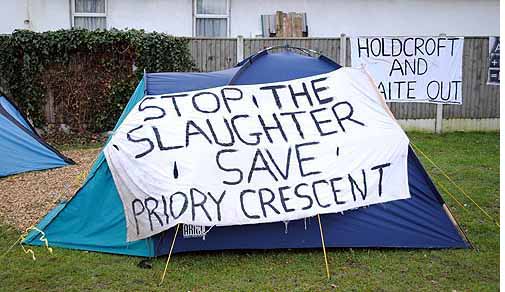
Cuckoo Corner tent27.2.2010
Important Update

6pm – so far, so good at Camp Cuckoo; food donations coming in but still need more people; latest twitter updates on PPPS website below or SKIPP facebook page.

Various sources have now confirmed that the Council will be felling the trees on Priory Crescent during Sunday. The affected stretch of Priory Crescent is going to be closed to traffic between midnight and 8pm Sunday.

There will be people climbing the trees to prevent them being felled – if you feel up to it, please volunteer! We also need as many people as possible on the ground to lend support, witness the Council’s, private security and Police’s actions and so on.

Please come down to lend your support. People have been campaigning against this road widening since 1972 and it’s all coming to a head tonight.

Additional from SKIPP: Urgent notice – help needed NOW! Tree felling begins tonight in Priory Crescent, anyone who can please come down to site, your help is desperately needed, if possible please cancel what ever you are doing, it is now or never, passive or active, you can help save the trees if we act together NOW… SKIPP Committee Contact: 07799414887 – mark 07747755205 – patsy Please let us know if you can help.

—-

After years of patient occupation and apparent victory, Southend activists have had to reoccupy land to prevent the councils new road building scheme. Evictions are expected imminently and crew are urgently needed.

Southend Borough Council has reneged on the agreement made last April with Bling and Parklife which resulted in an agreement with the residents to vacate the site.

Local Group SKIPP has since been campaigning to prevent the revised plan from becoming a reality, last week SKIPP joined force with Parklife, and Blingers to occupy a site in Priory Crescent with a view to preventing tree felling which is due in the next few days.

This morning a source within the Council informed us, that tree felling and eviction is now imminent.

Support is urgently needed, the site is situated in Priory Crescent on land adjacent to the Cuckoo Corner Roundabout; by car head into Southend using the A127, following the town centre signs, by train the nearest station is Prittlewell on the Liverpool Street Line.

(for background please refer to: www.campbling.org / www.ppps.org.uk / on facebook search for Saxon King In Priory Park.

Limited accommodation is available on site in the form of tents, please bring warm clothing and harness/lock on gear if poss, same old things needed; people, climbing gear/lock on gear, herras fencing, scaff bar/clips, kit and donations.

On Friday a council meeting was halted for 20 minutes following protests over the new plans.

Fossil Fools Day 2010

Climate change is no laughing matter – but that doesn’t mean we can’t confront the Fossil Fuel Empire with subversive humour.

WHAT: Direct actions, practical jokes and throwing a spanner in the works to stop the fossil fools.
WHERE: Your street, town or city.
WHEN: April 1st, 2010.

FFD graphic - bigClimate change is no laughing matter – but that doesn’t mean we can’t confront the Fossil Fuel Empire with subversive humour.

WHAT: Direct actions, practical jokes and throwing a spanner in the works to stop the fossil fools.
WHERE: Your street, town or city.
WHEN: April 1st, 2010.

Last December in Copenhagen, the politicians sold us out to the fossil fools, corporate lobbyists and big banks. Now we’re left with “green capitalism,” a deeply unjust carbon market and continued assaults on our communities and ecosystems. If we’re going to stop climate chaos, the only real solution is to keep fossil fuels in the ground.

The stakes couldn’t be higher: destabilisation of the global climate, local communities destroyed by dirty energy extraction and combustion, devastating freak storms, droughts, floods, the list goes on …

This April 1st, join Rising Tide in some creative direct action … use the simply subversive to the downright disruptive: office occupations, banner drops, clownish parades, road blockades, spoof websites, subvertising, street theatre, leaflets, lock-ons or laugh-ins. Whatever works for you and your group.

Join us this Fossil Fools Day and hatch some harebrained schemes that will strike a blow to climate criminals everywhere!

WANT MORE? Fossil Fools Day also marks the launch of the BP Tar Sands Fortnight of Shame: a two-week campaign culminating in actions surrounding BP’s AGM on April 15th. The goal? To stop BP from going into the Canadian Tar Sands – the biggest, dirtiest fossil fuel project on earth. Find out more: Tar Sands in Focus.. And a word to BP: be afraid… be very afraid.

NEED A HAND? If you would like ideas for actions, graphics for leaflets or websites, advice on dealing with the press, etc., send us an email and we’ll do our best to help out: info@risingtide.org.uk

For more information see: Fossil Fools Day.

In the words of that master of pranks: “That’s All Folks”.

Faslane noise demo & Free Cafe (every first Saturday each month)

Every first Saturday of the month we’ll be holding a noise demo at the base.

With workshops, afternoon kids space, discussion groups and free cafe at the camp.

For those wanting to stay longer there will be a film-screening and action meeting on Sunday.

Anyone is welcome to come along and get involved!
Call us for information on this or other upcoming events

Every first Saturday of the month we’ll be holding a noise demo at the base.

With workshops, afternoon kids space, discussion groups and free cafe at the camp.

For those wanting to stay longer there will be a film-screening and action meeting on Sunday.

Anyone is welcome to come along and get involved!
Call us for information on this or other upcoming events
Would be good to see old friends, and is also a great way to see camp if you’ve never been before.

Directions –

The camp is situated 6 miles North of Helensburgh. Helensburgh can be reached from Glasgow by train, for £5 return, trains leave every half hour from Glasgow Queens Street (Low level station).Or the 216 from Jamaica St – Helensburgh.
You can catch the 316 bus from Helensburgh Central train station (for Coulport or Garelochead, stops outside the camp) it only costs £1:50, and you can ask to be dropped off at the peace camp.

-F.P.C. is on the east verge of the A814 road, which leads to HMNB Clyde and beyond. The Camp is therefore visible to all traffic coming towards the base from the direction of Helensburgh.

We are about 30 miles west of Glasgow, by the Gareloch, a river Clyde estuary sea loch. Faslane Naval Base is on the Gareloch.
CAMP PHONE 01436820901

Faslane peace camp
faslaniapeacecamp@yahoo.co.uk

Open Day at the Tesco Occupation, Bristol

February 24 2010
To celebrate the second week of occupation and get people involved in the space we are holding an open day at the Tesco occupation this Sunday. Please come along!

February 24 2010
To celebrate the second week of occupation and get people involved in the space we are holding an open day at the Tesco occupation this Sunday. Please come along!

We are holding a Freeschool from 12 til 4. At 5 o’clock there will be Community Bingo, and at 6 o’clock a meal will be served. Hopefully we will also be showing films and running a free cafe. We will also be launching a VegBox scheme. Please feel free to come along and bring all of your friends!

Tesco’s lawyers have already issued court proceedings against us and are trying every trick in the book to get us out – from sending round the heavies with sledgehammers to infiltrating our meetings (they have admitted to doing this and they are using evidence from these meetings in their court proceedings!).

Hopefully Sunday be a fun and family-friendly invitation to the local community to reclaim their space and take control of it themselves. None of us want to see the multinationals take over Stokes Croft!

AUTONOMY NOT MONOPOLY

For more info call 07794894353 or drop by at any time (knock loudly!). See the following vids for a peek inside and out..

http://www.youtube.com/watch?v=NsolppofJIo&feature=related
http://stokescroft.wordpress.com/2010/02/24/tesco-squat-a-short-film-from-inside-former-jesters/

To read about the squatting of the building, read this

RBS attacked with rocks & fire over Tar Sands project

In the early hours of Tuesday 23rd February 2010, anarchists attacked the Royal Bank of Scotland HQ in the heart of developing Bristol, UK.

Despite road traffic and proximity of security, the mob succeeded in breaking windows, smashing paint-bombs against upper floors and setting fire to tyres in the middle of the road.

In the early hours of Tuesday 23rd February 2010, anarchists attacked the Royal Bank of Scotland HQ in the heart of developing Bristol, UK.

Despite road traffic and proximity of security, the mob succeeded in breaking windows, smashing paint-bombs against upper floors and setting fire to tyres in the middle of the road.

A litany of abuses by RBS or any other bank could continue for pages, but it is enough to state that every bank is part of the financial prison which incarcerates and impoverishes all of us.

These actions will escalate and multiply.

We dedicate this action to all indigenous fighters and their allies struggling against the Tar Sands project in Kanada which RBS is an investor in, and also all those who fight against the 2010 Winter-Olympics.

This action is also in solidarity with Alfredo M. Bonanno, Christos Stratigopoulos, Polykarpos Georgiades, Vaggelis Chrisohoides, Giannis Dimitrakis, Gabriel Pombo da Silva, the entire London G20 defendants/prisoners and all other prisoners in struggle.

For international struggle against capitalism and the state.

Shell retreats as solidarity with Pat O’Donnell continues

23rd Feb 2010
Round up of events in Dublin and a personal view of the progress of the campaign

23rd Feb 2010
Round up of events in Dublin and a personal view of the progress of the campaign

The week before last Erris fisherman Pat O’Donnell was jailed for seven months for his part in the communities ongoing resistance to Shell’s attempt to impose an experimental gas pipeline on them. Across the country local Shell to Sea groups have been holding solidarity protests and other events for Pat. In Dublin this has included two protests and a public meeting in UCD. Meanwhile Shell have been forced to admit a temporary defeat in the face of local opposition and call off the construction they have planned for Glengad this year.

The first of the Dublin protests was Tuesday last week when campaigners gathered outside Shell HQ to highlight the role of Shell in Pat’s jailing. Because Pat has the fishing rights along the pipeline route he has been repeatedly targeted for detention whenever Shell has needed to carry out construction work. And back in June, just before the arrival of Shell’s pipeline ship the Solitaire, Pat’s boat was boarded at night by four armed and masked men and sunk, an event reminiscent of how oil corporations have dealt with local protests around the world.

On Wednesday a well attended public meeting was held in UCD, speakers include Andy Storey chairperson of Afri (http://www.afri.ie/), Caoimhe Kerins from Dublin Shell to Sea and Maura Harrington, who like Pat has been imprisoned for resisting Shell’s experimental gas pipeline. A report and pictures from that meeting can be found at http://www.indymedia.ie/article/95771 Below I’ve attached audio recordings of the meeting including the question and answer sessions after the speakers presentations.

On Saturday Dublin Shell to Sea campaigners joined friends of Pat’s who had traveled from Mayo for a protest at the GPO. Banners highlighted not only the injustice of Pat’s imprisonment but also the fact that the Irish state is giving billions of gas & oil to the energy corporations without them paying any royalties. This at a time when health, education and pay is being slashed to save a tiny percentage of the sums that are to be given away. Thousands of the ‘Someday Independent’, the leaflet that explains the issues around the campaign in detail were distributed to the public during the protest. This is a 30 second video of this protest at http://www.youtube.com/watch?v=mE-irZ-0CFA

Before the protest another 1,000 copies had been distributed door to door in the Liberties. You can read the text of the leaflet at http://www.dublins2s.com/content/120000-all-facts-leafl…buted

Three years ago Shell thought it was all over. The millions spent on the media campaign along with the fact that most of the media is either state owned or owned by those who are also in oil & gas exploration meant that all critical voices in the press had been silenced. The Gardai use of violence against protests had been used to smash and demoralize the opposition in the area allowing refinery construction to proceed with only the occasional interruption. It appears at that point it was decided the gloves could come off to smash those who were still holding out and hundreds of private security guards were deployed who intimidated, abused and videoed local residents. Pat O’Donnell’s boat was sunk at sea and Willie Corduff was beaten in the Shell compound at Glengad. These tactics backfired in the Spring when it was discovered that not only were some of these security from east European fascist organisations but that several had been involved in an attempt to spark a civil war in Bolivia, see http://www.indymedia.ie/article/92865

Resistance is fertile

Despite the ongoing attempt to suppress and silence the campaign spirits are high. The pressure created by the campaign meant that An Bord Pleanala felt unable to rubber stamp Shell’s plan’s for running the experimental gas pipeline through the village of Rossport and instead pointed out the obvious safety issues that campaigners had been highlighting for years (e.g. people living in the blast zone) and gave Shell two months to address these. Of course when Shell proved unable to do so that deadline was extended for a further four months but this has forced Shell to call off construction at Glengad this summer.

This is a significant if temporary victory over Shell but Dublin Shell to Sea spokesperson Caoimhe Kerins warned that “Although this announcement is a significant victory for the local community, other major works will still be going ahead, while fisherman Pat O’Donnell is out of Shell’s way in prison. This means that 2010 is set to be another year of disruption for the community, continued harassment and intimidation by Gardai and Shell security, as well as the unlawful arrest and the targeted jailing of key campaigners. There are no options left for Shell, except to process the gas at sea, which is standard practice around the world. This is what local people have been demanding for almost a decade. It’s still not to late to do the right thing.”

The An Bord Pleanala decision has also started to break apart Shell’s well funded media campaign with some of the more courageous journalists daring to stand up to Shell and publish articles questioning the project. As might be expected these journalists are now being targeted in the media for doing so. Shell themselves seem scared of debating the issues with Shell to Sea, at least two TV debates have been canceled due to Shell or pro-Shell journalists pulling out at the last minute in recent weeks.

As the scale of the Great Oil & Gas giveaway has been revealed more and more people are taking a stand against Shell. In the last couple of months new Shell to Sea groups have sprung up around the country, the recently formed Kildare group has been leafletting in Kildare town. You can help in a wide range of ways from simple things like sending a solidarity letter to Pat in prison to let him know he is not alone to getting copies of the ‘Someday Independent’ off Dublin Shell to Sea (contact details on their web site) to joining or forming a local Shell to Sea group to do this and more.

Please write to Pat in prison. His address is: Pat O’Donnell, Castlerea Prison, Harristown, Castlerea,Co.Roscommon. Alternatively you can email mayoshelltosea@gmail.com and they will pass on your email to Pat. The Dublin Shell to Sea page can be found at http://www.dublins2s.com/

http://anarchism.pageabode.com/cat/rossport

Indigenous Groups Step Up Protests Over Vedanta Mining Project, India

February 23, 2010 – When 5,000 indigenous Dongria Kondhs trekked Sunday to Niyam Dongar hill, the abode of their presiding deity Niyam Raja, and designated it as inviolate, it meant they were stepping up their resistance to a controversial alumina refinery and bauxite mine project here.

February 23, 2010 – When 5,000 indigenous Dongria Kondhs trekked Sunday to Niyam Dongar hill, the abode of their presiding deity Niyam Raja, and designated it as inviolate, it meant they were stepping up their resistance to a controversial alumina refinery and bauxite mine project here.

They carried out religious rituals to Niyam Raja – the sacred dispenser of law, and then put up a totem pole in the area located in Niyamgiri hills in their homeland Lanjigarh, a bauxite-rich hilly area in Kalahandi of Orissa state in eastern India.

This was the latest act of defiance here against the backdrop of unrest since 1997 among communities, environmental and rights activists over the 2.13 billon U.S. dollar mining project by Vedanta Aluminium Ltd, the Indian arm of London-based Vedanta Resources Plc.

The alumina refinery, capable of producing one million tonnes of alumina from bauxite per annum, has been operating for over a year now at the foothills of Niyamgiri. Alumina is used in the production of aluminium metal.

Since 2007, Vedanta has been seeking clearance for a six-fold expansion of its refinery and 721-hectare bauxite mining project. The bauxite project however has been stalled by a forest law.

The mining operations would affect some 8,000 Dongria, Kutia and Jharania Kondh in 112 tribal and dalit villages in Kalahandi and adjacent Rayagada district, two of the most underdeveloped areas in Orissa.

For the forest-dwelling locals, Vedanta’s mining project would result in the demolition of the Dongria’s centuries-old sacred grove on Niyamgiri, threatening their ancient way of life, right to water, food, livelihood and cultural identity.

“These villages never had basic amenities like medical facilities, drinking water and properly functioning schools. The mining project will now take away even the sources of livelihood from them,” explained Dadhi Pusika, leader of Niyamgiri Surakhya Samity (Nayamgiri Protection Committee) that was formed by members of affected villages.

“Life is so hard. Old women and children are dying. They are living like dogs,” said 45-year-old Ladha Sikaka of Lakpaddar village, referring to the impact of the alumna refinery.

Six people from Rengopalli and villages near the refinery and its huge red mud pond – a receptacle of wastewater that is a mix of highly toxic alkaline chemicals and heavy metals – have died over the past year from undiagnosed respiratory ailments.

The Orissa State Pollution Control Board has issued several warnings to Vedanta since its refinery trial started in 2006, calling its attention to the shoddy protective lining of the red mud pond that leeches wastewater into Vamsadhara river flowing next to it. Villagers use that water for drinking.

Skin rashes and sores are common among residents. Some 40,000 truckloads of bauxite are transported to the refinery from outside Orissa per year, creating colossal air pollution from dirt roads, says Bhubaneswar-based environmentalist Biswajit Mohanty.

“If the mountain remains, our children remain, rains come, winter comes, the wind blows – the mountain will bring all the water, crops will grow. If they take away the rocks, water will dry, we will die,” said Ladha. “The mountain is our soul, we will lose our soul.”

“We cannot allow mining even if we are beheaded,” he added.

The Dongria’s Sunday protest comes on the heels of Amnesty International’s recent report on the Vedanta project, called ‘Don’t Mine Us Out of Existence’. The report alleges that 12 pollution-affected villages have never received direct information on the refinery.

Green activists say the gravest concern pertains to water. Hilltop mining will dry up perennial water sources, while possible poor management of refinery wastewater could degrade surface water and pollute groundwater too. There is also concern about the huge quantities of water that the expanded refinery will consume daily.

An expansion of the current Vedanta project would mean its bauxite requirement would jump from three to 18 million tonnes per annum, resulting in not just one but possibly several open-cast mines on Niyamgiri.

But Vedanta clarifies that its mineralisation area of three million tonne per annum is mere 3.5 percent of 250 square-kilometre hill range, and that its 30-metre deep excavations would not disturb the water table 78 metres below ground level.

Three rivers, Vamsadhara, Sakota and Nagavalli, flow four, 7.5 and 13 km respectively from the mine’s buffer zone, as do perennial streams. The larger rivers provide drinking water and irrigation to hundreds of thousands in Kalahandi, Rayagada and the neighbouring state of Andhra Pradesh. Watchdog groups point out that excavation will destroy the hills’ water recharging capacity because the porousness of the bauxite layer increases water retention. This will eventually kill the rivers, make the habitat drier and affect agriculture, wild vegetation and pasture, they add.

Pavan Kaushik, head of corporate communications for Vedanta group, countered this in earlier letter to journalists. “Bauxite extraction… removes a hard rocky layer called laterite which will allow rain water to percolate deep… increasing afforestation post-mining.”

Flash floods, which are common here, will be aggravated by hilltop deforestation. A flash flood in Vamsadhara can breach the red mud pond, causing disastrous wastewater spills into the river.

Three-quarters of the targeted hill have thick forests. The 300 species of plants in them include 50 species of medicinal plants and trees, six of which are in the International Union for Conservation of Nature Red List of threatened species. An elephant reserve, the forests are home to tigers, leopards, barking deer.

A tribal woman from Sindhabahal said, “The forest gives leaves, bamboo, roots, medicinal herbs, fruits, juice from the giant palm trees (to make liquor). These we sell or use for food. Hill slopes, known as ‘dongar’, are our cultivation fields.”

Local will have nothing less than the cancellation of Vedanta’s Niyamgiri mining lease.

They want the India Forest Rights Act of 2006, which gives forest-dwelling communities rights to land and other resources, implemented. They have demanded an irrigation dam from perennial hill streams, schools in each and one hospital for every 10 large villages, assured daily wage work under government schemes and support prices for forest products.

“The government is largely satisfied with its (Vedanta) pollution control measures at this time,” said a senior official of the Orissa government, Vedanta’s stake-holding partner, who spoke to IPS on condition of anonymity because “Vedanta has become a political issue”.

But “Vedanta’s corporate social responsibility however needs to shape up,” he underscored.

In an email reply to IPS, Mukesh Kumar, Vedanta’s chief operating officer at Lanjigarh, says that his company believes in sustainable development. “It is providing livelihood to tribal people through vegetable cultivation, pisciculture, poultry and goatery. Nutrition to children, health check-ups and malaria control are other programmes. Direct and indirect employment has been given to 20,000 people while 13 villages now have electricity,” he added.

Meantime, the London-listed mining major Vedanta Resources Plc has been seeing international investors sell their stakes in it due to ethical concerns over the Orissa project. Britain’s Joseph Rowntree Charitable Trust is the latest to leave, after the Church of England, the Norwegian government and Martin Currie Investment Management.

Said woman tribal leader Kulunji Sikhola: “It is our land; we will sit – the Dongria people – and decide directly”.

Okanagan Band launches road block to protect their water supply

The Okanagan Indian Band (OIB) launched a “protective blockade” this morning, February 23, at the Okanagan campsite near Bouleau Lake in southern British Colombia.

Okanagan blockade

The Okanagan Indian Band (OIB) launched a “protective blockade” this morning, February 23, at the Okanagan campsite near Bouleau Lake in southern British Colombia.

A member of the greater Okanagan Nation, the OIB say they have been left with no choice but to stop the logging company Tolko Industries from endangering their water supply.

“This is not an action we took lightly, nor is it one we commenced without exhausting all of our legal options,” states OIB Chief Fabian Alexis, in a recent press statement. “However given the active collusion between the Ministry of Forests and Tolko and the continued indifference of the federal government, we had no choice but to act…”

Since at least 2003, the OIB has been seeking the legal protection of their water, which is provided by the Browns Creek watershed. The region has been extensively logged for more than forty years; and now, the Okanagan People fear that any further logging will threaten their health and safety.

“The fact is that when our reserves were first established it was with the clear understanding that our water supplies would be maintained for future generations,” notes Chief Alexis. “Instead the federal government abandoned its fiduciary obligation and allowed the Province of British Columbia to sell off our water rights thus resulting in a number of fish bearing creeks that run through our reserve being reduced to dry gullies.”

“Even as these creeks ran dry the province continued to authorize the industrial clear cutting of the watersheds that provide our drinking water, thus presenting a clear threat to the safety and well being of all residents both indigenous and non-indigenous who live on and near our reserve,” he adds.

The OIB is also concerned that Tolko will cause irreparable harm to archeological sites scattered throughout the region. The Okanagan National Alliance explains:

“The Brown’s Creek Watershed is a sacred area of the Okanagan people that houses archaeological, ethno-botanical and cultural evidence that has been at the heart of litigation in the Wilson case since 1999. The litigation area is subject to a preservation order issued by Mr. Justice Sigurdson, entitling the Okanagan Nation to preserve and record evidence pertaining to Okanagan Title. Tolko’s logging plans would destroy title evidence, dating back as far as 7,500 years and extending into modern times, the Okanagan Nation have committed to ensuring that our traditional laws and governance systems are upheld for generations to come. This is our responsibility and sacred duty as Syilx (Okanagan)
People.”

Despite the governments awareness of this, and the fact that there is ongoing litigation concerning Aboriginal title in the watershed, on January 11, the British Colombia Supreme Court gave Tolko Industries permission to commence logging in eight separate “cutlbocks”.

Commenting on the decision, Grand Chief Stewart Phillip of the Okanagan Nation Alliance stated that, “the Courts failed to deal with the proprietary nature of Aboriginal Title to the lands and resources within the territory;” and, that, as a result of the ruling, “third party interests are protected at the expense of the community’s drinking water, archaeological history and their constitutionally protected rights.”

Following this, on Feb. 20, the OIB held an emergency meeting to discuss their options. As a result of the meeting, Elders and band members unanimously agreed to establish check-points on Westside Road, which Tolko has been using without the OIB’s permission. They also agreed to establish a protective blockade in the watershed.

With the blockade now ongoing, Chief Alexis today declared a full moratorium on all logging in the watershed, stating that “no commercial logging will be permitted in these areas until further notice.”

“Finally, in order to avoid any further repeat or escalation of this conflict we would also advise the Province of British Columbia to stop issuing cutting permits in areas where their title to the land is in dispute and is still a matter to be resolved by the courts,” Chief Alexis concludes.

What You Can Do

Chief Alexis is asking people to call their local MLAs and MPs to express their support for the OIB.

Supporters are also encourage to attend the blockade in person. If you’re in the area, a ride can possibly be arranged by contacting the Okanagan Indian Band Territorial Stewardship Office at (250) 542-7132.

For more information please contact: Chief Fabian Alexis cell (250) 306-2838, phone (250) 542-4328 or Sherry Louis, Executive Assistant Okanagan Indian Band – 12420 Westside Road, Vernon, BC, V1H 2A4 – okibcouncil@okanagan.org – PH: 250.542.4328 FAX: 250.542.4990