Indigenous Groups Step Up Protests Over Vedanta Mining Project, India

February 23, 2010 – When 5,000 indigenous Dongria Kondhs trekked Sunday to Niyam Dongar hill, the abode of their presiding deity Niyam Raja, and designated it as inviolate, it meant they were stepping up their resistance to a controversial alumina refinery and bauxite mine project here.

February 23, 2010 – When 5,000 indigenous Dongria Kondhs trekked Sunday to Niyam Dongar hill, the abode of their presiding deity Niyam Raja, and designated it as inviolate, it meant they were stepping up their resistance to a controversial alumina refinery and bauxite mine project here.

They carried out religious rituals to Niyam Raja – the sacred dispenser of law, and then put up a totem pole in the area located in Niyamgiri hills in their homeland Lanjigarh, a bauxite-rich hilly area in Kalahandi of Orissa state in eastern India.

This was the latest act of defiance here against the backdrop of unrest since 1997 among communities, environmental and rights activists over the 2.13 billon U.S. dollar mining project by Vedanta Aluminium Ltd, the Indian arm of London-based Vedanta Resources Plc.

The alumina refinery, capable of producing one million tonnes of alumina from bauxite per annum, has been operating for over a year now at the foothills of Niyamgiri. Alumina is used in the production of aluminium metal.

Since 2007, Vedanta has been seeking clearance for a six-fold expansion of its refinery and 721-hectare bauxite mining project. The bauxite project however has been stalled by a forest law.

The mining operations would affect some 8,000 Dongria, Kutia and Jharania Kondh in 112 tribal and dalit villages in Kalahandi and adjacent Rayagada district, two of the most underdeveloped areas in Orissa.

For the forest-dwelling locals, Vedanta’s mining project would result in the demolition of the Dongria’s centuries-old sacred grove on Niyamgiri, threatening their ancient way of life, right to water, food, livelihood and cultural identity.

“These villages never had basic amenities like medical facilities, drinking water and properly functioning schools. The mining project will now take away even the sources of livelihood from them,” explained Dadhi Pusika, leader of Niyamgiri Surakhya Samity (Nayamgiri Protection Committee) that was formed by members of affected villages.

“Life is so hard. Old women and children are dying. They are living like dogs,” said 45-year-old Ladha Sikaka of Lakpaddar village, referring to the impact of the alumna refinery.

Six people from Rengopalli and villages near the refinery and its huge red mud pond – a receptacle of wastewater that is a mix of highly toxic alkaline chemicals and heavy metals – have died over the past year from undiagnosed respiratory ailments.

The Orissa State Pollution Control Board has issued several warnings to Vedanta since its refinery trial started in 2006, calling its attention to the shoddy protective lining of the red mud pond that leeches wastewater into Vamsadhara river flowing next to it. Villagers use that water for drinking.

Skin rashes and sores are common among residents. Some 40,000 truckloads of bauxite are transported to the refinery from outside Orissa per year, creating colossal air pollution from dirt roads, says Bhubaneswar-based environmentalist Biswajit Mohanty.

“If the mountain remains, our children remain, rains come, winter comes, the wind blows – the mountain will bring all the water, crops will grow. If they take away the rocks, water will dry, we will die,” said Ladha. “The mountain is our soul, we will lose our soul.”

“We cannot allow mining even if we are beheaded,” he added.

The Dongria’s Sunday protest comes on the heels of Amnesty International’s recent report on the Vedanta project, called ‘Don’t Mine Us Out of Existence’. The report alleges that 12 pollution-affected villages have never received direct information on the refinery.

Green activists say the gravest concern pertains to water. Hilltop mining will dry up perennial water sources, while possible poor management of refinery wastewater could degrade surface water and pollute groundwater too. There is also concern about the huge quantities of water that the expanded refinery will consume daily.

An expansion of the current Vedanta project would mean its bauxite requirement would jump from three to 18 million tonnes per annum, resulting in not just one but possibly several open-cast mines on Niyamgiri.

But Vedanta clarifies that its mineralisation area of three million tonne per annum is mere 3.5 percent of 250 square-kilometre hill range, and that its 30-metre deep excavations would not disturb the water table 78 metres below ground level.

Three rivers, Vamsadhara, Sakota and Nagavalli, flow four, 7.5 and 13 km respectively from the mine’s buffer zone, as do perennial streams. The larger rivers provide drinking water and irrigation to hundreds of thousands in Kalahandi, Rayagada and the neighbouring state of Andhra Pradesh. Watchdog groups point out that excavation will destroy the hills’ water recharging capacity because the porousness of the bauxite layer increases water retention. This will eventually kill the rivers, make the habitat drier and affect agriculture, wild vegetation and pasture, they add.

Pavan Kaushik, head of corporate communications for Vedanta group, countered this in earlier letter to journalists. “Bauxite extraction… removes a hard rocky layer called laterite which will allow rain water to percolate deep… increasing afforestation post-mining.”

Flash floods, which are common here, will be aggravated by hilltop deforestation. A flash flood in Vamsadhara can breach the red mud pond, causing disastrous wastewater spills into the river.

Three-quarters of the targeted hill have thick forests. The 300 species of plants in them include 50 species of medicinal plants and trees, six of which are in the International Union for Conservation of Nature Red List of threatened species. An elephant reserve, the forests are home to tigers, leopards, barking deer.

A tribal woman from Sindhabahal said, “The forest gives leaves, bamboo, roots, medicinal herbs, fruits, juice from the giant palm trees (to make liquor). These we sell or use for food. Hill slopes, known as ‘dongar’, are our cultivation fields.”

Local will have nothing less than the cancellation of Vedanta’s Niyamgiri mining lease.

They want the India Forest Rights Act of 2006, which gives forest-dwelling communities rights to land and other resources, implemented. They have demanded an irrigation dam from perennial hill streams, schools in each and one hospital for every 10 large villages, assured daily wage work under government schemes and support prices for forest products.

“The government is largely satisfied with its (Vedanta) pollution control measures at this time,” said a senior official of the Orissa government, Vedanta’s stake-holding partner, who spoke to IPS on condition of anonymity because “Vedanta has become a political issue”.

But “Vedanta’s corporate social responsibility however needs to shape up,” he underscored.

In an email reply to IPS, Mukesh Kumar, Vedanta’s chief operating officer at Lanjigarh, says that his company believes in sustainable development. “It is providing livelihood to tribal people through vegetable cultivation, pisciculture, poultry and goatery. Nutrition to children, health check-ups and malaria control are other programmes. Direct and indirect employment has been given to 20,000 people while 13 villages now have electricity,” he added.

Meantime, the London-listed mining major Vedanta Resources Plc has been seeing international investors sell their stakes in it due to ethical concerns over the Orissa project. Britain’s Joseph Rowntree Charitable Trust is the latest to leave, after the Church of England, the Norwegian government and Martin Currie Investment Management.

Said woman tribal leader Kulunji Sikhola: “It is our land; we will sit – the Dongria people – and decide directly”.

Okanagan Band launches road block to protect their water supply

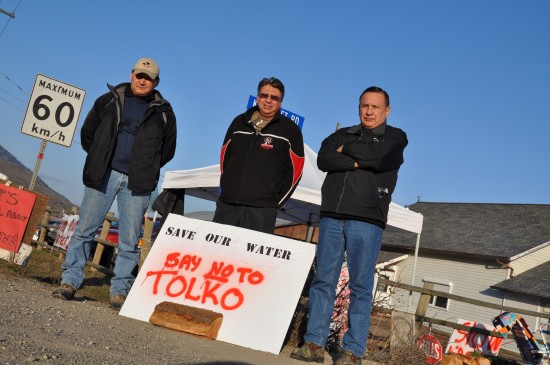
The Okanagan Indian Band (OIB) launched a “protective blockade” this morning, February 23, at the Okanagan campsite near Bouleau Lake in southern British Colombia.

Okanagan blockade

The Okanagan Indian Band (OIB) launched a “protective blockade” this morning, February 23, at the Okanagan campsite near Bouleau Lake in southern British Colombia.

A member of the greater Okanagan Nation, the OIB say they have been left with no choice but to stop the logging company Tolko Industries from endangering their water supply.

“This is not an action we took lightly, nor is it one we commenced without exhausting all of our legal options,” states OIB Chief Fabian Alexis, in a recent press statement. “However given the active collusion between the Ministry of Forests and Tolko and the continued indifference of the federal government, we had no choice but to act…”

Since at least 2003, the OIB has been seeking the legal protection of their water, which is provided by the Browns Creek watershed. The region has been extensively logged for more than forty years; and now, the Okanagan People fear that any further logging will threaten their health and safety.

“The fact is that when our reserves were first established it was with the clear understanding that our water supplies would be maintained for future generations,” notes Chief Alexis. “Instead the federal government abandoned its fiduciary obligation and allowed the Province of British Columbia to sell off our water rights thus resulting in a number of fish bearing creeks that run through our reserve being reduced to dry gullies.”

“Even as these creeks ran dry the province continued to authorize the industrial clear cutting of the watersheds that provide our drinking water, thus presenting a clear threat to the safety and well being of all residents both indigenous and non-indigenous who live on and near our reserve,” he adds.

The OIB is also concerned that Tolko will cause irreparable harm to archeological sites scattered throughout the region. The Okanagan National Alliance explains:

“The Brown’s Creek Watershed is a sacred area of the Okanagan people that houses archaeological, ethno-botanical and cultural evidence that has been at the heart of litigation in the Wilson case since 1999. The litigation area is subject to a preservation order issued by Mr. Justice Sigurdson, entitling the Okanagan Nation to preserve and record evidence pertaining to Okanagan Title. Tolko’s logging plans would destroy title evidence, dating back as far as 7,500 years and extending into modern times, the Okanagan Nation have committed to ensuring that our traditional laws and governance systems are upheld for generations to come. This is our responsibility and sacred duty as Syilx (Okanagan)
People.”

Despite the governments awareness of this, and the fact that there is ongoing litigation concerning Aboriginal title in the watershed, on January 11, the British Colombia Supreme Court gave Tolko Industries permission to commence logging in eight separate “cutlbocks”.

Commenting on the decision, Grand Chief Stewart Phillip of the Okanagan Nation Alliance stated that, “the Courts failed to deal with the proprietary nature of Aboriginal Title to the lands and resources within the territory;” and, that, as a result of the ruling, “third party interests are protected at the expense of the community’s drinking water, archaeological history and their constitutionally protected rights.”

Following this, on Feb. 20, the OIB held an emergency meeting to discuss their options. As a result of the meeting, Elders and band members unanimously agreed to establish check-points on Westside Road, which Tolko has been using without the OIB’s permission. They also agreed to establish a protective blockade in the watershed.

With the blockade now ongoing, Chief Alexis today declared a full moratorium on all logging in the watershed, stating that “no commercial logging will be permitted in these areas until further notice.”

“Finally, in order to avoid any further repeat or escalation of this conflict we would also advise the Province of British Columbia to stop issuing cutting permits in areas where their title to the land is in dispute and is still a matter to be resolved by the courts,” Chief Alexis concludes.

What You Can Do

Chief Alexis is asking people to call their local MLAs and MPs to express their support for the OIB.

Supporters are also encourage to attend the blockade in person. If you’re in the area, a ride can possibly be arranged by contacting the Okanagan Indian Band Territorial Stewardship Office at (250) 542-7132.

For more information please contact: Chief Fabian Alexis cell (250) 306-2838, phone (250) 542-4328 or Sherry Louis, Executive Assistant Okanagan Indian Band – 12420 Westside Road, Vernon, BC, V1H 2A4 – okibcouncil@okanagan.org – PH: 250.542.4328 FAX: 250.542.4990

Local Democracy Dumped! – Sizewell nuclear plant blockaded again

22.02.2010
As government ends flawed consultation on nuclear power, anti-nuclear power activists step up resistance and blockade Sizewell nuclear power station in Suffolk, England.

Sizewell democracy!22.02.2010
As government ends flawed consultation on nuclear power, anti-nuclear power activists step up resistance and blockade Sizewell nuclear power station in Suffolk, England.

Since 6.40am this morning, anti-nuclear power activists from the ‘People Power not Nuclear Power Coalition’ [1] have been blockading Sizewell power station in protest against the flawed government consultation on nuclear new build, which ends today, and the dumping of local democracy.

Sizewell is one of ten sites nominated for nuclear new build; and, together with Hinkley in Somerset, one of the two most likely sites for one of the first new nuclear reactors to be built by EDF Energy.

In preparation for new nuclear reactors, the government introduced the 2008 Planning Act [2] to limit the local planning procedure to relatively unimportant matters, and centralise siting and nuclear design decision on the national level. Today, the seriously flawed consultations end on the National Policy Statements for energy, including nuclear power, [3] designed to give the go ahead for ten new nuclear power stations in the UK.

“In order to build new nuclear power stations, government dumped local democracy”, Mell Harrison, 38 from Geldeston and a campaigns worker for the Campaign for Nuclear Disarmament (CND) said.

“We are blockading Sizewell today, to show that the government will not achieve its aim to fast track nuclear power. If local democracy is dumped, then nonviolent direct action will be our answer. Any new build will be met with resistance, and this blockade today is just the beginning.”

She continued:

“The government and the nuclear industry present nuclear power as low carbon energy and a necessity to combat climate change; but nuclear power is dangerous, expensive and does not deliver any significant reductions in carbon emissions. It locks us into a centralised energy system, and is part of the problem of climate change, not part of the solution.”

“Chipper”, 44, a male activist from Stop Hinkley added:

“The government and the nuclear industry approach the problem of nuclear waste with wishful thinking, as the conclusion of the National Policy Statement for Nuclear Power Generation shows.” [4]

Andreas Speck, 45, from London, originally from Germany, added:

“Just to wish away the problem of nuclear waste is highly irresponsible. Spent nuclear fuel is highly toxic and remains radioactive for tens of thousands of years. Here at Sizewell, a new dry storage facility is planned, to store spent fuel rods for more than 100 years in casks. However, how long these last is unknown, and problems with similar casks at Gorleben in Germany after only a few years show that this is no solution. There is no final safe storage [for high level radioactive waste] in existence anywhere in the world. The responsible thing to do is to shut down all nuclear power stations immediately and stop producing yet more nuclear waste.” [5]

Notes:

[1] The People Power not Nuclear Power Coalition is a non-hierarchical campaigning coalition of groups and individuals to promote and encourage visible and effective action against nuclear power in the UK and worldwide, to leave a nuclear-free, safe and healthy environment for future generations. More information at: http://stopnuclearpower.blogspot.com

[2] The Planning Act 2008 introduced a new stream-lined system for decisions on applications to build nationally significant infrastructure projects (NSIPs) in England and Wales. The new system for nationally significant infrastructure covers applications for major energy generation, railways, ports, major roads, airports and water and waste infrastructure. National policy will be set out by Ministers in a series of National Policy Statements (NPSs), thereby dumping local democracy. Fore more information, see Friends of the Earth:

Planning Act removes democratic decision making, http://www.foe.co.uk/campaigns/fair_future/news/planningbill_law_17248.html

[3] For more information, see Friends of the Earth press release from 22 January 2010: Legal warning to Government over energy policy statements, http://www.foe.co.uk/resource/press_releases/nps_22012010.html

[4] See paragraph 3.8.20, page 25 of the Draft National Policy Statement for Nuclear Power Generation (EN-6), November 2009, https://www.energynpsconsultation.decc.gov.uk/nuclear/nps/

‘Having considered this issue, the Government is satisfied that effective arrangements will exist to manage and dispose of the waste that will be produced from new nuclear power stations. As a result the IPC (Infrastructure Planning Commission) need not consider this question.’

[5] The existing storage facility for spent fuel at Sizewell will be full in 2015. In addition, a dry storage facility is to be built to create new storage capacity. In there, spent fuel rods will be stored in storage casks in a simple 110m storage hall with natural air cooling. Similar storage casks in Germany showed problems with the monitoring of pressure after only a few years (see http://www.contratom.de/news/newsanzeige.php?newsid=19588 – in German)

Activists taking part in this morning’s action include:

– Mell Harrison. 38 from Geldeston. Mell works for CND and is a member of Shut Down Sizewell and the Sizewell Blockaders. She was recently acquitted for aggravated tresspass at Sizewell A and B for a blockade that took place in 2008.

– Andreas Speck, 45, from London. Andreas works for War Resisters’ International. He was involved in the anti-nuclear power movement in Germany from the 1980s, until his move to London.

– “Chipper”, 44, from Wiltshire. He is a member of Stop Hinkley and CND.

– “Ziggy”, 39, an artist and historian from Ipswich, Suffolk. He is a member of CND and Shut Down Sizewell.

– Helen Swanston, 35, a milliner from Cromer. Helen is a member of Trident Ploughshares.

– Justus, 23, a student from London. He is involved in the Camp for Climate Action.

– Irene Willis, 65, from Wales. Irene is a Sizewell Blockader and a member of Trident Ploughshares.

– Nicky, 39, an environment education worker from Bungay. She was also recently acquitted following the Sizewell Blockaders’ action at Sizewell in 2008.

Nuclear People Power
vd2012-npp [at] yahoo.co.uk
http://stopnuclearpower.blogspot.com

Updates:

10:44
One of the blockaders, Chipper, was getting the chills after lying in the rain for several hours and decided to self release. He was immediately arrested without warning on suspicion of aggravated trespass and taken to Lowestoft police station. The remaining blockaders are still in position as of 10.40am. At least one TV crew is on the scene.

Mainstream coverage: http://bit.ly/d9ALSd

12:10pm

Another man arrested on suspicion of aggravated trespass. Two more blockaders still being cut out of lock-ons by police.

Follow on Twitter: http://twitter.com/NukePeoplePower

1:20pm

The two remaining blockaders (a female in her sixties and a male in his twenties) are still being drilled out of a concrete block lock-on. The police cutting team say it will take them at least another hour.

The pair have now been in the road for nearly seven hours, in wet, cold conditions.

Twitter updates: http://twitter.com/NukePeoplePower

2:40pm

Last blockader just drilled out and arrested after 8 hours in the cold and wet. Four people arrested in total.

Latest update, plus more pics

Approx. 9.30pm on Monday evening: The four arrestees are released after being interviewed and held in police custody for up to 11 hours. They have been bailed to return to Lowestoft police station on 30th March, at 2pm.

More photos from yesterday’s blockade: http://tinyurl.com/Sizewell22Feb10

Kernow Action Now – Send us Mail

Kernow Action Now is happy to publicise all actions and community events that educate and inform people about, or prevent, the exploitation of the environment and the community.

Kernow Action Now is happy to publicise all actions and community events that educate and inform people about, or prevent, the exploitation of the environment and the community. This includes reports of actions (sent anonymously) that inflict economic damage on those profiting from the destruction of the environment and the community, and on institutions that are classist and exploitative, so long as all necessary precautions are taken against harming any animal – human or non-human. We do not support and will not publicise actions that are racist, sexist or homophobic.

To contact us, send us useful information or leaflets, write to:

KAN
c/o Unit 1356
PO Box 7169
Poole
BH15 9EL

http://kernowaction.wordpress.com

Zapatistas reclaim Mother Earth

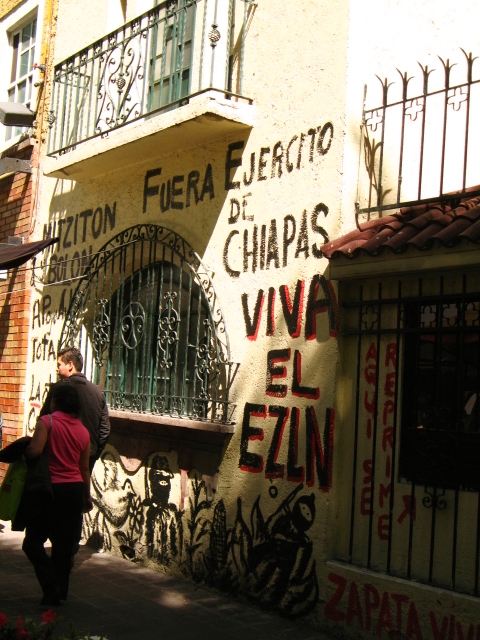
On 6th February 230 civilian Zapatistas took part in an action to retake control of their reclaimed lands at Bolon Ajaw, Chiapas, Mexico, which had been invaded and taken over since 20 January by the paramilitary group OPDDIC, report the human rights group Fray Bartolome de Las Casas.

Zapatista solidarity grafittiOn 6th February 230 civilian Zapatistas took part in an action to retake control of their reclaimed lands at Bolon Ajaw, Chiapas, Mexico, which had been invaded and taken over since 20 January by the paramilitary group OPDDIC, report the human rights group Fray Bartolome de Las Casas. The 25 Zapatista families of Bolon Ajaw, part of autonomous municipality Comandanta Ramona, were given solidarity by Zapatistas from further afield.

The human rights activists of Fray Bartolome present a detailed report which dismisses claims by the state government, OPDDIC and the mass media that on 6th February the Zapatistas shot at OPDDIC members, killing one and injuring others. On the contrary, report Fray Bartholomew, it was OPDDIC who at least four times opened fire on the Zapatistas, wounding three Zapatistas, including a sixteen year old.

Fray Bartholomew (Frayba) confirm that the OPDDIC member killed and those wounded were shot by mistake by fellow OPDDIC members, as two different OPDDIC groups opened fire on the inhabitants of Bolon Ajaw, from opposite sides of the village. OPDDIC, linked to the PRI – the Institutional Revolutionary Party which governed Mexico for many decades – have been involved in numerous attacks and harassment of Zapatista communities over recent years.

Frayba give a detailed account of the several clashes which occurred during the day. Actions included the Zapatistas repulsing an attempt by OPDDIC to retake the land, and the Zapatistas breaking out of an armed ambush and encirclement by OPDDIC in order to go to the aid of the inhabitants of Bolon Ajaw, who were being shot at by OPDDIC gunmen.

The Zapatista Good Government Council based at Morelia has also issued a full statement http://www.edinchiapas.org.uk/node/266 . This details the attacks by the OPDDIC paramilitaries, naming names, and holding all three levels of government – local, Chiapas state, and the national federal government – responsible for the attacks against the indigenous people and their lands. The statement describes how on 6th February OPDDIC shot at unarmed Zapatistas, seriously wounding one man in the stomach, how they completely destroyed a Zapatista’s home, and smashed up sacred objects in the Bolon Ajaw church.

The Zapatistas stress their willingness to hold talks over the problems:
‘We, the Council of Good Government, have never closed the door on finding a good solution to problems, we always show good will..’

HOLIDAYS IN THE SUN

The Frayba investigation emphasises that government plans for major tourist developments at the renowned local waterfalls lie behind the attacks on the Zapatistas. Nearby Agua Azul Falls are already heavily promoted, featuring in international tourist guides such as Lonely Planet, and Bolon Ajaw counts with five more as yet undeveloped Falls which are even more beautiful.

These proposed developments are part of a much bigger tourist development plan. Enormous interests are at stake in the Palenque CIP project, which covers six municipalities in the north of Chiapas around the world-famous Mayan temples of Palenque. The state government of Chiapas is due to invest half of the money involved, the balance presumably coming from private investment. The Project has been in development since 2007, and a major extension of Palenque airport is due this year.

The CIP Project emphasises specialist and luxury tourism, and long-stay visitors. A natural theme park is planned for the Agua Azul Waterfalls, with commercial areas and significant accommodation for ‘eco’, adventure and sporting tourism. But, international consultants point out, ‘before attracting investment the State must find a solution to the problems of acquiring the land and the problems of access.’

In other words, for the state and business interests, the Zapatistas and their determination to defend Mother Earth are ‘a problem’ standing in the way of the realisation of multi-million tourist investments.

These planned tourist developments are closely linked to a new highway through Chiapas, which threatens a number of communities on its route from the colonial tourist centre of San Cristobal de Las Casas to the magnificent Mayan temples at Palenque. As well as Bolon Ajaw, the communities of San Sebastian Bachajon http://www.edinchiapas.org.uk/node/235 , near Bolon Ajaw, and Mitziton near San Cristobal, both adherents to the Zapatista-initiated Other Campaign, are among the communities resisting the new highway in the face of state and paramilitary oppression.

Fray Bartolome denounce the Chiapas State authorities for trying to blame the Zapatistas and the Other Campaign supporters of San Sebastian Bachajon for the violence. They accuse the authorities of ‘generating the
conditions for a military intervention ordered by the Federal Government against the civilian population.’

The lands at Bolon Ajaw were reclaimed by the Zapatistas in the aftermath of the 1994 uprising. Till then they had been in the hands of private owners who brutally exploited the local indigenous people. Frayba detail the numerous attacks by OPDDIC on the Zapatistas since 2003.

DEFENDING MOTHER EARTH

These latest events at Bolon Ajaw are noteworthy not only for the scale of the threats facing the Zapatistas, but for the exemplary solidarity, courage, self-organisation and self-discipline displayed by the Zapatistas in taking collective direct action to defend ‘Mother Earth and its natural resources’.

In Bolon Ajaw, in Montes Azules http://www.edinchiapas.org.uk/node/263 , in Mitziton, in Sebastian Bachajon, in Chicomuselo http://www.edinchiapas.org.uk/node/262 and throughout Chiapas and Mexico a
war is being waged by the state, paramilitaries and big business to once more rob the indigenous and poor peasant peoples of their land and destroy Mother Earth for money.

In Chiapas, and also in other Mexican states like Oaxaca and Guerrero, the peasant and indigenous peoples’ resistance and struggle for autonomy continues – international solidarity is needed.

As the Fray Bartolome centre state:
‘We issue an URGENT call to civil society, in Mexico and internationally, to all those committed to the defence of human rights, to come out and denounce the clear increase in the actions of violence against the civilian, peaceful process of autonomy being developed by the Zapatista bases of support and their Councils of Good Governments which are civil authorities.’

NOTES

If interested in solidarity with the Zapatistas and people of Chiapas and Mexico contact Edinburgh Chiapas Solidarity Group edinchiapas@yahoo.co.uk
www.edinchiapas.org.uk
Plus UK Zapatista site http://ukzapatistas.wordpress.com/
There have already been solidarity actions in various towns and cities in the Spanish State and in Mexico.

Full statement by Zapatista Council of Good Government of Morelia on the events at Bolon Ajaw on 6th February, in English http://www.edinchiapas.org.uk/node/266

Fray Bartolome site, info in english
http://www.frayba.org.mx/index.php?hl=en

Regular reports from Chiapas, mainly Spanish, some English, on Indymedia Chiapas
www.chiapas.indymedia.org

Full report by Fray Bartolome human rights group on the events at Bolon Ajaw on 6th February, in Spanish
http://chiapas.indymedia.org/article_173362

Letter of protest to Mexican government about the eviction of Zapatista community in Montes Azules, Chiapas, in Spanish
http://www.europazapatista.org/spip.php?article2409

More info and protest letter in English can be found at:
http://glasgowchiapassolidaritygroup.wordpress.com

New eco village starting soon in London

20.02.2010
Following the eviction threat to Kew eco village, there will be a new eco village set up in London. A new site has already been located. People are needed to help set it up. A couple of other sites have also been located in case the chosen site gets blocked off before we can occupy it. No details of the location can be given at this stage.

20.02.2010
Following the eviction threat to Kew eco village, there will be a new eco village set up in London. A new site has already been located. People are needed to help set it up. A couple of other sites have also been located in case the chosen site gets blocked off before we can occupy it. No details of the location can be given at this stage.

Full details of the site will be posted on here within a couple of weeks when the eco village is set up. But first people are needed to help out with it.

Contact diggers360@yahoo.co.uk for more details and to get involved.

Construction equipment destruction — Lancaster, PA

Lancaster police are seeking the public’s help in finding the vandals who caused about $30,000 damage to some heavy equipment near a construction site over the weekend.

The vandals spray-painted messages, broke windows, cut engine wires and did other damage to a bulldozer and an excavator on Pavement Road near Nichter Road, police said.

Lancaster police are seeking the public’s help in finding the vandals who caused about $30,000 damage to some heavy equipment near a construction site over the weekend.

The vandals spray-painted messages, broke windows, cut engine wires and did other damage to a bulldozer and an excavator on Pavement Road near Nichter Road, police said.

The incident, discovered Sunday, apparently occurred some time between Friday night and Sunday.

http://www.buffalonews.com/437/story/959258.html

Disruption to 350 Road Projects in Chhattisgarh, India

Maoists Hold up Road Construction in Chhattisgarh

Maoists Hold up Road Construction in Chhattisgarh

Raipur, Oct 19 – Maoist guerrillas have held up construction work at more than 350 road sites in Bastar region of Chhattisgarh, an official said Monday. ‘At least 350 road construction projects under Prime Minister’s Rural Roads Scheme were held up in Maoist violence-hit Bastar region, mainly in Dantewada, Bijapur and Kanker districts. It is difficult to continue the work due to violence,’ an official in panchayat and rural development department told IANS. The projects amounted to Rs.1,000 crore (Rs.10 billion).

The contractors had told district police authorities that they were finding it difficult to carry on construction work due to Maoist intervention. According to police, Maoist guerrillas had set ablaze at least 65 vehicles this year alone in Bastar that were engaged in road construction projects. Several officials and workers who were carrying out construction work were abducted by the rebels and set free only after they guaranteed not to return to work.

Experts say Maoist guerrillas are holding up rural road construction projects as they do not want the infrastructure be built up in the interiors as it will give easy access to police and paramilitary forces to the forested areas…..

http://southasiarev.wordpress.com/2010/02/04/maoists-disrupt-construction-of-350-road-projects-in-chhattisgarh/

Support the Local Campaign Against Bradley Proposed Open-cast

This years EF! winter moot was held in Dipton Community Centre, which looks over the proposed site for an open-cast at Bradley. Members of the local campaign against the mine have asked if people who attended the moot, (as well as those who didn’t) would write in their objection to the development.

This years EF! winter moot was held in Dipton Community Centre, which looks over the proposed site for an open-cast at Bradley. Members of the local campaign against the mine have asked if people who attended the moot, (as well as those who didn’t) would write in their objection to the development.

UK Coal’s application is expected to be heard by the planning officials in the near future. The local campaign would appreciate it if people would write in letters of objection to the following address, stating the APPLICATION No. CMA/1/37

Mrs C.L.Teasdale
Plannng Development Control Team
Regeneration and Economic Development
Durham County Council
Durham
DH1 5UQ

Apparently letters hold more weight if you say that you have visited the area.

The facts about this proposed mine:
UK Coal has applied to surface mine 556,000 tonnes of coal from a coal seem covering 22,000 acres.
The current version of the application is has not yet gone to the Planning Authority.
The application is being resisted by The Pont Valley Network www.pontvalley.net
If the application goes ahead the residents are particularly concerned about the loss of their heritage sites.
The final destination for the coal is either the steel industry or a power station generating electricity.
Burning this coal will release over 2 million tonnes of CO2 being released into the atmosphere.
UK coal say the mine will create 38 jobs. Mr Cory of UK Coal says that there will be no new jobs but people will be transferred to this site.
The mine will need 3 lorry trips per hour, each way.
UK coal and other surface mining companies have applications at the planning stages for a further 13 mines in the area and a further 5 have been granted in the area.
The nearest planned site also currently at the planning stages is Skons Park, which Hall construction are applying to extract half a million tonnes of coal fire clay. This application was last refused in 2007 but Halls have since reapplied this year.

The Bradley site is 10 miles south of Newcastle in a beautiful area. The proposed site can be seen from Newcastle and Cheviot on a clear day. A mine would scar the landscape; cause habitat destruction which would affect many species, including Great Crested Newts and Red Kites; contribute to global warming; increase traffic locally and destroy the remains of wagon-ways and bell pit and shaft mines in the area. Residents are also concerned that if the mine is given the go ahead then they will see further extensions applied for and granted.

For more information about the site and to add strength to letters of objection please see http://pontvalley.net under NOTT campaign on the left hand side.

attempt to arrest whalers – Sea Shepherd captain abducted – crocodile assault

February 15 2010
Captain Pete Bethune Boards Shonan Maru 2 to Arrest Japanese Skipper

At 0629 Hours (Perth Time), New Zealand Captain Pete Bethune of the recently sunk Sea Shepherd vessel Ady Gil breached the Japanese government security ship Shonan Maru 2 and successfully boarded the vessel under cover of darkness.

'Crocodile egg' attackFebruary 15 2010
Captain Pete Bethune Boards Shonan Maru 2 to Arrest Japanese Skipper

At 0629 Hours (Perth Time), New Zealand Captain Pete Bethune of the recently sunk Sea Shepherd vessel Ady Gil breached the Japanese government security ship Shonan Maru 2 and successfully boarded the vessel under cover of darkness.

His mission is to attempt a citizen’s arrest of the skipper of the Shonan Maru 2 for the destruction of the Ady Gil and attempted murder of the six Ady Gil crewmembers.

At 0600 Hours, Captain Bethune (of New Zealand) left the Sea Shepherd ship Steve Irwin on a Jet Ski driven Larry Routledge (of Great Britain).

The Jet Ski lay in wait for the Shonan Maru 2 to approach. With the Japanese vessel making 14 knots through the water, Routledge maneuvered the Jet Ski into position under the anti-boarding spikes along the port side of the Shonan Maru 2.

Captain Bethune made the jump and climbed onboard the whaling ship without being noticed. Captain Bethune is presently onboard the Shonan Maru 2 awaiting sunrise to make his presence known.

Captain Bethune also has a bill for $3 million dollars to present to the Master of the Shonan Maru 2. The bill is for the cost of replacing the Ady Gil.

Captain Bethune will be demanding that the Shonan Maru 2 Captain surrender himself to Sea Shepherd or take his ship to the nearest Australian or New Zealand port to turn himself in to legal authorities.

Captain Bethune will make it clear that he does not wish to return to a Sea Shepherd ship without the Captain of the Shonan Maru 2.

Sea Shepherd anticipates that the Japanese will hold Captain Bethune as prisoner onboard the Shonan Maru 2.

“This was an impossible mission,” said Captain Paul Watson. “Captain Bethune boarded a Japanese whaling fleet security ship at high speed in total darkness, breached the spikes and anti-boarding nets and is presently onboard and the Japanese crew are still not aware that he is there. He is there to demand justice for the sinking of his ship.”

Japan Takes A Prisoner In their Crusade to Plunder the Southern Ocean Whale Sanctuary

The Japanese government has said they will have Captain Peter Bethune of New Zealand taken to Japan to be tried on unknown charges in a Japanese court.

The Sea Shepherd Conservation Society and Captain Peter Bethune were prepared for this possibility prior to the boarding of the Shonan Maru #2 by Captain Bethune.

“Captain Peter Bethune’s $3 million dollar vessel the Ady Gil was rammed, sunk and destroyed by the Captain of the Shonan Maru #2. The incident injured one of the six crewmembers and could have killed all six,” said Captain Paul Watson, “Captain Bethune was entirely in his rights to confront the man who almost killed him and destroyed his ship. And now this same Japanese captain who destroyed a ship almost killing its crew is intent on bringing Captain Bethune back to Japan as his captive. The question must be asked – who are the pirates here?”

The Sea Shepherd Conservation Society sees this as an opportunity to rally support for Captain Peter Bethune in New Zealand and Australia. These Japanese poachers plunder the Southern Ocean Whale Sanctuary with impunity and now they are hauling a courageous Kiwi hero to the Land of the Rising Sun to crucify him for defending the whales.

Captain Peter Bethune is no longer just a man who set a world record in boating and had the courage to defend the whales. He will now be the very symbol of the citizens of New Zealand and Australia and their love for the great whales.

The last time a Kiwi was taken prisoner to Japan was in their great war of imperialism when they attempted to enslave both Australia and New Zealand. They have now returned to plunder Australian and New Zealand waters and once again they are arrogantly flaunting the law and taking prisoners.

“I don’t think that Australian and New Zealanders are going to tolerate the abuse of Peter Bethune by the thugs from Japan who annually plunder the Southern Ocean Whale Sanctuary for profit in the name of research,” said Steve Irwin Chief Cook Laura Dakin of Canberra.

“If the Japanese put Peter Bethune on trial in Japan, it will be a case that will draw the attention of the world,” said Captain Paul Watson, “What is the Japanese government thinking? The persecution of Captain Peter Bethune will a rallying point for an international campaign to free Captain Bethune and to end the brutal illegal slaughter of the whales in the Southern Ocean Whale Sanctuary.

Steve Irwin Launches Croc Assault on the Japanese Whaling Fleet

Crikey! And now for something completely different.

The Sea Shepherd Conservation Society always likes to inject a little humor into our campaigns and today we decided to do just that.

As a tribute to the late and legendary Steve Irwin for whom the Sea Shepherd flagship is named, the crew of the Steve Irwin delivered dozens of crocodile eggs onto the flensing deck of the Nisshin Maru.

Each of these eggs was sponsored by Sea Shepherd supporters on shore who paid $50 to inscribe a message on the outside of the egg. When these eggs make contact with water, a baby crocodile emerges from the egg and expands rapidly.

A few of the eggs were signed with messages from Terri, Bindi and Robert Irwin.

“I cannot think of anything more appropriate for the Steve Irwin to toss onto the bloody flensing decks of the Nisshin Maru than crocodile eggs and baby crocs.” Said Captain Paul Watson.

Of course these baby crocs and their eggs are not real. We can just see the Japanese trying to accuse Sea Shepherd of cruelty to animals for this action and they probably will since they can’t seem to tell the difference between fact and fiction.

“Before his tragic death Steve wanted to join us in our efforts to defend the whales in the Southern Ocean Whale Sanctuary,” said Captain Paul Watson. “Because of that, we asked Terri Irwin for permission to name our ship in his honour.”

The croc delivery went very well. Japanese water cannons provided the moisture to crack the eggs and to release the expanding crocs onto the deck of the Nisshin Maru.

“Steve would have loved this,” said 3rd Officer Vincent Hayes of Williamstown, Victoria.

So down here in the Southern Ocean today – Crocs rule!

We love you Steve!