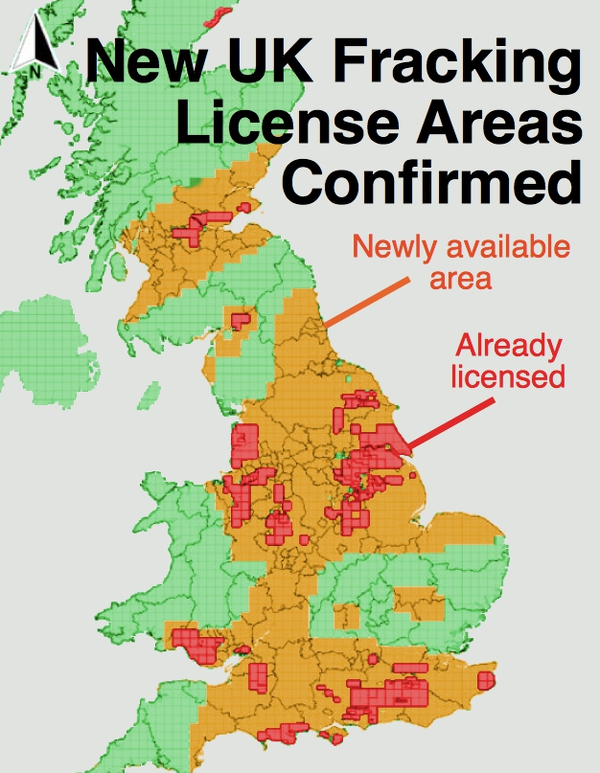
New UK Fracking License Areas Confirmed

Decem­ber 17th The UK gov­ern­ment has announced that rough­ly 60% of the UK is now avail­able to be licensed to frack­ing com­pa­nies.

Decem­ber 17th The UK gov­ern­ment has announced that rough­ly 60% of the UK is now avail­able to be licensed to frack­ing com­pa­nies. After a brief “con­sul­ta­tion” peri­od it is like­ly that the licens­es will be hand­ed out to frak­ing com­pa­nies in the first half of 2014. The licens­es would cov­er the exploita­tion of both shale oil and gas and coal bed methane (CBM).

The area is based on that cov­ered by a new­ly finalised Strate­gic Envi­ron­men­tal Assess­ment (PDF). Despite the name the doc­u­ment does not seem to be par­tic­u­lar­ly focused on the envi­ron­ment and does not address the long term impacts of issu­ing these poten­tial­ly 30 year long licens­es.

To extract the amounts of gas that com­pa­nies are brag­ging are in exist­ing license blocks would require tens of thou­sands of wells. If large addi­tion­al areas are licensed next year, the scale of threat will be much larg­er still. These devel­op­ments would dev­as­tate our remain­ing coun­try­side, indus­tri­al­is­ing huge areas with well pads, pipelines, com­pres­sor sta­tions and pro­cess­ing plants.

The real­i­ty of uncon­ven­tion­al gas is that it is very hard to extract. It is lit­er­al­ly scrap­ping the bot­tom of the fos­sil fuel bar­rel. Dense­ly packed wells must be drilled (up to 8 wells per square mile) over large areas, since each well indi­vid­ual wells does not pro­duce much gas and then only for a short time. Worse, frack­ing is not an iso­lat­ed tech­nol­o­gy but is part of a wider trend towards more extreme forms of ener­gy extrac­tion, which if not resist­ed could see even larg­er threats such as Under­ground Coal Gasi­fi­ca­tion (UCG) become wide­spread.

Right now the com­mu­ni­ty around Bar­ton Moss near Man­ches­ter is fight­ing the threat to their region posed by IGas Energy’s attempts to drill a Shale/CBM explo­ration well there. Across the coun­try com­mu­ni­ties are get­ting organ­ised to resist these threats, with around 70 anti-frack­ing groups already formed in the last two years, and that num­ber grow­ing fast.

Support Spied Upon, a vital expose film telling the story of activists targeted by secret police

Dear Earth First!ers,


Dear Earth First!ers,


Due to its effec­tive use of cre­ative direct action tac­tics in recent decades, Earth First! has con­sis­tent­ly been a tar­get of state repres­sion and exces­sive police tac­tics. Now we are mak­ing a film with oth­er envi­ron­men­tal activists who have been tar­get­ed by under­cov­er police, with the goal of expos­ing these abu­sive repres­sion tac­tics.


“Spied Upon” is an inter­na­tion­al­ly made full-length doc­u­men­tary that uses the out­ing of for­mer UK under­cov­er cop Mark Kennedy as it’s start­ing point. Kennedy had begun his inter­na­tion­al oper­a­tion by tar­get­ing Earth First! in the UK in 2003, and had worked across Europe as well as for the FBI for sev­en-years before being out­ed by his unknow­ing activist girl­friend and her cir­cle of Not­ting­ham friends in 2010. Now this woman and a num­ber of oth­er women are suing police boss­es in the UK for what has been exposed as a reg­u­lar under­cov­er police tac­tic of dup­ing activist women into long-term rela­tion­ships. Spied Upon is work­ing with some of these women to sup­port them and help them have their sto­ry told.


Mark Kennedy turned pri­vate in 2010 and start­ed his own secu­ri­ty firm as well as say­ing that he was work­ing for Glob­al Open, a pri­vate secu­ri­ty firm known to tar­get ani­mal rights activists on behalf of phar­ma­ceu­ti­cal com­pa­ny clients. It appears as though that is exact­ly what Kennedy was doing when he went to Italy to spy on an ani­mal lib­er­a­tion gath­er­ing in the sum­mer of 2010. He even tried to strength­en his cred­i­bil­i­ty by say­ing he was an impor­tant Earth First! activist, see the video clip here we shot with Ital­ian activists who tell about when they were unknow­ing tar­gets of Kennedy: http://www.youtube.com/watch?v=bBx38iZ14nc


State repres­sion has long fea­tured the use of under­cov­er police, but a less­er known use of under­cov­er tac­tics has been those used by pri­vate secu­ri­ty firms on behalf of pri­vate cor­po­ra­tions. These prac­tices con­strue an intense inva­sion of pri­va­cy that is not even allowed for state under­cov­er police, and this scan­dal needs to be exposed! We have also uncov­ered ille­gal col­lu­sion between pri­vate and state secu­ri­ty forces. This col­lu­sion is a key focus of the film Spied Upon, which we are also mak­ing as a tool that activists can use to high­light the cur­rent prob­lems envi­ron­men­tal groups face today.


We plan to release Spied Upon inter­na­tion­al­ly in 2014. How­ev­er, to do this, we need your sup­port to make this film hap­pen. Our film crew comes from grass­roots activism, and we are turn­ing to the grass­roots, mean­ing you, to seek fund­ing. Please take a look at our crowd­fund­ing web-site and teas­er video at Indiegogo, and take action to help us please by mak­ing a dona­tion if you sup­port our work: http://www.indiegogo.com/projects/spied-upon


In sol­i­dar­i­ty,
The crew at Spied Upon


PS. Lots more info at: www.spiedupon.com

28 Days Later: Please spread far and wide

Cuadzilla Balcome Rolling Blockade Red Version

Cuadzilla Balcome Rolling Blockade Red Version

A Rolling Block­ade of the Bal­combe frack­ing site, 1st Sep­tem­ber – 28th Sep­tem­ber

Frack­ing com­pa­ny Cuadrilla’s gov­ern­men­tal licence to drill in Bal­combe ends on Sep­tem­ber 28th. The gov­ern­ment may be allow­ing them to drill but they have no social licence from the peo­ple of Bal­combe to frack their land and threat­en their water sup­ply.  Nei­ther do they have any man­date to begin an entire wave of frack­ing across the coun­try. The vast major­i­ty of peo­ple in the UK want clean­er, green­er ener­gy.
After the upsurge of cli­mate activism at Reclaim the Pow­er in August, let’s make these last 28 days count. Let’s halt their work at Bal­combe, and also send a strong mes­sage to those want­i­ng to frack else­where.

A block­ade has been on-going at the drilling site, but trucks have still been get­ting through. Now it’s time to up the ante.

We invite groups from around the coun­try to come and play a part in a 28 day rolling block­ade.

Think cre­ative­ly and act respon­si­bly. Pick a week­day before Sep­tem­ber 28, gath­er friends and use­ful kit get your­selves to Bal­combe.

Frack­ing is stop­pable, anoth­er world is pos­si­ble.

* Peo­ple are remind­ed that this is a peace­ful block­ade and that the Bal­combe camp is alco­hol-free.

* For fur­ther infor­ma­tion please con­tact 28dayslater.balcombe@gmail.com

* Fol­low us on Twit­ter (@28_dayslater) and like us on Face­book (https://www.facebook.com/28dayslaterrollingblockade)

Reclaim the Power! Invite to protest camp

This sum­mer, a wide coali­tion of peo­ple and groups are com­ing togeth­er to Reclaim the Pow­er — join us.

This sum­mer, a wide coali­tion of peo­ple and groups are com­ing togeth­er to Reclaim the Pow­er — join us.

If you’re up for cre­at­ing a more sus­tain­able, equal soci­ety, we want you to join us. If you want to fight against the eco­nom­ic and envi­ron­men­tal crises that gov­ern­ments and big busi­ness have cre­at­ed, we want you to join us. If you want to meet, plan and take action with a diverse range of groups and indi­vid­u­als who have shared goals, we want you to join us.

Reclaim the Pow­er is going to be a 4 day action camp and protest at West Bur­ton pow­er sta­tion. West Bur­ton is the first of up to 40 new gas fired pow­er sta­tions that are cur­rent­ly being planned. If they are built, the UK will def­i­nite­ly fail to meet our mod­est car­bon reduc­tion tar­gets. This gives us a real oppor­tu­ni­ty to change the way our pow­er is gen­er­at­ed and con­trolled. The main­stream polit­i­cal par­ties want to tie us to fos­sil fuels for anoth­er gen­er­a­tion. They want to allow ener­gy com­pa­nies to get ever rich­er whilst more and more peo­ple are forced to choose between heat­ing and eat­ing. We want a sus­tain­able ener­gy sys­tem that pri­ori­tis­es peo­ple, not prof­it. This is a huge deci­sion and it’s hap­pen­ing now. Let’s Reclaim the Pow­er and stop this Dash for Gas.

Last Octo­ber, 21 envi­ron­men­tal activists shut down EDF’s West Bur­ton pow­er sta­tion for a week in protest at the government’s Dash for Gas. With your help, includ­ing a sol­i­dar­i­ty peti­tion signed by 64,000 peo­ple – they fought off EDF’s attempt to sue them for £5 mil­lion. 
And now we’re going back.

This sum­mer, from 16th-20th August, over 1000 peo­ple will gath­er on the doorstep of the pow­er sta­tion for a camp – includ­ing work­shops and action plan­ning – and a mass action. With your help, we will shut down the Dash for Gas.

Please share this call­out with your net­works.

Friends of Badgers Hack into NFU Mutual

www.savethebadger.com
11/06/12: received anony­mous­ly:

www.savethebadger.com
11/06/12: received anony­mous­ly:

“NFU Mutu­al is the com­mer­cial arm of the Nation­al Farm­ers Union (NFU). They pro­vide a huge part of the income for the NFU and enable it to be a lob­by­ing pow­er­house in UK pol­i­tics. The fund­ing they pro­vide to the NFU is used to ensure that ani­mal wel­fare reg­u­la­tions on farm­ers remain lax; that farm­ers con­tin­ue to receive huge sub­si­dies; that the hor­rif­ic live export trade can con­tin­ue and also ensure that they are able to get the gov­ern­ment to allow them to per­se­cute wildlife such as bad­gers in com­plete dis­re­gard to the law which has them as a pro­tect­ed species. The NFU and NFU Mutu­al are so close­ly linked that NFU reps are also sales agents for NFU Mutu­al. NFU Mutu­al makes the prof­it that greas­es the wheels of polit­i­cal lob­by­ing to allow the slaugh­ter of our inno­cent wildlife. Last Sep­tem­ber we decid­ed to come out of our sett and get hack­ing NFU Mutu­al, our biggest tar­get.

Since the begin­ning of May we have exploit­ed vul­ner­a­bil­i­ties on NFU Mutu­al sys­tems to allow us to down­load almost all of their cus­tomer files includ­ing full finan­cial details, claims and account his­to­ry. Our access is so com­plete that we were able to make sub­tle mod­i­fi­ca­tions to the accounts of sev­er­al peo­ple we know are involved in the bad­ger cull.

As more peo­ple are iden­ti­fied as being part of the bad­ger cull we will exploit the details we have on them. We will show the same mer­cy to their finances that they show to the lives of bad­gers. We already have plans to use the details we have on some of the more high pro­file sup­port­ers of the cull.

This is Bodger and Bad­ger. NFU Mutu­al bodged their secu­ri­ty and so we are now bad­ger­ing them.

Bad­gers have friends, and those friends are hack­ers.

Brock­Cy­ber­Clan — sav­ing wildlife one bit at a time.”

The Fuel Nightmare Continues

It’s as if the uni­verse is try­ing to tell us some­thing, isn’t it?

It’s as if the uni­verse is try­ing to tell us some­thing, isn’t it?

First, a dis­as­trous month that saw at least 15 sep­a­rate oil spills world­wide, near­ly all of them in North Amer­i­ca. That month also saw an oil barge catch fire after a col­li­sion, and the pub­li­ca­tion of a study impli­cat­ing frack­ing as a cause of earth­quakes.

Now at least 600 gal­lons have spilled from an Enbridge oil pump­ing sta­tion near Viking, Minnesota.Two fuel barges car­ry­ing a nat­ur­al gas deriv­a­tive have explod­ed and are still burn­ing on the Alaba­ma Riv­er. And new reports strong­ly sug­gest that tar sands from Exxon’s Pega­sus Pipeline in Mayflower, Arkansas have seeped into Lake Con­way and are head­ing toward the Arkansas Riv­er.

Dis­as­ters like these bring the real costs of fos­sil fuels into sharp focus, because we can imag­ine our­selves affect­ed by them. But the truth is, dis­as­ters like these are part of every­day life for the peo­ple and oth­er beings liv­ing in areas where fos­sil fuels are extracted—or any oth­er indus­tri­al mate­ri­als, from cop­per for solar pan­els to coltan for cell phones.

If you wouldn’t want oil spilling into your back yard, if you wouldn’t want a strip mine rip­ping open a hole behind your house and poi­son­ing your water, then it’s time to admit that the eco­nom­ic sys­tem found­ed on con­sum­ing these mate­ri­als has got to go. We’ll nev­er have jus­tice or sus­tain­abil­i­ty if we base one group’s “high stan­dard of liv­ing” on the dis­lo­ca­tion and destruc­tion of oth­ers.


The Efficiency of Green Energy

cap_1

We ought not at least to delay dis­pers­ing a set of plau­si­ble fal­lac­i­es about the econ­o­my of fuel, and the dis­cov­ery of sub­sti­tutes [for coal], which at present obscure the cri

cap_1

We ought not at least to delay dis­pers­ing a set of plau­si­ble fal­lac­i­es about the econ­o­my of fuel, and the dis­cov­ery of sub­sti­tutes [for coal], which at present obscure the crit­i­cal nature of the ques­tion, and are eager­ly passed about among those who like to believe that we have an indef­i­nite peri­od of pros­per­i­ty before us. –William Stan­ley Jevons, The Coal Ques­tion (1865)

There are, at present, many myths about green ener­gy and its effi­cien­cy to address the demands and needs of our bur­geon­ing indus­tri­al soci­ety, the least of which is that a switch to “renew­able” ener­gy will sig­nif­i­cant­ly reduce our depen­den­cy on, and con­sump­tion of, fos­sil fuels.

The oppo­site is true. If we study the actu­al pro­duc­tive process­es required for cur­rent “renew­able” ener­gies (solar, wind, bio­fu­el, etc.) we see that fos­sil fuels and their infra­struc­ture are not only cru­cial but are also whol­ly fun­da­men­tal to their devel­op­ment. To con­tin­ue to use the words “renew­able” and “clean” to describe such ener­gy process­es does a great dis­ser­vice for gen­er­at­ing the type of informed and ratio­nal deci­sion-mak­ing required at our cur­rent junc­tion.

To take one exam­ple – the pro­duc­tion of tur­bines and the allo­ca­tion of land nec­es­sary for the devel­op­ment, pro­cess­ing, dis­tri­b­u­tion and stor­age of “renew­able” wind ener­gy. From the min­ing of rare met­als, to the pro­duc­tion of the tur­bines, to the trans­porta­tion of var­i­ous parts (weigh­ing thou­sands of tons) to a cen­tral loca­tion, all the way up to the con­tin­ued main­te­nance of the struc­ture after its com­ple­tion – wind ener­gy requires indus­tri­al infra­struc­ture (i.e. fos­sil fuels) in every step of the process.

If the con­cep­tion of wind ener­gy only involves the pris­tine image of wind tur­bines spin­ning, ever so won­der­ful­ly, along a beau­ti­ful coast or grass­land, it’s not too hard to under­stand why so many of us hold green ener­gy so high­ly as an alter­na­tive to fos­sil fuels. Notice­ably absent in this con­cep­tion, though, are the images of every­thing it took to get to that end­point (which aren’t beau­ti­ful images to see at all and is large­ly the rea­son why wind ener­gy isn’t mar­ket­ed that way).

Because of the rapid growth and expan­sion of indus­tri­ali­a­tion in the last two cen­turies, we are long past the days of easy acces­si­ble resources. If you take a look at the type of min­ing oper­a­tions and drilling oper­a­tions cur­rent­ly sus­tain­ing our way of life you will read­i­ly see degra­da­tion and dev­as­ta­tion on uncon­scionable scales. This is our real­i­ty and these process­es will not change no mat­ter what our ends are – these process­es are the degree with which “basic” extrac­tion of all of the fun­da­men­tal met­als, min­er­als, and resources we are famil­iar with cur­rent­ly take place.

In much the same way that the absur­di­ties of tar sands extrac­tion, moun­tain­top removal, and hydraulic frac­tur­ing are plain­ly obvi­ous, so too are the con­tin­ued min­ing oper­a­tions and refin­ing process­es of cop­per, sil­ver, alu­minum, zinc, etc. (all essen­tial to the devel­op­ment of solar pan­els and wind tur­bines).

It is not enough – giv­en our cur­rent sit­u­a­tion and its dire impli­ca­tions – to just look at the pret­ty pic­tures and ignore every­thing else. All this does, as won­der­ful­ly reaf­firm­ing and uplift­ing as it may be, is keep us bound in delu­sions and false hopes. As Jevons affirms, the ques­tions we have before us are of such over­whelm­ing impor­tance that it does no good to con­tin­ue to delay dis­pers­ing plau­si­ble fal­lac­i­es. If we wish to go any­where from here, we absolute­ly need uncom­pro­mis­ing (and often bru­tal) truth.

A com­mon argu­ment among pro­po­nents of sup­posed “green” ener­gy – often preva­lent among those who do under­stand the inher­ent destruc­tive process­es of fuels, min­ing and indus­try – is that by sim­ply putting an end to cap­i­tal­ism and its prof­it motive, we will have the capac­i­ty to plan for the effi­cient and prop­er man­age­ment of remain­ing fos­sil fuels.

How­ev­er, the effi­cient use of a resource does not actu­al­ly result in its decreased con­sump­tion, and we owe evi­dence of that to William Stan­ley Jevons’ work The Coal Ques­tion. Writ­ten in 1865 (dur­ing a time of such great progress that crit­i­cisms were unfath­omable to most), Jevons devot­ed his study to ques­tion­ing Britain’s heavy reliance on coal and how the impli­ca­tion of reach­ing its lim­its could threat­en the empire. Many cov­ered top­ics in this text have influ­enced the way in which many of us today dis­cuss the issues of peak oil and sus­tain­abil­i­ty – he wrote on the lim­its to growth, over­shoot, ener­gy return on ener­gy input, tax­a­tion of resources and resource alter­na­tives.

In the chap­ter, “Of the econ­o­my of fuel,” Jevons address­es the idea of effi­cien­cy direct­ly. Preva­lent at the time was the thought that the fail­ing sup­ply of coal would be met with new modes of using it, there­fore lead­ing to a sta­tion­ary or dimin­ished con­sump­tion. Mak­ing sure to dis­tin­guish between pri­vate con­sump­tion of coal (which account­ed for less than one-third of total coal con­sump­tion) and the econ­o­my of coal in man­u­fac­tures (the remain­ing two-thirds), he explained that we can see how new modes of econ­o­my lead to an increase of con­sump­tion accord­ing to par­al­lel instances. He writes:

The econ­o­my of labor effect­ed by the intro­duc­tion of new machin­ery throws labor­ers out of employ­ment for the moment. But such is the increased demand for the cheap­ened prod­ucts, that even­tu­al­ly the sphere of employ­ment is great­ly widened. Often the very labor­ers whose labor is saved find their more effi­cient labor more demand­ed than before.

The same prin­ci­ple applies to the use of coal (and in our case, the use of fos­sil fuels more gen­er­al­ly) – it is the very econ­o­my of their use that leads to their exten­sive con­sump­tion. This is known as the Jevons Para­dox, and as it can be applied to coal and fos­sil fuels, it so right­ful­ly can be (and should be) applied in our dis­cus­sions of “green” and “renew­able” ener­gies – not­ing again that fos­sil fuels are nev­er com­plete­ly absent in the pro­duc­tive process­es of these ener­gy sources.

We can try to assert, giv­en the gen­er­al care we all wish to take in mov­ing for­ward to avert cat­a­stroph­ic cli­mate change, that much dili­gence will be tak­en for the effi­cient use of remain­ing resources but with­out the direct ques­tion­ing of con­sump­tion our attempts are mean­ing­less. His­tor­i­cal­ly, in many vary­ing indus­tries and cir­cum­stances, effi­cien­cy does not solve the prob­lem of con­sump­tion – it exas­per­ates it. There is no guar­an­tee that “green” ener­gies will keep con­sump­tion lev­els sta­tion­ary let alone result in a reduc­tion of con­sump­tion (an obvi­ous neces­si­ty if we are plan­ning for a sus­tain­able future).

Jevons con­tin­ues, “Sup­pose our progress to be checked with­in half a cen­tu­ry, yet by that time our con­sump­tion will prob­a­bly be three or four times what it now is; there is noth­ing impos­si­ble or improb­a­ble in this; it is a mod­er­ate sup­po­si­tion, con­sid­er­ing that our con­sump­tion has increased eight-fold in the last six­ty years. But how short­ened and dark­ened will the prospects of the coun­try appear, with mines already deep, fuel dear, and yet a high rate of con­sump­tion to keep up if we are not to ret­ro­grade.”

Writ­ing in 1865, Jevons could not have fath­omed the lev­el of growth that we have attained today but that doesn’t mean his ear­ly warn­ings of Britain’s use of coal should be whol­ly dis­card­ed. If any­thing, the con­tin­ued rise and dom­i­nance of indus­tri­al­i­sa­tion over near­ly all of the earth’s land and peo­ple makes his argu­ments ever more per­ti­nent to our present sit­u­a­tion.

Based on cur­rent emis­sions of car­bon alone (not fac­tor­ing in the reach­ing of tip­ping points and var­i­ous feed­back loops) and the best sci­ence read­i­ly avail­able, our time frame for action to avert cat­a­stroph­ic cli­mate change is any­where between 15–28 years. How­ev­er, as has been true with every sci­en­tif­ic esti­mate up to this point, it is impos­si­ble to pre­dict that rate at which these var­i­ous process­es will occur and large­ly our esti­mates fall extreme­ly short. It is quite prob­a­ble that we are like­ly to reach the point of irre­versible run­away warm­ing soon­er rather than lat­er.

Sup­pose our progress and indus­tri­al cap­i­tal­ism could be checked with­in the next ten years, yet by that time our con­sump­tion could dou­ble and the state of the cli­mate could be expo­nen­tial­ly more unfa­vor­able than it is now – what would be the capac­i­ty for which we could mean­ing­ful­ly engage in any amount of indus­tri­al pro­duc­tion? Would it even be in the realm of pos­si­bil­i­ty to imple­ment large-scale over­hauls towards “green” ener­gy? With­out a mean­ing­ful and dras­tic decrease in con­sump­tion habits (remem­ber­ing most of this occurs in indus­try and not per­son­al lifestyles) and a sub­se­quent decrease in depen­den­cy on indus­tri­al infra­struc­ture, the prospects of our future are severe­ly short­ened and dark­ened.


The Clause 21 Growth and Infrastructure Bill Threat: More Info


THE LOOSE ANTI OPENCAST NETWORK

IF THE GOVERNMENT GETS ITS WAY, ARE WE LIKELY TO SEE MORE ‘MOTHBALLED’ OPENCAST SITES POCK-MARKING OUR COUNTRYSIDE?


THE LOOSE ANTI OPENCAST NETWORK

IF THE GOVERNMENT GETS ITS WAY, ARE WE LIKELY TO SEE MORE ‘MOTHBALLED’ OPENCAST SITES POCK-MARKING OUR COUNTRYSIDE?

LAON PR 2012- 16                                                               1/12/12

The hid­den top­ic so far, in all the dis­cus­sion about the Ener­gy Bill is what will be its impact on the UK Coal Indus­try. This is a much shrunk­en indus­try, pro­duc­ing around 18m tonnes of coal a year. Last year 59% of that coal was pro­duced by open­cast meth­ods. This year, as the deep min­ing sec­tor con­tin­ues to suf­fer from prob­lems and cost pres­sures are clos­ing mines (on a tem­po­rary basis) at Malt­by and Aper­perg­wm and Daw Mill, our largest pit is almost cer­tain to close, domes­tic coal pro­duc­tion is becom­ing ever more reliant on sur­face min­ing – in the July to Sep­tem­ber quar­ter, of the 4m tonnes of coal the UK pro­duced, 65% now came from sur­face mines.

But even the sur­face mine sec­tor of the coal indus­try is not immune to the cold winds of eco­nom­ic real­ism com­ing from across the Atlantic, as US coal pro­duc­ers, des­per­ate to find a mar­ket for their coal now that it can no longer com­pete with gas in the US domes­tic mar­ket because of the ‘frack­ing rev­o­lu­tion’, send shiploads of coal to Europe at prices that make UK coal pro­duc­tion uncom­pet­i­tive. As a con­se­quence, ATH Resources, a major sur­face mine oper­a­tor has put itself up for sale and stopped devel­op­ment work on its new sites and Scot­tish Coal has asked its work­force to take a 10% pay cut and moth­balled its large Blair House open­cast site in Scot­land inde­fin­ably. It’s just left it as large hole.

Fur­ther­more, the Ener­gy Bill, intro­duced into Par­lia­ment this week is intend­ing to cre­ate a low car­bon gen­er­at­ing sys­tem which is design to squeeze out coal from being part of the fuel mix unless Car­bon Cap­ture and Stor­age (CCS) prove itself to be com­mer­cial­ly viable. The Bill will pro­vide for finan­cial dis­in­cen­tives to make it more cost­ly to burn coal in pow­er sta­tions with­out CCS, whilst, at the same time, pro­vide finan­cial incen­tives for exist­ing coal fired pow­er sta­tions to be ful­ly con­vert­ed to burn bio­mass. The result is that Coal Oper­a­tors in the UK are for the fore­see­able future like­ly to see their mar­ket for coal shrink­ing dra­mat­i­cal­ly.

All that may sound good to you, if you wor­ry about pro­tect­ing the coun­try­side from being treat­ed as one large coal bunker, or you are con­cerned about cli­mate change.

Except it is not all good news. The expect­ed decline in the use of coal for pow­er gen­er­a­tion pur­pos­es is going to take years to achieve. In the mean­time, we may be start­ing to wit­ness an increase in plan­ning appli­ca­tions for new open­cast mines across the UK, as Coal Oper­a­tors realise that they must try to cash in on the invest­ments they have already made before the coal mar­ket dries up.

This month LAON can report, in its 7th Review of Open­cast Sites avail­able here:

https://nottingham.indymedia.org/articles/3309

 that two new pro­pos­als have been made recent­ly, one for a new 10m tonne site called Cauld­hall, near Rosewell in Mid­loth­i­an (iron­i­cal­ly by Scot­tish Coal) and the oth­er at the Dean­field site for 1.18m tonnes at Sharleston near Wake­field, where UK Coal, anoth­er coal com­pa­ny which near­ly went into admin­is­tra­tion this year, intends to sur­face mine. As a con­se­quence, The Stop Open­cast in Sharl­ston (SOS) group has joined the Net­work

That is not the only bad news about the sur­face min­ing of coal in Eng­land. The Gov­ern­ment is propos­ing, through the Growth and Infra­struc­ture Bill (Clause 21), to make it eas­i­er to dig up coal in Eng­land, just when they are plan­ning to reduce the role coal plays in pro­duc­ing elec­tric­i­ty through the Ener­gy Bill. This clause of the Bill is like­ly to be debat­ed by the Growth and Infra­struc­ture Pub­lic Bill Com­mit­tee, along with our evi­dence, on Tues­day 4th Decem­ber.

LAON’s con­cern about these pol­i­cy changes is this. Giv­en the eco­nom­ic dif­fi­cul­ties that the UK Coal Indus­try finds itself in, is this the right time to be chang­ing the plan­ning sys­tem to make it eas­i­er for Coal Oper­a­tors to get per­mis­sion for new open­cast mines? This is increas­ing the risk that many more open­cast sites are left ‘moth­balled’ and pock-mark­ing our coun­try-side if UK Coal Pro­duc­ers find that they are increas­ing­ly priced out of their own declin­ing domes­tic mar­ket. In our view, this is not the time to relax plan­ning con­trols at all for new sur­face mines in Eng­land

We are hop­ing that the Gov­ern­ment realis­es the incon­sis­ten­cies in its cur­rent pol­i­cy pro­pos­als and whilst it con­tin­ues with its plans to decar­bonise the gen­er­at­ing sec­tor, it revis­es its plans and not allow any plans to sur­face mine coal in Eng­land to be treat­ed as a Major Infra­struc­ture Project.

A ref­er­enced ver­sion of this press release is avail­able by con­tact­ing LAON at the email address below.

About LAON

The Loose Anti-Open­cast Net­work (LAON) has been in exis­tence since 2009. It func­tions as a medi­um through which to oppose open cast mine appli­ca­tions. At present LAON links indi­vid­u­als and groups in N Ire­land (Just Say No to Lig­nite), Scot­land (Coal Action Scot­land), Wales (Green Val­leys Alliance, The Merthyr Tyd­fil Anti Open­cast Cam­paign), Eng­land, (Coal Action Net­work), Northum­ber­land, (Whit­ton­stall Action Group, Hal­ton Lea Gate Res­i­dents)) Co Durham (Pont Val­ley Net­work), Leeds, Sheffield (Cow­ley Res­i­dents Action Group), Kirklees, (Skel­mansthor­pe Action Group)  Not­ting­hamshire (Short­wood Farm Open­cast Oppo­si­tion), Der­byshire (West Hal­lum Envi­ron­ment Group, Smal­l­ey Action Group and Hill­top Action Group) , Leices­ter­shire (Minor­ca Open­cast Protest Group), Wake­field (Stop Open­cast in Sharl­ston) and Wal­sall (Alumwell Action Group).

Con­tact­ing LAON

Steve Leary LAON’Ss Co-ordi­na­tor, at infoatlaon@yahoo.com

You can now fol­low LAON on Twit­ter @ http://twitter.com/Seftonchase

EF! Winter Moot 2013: 22–24th February, near Preston

A week­end get-togeth­er for peo­ple involved in eco­log­i­cal direct action, from fight­ing open­cast coal, frack­ing, GM, nuclear pow­er to road build­ing. There’ll be dis­cus­sions and cam­paign plan­ning – with the empha­sis on the tac­tics and strate­gies we use, com­mu­ni­ty sol­i­dar­i­ty and sus­tain­able activism.

A week­end get-togeth­er for peo­ple involved in eco­log­i­cal direct action, from fight­ing open­cast coal, frack­ing, GM, nuclear pow­er to road build­ing. There’ll be dis­cus­sions and cam­paign plan­ning – with the empha­sis on the tac­tics and strate­gies we use, com­mu­ni­ty sol­i­dar­i­ty and sus­tain­able activism. This year we’ll be in Lan­cashire…


Update: full trans­port details and pro­gramme at link below.

Read more

BBC Investigates Opencast Mining

THE  LOOSE ANTI OPEN-CAST NETWORK

BBC’s COUNRTYFILE PROGRAMME INVESTIGATES WHY A REMOTE HAMLET IS ON THE FRONT LINE OF A PLANNING BATTLE OF NATIONAL IMPORTANCE.

THE  LOOSE ANTI OPEN-CAST NETWORK

BBC’s COUNRTYFILE PROGRAMME INVESTIGATES WHY A REMOTE HAMLET IS ON THE FRONT LINE OF A PLANNING BATTLE OF NATIONAL IMPORTANCE.

A small vil­lage, of just 75 house­holds, is all that may stand between pre­serv­ing large sec­tions of the Eng­lish coun­try­side and the expressed desire of the UK Min­er­al Extrac­tion Indus­try to see more per­mis­sions giv­en to exploit­ing England’s min­er­al resources in areas that are more envi­ron­men­tal­ly sen­si­tive and / or are clos­er to where peo­ple live.

The unfor­tu­nate vil­lage is Hal­ton Lea Gate, locat­ed on the Cum­bria / Northum­ber­land bor­der and near an Area of Out­stand­ing Nat­ur­al Beau­ty. A team from the BBC’s Coun­r­ty­file pro­gramme was film­ing there recent­ly to inves­ti­gate why this spot now finds itself on the front line of a nation­al plan­ning con­tro­ver­sy.

 In ear­ly August, after a Pub­lic Inquiry into an Appeal to grant per­mis­sion for an Open­cast Mine, the Inspec­tor found in favour of the Appli­cant. The sting in the tale, for all oth­er com­mu­ni­ties in Eng­land, is the rea­son­ing giv­en by the Inspec­tor to allow the Appeal. His rea­son­ing set a new case law prece­dent, it is argued, which affects all future min­er­al plan­ning appli­ca­tions in Eng­land.

 What the Appli­cant has to repli­cate in the future, is the argu­ment used here: that there is a nation­al need for the min­er­al in ques­tion, in this case coal. If they can per­suade the Plan­ning Author­i­ty (or the Inspec­tor, if the Appli­ca­tion has gone to an Appeal) that this is the case, then ‘great weight’ has to be attached to this claim. So much weight it seems, that this fac­tor alone may over­ride all oth­er con­sid­er­a­tions.  (1)

This sit­u­a­tion has arisen as a con­se­quence of the Gov­ern­ment imple­ment­ing the new Nation­al Plan­ning Pol­i­cy Frame­work. In the time lead­ing up to the 2010 elec­tion, lob­by­ing organ­i­sa­tions such as Coal­pro and the CBI lob­bied long and hard for a relax­ation of the plan­ning rules for min­er­al extrac­tion. (2) It seems, from this exam­ple, the first Pub­lic Inquiry for min­er­al extrac­tion to be held under the new rules, that their efforts have been reward­ed. The advice of the Inspec­tor has now gone to the Depart­ment of Com­mu­ni­ties and Local Gov­ern­ment to be con­firmed or reject­ed by a Min­is­ter.

The BBC came to inves­ti­gate the issue and explore why local peo­ple have tak­en on the task of rais­ing £40,000 so that they can mount a Judi­cial Review over the deci­sion. If local peo­ple are suc­cess­ful in rais­ing the mon­ey and mount­ing a suc­cess­ful action, they may have pre­vent­ed the flood­gates from open­ing and saved Eng­land from expe­ri­enc­ing a rash of min­er­al plan­ning appli­ca­tions for devel­op­ing swathes of the coun­try­side. This is now a Pub­lic Appeal, and dona­tions can be made payable to The North Pen­nines Pro­tec­tion Group, who have been one of the local groups who have opposed this Appli­ca­tion

An e peti­tion to the Gov­ern­ment has been start­ed about this plan­ning deci­sion and its impli­ca­tion for sim­i­lar plan­ning deci­sions else­where which can be signed by fol­low­ing this link:

http://epetitions.direct.gov.uk/petitions/36985

Steve Leary for the Loose Anti Open­cast Net­work com­ment­ed

“ LAON was con­tact­ed by the BBC in the lead up to film­ing for the Coun­try­side pro­gramme. We are delight­ed to be able to coop­er­ate in the mak­ing of the pro­gramme and show why we argue that this is an issue of nation­al impor­tance which will affect oth­er com­mu­ni­ties up and down the Coun­try if the deci­sion is not changed.

We know of five oth­er open­cast mine appli­ca­tions, near Smal­ly in Der­byshire (George Farm) , Kirklees, Sth. York­shire (Dearne Lea), Trow­el in Not­ting­hamshire (Short­wood Farm) , Whit­ton­stall in Northum­ber­land ( Hood­sclose) and Gateshead  (Birk­lands) that will be affect­ed by this deci­sion if it stands.

In addi­tion, we are aware of three oth­er sites where a poten­tial appli­cant is mak­ing the final deci­sion to pro­ceed with a full appli­ca­tion in Gateshead,   Mar­ley Hill Recla­ma­tion) , Der­byshire ( Hill Top Project near Clay Cross) and Northum­ber­land  (Fer­neybeds near Wid­dring­ton Sta­tion, Northum­ber­land) which might also be affect­ed.

The issue here though, we believe, goes way beyond open­cast min­ing. It’s about relax­ing the rules around all forms of min­er­al extrac­tion from pits for sand, grav­el and clay to quar­ries for gran­ite and lime­stone to open­cast mines for coal. This is what the indus­try lob­bied for and now, it seems, the Gov­ern­ment has deliv­ered, if it upholds the Inspector’s rec­om­men­da­tion to approve the Appli­ca­tion and the Judi­cial Review fails. We there­fore urge peo­ple every­where, who cher­ish and love our coun­try­side, to sup­port both the peti­tion and the pub­lic appeal for mon­ey to take this case to a Judi­cial Review.”

The Coun­r­ty­file edi­tion of the pro­gramme is to be broad­cast on Sun­day 30th Sep­tem­ber 2012. It will include a 12 minute sec­tion on the Hal­ton Lea Gate issue.

———————————————————————————-

Ref­er­ences

1)   For more infor­ma­tion on the sig­nif­i­cance of this deci­sion as far as open­cast mine appli­ca­tions are con­cerned see  LAON PR7 here

http://nottingham.indymedia.org/articles/2754

2)   Evi­dence about the lob­by­ing to relax these plan­ning rules can be found here.

Brief­ing Note E2 “Ener­gy Pol­i­cy and the Pro­posed Nation­al Plan­ning Pol­i­cy Frame­work,” MOPG 2011  @

http://www.leicestershirevillages.com/measham/mopg-briefing-notes-series.html

——————————————————————-

ABOUT LAON

The Loose Anti-Open­cast Net­work (LAON) has been in exis­tence since 2009. It  func­tions as a medi­um through to oppose open cast mine appli­ca­tions through which any per­son / group can com­mu­ni­cate ideas, infor­ma­tion, requests for infor­ma­tion and pos­si­bly con­cert­ed actions if we find a tar­get. In addi­tion feel free to invite any oth­er per­son / group who oppose open­cast min­ing appli­ca­tions, to join the net­work so that it grows. At present LAON links indi­vid­u­als and groups in N Ire­land, Scot­land, Wales, Northum­ber­land, Co Durham, Leeds, Kirklees Not­ting­hamshire, Der­byshire, Leices­ter­shire and Wal­sall.

You can now fol­low LAON on Twit­ter @ https://twitter.com/Seftonchase