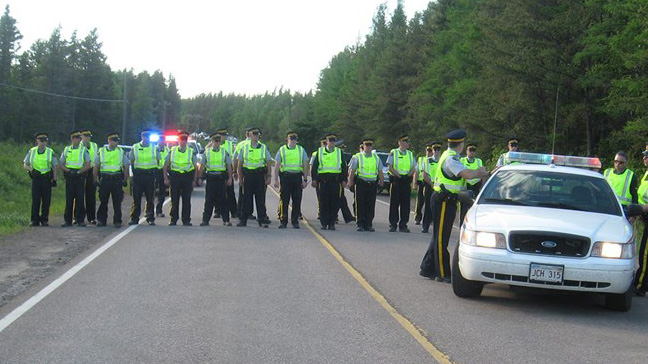
Mi’kmaq, Maliseet Continue Anti-Fracking Protests in New Brunswick

8/6/13

It was anoth­er day of protest in New Brunswick as Mi’kmaq, Maliseet and their sup­port­ers voiced their oppo­si­tion to shale gas explo­ration in Kent Coun­ty.

8/6/13

It was anoth­er day of protest in New Brunswick as Mi’kmaq, Maliseet and their sup­port­ers voiced their oppo­si­tion to shale gas explo­ration in Kent Coun­ty.

About 100 peo­ple have gath­ered near the town of Birch Ridge, NB, where SWN Resources Cana­da and their sub­con­trac­tors have equip­ment and vehi­cles used for shale gas explo­ration stored.

SWN Resources Cana­da is one of the largest com­pa­nies involved in shale gas explo­ration in the province. Many Mi’kmaq and Maliseet are opposed to the explo­ration, say­ing that it will even­tu­al­ly lead to ‘frack­ing’ and cause seri­ous harm to the envi­ron­ment, espe­cial­ly water.

First Nations also say there was insuf­fi­cient con­sul­ta­tion done by the province.

Ama­teur video and pho­tos show a heavy RCMP pres­ence at the site of today’s protest, although the sit­u­a­tion remains peace­ful.

This is the fourth day of protests in New Brunswick, sparked when mem­bers of the Elsi­pog­tog First Nation seized a vehi­cle belong­ing to Stan­tec, which is a Fred­er­ic­ton-based com­pa­ny sub­con­tract­ed to SWN Resources Cana­da.

One of the pro­test­ers is Susan Levi-Peters, once Chief of Elsi­pog­tog and for­mer can­di­date for the provin­cial NDP. She says frus­tra­tion is build­ing with shale gas explo­ration and with the RCMP.

Levi-Peters says with ten­sions run­ning so high, the province’s Pre­mier David Alward should halt fur­ther shale gas explo­ration until all sides can come togeth­er and dis­cuss the path for­ward.

But she and oth­ers warn that with oppo­si­tion against shale gas explo­ration so high, it’s unlike­ly First Nations will agree to allow the indus­try to devel­op.

Here’s a brief time­line of events:

Tues­day, June 4

Mem­bers of Elsi­pog­tog First Nation in New Brunswick sur­round­ed a vehi­cle owned by Stan­tec that was parked at a restau­rant near the com­mu­ni­ty. RCMP inter­vened and brought the vehi­cle to the local sta­tion. Com­mu­ni­ty mem­bers fol­lowed and refused to allow the vehi­cle to leave. The vehi­cle was even­tu­al­ly returned to the com­pa­ny and no arrests were made. Fol­low­ing the inci­dent, New Brunswick’s Ener­gy Min­is­ter issued a call for protests to remain peace­ful.

Wednes­day, June 5

Around 100 peo­ple from Elsi­pog­tog and sur­round­ing com­mu­ni­ties gath­er on provin­cial route 126, at the SWN Resources Cana­da site. Wit­ness­es say although the protest was peace­ful, a large con­tin­gent of RCMP moved in and arrest­ed 3, includ­ing a 16-year-old. The Chief of Elsi­pog­tog, Arren Sock, issued a state­ment say­ing that the com­mu­ni­ty is opposed to shale gas explo­ration and that Mi’kmaq voic­es must be heard. He also issued a call for calm among pro­test­ers, urg­ing them to remain peace­ful and law­ful.

Thurs­day, June 6

Anoth­er after­noon of protests on route 126. Around 100 gath­er again and there was a heavy RCMP pres­ence but no arrests are made.

Fri­day, June 7

Over 100 are gath­ered at the site on route 126, includ­ing St. Mary’s First Nation Chief Can­dice Paul. Chief Paul has been opposed to the shale gas indus­try since the province announced explo­ration would begin over the win­ter.

Indigenous Peruvians Protest State Oil Company Taking Over Their Land

Mem­bers of the Achuar indige­nous peo­ple in the north­ern Peru­vian Ama­zon have been protest­ing against Peru’s state oil company’s plans to enter their ter­ri­to­ry and exploit an esti­mat­ed 42 mil­lion bar­rels of light oil.

Mem­bers of the Achuar indige­nous peo­ple in the north­ern Peru­vian Ama­zon have been protest­ing against Peru’s state oil company’s plans to enter their ter­ri­to­ry and exploit an esti­mat­ed 42 mil­lion bar­rels of light oil.

A protest was held against Petrope­ru last month in an Achuar com­mu­ni­ty called Wisum near the bor­der with Ecuador, just 12 days after it was con­firmed the com­pa­ny would take over oper­a­tions in a con­ces­sion called “Lot 64.”

Petroperu’s involve­ment in this region fol­lows the deci­sion announced last Sep­tem­ber by Cana­di­an com­pa­ny Tal­is­man to with­draw from “Lot 64″, after dis­cov­er­ing oil but meet­ing oppo­si­tion from Achuar liv­ing with­in the con­ces­sion.

The recent protest could be con­sid­ered extreme­ly embar­rass­ing for Petrope­ru since its acqui­si­tion of “Lot 64″ con­sti­tutes a return to upstream oper­a­tions after a break of 17 years, accord­ing to Lima-based news­pa­per La Repub­li­ca, which called the move “his­toric.”

The protest was held on Wisum’s land­ing strip and involved men, women and chil­dren from more than 20 Achuar com­mu­ni­ties, some of whom held signs read­ing “We reject Petrope­ru” and “No Petrope­ru: no to the sale of our Achuar ter­ri­to­ry.”

A state­ment by the Peru­vian Fed­er­a­tion of Achuar Nation­al­i­ties (FENAP) reads:

Petrope­ru should not oper­ate in Lot 64. As the own­ers of our ter­ri­to­ry, we are opposed to oil activ­i­ties. We are inform­ing the Peru­vian state that the posi­tion of the Achuar peo­ple in the Pas­taza region has not changed since the cre­ation, with­out con­sul­ta­tion, of Lot 64 in 1995. We will con­tin­ue active­ly resist­ing any kind of oil oper­a­tion on our ances­tral ter­ri­to­ry which cov­ers the large major­i­ty of the con­ces­sion.

That fol­lowed a state­ment by anoth­er Achuar orga­ni­za­tion, Achuar­ti Irun­tramo (ATI), which is based in Wisum and affil­i­at­ed to FENAP, addressed to Peru’s pres­i­dent Ollan­ta Humala, Petrope­ru, var­i­ous min­istries and Con­gress express­ing “our rejec­tion of any kind of entrance of oil com­pa­nies, even Petrope­ru, in the Achuar people’s ances­tral ter­ri­to­ry”:

We’re aware of the Supreme Decree trans­fer­ring Lot 64 from Tal­is­man to Petrope­ru. We don’t want anoth­er buy­er, even if it’s Petrope­ru. Ever since the cre­ation of the con­ces­sion in 1995, we have opposed all the com­pa­nies here, begin­ning with Arco, then Occi­den­tal and most recent­ly Tal­is­man. Like we did for all of those, we will make it impos­si­ble for Petrope­ru to enter.

Both state­ments express con­cerns about the poten­tial social and envi­ron­men­tal impacts of oil oper­a­tions.

“We’ve seen that the Riv­er Cor­ri­entes is very con­t­a­m­i­nat­ed and know that Lot 1‑AB has been declared a Zone of Envi­ron­men­tal Emer­gency after years of com­plaints from our Achuar and Quechua broth­ers,” states FENAP, refer­ring to a near­by oil con­ces­sion. “We don’t want his­to­ry to be repeat­ed and so we don’t want any more com­pa­nies com­ing here – whether nation­al or inter­na­tion­al ones.”

“Our protest has many mean­ings,” says FENAP’s pres­i­dent, Peas Peas Ayui, speak­ing from San Loren­zo in the Ama­zon where FENAP has an office. “We’re not going to let any com­pa­ny enter. We are the own­ers. We are the orig­i­nal inhab­i­tants. We want to live in peace. We have the right to stand up for our­selves and if Petrope­ru tries to enter we will fight very hard against it.”

How­ev­er, accord­ing to Petroperu’s Juan José Bete­ta Her­rera, the com­pa­ny will start oper­at­ing as soon as it has met the envi­ron­men­tal require­ments stip­u­lat­ed by Peru­vian law, which will include prepar­ing an “Envi­ron­men­tal Impact Assess­ment” of its planned oper­a­tions.

“This will pro­vide light crude for Petroperu’s refiner­ies in Talara and Iqui­tos and return the com­pa­ny to upstream activ­i­ties, which forms part of our strat­e­gy,” he says. “At the same time, it will bring social ben­e­fits to the com­mu­ni­ties cur­rent­ly involved in the area.”

Asked how Petrope­ru will respond to the Achuar’s protest, Bete­ta Her­rera says the com­pa­ny will “con­tin­ue with the com­mu­ni­ty rela­tions pol­i­cy it has been imple­ment­ing for the last 40 years along the route of the North Peru­vian Pipeline.”

“Part of that pol­i­cy is to main­tain con­stant com­mu­ni­ca­tion with the com­mu­ni­ties in the areas of our oper­a­tions,” he says.

But Peas Peas Ayui says he has heard noth­ing from Petrope­ru since the protest in Wisum, and ATI’s recent state­ment claims the pipeline – an exten­sion of which pass­es through “Lot 64″ – is con­t­a­m­i­nat­ing their ter­ri­to­ry and threat­en­ing fish stocks.

US-based NGO Ama­zon Watch’s Exec­u­tive Direc­tor Atossa Soltani says:

As a cor­ner­stone of their strat­e­gy to strength­en Petrope­ru, Peru’s gov­ern­ment has cho­sen Block 64 as a pilot project to show­case the company’s poten­tial. But the over­whelm­ing major­i­ty of the block is ter­ri­to­ry of Achuar com­mu­ni­ties that have repeat­ed­ly reject­ed any oil activ­i­ty and have effec­tive­ly expelled mul­ti­ple transna­tion­al com­pa­nies since 1995. How does Petrope­ru think they are going to be suc­cess­ful where Arco, Oxy, and final­ly Tal­is­man have failed?

Hav­ing announced its dis­cov­ery of oil in “Lot 64″ in ear­ly 2006, Tal­is­man revealed it was pulling out on 12 Sep­tem­ber last year. Ama­zon Watch described it as a “major vic­to­ry for indige­nous rights” fol­low­ing “increased pres­sure by human rights groups and share­hold­ers for oper­at­ing with­out Achuar con­sent.”

But Talisman’s Phoebe Buck­land calls it a “busi­ness deci­sion.”

“Peru was part of our explo­ration port­fo­lio and we have sig­nif­i­cant­ly reduced the explo­ration bud­get to focus on oppor­tu­ni­ties near our core areas,” she says now. “We are cur­rent­ly wind­ing down oper­a­tions in Peru.”

June 11: International Day of Solidarity with Marie Mason and Eric McDavid

June 11th began as an inter­na­tion­al day of sol­i­dar­i­ty with long-term eco-pris­on­er Jeff “Free” Luers in 2004. At the time, Jeff was serv­ing 22+ years. Infu­ri­at­ed by the envi­ron­men­tal dev­as­ta­tion he saw occur­ring on a glob­al scale, Jeff torched three SUVs at a car deal­er­ship in Eugene, OR. The sen­tence imposed on him was meant to send a clear mes­sage to oth­ers who were angered by capitalism’s con­tin­ued war on the Earth’s ecosys­tems – and to those who were will­ing to take action to put a stop to it. Jeff is, after all, not alone in his con­cerns about cli­mate change, fos­sil fuels, pol­lu­tion and genet­i­cal­ly mod­i­fied organ­isms.

After years of strug­gle, Jeff and his legal team won a reduc­tion in his sen­tence and he was released from prison in Decem­ber 2009. But in the years inter­ven­ing Jeff’s arrest and release, the FBI had car­ried out a series of indict­ments and arrests in an attempt to dev­as­tate the rad­i­cal envi­ron­men­tal and anar­chist com­mu­ni­ties. Two of the peo­ple caught up in this mael­strom of repres­sion were Eric McDavid and Marie Mason.

Eric McDavid was arrest­ed in Jan­u­ary 2006 after being entrapped by a paid gov­ern­ment infor­mant – “Anna” – and was charged with a sin­gle count of con­spir­a­cy. Eric – who nev­er car­ried out any actions and was accused of what amounts to “thought crime” – refused to coop­er­ate with the state and took his case to tri­al. After a tri­al fraught with errors, the jury con­vict­ed Eric. He was sub­se­quent­ly sen­tenced to almost 20 years in prison. More infor­ma­tion on Eric’s case can be found at www.supporteric.org

Marie Mason was arrest­ed in March 2008 after her for­mer part­ner – Frank Ambrose – turned infor­mant for the FBI. Fac­ing a life sen­tence if she went to tri­al, Marie accept­ed a plea bar­gain in Sep­tem­ber 2008, admit­ting her involve­ment in the burn­ing of an office con­nect­ed to GMO research and the destruc­tion of a piece of log­ging equip­ment. At her sen­tenc­ing in Feb­ru­ary the fol­low­ing year, she received a sen­tence of almost 22 years. More infor­ma­tion on Marie’s case can be found at www.supportmariemason.org

Marie Mason and Eric McDavid share the unfor­tu­nate dis­tinc­tion of hav­ing the longest stand­ing sen­tences of any envi­ron­men­tal pris­on­ers in the Unit­ed States. Please join us in an inter­na­tion­al day of sol­i­dar­i­ty with Marie Mason, Eric McDavid, and oth­er long-term anar­chist pris­on­ers on every June 11th. This is a time to remem­ber our friends who are in prison – who are con­tin­u­ing their strug­gles on the inside. This is a time to con­tin­ue and strength­en the very work for which Eric and Marie are now serv­ing so much time – to strug­gle against cap­i­tal­ism, eco­log­i­cal dev­as­ta­tion, and the ever more dif­fuse forms of con­trol in this prison soci­ety.

Free Marie and Eric! Free all pris­on­ers!

Shale Gas Truck Seized By Elsipogtog First Nation Warriors

A shale gas explo­ration company’s ser­vice vehi­cle was sur­round­ed and seized by a group of self-described native war­riors near Elsi­pog­tog First Nation in so called “New Brunswick” on Tues­day, Roy­al Cana­di­an Mount­ed Police say.

A shale gas explo­ration company’s ser­vice vehi­cle was sur­round­ed and seized by a group of self-described native war­riors near Elsi­pog­tog First Nation in so called “New Brunswick” on Tues­day, Roy­al Cana­di­an Mount­ed Police say.

The truck dri­ver was con­front­ed at a gas bar along Route 116 dur­ing the lunch hour, police said, refer­ring to it as a peace­ful inci­dent.

RCMP would not con­firm who owns the truck, but it has a Stan­tec logo on its doors. Stan­tec is a Fred­er­ic­ton-based engi­neer­ing firm doing work for SWN Resources Cana­da, a major indus­try play­er in the province.

RCMP described the inci­dent as peace­ful.

Elsi­pog­tog Chief Aaron Sock had said ear­li­er in the day his coun­cil does not wel­come SWN’s seis­mic test­ing in New Brunswick.

SWN spokes­woman Tracey Stephen­son described the inci­dent as a “secu­ri­ty event” involv­ing one of the company’s sub­con­trac­tors.

The protest in Elsi­pog­tog con­tin­ued into the evening Tues­day at the local RCMP detach­ment, where the truck con­tain­ing seis­mic test­ing equip­ment was tak­en after pro­test­ers had seized it at a gas sta­tion along Route 116 dur­ing the lunch hour.

About 65 peo­ple, includ­ing chil­dren, gath­ered around the truck in a bid to keep it from being moved from the RCMP park­ing lot.


“I think [SWN] should pack up their gear and go,” said John Levi, who led the protest.

“This is not going to end until they do that,” he said. “That’s our goal.”

Levi said he is not affil­i­at­ed with the band chief and coun­cil, but was appoint­ed a few days ago as a war­rior chief for his tra­di­tion­al native ter­ri­to­ry.

He said he rep­re­sents about 5,000 peo­ple in Elsi­pog­tog and the sur­round­ing area, includ­ing non-native groups who oppose the devel­op­ment of a shale gas indus­try.

“They broke the law a long time ago when they start­ed this frack­ing in our tra­di­tion­al hunt­ing grounds, med­i­cine grounds, con­t­a­m­i­nat­ing our waters,” Levi said.

Hydraulic frac­tur­ing, also known as hydro-frack­ing, is a process where explo­ration com­pa­nies inject a mix­ture of water, sand and chem­i­cals into the ground, cre­at­ing cracks in shale rock for­ma­tions.

That process allows com­pa­nies to extract nat­ur­al gas from areas that would oth­er­wise go untapped.

Oppo­nents of the process say it could have a neg­a­tive effect on local water sup­plies and many of them have held protests across the province.

Fracking secrecy questioned

The Oppo­si­tion Lib­er­als argued Tues­day there will be too much secre­cy sur­round­ing shale gas devel­op­ment in the province.

They not­ed sec­tions of the Oil and Gas Act will remain off-lim­its from the Right to Infor­ma­tion law.

But the ener­gy min­is­ter con­tends the exempt sec­tions apply to the geo­phys­i­cal data com­pa­nies will col­lect and it’s unrea­son­able to expect it would be made pub­lic.

“That infor­ma­tion, the com­pa­nies that are putting the invest­ment into that research, they should have the oppor­tu­ni­ty to uti­lize that infor­ma­tion to their advan­tage, for a rea­son­able amount of time, and that’s what the Oil and Gas Act says,” Leonard said.

The Lib­er­als argue they want to make sure the pub­lic knows what chem­i­cals are used by shale gas com­pa­nies. The gov­ern­ment says the list of chem­i­cals will be released pub­licly.

Mine Security Chief Ordered Assassination of Indigenous Protesters 4th June

Alber­to Roton­do, exec­u­tive of Tahoe Mine, San Rafael in Guatemala, gave direct orders to assas­si­nate mem­bers of the com­mu­ni­ty San Rafael Las Flo­res.

Alber­to Roton­do, exec­u­tive of Tahoe Mine, San Rafael in Guatemala, gave direct orders to assas­si­nate mem­bers of the com­mu­ni­ty San Rafael Las Flo­res.

The inves­ti­ga­tion of the min­ing con­flicts in San Rafael Las Flo­res, San­ta Rosa, took a 180 degrees turn, after the Pub­lic Min­istry sub­mit­ted audio from wire­tap­ping as evi­dence. In the audio it can be clear­ly heard how Alber­to Roton­do, head of the San Rafael Min­ing Secu­ri­ty out­fit ordered to assas­si­nate oppo­nents of the mine.

The news­pa­per Siglo.21 pub­lished today a report titled “Roton­do ordered: Kill those sons of B..”, the report doc­u­ments how the Secu­ri­ty Chief gave direct orders to assas­si­nate min­ing pro­test­ers and oppo­nents of the min­ing project.

“The pre­lim­i­nary inves­ti­ga­tions found that Roton­do gave the order to attack the com­mu­ni­ty, he also ordered the crime scene to be cleaned up and change the police report.”

The infor­ma­tion reveals Roton­do mak­ing sev­er­al state­ments: “God dam dogs, they do not under­stand that the mine gen­er­ates jobs”. “We must elim­i­nate these ani­mals’ pieces of shit”. “We can not allow peo­ple to estab­lish resis­tance, anoth­er Puya no”. “Kill house sons of Bitch­es”

Despite this sit­u­a­tion, Roton­do is ben­e­fit­ed by a benev­o­lent sur­ro­gate mea­sure of only house arrest by offi­cials of the jus­tice depart­ment of Guatemala. The pros­e­cu­tion has asked to revoke that proxy mea­sure.

On the oth­er hand, oppo­nents of the mine are still detained with­out being brought before a judge, because their war­ranties were restrict­ed by a state of siege.

Ror­ton­do was appre­hend­ed at the air­port La Auro­ra, when he try­ing to flee the coun­try. Wire tap­ping of con­ver­sa­tions between him and his son reveal that he planned to leave Guatemala for a while, because “I ordered to kill some of these sons of Bitch­es.”

Sources: La Hora Guatemala, Siglo XXI.

For more exten­sive infor­ma­tion on the back­ground of the con­flict see: State of Siege: Min­ing Con­flict Esca­lates in Guatemala, May 2, 2013

http://upsidedownworld.org/main/guatemala-archives-33/4270-state-of-siege-mining-conflict-escalates-in-guatemala

Letter No. 9: Tragedies and Dams (the struggle does not end there nor here)

In an unprece­dent­ed step, the Brazil­ian gov­ern­ment has met pro­tes­tors’ demands by fly­ing the entire indige­nous occu­pa­tion – as well as their legal coun­cil and accom­pa­ny­ing jour­nal­ists – from Altami­ra to Brasil­ia to dia­logue with Pres­i­dent Rousseff’s Chief of Staff Gilber­to Car­val­ho and oth­er high offi­cials and min­is­ters. 

Led by the Mundurukú peo­ple of the Tapa­jós Riv­er basin, occu­pa­tions of Belo Monte’s main work camp spanned 17 days from May to June demand­ing the sus­pen­sion of dam con­struc­tion and envi­ron­men­tal fea­si­bil­i­ty stud­ies for future dams on indige­nous lands, and the guar­an­tee of the con­sti­tu­tion­al right to pri­or con­sul­ta­tion.

The 150 indige­nous pro­tes­tors who have staged a coura­geous nine-day occu­pa­tion of the Belo Monte dam’s main work camp have trav­eled to Brasil­ia today to meet in the Pres­i­den­tial Palace with high offi­cials from the Brazil­ian gov­ern­ment. Today the indige­nous groups issued a 9th let­ter to the gov­ern­ment (see below)

Let­ter No. 9:
Tragedies and Dams (the strug­gle does not end there nor here)

We have left our occu­pa­tion of the Belo Monte dam and have come to dia­logue with the gov­ern­ment.

We have not come to an agree­ment with you. We accept this meet­ing in Brasil­ia because the more we said we would not leave, the more you sent police to the work camp. And on the same day that we were to be removed by force by the police, you killed a one of our rel­a­tives, a Ter­e­na in Mato Grosso do Sul. There­fore we decid­ed that we did not want anoth­er death. We avoid­ed a tragedy, not you. You do not pre­vent tragedies, you com­mit them.

We came here to speak to you of anoth­er tragedy that we will fight to pre­vent: the loss of our ter­ri­to­ry and our life. We did not come to nego­ti­ate with you, because one can­not nego­ti­ate with ter­ri­to­ry nor life. We are against the con­struc­tion of dams that kill indige­nous land, because they kill cul­ture when they kill fish and drown the land. This kills us with­out need­ing a weapon. You con­tin­ue killing a lot, sim­ply a lot. You have killed too much, for 513 years.

We did not come to talk only about dams on the Tapa­jós, as you are telling the press. We came to Brasil­ia to demand the sus­pen­sion of fea­si­bil­i­ty stud­ies and the con­struc­tion of dams on the Xin­gu, Tapa­jós, and Teles Pires Rivers. You are not only talk­ing with the Mundurukú peo­ple. You are talk­ing with Xipaya, Kayapó, Arara, Tupinam­bás, and with all the peo­ple who are togeth­er in this strug­gle, because this is a major strug­gle of us all.

We did not bring wish lists. We are against dams. We demand the fed­er­al government’s com­mit­ment to con­sult us and ensure our right to veto projects that destroy us.

But no. You tram­ple every­thing and do what they [the dam build­ing com­pa­nies] want. And to achieve that you do every­thing to divide indige­nous peo­ples. We came here to tell you to stop, because we will resist togeth­er and stand unit­ed. We have been gath­ered for 35 days in Altami­ra, and for 17 days we occu­pied the main hydro­elec­tric dam that you are build­ing. Along with this let­ter we are send­ing all the let­ters from the two occu­pa­tions that we car­ried out. Read every­thing care­ful­ly to under­stand our move­ment. And in so doing respect us, as you have not done up until today.

Dis­re­spect does not come only from words. It is demon­strat­ed by your actions.

In the region of the Xin­gu River’s Big Bend, every­thing is being destroyed and has been turned upside down since you approved the con­struc­tion of the Belo Monte dam. Every­one very sad and only the rich are doing well. Our indige­nous rel­a­tives have fought a lot. Even the con­struc­tion work­ers suf­fer.

On the Teles Pires and Tapa­jós Rivers, you are begin­ning this process now, but have already grave­ly dis­re­spect­ed us.

In August 2012, your researchers began to invade our lands, cap­ture our ani­mals and plants, count hectares, mea­sure the water, and drill our land.

In Octo­ber, [the indige­nous agency] FUNAI and Eletro­bras said in the meet­ing that the dams would be built in any cir­cum­stance, whether or not we want them. And that they would send the police force to our land if nec­es­sary.

In Novem­ber, the fed­er­al police attacked and destroyed the Teles Pires vil­lage, where we are all against dams. Ade­nil­son Mundurukú was killed, shot three times, and anoth­er 19 indige­nous peo­ple were wound­ed. At the end of the month we went to Brasil­ia denounce the police oper­a­tion to the Min­istry of Jus­tice, FUNAI and the Gen­er­al Sec­re­tari­at of the Pres­i­den­cy. We also went to pros­e­cu­tors from the Fed­er­al Pubic Min­istry.

In Jan­u­ary 2013, we held a large assem­bly in the Mundurukú vil­lage of Sai Cin­za, where a doc­u­ment with 33 demands was deliv­ered to a rep­re­sen­ta­tive of the Gen­er­al Sec­re­tari­at of the Pres­i­den­cy.

The fol­low­ing month, we returned to Brasil­ia demand a response from the Gen­er­al Sec­re­tari­at on these 33 points. We man­aged to find the min­is­ter, but he ignored our demands and tried to get us to sign a doc­u­ment accept­ing dams on the Tapa­jós Riv­er.

To ensure that envi­ron­men­tal impact stud­ies of these dams were car­ried out, the gov­ern­ment issued a decree in March 2013 autho­riz­ing the entry of police troops on our land. On the fol­low­ing day our vil­lages were raid­ed by police squads.

On the Teles Pires Riv­er, the ancient bones of our rel­a­tives were unearthed. You are destroy­ing a sacred place.

We could not accept this sit­u­a­tion any­more. For this rea­son we occu­pied your work camp, bring­ing our claims, demand­ing the government’s com­mit­ment to respect the orig­i­nal peo­ples of this coun­try, to respect our right to land and to life. Or, at least for the gov­ern­ment to respect its own law: the Con­sti­tu­tion and the inter­na­tion­al treaties you sign. Yet you want to destroy the laws that pro­tect us, indige­nous peo­ples, with oth­er laws and new decrees. You want to legal­ize destruc­tion.

And now we come here to you. Hop­ing that you final­ly lis­ten to us, rather than lis­ten­ing to those who pay for your polit­i­cal cam­paigns. Even if you are not will­ing to learn to lis­ten, we are will­ing to teach.
– Con­struc­tion site of the Belo Monte dam, Vitória do Xin­gu, June 4, 2013

URGENT: “We will die. We will not leave without being heard.” 4th June

Only two days after the reoc­cu­pa­tion of the Belo Monte Dam began, the fate of 170 indige­nous peo­ple is at stake. Yes­ter­day, the Fed­er­al Court in Altami­ra ordered them to leave by 4 pm today or they would be removed by Fed­er­al Police. They respond­ed by tear­ing up the order and refused to leave by the dead­line. Instead, they are stand­ing strong and are demand­ing that Pres­i­dent Dilma’s Chief of Staff, Gilber­to Car­val­ho, come meet with them. Their let­ter to the Brazil­ian gov­ern­ment is below. Read, share and take urgent action right now!

You can also show your sup­port by donat­ing to the indige­nous occu­pa­tion on CAUSES.

Let­ter No. 8:
The mas­sacre has been announced and only the gov­ern­ment can avoid this fate

(Orig­i­nal ver­sion in Por­tuguese here)

We have occu­pied the con­struc­tion site of the Belo Monte Dam. We are defend­ing our lands. These ancient lands have always been ours and you have already tak­en a part of them. And now you are try­ing to take more. We will not leave.

You will come to kill us and we will die. We will not leave with­out being heard.

The fed­er­al gov­ern­ment announced a mas­sacre of indige­nous peo­ples, the 170 war­riors, women, chil­dren, lead­ers and shamans who are here. This mas­sacre is going to hap­pen at the hands of police, Funai, and the judi­cial sys­tem.

You have killed at Teles Pires and will kill again when you need to. You killed us because we are against the dams. We know what you are capa­ble of doing.

This time the gov­ern­ment and cor­po­ra­tions have asked Norte Ener­gia to kill us. Norte Ener­gia pled their case to a fed­er­al judge, who sub­se­quent­ly autho­rized the police to beat and kill us if need­ed. Gov­ern­ment of Brazil and cor­po­ra­tions build­ing Belo Monte, it will be your fault if any of us die.

Enough with the vio­lence! Stop threat­en­ing us! We want our peace and you want your war. Stop lying to the press that we are kid­nap­ping work­ers and bus­es and caus­ing an incon­ve­nience. The occu­pa­tion is qui­et The unrest is caused by the police sent by the judge, Norte Ener­gia, and the gov­ern­ment. You are the ones who are humil­i­at­ing us, threat­ing us, intim­i­dat­ing us, and assas­si­nat­ing us when you don’t know what else to do.

We demand the sus­pen­sion of the order to repos­sess the con­struc­tion site, until Thurs­day morn­ing, May 30th, 2013. The gov­ern­ment needs to come here and hear us. You already know our agen­da. We demand the sus­pen­sion of all works and stud­ies of dams on our lands. We demand the removal of the Nation­al Force from our lands. The lands are ours. You have wast­ed enough of our lands.

You want us to be tame and qui­et, obey­ing your civ­i­liza­tion with­out ques­tion. But in this case, we know you would rather see us dead because we are mak­ing noise.

Sea Turtle Activist Murdered in Costa Rica 4th June

Jairo Mora San­doval, a 26 year-old sea tur­tle con­ser­va­tion­ist and activist, was mur­dered late last week in Cos­ta Rica. Accord­ing to news reports from Cen­tral Amer­i­ca, San­doval and four oth­er sea tur­tle vol­un­teers, includ­ing three Amer­i­can women and a woman from Spain,  were kid­napped on Thurs­day,  May 30, by armed men.

San­doval was found tied up, beat­en and shot dead in the head on the beach the fol­low­ing day. The four vol­un­teers had escaped or been released.

Ini­tial reports on the police inves­ti­ga­tion point to the mur­ders being poach­ers after sea tur­tle eggs.

San­doval is yet anoth­er in a long list of fall­en war­riors mur­dered for defend­ing life on Earth.

60,000 in Tokyo Protest Government Plans to Restart Nuclear Power 3rd June

Approx­i­mate­ly 60,000 peo­ple ral­lied in Japan’s cap­i­tal of Tokyo on Sun­day, June 2nd in order to protest recent gov­ern­ment plans to restart the country’s idled nuclear reac­tors. Peo­ple gath­ered in Shi­ba Park and lat­er marched towards the par­lia­ment build­ing. Among the orga­niz­ers was Ken­z­aburo Oe, a Nobel lit­er­a­ture lau­re­ate, who called on the Japan­ese gov­ern­ment to leave the nuclear pow­er plants in sus­pen­sion out of fears for safe­ty.

The Japan­ese gov­ern­ment has pre­vi­ous­ly stat­ed that it will most like­ly allow those reac­tors to return to pow­er which have been approved by the Nuclear Reg­u­la­tion Author­i­ty (NRA), whose new safe­ty guide­lines are sched­uled to be adopt­ed in July. One of Japan’s largest-ever protests saw 170,000 peo­ple gath­er in a sim­i­lar fash­ion in July 2012, around the same time that then-Prime Min­is­ter Yoshi­hiko Noda decid­ed on the first two reac­tor restarts since the March 2011 Fukushi­ma dis­as­ter. As of now, the anti-nuclear pro­tes­tors say they have col­lect­ed over 8 mil­lion sig­na­tures of those opposed to reac­tor restarts.

As they marched through the streets, the pro­tes­tors car­ried signs and ban­ners that had mes­sages such as “No Nukes! Unevolved Apes Want Nukes!” As of today, the two reac­tors that were restart­ed last sum­mer, locat­ed in Oi, Fukui Pre­fec­ture, are the only ones out the country’s 50 that have returned to oper­a­tion. While Sunday’s ral­ly was orga­nized between three dif­fer­ent groups, Kyo­do news report­ed that the Tokyo Met­ro­pol­i­tan Police Depart­ment had put the num­ber of pro­test­ers between 20,000 and 30,000.

San Francisco Activists Liberate Park in Solidarity with Turkish Resistance 2nd June

On June 1st, in sol­i­dar­i­ty with the mas­sive resis­tance in Turkey which began six days ago, Lib­er­ate the Land activists in San Fran­cis­co marched to a park space known as “Hayes Val­ley Farm” and began an occu­pa­tion.

On June 1st, in sol­i­dar­i­ty with the mas­sive resis­tance in Turkey which began six days ago, Lib­er­ate the Land activists in San Fran­cis­co marched to a park space known as “Hayes Val­ley Farm” and began an occu­pa­tion. The piece of land is sched­uled to be turned into con­do­mini­ums, a devel­op­ment project which the pro­tes­tors plan to stop. Not only are they phys­i­cal­ly hold­ing the space with their bod­ies and mul­ti­ple treesits, the group is also plant­i­ng a “Free Farm” for the com­mu­ni­ty, shar­ing reg­u­lar meals, and hold­ing com­mu­ni­ty-build­ing and per­ma­cul­ture work­shops.

Par­tic­i­pants have renamed the space “Gezi Gar­dens” in sol­i­dar­i­ty with the cur­rent rebel­lion in Turkey, which began with the occu­pa­tion of Gezi park in Istan­bul. Pro­test­ers in Istan­bul began occu­py­ing Gezi park when devel­op­ers start­ed rip­ping up the trees to make way for a shop­ping mall. The insane police response sparked an upris­ing that has swept the coun­try. There have been oth­er sol­i­dar­i­ty demon­stra­tions all over the world, includ­ing the reoc­cu­pa­tion of Zuc­cot­ti park in New York City, the orig­i­nal home of Occu­py Wall Street.

Lib­er­ate the Land plans to occu­py indef­i­nite­ly, and has released a state­ment ask­ing oth­ers to join them:

Lib­er­ate the Land invites every­one to join this net­work in the days fol­low­ing today’s lib­er­a­tion, to plant food, cre­ate and pro­mote per­ma­cul­ture, host and attend work­shops, teach and take class­es, play and enjoy music, build, gath­er, exper­i­ment, play, learn, and be togeth­er.  A vibrant com­mu­ni­ty of plants and peo­ple are liv­ing on this land as of this first of June rather than the first lay­ers of con­crete foun­da­tion for con­do­mini­ums.  We invite our neigh­bors in Hayes Val­ley to join us in open dia­logue to fur­ther decide what Gezi Gar­dens will become.

Lib­er­ate the Land is bring­ing into dia­logue the con­cept of com­mon space, a clas­si­fi­ca­tion of space that goes out­side of the dichoto­my of pri­vate and pub­lic and instead places itself as the com­mons. The com­mons exist as the spaces owned and oper­at­ed nei­ther by gov­ern­ments and states, nor cor­po­ra­tions and pri­vate indi­vid­u­als. Instead, the com­mons are owned, or stew­ard­ed, by all peo­ple, with an under­stand­ing that the gifts of the earth are for all to enjoy and that peo­ple need land bases for grow­ing food, har­vest­ing med­i­c­i­nal plans, main­tain­ing healthy forests for build­ing mate­ri­als and fire­wood, wild­craft­ing plants for fab­rics, and host­ing wildlife habi­tat.

Read the rest of the state­ment here, and fol­low @LiberateLand on twit­ter for more updates on Gezi Gar­dens