
 Police violently disperse unar
med peasant protesters in Catatumbo, Colombia, Jun 2013 (photo by Telesur)
Police violently disperse unar
Police violently disperse unarmed peasant protesters in Catatumbo, Colombia, Jun 2013 (photo by Telesur)27 June The Colombian military has killed at least four peasant protesters in the region of Catatumbo, wounded dozens more (including 21 gunshot wounds) and arrested hundreds.
From Alliance for Global Justice:
In Catatumba, peasants have been holding protests, blocking roads and occupying facilities to protest to the government’s chemical spraying of Monsanto’s RoundUp Ultra herbicide as part of coca eradication efforts; and the refusal of the government to establish a Peasant Reserve Zone, as authorized by legislation in 1994 and 1996. That legislation would provide protected land for collective farming. Protesters say that they are being denied this in favor of concessions made to foreign coal [and oil] companies.
Learn more about the background of the protests here, then send a letter to Colombian officials demanding an end to the violence.
FBI Chases Anti-GMO Activists While Ignoring Monsanto’s Transgressions
25 June 2013 Some experimental GMO crops were torn out of a field in Oregon this month. That means it’s time for the federal government to freak the fuck out and do its best to clamp down again on eco-activism.
25 June 2013 Some experimental GMO crops were torn out of a field in Oregon this month. That means it’s time for the federal government to freak the fuck out and do its best to clamp down again on eco-activism.
The sugar beet plants, which were genetically engineered by Syngenta to survive applications of the herbicide Roundup, were uprooted in the middle of the night from a couple of fields, presumably by anti-GMO activists. The destruction of the experimental crops occurred in the same state where a strain of Monsanto’s illegal herbicide-resistant wheat recently showed up in a farmer’s field, threatening America’s multibillion-dollar wheat export market.
Guess which crime the FBI is desperate to crack?
That’s right: The sugar beet one. The agency announced that it “considers this crime to be economic sabotage and a violation of federal law involving damage to commercial agricultural enterprises.” According to the FBI, a $10,000 reward is being offered for clues by Oregonians for Food and Shelter, a corporate forestry and agriculture group that lobbies for pro-GMO and pro-pesticide legislation.
The Oregonian reports that 1,000 genetically engineered sugar beet plants were uprooted from land leased by Syngenta on June 8:
“Three nights later, the destruction continued on another property, where another 5,500 plants were ruined.
“It doesn’t look like a vehicle was used. It looks like people entered the field and destroyed the plants by hand,” said Paul Minehart, head of corporate communications in North America for Syngenta, a global agriculture corporation based in Basel, Switzerland.
Estimates for the damage were not specified but the financial losses are significant, according to FBI spokeswoman Beth Anne Steele.”
Meanwhile, Monsanto is continuing to push its claim that its genetically engineered wheat turned up on an Oregon farm because of an act of sabotage. That claim is drawing skepticism from the expert whose tests first confirmed that the rogue wheat was developed by Monsanto. From a report in The Guardian:
“While Monsanto’s chief technology officer suggested eco-activists were to blame, [Oregon State University weed sciences professor Carol] Mallory-Smith said deliberate contamination was the least likely scenario:
‘The sabotage conspiracy theory is even harder for me to explain or think as logical because it would mean that someone had that seed and was holding that seed for 10 or 12 years and happened to put it on the right field to have it found, and identified. I don’t think that makes a lot of sense.’”
We may learn more about the cause of the GMO wheat contamination after the U.S. Department of Agriculture completes an investigation.
But let’s get back to the sugar beets case. If you happen to know who uprooted those plants, The Oregonian has a request for you:
“Ring the local offices of the FBI at (541) 773-2942 during normal business hours or call the FBI in Portland anytime at (503) 224-4181
Tips may also be emailed to portland@ic.fbi.gov.”
Yeah, right.
FOOD LIBERATION FRONT – WHOSE FOOD? OUR FOOD! – Fri 14 Jun
THIS EVENT IS PART OF THE STOP G8 LONDON WEEK OF ACTION:
https://network23.org/stopg8/week-of-action/key-events/Hashtag: #FLF
Magical mystery tour!
Fun non-violent direct action!
THIS EVENT IS PART OF THE STOP G8 LONDON WEEK OF ACTION: https://network23.org/stopg8/week-of-action/key-events/Hashtag: #FLF
Magical mystery tour! Fun non-violent direct action! Jenny Jones on food poverty in London, Graciela Romero of War on Want on food sovereignty, Bianca Jagger (tbc) on GMOs & Ben De Vries on Permaculture. Free food!
We will be holding our first annual feast, with invited speakers, to discuss how to we can collectively liberate our food supply from corporations like Monsanto, and reclaim our food. You are invited to bring your ideas and healthy food to share.
The elites of the G8 nations will soon be meeting in 5 star luxury while the poorest sections of society, particularly children, women and older people, are increasingly going hungry in both the global south and the richest cities of the developed world.
Our governments are using the crisis that neo-liberal economic policies created to impose austerity in Europe , increasing food poverty. Western governments are supporting agricultural policies that are leading to international land grabs and a growing concentration of land ownership. This is leading to escalating food prices in some of the poorest countries in the globe.
However peoples movements are fighting back and developing real solutions: La Via Campesina is a global solidarity movement which represents 200 million agricultural producers globally and calls for "Food Sovereignty". Food Sovereignty prioritises local food production and consumption . It ensures that the rights to use and manage lands, territories, water, seeds , livestock and biodiversity are in the hands of those that produce food not the corporate sector.
People's movements in Bolivia are kicking out GM and supporting agroecology , just as the people of Europe continue to resist GM entering our food chain.
This year will see the launch of the IF campaign, during the G8 summit. This proposes more aid, transparency and an end to land grabbing, but fails to address the issue of corporate control of our food supply, the need for food sovereignty, and the increasing concentration of wealth and land in the hands of the 1%.
Join us in our campaign to highlight the real solutions to food poverty and enjoy a feast of free healthy food, together. We have invited after dinner speakers from War on Want, FareShare, Farmers' Unions and other assorted food campaigners.
Whose Food ? Our Food!
Friday 14 June, 5.30pm Crossharbour DLR station, Eastferry Rd, Isle of Dogs, E14 9QD
Monsanto Set to Halt GMO Push in Europe 2nd June

The march against Monsanto,
The march against Monsanto, Germany. (Image from twitter user@@HarvestPM)
Monsanto plans to halt lobbying for its genetically modified plant varieties in Europe due to low demand from local farmers, a representative from the US agricultural giant told a German daily.
“We are no longer working on lobbying for more cultivation in Europe,” Brandon Mitchner a representative for Monsanto’s European branch, Tageszeitung, said in an interview set to be published on Saturday.
“Currently we do not plan to apply for the approval of new genetically modified crops. The reason is, among other things, low demand of the farmers,” he continued.
A spokeswoman for Monsanto Germany, Ursula Luttmer-Ouazane, admitted that Monsanto recognizes that GMO crops were currently not embraced on the European market.
“We’ve understood that such plants don’t have any broad acceptance in European societies,” Luttmer-Ouazane said. “It is counterproductive to fight against windmills,” she added.
A spokesperson for the German Ministry of Economy and Technologies described the move as an “entrepreneurial decision” which needed no further comment. The ministry added, however, it has long made its opposition to gene modification technologies known.
“The promises of the GM industry have not come true for European agriculture, nor have they for the agriculture in developing and emerging economies,” the ministry said in a statement.
Eight national governments in the European Union have already banned Monsanto’s MON810 maize and other forms of GMO cultivation in their countries under an environmental protection provision known as the ‘Safeguard Clause’.
Particularly fierce protests in Germany prompted the government to introduce the measures in 2009 due to concerns that such cultivation could lead to ecological degradation.
Monsanto’s rivals, such as Bayer CropScience, BASF and Syngenta, had by and large pulled out of the German market because of large-scale public opposition, the German daily reported.
Austria, Bulgaria, France, Greece, Hungary, Luxembourg and most recently Poland are among other EU member states enforcing the ban. In April, Italy joined the ranks of EU states looking to ban the cultivation of GM crops on its soil.
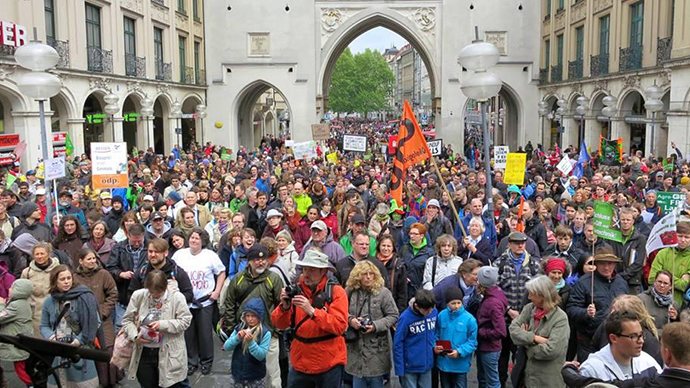
The march against Monsanto, Germany. (Image from twitter user@Julia_etc)
The announcement comes amidst a series of recent public relations battles that have brought the US firm considerable worldwide attention.
On Wednesday, the US Department of Agriculture (USDA) said it had conducted genetic tests on wheat from an 80-acre farm in Oregon this past April. The tests revealed the wheat was an experimental variety created by Monsanto that had never been approved for sale.
The discovery prompted Japanese authorities to cancel part of a tender offer to buy US western white wheat and have suspended imports of both that variety and feed wheat, while several other large importers of US-wheat throughout Asia said they were closely monitoring the situation.
The European Union for its part said it will test any incoming shipments, with plans to block those containing GMO wheat.
The USDA announcement followed a massive, global “March Against Monsanto” held on Saturday that saw demonstrations against the Missouri-based firm in 52 countries. Organizers for the global protest said around 2 million protesters showed up at rallies being held in 436 cities to protest against the seed giant and the genetically modified food.

The march against Monsanto, Munich. (Image from twitter user@nasimjo)
Fearing Protestors, Tree Biotech Conference Cancels Visit to GE Tree Test Plot 2nd May

EF! confronts GE tree scientists on the high seas in Charleston, SC in 2007

EF! confronts GE tree scientists on the high seas in Charleston, SC in 2007
There is still a month to go before activists hit the streets of Asheville, NC to protest the 2013 Tree Biotechnology Conference, but the industry is already showing signs of retreat. Apparently fearing that protestors will follow them wherever they go, the conference organizers recently cancelled a group trip to a test plot of genetically engineered eucalyptus trees. While the counties in which these test plots are planted are publicly known, the exact location of these mutant trees is a closely guarded secret. It seems they don’t want a mob of Earth First!ers to find out where they are!
The 2013 Tree Biotechnology Conference is an international gathering of scientists, forestry corporations and university researchers with a major focus on genetically engineered tree production. GE trees pose an unprecedented threat to native forests. Timber and utility corporations want to plant millions of acres genetically engineered trees throughout the South to burn for electricity, as well as to continue supplying the unsustainable lumber and paper industries. These trees would be engineered to produce their own pesticides, grow straighter and faster, tolerate manufactured pesticides, produce sterile seeds, and reduce lignin content (this is what makes the wood in a tree strong enough to stand up). If these traits escaped into native tree populations, the effects would be devastating and irreversible.
In another setback for the GE tree industry, the USDA just announced the results of their public comment period on the proposed approval of commercial plantings of genetically engineered eucalyptus trees. While over 30,000 people spoke out against the commercial planting of these Frankentrees, an underwhelming, four, yeah that’s right four, people spoke out in favor of planting GE trees. Though this public comment period shows that there is next to no support for GE trees, it is no time to let our guard down considering that government agencies regularly ignore the public opinion.
Help us keep the up the pressure on the USDA and the tree biotech industry. Join activists from around the country as we stand up for native forests and send a loud NO to GE trees with a week of protests and educational events in Asheville, NC May 26-June 1st.
Indigenous Hawaiian’s Take on Monsanto and GMOs 15th April
At 9 am on an overcast morning in paradise, hundreds of protesters gathered in traditional Hawaiian chant and prayer. Upon hearing the sound of the conch shell, known here as Pū, the protesters followed a group of women towards Monsanto’s grounds.
“A’ole GMO,” cried the mothers as they marched alongside Monsanto’s cornfields, located only feet from their homes on Molokai, one of the smallest of Hawaii’s main islands. In a tiny, tropical corner of the Pacific that has warded off tourism and development, Monsanto’s fields are one of only a few corporate entities that separates the bare terrain of the mountains and oceans.
This spirited march was the last of a series of protests on the five Hawaiian islands that Monsanto and other biotech companies have turned into the world’s ground zero for chemical testing and food engineering. Hawaii is currently at the epicenter of the debate over genetically modified organisms, generally shortened to GMOs. Because Hawaii is geographically isolated from the broader public, it is an ideal location for conducting chemical experiments. The island chain’s climate and abundant natural resources have lured five of the world’s largest biotech chemical corporations: Monsanto, Syngenta, Dow AgroSciences, DuPont Pioneer and BASF. In the past 20 years, these chemical companies have performed over 5,000 open-field-test experiments of pesticide-resistant crops on an estimated 40,000 to 60,000 acres of Hawaiian land without any disclosure, making the place and its people a guinea pig for biotech engineering.
The presence of these corporations has propelled one of the largest movement mobilizations in Hawaii in decades. Similar to the environmental and land sovereignty protests in Canada and the continental United States, the movement is influenced by indigenous culture.
“All of the resources that our kapuna [elders] gave to us, we need to take care of now for the next generation,” said Walter Ritte, a Hawaii activist, speaking in part in the Hawaiian indigenous language.
“That is our kuleana [responsibility]. That is everybody’s kuleana.”
In Hawaiian indigenous culture, the very idea of GMOs is effectively sacrilegious.
“For Hawaii’s indigenous peoples, the concepts underlying genetic manipulation of life forms are offensive and contrary to the cultural values of aloha ‘āina [love for the land],” wrote Mililani B. Trask, a native Hawaiian attorney.
Deadly practices
Monsanto has a long history of making chemicals that bring about devastation. The company participated in the Manhattan Project to help produce the atomic bomb during World War II. It developed the herbicide “Agent Orange” used by U.S. military forces during the Vietnam War, which caused an estimated half-million birth deformities. Most recently, Monsanto has driven thousands of farmers in India to take their own lives, often by drinking chemical insecticide, after the high cost of the company’s seeds forced them into unpayable debt.
The impacts of chemical testing and GMOs are immediate — and, in the long-term, could prove deadly. In Hawaii, Monsanto and other biotech corporations have sprayed over 70 different chemicals during field tests of genetically engineered crops, more chemical testing than in any other place in the world. Human studies have not been conducted on GMO foods, but animal experiments show that genetically modified foods lead to pre-cancerous cell growth, infertility, and severe damage to the kidneys, liver and large intestines. Additionally, the health risks of chemical herbicides sprayed onto GMO crops cause hormone disruption, cancer, neurological disorders and birth defects. In Hawaii, some open-field testing sites are near homes and schools. Prematurity, adult on-set diabetes and cancer rates have significantly increased in Hawaii in the last ten years. Many residents fear chemical drift is poisoning them.
Monsanto’s agricultural procedures also enable the practice of monocropping, which contributes to environmental degradation, especially on an island like Hawaii. Monocropping is an agricultural practice where one crop is repeatedly planted in the same spot, a system that strips the soil of its nutrients and drives farmers to use a herbicide called Roundup, which is linked to infertility. Farmers are also forced to use pesticides and fertilizers that cause climate change and reef damage, and that decrease the biodiversity of Hawaii.
Food sovereignty as resistance
At the first of the series of marches against GMOs, organizers planted coconut trees in Haleiwa, a community on the north shore of Oahu Island. In the movement, protesting and acting as caretakers of the land are no longer viewed as separate actions, particularly in a region where Monsanto is leasing more than 1,000 acres of prime agricultural soil.
During the march, people chanted and held signs declaring, “Aloha ‘āina: De-occupy Hawaii.”
The phrase Aloha ‘āina is regularly seen and heard at anti-GMO protests. Today the words are defined as “love of the land,” but the phrase has also signified “love for the country.” Historically, it was commonly used by individuals and groups fighting for the restoration of the independent Hawaiian nation, and it is now frequently deployed at anti-GMO protests when people speak of Hawaiian sovereignty and independence.
After the protest, marchers gathered in Haleiwa Beach Park, where they performed speeches, music, spoken-word poetry and dance while sharing free locally grown food. The strategy of connecting with the land was also a feature of the subsequent protest on the Big Island, where people planted taro before the march, and also at the state capitol rally, where hundreds participated in the traditional process of pounding taro to make poi, a Polynesian staple food.
The import economy is a new reality for Hawaii, one directly tied to the imposition of modern food practices on the island. Ancient Hawaii operated within the Ahupua’a system, a communal model of distributing land and work, which allowed the islands to be entirely self-sufficient.
“Private land ownership was unknown, and public, common use of the ahupua’a resources demanded that boundaries be drawn to include sufficient land for residence and cultivation, freshwater sources, shoreline and open ocean access,” explained Carol Silva, an historian and Hawaiian language professor.
Inspired by the Ahupua’a model, the food sovereignty movement is building an organic local system that fosters the connections between communities and their food — a way of resisting GMOs while simultaneously creating alternatives.
Colonial history
The decline of the Ahupua’a system didn’t only set Hawaii on the path away from food sovereignty; it also destroyed the political independence of the now-U.S. state. And indeed, when protesters chant “Aloha ‘āina” at anti-GMO marches, they are alluding to the fact that this fight isn’t only over competing visions of land use and food creation. It’s also a battle for the islands’ political sovereignty.
Historically, foreign corporate interests have repeatedly taken control of Hawaii — and have exploited and mistreated the land and its people in the process.
“It’s a systemic problem and the GMO issue just happens to be at the forefront of public debate at the moment,” said Keoni Lee of ‘Ōiwi TV. “‘Āina” [land] equals that which provides. Provides for who?”
The presence of Monsanto and the other chemical corporations is eerily reminiscent of the business interests that led to the overthrow of the Hawaiian Kingdom. Throughout the 19th century, the Hawaiian Kingdom was recognized as an independent nation. That reality changed in 1893, when a group of American businessmen and sugar planters orchestrated a U.S. Marine’s armed coup d’etat of the Hawaiian Kingdom government.
Five years later, the U.S. apprehended the islands for strategic military use during the Spanish-American War despite local resistance. Even then-President Grover Cleveland called the overthrow a “substantial wrong” and vowed to restore the Hawaiian kingdom. But the economic interests overpowered the political will, and Hawaii remained a U.S. colony for the following 60 years.
The annexation of Hawaii profited five sugarcane-manufacturing companies commonly referred to as the Big Five: Alexander & Baldwin, Amfac (American Factors), Castle & Cooke, C. Brewer, and Theo H. Davies. Most of the founders of these companies were missionaries who were actively involved in lobbying for the annexation of the Hawaiian islands in 1898. After the takeover, the Big Five manipulated great political power and influence in what was then considered the “Territory of Hawaii,” gaining unparalleled control of banking, shipping and importing on the island chain. The companies only sponsored white republicans in government, creating an oligarchy that threatened the labor force if it voted against their interests. The companies’ environmental practices, meanwhile, caused air and water pollution and altered the biodiversity of the land.
The current presence of the five-biotech chemical corporations in Hawaii mirrors the political and economic colonialism of the Big Five in the early 20th century — particularly because Monsanto has become the largest employer on Molokai.
“There is no difference between the “Big Five” that actually ruled Hawaii in the past,” said Walter Ritte. “Now it’s another “Big Five,” and they’re all chemical companies. So it’s almost like this is the same thing. It’s like déjàvu.”
Rising up
At the opening of this year’s legislative session on January 16, hundreds of farmers, students and residents marched to the state capitol for a rally titled “Idle No More: We the People.” There, agricultural specialist and food sovereignty activist Vandana Shiva, who traveled from India to Hawaii for the event, addressed the crowd.
“I see Hawaii not as a place where I come and people say, ‘Monsanto is the biggest employer,’ but people say, ‘this land, its biodiversity, our cultural heritage is our biggest employer,’” she said.
As she alluded to, a major obstacle facing the anti-GMO movement is the perception that the chemical corporations provide jobs that otherwise might not exist — an economic specter that the sugarcane companies also wielded to their advantage. Anti-GMO organizers are aware of how entrenched this power is.
Field liberation trial coming up in Belgium
Next GM potato-trial: April 2nd 2013, from 8 A.M. on, Justitieplein in Dendermonde. You are warmly invited to come and support the 11 activists that are resisting the unjust sentences in the ‘GM potato trial’. This time, you are not only welcome to show your support, but also to contribute with all your experience, knowledge…
Next GM potato-trial: April 2nd 2013, from 8 A.M. on, Justitieplein in Dendermonde. You are warmly invited to come and support the 11 activists that are resisting the unjust sentences in the ‘GM potato trial’. This time, you are not only welcome to show your support, but also to contribute with all your experience, knowledge…
Criminalisation of Activism for a Sustainable Agriculture
11 activists have been accused of belonging to a criminal gang, and were being asked to pay €200,000 damages to pay for the pro-GM campaign!
The accused and their defence lawyers walked out of the first trial en masse, the first time in Belgian history.
More info at
World’s Longest Treesit Campaign, Update from Bilston Glen
Yesterday, people involved in the campaign to save Bilston Glen sent an update stating, “We have new information from the Midlothian Council and it would seem likely that the road is being redirected along a different route, one that does not go through Bilston Glen.
Yesterday, people involved in the campaign to save Bilston Glen sent an update stating, “We have new information from the Midlothian Council and it would seem likely that the road is being redirected along a different route, one that does not go through Bilston Glen. We have a map of the alternative route and it makes a lot more sense than any of the plans that we had seen before. We will not know until the spring what plan has been finalized for the road. They are also planning a lot of other development in the area so it is possible that the glen might still be under threat even if the proposed development is not the road.
We should have a lot more information in the spring. They are also considering building a new open cast coal mine somewhere near Rosewell, so depending on what is going on we may be joining in with that campaign as well. Keep in touch and we’ll let everyone know what is going on.”
The tree village is open for visiting and staying. Help is always needed in a variety of ways, from donating funds and supplies to attending Sunday Free Cafes in the glen and participating in the public outreach, education and demonstrations against the development in Midlothian Scotland.
Campaign History
Since June 2002 Bilston Glen, located near Penicuik, Scotland about eight miles from the city of Edinburgh, has been occupied and fortified by an ever-expanding group of multinational environmental activists. The Bilston Glen Anti-Bypass Protest Site began when a proposal to build a road through the glen was put on the table by biotech giant Bayer. At the time, Bayer was building big dreams around commercial farming of genetically modified foods (GMOs) in the UK. While Bayer was dreaming, we were scheming. A strong anti-GMO movement in the UK attacked the biotech industry from every angle – slashing crop fields and test sights, protesting universities funding the research for further development, staging large public demonstrations outside grocery stores demanding the labeling of GMOs on consumer products, and last but not least – attacking the infrastructure of industrial development – the roads that would lead to commercial farm lands.
So far the activism exposing GMOs for the evils they are has worked in many parts of the world. To this day, commercial farming of GMOs is illegal in the UK, and by European law, food products containing more than .9% of a GM or GE ingredient must be labeled as containing GMOs. However, these victories did not get the proposal for the road off the Midlothian council agenda. After Bayer was no longer funding the road, a large “industrial estate” near to the glen where Ikea and other large “box” stores and packaging facilities reside took up the bid to fund the road. The new investors meet uproars from the community, who for many reasons feel that the road is needless and are opposed to industrial development through the ancient woodland. Bilston Glen is not only a designated “Sight of Scientific Special Interest” (SSSI) – a conservation designation denoting a protected area in the UK – it is also apart of the Green Belt. The Green Belt was designated as a cooridor for wildlife in the Midlothian area of Scotland, it’s purpose is to prevent development along the belt line. With blatent disregard to these already protected areas, the local council itself became the face of the road expansion.
Luckily, Earth warriors, forest squatters, world travelers, Earth First!ers and the like have done an amazing job at preventing road expansion through Bilston Glen for over 10 years! The tree-sit is the one of the longest standing peace and solidarity projects in the world, along side The Fasland Peace Camp, which is also located in Scotland. Intent on blocking any attempts to build a road through Bilston Glen, residents are also doing a alternative lifestyle project. Living and working together, organising ourselves and co-operatively helping each other.
EF! Winter Moot 2013: 22-24th February, near Preston
A weekend get-together for people involved in ecological direct action, from fighting opencast coal, fracking, GM, nuclear power to road building. There’ll be discussions and campaign planning – with the emphasis on the tactics and strategies we use, community solidarity and sustainable activism.
A weekend get-together for people involved in ecological direct action, from fighting opencast coal, fracking, GM, nuclear power to road building. There’ll be discussions and campaign planning – with the emphasis on the tactics and strategies we use, community solidarity and sustainable activism. This year we’ll be in Lancashire…
Update: full transport details and programme at link below.
USA: Protesters Blockade Monsanto Seed Facility in California
The protesters, who want to remove all so-called genetically modified organisms (GMOs) from the food supply, say their action is a preview of about five dozen other events planned for countries around the world next week. Monsanto and other developers of these biotech crops say they are safe. But U.S. regulators do not require any independent safety tests that would put a lid on doubts raised by consumers and some scientific and health groups. More than 40 countries around the world have some requirements for labeling foods containing ingredients from genetically modified crops. But U.S. regulators have rejected requests by many groups for similar labeling rules, and as a result many Americans do not know that they have been eating GMOs for years. At the protest on Wednesday, about a dozen people organized by a network of anti-GMO activists called Occupy Monsanto stopped trucks from entering or leaving Monsanto’s Oxnard, California-based Seminis for nearly six hours. The activists, some dressed in biohazard suits, blocked truck entrances with cars and chained themselves to the vehicles. Police arrested nine of the protesters and charged them with trespassing, organizers said. Seminis’ biotech sweet corn is one of the newest GMO crop products to make it to market. The corn was altered genetically to withstand dousings of a common weedkiller and to ward off certain pests. “We deserve to know what we are eating and we should put GMO crops back in the lab and off the kitchen table,” protester Rica Madrid said. Occupy Monsanto is not affiliated with the backers of a California proposal to label foods that are made with crops or from animals that have had their genetic makeup altered in the laboratory. Monsanto did not directly address Wednesday’s events but said the company’s work helped improve farm productivity and food quality. “We respect each individual’s right to express their point of view on these topics,” Thomas Helscher, a Monsanto spokesman, said of the Seminis protest. DIFFERENT VIEW IN EUROPE GMOs are deeply unpopular in Europe and many other countries, but they eventually came to dominate key crops in the United States after Monsanto in 1996 introduced a soybean genetically altered to tolerate Monsanto’s Roundup weed killer. Using genes from other species, Monsanto and rivals including DuPont and Dow Chemical have since introduced an array of genetically altered crop varieties. The most popular genetically engineered crops in the United States include corn, soybeans, sugar beets and canola – staple ingredients in a wide array of popular packaged foods. Proponents of GM crops say they make farming more efficient by making plants resistant to pesticides, pests and harsh growing conditions, such as drought. They say genetically modified crops are no different from conventional types and that increasing demand for food, biofuels and livestock feed can only be met with help from the biotech industry that Monsanto dominates. Critics say GM crops have not always lived up to their promise and that the benefits to farmers do not outweigh myriad risks to human and animal health and to the environment. Assessing such risks is difficult in the United States. The government does not require GMO crops to undergo independent safety testing before they are approved, and it does not require labeling for GMO content which makes it next to impossible to track any links to human health problems. The World Health Organization says “individual GM foods and their safety should be assessed on a case-by-case basis.” Recently, some U.S. scientists have raised alarm bells over what they see as potentially dangerous implications from overuse of GMO crops. Among the concerns is the fact that the rapid adoption by U.S. farmers of genetically engineered corn, soybeans and cotton has promoted increased use of herbicides, which critics say has triggered an epidemic of herbicide-resistant weeds and more chemical residues in foods. This week, the Center for Food Safety vowed to sue the U.S. government if it approves a new type of genetically altered corn developed by Dow. 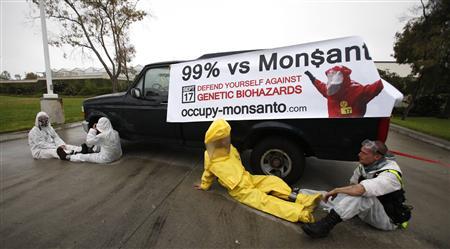
Opponents of genetically engineered foods blocked shipments and deliveries yesterday at Monsanto Co’s vegetable seed company that developed a new genetically modified sweet corn that will hit stores this fall.
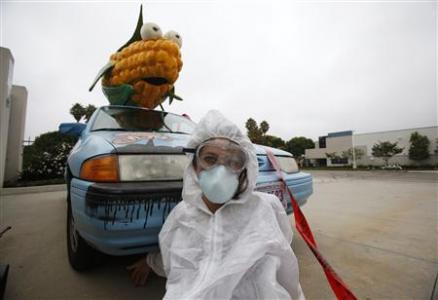 They also hope to drum up support for a California ballot measure that would require food sellers to label a broad range of products, including soup, soy milk, breakfast cereals and chips, that contain GMOs.