Letter No. 9: Tragedies and Dams (the struggle does not end there nor here)

In an unprecedented step, the Brazilian government has met protestors’ demands by flying the entire indigenous occupation – as well as their legal council and accompanying journalists – from Altamira to Brasilia to dialogue with President Rousseff’s Chief of Staff Gilberto Carvalho and other high officials and ministers. 

Led by the Mundurukú people of the Tapajós River basin, occupations of Belo Monte’s main work camp spanned 17 days from May to June demanding the suspension of dam construction and environmental feasibility studies for future dams on indigenous lands, and the guarantee of the constitutional right to prior consultation.

The 150 indigenous protestors who have staged a courageous nine-day occupation of the Belo Monte dam’s main work camp have traveled to Brasilia today to meet in the Presidential Palace with high officials from the Brazilian government. Today the indigenous groups issued a 9th letter to the government (see below)

Letter No. 9:
Tragedies and Dams (the struggle does not end there nor here)

We have left our occupation of the Belo Monte dam and have come to dialogue with the government.

We have not come to an agreement with you. We accept this meeting in Brasilia because the more we said we would not leave, the more you sent police to the work camp. And on the same day that we were to be removed by force by the police, you killed a one of our relatives, a Terena in Mato Grosso do Sul. Therefore we decided that we did not want another death. We avoided a tragedy, not you. You do not prevent tragedies, you commit them.

We came here to speak to you of another tragedy that we will fight to prevent: the loss of our territory and our life. We did not come to negotiate with you, because one cannot negotiate with territory nor life. We are against the construction of dams that kill indigenous land, because they kill culture when they kill fish and drown the land. This kills us without needing a weapon. You continue killing a lot, simply a lot. You have killed too much, for 513 years.

We did not come to talk only about dams on the Tapajós, as you are telling the press. We came to Brasilia to demand the suspension of feasibility studies and the construction of dams on the Xingu, Tapajós, and Teles Pires Rivers. You are not only talking with the Mundurukú people. You are talking with Xipaya, Kayapó, Arara, Tupinambás, and with all the people who are together in this struggle, because this is a major struggle of us all.

We did not bring wish lists. We are against dams. We demand the federal government’s commitment to consult us and ensure our right to veto projects that destroy us.

But no. You trample everything and do what they [the dam building companies] want. And to achieve that you do everything to divide indigenous peoples. We came here to tell you to stop, because we will resist together and stand united. We have been gathered for 35 days in Altamira, and for 17 days we occupied the main hydroelectric dam that you are building. Along with this letter we are sending all the letters from the two occupations that we carried out. Read everything carefully to understand our movement. And in so doing respect us, as you have not done up until today.

Disrespect does not come only from words. It is demonstrated by your actions.

In the region of the Xingu River’s Big Bend, everything is being destroyed and has been turned upside down since you approved the construction of the Belo Monte dam. Everyone very sad and only the rich are doing well. Our indigenous relatives have fought a lot. Even the construction workers suffer.

On the Teles Pires and Tapajós Rivers, you are beginning this process now, but have already gravely disrespected us.

In August 2012, your researchers began to invade our lands, capture our animals and plants, count hectares, measure the water, and drill our land.

In October, [the indigenous agency] FUNAI and Eletrobras said in the meeting that the dams would be built in any circumstance, whether or not we want them. And that they would send the police force to our land if necessary.

In November, the federal police attacked and destroyed the Teles Pires village, where we are all against dams. Adenilson Mundurukú was killed, shot three times, and another 19 indigenous people were wounded. At the end of the month we went to Brasilia denounce the police operation to the Ministry of Justice, FUNAI and the General Secretariat of the Presidency. We also went to prosecutors from the Federal Pubic Ministry.

In January 2013, we held a large assembly in the Mundurukú village of Sai Cinza, where a document with 33 demands was delivered to a representative of the General Secretariat of the Presidency.

The following month, we returned to Brasilia demand a response from the General Secretariat on these 33 points. We managed to find the minister, but he ignored our demands and tried to get us to sign a document accepting dams on the Tapajós River.

To ensure that environmental impact studies of these dams were carried out, the government issued a decree in March 2013 authorizing the entry of police troops on our land. On the following day our villages were raided by police squads.

On the Teles Pires River, the ancient bones of our relatives were unearthed. You are destroying a sacred place.

We could not accept this situation anymore. For this reason we occupied your work camp, bringing our claims, demanding the government’s commitment to respect the original peoples of this country, to respect our right to land and to life. Or, at least for the government to respect its own law: the Constitution and the international treaties you sign. Yet you want to destroy the laws that protect us, indigenous peoples, with other laws and new decrees. You want to legalize destruction.

And now we come here to you. Hoping that you finally listen to us, rather than listening to those who pay for your political campaigns. Even if you are not willing to learn to listen, we are willing to teach.
– Construction site of the Belo Monte dam, Vitória do Xingu, June 4, 2013

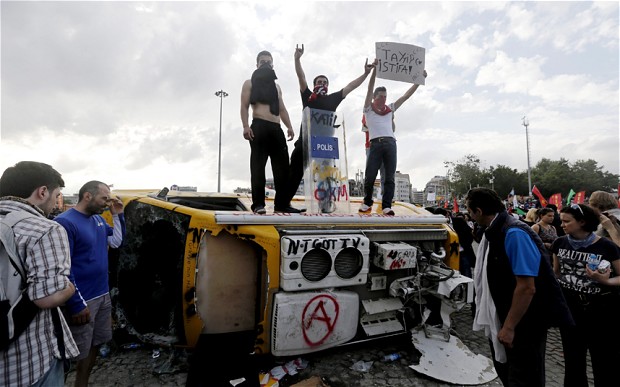
I Am Writing To You On the Motor Hood of a Knocked-over Police Car, Taksim Square 4th June

A barricade in Taksim Square, Istanbul, Turkey

A barricade in Taksim Square, Istanbul, Turkey

A barricade in Taksim Square, Istanbul, Turkey

A barricade in Taksim Square, Istanbul, Turkey

Raising Our Voices in Taksim Square

What began in Turkey seven days ago as the takeover of Gezi Park turned into a national uprising from Istanbul to other major cities. A small protest to protect public space – which the government had ordered to be razed to make room for a shopping mall – united a wide range of citizens protesting what they see as the Prime Minister’s pro-business, authoritarian, and religious policies. Tomorrow, June 4, the public sector union coalition, KESK, will strike in solidarity with the protests.

This is a first-hand account from Taksim Square in Istanbul, written by trade union leader Kıvanç Eliaçık, originally posted at Equal Times.

My trade union, the Revolutionary Worker Unions Confederation of Turkey (DISK), is part of a platform with professional associations and neighborhood organisations.

This platform protests the construction work in Taksim Square, Istanbul, that will demolish the park there, replacing it with a shopping centre.

When I heard that bulldozers came and cut the trees in the park on Tuesday, I ran to the park.

Instead of shutting down the illegal construction – the court revoked the construction project – the police used tear gas against people who want to save the trees.

On that first night, we took tents and sleeping bags and went to the park. We sang and chatted till dawn. In the evening, thousands of people were gathered. A concert took place on a stage.

We were discussing urban regeneration, environmental destruction, human rights and workers’ rights. The highlight of all these discussions was that they are all the result of government policies. An ever-changing and growing committee was established.

When I woke up in the morning the camp was drowned into tear gas and everyone was running around. The police set the tents on fire. They uprooted the saplings that were planted a day before. The bulldozers were working under the protection of riot police.

We did not want to get revenge. Someone was reading a novel to the police using a megaphone that was saved from the fire. Another person was asking “why did you set my guitar on fire?” but by singing.

When we succeeded in entering the park we set up bigger tents. In the evening there were tens of thousands people in the Square. Renowned musicians cancelled their concerts and came to the park.

People from various views came together: people and workers on strike from regions that have been harmed by corporate and government greed; football fans; radical left parties; student organisations; feminists; anarchists; and vegans.

The following night we were better prepared. The garbage was periodically cleared. Volunteer security staff were on patrol. Women were able to walk comfortably in the camp area.

The government’s new alcohol regulations [Turkey’s president is this week expected to approve strict legislation that will prohibit the sale of alcohol in shops between 22.00 and 06.00, ban all alcohol advertising and promotion, and stop new shops and bars from opening within 100m of schools and mosques] converted drinking to a political action. People were chanting slogans, on the other hand they were singing songs, and drinking.

Towards the morning hundreds of goggles, gas masks, lemon, vinegar, home-made anti-tear gas solutions prepared by stomach pills were distributed.

There were thousands of people in the park when the police attacked at 05.00 in the morning. There were no warnings and suddenly we were unable to see anything. We evacuated the park in-line with the plan we made earlier.

Clashes in the street continued till morning. I managed to sneak in the park quietly, taking advantage of the tired police. I watched the Bosphorus sipping my tea in the shadow of a tree. I hope it won’t be the last time I see this view.

The protestors tried to enter the park by gathering in back streets again and again. The police prevented them by using excessive use of force. The whole city turned into a rally arena. Some demonstrators walked the Bosphorus Bridge that connects Asia and Europe.

So, who are these people that gathered in the square? It won’t be true to say that these people have common views and common aims. The only common thing was they were angry to the government… The police violence against the youth who wanted to protect the trees triggered people and all the people who are against the government were out on the streets.

Thousands of women and men who have not participated in a political demonstration before clashed with the police till late at night. The entered a new demonstration without event having breakfast.

With their home-made gas masks they revolted against the police sometimes by singing, sometimes by swearing.

There were demonstrators from wealthy families, but also unemployed people. There were people from Muslim associations and socialist parties – everyone standing shoulder to shoulder.

People, who sought refuge in the barricades, were tweeting and uploading photos to Instagram. Pupils were drawing nasty graffiti addressing the Prime Minister, Recep Tayyip Erdogan.

I met a couple who were making plans for their wedding in the telephone booth where I sheltered as rubber bullets rained down around me.

For the past five days, a growing number of demonstrators are having fun and demonstrating at the same time without sleeping or resting. The most common slogan chanted by the protestors is “Resign Government!”

Police violence is not driving us away. Fear has been defeated now. We have learned to raise our voice when we are angry.

Some people are fighting, others are dancing. Some are lashing out drunk; others are collecting garbage and treating stray animals.

I do not know what is going to happen tomorrow. But today is a new day and we are all new people.

What am I doing now? While tens of thousands of demonstrators across the country are asking the Prime Minister to resign for many different reasons, I am writing to you on the motor hood of a knocked-over police car.

Kıvanç Eliaçık is the Director of the International Relations Department of the Confederation of Progressive Trade Unions of Turkey (DISK).

 

URGENT: “We will die. We will not leave without being heard.” 4th June

Only two days after the reoccupation of the Belo Monte Dam began, the fate of 170 indigenous people is at stake. Yesterday, the Federal Court in Altamira ordered them to leave by 4 pm today or they would be removed by Federal Police. They responded by tearing up the order and refused to leave by the deadline. Instead, they are standing strong and are demanding that President Dilma’s Chief of Staff, Gilberto Carvalho, come meet with them. Their letter to the Brazilian government is below. Read, share and take urgent action right now!

You can also show your support by donating to the indigenous occupation on CAUSES.

Letter No. 8:
The massacre has been announced and only the government can avoid this fate

(Original version in Portuguese here)

We have occupied the construction site of the Belo Monte Dam. We are defending our lands. These ancient lands have always been ours and you have already taken a part of them. And now you are trying to take more. We will not leave.

You will come to kill us and we will die. We will not leave without being heard.

The federal government announced a massacre of indigenous peoples, the 170 warriors, women, children, leaders and shamans who are here. This massacre is going to happen at the hands of police, Funai, and the judicial system.

You have killed at Teles Pires and will kill again when you need to. You killed us because we are against the dams. We know what you are capable of doing.

This time the government and corporations have asked Norte Energia to kill us. Norte Energia pled their case to a federal judge, who subsequently authorized the police to beat and kill us if needed. Government of Brazil and corporations building Belo Monte, it will be your fault if any of us die.

Enough with the violence! Stop threatening us! We want our peace and you want your war. Stop lying to the press that we are kidnapping workers and buses and causing an inconvenience. The occupation is quiet The unrest is caused by the police sent by the judge, Norte Energia, and the government. You are the ones who are humiliating us, threating us, intimidating us, and assassinating us when you don’t know what else to do.

We demand the suspension of the order to repossess the construction site, until Thursday morning, May 30th, 2013. The government needs to come here and hear us. You already know our agenda. We demand the suspension of all works and studies of dams on our lands. We demand the removal of the National Force from our lands. The lands are ours. You have wasted enough of our lands.

You want us to be tame and quiet, obeying your civilization without question. But in this case, we know you would rather see us dead because we are making noise.

Sea Turtle Activist Murdered in Costa Rica 4th June

Jairo Mora Sandoval, a 26 year-old sea turtle conservationist and activist, was murdered late last week in Costa Rica. According to news reports from Central America, Sandoval and four other sea turtle volunteers, including three American women and a woman from Spain,  were kidnapped on Thursday,  May 30, by armed men.

Sandoval was found tied up, beaten and shot dead in the head on the beach the following day. The four volunteers had escaped or been released.

Initial reports on the police investigation point to the murders being poachers after sea turtle eggs.

Sandoval is yet another in a long list of fallen warriors murdered for defending life on Earth.

60,000 in Tokyo Protest Government Plans to Restart Nuclear Power 3rd June

Approximately 60,000 people rallied in Japan’s capital of Tokyo on Sunday, June 2nd in order to protest recent government plans to restart the country’s idled nuclear reactors. People gathered in Shiba Park and later marched towards the parliament building. Among the organizers was Kenzaburo Oe, a Nobel literature laureate, who called on the Japanese government to leave the nuclear power plants in suspension out of fears for safety.

The Japanese government has previously stated that it will most likely allow those reactors to return to power which have been approved by the Nuclear Regulation Authority (NRA), whose new safety guidelines are scheduled to be adopted in July. One of Japan’s largest-ever protests saw 170,000 people gather in a similar fashion in July 2012, around the same time that then-Prime Minister Yoshihiko Noda decided on the first two reactor restarts since the March 2011 Fukushima disaster. As of now, the anti-nuclear protestors say they have collected over 8 million signatures of those opposed to reactor restarts.

As they marched through the streets, the protestors carried signs and banners that had messages such as “No Nukes! Unevolved Apes Want Nukes!” As of today, the two reactors that were restarted last summer, located in Oi, Fukui Prefecture, are the only ones out the country’s 50 that have returned to operation. While Sunday’s rally was organized between three different groups, Kyodo news reported that the Tokyo Metropolitan Police Department had put the number of protesters between 20,000 and 30,000.

A Few Inspiring Moments from Turkey, Occupy Gezi. 2nd June

There is a lot of fear, there is a lot of anger, there is a lot of bloodshed.

There is a lot of fear, there is a lot of anger, there is a lot of bloodshed.
But there is also a lot of beauty.

OccupyGezi1

Istanbul Government Truck, one of many destroyed last night. Graffiti reads "You are not innocent anymore" #gezi pic.twitter.com/yFAKG78SYL

Istanbul Government Truck. Graffiti reads “You are not innocent anymore” pic.twitter.com/yFAKG78SYL


occupygezi2

Clean up in Gezi Park

peoplesbulldozeroccupygezi4

San Francisco Activists Liberate Park in Solidarity with Turkish Resistance 2nd June

On June 1st, in solidarity with the massive resistance in Turkey which began six days ago, Liberate the Land activists in San Francisco marched to a park space known as “Hayes Valley Farm” and began an occupation.

On June 1st, in solidarity with the massive resistance in Turkey which began six days ago, Liberate the Land activists in San Francisco marched to a park space known as “Hayes Valley Farm” and began an occupation. The piece of land is scheduled to be turned into condominiums, a development project which the protestors plan to stop. Not only are they physically holding the space with their bodies and multiple treesits, the group is also planting a “Free Farm” for the community, sharing regular meals, and holding community-building and permaculture workshops.

Participants have renamed the space “Gezi Gardens” in solidarity with the current rebellion in Turkey, which began with the occupation of Gezi park in Istanbul. Protesters in Istanbul began occupying Gezi park when developers started ripping up the trees to make way for a shopping mall. The insane police response sparked an uprising that has swept the country. There have been other solidarity demonstrations all over the world, including the reoccupation of Zuccotti park in New York City, the original home of Occupy Wall Street.

Liberate the Land plans to occupy indefinitely, and has released a statement asking others to join them:

Liberate the Land invites everyone to join this network in the days following today’s liberation, to plant food, create and promote permaculture, host and attend workshops, teach and take classes, play and enjoy music, build, gather, experiment, play, learn, and be together.  A vibrant community of plants and people are living on this land as of this first of June rather than the first layers of concrete foundation for condominiums.  We invite our neighbors in Hayes Valley to join us in open dialogue to further decide what Gezi Gardens will become.

Liberate the Land is bringing into dialogue the concept of common space, a classification of space that goes outside of the dichotomy of private and public and instead places itself as the commons. The commons exist as the spaces owned and operated neither by governments and states, nor corporations and private individuals. Instead, the commons are owned, or stewarded, by all people, with an understanding that the gifts of the earth are for all to enjoy and that people need land bases for growing food, harvesting medicinal plans, maintaining healthy forests for building materials and firewood, wildcrafting plants for fabrics, and hosting wildlife habitat.

Read the rest of the statement here, and follow @LiberateLand on twitter for more updates on Gezi Gardens

Monsanto Set to Halt GMO Push in Europe 2nd June

The march against Monsanto,

The march against Monsanto, Germany. (Image from twitter user@@HarvestPM)

Monsanto plans to halt lobbying for its genetically modified plant varieties in Europe due to low demand from local farmers, a representative from the US agricultural giant told a German daily.

“We are no longer working on lobbying for more cultivation in Europe,” Brandon Mitchner a representative for Monsanto’s European branch, Tageszeitung, said in an interview set to be published on Saturday.

“Currently we do not plan to apply for the approval of new genetically modified crops. The reason is, among other things, low demand of the farmers,” he continued.

A spokeswoman for Monsanto Germany, Ursula Luttmer-Ouazane, admitted that Monsanto recognizes that GMO crops were currently not embraced on the European market.

“We’ve understood that such plants don’t have any broad acceptance in European societies,” Luttmer-Ouazane said. “It is counterproductive to fight against windmills,” she added.

A spokesperson for the German Ministry of Economy and Technologies described the move as an “entrepreneurial decision” which needed no further comment. The ministry added, however, it has long made its opposition to gene modification technologies known.

“The promises of the GM industry have not come true for European agriculture, nor have they for the agriculture in developing and emerging economies,” the ministry said in a statement.

Eight national governments in the European Union have already banned Monsanto’s MON810 maize and other forms of GMO cultivation in their countries under an environmental protection provision known as the ‘Safeguard Clause’.

Particularly fierce protests in Germany prompted the government to introduce the measures in 2009 due to concerns that such cultivation could lead to ecological degradation.

Monsanto’s rivals, such as Bayer CropScience, BASF and Syngenta, had by and large pulled out of the German market because of large-scale public opposition, the German daily reported.

Austria, Bulgaria, France, Greece, Hungary, Luxembourg and most recently Poland are among other EU member states enforcing the ban. In April, Italy joined the ranks of EU states looking to ban the cultivation of GM crops on its soil.

The march against Monsanto, Germany. (Image from twitter user@Julia_etc)

The march against Monsanto, Germany. (Image from twitter user@Julia_etc)

The announcement comes amidst a series of recent public relations battles that have brought the US firm considerable worldwide attention.

On Wednesday, the US Department of Agriculture (USDA) said it had conducted genetic tests on wheat from an 80-acre farm in Oregon this past April. The tests revealed the wheat was an experimental variety created by Monsanto that had never been approved for sale.

The discovery prompted Japanese authorities to cancel part of a tender offer to buy US western white wheat and have suspended imports of both that variety and feed wheat, while several other large importers of US-wheat throughout Asia said they were closely monitoring the situation.

The European Union for its part said it will test any incoming shipments, with plans to block those containing GMO wheat.

The USDA announcement followed a massive, global “March Against Monsanto” held on Saturday that saw demonstrations against the Missouri-based firm in 52 countries.  Organizers for the global protest said around 2 million protesters showed up at rallies being held in 436 cities to protest against the seed giant and the genetically modified food.


The march against Monsanto, Munich. (Image from twitter user@nasimjo)

The march against Monsanto, Munich. (Image from twitter user@nasimjo)


Plea from Turkey 1st June

Turkey’s protests against the logging of trees in  Gezi Park have grown into a nation-wide upheaval. The heavy-handed police response, using tear gas and pepper spray against bystanders and protestors, alike, has ignited a profound response against state repression in Turkey.

Environmentalism in Turkey as well as Eastern Europe/West Asia has been on the rise in the last 5-10 years, and this massive demonstration rising from anti-logging protests presents a landmark in the history of this region.

Thousands of protestors have swelled in the streets of every major city in Turkey. More solidarity demonstrations are planned from Germany to the US. From Athens to London, San Francisco to Boston, protests are already drawing thousands of people, and more are planned for the future.

Gezi Park is one of the smallest parks in Istanbul, but the symbolic value of replacing it with an Ottoman-style barracks aggravates the anti-imperial drive of the Turkish people. The police brutality is shocking even to veterans of pro-democracy struggles.

Here is an urgent message from an anonymous source in Turkey right now: “I am writing you all to ask that you please share any and all information you can about the current situation in Istanbul. There is desperate need of int`l support from what I witnessed last night and from the news coming via social networking, etc. They are getting no domestic media attention, and the Prime Minister has offered no explanations for the unprecedented police violence. Gov`t supporters also went completely unchecked by police last night, beating (and as i understand it) killing at least one protester on their walk home.”

New Teargas Crackdown on Anti-government Protesters in Turkey 31st May

Turkish police fired tear gas and water cannon on Friday at protesters occupying a park in central Istanbul, injuring scores in the latest violent crackdown on anti-government demonstrations.

Turkish police fired tear gas and water cannon on Friday at protesters occupying a park in central Istanbul, injuring scores in the latest violent crackdown on anti-government demonstrations.

The protest at Gezi Park started late on Monday after developers tore up trees but has widened into a broader demonstration against Prime Minister Tayyip Erdogan’s Islamist-rooted Justice and Development Party (AKP).

Riot police recently clashed with tens of thousands of May Day protesters in Istanbul. There have also been protests against the government’s stance on the conflict in neighboring Syria, a recent tightening of restrictions on alcohol sales and warnings against public displays of affection.

Police staged a dawn raid on demonstrators who had been camping for days in Gezi Park in anger at plans to build a shopping mall, and clouds of tear gas rose around the area in Taksim Square that has long been a venue for political protest.

“We do not have a government, we have Tayyip Erdogan…Even AK Party supporters are saying they have lost their mind, they are not listening to us,” said Koray Caliskan, a political scientist at Bosphorus University who attended the protest. “This is the beginning of a summer of discontent.”

The Istanbul Medical Chamber, a doctors’ association, said at least 100 people sustained minor injuries on Friday, some of them when a wall they were climbing collapsed as they tried to flee clouds of tear gas.

Amnesty International said it was concerned by what it described as “the use of excessive force” by the police against what had started out as a peaceful protest.

Erdogan has overseen a transformation in Turkey during his decade in power, turning its economy from crisis-prone into Europe’s fastest-growing. Per capita income has tripled in nominal terms since his party rose to power.

He remains by far Turkey’s most popular politician, and is widely viewed as its most powerful leader since Mustafa Kemal Ataturk founded the modern secular republic on the ashes of the Ottoman Empire 90 years ago.

The unrest has been far from the sort of mass demonstrations seen in other parts of the Middle East or even parts of Europe in recent years, but it reflects growing opposition concern about Erdogan’s authoritarianism.

DEFIANCE

Hundreds of military officers have been jailed on charges of plotting a coup against Erdogan in recent years; others including academics, journalists and politicians face trial on similar accusations.

Erdogan has made no secret of his ambition to run for the presidency in elections next year when his term as prime minister ends, exacerbating opposition concerns.

“These people will not bow down to you” read one banner at the Gezi Park protest, alongside a cartoon of Erdogan wearing an Ottoman emperor’s turban.

Postings on social media including Twitter, where “Occupy Gezi” – a reference to protests in New York and London last year – was a top-trending hashtag, and Facebook said similar demonstrations were planned for the next few days in other Turkish cities including Ankara, Izmir, Adana and Bursa.

“Kiss protests” – in which demonstrators are urged to lock lips – had already been planned for Istanbul and Ankara this weekend after subway officials were reported to have admonished a couple for kissing in public a week ago.

Erdogan is pushing ahead with a slew of multi-billion dollar projects which he sees as embodying Turkey’s emergence as a major power. They include a shipping canal designed to rival Panama or Suez, a giant mosque and a third Istanbul airport billed to be one of the world’s biggest.

Speaking just a few miles from Gezi Park at the launch on Wednesday of construction of a third bridge linking Istanbul’s European and Asian shores, Erdogan vowed to pursue plans to redevelop Taksim Square.

Architects, leftist political parties, academics, city planners and others have long opposed the plans, saying they lacked consultation with civic groups and would remove one of central Istanbul’s few green spaces.