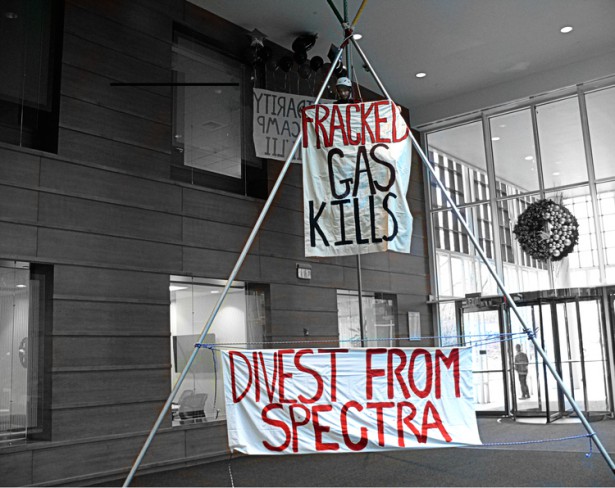
Activists shut down Spectra Energy’s Waltham office after deploying
a 24-foot tall tripod.
February 4th, 2015
While a gaggle of confused police tried to unseat Shane Capra from his perch atop a 24-foot tripod inside Spectra Energy’s Waltham, Mass., office on the morning of December 17, and others tried to snare a balloon banner floating near the office ceiling — all while accompanied by a brass band providing the rousing soundtrack — one Spectra employee was overheard muttering to another, “This is extremely disruptive.”
Of course, that was the point.
The action in Waltham was part of the Week of Respect and Resistance, a series of demonstrations, sit-ins, and lock-downs aimed at Spectra Energy, their investors, and the politicians who support them in their plan to expand a fracked gas pipeline — the so-called Algonquin, a name which many activists describe as insulting to the indigenous speakers of the Algonquian language — through New England. With FERC poised to present its final Environmental Impact Statement any day, and with New England politicians and Big Greens voicing their unwavering support for their favorite “bridge fuel,” climate justice organizers and pipeline fighters in New York, Connecticut, Massachusetts, and Rhode Island knew they had to escalate their already long-running campaign against Spectra.
For Nick Katkevitch of Fighting Against Natural Gas, or FANG, this sense of urgency was fueled by a recent trip to Ferguson, MO, where he saw first-hand the power of the confrontational direct action tactics that had yet to be seen in the campaign against Spectra. “A lot of times in the climate movement, especially in New England, there’s a tendency to follow the political process, to not disturb things too quickly, to take it slow,” Katkevitch said. “When I went to Ferguson, it was a total learning experience. I learned to be tenacious, to be fearless, and to just say it like it is. I learned the true meaning of speaking truth to power.”
During the week of December 13–19, activists brought that tenaciousness and fearlessness to a variety targets, from Danbury, Conn., where Spectra plans to expand the already-existing gas pipeline to accommodate the higher volume of gas flowing from the Marcellus Shale, to the gas compressor station in Cromwell, Conn., to the offices of some of the most powerful individuals and entities involved in the so-called Algonquin Incremental Market project — including Spectra themselves.
Sherrie Andre of FANG, who gave the week of action its name, stresses that while many of the actions carried out against Spectra and their financial and political supporters involved acts of civil disobedience, “We need to respect those who have been organizing before us and have their own way of doing things. We need to show that we know how to pay homage to different types of nonviolent direct action.” She added, “I recently bumped into a friend who’s become interested in what we’re doing, but said, ‘I can’t climb a tripod.’ It’s really disheartening if that’s all they’re seeing because there are so many other players and parts involved that make that happen.”
For Noga Heyman of Flood Boston, the success of the campaign against Spectra — and the broader climate justice movement — hinges on making activism as accessible as possible for a wide variety of people. “Maybe lock-downs don’t always draw people in, but giving someone a zine to read, or getting a song stuck in their head, might engage them more.”
A bridge to nowhere
This emphasis on engagement and creativity was crucial to one of the goals for the week: to not only disrupt business as usual at the locations of the protests, but to disrupt the narrative about fracked gas perpetuated by the energy industry, fossil fuel-friendly politicians, and mainstream environmental groups alike.
In addition to blocking the driveway to the Cromwell gas compressor station, Dan Fischer explained, he and fellow Capitalism vs the Climate member Vic Lancia “were also trying to block the formation of misleading assumptions. People drive by the compressor station every day, and either don’t know about it or falsely assume it’s part of the clean energy process. So we felt it was important to take direct action at the point of assumption and say this is a dirty fuel, and there are plenty of clean, renewable alternatives that make fracking unnecessary.” To help make this point, Fischer and Lancia locked themselves to a massive wooden “bridge to nowhere” built in the days leading up to the action.
Members of Flood Boston and other groups fighting pipeline expansion in Massachusetts echoed this sentiment at their action at the Boston office of the State Street Corporation, one of Spectra’s biggest financial backers, later in the week. For Heyman, the action was an opportunity to use art, theater and music to “dismantle the myths surrounding natural gas” and advocate for community-controlled renewables. To this end, activists constructed a giant pair of lips “spewing myths” about fracked gas which protesters challenged with facts about the health and safety impacts of the pipeline project.
“The people of West Roxbury are traumatized,” said David Ludlow, a 72 year-old organizer in the Boston area, citing the 2010 explosion of a gas pipeline in San Bruno, Calif., which killed eight people and which looms large in the minds of local residents bracing themselves for the construction of the West Roxbury Lateral pipeline and a new, high-pressure Metering and Regulating Station, both of which would be built dangerously close to an active quarry and residential areas.
Activists and community members expressed these concerns in songs, chants and cantastorias that rang out in State Street’s office and continued to Boston’s South Station after protesters delivered a letter urging State Street to divest from Spectra Energy and other similarly destructive corporations, including Kinder Morgan, whose gas pipeline projects also threaten Massachusetts communities and ecosystems.
In Rhode Island, activists drew attention to the hypocrisy of the politicians and government agencies supporting Spectra’s plan, with Burrillville Against Spectra Expansion holding a protest at the Rhode Island Department of Environmental Management and FANG organizing a sit-in at Sen. Sheldon Whitehouse’s office. Ten protesters joined University of Rhode Island physics professor Peter Nightingale, a member of Fossil Free Rhode Island, in the sit-in, and cheered for Nightingale as he was eventually arrested for refusing to leave the office. Whitehouse, who Nightingale calls a “wolf in sheep’s clothing,” has long been a focal point in the Rhode Island fight against Spectra’s pipeline projects: in August, members of Burrillville Against Spectra Expansion held a sit-in at Whitehouse’s office which led to a meeting with the senator.
Despite Burrillville residents expressing their concerns about the health and safety impacts of Spectra’s plans to expand the gas compressor station in their town, however, Whitehouse’s support for the pipeline expansion has not changed; in light of Whitehouse’s climate-friendly rhetoric from the Senate floor, Nightingale finds this inexcusable. “Compared to any of the other climate zombies, [Whitehouse] may be a ‘climate champion,’” Nightingale explained. “But at the same time he supports this plan out of Washington and Wall Street that wants to push natural gas and gets in the way of developing the green power sector.”
Blockadia and beyond
The actions during the Week of Respect and Resistance garnered significant local media attention and, some speculate, may have played a role in FERC delaying the release of their final Environmental Impact Statement on the AIM project — not to mention Spectra’s stock hitting a 52-week low. Still, organizers know that the fight against Spectra — and the fight for climate justice — is far from over.
“Before this week, the fight against Spectra had been mostly polite and playing by the rules,” Fischer said. “We’re still going to keep using the old tactics, but this was the week where people in four different states said that they’ve had enough with Spectra’s misleading claims and with the whitewash advanced by the government and business-friendly environmental groups. This is the week where we entered a more committed resistance, and hopefully a more successful resistance.”
As many of those involved in this week of action think about what that resistance will look like, one word seems to be on many of their minds: “Blockadia,” a name given to the growing network of groups disrupting the extraction and transportation of fossil fuels with elaborate and longstanding protest camps. “We see Blockadia as an important way of achieving victory against not only this project, but extreme energy in general,” Fischer explained. “Spectra Energy can keep its eyes peeled for the construction of Blockadia in more and more places.”
However, even as the resistance to Spectra and the fossil fuel energy industry mounts, many organizers also recognize that there is still significant work that needs to be done within the environmental movement itself, a fact that was highlighted by the Week of Respect and Resistance coinciding with an escalation of the Black Lives Matter movement following the non-indictment of the police officers responsible for the choking death of Eric Garner. Andre explained that as FANG shared Black Lives Matter memes and articles on their social media platforms, “there was a lot of backlash from environmental organizers who follow the FANG page and who wanted us just to focus on pipelines. But life is not just about pipelines. Our struggles are not siloed.” Indeed, FANG members underscored this point by blocking a commuter train carrying passengers to a New England Patriots game for four and half minutes earlier this month to signify the four and a half hours Mike Brown’s dead body remained in the streets of Ferguson after he was shot by officer Darren Wilson.
For Andre and many of the other organizers involved in the Week of Respect and Resistance, the fight against Spectra has to be seen as part of a larger fight for justice that begins with recognizing that the land members of the predominantly white environmental movement live on and struggle to protect “is not theirs. It was stolen. Environmentalists need to understand the history of colonization and what it’s done to indigenous people before they can even begin to talk about pipelines. Pipelines are just a new form of colonization. They’re a new trauma.”
Ludlow, who stresses the implications of the climate crisis for indigenous communities in the United States and around the world, also emphasizes the need to recognize the connections between the climate justice movement and movements fighting militarism and economic injustice. “The U.S. makes more wars to protect its resources and gobble up more of the world’s existing resources. We’re not going to stop this by being nice. We’re not going to stop it by just talking to our local areas about safety. We need to make alliances to build a broad-based movement.”
For all the work that needs to be done to stop Spectra and combat the oppressive tendencies within the environmental movement, the activists involved in the Week of Respect and Resistance all agree that the week of action marked a turning point in their campaign against Spectra. As Katkevitch reflected on the week’s impacts, his mind turns to one of the other great passions of his life besides organizing: basketball.
“When the team you’re playing is much better, they don’t respect you and they think it’s going to be an easy game,” he said. “But if you start playing aggressively and assertively and really confidently, at first they’ll think it’s kinda funny, like, ‘look at these kids trying so hard.’ But there’s a certain moment in the game when all of a sudden the energy switches and the opponent is actually afraid, because they’re recognizing that your confidence and your aggression is actually coming from a real place — that you could actually win. In Spectra’s office, it definitely felt like one of those moments of turning the energy. Now they have to respect us.”