
28th July 2013
Portland Activists Blockade Columbia River in Symbolic Protest Against Fossil Fuel Shipments

28th July 2013
In a day-long affair involving hundreds of activists, the Portland Rising Tide and 350.org collaboration, Summer Heat, went off yesterday without a hitch.
Activists congregated in the morning at the Vancouver Landing in Vancouver, Washington, where the port authorities recently OKed a terminal to ship hundreds of thousands of barrels of oil carried on trains from the Bakken Shale.
 Hosting info sessions about free trade agreements, direct action, and infrastructure resistance, the event carried a festive air into the early afternoon. By 3pm, around 250 activists in more than 100 boats took to the river for a symbolic blockade and massed under the Columbia Bridge.
More activists gathered on the bridge, and three climbers repelled down with a long, transparent banner that read, “Coal, Oil, Gas: None Shall Pass.”
“It went as well as I thought it could have,” stated one Rising Tide activist to EF! News. Although the FBI had been snooping around in the weeks prior to the event, the crowd that came out to the protest showed that they will not be intimidated.

Police presence was relatively minimal at the protest compared to other Rising Tide and Occupy actions that have occurred. Nobody was arrested, and the message was sent: Expect Resistance.
Summer Heat was only a high point in what has been a long, hard, and in many ways successful struggle, which has seen three three proposed coal terminals shut down so far. Today, Portland Rising Tide looks invigorated, confident, and more dedicated than ever to the mission of stopping climate change.
Myanmar Activist Jailed 10 years For Anti-Mine Protest

Security forces move in to stop protesters ploughing fields near the copper mine at Letpadaung Mountain in northern Burma’s Sagaing division on April 25, 2013.
28th July 2013
A court in central Myanmar has sentenced an activist to a decade in prison for “threatening national security” after he led a protest against a controversial China-backed copper mine which led to clashes with authorities, according to a fellow campaigner.
Judge Kaythi Hlaing of the Shwebo city court handed Aung Soe, an activist with Myanmar’s People’s Support Network, the 10-year sentence on Monday after convicting him on eight charges linked to the violence on April 25, Moe Moe, also of the activist’s group, told RFA’s Myanmar Service.
The group had backed hundreds of farmers protesting the alleged seizure of their land by Wan Bao Company, which runs the copper mine near Mount Letpadaung in northern Burma’s Sagaing division.
The clashes broke out after security forces moved in to stop the farmers from plowing their fields on the contested land. At least ten protesting farmers were injured, some of them reportedly with gunshot wounds, while 15 policemen were also wounded.
Aung Soe “was sentenced under eight charges, including for threatening religious purity and national security, and for illegal assembly,” Moe Moe said Tuesday.
“He was sentenced at the Shwebo court by the judge, Daw Kaythi Hlaing,” he said, using an honorific title.
Two residents of Setae village, near the Letpadaung copper mine, named Soe Thu and Maung San, were also sentenced for “violating orders” and “inciting riots,” Moe Moe added.
He did not say how long the two villagers were sentenced to prison.
Moe Moe said that Aung Soe’s lawyer will appeal his conviction.
Suspended operations
An inquiry commission in Myanmar ruled in March that the copper mine should be allowed to continue despite widespread objections.
But nearly four months later, operations at the facility remain suspended with protesting villagers refusing to accept compensation offers.
Operations at the mine have been suspended since November, when a brutal crackdown on protests against the mine prompted the government to set up the commission to look into the project’s viability.
The commission recommended that the project should be allowed to move ahead despite conceding that it brought only “slight” benefits to the nation.
Since then, villagers who are mostly farmers have staged regular protest against the mine, complaining that the compensation was not enough and calling for a complete halt to the project.
Some 15 protesters—both local residents and activists from Yangon—are wanted by the authorities over demonstrations against the mine in recent months.
Villagers have said that they do not want pollution from the mine to destroy the area and that authorities have confiscated some 8,000 acres (3,000 hectares) of farmland from 26 villages to make way for the mine.
Reported by Yadanar Oo for RFA’s Myanmar Service.
All-Night Anti-Shale Gas Truck Seizure, Road Block, Ends Peacefully Despite RCMP Negotiation Failure
 Last night, July 27th,
Last night, July 27th, about 35 anti-shale gas activists blockaded a 20 ton truck, subcontracted to SWN Resources Canada, for over 8 hours. The truck, filled with helicopter bags – each containing dozens of geophones – was attempting to exit southward along Irving Road, a back road west of highway 126 in New Brunswick. The truck, as well as eight other equipment trucks subcontracted to SWN, were conducting seismic testing in the hopes of finding shale gas deposits along a 35.9 kilometer north-south line known as ‘Line 5′. All the equipment and workers were halted until about 3:30am Atlantic Time.
Activists had originally negotiated with RCMP for a 3 hour work stoppage, in homage to the Ghost Dance that the Sundancers in Elsipogtog were undertaking yesterday evening. Elsipogtog War Chief John Levi, himself a Sundancer, was absent from the blockade. In his stead, Jason Okay, District War Chief, and ‘Seven’, the Mi’kmaq territory War Chief, had come to the assistance of the anti-shale gas movement.
The 3 hour work stoppage was meant to occur at the end of the workday. It would appear that RCMP had agreed to this temporary block.
However, when the 20 ton truck was first blocked at about 5pm – in front of an already heavy police presence – the RCMP immediately blocked in the activists who surrounded the truck. At the time there were about 35 activists at the scene, and word began to trickle in to those encamped that an RCMP roadblock at the entrance to Irving Road – about 16 kilometers to the south – was not allowing anyone to pass. This was apparently counter to the original agreement, and began what was to be a standoff that continued until the early morning hours.
RCMP and the ‘Elsipogtog Peacekeepers’ – a group of three individuals on Elsipogtog Band payroll who ostensibly serve as a neutral party – did not seem able or desirous of undoing the police roadblock that was refusing all entry. The activists requests were initially straightforward, only asking that anyone wishing to attend their ceremony be allowed to drive the 16 kilometer distance. The activists also specifically requested a drum leader and a pipe carrier to assist them. Social media sources continued to note that a sizable line of cars was still being refused entry.
Tensions further increased at about 7:30pm when Annie Clair, also known as ‘Pochahontas’ to the anti-shale gas activists, climbed atop the roof of the seized truck and chained and padlocked herself to a spare tire mounting welded to the roof. She was quickly joined by two other activists, one of whom also chained herself to the roof while the other locked herself to a helicopter bag filled with geo-phones.
Clair, who only days before had tied herself to helicopter bags and had halted work at a helicopter launching site, was defiant in her message to the gathered police force, noting that if they were going to shoot her, to go ahead.
RCMP and the Peacekeepers again continued to ‘negotiate’, but did not seem able to relay the message to the RCMP blockade that the first step towards resolving the standoff was to allow traffic to flow freely. Activists, for their part, remained adamant that the 3 hours they were promised for ceremony would only begin once the RCMP blockade was removed and their supporters could join them. As the hours of standoff continued, and food and water were denied to the activists, RCMP marched in formation through the blockade with numerous boxes of pizza and cases of water.
Eventually, one of the Elsipogtog Elders – also a clan mother – begged Clair to unchain herself and descend from the truck roof. With social media now reaching something of a frenzied pitch – and stories of dozens of police cruisers and paddy wagons waiting for the activists, Clair complied. Indeed, the activists were now visibly blocked in by numerous police trucks and cruisers. Infrared lights shone from some of the RCMP cars and a large spotlight was erected shining directly onto the activists’ makeshift encampment.
RCMP negotiators noted that they would not arrest anyone that night, but made no guarantees that future days might not see activists picked off one by one in house arrests. As has been the case since early June when active protests began against shale gas exploration in Kent County, yesterday police made no secret of their heavy surveillance of the action. At 3:30am, as activists moved their trucks and cars off the road, it became clear that an entire SWN work crew had been stopped. With a heavy police escort, eight SWN trucks emerged from a side road and quickly sped past the gathered crowd. With no equipment or SWN workers left to guard, the RCMP quickly left the scene as well.
Indian tribe blocks Pan-American Highway to protest land invasion
23 July 2013 Cross posted from Survival
23 July 2013 Cross posted from Survival
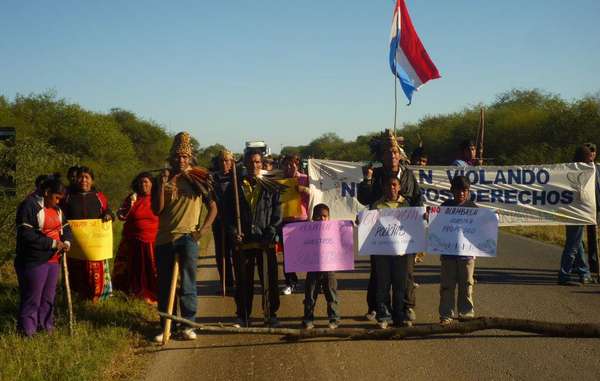
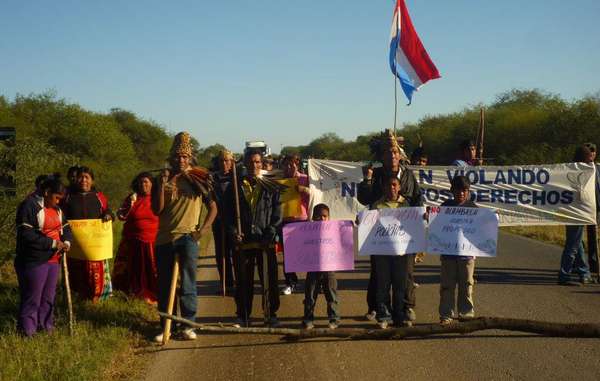
A key South American highway connecting Paraguay and Bolivia is being blocked by an Indian tribe angry at the destruction of their rapidly-shrinking island of forest.
Ayoreo Indians today blocked the Trans-Chaco Highway, which forms part of the Pan-American Highway, and have vowed to maintain their protest until outsiders who have occupied their land are removed.
The Indians are angry about the illegal invasion of their land by two Paraguayan farmers, in an area to which the Ayoreo secured official land title 16 years ago.
The farmers and their workers have erected cattle fences and bulldozed wide tracks, and claim that the land belongs to them. They were guarded by police, to prevent any attempt on the Ayoreos’ part to stop the work.
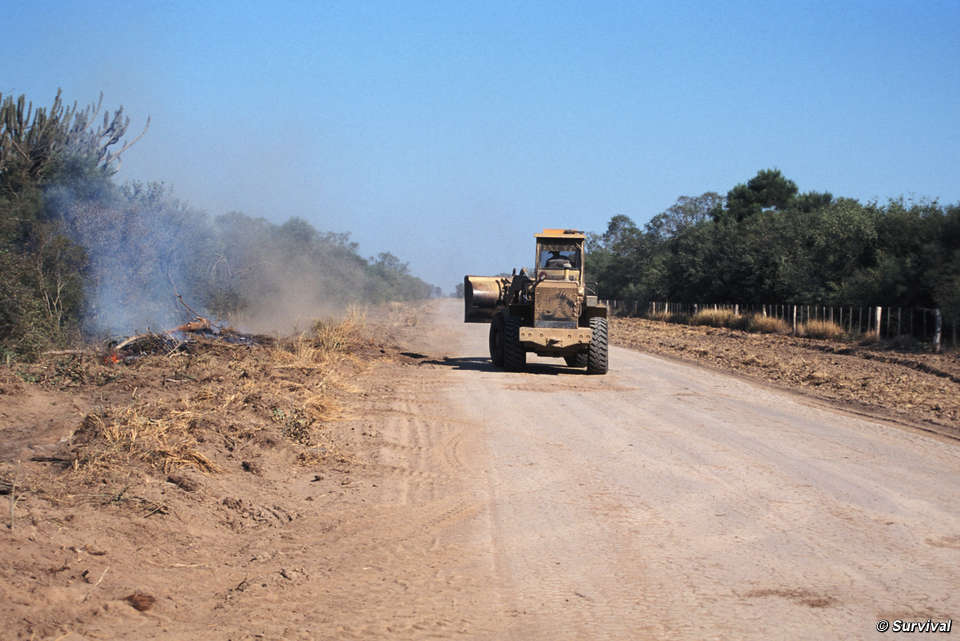
The land is titled to the Ayoreo, but the farmers have erected cattle fences and bulldozed wide tracks.
© Survival
Although most members of the Ayoreo tribe are contacted, some groups are known to remain uncontacted in the forest in the area now under threat.
The Ayoreo have said to Survival International, ‘We don’t want any outsiders in our territory – it’s dangerous for us, and dangerous for our relatives in the forest. We’ll stay here [on the road] until all the outsiders leave our land.’
Survival’s Director Stephen Corry said today, ‘The Ayoreo are extremely angry that one of the few parts of their territory that they had managed to secure is now being invaded by outsiders, with the connivance of the local police. It seems like the authorities in Paraguay favor the rich and powerful over people like the Ayoreo, who simply try to live in peace on their own land.’
New Wick Drain Protest Delays CalTrans Again, USA
23.7.13
23.7.13
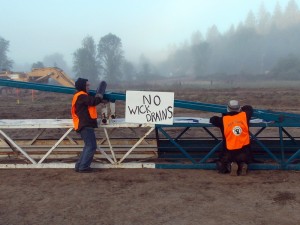
Caltrans’ attempt to drain and fill wetlands was shut down today when two activists locked themselves to both of the giant “stitcher” towers that are punching thousands of wick drains into the water table near this small rural town. The wick drains are being used to compact the soil so that it can no longer hold water, in preparation for building a freeway. The Willits Bypass freeway project entails the biggest loss of wetlands in Northern California in 50 years. Opponents of the project say it is a giant loss for taxpayers as well.
Two protesters were able to slip past CHP guards in the predawn darkness to get to the steel towers, which had been lowered to the ground for the night. The towers are now lowered each evening ever since activist Will Parrish climbed 60 feet into an upright tower, occupying it and shutting down work for eleven days from June 20 to July 1.
Travis Jochimsen and a woman calling herself Blue Heron used welded steel lock boxes to attach themselves to the equipment, placing their arms deep into the metal tubes they had inserted between the tower’s open grid work. “We can’t afford to lose precious water for the sake of an unnecessary freeway, said Jochimsen. “Every day the wick drains aren’t being installed is a victory for farmers, taxpayers and the planet”.
Bypass opponents continue to say the project is unjustified by Caltrans’ own traffic data, pointing to a virtually empty two-lane highway north of town. The empty highway can be seen on Caltrans’ webcam that records traffic every hour. http://www.dot.ca.gov/dist1/d1tmc/1_cam.php?cam=27
Over 70% of traffic is local and would not be served by the bypass. “This project is a bonanza for the contractors and a massive loss for everyone else—especially the taxpayers,” said Willits city councilwoman Madge Strong. The controversial project has a “sticker price” of $210 million, but with interest on the prop 1B bonds and the usual cost overruns, the final cost could be as high as $500 million dollars.
A delegation from Willits, including Strong, met with Caltrans Chief Officer Malcolm Dougherty in Sacramento on July 9 to show how Caltrans employees inflated the traffic figures and other data in order to justify a four lane freeway, ignoring less costly and destructive alternatives. Dougherty dismissed the traffic data as irrelevant, although he could not explain why the taxpayers should finance an I-5 style freeway for a rural area that has been losing population for a decade. Caltrans only has sufficient funding for a two-lane bypass at present, yet it is building a massive four lane footprint. Dougherty expressed confidence that plenty of funding will be available in the future.
Breaking news: Reporter/photographer Steve Eberhart of The Willits News was arrested at 7:35 a.m. this morning on the construction site while waiting for his Caltrans escort to arrive
Michigan Activists Locking Down to Halt Tar Sands Pipeline Construction

From MI-CATS Press Release:
Monday, July 22nd, 2013
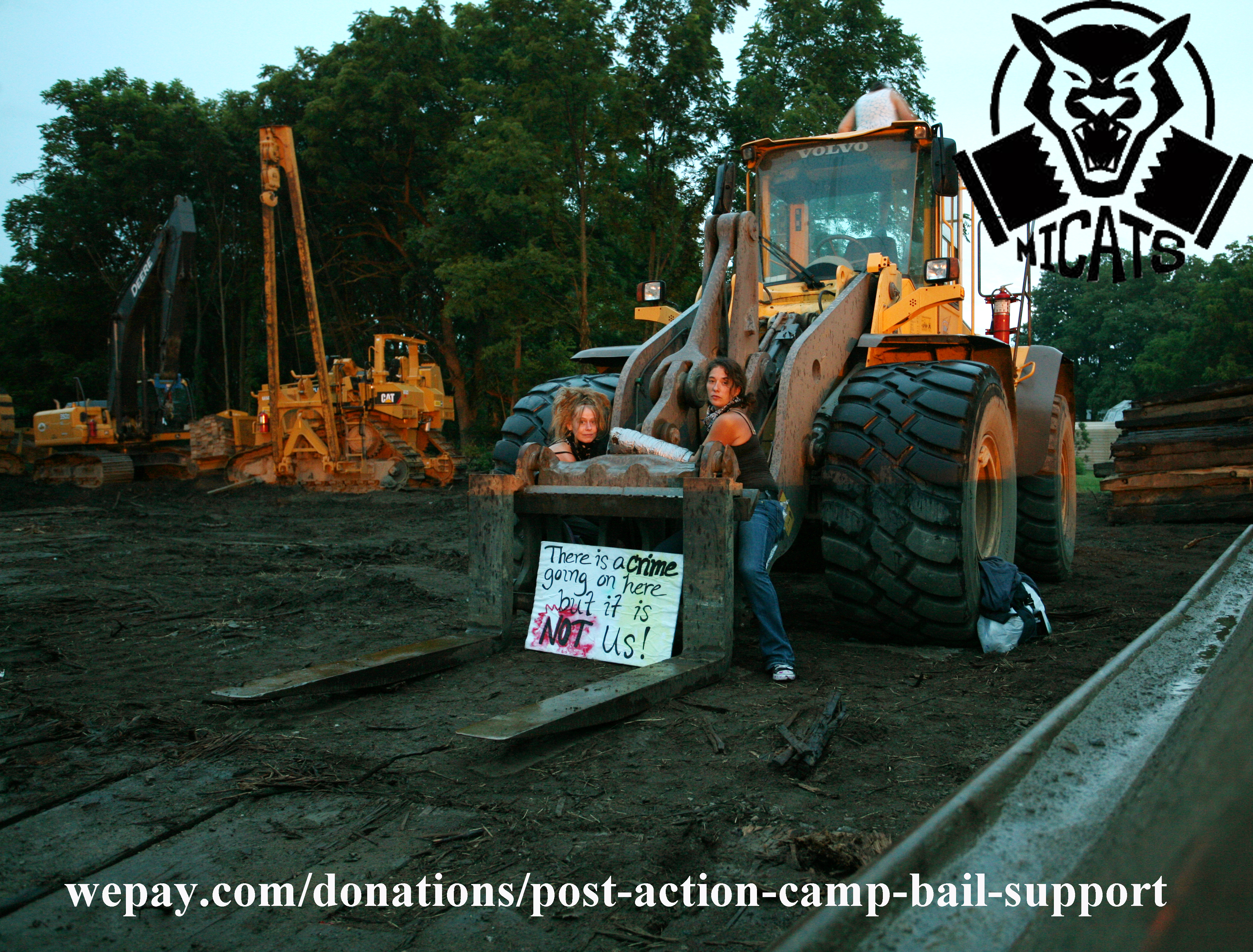
From MI-CATS Press Release:
Monday, July 22nd, 2013
This morning Michigan Coalition Against Tar Sands (MI-CATS) is taking direct action near Stockbridge `to halt construction of the Tar Sands pipeline 6B expansion project of Canadian corporation Enbridge. Over 40 Michiganders have come to oppose the infamous corporation’s flagrant expansion of the very same pipeline that spilled out into the Kalamazoo River only three years ago. Enbridge claims they have restored the river after a spill is no excuse to expand the pipeline, expanding the pipeline increases the risk for everyone.
Residents are currently halting Enbridge’s construction plans by putting their bodies on the line in an act of non violent civil disobedience against Enbridge’s plans. At least 6 people have been arrested so far as police attempt to shut down the protest. 4 people are currently locked down to construction equipment and refusing to move. Police have arrested their medical support team and threaten to arrest anyone who tries to approach them.
These measures come after the exhaustion of every method within the law, as it has has become apparent from our experiences all throughout the state. Our state government is ready to set aside its own laws and legal processes to accommodate this foreign corporation.
Enbridge itself has consistently demonstrated that their sole priority is their own bottom line, not the health and safety of the people of Michigan, our ecosystem, and even their own workers.
Michigan Coalition Against Tar Sands seeks to unite the people of Michigan toward the common goal of stopping all transportation of tar sands oil in the state and advocating against the production and transportation of tar sands everywhere. We work in solidarity with the global movement against harsh fossil fuel extractive practices.
According to one person who is participating in this action “This pipeline is a disaster for Michigan’s water and the global climate. I’m blockading this pipeline to prevent the next spill because I care about Michigan’s air and water. People all over the world are taking action in their own community this Fearless Summer. We need to leave all fossil fuels in the ground.” – William Lawrence of East Lansing
We will not allow Canadian tar sands to pass through our backyards. We will no longer allow the same Canadian corporation responsible for the tar sands which still lie at the bottom of our Kalamazoo River to place all of us at risk. We are taking this action to protect from another spill and to ensure a livable planet for generations to come.
Location of the action is the Enbridge 6B easement off of Grimes west of M-52 near Stockbridge, MI. Look for the orange construction signs and the police presence. #micatsact. Updates on the action will continue, as events unfold.
This is MI-CATS’ second action at the Enbridge 6B pipeline this summer; in the first an activist climbed inside the Enbridge 6B pipe. Follow @MichiganCats and @efjournal on twitter for updates
Flotilla Protests Development in Manatee County
Residents opposed to the proposed Long Bar Pointe development project gathered in boats on Sarasota Bay to protest losing the last piece of undeveloped shoreline in Manatee County.
Residents opposed to the proposed Long Bar Pointe development project gathered in boats on Sarasota Bay to protest losing the last piece of undeveloped shoreline in Manatee County.
Dozens of protestors gathered on a flotilla of boats, kayaks, paddle boards and jet skis in Sarasota Bay Saturday afternoon.
“This is tipping point for Manatee County, we got to make a decision which way we go,” protestor Jaime Canfield said. “Do we want to follow the rest of Florida and develop the coast or do we preserve it.”
Canfield is opposed to an ambitious project that threatens to remove mangroves and sea grass in Sarasota Bay to make way for a marina and five-star resort-style development. The project is proposed for an area that parallels El Conquistador Parkway where 75th Street West intersects with 53rd Avenue West that has long been agricultural.
Currently a project including condos and single family homes with docks is already approved but developers want to expand.
Developers behind the project — Carlos Beruff of Medallion Home and Larry Lieberman from the Barrington Group — however believe the project will be a welcome and much needed addition to Manatee County.
The new plans call for a mixed-use development — single- and multi-family units, hotel, marina, office and commercial space, and a conference center — on the 463.2 acres.
However nearly 295 acres is within the Coastal High Hazard zone, an area prone to flooding during storms. Because the land is vulnerable in a storm, developers must get the county to amend the comprehensive plan to allow for the more intense development.
Terri Wonder, one of the organizers of the protest thinks an amendment to the comprehensive plan is a terrible idea.
“We hope Carlos changes his mind now or before Aug. 6,” Wonder said. “If not, that the Manatee County Commission will not ratify his project.”
Wonder, a Bayshore, resident said she grew up on Siesta Key and saw how development changed the island. She moved to Bayshore Gardens to get back some of what she had lost and because Siesta Key became to pricey.
Many of the protestors including Wonder are concerned about the effects the proposed development will have on the bay, a breeding and feeding ground for dolphins and manatees.
The boaters gathered in a flotilla and shared banners and signs reading “Protect the bay” and “Save our Shore.” They even targeted the project’s financing, which is from Bain Capital.
“We want to preserve what is precious,” Wonder said. “Homeowners want to retire here and their children and grandchildren want to come here.”
Wonder fears that if the project is approved, development will reach a point of no return and that Manatee County will no longer represent the best of Florida.
“Well it’s interesting because last night we held a meeting at the El Conquistador Country Club and we received a tremendously positive reaction from people that would be thrilled that there would be some place to go, eat and enjoy the water,” Lieberman said. “They were thrilled that there would be a revitalization of Manatee County.”
Liberman says one of the project’s environmental experts was at meeting to explain how the project intends to have zero negative impact to the environment.
“I know there are a lot of people that are protesting, but these people have not seen the plan. They have not talked to the expert environmentalist who have guaranteed us that this would have a positive environmental impact on the environment and Sarasota Bay,” Lieberman said. “They are out there protesting and they don’t know the facts and that is dangerous.”
Longtime Bayshore resident Richard Nelson looked to the Sarasota side of the bay Saturday afternoon and then around him, fearful of the changes that could come.
“Look at this, they all want it to look like that,” Nelson said. “That actually looks more like the Bronx.”
Nelson moved to Florida from New York City nearly 23 years ago, and he says he hasn’t regretted it for a day.
“We have to try and preserve everything we got,” Nelson said. “You have to fight for it or else they are just going to try and do whatever they want.”
Mapuche, Human Rights Activists Slam Argentina’s Chevron Deal
 18 July 2013 The Argentine government’s long-sought deal with Chevron Corp.
18 July 2013 The Argentine government’s long-sought deal with Chevron Corp. to exploit shale oil reserves in Patagonia was strongly criticized Wednesday by Mapuche Indians, human rights activists, environmentalists and leftists who called it a sellout to the U.S. that could drain and pollute the nation’s resources.
The $1.5 billion joint venture with Chevron was made public in a brief announcement by the state-owned YPF oil company Tuesday night. President Cristina Fernandez said the deal will promote energy independence for Argentina, but many of her one-time allies warned that it would do the opposite.
“It’s an irresponsibility and a lack of consciousness that the national government hands over these resources to Chevron,” said Nilo Cayuqueo, who leads a Mapuche community in Neuquen province, where the Vaca Muerta shale oil basin is. “We’re talking about money here, nothing else. They don’t talk about the environment, or of future generations.”
Mapuches say the land belongs to them and contend they weren’t consulted about the deal in violation of international treaties covering indigenous peoples. YPF denied that claim Tuesday.

Adolfo Perez Esquivel, an Argentine rights activist awarded the Nobel Peace Prize in 1980, said the deal would hurt the country.
“We Argentines,” he said, “are giving our resources to the United States and converting YPF into a highly polluting company that will use this method known as fracking,” which requires millions of gallons of fresh water pumped at high pressure to extract oil and natural gas from otherwise unproductive wells deep underground in shale deposits.
Perez Esquivel said he would file suit demanding to see environmental impact studies and try to block the oil development. But he said he had little hope of success since the court system recently overturned an injunction seizing any Chevron profits in Argentina if the company didn’t pay a $19 billion damage judgment won by plaintiffs in Ecuador, where the Texaco oil company since bought by Chevron was judged to have contaminated parts of the Amazon.
The deal reached with Chevron is the biggest foreign investment that Argentina has attracted since expropriating YPF from control of the Spanish company Grupo Repsol last year. Repsol is demanding $10 billion in compensation and threatens to sue any oil company that takes over the wells.
Tanks Move in Around Earth’s Most Threatened Tribe

Brazil’s military has moved in to stop illegal logging around the land of Earth’s most threatened tribe.
© Exército Brasileiro
Cross Posted from S
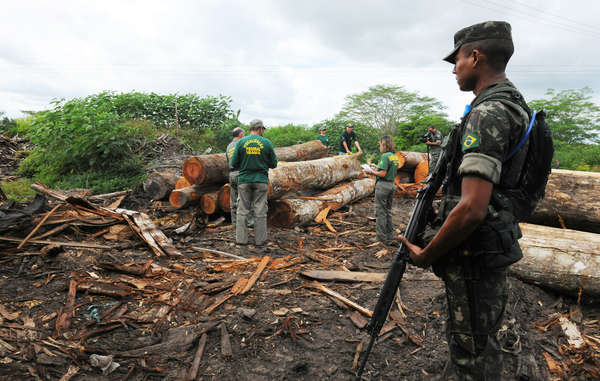
Brazil’s military has moved in to stop illegal logging around the land of Earth’s most threatened tribe.
© Exército Brasileiro
Cross Posted from Survival International
Survival International has received reports that Brazil’s military has launched a major ground operation against illegal logging around the land of the Awá, Earth’s most threatened tribe.
Hundreds of soldiers, police officers and Environment Ministry special agents have flooded the area, backed up with tanks, helicopters and close to a hundred other vehicles, to halt the illegal deforestation which has already destroyed more than 30% of one of the Awá’s indigenous territories.
Since the operation reportedly started at the end of June, 2013, at least eight saw mills have been closed and other machinery has been confiscated and destroyed.

Little Butterfly, an Awá girl. The Awá have pleaded for all illegal invaders to be evicted from their forest.
© Sarah Shenker/Survival
The operation comes at a critical time for the Awá, one of the last nomadic hunter-gatherer tribes in the Brazilian Amazon, who are at risk of extinction if the destruction of their forest is not stopped as a matter of urgency.
But while the operation is making it more difficult for loggers to enter Awá territory and remove the valuable timber, the forces have not moved onto the Awá’s land itself – where illegal logging is taking place at an alarming rate and where quick action is crucial.
Amiri Awá told Survival, ‘The invaders must be made to leave our forest. We don’t want our forest to disappear. The loggers have already destroyed many areas.’

Tanks, helicopters and close to a hundred vehicles have been deployed to protect the forest.
© Maycon Alves
Tens of thousands of people worldwide, including many celebrities, have joined Survival International’s campaign urging the Brazilian government to send forces into the Awá’s territories to evict the illegal invaders, stop the destruction of the Awá’s forest, prosecute the illegal loggers and prevent them from re-entering the area.
Survival’s Director Stephen Corry said today, ‘Brazil has taken a promising first step towards saving the world’s most threatened tribe, and it’s thanks to the many thousands of Awá supporters worldwide. This is proof that public opinion can effect change. However, the battle is not yet won: the authorities must not stop until all illegal invaders are gone.’
New Blockades in Guangdong, Third Major Protest This Week
 17 July 2013 Authorities in the southern Chinese province of Guangdong have promised to halt production at two factories near Sihui city after demonstrators blocked the gates, clashing with workers in the third mass e
 17 July 2013 Authorities in the southern Chinese province of Guangdong have promised to halt production at two factories near Sihui city after demonstrators blocked the gates, clashing with workers in the third mass environmental protest in the region this week, activists said on Tuesday.
Local residents said vehicles continued to come in and out of the main gates of an ink-making plant and a print factory on Tuesday, however, raising suspicions that production may still be going on.
The promise from local government officials came after hundreds of residents of Sihui’s Baisha village converged on the Nanyue Screen Printing Factory and the Precision Ink. Co. Ltd. plant, which they claim are polluting the local environment.
“We blocked up their gates using cement,” one protester surnamed Lu said on Tuesday.”We demanded that the workers on the production floor stop work, but they closed the door on us and wouldn’t let us in.”
“A group of people got overexcited and forced their way onto the shop floor, and got into a fight with some of the workers there,” Lu said. ”A number of villagers were injured in the fight, and had to be taken to hospital.”
Mounting anger
A second Baisha resident surnamed Liang said anger had been mounting over alleged pollution from both factories among local people for a number of years.
“In recent years, people have been getting sick, and it’s getting worse and worse,” Liang said. “A lot of villagers have developed respiratory diseases like asthma and pneumonia.”
“A lot of people have constant sore throats and inflammation, too, while some of the older people in the village have lung cancer,” he said.
“The kids all have upper respiratory tract inflammation, asthma and even pneumonia.”
Lu said villagers were still suspicious that the promise to halt production hadn’t been carried out, because both factories provided high levels of income to local government through taxation
“These two factories are class A taxpayers to the Sihui municipal goverment,” he said. “They are very large, and they pay huge amounts in taxes.”
“They are big customers around these parts, and they hire a lot of workers, so of course the government is going to be on their side.”
‘Running normally’
An employee who answered the phone at the neighborhood committee of the ruling Chinese Communist Party in Sihui’s Chengzhong district declined to comment. “I don’t know about this,” the employee said.
Repeated calls to the district environmental protection department went unanswered during office hours on Tuesday.
An employee who answered the phone at the Nanyue Screen Printing Co. said administrative staff were operating normally on Tuesday, but declined to comment on the protest, or on the reported halt in production.
“We are all at work, and things are running normally,” the employee said, in reference to the office staff. “I don’t really know about it, because the top-level leadership is dealing with it.”
Third protest
The Sihui confrontation on Monday marks the third mass environmental protest in Guangdong this week.
On the same day, thousands of people marched in Huadu district of the provincial capital Guangzhou in protest over plans to build a waste incinerator plant on their doorstep.
And the Huadu protest came just one day after residents of Jiangmen won an apparent concession from local officials, who said they would cancel plans to build a nuclear fuel processing plant near the city after three days of demonstrations.
Worsening levels of air and water pollution, as well as disputes over the effects of heavy metals from mining and industry, have forced ordinary Chinese to become increasingly involved in environmental protection and protest.