Indigenous protests sweep Canada

17 January 2013

17 January 2013

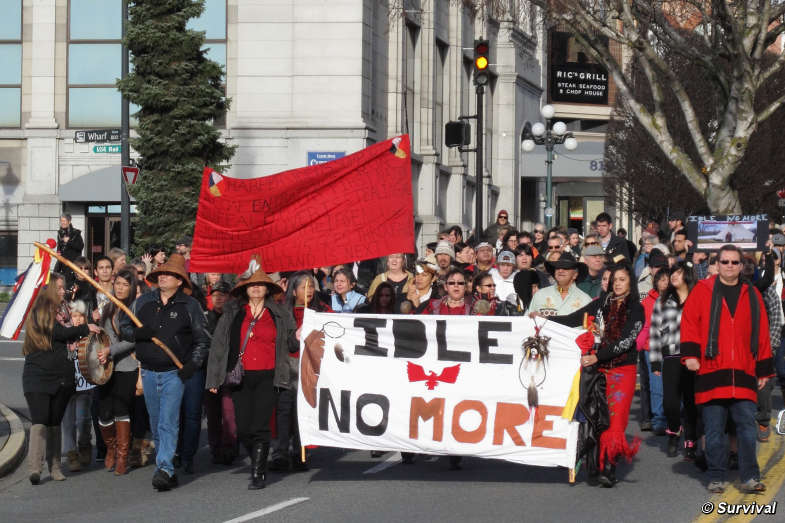
Idle no more protesters marching in Victoria, BC, December 21, 2012.

Native people across Canada have blockaded roads, bridges and railway lines as part of the grass-roots indigenous movement Idle No More.

From British Columbia, where dozens of protesters demonstrated outside hearings for a proposed oil pipeline, to Ontario, where border crossings to the USA were blocked, the scale of the protests strongly suggest that the movement is showing little sign of dying down.

The Idle No More movement began in November 2012, when four women from the province of Saskatchewan held a ‘teach-in’ about the likely effects of Bill C-45, a large and complex bill proposed by Prime Minister Stephen Harper, which would seriously weaken many environmental regulations.

On 4 December, a group of chiefs from the Assembly of First Nations (AFN), Canada’s principal indigenous organization, were prevented from entering the Parliament buildings to lobby MPs over the bill. News of the snub, using the Idle No More hashtag, quickly spread across the country.

Another important element of the protests has been a hunger strike by Theresa Spence, chief of the Attawapiskat First Nation in northern Ontario. This Cree community, despite being the location of De Beers’s Victor diamond mine, is riven by social problems, including poor housing and chronically inadequate education provision.

Chief Spence declared that her hunger strike would continue until the Prime Minister and the Governor General (the Queen’s representative in Canada), agreed to meet her to discuss Aboriginal rights.

On January 11 a delegation of First Nations leaders, under the aegis of the AFN, held a meeting with Mr Harper and various other ministers. The Governor General, however, did not attend. The meeting was inconclusive, with the Aboriginal Affairs Minister reporting that ‘it would be followed by high-level dialogue between the Prime Minister and Shawn Atleo’, leader of the AFN.

As described by the native writer Lisa Charleyboy, the objectives of Idle No More are ‘to build indigenous sovereignty, to repair the relationship between indigenous peoples of Canada (First Nations, Métis, and Inuit), the crown, and the government of Canada from a grassroots framework, and to protect the environment for all Canadians to enjoy for generations to come.’

Idle No More has called for a World Day of Action on January 28th.


Six People Arrested Inside Enbridge Hearings

Vancouver, BC / Coast Salish Territories – This morning (15th Jan), six people directly intervened in the Enbridge pipeline joint Environmental Assessment and Energy Board hearings and put climate change on the agenda.

Vancouver, BC / Coast Salish Territories – This morning (15th Jan), six people directly intervened in the Enbridge pipeline joint Environmental Assessment and Energy Board hearings and put climate change on the agenda. The group managed to make their way past police undetected and into the secured 4th floor of Vancouver’s Sheraton Wall Center. Once inside they revealed shirts emblazoned with messages like “Stop the Pipelines” and proceeded to use police tape to cordon off the hearing area as a “climate crime scene.”

“Climate change is killing thousands of people every year, primarily in developing countries and Indigenous communities that are the least responsible for creating this problem. Despite this fact, the Joint Review Panel has instructed those participating in the hearings not to talk about climate change. This is a shockingly irresponsible move considering Canada’s tar sands contain twice the amount of carbon dioxide emitted by global oil use in our entire history. New fossil fuel pipelines are an irresponsible step in the wrong direction.” said Sean Devlin.

The impacts of climate change have been drawing global attention recently, between Hurricane Sandy, unprecedented deadly typhoons in the Philippines and previously unimaginable temperature records in Australia. In this urgent context the JRP has designated climate change and the carbon emissions of Canada’s tar sands “outside of the panel’s mandate,” a move that officially discourages interveners from raising these critical issues during their oral statements.

“Enbridge and the federal government are using their position of authority within this process to coerce members of the public into silence on these issues. The majority of First Nations and settler communities in the province oppose fossil fuel pipelines. We respect those who are voicing their opposition to the pipelines inside the hearings, but the hearing process is meaningless, especially since Harper has changed the law, giving his cabinet final say on pipeline projects,” said Fiona De Balasi Brown.

Today marks the second day of the Joint Review Panel hearings in Vancouver and the second day that the members of the public have crossed police lines to make their opposition heard. On Monday more than a thousand protesters peacefully forced their way past police onto the Sheraton property drumming so loudly the noise could be heard inside the hearings. Public outrage has been emboldened by a decision to exclude the public from the hearings in Vancouver, a move the BC Civil Liberties Association criticized yesterday as “potentially unlawful.”

The Economics of Insurgency – Thoughts on Idle No More & critical infrastructure

News reports are ablaze with reports of looming Indigenous blockades and economic disruption.

News reports are ablaze with reports of looming Indigenous blockades and economic disruption. As the Idle No More movement explodes into a new territory of political action, it bears to amplify the incredible economic leverage of First Nations today, and how frightened the government and industry are of their capacity to wield it.

In recent years, Access to Information (ATI) records obtained by journalists reveal a massive state-wide surveillance and “hot spot monitoring” operation coordinated between the Department of Indian Affairs, the Royal Canadian Mounted Police (RCMP), the Canadian Security Intelligence Service (CSIS), local security forces, natural resource and transportation ministries, border agencies, and industry stakeholders. These efforts have been explicitly mobilized to protect “critical infrastructure” from Indigenous attack.

What is critical infrastructure? According to an RCMP internal document concerning the risk of Aboriginal protest, “critical infrastructure refers to infrastructure, both tangible and intangible, that is essential to the health, safety, security or economic well-being of Canadians and the effective functioning of government.” RCMP National Security Criminal Investigations have prioritized four critical infrastructure sectors: finance, transportation, energy, and cyber-security.

On January 5 alone, INM protests included five border crossing blockades, bridge blockades, and rail line disruptions spanning the country.

And it’s not only intelligence services that are warning of threats to critical infrastructure.

Conservative military analyst Douglas Bland has also long warned that Canada’s economic vulnerability is based on the “critical infrastructure that transports natural resources and manufactured goods from mines, oil fields, hydro-electric facilities and factories to international markets.” Without these critical systems, he cautions, “Canada’s economy would collapse."

Though Bland has counseled a conciliatory approach to Aboriginals in order to stave off the coming crisis, his alarmism – and that of other right-wing pundits – simultaneously justifies the state’s security and surveillance apparatus by manufacturing a fear of native uprising. But for Bland and others, a coming “Native Spring” is less feared for its potential “violence” and all the more grave for its threat to property rights.

In Bland’s fictional book Uprising, he predicts coordinated attacks by secret native cells on key installations and urban hubs, such as the James Bay hydro-electric dam and the downtown core of Winnipeg. This attack on critical infrastructure tellingly ends in a blaze of heroic Canada-US military attacks on the rebel army. (The US gets involved only when they realize their source of electricity, oil, and gas is at stake.)

Herein lies the real role of right wing alarmists in the INM movement: to maintain the economic status quo, because territory is capital. Land is money. And the circulation of goods, resources and energy through territory is the very essence of capitalism today.

The fact is that critical infrastructure in Canada is at the mercy of Indigenous peoples, who are more rural than Canadians and have access to important arteries for economic flows: transportation corridors, energy sectors, and sites of natural resource extraction.

This vulnerability is deadly to the logistics industry. Logistics is a business science concerned with the management of goods and information through global supply chains. As the World Bank has declared: “A competitive network of global logistics is the backbone of international trade.” For an industry dependent on maintaining open channels for capital circulation, a blockade means massive losses: the trucking industry alone is worth $65 billion and employs more than 260,000 drivers.

In the energy sector, Canada has oil reserves second in the world after Saudi Arabia, though less accessible – 98 per cent of this oil is in Alberta and 95 per cent of it is in the tar sands, where effective Indigenous resistance by Treaty 8 and other First Nations has led to global boycott campaigns and fierce resistance.

In northern BC, the Unist’ot’en Clan, with support from grassroots Wet’suwet’en, have built a community of resistance directly on the GPS co-ordinates of the proposed pipeline route from the Alberta tar sands to the Kitimat port. From this camp they have evicted surveyors working for Pacific Trails Pipeline. Meanwhile, in Ontario, Enbrdige’s Line 9 has been has been opposed by the Oneida, the Haudenosaunee Development Institute, and Aamijiwaang First Nation, who have all vowed to fight the pipeline to protect their lands and waters.

In terms of natural resource extraction, over 10 per cent of Canada’s economy is comprised of the natural resources sectors and earth science industries, which directly employ close to 763,000 people. The greatest concentration and correlation between Indigenous lands and mineral claims are being currently developed in the northern modern treaties and territories, such as Nunavut; Yukon; the James Bay region of Quebec, and the Quebec-Labrador border; on unceded northwestern BC lands (e.g. on Nakazdli, Tzalten, and Tlingit traditional territory); and in northern Ontario’s “Ring of Fire” on historic treaty lands, particularly Treaties 3 and 9.

In addition to mineral resources, over half of large intact forest landscapes are found on lands in historical Aboriginal treaty areas. More specifically, as Global Forest Watch reports, “Treaties 8 and 9 contain about a quarter of all of Canada’s intact forest landscapes and close to half of all the intact forest landscapes that occur within treaty areas. Modern land claim settlements contain about a quarter of Canada’s intact forest landscapes.”

That is not to say meaningful consultation concerning critical infrastructure has not been taking place. The problem is that it has exclusively been between industry and government, instead of between Indigenous peoples and the state. Journalists have been uncovering multiple incidents of high-level co-ordination between industry and government officials. For example, Access to Information requests revealed that the government has been sharing information with the oil industry on environmentalists and Indigenous groups twice a year since 2005 at secret briefings, even on such seemingly irrelevant activities such as participation in anti-G20 demonstrations.

The irony is that many corporations are tired of having operations held up by Indigenous protest and are willing to go further than governments to recognize Indigenous rights. The logics of colonialism and capitalism divide here around conflicting objectives of territorial acquisition versus the circulation of goods. But more often than not, the state and industry converge around the common interests of the ruling class. For Indigenous peoples, this becomes a question of co-ordinating leverage.

In conclusion, I want to highlight three main concerns expressed in the risk assessments undertaken by RCMP, CSIS, Indian Affairs, and right-wing thinkers on Indigenous uprising that foreground Indigenous economic power.

The first is that a mishandling of conflict will galvanize co-ordinated efforts of First Nations across the country; hence the relatively hands-off approach taken until now. In the Federal Coordination Framework for the AFN Day of Action in 2007, the proposed solution in the case of co-ordinated mobilization is to “isolate the splinter group.”

Second, the economic cost of even a few hours of such co-ordinated efforts would be crippling and impossible to police given current resources.

Third – and this is one of the most worrisome trends to observers – solidarity and co-ordination between non-Natives and Indigenous peoples will encourage the movement to build.

As a final thought, while the general population might have been taken by surprise by the strength of Idle No More, the government had long prepared for this inevitability. As far back as 2008, when changes were first proposed to the Navigable Waters Act, CSIS’s Integrated Threat Assessment Centre warned about “potential unrest.”

Canada created the crisis of insurgency. Canada’s greed created a situation where Indigenous peoples stand with almost nothing to lose. Therefore, the fight is theirs to take. It is also ours to support.

Read the full article here.

Anti-road campaigners peacefully resisting camp evictions (16 Jan)

The eviction of the two remaining camps (“Base camp” and “Decoy Pond Wood” – see here and below for maps) has begun, and campaigners are resisting peacefully in treehouses and tun

The eviction of the two remaining camps (“Base camp” and “Decoy Pond Wood” – see here and below for maps) has begun, and campaigners are resisting peacefully in treehouses and tunnels. Please protest, support and publicise!

Bailiffs arrived just before 8am, and the eviction proper began around 8.15am. As at 8.37am there were 30+ bailiffs on site with more security arriving, focussing mainly on the tunnel(s). As at 8.59am it was no longer possible to access the camp via the access road to Adam’s farm (though other cross-country routes may still be available), and Harris fencing was being brought in.

Please note: This is only the end of the beginning for the protests against the Bexhill Hastings Link Road (BHLR)! We urgently need to replenish our finances following the last month of protests, so please consider giving a donation, using the “donate” button on our web-site and Facebook page, if you are able.


Press release Combe Haven Defenders [1]
Wednesday 16 January
Contact 07926 423 033

EVICTION OF ANTI-ROAD CAMP NEAR HASTINGS HAS STARTED
Protestors resisting peacefully in treehouses and tunnels

Wednesday 16 January, 8.16am: Opponents of the Bexhill-Hastings Link Road (BHLR) are defending trees and  occupying tunnels at their main protest camp in Crowhurst. Security guards and bailiffs, supported by police, began attempts to evict the camp at 8am today.

The main camp, which has been in place since 21 December, is located on the proposed route of the BHLR close to Adam’s Farm, Crowhurst [2]. Further trees on route are occupied by protestors at nearby “Decoy Camp”.

The peaceful protests against the road– which have now been running for a month, with 12 arrests – have seized national attention over the past week [3].

Tree-felling work for the road started on 14 December 2012 and represents the first significant work on the highly-controversial £100m road, one of over forty “zombie roads” that were declared dead years ago but have now been resuscitated as part of as part of Britain’s largest road-building programme in 25 years [4, 5].

Contact 07926 423 033

NOTES
[1] http://www.combehavendefenders.org.uk
[2] Nearby postcode TN33 9AY. For map see http://combehavendefenders.wordpress.com/camp-groundrules-directions/
[3] http://combehavendefenders.wordpress.com/recent-media-coverage/
[4] See ‘Controversial ‘zombie roads’ scheme to be resuscitated’, Guardian, 10 October 2012, http://tinyurl.com/zombieroads
[5] http://bettertransport.org.uk/media/26-Oct-roads-report

Ecuadorian Indigenous Village Threatens to “Die Fighting” Against Oil Company – 15th Jan


An indigenous community in the Ecuadorian rainforest says they “will die fighting to protect the rainforest” after they say they were swindled by an oil company into signing away rights to 70,000 hectares of one of the most biodiverse areas in the world.


An indigenous community in the Ecuadorian rainforest says they “will die fighting to protect the rainforest” after they say they were swindled by an oil company into signing away rights to 70,000 hectares of one of the most biodiverse areas in the world.

But the state-backed oil company, PetroAmazonas—backed by the Ecuadorean army—plans to begin prospecting the Kichwa village on the Napo River on Tuesday, The Guardian reports.

PetroAmazonas, one of the biggest oil companies in South America, originally offered the village a new school, university places for village children and better healthcare, but dropped those provisions before the chief of the village signed away the rights to the land for $40 per hectare.

But the community secretary, Klider Gualinga, said 80 percent of the village opposes the deal, which he says has not yet been finalized. “People think it is dishonest and the oil company is treating them like dogs. … They’re very upset and worried. We have decided to fight to the end. Each landholder will defend their territory. We will help each other and stand shoulder to shoulder to prevent anyone from passing.”

“If there is a physical fight, it is certain to end tragically,” Shaman Patricio Jipa said. “We may die fighting to defend the rainforest.”

He continued:

It makes me feel sad and angry. Sad because we are indigenous people and not fully prepared to fight a government. And angry because we grew up to be warriors and have a spirit to defend ourselves. I wish we could use this force to fight in a new way, but our mental strength is not sufficient in this modern world.

[…]

There is huge concern the oil company will move quickly to clear the land. When that happened elsewhere, they used armed troops, beatings and abductions to remove those who stood in their way.

Jipa and his wife, Mari Muench, a British businesswoman, are fighting the plan.

Scientists say a single hectare in this part of the Amazon contains a wider variety of life than all of North America. The Amazon rainforest and other tropical forests are also among the earth's best defenses against climate change, absorbing some 20 percent of carbon dioxide produced by burning fossil fuels.

"Protecting the Amazon basin, which contains the largest tropical rainforest on the planet, is critical to our planet's climate stability," according to Amazon Watch.

Police say camps to be evicted this week, as 400-year-old oak felled

Contractors moved in in force on Monday (14 January) to evict the “Three Oaks” camp near the railway line opp.

Contractors moved in in force on Monday (14 January) to evict the “Three Oaks” camp near the railway line opp. Upper Wilting Farm in Crowhurst (see press release below), and police have told activists that they plan to evict the remaining two camps (“Decoy Pond Wood” and “Base Camp” – see map below) this week.

So if you want to come and help peacefully stop the felling (whether in an arrestable or non-arrestable role): now’s the time! See here for more info re. the Camp.

[Update at 12.30pm: Despite being heavily outnumbered by security and contractors, activists at the "Three Oaks" protest camp were able to delay the felling of the 400-year-old oak by 3-4 hours this morning. Two people were finally evicted from high-up in the oak, and a third person, locked-on near the base, was also removed. No arrests were made, and the trees in question are now being felled.]

Press Release
14 January 2013
Combe Have
n Defenders

CHAINSAWS MOVED IN TO FELL 400-YEAR-OLD OAK AT HASTINGS TREE PROTEST

9am, Monday 14 January, Crowhurst:  Contractors preparing the way for the Bexhill-Hastings Link Road (BHLR) are believed to be felling a 400-year-old Oak Tree as they evict the “Three Oaks” protest Camp near the railway line opp. Upper Wilting Farm (TN38 8EG) in Crowhurst (see map below).

Police, security, chainsaw operatives, and a digger moved in on the tree-protest Camp (one of three along the route of the BHLR) this morning, shortly after 7am. Despite being heavily outnumbered by police and security, as at 8.30am several activists were in the trees and at least one was locked-on.

According to a recent report in the Guardian: “When the landowner signed the compulsory purchase order for the land at Three Oaks, where a flyover is to be built above the railway, he persuaded the council to spare one tree thought to be 450 years old (not a promise the protesters expect to be kept).” [3]

Two more protest camps (“Decoy Pond Wood Camp” and “Base Camp”) have not yet been evicted.

The BHLR is one of over forty “zombie roads” that were declared dead years ago but have now been resuscitated as part of Britain’s largest road-building programme in 25 years [4].

[2] See map here: www.combehavendefenders.org.uk
[3] “Road protests return: a new generation takes on the bypass builders”, Guardian, 12 January 2013, http://www.guardian.co.uk/environment/2013/jan/12/combe-haven-green-protesters-trees
[4] http://bettertransport.org.uk/media/26-Oct-roads-report

Self-Determination and Self-Defense in Cherán, Michoacán

On December 11, 2012, the US Justice Department announced that banking giant HSBC was immune from prosecution despite overwhelming evidence that they consistently failed to implement controls against money-laundering. Assistant attorney general Lanny Breuer said: “Had the US authorities decided to press criminal charges, HSBC would almost certainly have lost its banking license in the US, the future of the institution would have been under threat and the entire banking system would have been destabilized.”

The entire banking system would have been destabilized?


The Department of Justice opted rather to charge HSBC a record-breaking 1.9 billion dollar fine, and ordered the bank’s activities monitored for five years. The 1.9 billion is equivalent to five weeks’ worth of HSBC earnings, in other words, a drop in the bucket. The saddest part of the story in the mainstream media, is the focus on money laundered and money fined, as opposed to lives lost and crime legitimized in one of the most grotesque admissions of complicity with organized crime in the so-called war on drugs. Basically what was announced to the world by the US Justice Department was that the money ran too thick, and the criminals were too powerful. The global economic impact of prosecuting a bank where the dirty money has been going, was too dangerous to risk. “Sorry kids, but we guess the bad guys win.”

In Cheran, Michoacan, Mexico the news of HSBC’s immunity from criminal prosecution and US sanctions comes as no surprise. Organized crime has been prevalent in the community since 2000. After a 2008 mayoral race that left a PRI (Institutional Revolutionary Party) candidate in office, illicit activity increased substantially. The community learned that organized crime is an integral part of local politics and economics everywhere. Cheran is a beautiful small indigenous Purepecha mountain community surrounded by precious forests, that knows the true cost of those profits laundered. Immediately after the 2008 mayoral race the community began experiencing the devastating effects of dog eat dog capitalism of which organized crime is only another part.

The illegal logging industry began to ravage the community’s most precious forests, which have been traditionally respected as a spiritual connection by the Indigenous Purepecha people to their territory. The logging began to look a lot more like pillaging and when community members began to attempt to defend their forests, they were met with a real life nightmare: the loggers were not only aided and protected by government agencies and local police, the entire logging operation was being coordinated by members of a major organized crime syndicate. [To this day I am told by community members not to name the actual syndicate in anything I write or say, or risk an almost certain death.]

The first community members who began to defend their forest were simply and quickly assassinated. From 2008-2011 the situation only became worse. Criminals charged protection to run even a small business in the community of Cheran. The forest was raped and terror reigned as anyone felt at risk. The city would become a ghost town by sunset. This is a reality confronted by too many communities in Mexico every day.

Murders, disappearances, kidnappings, the criminal amounts of illegal logging and the reign of terror came to a head on the early morning of April 15th, 2011. A group of women had begun quietly organizing in the days before an action to bring the ravaging of their town to a halt. On April 15th, with children and youth at their sides, the women rose up and attempted to detain loggers traveling through town. The loggers tried to run the women over and in response the community reacted as a whole, and began burning the loggers’ vehicles and began detaining the loggers themselves.

It is at this point that the community recognized the complicity of the local police when it was police officers who guided organized crime thugs to the place where the loggers were being held, in an attempt to violently release them. The community erected “fogatas” or bonfire barricades throughout town in order to prevent violence against community members. Within days the community decided that it no longer trusted any politicians from any political party or any of the local and state police. They began to organize for self-determination and self-defense and chose to return to their traditional Purepecha forms of self governance.

A general council of community elders was elected and commissions were formed in order to carry out the community’s logistical, social, economic, and political needs. Community members simply say that they referred to their history and referred to their elders in order to return to the way the community was organized before political parties, police, and organized crime existed. The general council is legally recognized as the governing body of Cheran, Michoacan today.

The community has maintained that they only have three demands: safety, justice, and the reforestation of their territory. They have actively been reforesting the entire region and take that aspect of their struggle very seriously, and remind us that for them protecting the forest is both a traditional and a spiritual obligation. Cheran does not believe that anybody will ever be able to bring them justice for their dead, disappeared, and displaced as a result of the conflict, nor do they expect anyone in power to understand the justice they seek for the forest. Today Cheran knows that justice is something that they will have to take care of obtaining on their own from now on. When it comes to safety, the world is able to see what it looks like for a community to take responsibility for its own safety through traditional indigenous forms of self governance and self-defense.

Shortly after the 2011 uprising began, community members state that the local politicians and the police simply exiled themselves in fear from the community, warranting no need to run them out of town. Community members took the local government offices, took police trucks, took the polices’ weapons, and put them all to use. Historically, Cheran had traditionally been “policed” or defended by members from the community. In a voluntary rotation members from each of the four “barrios” or neighborhoods would patrol the community for self-defense in what is known as the “community ronda.” After the uprising the general council made a call out for volunteers to participate in the community “ronda”, or community guard. Community members maintain that police are imposed by the government, but the “ronda” is a traditional way in which community members protect themselves and their community. Today the “ronda” is separated into two parts. The “ronda comunitaria” which is responsible for patrolling and protecting the community from within its borders and the “guardabosques” or forest defenders, which patrol the outskirts of town and deep into the forests in order to protect community members living in those more rural areas and in order to protect the forest itself.

Cheran is not the first community in Mexico to return to their traditional means of community self-defense, nor is it the first place in the state of Michoacan, nor in the indigenous Purepecha region. Other communities have engaged in similar practices of self governance and self-defense, and little by little more and more communities are seeing traditional self governance and self-defense as a viable alternative to corrupt politics and submission to organized crime. Recently council members from Nurio, Michoacan, a larger community and long time practitioner of self governance and self-defense, suggested that the entire Purepecha region should begin to organize a regional “ronda” that could potentially coordinate self-defense patrols on a regional level for the indigenous Purepecha people living throughout the state of Michoacan.

It is hard not to throw your hands up in the air in resignation when you hear about criminals such as HSBC being granted immunity from prosecution and sanctions, but it is even harder not to throw a fist in the air when you see indigenous Purepechas successfully overcoming organized crime, corrupt politicians, and big business by establishing models for self-determination and self-defense, on a community level.

Simòn Sedillo

Combe Haven Defenders cordially invite you to help! Serious lack of numbers, camps facing eviction tomorrow tuesday 15th Jan

We need more people urgently, please help either NVDA or legal observer, urgent urgent camps facing eviction tomorrow, come and run around in the cold muddy fields! Your trees need you

We need more people urgently, please help either NVDA or legal observer, urgent urgent camps facing eviction tomorrow, come and run around in the cold muddy fields! Your trees need you

Idle No More International Day of Action – January 28, 2013

14th Jan 2012.

14th Jan 2012. Indigenous Resurgence Explodes with Idle No More Day of Action

Idle No More grassroots founders and organizers from across Canada, in solidarity with common causes – a new initiative bringing together social justice, environmental, labour and other Activist Groups…

– UNITED we are planning IDLE NO MORE WORLD DAY OF ACTION on January 28th, 2013 #J28.

This day of action will peacefully protest attacks on Democracy, Indigenous Sovereignty, Human Rights and Environmental Protections when Canadian MPs return to the House of Commons on January 28th. As a grassroots movement, clearly no political organization speaks for Idle No More. This movement is of the people… For The People! #IDLENOMOREFTP

The Vision of IDLE NO MORE revolves around Indigenous Ways of Knowing rooted in Indigenous Sovereignty to protect water, air, land and all creation for future generations.

The Conservative government bills beginning with Bill C-45 threaten Treaties and this Indigenous Vision of Sovereignty.

The Goal of the movement is education and the revitalization of Indigenous peoples through Awareness and Empowerment.  IDLE NO MORE has successfully encouraged knowledge sharing of Indigenous Sovereignty and Environmental Protections. 

This message has been heard around the world and the world is watching how Canada responds to the message sent by many INM Supporters.

INM urges the government of Canada to repeal all legislation; which violates Treaties, Indigenous Sovereignty and subsequently Environmental Protections of land and water.

INM is grateful to many leaders who have supported this vision and the movement of the grassroots people.

“The Treaties are the last line of defense to protect water and lands from destruction,” stated Oren Lyons, Faithkeeper Turtle Clan, Onondaga Nation Council of Chiefs.

Please watch and share this video of the Idle No More action in Toronto, and organize events in solidarity with Idle No More within your local collectives:

Today Marks 7th Year Anniversary of Eric McDavid’s Arrest

13th Jan 2013. Today marks the 7th Anniversary of Eric McDavid’s (also known as “D”) arrest. Eric was arrested (along with Zachary Jenson and Lauren Weiner) on January 13, 2006, as part of the government’s ongoing Green Scare campaign.

13th Jan 2013. Today marks the 7th Anniversary of Eric McDavid’s (also known as “D”) arrest. Eric was arrested (along with Zachary Jenson and Lauren Weiner) on January 13, 2006, as part of the government’s ongoing Green Scare campaign. All three were charged with “Conspiracy to damage and destroy property by fire and an explosive.” His arrest was the direct result of a government informant – known only as “Anna” – who spent a year and a half drawing him in and working with the FBI to fabricate a crime and implicate Eric in it. Anna was paid over $65,000 for her work with the FBI. Eric was imprisoned for what amounts to thought-crime – no actions were ever carried out, and Eric was charged with a single count of “conspiracy” – a powerful legal tool often used by the state to crush dissent.

Below is his personal correspondence followed by a correspondence from Jenny, his partner.

Learn more about Eric’s story or find out how to write to him at supporteric.org.

Letter from Eric McDavid,

7 yrs…  i can’t say it’s easy 2 put these words dn on paper – that it doesn’t pain me 2 look bk over these past 7 trips around the Sun… w/the process of the courts continuing n the final appeal stages; it’s end yet 2 show up on the horizon = no illusions, while still Dancing w/wishes… Love & Joy have also made their presence known = the overwhelming support from all over the Earth ~ i wish 2 Thank every persyn/grp that has written & supported me along this journey – Ur intents, N which ever forms they’ve taken, have aided & nourished me N remembering who i am N a situation &
environment bent on unraveling, dismembering & remolding…along w/all the communal Solidarity, i’m grateful 4 the support of friends & family – & how i’ve been buoyed by the Love and Passionate Patience of my Partner = i Love you J, you R my Joy…  …  i’m unable 2 adequately express my feelings of Respect & Solidarity 4 all the folx Dancing w/the overt repression across the continent while staying True 2 their Hearts…  2 the folx Dancing w/Grand Juries = bide Ur time, this is 1 of the few circ.s where time is on the SD of the oppressed…  w/N this cultural climate the Path is not easy or simple by any means – making it all the more important 2 find those unique, ever changing, beautiful & sustainable
ways 2 aid & nurture each other… …. i’ll close wishing that each of U continue 2 explore & heal Ur Hearts & communities; may U find the space & time over the coming yr 2 let Ur minds play w/new & safe communication skills, & Ur bodies w/self-defense…

Stay safe & have fun finding Ur Joy

N Solidarity
w/much Love
D

Letter from Jenny,

Hello friends,

Tomorrow, January 13th,  marks the 7th year of D’s arrest.  It’s strange
how life really does move in cycles.  Glancing at the note I sent you all
last year my eyes are greeted by good news.  After his move to Terminal
Island last year – right before the New Year – D and I were finally
allowed to hold hands during our visits for the first time since his
arrest.  After 6 years.  It was a reminder of how precious such seemingly
insignificant acts can be – and to remember to never take them for
granted.

On New Year’s Eve this year I spent the day visiting D at Terminal Island.
The visit started normally – a much awaited hug and kiss, slowly moving
to our chairs, but letting our hands linger – fingers intertwined as we
reached across the tiny table between us.  That lasted about 30 seconds.
They called D up to the podium where they sit and watch…  I heard a
flurry of voices with undertones of urgency, although never hostility. 
When he came back he told me they weren’t allowing us to hold hands
anymore.  He tried once more to get them to check their own rules, but to
no avail.  After over a year of being granted this glorious privilege, it
was yanked from underneath us.

So many things have been taken from us.

A million thoughts swim through your head at times like that.  I knew this
might happen.  It’s always in the back of your mind – what they
can/might/will take one day.  I’m more prepared for it now than I used to
be – which is to say it’s slightly less devastating when it happens.

I spent much of the car ride home thinking about loss.  Sometimes it feels
like my heart has broken so many times that the thing I am mending bears
no resemblance to the original.  That thought scares me.  But then I think
of the alternative.  A friend recently told me that she always felt like
love should be a safe space…  I wish I could agree.  But that has never
been my experience.  With love we throw our hearts wide open – which means
everything gets in.  The good, the bad, the ugly.  And sometimes that
means we hurt like hell.  But other times that means we get to experience
so much joy and beauty that we almost can’t stand it.  And that is what I
have experienced with D.  And I would do it all over again in a heartbeat.

D is an amazing individual.  His heart is bigger than any i’ve ever known
and his mind powerfully creative and beautiful…  and his commitment to
his friends, his family, and struggle is rock solid.  Being his partner
has been the most amazing, beautiful journey.  I wouldn’t trade it for
anything.

Even with all of the loss.

Sometimes my heart gets so heavy…  but then I remember our friends and
comrades who have followed similar paths.  Many of whom are now out here
with us, again.  And then I remember all of you – who have been a part of
this struggle.  Who have been here with us every step of the way.  And
together we inch closer to that light at the end of the tunnel…

Tomorrow is the 13th.  I’ll be driving down to visit D again.  He called
me the day after our last visit to tell me they found the “memo” that
allows us to hold hands.  How strange that a piece of paper can dictate my
interactions with my partner of 7+ years.  And that someone misplacing
that piece of paper can be such a cause for panic, sorrow and reflection.
I’m glad they found it.  But D has told me it doesn’t seem to have fixed
the problem…  either way,  I’m not holding my breath.  Nothing is ever
certain.  And even if they don’t have it fixed…I know that nothing can
stop us.  Because we have each other.  And we have all of you.

To all of our friends and comrades who have experienced so much loss this
year – our unending love, support, and solidarity.  You are never alone.

And to our friends and comrades who have gained their freedom – or at
least pieces of it – welcome home.

With love and solidarity,
jenny

P.S.
Eric has been in prison a long time…and he has a lot more to go.  Please
let him know that you are still thinking about him!  Letters, books,
donations, fundraisers and support events are still always needed.  For
more information on how to write Eric a letter or how to donate to his
support fund, please visit:  www.supporteric.org