Fearing Protestors, Tree Biotech Conference Cancels Visit to GE Tree Test Plot 2nd May

irB

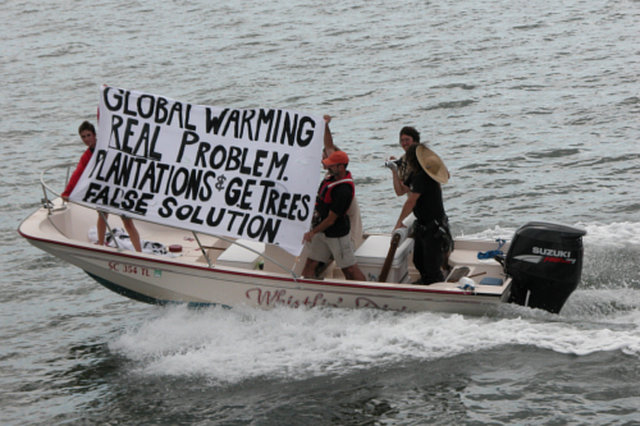
EF! confronts GE tree scientists on the high seas in Charleston, SC in 2007

irB

EF! confronts GE tree scientists on the high seas in Charleston, SC in 2007

There is still a month to go before activists hit the streets of Asheville, NC to protest the 2013 Tree Biotechnology Conference, but the industry is already showing signs of retreat. Apparently fearing that protestors will follow them wherever they go, the conference organizers recently cancelled a group trip to a test plot of genetically engineered eucalyptus trees. While the counties in which these test plots are planted are publicly known, the exact location of these mutant trees is a closely guarded secret. It seems they don’t want a mob of Earth First!ers to find out where they are!

 The 2013 Tree Biotechnology Conference is an international gathering of scientists, forestry corporations and university researchers with a major focus on genetically engineered tree production. GE trees pose an unprecedented threat to native forests. Timber and utility corporations want to plant millions of acres genetically engineered trees throughout the South to burn for electricity, as well as to continue supplying the unsustainable lumber and paper industries. These trees would be engineered to produce their own pesticides, grow straighter and faster, tolerate manufactured pesticides, produce sterile seeds, and reduce lignin content (this is what makes the wood in a tree strong enough to stand up). If these traits escaped into native tree populations, the effects would be devastating and irreversible.

 In another setback for the GE tree industry, the USDA just announced the results of their public comment period on the proposed approval of commercial plantings of genetically engineered eucalyptus trees. While over 30,000 people spoke out against the commercial planting of these Frankentrees, an underwhelming, four, yeah that’s right four, people spoke out in favor of planting GE trees. Though this public comment period shows that there is next to no support for GE trees, it is no time to let our guard down considering that government agencies regularly ignore the public opinion.

 Help us keep the up the pressure on the USDA and the tree biotech industry. Join activists from around the country as we stand up for native forests and send a loud NO to GE trees with a week of protests and educational events in Asheville, NC May 26-June 1st.

Faslane Peace Camp: Phoenix Gathering 3-5 May 2013

meeting

Watch the great new video call-out.

meeting

Watch the great new video call-out.

A 3 day gathering at Faslane Peace Camp to work out logistics etc of rebuilding or tatting down the camp.  For everyone who wants to be involved as a new resident or part of the new support group.  
Please get in touch if you want to attend either phone the camp on 01436-820901 or e-mail the peace camp solidarity group:
faslanepeacecampsolidarity@gmail.com

3rd, 4th and 5th May
Faslane Peace Camp, Shandon, Helensburgh, Dunbartonshire G84 8NT

Faslane Peace Camp is looking for new members!

Faslane Peace Camp is the longest running peace camp in the world.  Opened in 1982 by local people opposed to the basing of Trident missile submarines here, the peace camp has been a symbol of hope and resistance for over thirty years.
Over that time numbers at the camp have fluctuated from 2 to 25 people living there at any one time.
Now numbers are falling and the people living at the camp want to move on.  They've decided to set a deadline of May 12th 2013 to find more people or they are going to start dismantling the camp and turning it into a peace garden in time for the peace camp's 31st birthday on 12th June 2013.  
We don't have that much time to find a group of people who are committed to staying at the camp to continue the resistance to British nuclear weapons on the Clyde.  
Some former peace campers and friends at the peace camp have set up a group to try to do this and are committed to providing support for new people moving to the peace camp.
Please if you don't want to see the Peace Camp close at this crucial time in the debate about nuclear weapons in Scotland and can offer help in any way or are interested in finding out more about living at the peace camp please email us the Faslane Support Network at: faslanepeacecampsolidarity@gmail.com
Or talk to the peace campers themselves by contacting Faslane Peace Camp on 01436-820901 or faslane30@gmail.com

Lots more recent stories here,

Goldcorp Security Shoots Peaceful Protesters in Guatemala 1st May

Police, military and private security attack peaceful anti-mining protesters at the San Rafael mine in Guatemala, Sep.

Police, military and private security attack peaceful anti-mining protesters at the San Rafael mine in Guatemala, Sep. 2008

From Rights Action:

Six civilians were shot and wounded (2 seriously) on April 27, 2013 by Tahoe / Goldcorp security forces at Tahoe’s “San Rafael” mine site (municipality of San Rafael Las Flores, department of Santa Rosa, Guatemala).  The wounded are: Adolfo García, 57; his son Luis García, 18; Wilmer Pérez, 17; Antonio Humberto  Castillo, 48;  Noé Aguilar Castillo, 27; Érick Fernando Castillo, 27.  Local residents, who are maintaining a permanent peaceful occupation by the mine entrance in protest against it, saw company armed guards open fire on the group of men who were walking by.  (Prensa Libre, April 29, 2013, http://www.prensalibre.com/santa_rosa/personas-resultan-incidente-San-Rafael_0_909509181.html)

Read more here about Goldcorp’s (and subsidiary Tahoe Resources’) recent history of violence and repression against indigenous and campesino communities in Guatemala.


The Fuel Nightmare Continues

It’s as if the universe is trying to tell us something, isn’t it?

It’s as if the universe is trying to tell us something, isn’t it?

First, a disastrous month that saw at least 15 separate oil spills worldwide, nearly all of them in North America. That month also saw an oil barge catch fire after a collision, and the publication of a study implicating fracking as a cause of earthquakes.

Now at least 600 gallons have spilled from an Enbridge oil pumping station near Viking, Minnesota.Two fuel barges carrying a natural gas derivative have exploded and are still burning on the Alabama River. And new reports strongly suggest that tar sands from Exxon’s Pegasus Pipeline in Mayflower, Arkansas have seeped into Lake Conway and are heading toward the Arkansas River.

Disasters like these bring the real costs of fossil fuels into sharp focus, because we can imagine ourselves affected by them. But the truth is, disasters like these are part of everyday life for the people and other beings living in areas where fossil fuels are extracted—or any other industrial materials, from copper for solar panels to coltan for cell phones.

If you wouldn’t want oil spilling into your back yard, if you wouldn’t want a strip mine ripping open a hole behind your house and poisoning your water, then it’s time to admit that the economic system founded on consuming these materials has got to go. We’ll never have justice or sustainability if we base one group’s “high standard of living” on the dislocation and destruction of others.


The Efficiency of Green Energy

cap_1

We ought not at least to delay dispersing a set of plausible fallacies about the economy of fuel, and the discovery of substitutes [for coal], which at present obscure the cri

cap_1

We ought not at least to delay dispersing a set of plausible fallacies about the economy of fuel, and the discovery of substitutes [for coal], which at present obscure the critical nature of the question, and are eagerly passed about among those who like to believe that we have an indefinite period of prosperity before us. –William Stanley Jevons, The Coal Question (1865)

There are, at present, many myths about green energy and its efficiency to address the demands and needs of our burgeoning industrial society, the least of which is that a switch to “renewable” energy will significantly reduce our dependency on, and consumption of, fossil fuels.

The opposite is true. If we study the actual productive processes required for current “renewable” energies (solar, wind, biofuel, etc.) we see that fossil fuels and their infrastructure are not only crucial but are also wholly fundamental to their development. To continue to use the words “renewable” and “clean” to describe such energy processes does a great disservice for generating the type of informed and rational decision-making required at our current junction.

To take one example – the production of turbines and the allocation of land necessary for the development, processing, distribution and storage of “renewable” wind energy. From the mining of rare metals, to the production of the turbines, to the transportation of various parts (weighing thousands of tons) to a central location, all the way up to the continued maintenance of the structure after its completion – wind energy requires industrial infrastructure (i.e. fossil fuels) in every step of the process.

If the conception of wind energy only involves the pristine image of wind turbines spinning, ever so wonderfully, along a beautiful coast or grassland, it’s not too hard to understand why so many of us hold green energy so highly as an alternative to fossil fuels. Noticeably absent in this conception, though, are the images of everything it took to get to that endpoint (which aren’t beautiful images to see at all and is largely the reason why wind energy isn’t marketed that way).

Because of the rapid growth and expansion of industrialiation in the last two centuries, we are long past the days of easy accessible resources. If you take a look at the type of mining operations and drilling operations currently sustaining our way of life you will readily see degradation and devastation on unconscionable scales. This is our reality and these processes will not change no matter what our ends are – these processes are the degree with which “basic” extraction of all of the fundamental metals, minerals, and resources we are familiar with currently take place.

In much the same way that the absurdities of tar sands extraction, mountaintop removal, and hydraulic fracturing are plainly obvious, so too are the continued mining operations and refining processes of copper, silver, aluminum, zinc, etc. (all essential to the development of solar panels and wind turbines).

It is not enough – given our current situation and its dire implications – to just look at the pretty pictures and ignore everything else. All this does, as wonderfully reaffirming and uplifting as it may be, is keep us bound in delusions and false hopes. As Jevons affirms, the questions we have before us are of such overwhelming importance that it does no good to continue to delay dispersing plausible fallacies. If we wish to go anywhere from here, we absolutely need uncompromising (and often brutal) truth.

A common argument among proponents of supposed “green” energy – often prevalent among those who do understand the inherent destructive processes of fuels, mining and industry – is that by simply putting an end to capitalism and its profit motive, we will have the capacity to plan for the efficient and proper management of remaining fossil fuels.

However, the efficient use of a resource does not actually result in its decreased consumption, and we owe evidence of that to William Stanley Jevons’ work The Coal Question. Written in 1865 (during a time of such great progress that criticisms were unfathomable to most), Jevons devoted his study to questioning Britain’s heavy reliance on coal and how the implication of reaching its limits could threaten the empire. Many covered topics in this text have influenced the way in which many of us today discuss the issues of peak oil and sustainability – he wrote on the limits to growth, overshoot, energy return on energy input, taxation of resources and resource alternatives.

In the chapter, “Of the economy of fuel,” Jevons addresses the idea of efficiency directly. Prevalent at the time was the thought that the failing supply of coal would be met with new modes of using it, therefore leading to a stationary or diminished consumption. Making sure to distinguish between private consumption of coal (which accounted for less than one-third of total coal consumption) and the economy of coal in manufactures (the remaining two-thirds), he explained that we can see how new modes of economy lead to an increase of consumption according to parallel instances. He writes:

The economy of labor effected by the introduction of new machinery throws laborers out of employment for the moment. But such is the increased demand for the cheapened products, that eventually the sphere of employment is greatly widened. Often the very laborers whose labor is saved find their more efficient labor more demanded than before.

The same principle applies to the use of coal (and in our case, the use of fossil fuels more generally) – it is the very economy of their use that leads to their extensive consumption. This is known as the Jevons Paradox, and as it can be applied to coal and fossil fuels, it so rightfully can be (and should be) applied in our discussions of “green” and “renewable” energies – noting again that fossil fuels are never completely absent in the productive processes of these energy sources.

We can try to assert, given the general care we all wish to take in moving forward to avert catastrophic climate change, that much diligence will be taken for the efficient use of remaining resources but without the direct questioning of consumption our attempts are meaningless. Historically, in many varying industries and circumstances, efficiency does not solve the problem of consumption – it exasperates it. There is no guarantee that “green” energies will keep consumption levels stationary let alone result in a reduction of consumption (an obvious necessity if we are planning for a sustainable future).

Jevons continues, “Suppose our progress to be checked within half a century, yet by that time our consumption will probably be three or four times what it now is; there is nothing impossible or improbable in this; it is a moderate supposition, considering that our consumption has increased eight-fold in the last sixty years. But how shortened and darkened will the prospects of the country appear, with mines already deep, fuel dear, and yet a high rate of consumption to keep up if we are not to retrograde.”

Writing in 1865, Jevons could not have fathomed the level of growth that we have attained today but that doesn’t mean his early warnings of Britain’s use of coal should be wholly discarded. If anything, the continued rise and dominance of industrialisation over nearly all of the earth’s land and people makes his arguments ever more pertinent to our present situation.

Based on current emissions of carbon alone (not factoring in the reaching of tipping points and various feedback loops) and the best science readily available, our time frame for action to avert catastrophic climate change is anywhere between 15-28 years. However, as has been true with every scientific estimate up to this point, it is impossible to predict that rate at which these various processes will occur and largely our estimates fall extremely short. It is quite probable that we are likely to reach the point of irreversible runaway warming sooner rather than later.

Suppose our progress and industrial capitalism could be checked within the next ten years, yet by that time our consumption could double and the state of the climate could be exponentially more unfavorable than it is now – what would be the capacity for which we could meaningfully engage in any amount of industrial production? Would it even be in the realm of possibility to implement large-scale overhauls towards “green” energy? Without a meaningful and drastic decrease in consumption habits (remembering most of this occurs in industry and not personal lifestyles) and a subsequent decrease in dependency on industrial infrastructure, the prospects of our future are severely shortened and darkened.

 

Affirmative: Fracking Awareness North Somerset is go, go, GO! 30th April

Fracking Awareness North Somerset (F.A.N.S) is a new organisation seeking to mobilize community based resistance against fracking. We aim to build a network of groups all over North Somerset to collectively struggle against the insidious threat posed by fracking to our local communities and landscape.

Fracking Awareness North Somerset (F.A.N.S) is a new organisation seeking to mobilize community based resistance against fracking. We aim to build a network of groups all over North Somerset to collectively struggle against the insidious threat posed by fracking to our local communities and landscape.

F.A.N.S. will encompass and offer support for all anti-fracking/environmental groups in North Somerset, providing them with up to date information, encouragement and solidarity in fighting this cause.

Our Facebook page is now up and running and we are currently in the midst of designing our new North Somerset focused leaflets. We are also creating a new website so that we are easily contactable and can provide information and help for other groups around North Somerset.

Once our leaflet and website are finished, we are planning F.A.N.S Fortnight – two weeks of talks, presentations, meetings, workshops and film showings around the towns and villages of North Somerset. F.A.N.S Fortnight aims to educate the residents of these areas on the often complex issue of fracking. We seek to show them how they may be affected by fracking in the coming years, but also that there is light at the end of the tunnel.

So it’s all go from North Somerset! Please feel free to get in touch if you are interested in supporting us or have a new group that would like to join F.A.N.S. We would also very much like to hear from anyone interested in helping out with festivals or ideas for promotion.

Fracking will bring industrial North Sea gas extraction to our very doorsteps. Together, we can stop it.

Community resistance will be one of the most effective tools deployed against the fracking corporations. Despite what may appear at first glance to be a very bleak situation, hope can be found by standing together in focused solidarity.

Therefore, we will be encouraging and providing support for anyone who would like to start their own local group. Our aim is to help as many people as possible take their first tentative steps in this struggle. United communities are key to ending (with a firm and resolute full stop) fracking's threat to North Somerset.

A lot of promotion is needed to ensure that residents know who we are and when we will be in their area. Therefore, members of F.A.N.S are planning to visit a large number of local South West summer festivals this year to manage stalls, run workshops and hold talks. We will also be promoting F.A.N.S Fortnight and the events/meetings that are going to be held during that time.

Last on our current agenda is 'Love and Rage' – a monthly spoken word poetry and acoustic music night held in Bristol. Love and Rage will be a regular fund-raiser to help contribute towards the monetary demands of our campaign. It will also be a platform from which to inform people of the dangers posed by Fracking and, at the same time, hopefully mobilise them into action.

Related Link: https://www.facebook.com/pages/FANS-Fracking-Awareness-…07437

attack on bristol security firm

No peace for the defenders of commodity-society. Their security = a joke once again. Our latest target was Avon and Somerset Guarding, on Fishponds Rd, we broke half the storefront glass and attacked the CCTV camera, leaving an anarchy symbol tagged on the scene. Enough uniformed bastards in our lives, let's trash the control apparatus.

No peace for the defenders of commodity-society. Their security = a joke once again. Our latest target was Avon and Somerset Guarding, on Fishponds Rd, we broke half the storefront glass and attacked the CCTV camera, leaving an anarchy symbol tagged on the scene. Enough uniformed bastards in our lives, let's trash the control apparatus. Shouts to anti-fascist of action Jock Palfreeman, held in Bulgaria – love for our comrades, hate for their jailers. That's all for now

35 Arrested in Winona Frac Sand Protests 29th April

Thirty-five people were arrested for trespassing during a large protest against frac sand Monday morning staged at two separate locations in Winona.

Thirty-five people were arrested for trespassing during a large protest against frac sand Monday morning staged at two separate locations in Winona.

The Winona Police Department arrested 19 people at the city’s commercial dock, after they were asked multiple times to leave the private property. Officers than responded to a frac sand processing plant on Winona’s west end, where they arrested another 16 people for trespassing there.

Protesters said their goal was to halt business operations at each site.

“I think people see that the issue of silica sand is something affecting the entire region,” said protester Molly Greening. “They’ve come to stand in solidarity with this issue.”

Dan Nisbit, the owner of CD Corp., which leases the commercial dock, said the protest created a distraction for workers and temporarily slowed operations at the facility.

“Obstructing business isn’t the right way to go about things,” Nisbit said.

Winona Catholic Workers organized the protest, reaching out to area residents who oppose the frac sand industry, as well as others in the region’s Catholic Worker community.

The protest was part of an annual celebration of the regional Catholic Worker community, and volunteers from Iowa, Missouri, Wisconsin, Michigan and other states in the Midwest traveled to Winona to participate.

Catholic Workers and others in the Winona area have protested the industry for more than a year. They have blocked a rail loading terminal, demonstrated at the steps of the Winona City Hall prior to a city council meeting on frac sand regulations, and held other rallies.

“As Catholic Workers living with the poor and marginalize, we come to this land to prevent the desecration of this land and the health of this community,” they wrote in a statement sent Sunday evening to area media outlets.

“We declare Monday to be a moratorium of business as usual at the sites of production of silica sand to eliminate a necessary component of fracking.”

There hasn’t been a history of citations or arrests at any of the demonstrations, though during one rally at city hall in May 2012 a protester was cited for littering after he threw a handful of frac sand on the front steps.


Lockdown Halts Keystone XL Work in Oklahoma 29th April

Spaulding, OK- Monday, April 29th, 6:15 AM– Earlier this morning two Texas residents locked themselves to machinery being used to construct TransCanada’s dangerous and controversial Keystone XL tar sands pipeline in Spaulding, OK through Muscogee Creek Nation land by treaty. Benjamin Butler and Eamon Treadaway Danzig took action today to prevent the Cross Timbers bioregion from being poisoned by this inherently dangerous tar sands pipeline, just as the surrounding wetlands and residential areas have been poisoned as a result of Exxon’s Pegasus pipeline rupture near Mayflower, Arkansas.  Recent Tar Sands spills in Minnesota and Arkansas, as well as an explosion at a Tar Sands refinery in Detroit have highlighted the urgency in stopping Tar Sands extraction and transportation.

Butler and Danzig are acting as a part of Great Plains Tar Sands Resistance, a growing coalition of groups and individuals dedicated to stopping the expansion of Tar Sands infrastructure throughout the Great Plains. Their actions follow the escalating number of work-stopping actions that have occurred in Oklahoma this past month.  Both anti-extraction activists cite concern of the effect a spill will have in the Cross Timbers bio-region that they call home. Their action comes in the wake of the rupture of Exxon-Mobile’s Pegasus pipeline which spilled Tar Sands bitumen in neighboring Mayflower, Arkansas. In addition to the high rates of sickness that the surrounding community displayed, the spill in Arkansas has polluted Lake Conway and has had devastating effects on local wildlife. The permanent effect on people’s livelihoods and the health of affected ecosystems remains to be seen.

“This pipeline is essential for continued tar sands exploitation which poses an imminent threat to the health of indigenous communities near the point of extraction, fence-line communities around the toxic refineries, and ultimately the health of every living being along the route,” said Benjamin Butler, who was born at Tinker Air force Base in Oklahoma. “I believe in a more beautiful world, one where the profits of a corporation don’t outweigh the health of the people and the planet.”

“These companies come through with false promises and leave sickness and devastation in their wake,” said Eamon Danzig of Denton, TX. “People in Mayflower experienced fainting, nausea, and nosebleeds from the benzene gas which separates from the diluted bitumen in a spill and hovers above the ground. Leaks, ruptures, and other accidents on tar sands pipelines are so commonplace and inevitable that I can’t let this pipeline be built through the Cross Timbers.”

The Tar Sands megaproject is the largest industrial project in the history of humankind, destroying an area of pristine boreal forest which, if fully realized, will leave behind a toxic wasteland the size of Florida. The Tar Sands megaproject continues to endanger the health and way of life of the First Nations communities that live nearby by poisoning the waterways which life in the area depends on. This pipeline promises to deliver toxic diluted bitumen to the noxious Valero Refinery at the front door of the fence-line community of Manchester in Houston.

Currently, there is staunch resistance to the expansion of Tar Sands infrastructure—Lakota and Dakota peoples in “South Dakota” have sworn to protect their land and people from the Keystone XL, lifelong Oklahomans and Texans are consistently halting construction of the inherently dangerous Keystone XL, and the Unis’tot’en Camp has entered the third year of their blockade of the Pacific Trails Pipeline.

UPDATE: 11:27AM : Eamon and Ben are both being charged with trespassing. We need $500 to get them out of jail.

UPDATE:  Eamon has been charged with trespassing and is being held on a $250 bail in the Hughes County Jail. We are still waiting to find out Ben’s charges.

&

UPDATE: 9:18 AM: Lock box has been cut in half with jaws of life. Ben and Eamon have been taken into custody by the police.

UPDATE: 9:12 AM: Using jaws of life on the lock box

UPDATE: 9:08 AM: More police and firetruck has arrived

UPDATE: 8:12AM: Another sheriff has arrived. Failed at sawing

UPDATE: 8:05AM: Private security has given the sheriff a hacksaw. The sheriff is sawing at the lock box

UPDATE: 8:02: Sheriff talking to Ben and Eamon. The sheriff is inspecting the lock box

UPDATE 7:51AM: Hughes County Sheriff has arrived

UPDATE: 7:43 AM: Private security trying to convince Ben and Eamon to unlock

UPDATE: 7:36 AM: More workers arriving on site

UPDATE: 7:30 AM: Private security has arrived on site. Head of security has informed us that he is a retired sheriff of Hughes County.

UPDATE: 6:20 AM: Workers on site

Climate Activist on Day 29 of Hunger Strike

Earlier this month, 350.org founder Bill McKibbenwrote about the new movement of fossil fuel resistance that was spreading around the world.

This resistance is needed now more than ever, as global temperatures edge towards the 400 parts per million (ppm) mark for the first time in millions of years, something that is seriously worrying scientists. “It looks like the world is going to blow through the 400 ppm level without losing a beat,” argues Scripps Institution of Oceanography scientist, Ralph Keeling.

One person who is part of this resistance is a young American activist Brian Eister, who has worked with John Kerry’s presidential campaign, League of Conservation VotersGreen PartyPublic Citizen and was involved in the Occupy Movement.

But now he has put his body on the line for climate change. He is on day 29 of a planned 30 day hunger strike. For nearly the last month, all he has consumed is water, salt and potassium.

Eister is currently camped outside the American Petroleum Institute (API) in Washington, DC, the oil industry’s most powerful lobby group.

He is trying to raise awareness about climate change. “I am on hunger strike,” Eister writes, “because I can think of no action which could adequately express the urgency of humanity’s present situation. There are more than a few trends which, left unchecked, are likely to make life impossibly difficult for future generations.”

He argues that, “Given the urgency of what is coming, every one of our lives should, first and foremost, be dedicated to preventing this coming catastrophe.”

Over the weekend, Eister gave an interview as to why he is taking what many would argue is radical action. His anger is channeled towards those in power: politicians, the press and of course the oil industry itself.

“There are the policymakers, who treat this issue as though we had all the time in the world to fix it. They already know better,” he argues. “There are members of the press, who bury stories about the impending ruination of the world’s economy by global warming on page 13 of the newspaper, while consistently placing stories about members of congress wrangling over budgets on front page. They already know better.”

Perhaps saddest of all, he says: “there are educated, intelligent people who surely love their children working for groups like the American Petroleum Institute and Americans for Clean Coal Electricity. They already know better.”

The lobbyists at the API do know better, but like the tobacco barons before them, they are trying to still spin a web of denial and deception over the science and urgency of climate change.

As the world hurtles towards 400 ppm, the window for meaningful action on climate is rapidly closing. But, as Eister says, politicians, the press and the oil industry, all know better but carry on as if nothing is the problem.

If President Obama is to start listening to people like Eister, one first small step would be to cancel the Keystone XL pipeline. But that would only be the first small step of true meaningful action.

Eister argues, “In our minds, we imagine that somehow, someway, this problem will be solved: how, after all, could a world full of responsible adults allow all of our children’s lives, and their children’s lives, to be ruined?”