Two Indigenous women, representing communities impacted by Shell’s operations abroad, will attend the AGM to confront the Chairman and Board over the massive human and ecological rights violations and economic devastation that the company’s operations bring to Indigenous communities. They will argue that Shell’s decision to pursue highly risky ‘extreme energy’ projects, like Arctic drilling and Canadian tar sands, will have little long term benefit for the company, and expose it to both reputational damage and political risk, including litigation.
One of the communities represented, the Athabasca Chipewyan First Nation (ACFN), which resides downstream from tar sands operations, is currently suing Shell for violating past agreements that have threatened their treaty rights. The community is also actively opposing two new tar sands mines Shell is proposing to develop on their land. For more details, watch the powerful film above. Legal challenges by other First Nations against tar sands extraction on their traditional territories is also increasing.
Eriel Deranger, community member and spokesperson for ACFN, states:
“Shell’s current and proposed tar sands projects violate terms of our treaty, destroy our land and contaminate waters critical to our survival. The ACFN leadership has made a commitment to protect our lands, rights and people currently being threatened by tar sands development. We have tried exploring amenable agreements and options with Shell only to be disappointed by their inability to compromise and adjust proposed plans to adequately work with us which has led and continues to lead toward litigation. Our culture, lands and rights can no longer stand for unabated and irresponsible development of tar sands in the region by Shell or any operator.”
Shell is also under fire for its Arctic operations. The company has spent $4.5bn securing permits to drill in Arctic waters. However it has been proven incapable of operating in the area and has had to suspend its plans for drilling this summer.
Mae R Hank, tribal member of the Native Village of Point Hope, Alaska, said:
“The Beaufort and Chukchi Seas are critical to the Inupiaq culture and traditions, and provide a vital habitat for the endangered bowhead whales, beluga whales, polar bears, walruses, seals and migratory birds. If an oil spill were to occur in the Arctic’s extreme conditions, there is no proven method to clean it up during Winter. Shell is taking a deadly risk with Inupiat and other Arctic Indigenous peoples’ cultures and food security for shortsighted profit, while the community faces long term consequences to their survival.”
Shell wants to drill in the Beaufort and Chukchi Seas, which provide a vital habitat for polar bears as well as many other endangered species. Photo by Martha de Jong-Lantink.
In addition, the UK Tar Sands Network is bringing concerns to Shell’s shareholders over other long-term risks to the company’s investments in tar sands.
The tar sands are landlocked, making them difficult and expensive to get to market. The pipelines that present the industry’s only viable solution to this problem – such as Keystone XL and Enbridge Northern Gateway – are facing massive public opposition, and look unlikely to be built soon. The price of tar sands crude has dropped as a result. Meanwhile, in Europe, the Fuel Quality Directive (FQD) is likely to strongly discourage future tar sands imports into Europe. Lax standards and lack of adequate environmental regulation have led to several high-profile leaks and spills in recent weeks, including the flooding of an Arkansas suburb with tar sands oil. Meanwhile, a recent report by the Carbon Tracker initiative identified an alarming ‘carbon bubble’, arguing that 80% of oil companies’ current fossil fuel reserves are ‘unburnable carbon’, and anticipating a crash in prices as climate regulations kick in.
In March, French oil giant Total pulled out of one of its three Canadian tar sands projects, citing the high costs and fragile profit margins that are besetting the whole industry. Total was willing to take a $1.65 billion loss rather than press ahead with what has become a bad investment.
Shell will also be criticised by UK campaigners for heavily lobbying the UK government against the labelling of tar sands as highly polluting in the Fuel Quality Directive. Shell was revealed to have a close relationship with its former Chief Economist, now Secretary of State for Business and Industry and official ‘Minister for Shell’ Vince Cable, in a letter published last year. The letter urged him to harden the government’s line against the FQD, a move which was revealed to have happened in leaked documents published last week.
Representatives from Indigenous communities in Canada and the Arctic attended Shell’s AGM last year, but did not feel their concerns were taken seriously. Photo by Ben Powless.
Suzanne Dhaliwal, from the UK Tar Sands Network, commented:
“The risk factors that recently led Total to ditch a major tar sands project are increasing. The tar sands are landlocked and expensive, and opposition to new pipelines has led the price of tar sands crude to drop. Meanwhile, the industry’s high emissions mean that Canada’s oil is increasingly looking like ‘unburnable carbon’. Despite Shell’s frenzied lobbying, upcoming EU legislation on transport emissions could close off this key future market and set a precedent that other countries will follow. Shell should ditch its expansion plans before the carbon bubble bursts, exposing its shareholders to financial disaster.”

20.5.13
If any more proof is needed that direct action works, take a trip to Nantes in western France.
20.5.13
If any more proof is needed that direct action works, take a trip to Nantes in western France.
Fifteen or so miles outside the city, the regional authority backed by the French national government, has been trying to build “Nantes International” Airport. It claims it is required to replace the single runway airport in the city in order to attract investment into the area. The opponents commissioned their own study which refuted those claims. They also point out that Nantes is just a little over two hours by fast train from Charles de Gaulle Airport in Paris. The new airport is dismissed as little more than an ego project of the former major of Nantes, Jean-Marc Ayrault, now the Prime Minister of France. It has been dubbed ‘Ayrauoport’.
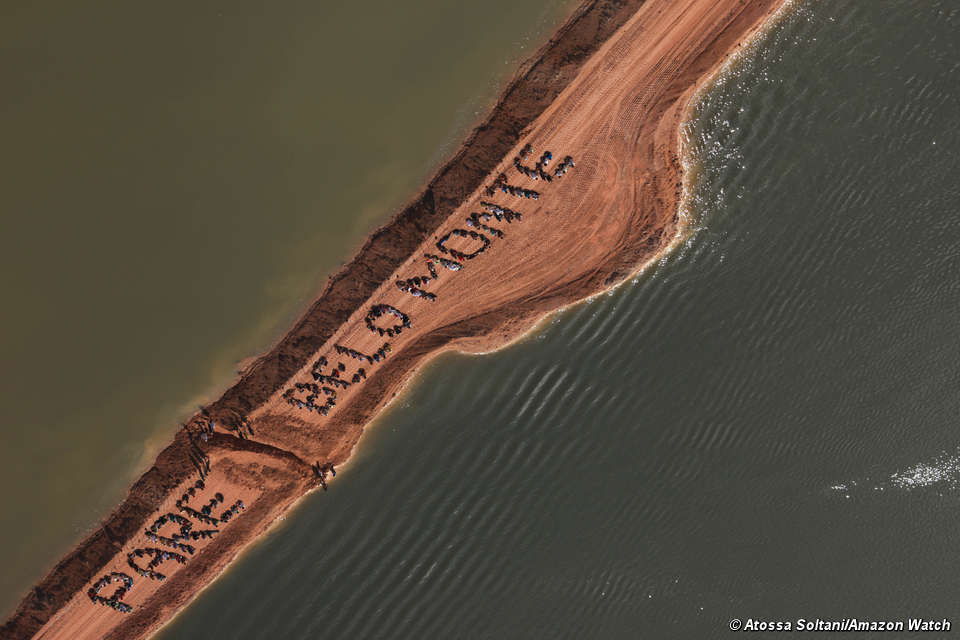
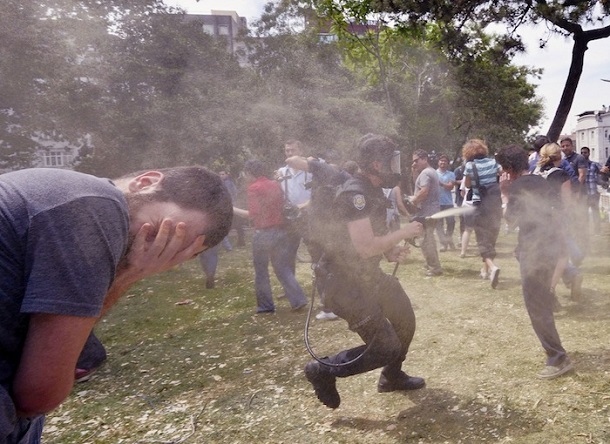
Last weekend (11th May) I was one of the 40,000 or so people who formed a 25 kilometre-long human chain around the site of the airport. The huge numbers have been inspired by the direct action of last winter. During the winter months there were tear-gas battles in the woods as police fought to remove hundreds of young protesters who had set up make-shift homes in support of the local community. The courage of the protesters from the self-styled ZAD as they resisted the police in the bitter cold and driving rain of last winter both cemented their support in the local community and inspired people from around France and beyond.
Now there are support groups, called “committees”, in 200 towns and cities. Each group stages demonstrations in their own towns and lobbies politicians in their own areas in support of the Nantes campaigners. Hardly a week goes by without one of the committees cycling or walking through France to the site of the proposed airport. Last weekend on my way back from the protest I spied a billboard in Le Mans– over 100 miles from Nantes– opposing the airport.
The ZAD resistance followed on from the 28 day hunger strike staged last year during the presidential election campaign by four peasant farmers against the plan to evict them from their properties.
The local community has fought a great campaign over the years – and recently won an important court case in the courts where the judge ruled that the airport’s promoters had failed to carry out proper flood plain and environmental assessments of the project, as required by the European Union. The campaigners believe that the ruling from the court may provide a way for the Government to drop the airport and save face. But the reason the Government is under so much pressure is because of the way that direct action – the hunger strikes and the resistance from ZAD – electrified support from across France. No wonder there was such a carnival atmosphere last Saturday. We were holding hands around an airport that will probably now never be built.
John Stewart guest post's blog
Protests from students, staff and alumni as Energy Minister Ed Davey attends opening ceremony
The protest begins!
9th May 2013
Today Oxford University launched a new research partnership with Shell, and opened the Shell Geoscience Laboratory. The ceremony was attended by Ed Davey, Secretary of State for Energy and Climate Change, Andrew Hamilton, Vice-Chancellor of Oxford University and Alison Goligher, Shell’s Executive Vice-President for Unconventionals.
The partnership with the Earth Sciences Department has drawn criticism from alumni, staff and students in a letter published in today’s Guardian. There are over 75 signatories (with more continuing to come in) including prominent environmentalists Jonathon Porritt, George Monbiot and Jeremy Leggett, Emeritus Fellow of Oxford’s Environmental Change Institute Brenda Boardman, and Director of the Centre for Sustainable Healthcare Rachel Stancliffe. Last night, Oxford University Students’ Union passed an emergency motion to ‘formally oppose’ the partnership.
Paula bear listening to the apology from “Shell representative” Photo by Zoe Broughton
About 50 Oxford students, alumni, staff and residents protested outside the opening ceremony (see video), supported by several national human rights and environmental groups (see below). They held their own futuristic ‘closing ceremony’ – a tongue-in-cheek piece of street theatre set in 2018 which celebrated the closure of the ill-fated and unpopular Shell-funded geosciences laboratory after 5 years of criticism. The crowd heard pologetic speeches from ‘the Vice-Chancellor’, ‘Shell’ (including a direct apology to Paula the polar bear who was among the protesters) and ‘ex-Secretary of State Ed Davey’. This was followed by various creative chants such “We’re united in defiance, get the Shell out of our science”, “Oxford Uni funding fail, Shell’s just in it for the shale” and “Oxford Uni, please dump Shell. If you don’t we’ll raise hell!”
Later today two people were dragged out of Oxford’s St Edmund Hall, where the Earth Sciences department members were having dinner with Shell and the Vice-Chancellor, to celebrate their controversial new partnership. One of them started to calmly and politely explain why the partnership is receiving so much criticism, but was dragged out by the college porters. Film below.
The concerns about this partnership are wide-ranging. Shell is seen by many as an inappropriate choice of partner for Oxford University due to its enormous contribution to climate change. The new partnership includes research on, amongst other things, the location and properties of black shale – a type of rock rich in oil and gas. Whatever the scientific merits of this work, it will be of great assistance to Shell in locating and extracting more fossil fuels at a time of climate emergency.
Shell’s research money is also being criticised as an attempt to buy legitimacy for its controversial activities globally. These include human rights abuses in the Niger Delta, highly-destructive tar sands extraction which is undermining Indigenous rights in Canada, reckless drilling plans in the Arctic, and controversial gas fracking in South Africa.
Today’s action also marked the beginning of a movement for ‘Fossil Free‘ universities, spearheaded by student network, People & Planet, calling on the higher education sector to sever ties with the fossil fuel industry. Its petition calling on Oxford University to go ‘fossil free’ was signed by nearly 500 students, alumni and others, in less than 24 hours.