Opponents of a controversial method of extracting oil and gas will deliver petitions to lawmakers around California on Thursday urging them to limit or ban the controversial practice.
Opponents of a controversial method of extracting oil and gas will deliver petitions to lawmakers around California on Thursday urging them to limit or ban the controversial practice.
Groups against fracking say the method could damage groundwater supplies and harm unspoiled habitat for native animals like the kit fox.
Organizers say around 70 groups are involved in the coordinated effort. One of the largest, MoveOn.org, plans to deliver petitions to a dozen assembly members asking for limits on the oil extraction method. The group is also organizing protests in Sacramento, San Jose, San Diego, San Ramon, and Los Altos, among other places.
Food and Water Watch and the Center for Biological Diversity are planning similar marches in San Francisco and here in Los Angeles. Documentary filmmaker Josh Fox, who directed “Gasland,” will join activists as they protest outside Governor Brown’s Los Angeles office on Spring Street.
The federal government estimates that as much as 15 million barrels of oil and gas are trapped in a rock formation that sprawls across southern and central California called the Monterey Shale. Petroleum companies say breaking open that rock will unleash an economic boom, including fuel, jobs and tax revenue.
One squatter convicted, two walk free. An appeal for the one has already been launched…
We are pretty shocked to report that the third and last defendant was found GUILTY under s144 on May 24. He was sentenced to 40 hours unpaid labour and a £250 fine. Previous updates can be found on the rooftopresistance website. This decision was immediately appealed and we will let you know the next court date asap.
The magistrates said in their “judgement” that:
The defendant was a trespasser The defendant was living there The building was residential
In support of their claim that the defendant lived there, the magistrates said there was shower gel in the shower, pots and pans in the kitchen and a light on in the fridge. This is clearly far from a legal definition of living, especially since the defendant was not actually linked to any of the items in any way.
In support of their claim that the building was residential, the magistrates appeared to rely on the tried and trusted adage that ‘the police said it was true so it must be true.’ They ignored evidence obtained from the Council that the building had never been converted to residential.
What does this mean? We think this means that a judge (or indeed anyone with legal training) will quickly overturn this decision. Mike Weatherly says he is delighted that our friend is convicted. We will be interested to hear his reaction when our friend returns to having no convictions again in about six weeks.
The other two defendants had previously had their cases dropped on grounds of no case to answer (no comment from Weatherly about that). The only difference with the case for the third defendant was that a cop claimed the defendant had said to him that he lived in the building. This evidence was used in court despite not being taken under caution (there are grounds for appeal on that alone!) and the magistrates took it as a voluntary confession, despite it being disputed by the defence.
In order to reach this decision, the magistrates appeared to prize the word of one policeman over another, since although one had claimed that the defendant had said he lived in the building, another said he had not.
In the eyes of these right-wing dipshits, it is fine for the police to act as property protectors, an approach which has already had tragic consequences.
All in all, this trial was a farce, with untrained magistrates being asked to implement an ill-thought out new law. They failed to do their job properly and the only good thing to come out of this conviction is that hopefully a decent legal precedent will be set on appeal which makes clear what ‘living’ and ‘residential’ mean in the eyes of the law. We do not doubt that this will lead to our friend’s conviction being overturned AND this new law becoming unworkable in practice.
PS Thanks to everyone for their continued support and props to the entire public gallery for walking out when the magistrates unveiled their prejudices.
A simple protest by Turkish citizens against the cutting dow
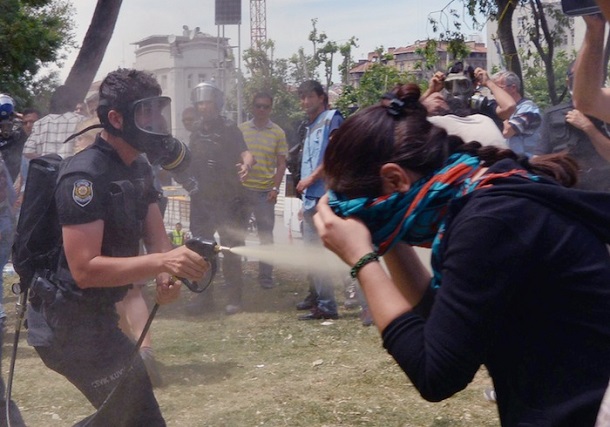
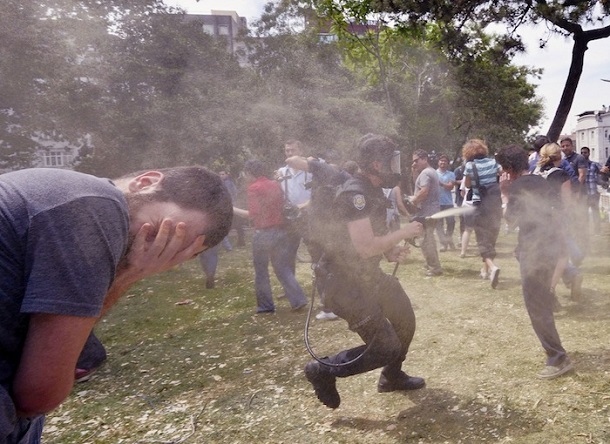
A simple protest by Turkish citizens against the cutting down of trees in the center of Taksim Square in Istanbul turned into a great opportunity for riot police to break out the pepper spray.
Local demonstrators and a number of parliamentary deputies partially blocked the demolition of the last green public space in the center of Istanbul on May 28, despite police forces again resorting to tear gas to disperse the group. The struggle eventually transformed into a night-long sit-in protest by the demonstrators.
Peace and Democracy Party (BDP) Istanbul deputy Sırrı Süreyya Önder helped halt an operation to remove trees in Taksim Gezi Park when he obstructed the path of a bulldozer, amid running altercations between demonstrators on one side and police and company workers on the other. Önder demanded the license for the demolition, which was not provided by municipality workers.
Police pulled out of the area as dusk set, allowing around 1,000 protesters to stage a mini-festival during which they vowed that the park would not be turned over to “land speculators.” A group of protesters said they planned to stand guard at the site all night long to prevent any night-time demolition.
Protesters first gathered late May 27 in response to social media messages alerting activists to the arrival of workers tasked with cutting down trees on the site, on which the Topçu Kışlası (Artillery Barracks) are set to be rebuilt as part of the ruling Justice and Development Party’s (AKP) controversial plan to pedestrianize Taksim Square.
“They are planning to demolish at night; we will be here to stop them until this thing is canceled,” Önder posted on his official Twitter account. Gülseren Onanç, a former deputy of the main opposition Republican People’s Party (CHP), also joined the protesters, while CHP deputy Gürsel Tekin also came to Gezi Park to support the protests.
The rebuilding of the barracks was approved by the High Council for Protection of Cultural and Natural Assets on March 1.
As you may know Faslane Peace Camp recently put out an appeal for new members. Fortunately the publicity has generated more people moving to the camp and the good news is that it now looks like the peace camp is not going to close at this crucial time in the debate about nuclear weapons in Scotland.
As you may know Faslane Peace Camp recently put out an appeal for new members. Fortunately the publicity has generated more people moving to the camp and the good news is that it now looks like the peace camp is not going to close at this crucial time in the debate about nuclear weapons in Scotland. Visit Faslane Peace Camp from Camcorder Guerrillas on Vimeo.
To help the peace camp some former residents and supporters of the camp have set up a Faslane Peace Camp Supporters network to help distribute information, fundraise, organise events and protests, benefit gigs, trips out to the camp and staying there regularly etc.
This summer the Support Network are planning to build an eco-house using recycled materials for use as a communal space at the peace camp and we recently held a successful 'Phoenix Gathering' at the peace camp. Some of us are meeting in Mono on Wednesday 22nd May at 7.30 to discuss setting up a Support Network in Glasgow and how we can do more to help the camp.
Anyone interested in helping to support the camp is welcome to come along!
Eriel and Mae in the Netherlands, preparing to take on Shell tomorrow!
Two Indigenous women, representing communities impacted by Shell’s operations abroad, will attend the AGM to confront the Chairman and Board over the massive human and ecological rights violations and economic devastation that the company’s operations bring to Indigenous communities. They will argue that Shell’s decision to pursue highly risky ‘extreme energy’ projects, like Arctic drilling and Canadian tar sands, will have little long term benefit for the company, and expose it to both reputational damage and political risk, including litigation.
One of the communities represented, the Athabasca Chipewyan First Nation (ACFN), which resides downstream from tar sands operations, is currently suing Shell for violating past agreements that have threatened their treaty rights. The community is also actively opposing two new tar sands mines Shell is proposing to develop on their land. For more details, watch the powerful film above. Legal challenges by other First Nations against tar sands extraction on their traditional territories is also increasing.
Eriel Deranger, community member and spokesperson for ACFN, states:
“Shell’s current and proposed tar sands projects violate terms of our treaty, destroy our land and contaminate waters critical to our survival. The ACFN leadership has made a commitment to protect our lands, rights and people currently being threatened by tar sands development. We have tried exploring amenable agreements and options with Shell only to be disappointed by their inability to compromise and adjust proposed plans to adequately work with us which has led and continues to lead toward litigation. Our culture, lands and rights can no longer stand for unabated and irresponsible development of tar sands in the region by Shell or any operator.”
Shell is also under fire for its Arctic operations. The company has spent $4.5bn securing permits to drill in Arctic waters. However it has been proven incapable of operating in the area and has had to suspend its plans for drilling this summer.
Mae R Hank, tribal member of the Native Village of Point Hope, Alaska, said:
“The Beaufort and Chukchi Seas are critical to the Inupiaq culture and traditions, and provide a vital habitat for the endangered bowhead whales, beluga whales, polar bears, walruses, seals and migratory birds. If an oil spill were to occur in the Arctic’s extreme conditions, there is no proven method to clean it up during Winter. Shell is taking a deadly risk with Inupiat and other Arctic Indigenous peoples’ cultures and food security for shortsighted profit, while the community faces long term consequences to their survival.”
Shell wants to drill in the Beaufort and Chukchi Seas, which provide a vital habitat for polar bears as well as many other endangered species. Photo by Martha de Jong-Lantink.
In addition, the UK Tar Sands Network is bringing concerns to Shell’s shareholders over other long-term risks to the company’s investments in tar sands.
The tar sands are landlocked, making them difficult and expensive to get to market. The pipelines that present the industry’s only viable solution to this problem – such as Keystone XL and Enbridge Northern Gateway – are facing massive public opposition, and look unlikely to be built soon. The price of tar sands crude has dropped as a result. Meanwhile, in Europe, the Fuel Quality Directive (FQD) is likely to strongly discourage future tar sands imports into Europe. Lax standards and lack of adequate environmental regulation have led to several high-profile leaks and spills in recent weeks, including the flooding of an Arkansas suburb with tar sands oil. Meanwhile, a recent report by the Carbon Tracker initiative identified an alarming ‘carbon bubble’, arguing that 80% of oil companies’ current fossil fuel reserves are ‘unburnable carbon’, and anticipating a crash in prices as climate regulations kick in.
In March, French oil giant Total pulled out of one of its three Canadian tar sands projects, citing the high costs and fragile profit margins that are besetting the whole industry. Total was willing to take a $1.65 billion loss rather than press ahead with what has become a bad investment.
Shell will also be criticised by UK campaigners for heavily lobbying the UK government against the labelling of tar sands as highly polluting in the Fuel Quality Directive. Shell was revealed to have a close relationship with its former Chief Economist, now Secretary of State for Business and Industry and official ‘Minister for Shell’ Vince Cable, in a letter published last year. The letter urged him to harden the government’s line against the FQD, a move which was revealed to have happened in leaked documents published last week.
Representatives from Indigenous communities in Canada and the Arctic attended Shell’s AGM last year, but did not feel their concerns were taken seriously. Photo by Ben Powless.
Suzanne Dhaliwal, from the UK Tar Sands Network, commented:
“The risk factors that recently led Total to ditch a major tar sands project are increasing. The tar sands are landlocked and expensive, and opposition to new pipelines has led the price of tar sands crude to drop. Meanwhile, the industry’s high emissions mean that Canada’s oil is increasingly looking like ‘unburnable carbon’. Despite Shell’s frenzied lobbying, upcoming EU legislation on transport emissions could close off this key future market and set a precedent that other countries will follow. Shell should ditch its expansion plans before the carbon bubble bursts, exposing its shareholders to financial disaster.”
If any more proof is needed that direct action works, take a trip to Nantes in western France.
20.5.13
If any more proof is needed that direct action works, take a trip to Nantes in western France.
Fifteen or so miles outside the city, the regional authority backed by the French national government, has been trying to build “Nantes International” Airport. It claims it is required to replace the single runway airport in the city in order to attract investment into the area. The opponents commissioned their own study which refuted those claims. They also point out that Nantes is just a little over two hours by fast train from Charles de Gaulle Airport in Paris. The new airport is dismissed as little more than an ego project of the former major of Nantes, Jean-Marc Ayrault, now the Prime Minister of France. It has been dubbed ‘Ayrauoport’.
Last weekend (11th May) I was one of the 40,000 or so people who formed a 25 kilometre-long human chain around the site of the airport. The huge numbers have been inspired by the direct action of last winter. During the winter months there were tear-gas battles in the woods as police fought to remove hundreds of young protesters who had set up make-shift homes in support of the local community. The courage of the protesters from the self-styled ZAD as they resisted the police in the bitter cold and driving rain of last winter both cemented their support in the local community and inspired people from around France and beyond.
Now there are support groups, called “committees”, in 200 towns and cities. Each group stages demonstrations in their own towns and lobbies politicians in their own areas in support of the Nantes campaigners. Hardly a week goes by without one of the committees cycling or walking through France to the site of the proposed airport. Last weekend on my way back from the protest I spied a billboard in Le Mans– over 100 miles from Nantes– opposing the airport.
The ZAD resistance followed on from the 28 day hunger strike staged last year during the presidential election campaign by four peasant farmers against the plan to evict them from their properties.
The local community has fought a great campaign over the years – and recently won an important court case in the courts where the judge ruled that the airport’s promoters had failed to carry out proper flood plain and environmental assessments of the project, as required by the European Union. The campaigners believe that the ruling from the court may provide a way for the Government to drop the airport and save face. But the reason the Government is under so much pressure is because of the way that direct action – the hunger strikes and the resistance from ZAD – electrified support from across France. No wonder there was such a carnival atmosphere last Saturday. We were holding hands around an airport that will probably now never be built.
Protests from students, staff and alumni as Energy Minister Ed Davey attends opening ceremony
Protests from students, staff and alumni as Energy Minister Ed Davey attends opening ceremony
The protest begins!
9th May 2013
Today Oxford University launched a new research partnership with Shell, and opened the Shell Geoscience Laboratory. The ceremony was attended by Ed Davey, Secretary of State for Energy and Climate Change, Andrew Hamilton, Vice-Chancellor of Oxford University and Alison Goligher, Shell’s Executive Vice-President for Unconventionals.
The partnership with the Earth Sciences Department has drawn criticism from alumni, staff and students in a letter published in today’s Guardian. There are over 75 signatories (with more continuing to come in) including prominent environmentalists Jonathon Porritt, George Monbiot and Jeremy Leggett, Emeritus Fellow of Oxford’s Environmental Change Institute Brenda Boardman, and Director of the Centre for Sustainable Healthcare Rachel Stancliffe. Last night, Oxford University Students’ Union passed an emergency motion to ‘formally oppose’ the partnership.
Paula bear listening to the apology from “Shell representative” Photo by Zoe Broughton
About 50 Oxford students, alumni, staff and residents protested outside the opening ceremony (see video), supported by several national human rights and environmental groups (see below). They held their own futuristic ‘closing ceremony’ – a tongue-in-cheek piece of street theatre set in 2018 which celebrated the closure of the ill-fated and unpopular Shell-funded geosciences laboratory after 5 years of criticism. The crowd heard pologetic speeches from ‘the Vice-Chancellor’, ‘Shell’ (including a direct apology to Paula the polar bear who was among the protesters) and ‘ex-Secretary of State Ed Davey’. This was followed by various creative chants such “We’re united in defiance, get the Shell out of our science”, “Oxford Uni funding fail, Shell’s just in it for the shale” and “Oxford Uni, please dump Shell. If you don’t we’ll raise hell!”
Later today two people were dragged out of Oxford’s St Edmund Hall, where the Earth Sciences department members were having dinner with Shell and the Vice-Chancellor, to celebrate their controversial new partnership. One of them started to calmly and politely explain why the partnership is receiving so much criticism, but was dragged out by the college porters. Film below.
The concerns about this partnership are wide-ranging. Shell is seen by many as an inappropriate choice of partner for Oxford University due to its enormous contribution to climate change. The new partnership includes research on, amongst other things, the location and properties of black shale – a type of rock rich in oil and gas. Whatever the scientific merits of this work, it will be of great assistance to Shell in locating and extracting more fossil fuels at a time of climate emergency.
Today’s action also marked the beginning of a movement for ‘Fossil Free‘ universities, spearheaded by student network, People & Planet, calling on the higher education sector to sever ties with the fossil fuel industry. Its petition calling on Oxford University to go ‘fossil free’ was signed by nearly 500 students, alumni and others, in less than 24 hours.
Talvivaaras' nickel-uranium mine has caused the most serious environmental damages in the finnish history in decades. The mine has been continuously polluting the amazing waterscapes of eastern Finland.
Talvivaaras' nickel-uranium mine has caused the most serious environmental damages in the finnish history in decades. The mine has been continuously polluting the amazing waterscapes of eastern Finland. More and more people and organizations are demanding closing of the mine and the locals can't use water from several lakes anymore, but it doesn't seem to have any impact in a country where the finance elite knows that the government is in their service.
The eco-disaster in the Talvivaara mine is not a rare exception: rather, it is business as usual wherever large mining corporations are operating. For the surrounding areas, polluted groundwater has been the price to pay for every single uranium mine in the world so far. Despite this, a number of projects for opening huge mines are underway in Finland and Sweden.
Disregarding the cost to the ecosystem or the opposition of locals, the international elite has decided to sacrifice the Nordic flora, fauna and waters to fuel the growth-compulsive economy.
Determined resistance is needed to keep the environment viable. Join us to share knowledge and skills, and to act!
The camp is located ca. 30 km from the Talvivaara mine. The first week of the camp, we will share info about the mining situation in the north and explore tactics for open direct action. These skills will be put to use during the second week.
Feel free to offer your own program! The camp will work in a self-organized manner, so participants are expected to do their share of running the camp. To cover costs we ask for a donation of 5-10 € per day, taking into account people's personal economic situations. Rides from more accessible locations will be arranged as often as possible. When signing up for the camp, please contact us if you would want a ride or have any other special needs, allergies etc.
Let us know you're coming by mailing turva@riseup.net before 10th of June, if possible!
There is also an online map which will feature more details and even more addresses. It is still being updated. To check in for latest progress go to: mappingthecorporations.org/ and select “Mapping Capitalist London” in the sector menu.
If you have more information on any company, or want to add a new address, please email stopg8@riseup.net
We plan to appear somewhere in Canary Wharf, to reclaim and transform a space, bringing beauty and hope to the soulless heart of Capitalism.
In response to the combined crises of cuts and climate chaos, and the call for a week of action against the G8, we have come together to organise a gathering of those who want to stop the assault on people and planet. In the penthouse suite of global capitalism, in front of the eyes of the financial elite we will demand that They Owe Us.
Off the back of Sea Shepherd’s most successful campaign to date, Operation Zero Tolerance that saved 932 whales, Sea Shepherd launches Operation Relentless. Like last season’s campaign, Operation Relentless will be managed and led by Sea Shepherd Australia with campaign leaders Bob Brown and Jeff Hansen.
It will be Sea Shepherd’s 10th Antarctic whale defence campaign defending at risk whales in the Southern Ocean Whale Sanctuary. During the past nine seasons, Sea Shepherd’s direct-action interventions have saved the lives of more than 4,500 whales and exposed illegal Japanese whaling to the world. With the help of Australians and people around the world, Operation Relentless is shaping up to be a monumental success for the whales.
“Australia is now the focus of the biggest whale saving operation on Earth and funding depends on the generosity of whale loving Australians. These whales are Australia’s responsibility. Sea Shepherd is acting where Governments have failed to intervene in the illegal slaughter of these magnificent creatures,” said Dr Bob Brown, Sea Shepherd board member.
“Japan stated that the attempt to kill whales in the Antarctic whale sanctuary was abandoned due to ‘relentless interference’ by Sea Shepherd,” said Jeff Hansen, Sea Shepherd Australian Director.
“Sea Shepherd likes that kind of relentless accusation, we like being relentless in the pursuit of finally bring peace to the whales of the Southern Ocean Whale Sanctuary. Sea Shepherd knows that this is a David and Goliath struggle. Our past victories show we have one thing that the whalers do not, and that’s the passion and courage of our crew. No matter what the odds, no matter what the risks, no matter how well equipped, funded and Government backed your opponents are, you must never give in, must never surrender. You must fight for what is right, because the one thing that is worth fighting for on our beautiful planet is life,” said Mr Hansen.

 27.05.2013
 27.05.2013