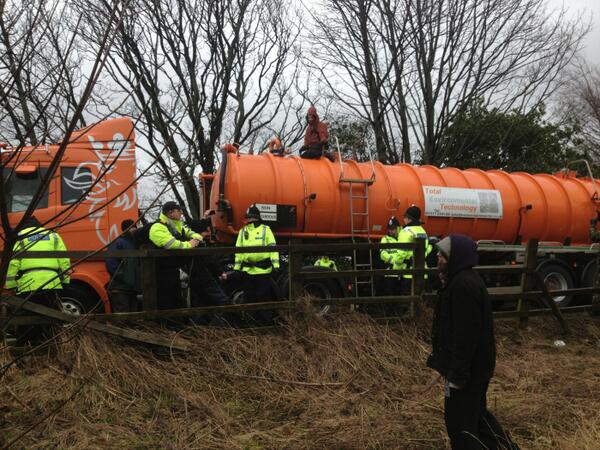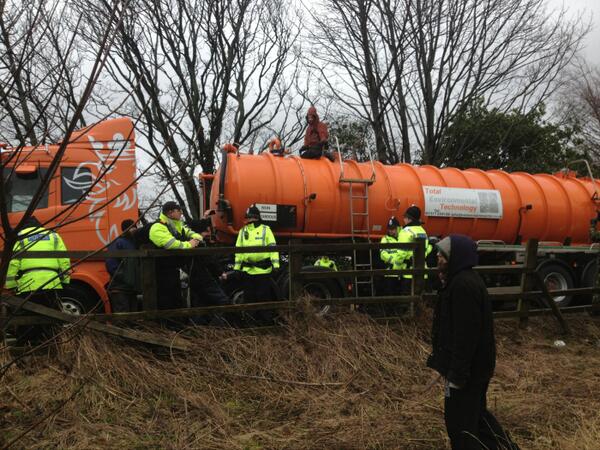
Romanian Villagers and Priests Occupy Chevron Fracking Site in Protest

9/2/14

Romanian police clashed with villagers on Wednesday as they tried in vain to force them off a field they have occupied for a third day to prevent U.S. energy giant Chevron from drilling for shale gas.

9/2/14

Romanian police clashed with villagers on Wednesday as they tried in vain to force them off a field they have occupied for a third day to prevent U.S. energy giant Chevron from drilling for shale gas.

Hundreds of protesters blocked access to the site at Silistea in eastern Romania where Chevron plans to drill an exploration well, lying down in the mud and holding hands to form a human chain.

Some 250 anti-riot police engaged in an hours-long stand-off with the protesters, with skirmishes as they physically tried to force them off, but the demonstrators pushed their way back onto the field.

The group of protesters, some of whom have been sleeping at the site since Monday, had grown to about 500 on Wednesday, preventing Chevron bulldozers and excavators from accessing the site.

Orthodox priests also joined the protest.

Many of the villagers in the rural region arrived on horse carts, some brought their children who held up signs reading: “Stop Chevron!”, while an elderly woman leaned on her cane beside them.

They are afraid of the environmental and health impact of the highly controversial method used for shale gas drilling, called hydraulic fracturing or ‘fracking’.

The technique consists of pumping water and chemicals at high pressure into deep rock formations to free oil and gas.

Environmentalists say fracking may contaminate ground water and even cause small earthquakes.

Chevron has permits to explore for shale gas in three villages in this part of eastern Romania as well as on Romania’s Black Sea coast.

“Chevron is committed to building constructive and positive relationships with the communities where we operate and will continue our dialogue with the public, local communities and authorities on its projects,” the company said in a statement to AFP.

“Our priority is to conduct … activities in a safe and environmentally responsible manner consistent with the permits under which we operate,” it added.

Also Wednesday, more than 2,000 people staged a protest in the capital Bucharest, shouting “no to shale gas”.

Romania’s ruling centre-left coalition has been defending shale gas exploration after fighting it when it was in the opposition.

Brazil: Munduruku People Kick Miners Off Indigenous Territory, Seize Equipment

Translated from Portuguese by Thomas Walker / Earth First! Newswire

Translated from Portuguese by Thomas Walker / Earth First! Newswire

Threatened by Death, Muduruku Expel Miners from their territories, West of Para.

Under threat of death, Muduruku expel miners from their territories, west of Para.

Night had hardly arrived when indigenous Munduruku people landed on the bank of a mine on Tropas River, a tributary of Tapajós river, in a region west of Pará.  From the five speedboats, all of them full, came warriors and children, all with one objective: to drive out illegal miners from Munduruku land.

Right at the entrance of the shed, the indigenous encountered two of the twelve miners present.  Painted for war, the Munduruku held strong.

“You have ten minutes to get out.  Get your things, go away, and don’t come back.  This is the land of the Munduruku,” ordered Paigomuyatpu, chief of the warriors, while the miners were packing their bags and preparing to abandon the area.

According to the workers in the mine, the four pairs of dredges, used for the extraction of gold, belonged to Alexandre Martins.

Known as Tubaína, Martins is also owner of at least two more mines in the region, and left the site three days before the operation, exactly when the Munduruku started the survey in the Tapajós basin.

“He (Tubaína) said that he was going there to another of his posts. He isn’t there, and he isn’t here.  No one knows,” confirmed Mara Almeida, who cooked in the posts for the miners in Tubaína.  The action came after numerous complaints filed with government agencies.  Ozimar Dace, Munduruku member of the movement and reporter of the operation, said that the indigenous have already tried to kick out the pariwat (who are not indigenous) by way of the Brazilian Environmental Institute (Ibama), Institute Chico Mendes of Biodiversity Conservation (ICMBio), and National Foundation of the Indigenous (Funai).

“The people decided that these authorities would never give results to us.  They are never going to do this so that we can live in peace.  They gave the deadline for when they would give results, but this never happened.  So, for these reasons, we decided to resolve the issue by our own account.”

The illegal exploration of the mine inside the indigenous land of the Munduruku is not new.  Accounts trace the start of these activities to the 1980s.  One story of threats, agreements with a small group of leaders, and exploitation of indigenous labor weave a web that does not benefit the majority of people.

According to local communities, the miners have caused various problems in the indigenous lands due to uncontrolled exploitation.  Pollution of the river, lack of fish, misunderstandings, and threats are the main reasons cited for the indigenous actions.  For these reasons, the indigenous were “expelling miners and taking their machines,” explains Paigomuyatpu, chief of the Munduruku warriors.

“The miners already made too many damages in our territory.  We are evicting problems, sickness, and many other things that are happening.  We are evicting this for our future generation,” he added.

The surveillance started on January 15, lasted almost twenty days, and passed through various tributaries of the Tapajós river basin, such as Tropas river, Kaburuá river, Kadiriri river, and Kabitutu river.  In all, the Munduruku confiscated twelve dredges.  They will remain in the villages for a month while the indigenous decide what they will do.

“In relation to the mines, they will stay put.  After a month passes and we decide what we are going to do with machines: if we are going to do projects to benefit the communities in the area where there are already machines.  But we need alternative projects to generate funds for the community, like fish farming, flour production, nut extraction, copal and honey.  We need the support of FUNAI,” Paigomuyatpu said.

Pressed by the Munduruku, the FUNAI supported the autonomous action of the indigenous, financing fuel for the boats.

“It was one of their demands, it came from pressure.  They wanted this to happen in any form they could.  We think that taking their own initiative is even better, so that they can understand themselves with their relatives and decide that they are not going to permit the entry of the miners anymore,” commented Julian Araujo, from the coordination of the FUNAI of Itaituba.

According to Juliana, since she arrived in the region in 2010, FUNAI has received complaints from the Munduruku on illegal mining on indigenous land.  In October of last year, the complaints were reiterated and forwarded to ICMBio and the Federal Police.  In 2012, an operation against the miners had only a provisional effect because the miners returned.  Because of this, it was suggested that FUNAI work towards awareness within the manage plant.

“It’s not enough to just do the operation and afterwards other indigenous people authorize the entrance of miners.  We resolved to take a little more care with this.  As much as ICMBio, we have personal difficulties.  There is one person that is responsible for a number of units when we are monitoring [the area], so we will try calling volunteers from other places because the local volunteers end up being targeted by the miners.”

The climate is tense in the region.  Communicating by radio, the leaders discovered that they are being followed.  There is a list with at least five names of indigenous leaders marked for death.  The author of the threats could be Tubaína.  According to a Munduruku, he commands a group of gunmen with automatic weapons.

“Tubaína is feared in the region and walks with a rifle in his right hand through the village.  No one says anything.  I said, ‘Hey, inside indigenous territory, only the Federal Police and FUNAI are authorized to be armed,’” Valmar Kaba related.  Beyond the leaders, Tubaína has allegedly threatened the chief of the village surveillance station, Oswaldo Waro, and his son, Joao Waro.  In the last nineteen days, the two closed the village airstrip with sticks and stones in order to make sure that the miners leave with the seized machines.

“Tubaína passed the radio to the chief and said that when Oswaldo went to work, in the Bananal, Tubaína would catch him and his kid,” said Leuza Kaba, an indigenous woman.  One of the workers expelled by the Mundruku, known as Shorty, informed that the miners of Humaita and from 180 kilometers across the Tranamazonica (Trans Amazon Highway) would be planning to go to Tapajós and to “work things out” with the indigenous people.  Shorty did not reveal his true name.  He is frank and soft-spoken.  At a bar table, Shorty said that he became a miner 14 years ago, when his partner left him.

“I’ve only been here in the region for six years.  The people tell a lot of lies about the miners.  They talk a lot about Tubaína, but he is a good person and helps everybody,” he said.

He left saying that he is still going to return to get the gold from the indigenous area.  Some acquaintances said that Shorty got out of prison two months ago.  He was imprisoned for killing a man with a knife in a mining village near Caton, within the indigenous area.

“And he killed another with a .20 bullet, right here, on this road,” said one of his acquaintances.  The reporter was not able to contact Tubaína.  On Friday, (January 31, 2014), indigenous leaders in the Jacareacanga delegation registered a police report denouncing the threats of the mine owner and reported the situation to federal prosecutors.

Letter

In a letter, the indigenous say they do not have fear of death and that they will continue fighting for their rights.

Carta VI—Letter of the Munduruku Ipereg Ayu Movement

We, chiefs, leaders, and warriors, came across to greet you, ladies and gentlemen—those who support our movement Munduruku Ipereg Ayu.

We, warriors, did our surveillance of our territory.  We took out and expelled the invading miners from our territory and we seized their machines.  Now they are threatening us with death, but we are not intimidated.

This is the first step.  We are going to defend our territory, our river, our forest, our riches, and our people until the end.  This is our word. 

We finish this letter with much peace and friendship.  Sawe! Sawe! Sawe! 

            Sincerely,

            Munduruku Apereg Ayu Movement

            Carocal Village, Tropas River,

            In the Municipality of Jacareacanga, West of Para.

Occupation of Minvest Deva Headquarters in Romania

3/2/14

Nine activists from Romania and Germany climbed the fire escape of Minvest Deva’s headquarters today and unfurled two thirty-foot-long banners calling for a ban on cyanide mining. They were fined 500 lei each, but declared they would not pay.

3/2/14

Nine activists from Romania and Germany climbed the fire escape of Minvest Deva’s headquarters today and unfurled two thirty-foot-long banners calling for a ban on cyanide mining. They were fined 500 lei each, but declared they would not pay.

The banners read, “Respect Existance or Expect Resistance,” “Mining with Cyanide Causes Death!” and other slogans

The activists chose Minvest Deva due to conflict of interest. According to one activist named Mihnea Blidariu who was involved in the banner drops, ”The current Director of Deva Gold , Mr Nicolae Stanca, is the same person who in 1987 signed the Association Agreement between Gabriel Resources and the Romanian state.”

The full statement from the group is below (from Revolution Sociale)

“Today, the 3rd of February 2014, we, citizens of Romania and Germany have occupied Minvest Deva headquarters in order to draw attention at the illegal and illegitimate favoring of mining companies by the Romanian state authorities.

We denounce the cyanide based mining projects from Certej, Deva-Muncel, Băiţa Crăciunești, Brad, Rovina și Roșia Montană, projects that have destructive effects towards nature and humans and can only start with no regard of legal procedures.

Only at Certej, in 16 years of operation 26.448 tons of sodium cyanide and 15.280 tons of copper sulphate would be used. Large-scale cyanide use does not bring prosperity to a community, only death and the impossibility to develop other economic activities. We denounce deeds that reek of corruption, conflict of interests and abuses of Nicolae Stanca, current director at Deva Gold. He has signed, in the name of the Romanian state, the associating documents between Minvest Deva and Gabriel Resources in 1997, then being employed by the controverted businessman Frank Timis.

We condemn the government’s intention to bring forward to the parliament a new mining law, we condemn the irresponsible and undignified attitude of the Minister of Environment, Rovana Plumb, and ask for her resignation. We warn prime-minister Victor Ponta that a new attempt to pass the mining law with absurd stipulations that only serve the interests of the mining industry will not remain without consequences. In his urgency and pressure on the parliamentarians to make forced expropriation of citizens by private companies legal he is doing exactly the opposite of what the public opinion wants. As the events of last year have demonstrated, illegitimate support of mining companies is not backed up by parliament (two legislative attempts have failed last year), nor by the tens of thousands of people that have gone to the streets in 2013.

Last but not least, we wish to draw attention to the total abandon of morality by political people such as Dan Șova or Rovana Plumb. Dan Șova, from the government table proposes legal solutions for mining projects of his mother’s law clients. Cyanide-based projects are then passed to be evaluated to his colleague minister, Rovana Plumb, who will do anything to see them approved, including dropping charges in court.

We ask the citizens of Romania to inform themselves correctly about the many drawbacks of mining projects and remember the horrible ecological accidents at Certej in 1971 and Baia Mare in 2000. We do not want such tragedies to be repeated! We show our solidarity with movements around the world that struggle against such destructive mining projects: Kremnica (Slovakia), Halkidiki (Greece), Corcoesto (Spain), Salave Asturias (Spain), Bergama (Turkey), Kumtor (Kyrgyzstan), Talvivaara (Finland).

Respect existence or expect resistance!
Romania without cyanide!

Live update pe mobil: http://goo.gl/RnJUsl
Live update pe Vice: @MinvestDevaLIVE (this account has now been suspended by Twitter)

Via https://www.facebook.com/rosia.montana.in.unesco

Reclaim the Power gathering 8-9 February

After an incredible day of idea generation and visioning at the last gathering, it’s time for concrete proposals and decisions about our next steps.


Location: Oxford
Time: Saturday 8th February 11am ­­– Sunday 9th 4pm

Address: TBC
Crash Space/Social: Provided. Further details TBC.
Meals: Provided, donation cost TBC
Travel Pool: Available. Please book travel tickets in advance so that this can support the most people.
Notes from Manchester Visioning Day are here: http://bit.ly/1lQ0Yd3

In early December a large number of people came together to discuss the radical visions they had for the future – visions that Reclaim the Power, as a network, could help bring about.

It was a very open day of discussion with a clear structure, but with no pre-planned agenda. Everything we talked about was generated by participants, and a huge number of different ideas were placed on the table.

So what next? Well, the idea is that all of that discussion feeds into a month of creative proposal making before the next gathering. This will be a space for short and medium-term decision making where we work out what we’re doing in the next few months – and how this fits in with long term visions.

Rough proposal area groups formed at the December gathering, including:

1. How to challenge corporate power
2. Movement and diversity
3. Energy and fossil fuels
4. Positive solutions

If you would like to link up with these groups and input into proposals for next steps, just contact info@nodashforgas.org.uk and you will be put in touch with a group contact.

This said, all proposals are welcome! If you’re working on your own, outside these groups, then great. The more ideas the better.

The proposal deadline is the 31st January 2014. Please try and follow this rough four point list when writing them, as it is essential that all the proposals be considered on an equal footing.

1. What is it?
2. How does it link to long-term strategic aims?
3. Timeline?
4. Resources needed? (inc, people, costs, skills)

Specific venue and agenda details to follow soon. In the meanwhile, please check http://bit.ly/1lQ0Yd3 to see the discussions and outcomes of the last agenda.

See you soon,

RTP Gatherings Team

info@nodashforgas.org.uk


SALFORD COUNCIL CIVIC CENTRE SHUT DOWN BY BARTON MOSS CAMPAIGNERS

Salford Civic Centre Shut Down By Barton Moss Protectors     31st January 2014


ANTI FRACKING CAMPAIGNERS SHUT SWINTON CIVIC CENTRE

Salford Council's Civic Centre in Swinton was dramatically shut down this afternoon as five anti-fracking campaigners from the Barton Moss Protection Camp locked on in the reception area.

The campaigners' action was against Government attempts to bribe Salford Council to allow fracking in the city.

The front doors of Salford Civic Centre were closed this afternoon as five campaigners locked on in its reception area to draw attention to ConDem Government attempts to bribe councils to accept rates and community payments in exchange for allowing fracking in their cities.

Two anti-fracking campaigners from the Barton Moss Community Protection Campsite of exploratory drilling by fracking company IGas – superglued themselves to bars on the reception windows, while two more attached themselves to an arm tube, with another superglued to them. It took the Greater Manchester Police Protester Removal Team around two hours to free them, while the Centre remained closed to the public.

"The protectors are here protesting against Salford Council's allowance of IGas to do exploratory drilling with a view to fracking at Barton Moss" said Darren Nesbit, an observer from the Camp "We've had one of the protectors, Boris, here on the lawn of the Civic Centre for the last few weeks and we attended the demo at the full Council meeting recently.

"Everything we do is to, firstly, raise awareness of fracking and the corruption of the Government and Council, and, secondly, to let councils know that this is what will happen to every council in the country if they allow fracking or any other corporate rape of the earth which will affect their residents."

Eleven Arrested Protesting Monsanto Shareholder Meeting

Dozens of protestors from around the globe rallied against Monsanto, the world’s largest seed company, on Tuesday urging its shareholders to consider the risks of growing and consuming genetically modified crops.

Protestors, with signs in hand, converged at the Monsanto headquarters in suburban St. Louis, MO during the company’s annual investors meeting in support of two shareholder resolutions that questioned the level of contamination passed onto non-GMO (genetically modified organisms) crops and requested the seed giant end its fight against mandatory labels on foods containing GMO ingredients, reports Reuters.

The resolutions failed by considerable margins and 11 protestors were arrested after attempting to disrupt traffic near the Monsanto gates.

“Right now there’s a growing movement to label genetically modified food,” said Dave Murphy, executive director of Food Democracy Now!, who presented the labeling proposal at Tuesday’s shareholder meeting “Monsanto has chosen unfortunately to resist the rights of American people.”

Over the last two years, Monsanto has spent more than $13.4 million to defeat GMO labeling efforts in California and Washington state, said Murphy.

Shareholder Adam Eidinger introduced the labeling resolution, hoping to get at least 7 percent of investors to support it, but wound up with just 4 percent, according to the St. Louis Post-Dispatch.

The second resolution, introduced by shareholder John Harrington, focused on Monsanto’s potential liability to organic farmers. It received just 6.5 percent support from investors.

Live audio of the shareholder meeting, which was broadcast for the first time on the internet, also attracted Monsanto supporters, reports the Wall Street Journal.

Justin Danhof, general counsel for the National Center for Public Policy Research, told WSJ.com the protest was a “campaign of junk science” against biotech foods. Danhof insisted Monsanto combat the environmentalist outcry by enlisting its scientists as spokespeople on talk radio and other media to create an open conversation with the public.

According to Reuters, the protest resolutions were backed by environmental, food safety and consumer activist groups. Protestors said that 2.6 million members of those groups support the anti-GMO initiative.

“It’s time that Monsanto join the 21st century and allow Americans the basic right to know what’s in their food, something that’s already done in 64 other countries around the world. Why not America?” said Murphy.

Eleven Arrested Protesting Monsanto Shareholder Meeting

photo credit: Eco Watch

30/1/14

photo credit: Eco Watch

30/1/14

Dozens of protestors from around the globe rallied against Monsanto, the world’s largest seed company, on Tuesday urging its shareholders to consider the risks of growing and consuming genetically modified crops.

Protestors, with signs in hand, converged at the Monsanto headquarters in suburban St. Louis, MO during the company’s annual investors meeting in support of two shareholder resolutions that questioned the level of contamination passed onto non-GMO (genetically modified organisms) crops and requested the seed giant end its fight against mandatory labels on foods containing GMO ingredients, reports Reuters.

The resolutions failed by considerable margins and 11 protestors were arrested after attempting to disrupt traffic near the Monsanto gates.

“Right now there’s a growing movement to label genetically modified food,” said Dave Murphy, executive director of Food Democracy Now!, who presented the labeling proposal at Tuesday’s shareholder meeting “Monsanto has chosen unfortunately to resist the rights of American people.”

Over the last two years, Monsanto has spent more than $13.4 million to defeat GMO labeling efforts in California and Washington state, said Murphy.

Shareholder Adam Eidinger introduced the labeling resolution, hoping to get at least 7 percent of investors to support it, but wound up with just 4 percent, according to the St. Louis Post-Dispatch.

The second resolution, introduced by shareholder John Harrington, focused on Monsanto’s potential liability to organic farmers. It received just 6.5 percent support from investors.

Live audio of the shareholder meeting, which was broadcast for the first time on the internet, also attracted Monsanto supporters, reports the Wall Street Journal.

Justin Danhof, general counsel for the National Center for Public Policy Research, told WSJ.com the protest was a “campaign of junk science” against biotech foods. Danhof insisted Monsanto combat the environmentalist outcry by enlisting its scientists as spokespeople on talk radio and other media to create an open conversation with the public.

According to Reuters, the protest resolutions were backed by environmental, food safety and consumer activist groups. Protestors said that 2.6 million members of those groups support the anti-GMO initiative.

“It’s time that Monsanto join the 21st century and allow Americans the basic right to know what’s in their food, something that’s already done in 64 other countries around the world. Why not America?” said Murphy.

Australia: Anti-mining Blockade at Maules Creek Steps It Up a Notch

Maules Creek mining site protest.  Photo credit: Leard Forest Alliance

28.01.14 – More than 100 protesters have blocked access for work crews in the Leard State Forest as the campaign to block construction of the Maules Creek open-cut coal mine expands.

Workers from Whitehaven Coal, the developer of the planned mine in northern NSW, were turned away early on Tuesday, said Georgina Woods, spokeswoman for the Leard Forest Alliance. Machinery is tied up at three sites and four access roads are blocked, she said.

“We’re basically digging in to stop them from using the machines to clear the forest,” said Ms Woods. “It’s not going to end until this forest gets a reprieve.”


Police have arrested at least 10 protesters since the main blockade began about two weeks ago. One protester has been arrested on Tuesday as police move in on campaigners attached to several structures on the work site.

The campaigners want federal Environment Minister Greg Hunt to revoke approval to clear the forest for coal mining.

Police and the Rural Fire Service this month succeeded in having the Leard forest declared closed to the public until March 31 by the Forestry Corporation of NSW because of fire risks. The move sparked complaints by environmental groups and a firefighters’ union.

Council eviction vote

A separate move by the Narrabri Council to evict the protesters from crown land under their control will now proceed after after several councillors had lodged an objection to the move. The council brought forward a vote on the eviction from February 4 and passed the eviction order on Tuesday afternoon.

“There’s a prediction that there’s very hot weather on the way,” said Bevan O’Regan, one of the councillors who halted the original council move, detailing the reason given for the early vote.

Mr O’Regan said the council’s general manager may not proceed to issue fines for those who refuse to move on from crown land.

“The question is now whether they will start evicting, or is it a bluff?,” said Mr O’Regan. “We’ll soon find out,” he said, adding that the protestors may not move their camps back into the forest.

The Bureau of Meteorology is forecasting a maximum of 35 degrees on Tuesday and then six days ranging from 37 to 40 degrees.

Among people risking arrest on Tuesday is Bill Ryan, a legally blind 91-year old Kokoda veteran, who is taking part with his 65-year old son, campaigners said.

“This blockade has given our community hope that we are not just the collateral damage of the coal industry,” said Maules Creek resident Roslyn Druce in a statement “(It) is doing the job the government should have done, protecting an irreplaceable forest.”

Earth First! Winter Moot 7-9 March 2014: programme up

A weekend gathering for people involved or want to know more about ecological direct action around the UK including fighting opencast coal, fracking, GM, nuclear power, new road building and quarries with discussions and campaign planning – emphasis on the tactics and strategies, community solidarity and sustainable activism.

A weekend gathering for people involved or want to know more about ecological direct action around the UK including fighting opencast coal, fracking, GM, nuclear power, new road building and quarries with discussions and campaign planning – emphasis on the tactics and strategies, community solidarity and sustainable activism.

Evening Friday 7th – afternoon Sunday 9th March 2014, Nottingham

Cost scale £20 to £30. This includes full vegan meals and accommodation.

It will be an indoor floor sleeping space so bring a warm sleeping bag and mat. Train to Nottingham then tram to Beaconsfield street– walk to the end turn right on to Gladstone St — 245 Gladstone St, Nottingham NG7 6HX — www.earthfirst.org.uk

Full map/travel details

For offers of help or questions email themiddle@earthfirst.org.uk


Programme

Friday

16.30-17.30 Security Workshop
17.30-18.30 Film

18.30 Dinner

20.00 Benefit Gig

Saturday

8.30-9.30 Breakfast
9.30-10.45 Intro go round of campaigns

10.45-11.00 Break

11.00-12.00 Future of Earth First Part 1
12.00-13.00 Security Workshop

13.00-14.00 Lunch

14.00-14.30 Lush/fundraising workshop
14.30-18.15 Campaign Workshops (timings to be finalised to include Fracking, Nuclear, Roads and Coal)
18.15-18.30 Summer Gathering handover

18.30 Dinner
20.00 DJ??

Sunday

9.00-10.00 Breakfast fry up
10.00-10.30 Tidy up of venue
10.30-11.30 Feedback go round
11.30-12.30 Future of Earth First Part 2
12.30-14.00 Summer Gathering Planning (and time of other workshops to run in parallel)

14.00-15.00 Lunch
15.00 End