Barrick and Argentine Officials Violently Assault Women at Roadblock

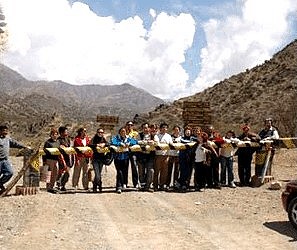
On April 14, a group of Argentine government officials and employees of Barrick Gold Corporation, carried out a violent assault against Women at the Famatina mining camp in the province of La Rioja, where a road blockade has stood for the past two years.

Famatina roadblock

On April 14, a group of Argentine government officials and employees of Barrick Gold Corporation, carried out a violent assault against Women at the Famatina mining camp in the province of La Rioja, where a road blockade has stood for the past two years.

When the officials arrived, a group of Women from the “Self-Organized (Autoconvocados) Neighbors of Famatina for Life,” gathered at site and lowered a metal bar they installed to deny the company’s passage to the mine site.

The officials and Barrick employees then began to ram their trucks against the barrier, but “without any success,” explains an April 14 media alert.

The officials then exited their vehicles and carried out a violent assault against a handful of women, who had peacefully sat down in front the vehicles – first shoving them, and then kicking and striking the women with their fists.

“When the women did not budge,” the Barrick and government officials decided to leave the mining camp, and set out to the Famatina police station masquerading as victims with a plan to file charges against the Women.

However, “upon entering the police station, the aggressors encountered Famatina residents who had been alerted to what was taking place,” the alert states. “The Barrick and government officials then continued to verbally assault the community members in an arrogant manner, self-assured of their impunity.”

“This attitude did not fall well upon the community: Practically the entire population of Famatina immediately turned out in force, and has gathered to surround the police station. As of this moment, the Barrick and mining officials are now ‘trapped’ inside, afraid to exit the police station.”

Police forces from the city of Chilecito have since been contacted to support the Famatina police and the agressors.

Further updates (in Spanish) will be posted at http://www.noalamina.org/

114 Climate Change Protestors Arrested in Nottingham – updated

114 people were arrested in a raid on a school & community centre in Sneinton Dale, Nottingham, at half past midnight on Easter Monday, 13th April 2009. According to police and Eon, the planned target of the protest was the Eon coal-fired power station at Ratcliffe-on-Soar.

Ratcliffe-on-Soar power station114 people were arrested in a raid on a school & community centre in Sneinton Dale, Nottingham, at half past midnight on Easter Monday, 13th April 2009. According to police and Eon, the planned target of the protest was the Eon coal-fired power station at Ratcliffe-on-Soar. The Ratcliffe-on-Soar coal-fired power station is the 3rd largest source of carbon dioxide emissions in the UK and has been previously targeted by activists.

Other power stations across the north and Midlands were warned some days in advance to heighten their security measures by police, and Eon warned all their staff nationally last month to be on the look-out, and what to do if confronted by protestors. It was an intelligence-led police operation, involving 200 officers from 5 different police forces. It is believed that it is the largest pre-emptive arrest and largest ‘in-one-go’ of activists in the UK (ie this excludes mass street protests and protest camps). Equipment taken from the school included cutting equipment, lock-ons, climbing equipment and food “for a prolonged stay”.

Doors at the school were broken down, despite a member of staff having arrived with a key, and broken glass and other damage mean that the school has not been able to re-open after the Easter break; they knew nothing till police arrived en masse. Some people have had their houses searches whilst in custody, and these raids are continuing now everyone has been released. So far, no-one has been charged with an offence, and all are due to return to answer police bail in July – some have had bail conditions imposed. Legal advice on searches & seizure of property at homes – Activists’ Legal Project briefing

This police action is reminiscent of the 16th April 2007 arrests of climate change activists on their way to protest again the M1 widening, while the protestors were held in custody their homes were raided and computers were taken. A year after the arrests the M1 case was thrown out of court.

Select mainstream articles:
Alan Simpson MP: More al-Ikea than al Qaida!
Mass arrests over power station protest raise civil liberties concerns
E.ON’s fence plans after power station security breach
How do environmentalists spot a mole?

‘A Wake for BP’, (ExCel 16.4.09; British Museum 6.5.09)

ART NOT OIL REQUESTS THE PLEASURE OF YOUR COMPANY AT ‘A WAKE FOR BP’ AT ITS CENTENARY PARTY, (BRITISH MUSEUM, 6-7PM, 6.5.09)

** dress rehearsal to take place at BP’s 100th AGM, Custom House DLR, 10.30am, 16.4.09 **

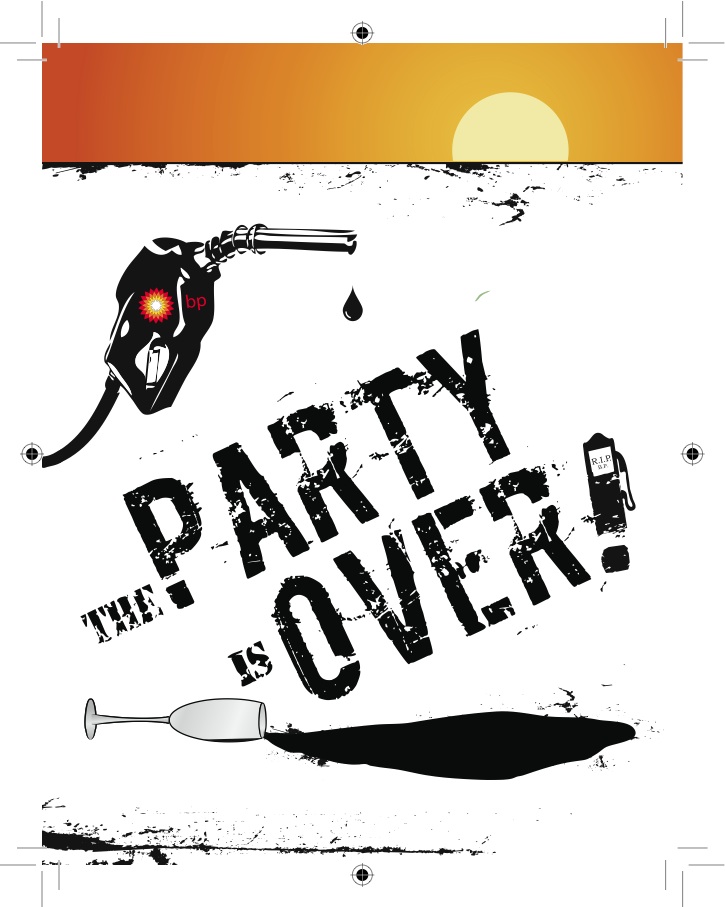
BP the party is overART NOT OIL REQUESTS THE PLEASURE OF YOUR COMPANY AT ‘A WAKE FOR BP’ AT ITS CENTENARY PARTY, (BRITISH MUSEUM, 6-7PM, 6.5.09)

** dress rehearsal to take place at BP’s 100th AGM, Custom House DLR, 10.30am, 16.4.09 **

Oil goliath BP, already forced to postpone its centenary party at the British Museum on April 1st, (also known as Fossil Fools Day[1]), has rescheduled the event for May 6th. Art Not Oil[2], the group behind the original demonstration against its ‘tarnished centenary’, will be throwing ‘A Wake for BP’ as guests arrive at the British Museum between 6pm and 7pm on the new date.

As before, people wanting to come and say ‘BP – your party’s over!’ and wish the behemoth a happy last birthday are more than welcome. The British Museum’s main gate on Great Russell Street will find a contingent of the newly-formed Brazen Pranksters playing tunes to usher in a new era of climate justice and ecological sanity.

They will also be warming up between 10.30 and 11.30am outside BP’s 100th AGM at the ExCel Centre on April 16th. There, Art Not Oil hopes to present BP Chairman Peter Sutherland a special ‘I survived BP, but the planet might not’ T-shirt, to commemorate his last AGM with the company, to place alongside his £600,000 2007-8 pay packet. They also plan to wish him a happy low-carbon retirement.

‘This really is a case of “BP100 = World Plundered”, said Art Not Oil’s Jo Castell. ‘Throughout its history, BP has spread the curse of oil wherever it has operated, injuring (and sometimes killing) workers, tearing communities asunder and decimating wildlife. And that’s long before the CO2 from burning the stuff hits the upper atmosphere and wreaks havoc with the climate. Perhaps the most valuable lesson we could learn from the 20th century is that the 21st century will need to see us kick the fossil fuel habit, and pretty damn soon. Art Not Oil would prefer to be in this for the short haul, but either way we’re determined to see BP decommissioned as a central part of that oily cold turkey.’

Sam Chase added that ‘Any company that can boast that it’s replacing “2008 oil production by 121% and aims to grow annual output through to 2020”(4) needs to be decommissioned forthwith, if we’re to have a chance of avoiding climate catastrophe in the not-so-distant future. Fortunately, Art Not Oil is not alone in working for this to happen, as movements of resistance are gathering strength all over the world.’

Notes to editors:

(1) Fossil Fools Day was big and international in 2008 and 2009:
http://www.newint.org/columns/currents/2008/06/01/climate-campaigning;
www.fossilfoolsdayofaction.org

(2) Art Not Oil stands for ‘creativity, climate justice and an end to oil industry sponsorship of the arts’, and is part of Rising Tide UK. Look out for its nigh-on irresistible 2010 desk diary in September!
info@artnotoil.org.uk
07709 545116
www.artnotoil.org.uk
www.risingtide.org.uk

(3) The Carbon Town Cryer has now posted his BP paean ‘Celebrate This!’ here: www.myspace.com/carbontowncryer

(4) What’s Right With BP?
(An edited version of this text is now available on a free Art Not Oil postcard):
* Beyond Petroleum? ‘BP replaces 2008 production by 121% & aims to grow annual output through to 2020’; (BP press release)

* Fossil fuel-induced climate chaos hit Europe in August 2003, killing tens of thousands of mostly older people in record-breaking temperatures. 150,000 may have died worldwide.

* In 2007, BP bought 50% of the Sunrise oil tar sands field in Canada. Tar sands are most polluting of all the fossil fuels. ‘Fund managers attack BP over tar sands plan’, Times, 18.4.08; www.tarsandswatch.org

* ‘Exposed: BP, its pipeline, and an environmental time-bomb’, Independent (26.6.04) on BP’s Baku-Ceyhan oil & gas pipelines, which will produce over 150m tonnes of CO2 each year for 40 years, causing untold damage to the world’s climate; baku.org.uk

* ‘BP doubles corporate ad budget in $150m bid for greener image’, Times, 28.12.05; BP invests 2.6% of its annual budget in solar & other renewable energy sources, much less than it ploughs into advertising and PR like its sponsorship of the Olympics, Tate, NPG, NHM etc.

* ‘BP and Shell have discussed with the government the prospect of claiming a stake in Iraq’s oil reserves in the aftermath of war.’ Financial Times, 11.3.03.

* ‘BP slated for ‘systemic lapses’, FT, 18.8.05; 15 workers were killed and 500 injured in an explosion at BP’s Texas City refinery on March 23rd 2005.

* ‘Oil gushes into Arctic Ocean from BP pipeline’, (265,000 gallons, to be more exact.) Independent, 21.3.06.

* ‘BP profits soar 148%’, Guardian, 28.10.08. ‘Oil giant BP today beat analysts’ forecasts as its reported a 148% surge in third-quarter profits to top $10bn (£6.5bn), boosted by record oil prices.’

* Community-controlled, post-capitalist renewable energy is already a reality; see for example www.escanda.org

…and by the way, Shell’s no better. In fact, they’re all up to no good!

Shell to Sea Good Friday Walk ends with net removal after battle with Shell security.

Shell to Sea supporters on the annual Good Friday Walk, walked to Glengad beach this morning to take action in defence of their community and environment by removing nets over the cliff face in the Special Area of Conservation, despite a battle with Shell Security.

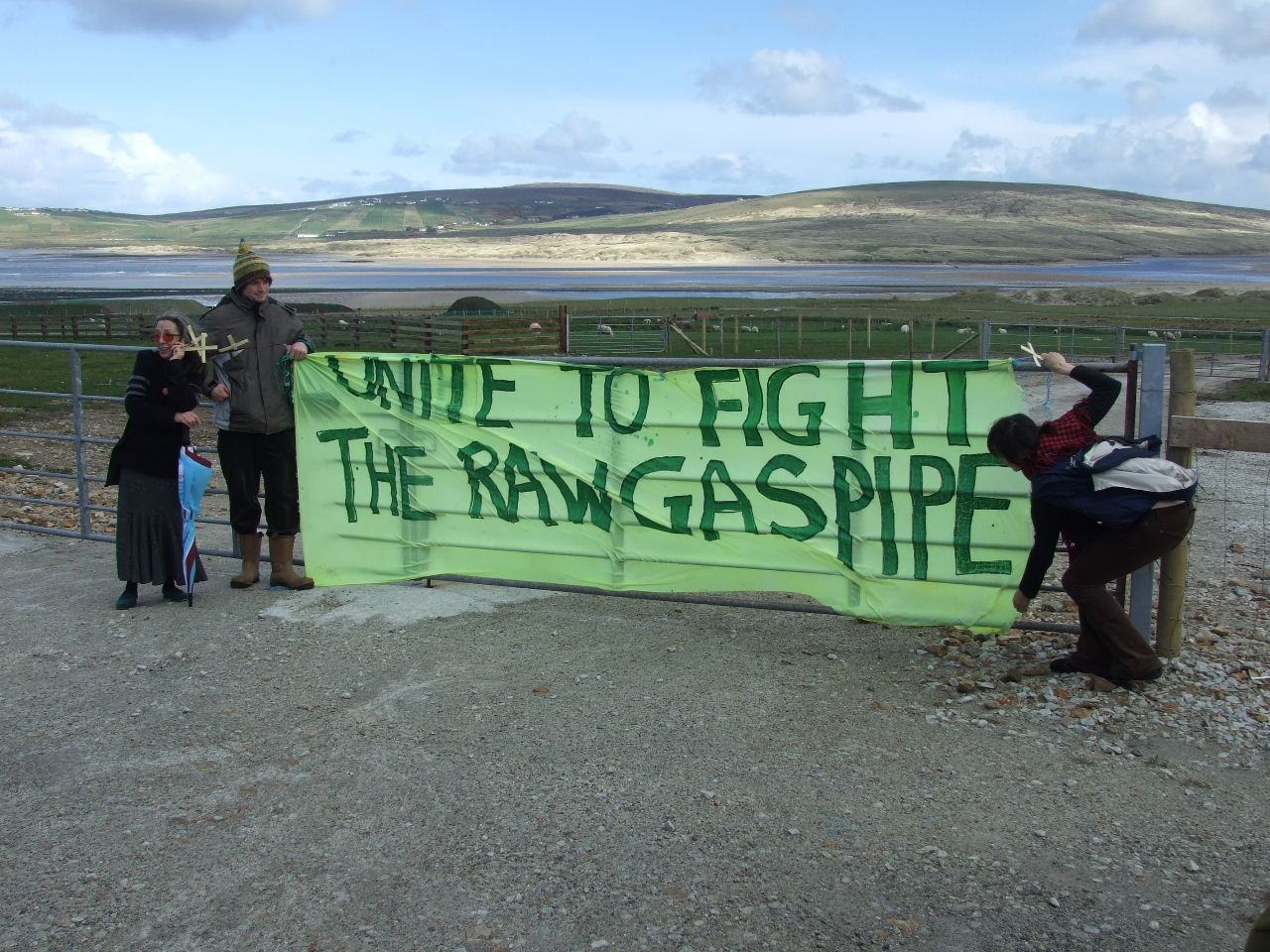
Glengad bannerShell to Sea supporters on the annual Good Friday Walk, walked to Glengad beach this morning to take action in defence of their community and environment by removing nets over the cliff face in the Special Area of Conservation, despite a battle with Shell Security.

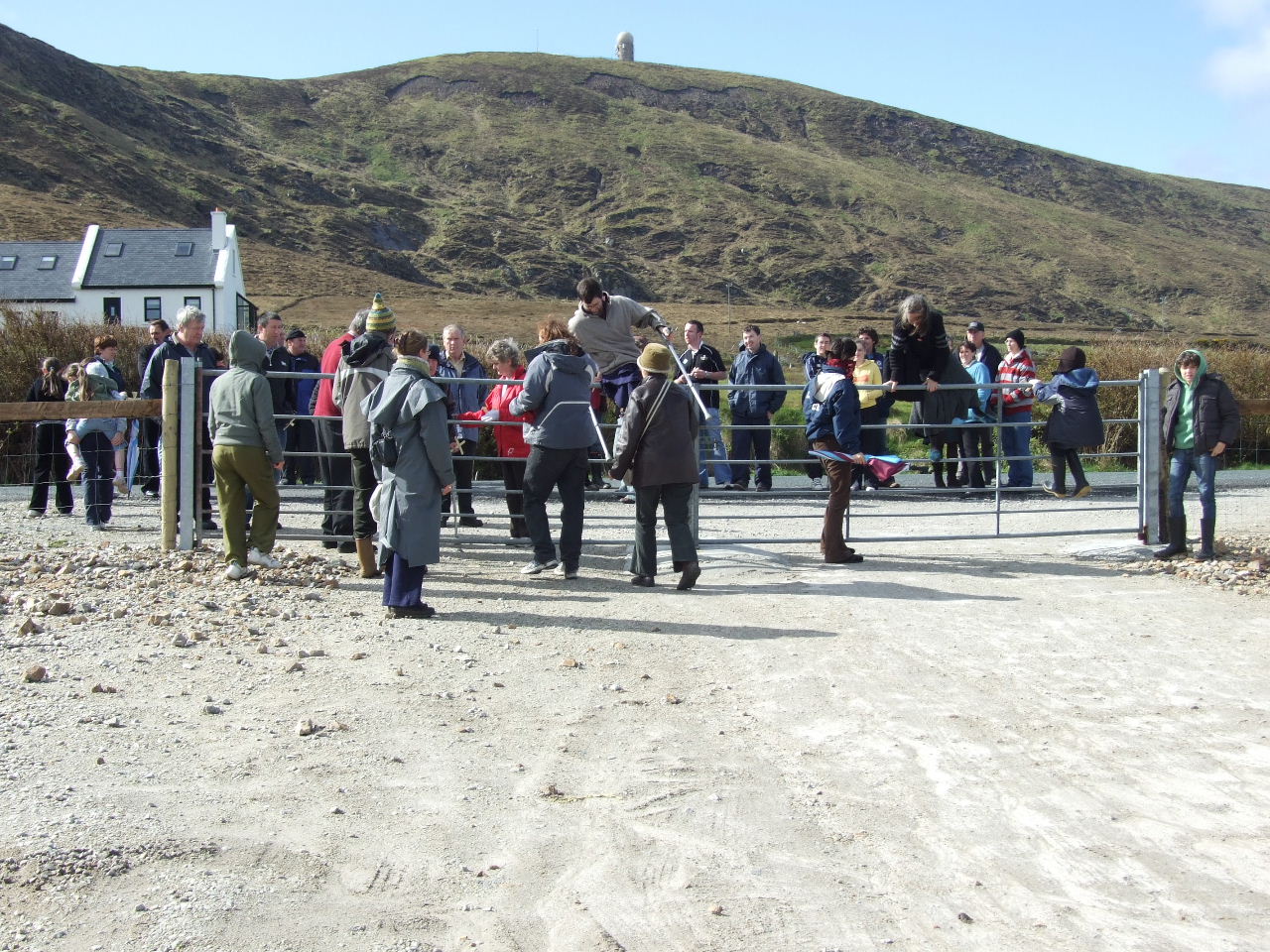
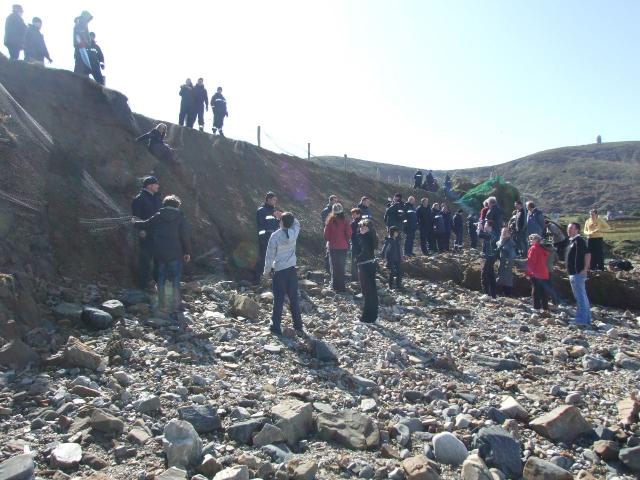
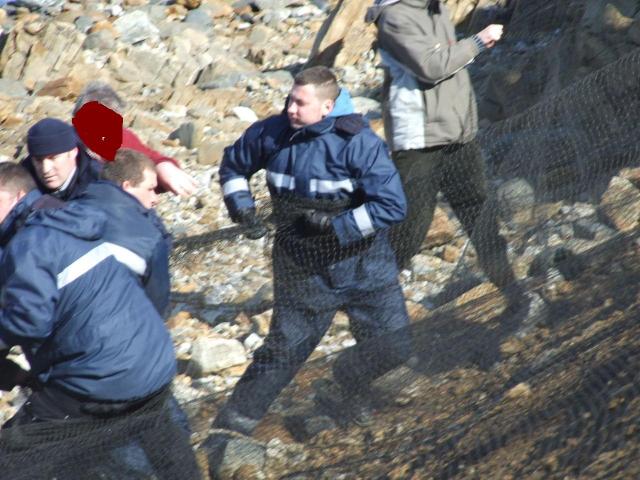
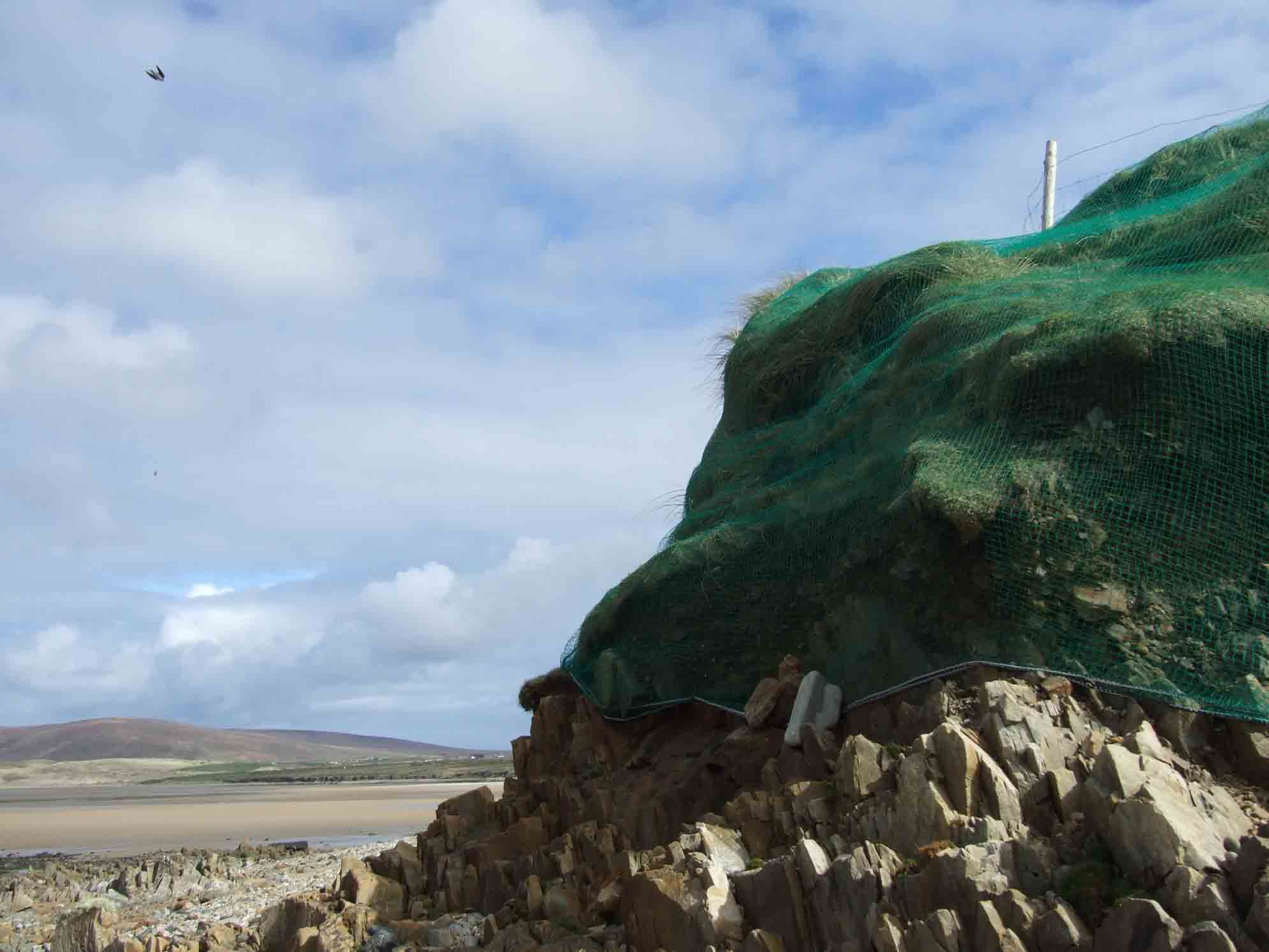
Today, the traditional Good Friday walk took place in both Glengad and Rossport. Over 150 people attended in total. The first walk ended at the site of the Shell compound in Glengad. The group walked together to the Glengad cliff-face and removed netting, recently erected by Shell, intended to stop Sand Martins nesting in the area. This is the eighth time the netting has been removed in the last two weeks by local residents.
Crossing Glengad gate
Although Eamon Ryan only signed the final consents for work at Glengad yesterday, there were already over 40 security personnel present on the site. They were wearing dark, military-style clothing with no visible identification badges. In scenes reminiscent of last year at Glengad, they used excessive force in dealing with the group, which included elderly people and children.
Glengad standoff
For around 45 minutes the group attempted to remove the net and the security attempted to stop them … Eventually, a pair of scissors was produced and the net was cut in two. After, everyone left together; there were no arrests.

Glengad tug-o-war
The action taken today is a demonstration of resistance to come if Shell attempt to recommence work in Glengad.

http://www.youtube.com/watch?v=I7ZHynY0sKw

California: Saboteurs Knock Out Phone & Internet Service

April 10, 2009
Vandals chopped fiber-optic cables and killed landlines, cell phones and Internet service for hundreds of thousands of people in Santa Clara, Santa Cruz and San Benito counties on Thursday.

April 10, 2009
Vandals chopped fiber-optic cables and killed landlines, cell phones and Internet service for hundreds of thousands of people in Santa Clara, Santa Cruz and San Benito counties on Thursday.

The sabotage essentially froze operations in parts of the three counties at hospitals, stores, banks and police and fire departments that rely on 911 calls, computerized medical records, ATMs and credit and debit cards.

The first four fiber-optic cables were cut shortly before 1:30 a.m. in an underground vault along Monterey Highway north of Blossom Hill Road in south San Jose, police Sgt. Ronnie Lopez said. The cables belong to AT&T, and most of the service disruption came from this attack.

Four more underground cables, at least two of which belong to AT&T, were cut about two hours later at two locations near each other along Old County Road near Bing Street in San Carlos. Two additional lines were sliced on Hayes Avenue in South San Jose.

In each case, the vandals had to pry up heavy manhole covers with a special tool, climb down a shaft and chop through heavy cables. The four cables cut in San Jose were about the width of a silver dollar and were encased in tough plastic sheath. One cable contained 360 fibers, and the other three had 48 fibers each.

The vandalism comes as AT&T is in talks with the Communications Workers of America for a contract covering more than 80,000 employees, who have been working under their old deal since it expired at 11:59 p.m. Saturday. Union members voted in late March to authorize a strike but have not scheduled one.

http://anarchistnews.org/?q=node/7166

Why climate camping & other protest? Ecological debt day for your city…coming soon!

Ecological debt: no way back from bankrupt

3 planetsEcological debt: no way back from bankrupt

While most governments’ eyes are on the banking crisis, a much bigger issue – the environmental crisis – is passing them by, says Andrew Simms. In the Green Room this week, he argues that failure to organise a bailout for ecological debt will have dire consequences for humanity.

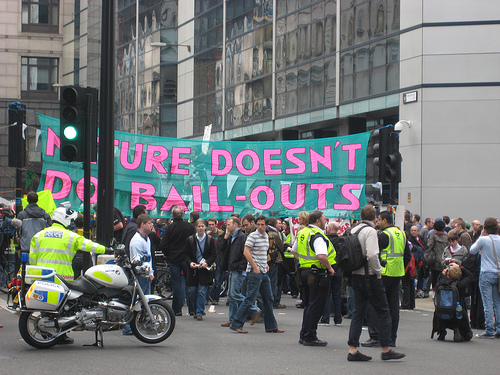
“Nature Doesn’t Do Bailouts!” said the banner strung across Bishopsgate in the City of London.

Civilisation’s biggest problem was outlined in five words over the entrance to the small, parallel reality of the peaceful climate camp. Their tents bloomed on the morning of 1 April faster than daisies in spring, and faster than the police could stop them.

Across the city, where the world’s most powerful people met simultaneously at the G20 summit, the same problem was almost completely ignored, meriting only a single, afterthought mention in a long communique.

World leaders dropped everything to tackle the financial debt crisis that spilled from collapsing banks.

Gripped by a panic so complete, there was no policy dogma too deeply engrained to be dug out and instantly discarded. We went from triumphant, finance-driven free market capitalism, to bank nationalisation and moving the decimal point on industry bailouts quicker than you can say sub-prime mortgage.

But the ecological debt crisis, which threatens much more than pension funds and car manufacturers, is left to languish.

It is like having a Commission on Household Renovation agonise over which expensive designer wallpaper to use for papering over plaster cracks whilst ignoring the fact that the walls themselves are collapsing on subsiding foundations.

Beyond our means

Each year, humanity’s ecological overdraft gets larger, and the day that the world as a whole goes into ecological debt – consuming more resources and producing more waste than the biosphere can provide and absorb – moves ever earlier in the year.

The same picture emerges for individual countries like the UK – which now starts living beyond its own environmental means in mid-April.

Because the global economy is still overwhelmingly fossil-fuel dependent, the accumulation of greenhouse gases and the prognosis for global warming remain our best indicators of “overshoot”.

World famous French free-climber Alain Robert, known as Spiderman, climbed the Lloyds of London building for the OneHundredMonths.org campaign as the G20 met, to demonstrate how time is slipping away.

Using thresholds for risk identified by the Intergovernmental Panel on Climate Change (IPCC), on current trends, in only 92 months – less than eight years – we will move into a new, more perilous phase of warming.

It will then no longer be “likely” that we can prevent some aspects of runaway climate change. We will begin to lose the climatic conditions which, as Nasa scientist James Hansen points out, were those under which civilisation developed.

Small dividend

As “nature doesn’t do bailouts”, how have our politicians fared who ripped open the nation’s wallet to save the banks?

Not good.

According to the International Monetary Fund (IMF), the UK spent a staggering 20% of its GDP in support of the financial sector.

Yet the amount of money that was new and additional, announced in the “green stimulus” package of the Treasury’s Pre-Budget Report, added-up to a vanishingly small 0.0083% of GDP.

Globally, the green shade of economic stimulus measures has varied enormously. For example, the shares of spending considered in research by the bank HSBC to be environmental were:

* the US – 12%
* Germany – 13%
* South Korea – 80%

The international average was around 15%. HSBC found the UK planned to invest less than 7% of its stimulus package (different from the bank bailout) in green measures.

Comparing the IMF and HSBC figures actually reveals an inverse relationship – proportionately, those who spent more on support for finance had weaker green spending.

So here we are, faced with the loss of an environment conducive to human civilisation, and we find governments prostrate before barely repentant banks, with their backs to a far worse ecological crisis.

Extreme markets

On top of low and inconsistent funding for renewable energy, the shift to a low carbon economy is being further frustrated by another market failure in the trade for carbon seen, for example, in the EU’s Emissions Trading Scheme.

Bad market design, feeble carbon reduction targets and the recession have all conspired to drive down the cost of carbon emission permits, wrecking economic incentives to grow renewable energy.

Worse still, the difficulty of accounting to ensure that permits represent real emissions has led both energy companies and environmentalists to warn of an emerging “sub-prime carbon market”.

Relying on market mechanisms is attractive to governments because it means they have less to do themselves. But they will fail if carbon markets are just hot air.

There seems to be a hard-wired link between memory failure and market failure.

As the historian E J Hobsbawm observed in The Age of Extremes: “Those of us who lived through the years of the Great Slump still find it almost impossible to understand how the orthodoxies of the pure free market, then so obviously discredited, once again came to preside over a global period of depression in the late 1980s and 1990s”.

Perhaps the greatest failure is one of imagination.

Some people alive today lived through those past recessions and depressions. They know they can be nasty and need averting.

But the last time the Earth’s climate really flipped was at the end of the last Ice Age, more than 10,000 years ago. No one can remember what that felt like.

Lessons of history

Looking forward, the IPCC’s worst case scenario warns of a maximum 6C rise over the next century.

Looking back, however, indicates that an unstable climate system holds worse horrors.

Work by the scientist Richard Alley on abrupt climate change indicates the planet has previously experienced a 10C temperature shift in only a decade, and possibly “as quickly as in a single year”.

And, around the turn of the last Ice Age, there were “local warmings as large as 16C”.

Imagine that every day of your life you have taken a walk in the woods and the worse thing to happen was an acorn or twig falling on your head.

Then, one day, you stroll out, look up and there is a threat approaching so large, unexpected and outside your experience that can’t quite believe it, like a massive gothic cathedral falling from the sky.

In tackling climate change we need urgently to recalibrate our responses, just as governments had to when they rescued the reckless finance sector.

Then officials had to ask themselves “is what we are doing right, and is it enough?”

They must ask themselves the same questions on the ecological debt crisis and climate change.

The difference is, that if they fail this time, not even a long-term business cycle will come to our rescue. If the climate shifts to a hotter state not convivial to human society, it could be tens of thousands of years, or never, before it shifts back.

Remember; nature doesn’t do bailouts.

Andrew Simms is policy director of the New Economics Foundation (nef), and author of Ecological Debt: Global Warming and the Wealth of Nations

——

One Planet Living http://www.oneplanetliving.org

Your city’s Ecological Debt Day:

Using the latest data available WWF has calculated when residents of British cities will have consumed their fair share of natural resources for 2008 – or when their ecological debt day is.

City Ecological debt day

Winchester 10 April
St Albans 13 April
Chichester 14 April
Brighton & Hove 14 April
Canterbury 17 April
Oxford 17 April
Southampton 21 April
Durham 22 April
Cambridge 23 April
Portsmouth 23 April
Edinburgh 23 April
Chester 24 April
Aberdeen 24 April
Ely (East Cambs) 26 April
Hereford (County of Herefordshire) 28 April
Stirling 28 April
London 29 April
Lichfield 29 April
Lancaster 30 April
Newcastle upon Tyne 30 April
Wells (Bath and NE Somerset) 1 May
Bath (Bath and North East Somerset) 1 May
Ripon (Harrogate) 2 May
Manchester 2 May
Inverness (Highland) 2 May
Preston 2 May
Norwich 2 May
Peterborough 2 May
Dundee City 3 May
Leeds 3 May
York 3 May
Sheffield 3 May
Derby 4 May
Carlisle 4 May
Leicester 4 May
Worcester 4 May
Bangor (Gwynedd) 4 May
St Davids (Pembrokeshire)4 May
Nottingham 4 May
Liverpool 4 May
Bristol 5 May
Birmingham 5 May
Lincoln 5 May
Bradford 5 May
Glasgow 6 May
Cardiff 6 May
Exeter 6 May
Coventry 7 May
Swansea 8 May
Salford 8 May
Wolverhampton 8 May
Truro (Carrick) 8 May
Sunderland 8 May
Wakefield 9 May
Gloucester 9 May
Stoke on Trent 10 May
Kingston upon Hull 10 May
Salisbury 10 May
Plymouth 11 May
Newport 11 May

G20 update – police violence; what happened b4 Ian Tomlinson’s death witnesses; vigil on 11th; legal support; protest tactics

Channel 4 commentary on what happened to Ian Tomlinson just before his death – the latest ITN footage combined with the first footage published on the Guardian website. On the ground, protestors try to help before being cleared out of the area – counter the media-bottle-throwing hype, watch two eye witnesses.

New incident of systemic police violence – when an officer slaps the face then batons the legs of a woman – captured on film.

Even newer video evidence of yet more police violence – shields and fists used to punch without provocation – more details.

Newest footage which shows Ian Tomlinson’s head hit the ground from the push by police.

Police charge press photographers.

Collections of videos of police violence: 1 | 2
—————-

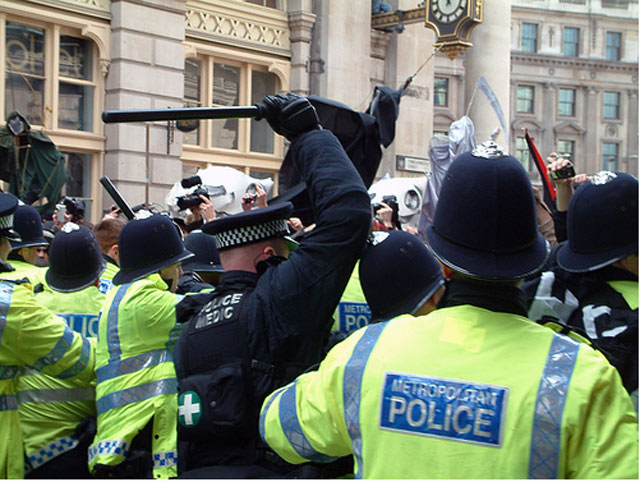
G20 police medic -cracking heads with baton

Channel 4 commentary on what happened to Ian Tomlinson just before his death – the latest ITN footage combined with the first footage published on the Guardian website. On the ground, protestors try to help before being cleared out of the area – counter the media-bottle-throwing hype, watch two eye witnesses.

New incident of systemic police violence – when an officer slaps the face then batons the legs of a woman – captured on film.

Even newer video evidence of yet more police violence – shields and fists used to punch without provocation – more details.

Newest footage which shows Ian Tomlinson’s head hit the ground from the push by police.

Police charge press photographers.

Collections of videos of police violence: 1 | 2
—————-

London assembly and procession:

Easter rising!
Reclaim the City, Saturday April 11

* 12.00 noon Saturday – 12.00 noon Sunday
* Wear Black
* Assemble 11:30am, Bethnal Green
* Lay your flowers where Ian Tomlinson died
* Bring pop-up tents to stay with Ian through the night

—————-

Edinburgh protest:

Four months ago it was a 15-year-old schoolboy in Greece – today it’s a 47-year-old newspaper seller in the UK.

Enough with the state murders!

Whether civilians’ deaths are caused because of “heart attacks” (most likely due to police terror) or head injuries (due to police brutality) or “misfires” (due to police stupidity), we say we had Enough!

Enough! Of your lies in attempting to cover up your mistakes
Enough! Of your “Robocop” attitude
Enough! Of your “to serve and protect” fake masks
Enough! Of you being the guardian dogs of the privileged elite

We say Enough! and we are going to say it out loud so everyone can hear us.

Saturday 11th of April at 1:30pm in Bristo Square (Edinburgh)

Bring friends, banners, candles and something to make noise with (drums, whistles etc.)

—————-

Redditch protest:

The policing at the G20 protests was extremely violent and aggressive. Peaceful protesters were attacked and beaten, many of them suffering injuries. We’ve all seen the videos of police laying into the climate campers who stood there with their hands in the air calmly stating “this is not a riot”. And now we see film evidence that Ian Tomlinson, who was not even a protester, was brutally attacked from behind with a baton, before being shoved hard to the ground by a vicious cop. Ian Tomlinson died minutes later – I call this MURDER and it happened on Jacqui Smith`s watch!!

This is a call out for a National Demonstration in Redditch, the constituency of Jacqui Smith, the Home Secretary.

Demonstrate against the increasingly violent and aggressive policing at peaceful protests. Demonstrate against the erosion of civil liberties in our so called democracy. Demand that Jacqui Smith ensures that the officers who murdered Ian Tomlinson are brought to justice.

Let`s see how Jacqui Smith likes it when 1,000s of protesters turn up in her home town demanding JUSTICE!!!

Saturday 18th April – 12 noon outside Redditch Town Hall.

The town hall is about 10 minutes walk from the train station.
http://www.multimap.com/s/QKjPxY9S

—————-

A protest against the death of Ian Tomlinson and the growing use of violent tactics by police against protesters will take place 1 pm Saturday 11 April, Grey’s Monument, Newcastle

—————-

Legal call-out

G20 LEGAL UPDATE
First, thank you for all the emails. We are reading them but not acknowledging them at the moment due to the quantity. Our apologies. For the time being, if you would like us to respond – please send us another email requesting a response.

HOW THE POST-PROTEST LEGAL PROCESS WORKS:
Lots of people are writing to us with evidence of police misbehaviour and there certainly seems to be grounds for complaint in many of them.
However, crucially complaints and legal claims need to be brought by individuals: we can’t do it on your behalf. Also, do NOT make a complaint if there’s a possibility that you will make a legal claim, or could support someone else doing so – complaining to the IPCC before suing the police will compromise the case.

What we are doing is:

1. We are making sure we have the evidence available to us sorted so we can locate supporting evidence for those arrested or those who bring complaints of assault and so forth against the police.

2. We are exploring whether there is a legal challenge strategically worth bringing this time. If so, we will be looking for potential litigants.

3. We are preparing report and film on the Camp and may be in contact with some of you to use your statements. We have made no decision as to what we will do with the report at this point.

4. We have a particular interest in how those with injuries or illnesses were treated by the police – so if you have relevant evidence there please let us know. Depending on the evidence, we may focus on this as an area of concern.

What you could do:

If you were wrongfully arrested, or assaulted and injured by a police officer, you may be able to bring a case against the police. Please contact Bindmans Solicitors in the first instance: 020 7833 4433. If they do not have the capacity then we can recommend other firms of solicitors who have worked with activists in the past. We may have supporting evidence so let us know if we can help. Please keep us informed of the outcomes – legal@climatecamp.org.uk.

If you were arrested and charged, let us know as we may have supporting evidence that may help with your defence. You will need to give your solicitor your consent to them talking to us or they will not be able to tell us about your case. Please keep us informed of the outcome – legal@climatecamp.org.uk.

N.B. If you have previously left any important legal information on an answering machine or sent to a different email address and nobody got back to you, please try again using the email address above

Meanwhile write up anything relevant now and email us, let us know if you have footage and we will send you some information on how to share it with us, keep copies of any original notes, photos and film (and keep them for 12 months).

Finally, if your witness statement relates to the G20 Meltdown protests at Bank, there is a separate legal support process. Please contact the Legal Defence and Monitoring Group – email ldmgmail@yahoo.co.uk or post to Legal Defence and Monitoring Group, BM Box HAVEN, London, WC1N 3XX .

—————-
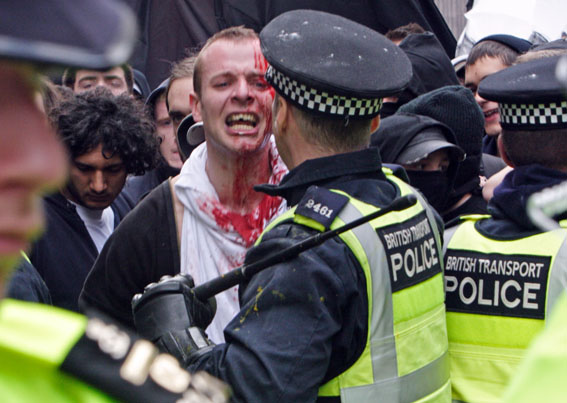
Bloody protestor & baton-wielding cop
Public Order strategies to not get kettled and beaten by the police

For how to survive police tactics in big public order situations such as the G20 protests, and still do what you want to do, read the Guide to Public Order Situations – any comments or ideas please send them in to manchester@earthfirst.org.uk

—-

Video of police rush on climate camp – why you should read the above, rather than listen to someone on a megaphone suggesting people put their hands up AND link arms! The same charge but clearer and more brutal can be seen here. Other clips and reports from the day are all here.

—————-

Journalists removed from covering G20 protests with illegal use of laws and through injury – see the commentaryhere.

—————-

Beautiful & inciteful G20 photo essaychapter 1: the anarchists are coming! | chapter 2 part 1: storm the banks? | chapter 2 part 2: a tale of kettles, and death | chapter 3: police work

—————-

Correcting the media narrative of the G20 protests on April 1, 2009

The media coverage of the G20 protests has been systematically biased, writes Musab Younis – ignoring the violent policing, the tactic of open-air imprisonment of demonstrators, and the real chronology of events. “It has taken remarkable obedience by the press,” writes Musab, “to refuse to ask some simple and obvious questions.”

#1 – The reversal of events

“Anti-capitalist protesters embarked upon a wrecking spree within a City branch of the Royal Bank of Scotland today,” shrieked The Times on April 1, “and engaged in running battles with police as G20 demonstrations turned violent. Police were forced to use dogs, horses and truncheons to control a crowd of up to 5,000 people who marched on the Bank of England, in Threadneedle Street, on the eve of the London summit.”

This narrative of events is entirely typical. Under the headline “Police clash with G20 protestors”, the BBC reported that “protesters stormed a London office of the Royal Bank of Scotland”, later adding tha: “officers later used ‘containment’ then ‘controlled dispersal’” (BBC, April 1). The Guardian reported: “The G20 protests in central London turned violent today ahead of tomorrow’s summit, with a band of demonstrators close to the Bank of England storming a Royal Bank of Scotland branch … [S]ome bloody skirmishes broke out as police tried to keep thousands of people in containment pens” (The Guardian, April 1).

What is interesting about this narrative is that it precisely reverses the events of the day.

Eyewitness accounts of the day agree that the police began the now-infamous tactic of ‘kettling’ protestors – refusing to allow anyone in or out of a confined space held by police lines – as soon as the four marches had converged on the Bank of England, at around midday. An article in The Times a day earlier by a former Assistant Commissioner of the Metropolitan Police, Andy Hayman, suggested that the police had planned to use this tactic well in advance: “Tactics to herd the crowd into a pen, known as ‘the kettle’, have been criticised heavily before, yet the police will not want groups splintering away from the main crowd. This would stretch their resources” (The Times, March 31).

Note that the “violent outburst” (Telegraph) of window-breaking took place hours after the police had decided to “herd the crowd” of at least 5,000 people “into a pen” without access to food, water or toilet facilities – and without allowing them to leave.

The press was surely aware of this. The Guardian’s live blog from the day noted at 11.57 a.m. that “the barriers designed to fence in the protesters are not big enough”, an hour later it confirms that there is “a ‘kettle’ at the Bank of England”: half an hour later they report “clashes” and finally, at 1.30 p.m., “a window has been smashed.” An objective observer of the sequence of events here might ask whether the police ‘kettle’ had in fact been responsible for the “clashes”, “violence” and smashed window.

But this idea – that the kettle might have provoked the “clashes”, and that the police might therefore be responsible for the “violence” – is remarkably absent from virtually all of the reams of press coverage of the protests. We do, of course, have a spectrum of opinion: whereas the right-wing Daily Mail sees the protestors as “a fearsome group of thugs”, a “bizarre group of misfits” fuelled by “Dutch courage” and a “willingness to use violence” (April 1), for the left-wing Guardian only “a minority of demonstrators seemed determined to cause damage” whilst “much of the protesting” was “peaceful” (April 1).

Again, the notion that there was not a “violent” core of demonstrators at all, but that people were provoked into “clashes” with the police due to police tactics, is absent. Even the article which is by far most critical of the police actions – a piece by Duncan Campbell in The Guardian titled ‘Did police containment cause more trouble than it prevented?’ – only goes as far as to say: “As for the violent clashes that led to cracked heads and limbs, how much was inevitable and how much avoidable?”. Campbell concedes that “some demonstrators were bent on aggro” but adds: “so were some of the officers.” He also criticises the conditions inside the kettle and suggests that it will make people think twice before embarking on a demonstration in future. Thus Campbell suggests the “clashes” were avoidable, but does not indicate that the kettles actually led to the “clashes” – though, to give credit where it is due, his is the only piece in the press which dares to suggest that the police were themselves violent.

#2 – Justifications

Well before the protests, the press had been reporting with glee the “violence” predicted as “London went into lockdown” and “protestors issued a call to arms” with “police fears” of protestors “intent on violence” (The London Paper, 31 March).

The BBC posted a sympathetic article titled ‘The challenge of policing the G20’ (30 March) which pointed out that: “police officers spend their professional lives trying to play down the public order implications of demonstrations – it’s in their interests to keep things calm.”

“The security strategy of the day,” they reported breathlessly, “resembles a three-dimensional ever-changing puzzle” where “the unknowable factor is the demonstrator bent on violence”. The article ended with a quote from Commander O’Brien: “If anyone wants to come to London to engage in crime or disorder, they will be met with a swift and efficient policing response.”

This flurry of media coverage predicting “violence” from “anarchists” was clearly initiated by the police, who released a barrage of press statements before the protests which served to pre-emptively quell criticism of their actions on the day – actions which had, of course, been planned well in advance. The G20 policing was to be “one of the largest, one of the most challenging, and one of the most complicated operations” ever “delivered” by the Metropolitan Police, according to Commander Simon O’Brien, who hit the press circuit with gusto in the days preceding the G20.

The press obediently played their part by reporting police “fears” word for word, with complete sympathy, and with no question on asking those who planned to protest whether they thought the police reaction might be overly violent. After all, “the police have had to prepare for every possibility” on April 1, noted the Times: “from terrorism to riots” (The Times, March 31).

With ample opportunity to question an unusually talkative police force, barely a single sentence in the press asked whether the police preparation for the protests might be heavy-handed or that a violent reaction by the police to the protests might lead to serious injury or death. The protestors, of course, were to be “violent” “mobs” (based on police “intelligence” gleaned from “social networking sites”), but the police were to be calm, measured and undertake only necessary measures.

The effect of this press coverage was to justify in advance all police actions whilst de-legitimising any actions by protestors. Endless predictions of “violent protestors” meant that all the day’s “clashes” were sure to be blamed on the “minority” of “intent on violence” – even if evidence suggested that “clashes” were actually instigated by police, and that violence was in the main inflicted by the police on protestors. Within the press narrative, the police are merely reactive; forced to respond to a “violent” situation and “keep things calm”; the notion that they could have actively encouraged and provoked “clashes” seems patently absurd.

#3 – So what’s missing?

There are a number of important questions which simply didn’t appear in the press.

a) Did the police intend to ‘kettle’ demonstrators in a confined space regardless of whether there was any violence or not?

All the evidence, including past cases of the police using this tactic, suggests this was the case. (At the Climate Camp protest at Bishopsgate on the same day, the police beat protestors back into a kettle despite them holding up their hands and chanting ‘this is not a riot’, as can clearly be seen on the Indymedia video ‘Riot police attack peaceful protestors at G20 climate camp’).
Is there a possibility that the police were not in fact “forced to use dogs, hoses and truncheons” due to “violent” protestors, but that they inflicted violence on peaceful protestors?

b) Was there really “violence” from the protestors?

The Metropolitan Police state that “small groups of protestors intent on violence, mixed with the crowds of lawful demonstrators” (Met Police, 2 April) and The Guardian quotes Commander Simon O’Brien as claiming there were “small pockets of criminals” within the crowd who attended a memorial for Ian Tomlinson on April 2. Again, eyewitness accounts of both days state that virtually all of the violence came from police. Despite hours of kettling and media reports of “missiles” being thrown at police (translation: plastic bottles), the only tangible evidence of protestor violence at either of the two main protest sites seems to have been some smashed windows, which of course is damage to property and not “violence”.

The Guardian reports that a small group of demonstrators were “seeking confrontation as they surged towards police lines.” Of course you’re expected to sit quietly when you are being held against your will behind police lines and periodically beaten with batons. But is it conceivable that those who “charged” police lines simply wanted to leave? And why is it confrontational to “charge police lines” without using any weapons, but not confrontational to hold thousands of people in an area, keeping them there with kicks and batons? That the protestors could have actually showed remarkable restraint when being provoked in an unbearable situation is laughable according to all the press. Yet this is what eyewitness accounts point to. Only the Letters page in the Guardian gives any credence to this: one person writes that “the few scuffles we did witness were caused precisely at the frustration of people not being allowed to come and go as they pleased”; another states that: “an ugly mood developed after those who had come to exercise their democratic right to protest were detained against their will” (Guardian, April 3).

c) Were the police tactics responsible for the “violence” of the day?

Because the press has been admirably obedient in reversing the course of events, this is an impossible question – according to the media first there was “violence” from “anarchist” protestors, then the kettle began. Yet once we establish a more accurate chronology, and take into account police prior planning, it seems that it had always been intended to shut thousands of people into an enclosed space without being able to leave.

d) Was the ‘kettling’ tactic intended to make people think twice about demonstrating in future?

The most critical piece in the press, by Duncan Campbell in the Guardian, states that those “people thinking about embarking on demonstrations in the future may have to decide whether they want to be effectively locked up for eight hours without food or water and, when leaving, to be photographed and identified.” Yet it does not suggest that this may have been the initial intention of the police in adopting this tactic, even though it is absurd to suggest the police might have planned to use this tactic without imagining it would lead to anger and frustration on the part of those trapped in the kettle. In conjunction with the extensive restrictions to freedom of protest under the New Labour government, amply documented elsewhere, it might be reasonable to suggest that the police tactics were in part, at least, designed to deter protestors.

e) Were the police violent and should any officers face charges?

Remarkably, this question is absent from virtually all the press coverage – despite hundreds of injuries to protestors, the death of someone apparently trapped in a kettle, and video footage showing baton charges directed towards crowds of people with their hands in the air, the use of riot shields as an offensive weapon, and the beating with batons of protestors sat on the ground (see, for example, ‘Riot police attack peaceful protestors at G20 climate camp’ on Indymedia). The ample groundwork laid by the police suggesting there would be protestors “intent on violence” happily accounts for all the violence of the day and makes easy to ignore eyewitness accounts that state that peaceful protestors being kettled, charged, beaten and provoked by the police. Given the number of witnesses and video evidence, it has taken remarkable obedience by the press to refuse to ask this question – and for a media so obsessed with violence, it seems strange that the overwhelming violence of the day, that inflicted by the police on protestors, barely merits a mention.

Lappersfort forest occupation – ongoing Repression in Brugge – 2 people in prison

In the early hours of Wednesday 30th of march, two occupants of the Lappersfort forest protest site were arrested cycling back to the camp. Based on the fact that they had a screwdriver on them and a bike trailer full of food, they are accused of breaking a fence in order to take food from a skip that they never actually visited.

In the early hours of Wednesday 30th of march, two occupants of the Lappersfort forest protest site were arrested cycling back to the camp. Based on the fact that they had a screwdriver on them and a bike trailer full of food, they are accused of breaking a fence in order to take food from a skip that they never actually visited.

They are currently in prison awaiting a hearing on Friday morning 9:00. There will be a noise demo tomorrow before the court house; those who wish to come, meet us at the train station at 8:00 or come to the forest tonight. In case they don’t get released, there will be another demo in Brugge on Saturday, meeting at 13:00 at the front of the train station. BRING YOURSELF AND YOUR FRIENDS, BRING YOUR NOISE AND WHATEVER YOU WISH!

These arrests are the latest development in the ongoing campaign of repression against the occupants of the protest site. In February one person was arrested for skipping food and was held for 15 days in a high-security prison after refusing to identify himself in court. After the judge in Gent ordered his release, the Lappersfort lawyer is expecting the judge in Brugge to flex his little muscles and try to make an example of the two people in prison.

Other ‘offences’ occupants have been arrested for in the last five months include: Taking scrap wood from a bin, carrying wood chips in wheelbarrows in the street, handing out flyers at a market in the city centre and putting up posters on a legal postering spot.

The Lappersfort occupants see this as an ongoing campaign of repression to try to force them out of the woods and discover as many of their identities as possible. It is also seen as a criminalization of environmental activism, skipping and generally increasing the power of the police state. THIS IS NO LONGER A FIGHT ONLY FOR THE FOREST, BUT ALSO FOR PERSONAL FREEDOM, SELFDETERMINATION AND THE RIGHT TO RECYCLE.

Lappersfort forest has been occupied since September 2008 to prevent it from being cut down to build warehouses, office buildings and a car park. The owner of the land, FABRICOM GTI, entity of energy-giant GDF SUEZ, has until now offered little contact to the occupiers except to say that they insist on going ahead with their destructive project.

The site is under constant eviction threat. People who want to come and live with us to defend the forest are welcome, and visitors too!

Directions from Brugge Train Station: Exit at the back – where all the construction is going on – turn left and follow the road for a while until the roundabout, turn left under the railway bridge. You’ll see the forest soon on your right!

0032 (0) 471 658 544
(For information in dutch – not yet translated nor updated – www.lappersfort.tk)
lappersfort@gmail.com

————-

update – 3/4/2009
A trial was held today in the Brugge courthouse for the two Lappersfort occupiers, Sophie and Pitree, who were arrested on tuesday night while riding their bicycles back to the forest. Occupiers and other folk went along to the courthouse to make some noise and show solidarity with their friends.

The judge decided they must be detained longer to give the police/repressive scum more time for “further investigation”. They are maintaining their accusation that the two girls had been skipping at the Delhaize in Assebroek, which is obviously made up and is simply being used as an excuse to hold them longer in prison. The only evidence they claim to have is some footprint on the wall by the skip in question.
As this is being written an appeal process is going on, to request a second opinion from another judge. We cant say yet what the results are, but if the appeal is unsuccesfulk the two will have to wait ANOTHER MONTH WITHOUT TRIAL to receive their next judgement….

The developments of police repression against the Lappersfort occupiers in Brugge could not only threaten the action camp and the forest, but may also set precedents for further arrests and charges involving skipping/dumpster diving…WE SEE THIS AS A CLEAR AND ROTTEN ATTEMPT TO CRIMINALISE A WAY OF LIFE, TURN PUBLIC OPINION AGAINST US,TO WEAKEN SUPPORT AND DEMORALISE THE SPIRIT OF THE ACTION CAMP ITSELF….

SO… AS SOPHIE AND PITREE SIT IN PRISON, WE WILL GATHER TOMORROW (SATURDAY) AT 13:00 AT BRUGGE TRAIN STATION AND NOISILY WALK TO THE BRUGGE PRISON, TO SHOW OUR SOLIDARITY WITH OUR FRIENDS, WITH DUMPSTERDIVERS EVERYWHERE, AND AGAINST THE ONGOING REPRESSION BY THE POLICE STATE…..THE FIGHT FOR THE LAPPERSFORT FOREST WILL NOT BE STOPPED BY STUPID ARRESTS AND POINTLESS REPRESSION BY POLICE ANYWHERE…….
after the demo all are invited back to the Lappersfort forest for some yummy hot soup, campfire and all the rest of it, and are welcome to stay as long as they wish…

RE-CYCLE, CREATE, FUCK THE STATE!!!
RED HET BOS!!

Shell to Sea Update from Erris – Shell Nets and Boats at Glengad

Shell has returned to Glengad beach to install nets over the cliff face. This cliff is a sand martin nesting area, and the sand martin nesting season is beginning this month.

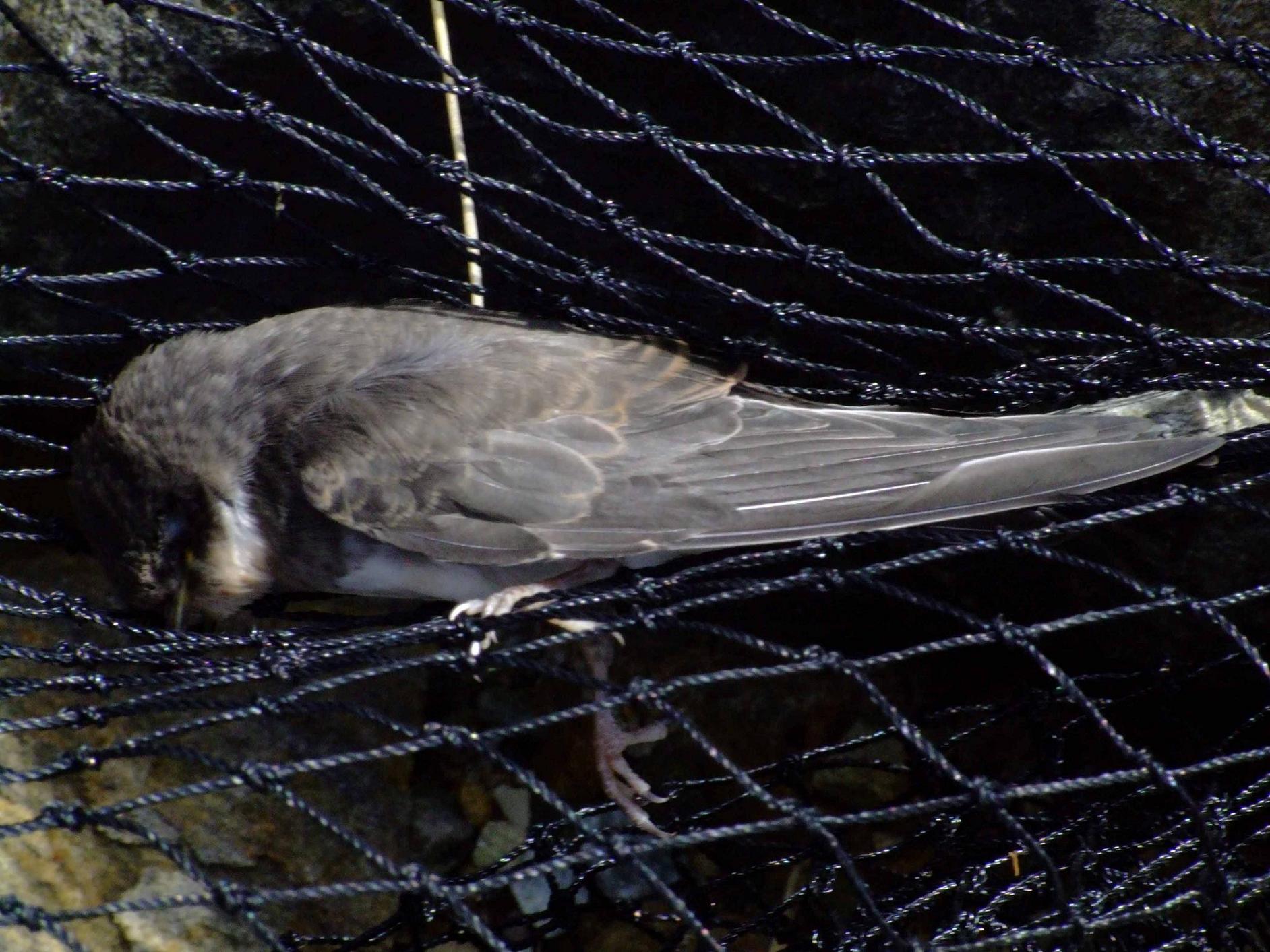
Glengad cliff nettedDead sandmartin in Shell's netShell has returned to Glengad beach to install nets over the cliff face. This cliff is a sand martin nesting area, and the sand martin nesting season is beginning this month. Birds have been spotted in the area, and although there are some sections of cliff not covered by the nets, the nesting area is severely restricted. The surface of the cliff face is markedly different from years past, after being destroyed last fall during Shell’s failed attempt to bring their raw gas pipeline onshore. For a report on the destruction done to the beach last fall, you can read the Solidarity Camp’s November update here on Earth First! Action Reports.

Two boats were present in Broadhaven Bay today from at least 10am until 4pm. The larger boat moved all around the bay, while the smaller boat mostly stayed close to the green buoy. It is possible that they are carrying out survey works to prepare for the offshore pipe laying. According to Shell’s Environmental Management Plan, Shell may be planning to begin offshore pipe laying in May of this year, using an alternative “wet start” option. From the Environmental Management Plan:

“Alternative “wet start” option
If the dredging of the trench for the nearshore section of the pipeline has not been completed and the pipelay vessel is available to start work an alternative sequence of installation maybe undertaken.
The pipelay vessel will install a marine anchor on the pipeline route in approximately 20 to 25m of water. A wire between this anchor and the leading end of the pipeline will maintain tension in the pipeline and the vessel will start to lay pipe towards the Corrib Field as outlined previously.
Depending upon the progress of the dredging operation, the pipelay vessel may continue and lay all of the line to Corrib. Alternatively, it may suspend its operations part way and return to Broadhaven Bay to complete the pull-in of the landfall section and then pick up the previously laid section before continuing to the field.
If a “wet start” is undertaken, it will be necessary to join the two sections of pipeline together within Broadhaven Bay by lifting the pipe ends above water and welding them together, or completing the weld on the seabed using divers.”

As expected, Shell seems to be gearing up for another attempt at forcing their project ahead without community consent again in 2009. The struggle against Shell continues, following a spirited weekend in Dublin outside Mountjoy Prison in solidarity with Maura Harrington. Maura has been imprisoned for 20 days and has another 8 days yet to serve in her sentence. Another People’s Forum will take place this weekend, with talks on the upcoming US case against Shell’s actions Nigeria, Climate Change, and Corrib Gas Permissions.

The Forum will take place in the Inver Community Center on Saturday, April 4th from 10.30am – 3.30pm. As always, the Solidarity Camp is open to anyone who wants to visit Erris to support the campaign. Contact the Rossport Solidarity Camp: 085 1141170 rossportsolidaritycamp at gmail dot com

—-

April 2nd, 2009

The netting over the cliff face at Glengad was taken down yesterday by two members of Pobal Chill Chomain, in the presence of a NPWS manager.

Attempts are being made by Belcross contractors this morning (Thursday, 11am) to put the nets back up. They are currently being prevented from finishing this work.

Sand martins and Brent geese are present on the beach.

Two boats, possibly survey boats, are in Broadhaven Bay.

Beautiful day on the beach!

Climate Camp in the City, Critical Mass & the G20 Meltdown Bank of England plus other protests from this week – updated

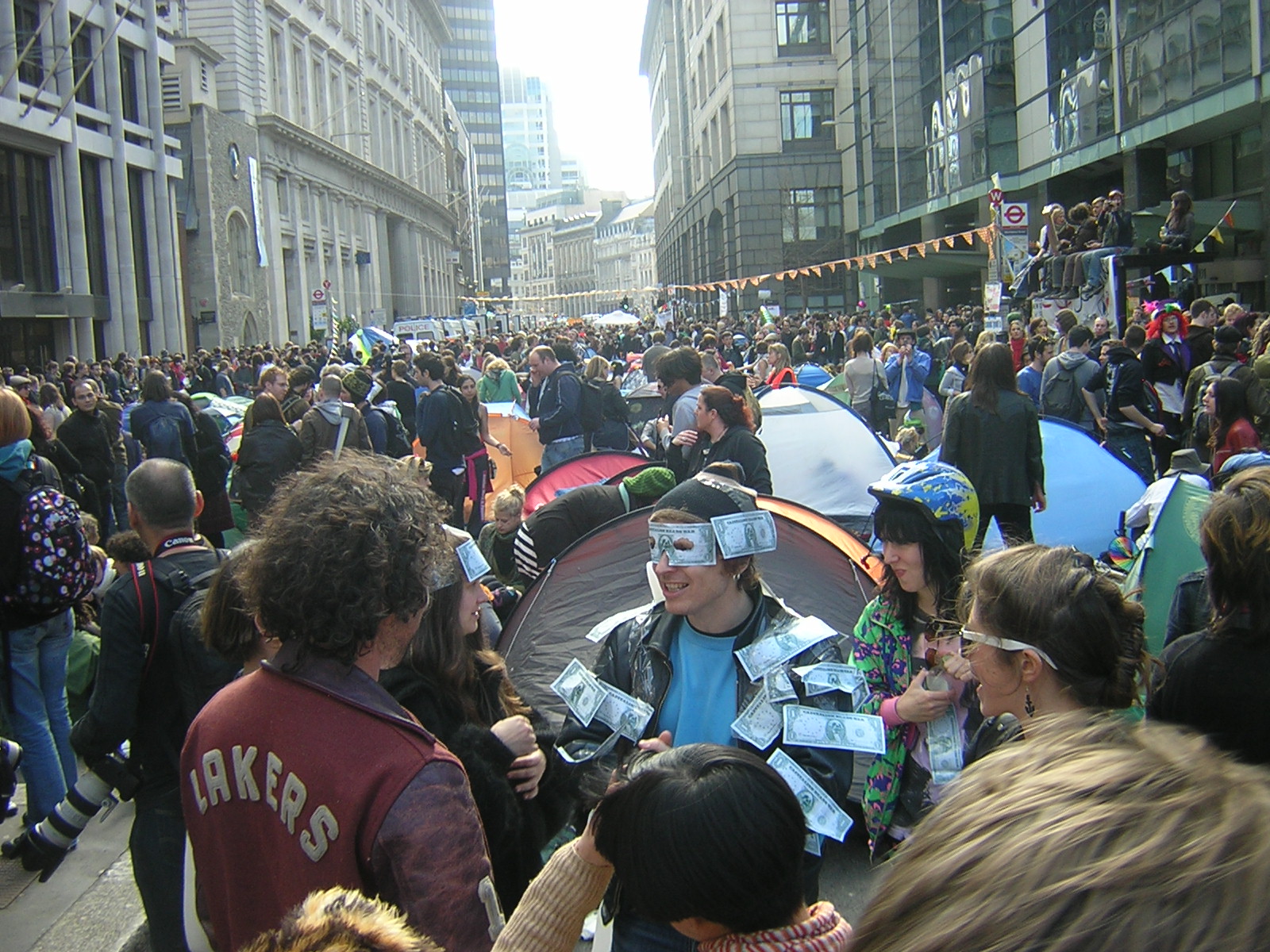
The urban Climate Camp at Bishopsgate by the European Climate Exchange has been reported to have over 2000 people and 150 tents, and has been described as a hugely impressive infrastructure.

Welcome to the Climate Camp in the CityThe urban Climate Camp at Bishopsgate by the European Climate Exchange has been reported to have over 2000 people and 150 tents, and has been described as a hugely impressive infrastructure. There has been numerous theatrical performances, and sound-systems alongside compost toilets, a medical tent, a children’s area, a couple of working kitchens, speakers, banners across the street and numerous workshops. Many people have been picnicking there and the camp has been attracting passers by and city workers. There have been police lines on either side of the camp but people are allowed in and out. There has been dancing near the police lines and the atmosphere has generally been described as very good, with office workers waiving out of windows at the campers.

'Nature doesn't do Bailouts'CC London money-eyes
“Street empty. They beat us out and squashed our tents. But oh what a world we created! Shame on the powers that be.”
– Climate Camp London

Climate Camp in the City has come to a end as police aggressively cleared protesters from Bishopsgate. Several hours earlier campers agreed to move to the North to shore up their defences, but after heavily provocative policing, people began to try and leave.
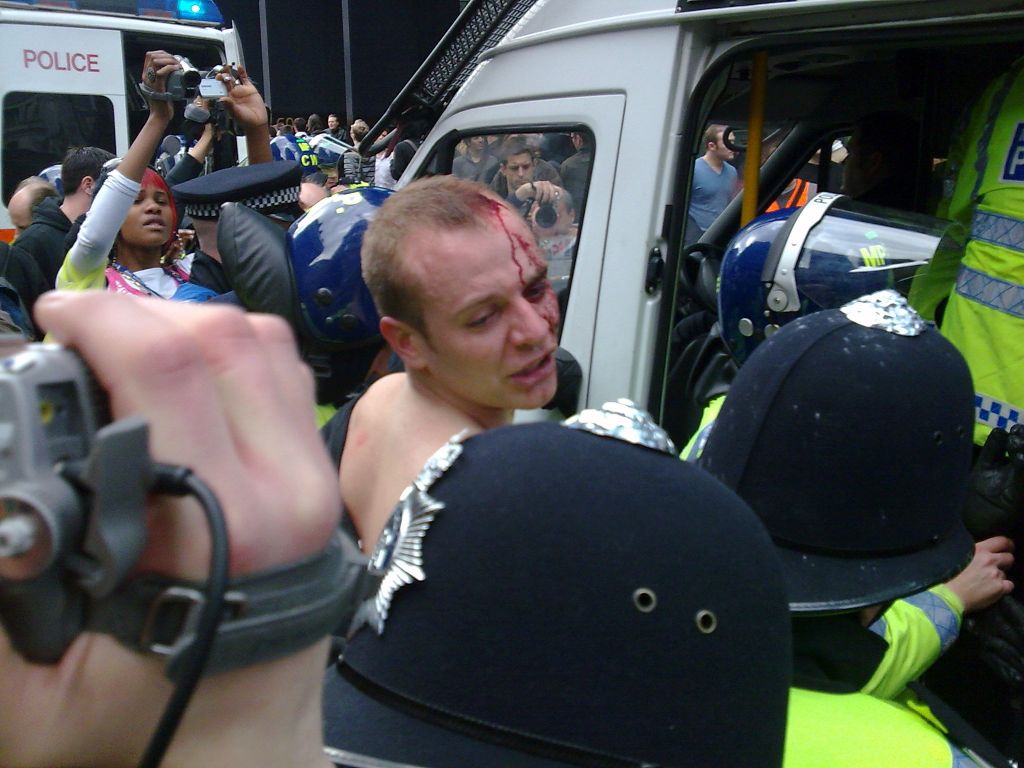
Bloodied & put in vanMany campers head home with light injuries after a long evening of intimidation and violence from the police. At several points they moved in to snatch individuals from the crowd and sent lines of officers into sitting campers, unprovoked. One protester said “the police acted aggressively, goading protesters, but we remained peaceful and the aim remains strong.” By 2am their aggressive tactics succeeded with most of the campers doing their best to escape the cordon. Soon after the camp was broken.
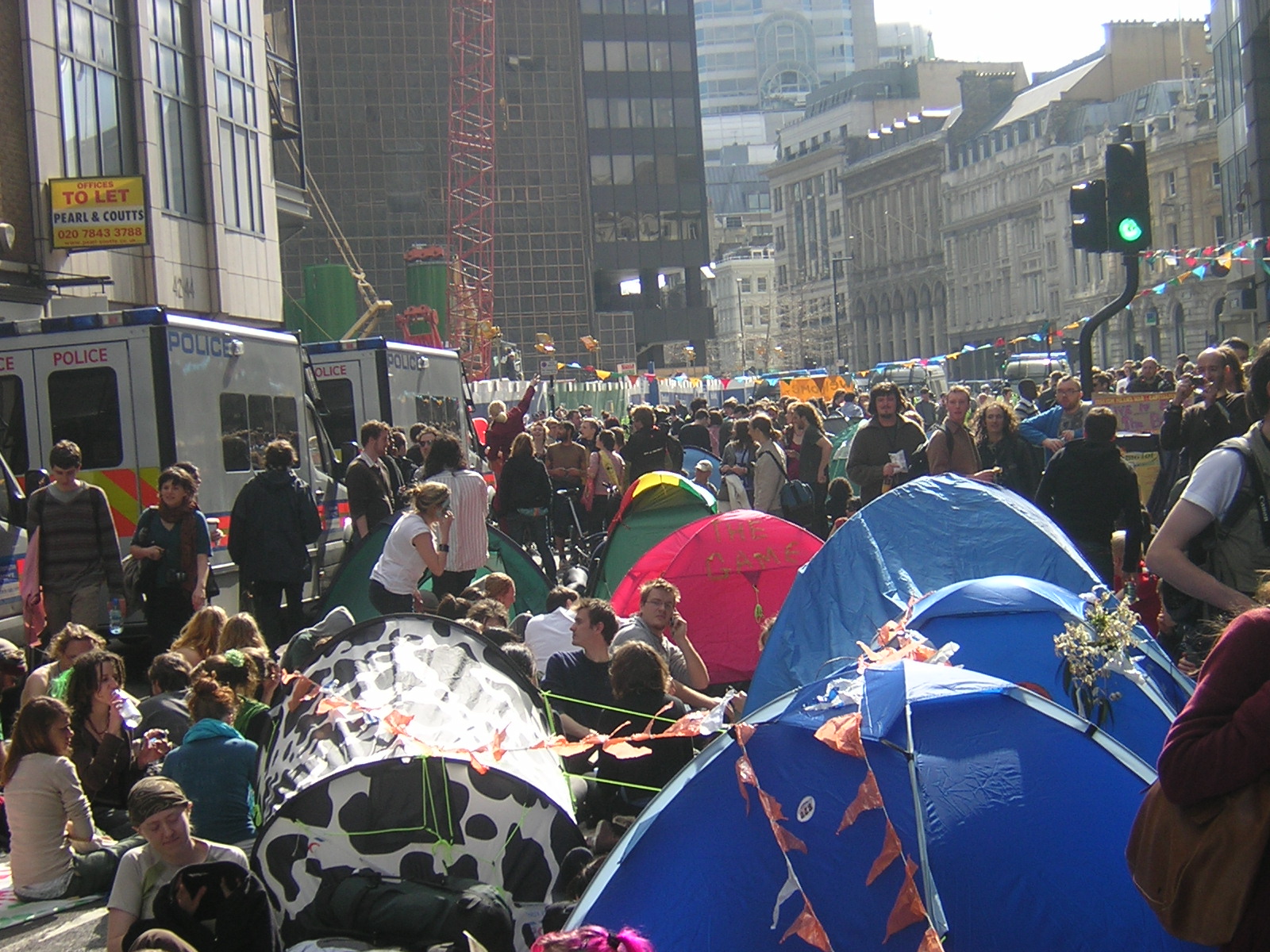
Climate Camp in the City tentsCampers claim a victory having held their ground peacefully for so long, serving food, drink, a variety of workshops to the campers, and above all, creating a positive space for change. We also pay homage to the inventor of the pop-up tent, for making today possible.

Updates:

01:20 Reports that Climate Camp has been evicted by police – people pushed back and beaten, wondering how to retrieve their belongings.

01:10 – Police pulling people out of Climate Camp from southern perimeter.

00:30 – Climate Camp participants have been making speeches to the police about why they have been taking action today.

00:20 – Reports from Climate Camp of police using bolt-cutters to dismantle the bike barricade whilst there is now nothing to stop them coming in from the North.

23:55 – Police are now moving from south to north pushing people out of the space occupied by the climate camp, and it’s clearing out fast. About 500 people are left at this point.

23:28 – Push past Liverpool Street as a group are chased at speed pursued by police dogs and vans. At least one arrest.

23:18 – Letting people out from South side opposite Liverpool St. Lots of police charging, Bottles being thrown from outside camp towards charging cops

22:48 – About 2000 people in Climate Camp Kettle, police want to impose a section 14 and ID everyone. They’re looking to force people out through the North two at a time. There are police massing at the South End, Due to the amount of campers that does currently not seem feasible.

22:15 – riot police have moved into the climate camp crowd at bishopsgate and are violently dragging peaceful sitting protesters to disperse the area

earlier this evening riot police forced their way into the peaceful climate camp. protesters held their hands up and shouted ‘this is not a riot’ over and over, while fully-kitted riot police used shields and batons to push and violently surge forward into the camp along the eastern pavement of bishopsgate. it seems likely this clearance operation had been planned all day – a line of police vans parked along the eastside had created a ‘walkway’ along that pavement which was effectively separated from the camp itself. all the riot police had to do was push their way onto that side, and it is clear that was their strategy. once done, there was a further stand-off for a while before the next stage to start moving protesters out one-by-one.

21:35 – we are current receiving reports from the Climate Camp in the city, that all people are going to be searched to be allowed out, as well as people are told to delete photos of officers from their cameras, under the threat of seizure. Interestingly the joint committee on human rights of the UK parliament has just made a couple of recommendation about policing directly condemning the use of these anti-terror power to police protest. Here are the direct quotes and links.
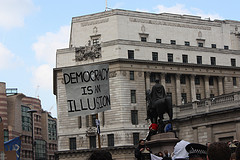
Democracy is an illusionRecommendations of the UK Parliament Joint Committee on Human Rights concerning the use of anti-terror powers for stop-and-search:

“93. Whilst we accept that there may be circumstances where the police reasonably believe, on the basis of intelligence, that a demonstration could be used to mask a terrorist attack or be a target of terrorism, we have heard of no examples of this issue arising in practice. We are concerned by the reports we have received of police using counter-terrorism powers on peaceful protesters. It is not clear to us whether this stems from a deliberate decision by the police to use a legal tool which they now have or if individual officers are exercising their discretion inappropriately. Whatever the reason, this is a matter of concern. We welcome the Minister’s comments that counter-terrorism legislation should not be used to deal with public order or protests. We also welcome the recommendation in the new guidance to human rights being included in community impact assessments. We recommend that the new guidance on the use of the section 44 stop and search power be amended to make clear that counter-terrorism powers should not be used against peaceful protesters. In addition, the guidance should make specific reference to the duty of police to act compatibly with human rights, including, for example, by specifying the human rights engaged by protest.”
http://www.publications.parliament.uk/pa/jt200809/jtselect/jtrights/47/4707.htm

Concerning the impact of the recent legislation about taking photographs of officers in public the joint committee said:

“94. Concerns have recently been expressed in the media that a new provision in the Counter Terrorism Act 2008 makes it a criminal offence to take and publish a photograph of a police officer. Section 76 of the 2008 Act makes it an offence to elicit or attempt to elicit information about an individual who is or has been a constable “which is of a kind likely to be useful to a person committing or preparing an act of terrorism.”[174] As the Explanatory Notes to the Counter Terrorism Bill correctly stated, the new offence will only be committed where the information in question is “such as to raise a reasonable suspicion that it was intended to be used to assist in the preparation or commission of an act of terrorism, and must be of a kind that was likely to provide practical assistant to a person committing or preparing an act of terrorism.”[175] That is the effect of a decision of the Court of Appeal in a case in 2008[176] interpreting the same statutory language in the separate terrorism offence of possessing a document or record containing information of a kind likely to be useful to a person committing or preparing an act of terrorism.[177]”

“95. We therefore do not share the concerns expressed in the media that the new offence criminalises taking photographs of the police. However, we do regard as significant the fact that this is being widely reported as a matter of concern to journalists. Legal uncertainty about the reach of criminal offences can have a chilling effect on the activities of journalists and protesters. We therefore recommend that, to eliminate any scope for doubt about the scope of the new offence in section76 of the Counter Terrorism Act 2008, guidance be issued to the police about the scope of the offence in light of the decision of the Court of Appeal, and specifically addressing concerns about its improper use to prevent photographing or filming police. ”
http://www.publications.parliament.uk/pa/jt200809/jtselect/jtrights/47/4707.htm

20:45 – currently kettled in but they are having a ceilidh/ barn dance so not broken yet! Fuck the po-lice.

18:35 – Riot police baton charge climate camp
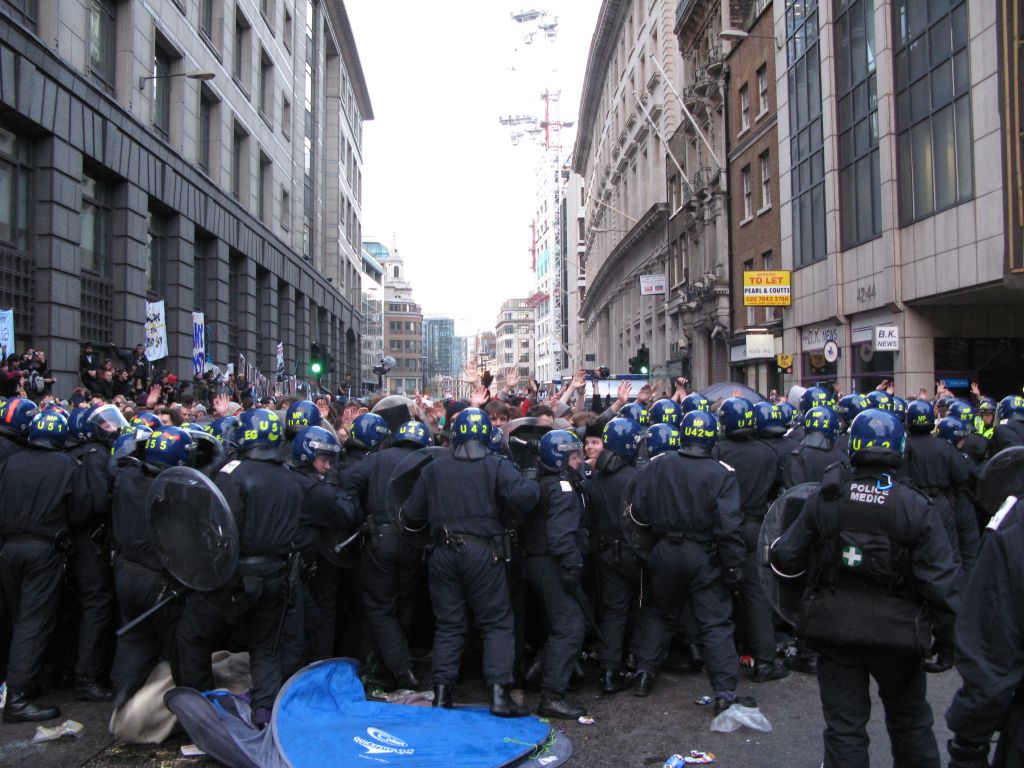
Police clearing climate camp in city
Numerous reports come in stating the riot police are in the process of attacking the peaceful climate camp. Even in the face of severe and unprovoked police brutality the protesters are maintaining their peaceful protest.

Despite events throughout the day at the urban climate camp being entirely peaceful, riot police are mobilising at the camp with 14 riot vans pulling up in addition to the six already present there. While climate campers appealed to the police highlighting the peaceful nature of the protest and the presence of many families with children, the police stormed into into the camp through a gap in the bicycle perimeter of the camp indiscriminately attacking campers with batons, pushing families and children out of tents and destroying sections of the camp. Camomile, Bishopsgate and Womwood st are closed off hemming in the campers. Five police motor bikes pulled up with what looked like surveillance gear. Another report comes in from climate camp stating that the police have formed lines at the Liverpool st end of the camp. a third report comes in from an Indymedia volunteer reporting that he has ‘never seen anything like this’ three lines of helmeted riot police are indiscriminately beating protesters with batons. Protesters are not fighting back and are maintaining the non-violent nature of their action in spite of this there are reported to be at least four arrests. The crowd chants shame on you as the police continue to attack campers.

Full 1st April timeline

Video showing police tactics clearing space.

Camp setting-up video.

Panorama – click through to original for bigger image: Climate Camp in the City panorama

Another personal report: I arrived at about 5pm, at the north end of it. Police were already forming a line alongside the barrier that had been erected made up of railings and bikes attached to them, but they were not blockading and every one was free to visit, come in and out.

There was a festive atmosphere, colourful tents, banners, street decoration…

A man with the slogan “God is too big for religion” on his t-shirt then started to try and make every single riot policeman and woman on the line to smile. “This is an order”, he shouted, “and if they don’t comply, things will only get worse”. He managed to get or steal a smile of every single police officer including a police woman who tried just too hard to keep a stony face.

He then proceeded to try and hug every one “of these very wonderful people” as a sign of his love. To try to get to their hearts, he asked them if they had children: “please raise your hands if you do not have children, or keep your hands down if you do have children”. None of the police moved their arms but he did not succeed to hug every one of the officers. One of them claimed that he was embarrassing them.

I then proceeded to photograph the rest of the camp. A few police vans had somehow made their way into the middle of the climate camp.

At about 6.15pm the south end of the camp started to get “nasty”. Police charged into the peaceful people, bringing tents violently down to the ground, but people managed to peacefully stop the police violence, and a party was established in front of the police lines.

A few police also moved to the middle of the camp, next to the vans, and it looked like they were trying to divide the crowd. But people kept the area occupied and this didn’t happen.

As it got darker, more and more riot police and vans gathered at the south end of the camp, and I heard that a demonstration had formed at the north end of the camp, but that the police were afraid of the growing numbers and were preventing people from getting in or out of the camp. We had been cordoned off without warning.

Three meetings were held in the camp. One at the south end, another at the north end, and another one in the middle, right in front of police. We were informed that the police had decided to keep us penned for two hours, and that after that, they would allow us out in groups of 20, after taking every one’s photograph and details.

Some people considered sleeping the night in the camp, but it was clear from the beginning of the night that police were going to disrupt people’s sleep all through the night, just like it had happened during the climate camp in the summer, last year, with a helicopter flying over our heads firing an intense light over the street and with the vans’ strongest lights also focusing on the campers.

At about 10.00 I tried my luck to get out of the pen by asking permission to leave to one of the police officer. He said, “I can not tell you if you can go out. Ask one of your senior members (eh?) Your legal observers should know more”. A legal observer told me that the police had decided to only allow people out in groups of two after pushing the crowd in a way that I didn’t manage to understand.

It was getting colder and most people present in the camp by then had not brought a camping tent or sleeping bag. Luckily people had brought plenty of food, which was widely shared. Music was heard around the camp most of the time, and at about 10.30 members of Radio Revolucion gave a taste of their music towards the middle of the street. Police officers looked at the scene in astonishment and a security guard inside the building began to video them using his phone, as if he had never in his life seen spontaneous acts of arts happening. After a few songs, random people in the crowd took on the microphone and the instruments and shared their art with a small crowd dancing around them.

At about 22.45 we again heard desperate cries from the south end of the street and there we went, to learn that the police had charged again on the peaceful crowd, using batons and pepper spray, and to see that the people had decided to sit down and hold the site as much as possible.

I joined some people that had shared their food with me before and started to help them putting their tent down. It was pretty clear that the police were going to charge again so we thought better to have the tent and other things on our backs than destroyed. As we were in the process of undoing the tent, the whole of the police line that was at the north end of the camp moved in and we frantically continued to undo the tent as the police approached, with people running ahead of them, crying for help. We decided to stay and continue to gather and pack everything until the police stopped us with their batons.

Strangely, they just passed by. It seemed all they wanted to do was reach the north end of the street and join the cops there.

By then it seemed that there were fewer people than before and we were informed that, although the police had intended to search every one before leaving, they were only doing so randomly. We gathered tent, sleeping bags and food, and headed for the convergence centre unmolested.

At 11.30 the street was still cordoned off and people were not allowed in, but from the outside, it looked like the people who were remained inside the cordon actually wanted to be there; exit seemed to be allowed.


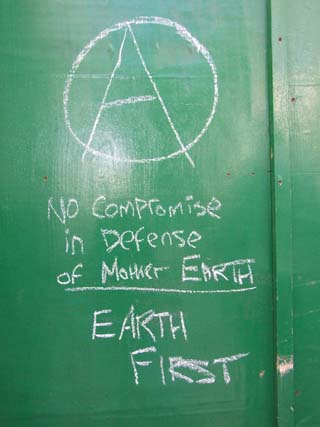
G20 EF! graffiti
Although for the first half hour or so the police seemed content to watch the protest, scuffles started to develop around the edges. Most seemed to be caused by groups of police grabbing masked demonstrators and attempting to unmask them.

——–

Critical Mass

At 9.30 we were still waiting for more people to join in Bank Junction. We started off at about 10am, with a big sound system and lots of people in costumes.

Our first stop was the Royal Bank of Scotland, RBS, next to Bishopsgate. There we were informed that RBS heavily invest in fossil fuels. RBS has recently given a massive loan to EON, the company behind the coal power station in Kingworth, where the last climate camp took place.

Back on Bishopsgate, we went then to the Deutche Bank, where again the sound system person informed us that this bank has been actively involved in “carbon trading”, which means planting trees to “offset” the excessive carbon emissions that companies in the rich part of the world should not be producing if they were complying with their companies’ signed treaties. This tree-planting has been done in lands of indigenous peoples in the poor part of the world that have been how the land that they need for their own food is used for this business without their being able to do anything about it. We were told that carbon trading is now big business, and that it basically consists of selling the air we breath.

From where we were, across the road, was the Carbon Exchange, which, we’re informed, gives us in the Rich West the ability to use more carbon than we have agreed to use in order to try and stop climate chaos. Big companies in developing countries are said to be making money by selling their carbon credits to big companies in rich countries so that they can use more carbon.

We’re told about a company in South Korea that discovered a product in the 70s that is useful to “decarbonate” the air, but for some mysterious reason it has not made this discovery public, nor used the product, until now, so it has been allowing the South Korean population to be unnecessarily polluted for about 40 years. Now that it is selling this product, this company still makes (10 times?) more money selling carbon trade credits than producing and selling this de-contaminating product.
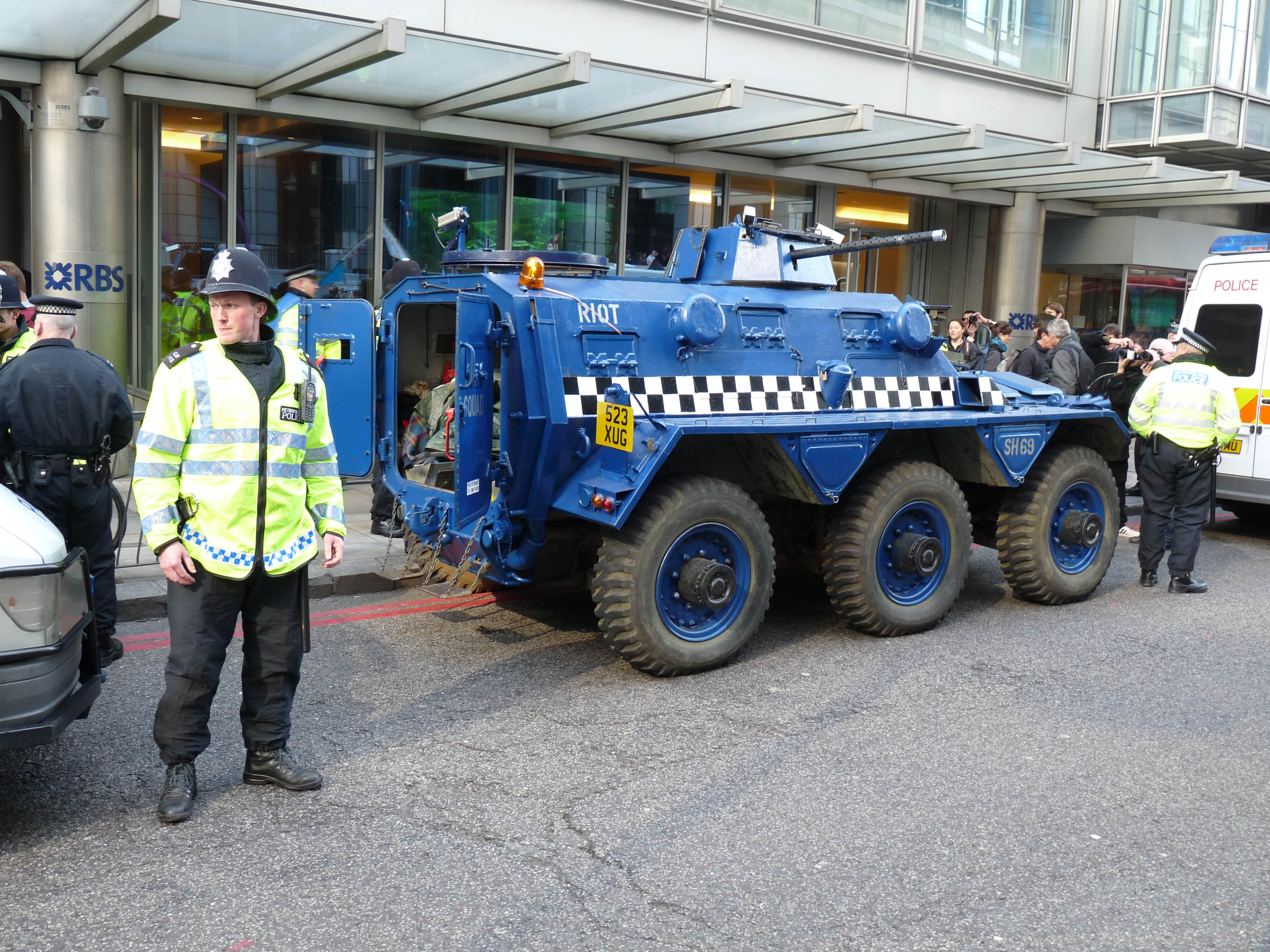
Space Hijackers APC outside & guarding RBSAt this point the Space Hijackers took on the microphone to ask us for support because their tank had been “stopped”, surrounded by police. We went there to show our support but the cops didn’t seem very prepared to allow the tank move peacefully.

At about 10.30 we moved south towards London Bridge. Last stop before crossing the bridge was a spot next to premises of Caterpillar, the company providing home-destroying bulldozers to the Israeli government, and right next to an “Abbey” branch, now property of Grupo Santander, currently in the process of buying most of the Hispanic world and part of the rest, and object of protests and contempt in Spain and Latin America.

From there crossed London Bridge and then Tower Bridge back to the north bank of the river. Next to the tower, we were served with free vegan food reclaimed from the system’s daily waste. There we were joined by the Dancers and then moved on to join the Climate Camp.

In the meantime police had moved on to close all streets that lead to Bank junction to the traffic, and at noon they were preparing to completely cordon off the area, allowing people in but not out, except city workers.
Police separate crowdAt 12.15 people were in Bank Junction already penned in and allowed in but not out. In Princess Street there were to lines of cops, separated by about 100 metres. The “outside” line, away from the crowd penned in, was reinforced with three vans crossed.

At 12.30, Queen Victoria Street, on the west side of Bank Junction, it didn’t look like the police had formed a line, but quickly formed at the shout of one of their offices, then moved away from the pen, still forming a line, and pushing people away from the junction, so the police line came to block the access of people coming both from Poultry Street and Queen Victoria Street. The police were wearing bullet proof vests.

In Mansion House Place, a small alley way approaching the Junction from St. Stephen’s Row in the South, police were also forming two lines separated by a few metres, cordoning off the junction and only allowing families and city workers out.

A single line of vans combined with cops blocked the point where King William Street and Lombard Street meet.

A few minutes later horse mounted police were forming the lines instead of policemen on foot.

——–

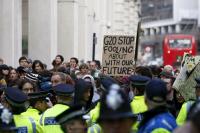
Photos from the G20 Meltdown, and other protests from todayG20 Stop Fooling placard
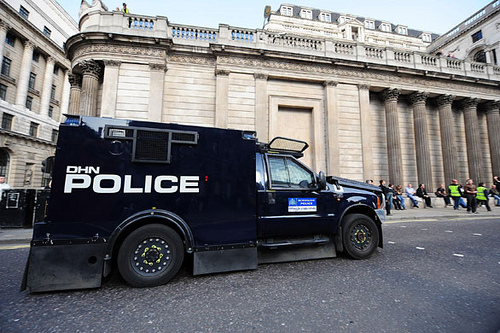
Police armoured vehicle at G20 | Other pictures of police APCs: 2 | 3
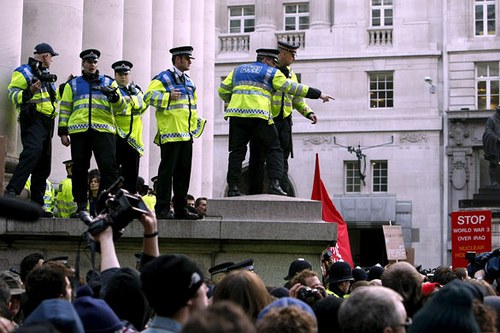
FIT spotting from on high
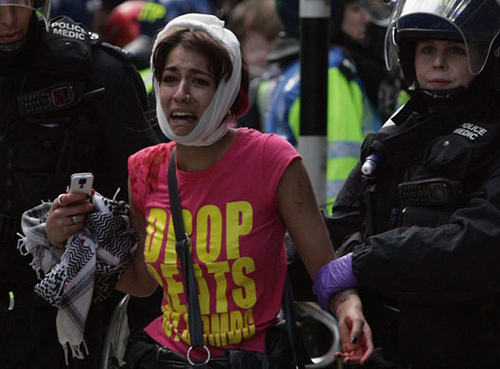
Injured woman at G20
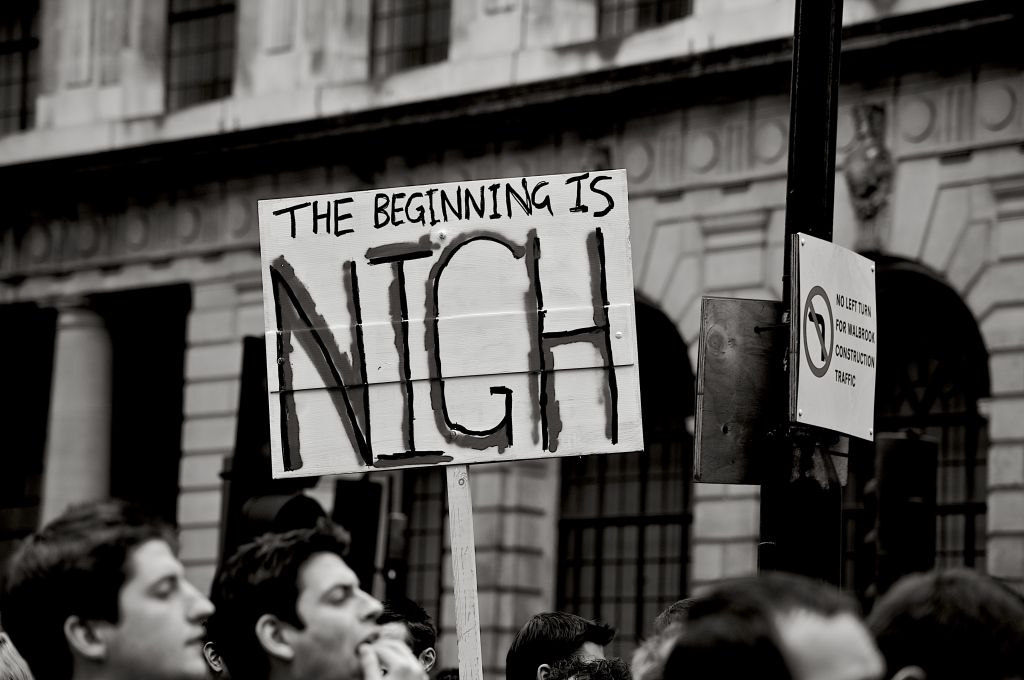
'The Beginning is Nigh' placard
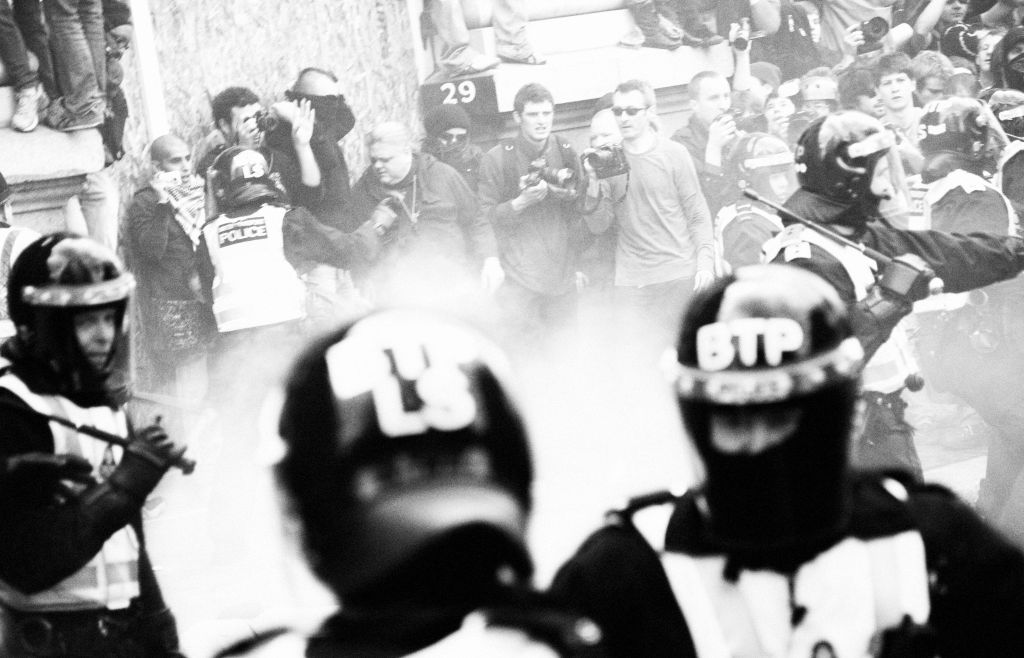
Riot cops at G20
Video of police forced into retreat at G20 Meltdown.

How not to use crowd control barriers when dealing with the police video – also watch police advances & retreats! Tips for how – see the Guide to Public Order Situations.
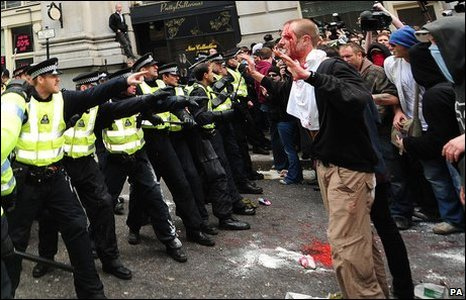
Violent cops at G20
Link to many other video clips.

——–

Activist tank at Royal Bank of Scotland

The activist group Space Hijackers joined with police to take care of any “bad” demonstrators who might have shown up to anti-G20 protests in the City of London today. At 10:30 this morning they showed up with a CCTV-equipped armoured vehicle in front of the Royal Bank of Scotland and prepared to defend the building.

Police spoilsports refused their help, conducted thorough search of the vehicle, and moved them along. They were later arrested outside News International.

——–
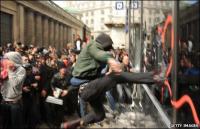
Window-kicking at the G20Despite the media’s apocalyptic predictions, the four horsemen (See SchNEWS 667) did at least make it to the Bank of England. Whether this was a good idea or not is open to question. It certainly brought a measure of mayhem to the financial heart of London, which seemed largely closed down for the duration. Our numbers were impressive – given the short notice and the media hype of extreme violence. But tactics adopted gave the Met free rein to place a huge cordon around the entire demo – the so-called kettle.

As soon as the final Black Horse (ironically the one symbolising land enclosure) arrived, police lines rapidly snapped into place across the streets surrounding the plaza that the bank sits on. Unfortunately – although many did successfully make a break for it – the majority of the crowd, with little idea of what to do (unless they’d read last week’s SchNEWS public order guide obviously) stood around as this manoeuvre was executed. Whilst we know that the protests were organised on very short notice, there seemed to be little aim other than simply getting into the area – there were no bust-cards, and no attempts at crowd co-ordination.

At first most seemed happy to be inside the huge kettle – a few sound-systems were blasting out and there was even a bizarre outburst of contemporary dance in front of the The Royal Exchange. As the hours wore on and the few city types caught in the circle had shown ID and got themselves extracted, it became obvious that if the police had their way no-one was getting out ‘til long after dark. No water, no food, not even a toilet. The reason given? – ‘to prevent a breach of the peace’.

By around half-one the kettle had been truly brought the boil and fighting had broken out along Threadneedle St. A line of police were pushed back by a crowd shouting, “Let us out”. A few bottles were lobbed but even without these the cops were forced to give way to the sheer physical pressure. Alerted by the noise, support streamed over from the other exits to reinforce Threadneedle and push the cops back to the junction with Bartholomew Lane. This left the windows of Royal Bank of Scotland exposed. They were duly smashed, although rioters were outnumbered by photographers by around fifteen to one. However police lines here were too strong to breach.

At around 2.30, the crowd facing a thinner police line across Victoria St suddenly surged forward and by sheer weight of numbers pushed their way through. One of the shovers told SchNEWS, “It was amazing – we were resigned to being in the kettle until midnight but the lines broke right in front of me and confused police were shouting asking each other, ‘What’s the plan?’”. Despite the rapid deployment of riot cops, possibly up to a thousand people escaped at this point. Soon the windows of HSBC on Cheapside had gone in.

SchNEWS has heard reports that others managed to sneak or blag their way out over the next few hours but during the afternoon the noose was gradually tightened with baton charges. Eyewitnesses reported a sense of panic developing inside the pen. People were not allowed out until after 8pm and only then after being photographed.

One man, Ian Tomlinson is known to have died inside the cordon. SchNEWS has heard conflicting reports as to whether he was struck by police. Perhaps a coroners inquiry into his death will expose police tactics to public glare (unless they invoke their handy new powers to keep it all secret of course).

This report and others at http://www.schnews.org.uk/archive/news671.htm

——–
——–

2nd April

Timeline
——–

Bank of England vigil underway for the man who died at yesterday‘s G20 Meltdown protest.
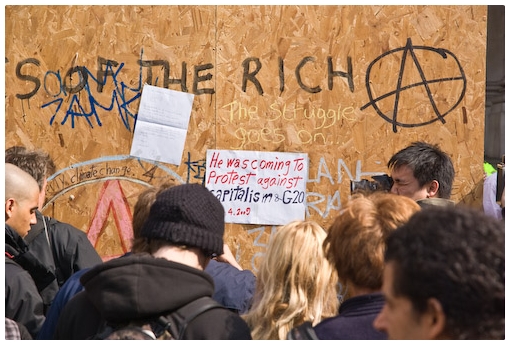
G20 vigil
Around 200 protesters have gathered in the City, on the steps of the Old Exchange by the Bank of England. Their presence represents a spontaneous protest in solidarity for the man who died while kettled at G20 Meltdown yesterday.

No details of the man’s death have been released. All that’s known is he was around 30-years-old and died while kettled with thousands of others outside the Bank of England.

Demonstrators are demanding answers and an independent inquiry into the man’s death. A wall of condolences for the man who died as sprung up. A minute silence was held also.

Police are operating an on off kettle policy. This appears to be a method of encouraging people to leave while they can.

The mood over all is calm. There have been waves of chanting: SHAME SHAME SHAME ON YOU and WHO’S STREETS? OUR STREETS! to the 200-odd police drafted in to “keep the peace.”

While some protesters have left, many others continue to arrive. Some line the pavements outside the Bank of England. Police are now attempting to move these people on.

Interview with two eyewitnesses of the events preceding the death of Ian Tomlinson, the man who died during anti G20 protests in the City of London on the 1st of April.

Witnesses Statement: Death at G20

PRESS RELEASE
FOR IMMEDIATE RELEASE

Various participants in the City of London demonstrations on April 1st have come forward as witnesses to the collapse of a man later identified by authorities as Ian Tomlinson. Four different university students witnessed the collapse of Mr. Tomlinson. “He stumbled towards us from the direction of police and protesters and collapsed,” said Peter Apps. “I saw a demonstrator who was a first aider attend to the person who had collapsed. The man was late 40s, had tattoos on his hands, and was wearing a Millwall shirt.”

While the first aider was helping the man, another demonstrator with a megaphone was calling the police over so that they could help.

Natalie Langford, a student at Queen Mary, said “there was a police charge. A lot of people ran in our direction. The woman giving first aid stood in the path of the crowd.” The running people, seeing a guy on the ground, went around them.

Another demonstrator had already called 999 and was getting medical advice from the ambulance dispatcher. “Four police with two police medics came. They told her [the first aider] to ‘move along’.”, said Peter Apps. “Then they pushed her forcibly away from him. They refused to listen to her [the first aider] when she tried to explain his condition.”

The first aider, who did not wish to be named, said “The police surrounded the collapsed man. I was standing with the person who’d called 999. The ambulance dispatcher wanted to talk to the police, the phone was being held out to them, but the police refused.”

Another witness, Elias Stoakes, added “we didn’t see them [the police] perform CPR.”

Other people who had tried to stay with the collapsed man were also pushed away.

All of the witnesses deny the allegation that many missiles were thrown.

According to Peter Apps, “one bottle was thrown, but it didn’t come close to the police. Nothing was thrown afterwards as other demonstrators told the person to stop. The person who threw the bottle probably didn’t realize that someone was behind the ring of police.” All the witnesses said that the demonstrators were concerned for the well-being of the collapsed man once they realized that there was an injured person.

Natalie Langford said “when the ambulance arrived the protesters got straight out of the way.”

These witnesses are happy to give media statements.

They can be contacted through this press liaison email: g20witnesses@gmail.com

——–

Police Raid at Earl Street G20 Convergence Centre

As people were organising to leave the convergence space at mid-day today police raided. 30-40 people attempted to protect the space by blockading the main doors. We then congregated on the top floor and sat in a circle with our arms in the air to show the police that we were not violent. However, the police met us with a taser gun, full riot gear and proceeded to make us lie face down with our hands on the floor.

We believe two people were arrested, although we are unsure what they have been charged with. One has been taken to hospital following an injury. The rest were searched, handcuffed and had names, DOB, addresses and photos taken.

If anyone has more information please contact legal support urgently: legal@climatecamp.org.uk

Searches/details illegally demanded before raid begins here.
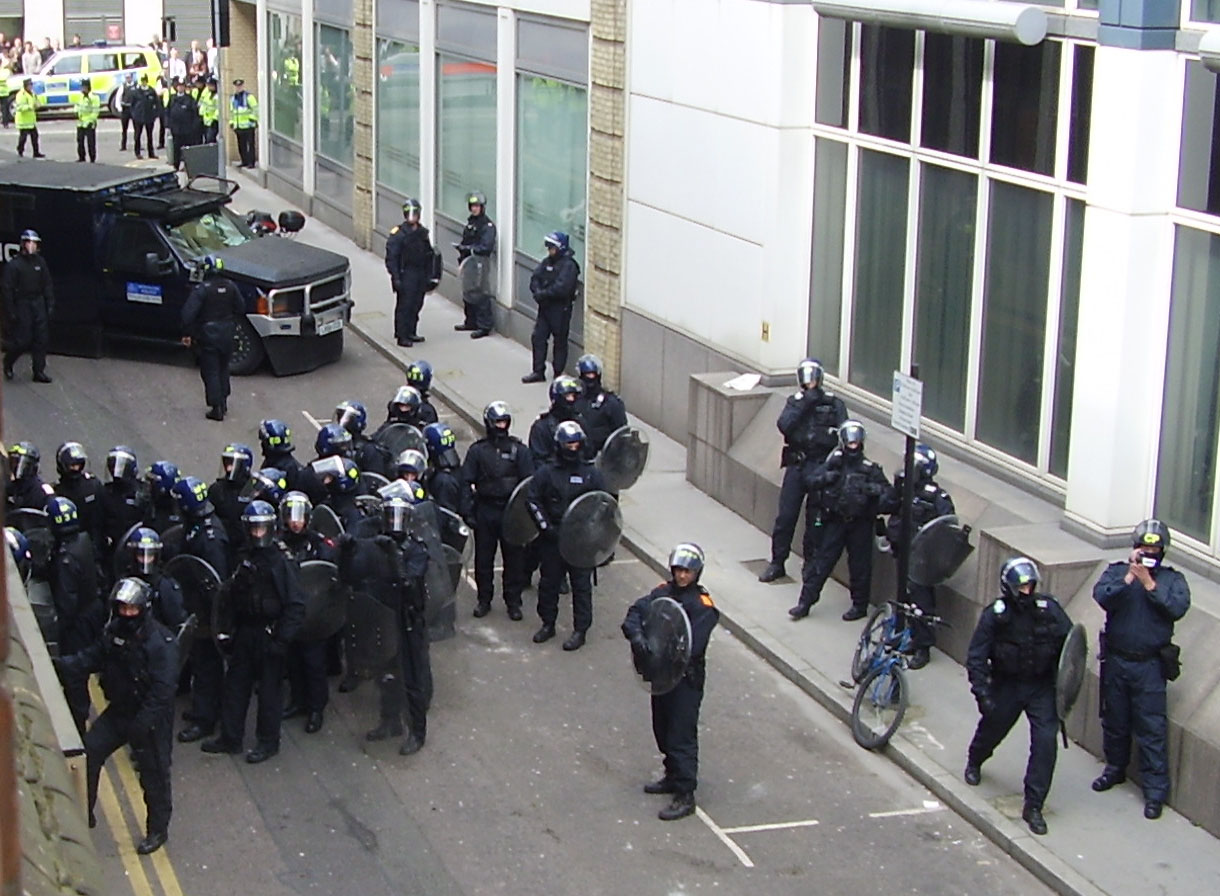
Police massed outside convergence centreConvergence centre eviction full timeline here.
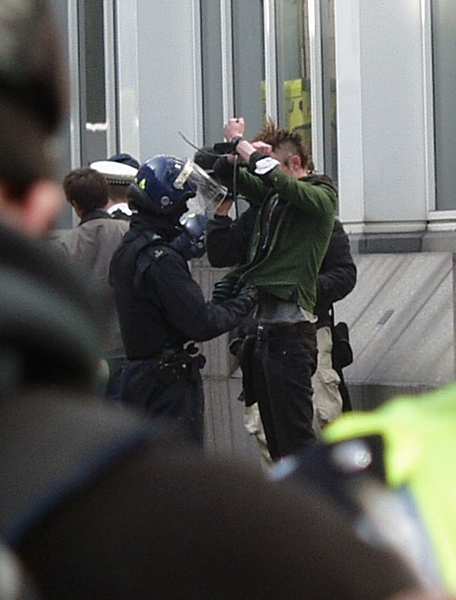
Convgence centre raid search

——

Police attack Rampart Social Centre

At around 12:30 this afternoon, 30-50 police arrived at the Rampart, an activist social centre in Whitechapel, East London. A formerly derelict building which had been empty for years, Rampart was occupied by activists and turned into a social and cultural venue more than four years ago.

When the police arrived, someone went outside to speak to them, asking them if they were going to search the place and telling them that if they had a warrant they could just knock on the door. The police told him not to worry.

A few minutes later riot police in black uniforms, wearing balaclavas came through a downstairs window, the door to the roof and a door to an adjoining building. The police broke down the doors and stormed in with drawn tasers, screaming at everyone to get down on the ground, jumping on them and handcuffing them. They had a TV crew with them when breaking in through the door. They were insulting people and saying things like “one of you croaked last night”, trying to provoke a bad reaction from people.

They then demanded identification from everyone and checked IDs against what appeared to be a list of specific people. There were 2 or 3 arrests. The remaining people were then let go.

Right now it’s calm, however people are a bit shaken after the experience. The cops have left the neighbourhood.

——

Spiderman on bail after G20 Lloyds Climate Demo

Alain Robert, otherwise known as ‘Spiderman’ for his daring free climbs of urban buildings was arrested earlier today for climbing the Lloyds building in London in a G20 climate change protest.

Unfurling a banner that advertised the campaign onehundredmonths.org (which says we have little under 92 months left to prevent catastrophic climate change), he climbed down from the 9th floor and was arrested by police for aggravated trespass.

——–
——–

Other interesting articles from other days:

——

There have been 122 arrests related to the G20, including 86 on Wednesday and 32 on Thursday, police said.

——

Police ask train staff to spy on G20 protesters

——

One-man G20 protest on 28th March 2009

——

Spoof Financial Times hits London streets

10000 copies of a spoof Financial Times were distributed in London today.

“Set in 2020, the 12-page paper revealed how action in 2009 reined in climate change, saving billions from extinction. Carbon rationing didn’t kill us, it explained, despite the inconvenience to multinational companies. But we couldn’t have endless growth with finite resources. Editors even apologised for suggesting otherwise.”

The paper is a full-colour replica of the iconic pink broadsheet including national and international pages and editorials and comment, poking fun at FT columnists. It was funded by donations on the Internet, and given away for free by volunteers. Tens of thousands of copies were printed – almost as many as the FT sells here daily.

http://ft2020.com

Download as a PDF file

——

International SolidarityAotearoa/New Zealand | Finland