
 26 June 2013
Fracking Equipment Set Ablaze in Elsipogtog!
26 June 2013
Halifax Media Co-op reports that a piece of drilling equipment was set ablaze on the 24th, by person or persons unknown. This comes amidst escalating resistance to hydraulic fracturing by indigenous peoples in Elsipogtog, “New Brunswick”.
This comes after numerous direct actions, the midnight seizure of drilling equipment, and a local man being struck by a contractor’s vehicle.
Farmers Unite With Hydro-Fracking Activists

By Adam McGibbon, www.newint.org
By Adam McGibbon, www.newint.org
As the G8 Summit began in Fermanagh, Northern Ireland, a group of farmers drove 60 tractors in a ‘go-slow’, bringing a 24-kilometre stretch of road to a halt. The 16 June action opposed hydraulic fracturing – fracking – which could take place on both sides of the Irish border. It was followed by statements against fracking from the major farmers’ unions in the Republic of Ireland and in Northern Ireland.
This is a significant development in the fight against fracking in Ireland and Northern Ireland, where at least four energy companies are seeking to rend the landscape apart drilling for gas in the very area that the G8 took place. Although there is a temporary freeze on drilling in the Republic, Canadian company Tamboran Resources already have a license to start exploring for shale gas in Northern Ireland due to commence this year.
For over two years, the battle against fracking in Ireland has mostly been the preserve of the seasoned activist. But impressive organizing efforts in Fermanagh over the past few years have mobilized communities as campaign groups harangue elected representatives.
Assembly members speaking against fracking are treated like cranks by ministers. Despite the scientifically proven environmental devastation, the rubbished claims of hundreds of ‘fracking jobs’, and the fact that fracking will make the climate crisis worse, the slippery slope towards fracking in Ireland has continued.
But now, the endorsement of the official organizations of the farmers lobby could turn this opposition into a mass movement. Given their ambivalence on the issue not so long ago, this is refreshing news. After the ‘go-slow’ action, Pat Gilhooley from the Irish Farmers Association said fracking will be an election issue in the Republic’s local authority elections in 2014. John Sheridan from the Ulster Farmers’ Union stated that the risk to the farming industry from fracking was too great. ‘We Deserve Better,’ runs the monicker of a new, cross-border campaign, launched this month.
With the addition of the farming lobby, it’s hard to imagine how the conservative Unionist parties in the Northern Ireland Assembly, both heavily dependent on rural votes, can maintain their support or ambivalence for fracking forever. The North’s Minister for Enterprise, Arlene Foster, is aggressively pro-fracking. Two years ago, allegations of impropriety emerged when it turned out Foster’s husband owns 62 hectares of land within the gas exploration zone. With Foster holding a rural seat, the addition of the organized farm lobby that could break the back of the corporations and politicians that want fracking to take place in Ireland.
There are definitely lessons to be learnt here for other activists battling fracking across the world. Fracking isn’t just an environmental issue – it’s a livestock issue. It’s a food issue. It’s a livelihood issue for those who toil to provide us with food. The Left needs to make common cause with rural communities on fracking; the myth that they are more conservative than urban areas needs to be shattered.
To win on fracking, links have to be made beyond the ‘usual suspects’ of activist groups. Internationally, there are great examples: In Australia, a group called Lock The Gate are succeeding in uniting environmentalists, activists and farmers. In Germany, the unlikely allies have been found in the beer industry, which fears for the future of their products. In France, where fracking is currently banned, farmers stand with activists gathering on their fields and hang protest banners from hay bales to campaign to keep the ban in place.
Across the world, building the broadest coalition possible to defeat fracking means getting out of the activist comfort zone and working with people we wouldn’t usually work with – and people we might not agree with on many issues. Farmers, environmentalists, activists, conservationists must unite and fight.
Hamilton Police direct Mass Arrest at Enbridge Blockade
JUNE 26, 2013
BREAKING NEWS: 20 PROTESTERS ARRESTED AT TAR SANDS BLOCKADE, INCLUDING THOSE OUTSIDE INJUNCTION ZONE
JUNE 26, 2013
BREAKING NEWS: 20 PROTESTERS ARRESTED AT TAR SANDS BLOCKADE, INCLUDING THOSE OUTSIDE INJUNCTION ZONE
(Hamilton, ON) — Hamilton Police moved on to the #SwampLine9 protest action in Ontario this morning mass arresting almost everyone on site including activists further up the street and the police liaison.
Activists have been occupying an Enbridge pumping station north of Hamilton, Ontario early Thursday morning. This action, dubbed Swamp Line 9, aims to prevent construction on Line 9 and block the transport of Tar Sands through Ontario and Quebec. This action is also part of the Idle No More campaign Sovereignty Summer.
News is developing. Much of the photographic evidence was seized but some video footage will be coming soon.
QUOTES:
“This pipeline puts the health of drinking water of millions of people at risk of an oil spill yet Enbridge used the courts and police to arrest 20 people who wanted to protect their lives and our future.
This was a political action. We demand the immediate release of those arrested and insist that their charges be dropped.
The police went above and beyond the limits of the court order by arresting people off the property – people who were on the side walk, and even the police liaison who was on the street. This heavy-handed tactic comes at the heels of Hamilton police receiving over $44,000 from Enbridge recently.
Destructive Enbridge projects across Ontario, and Tar Sands projects across the country will continue to be resisted.”
BACKGROUND
Press Statement on Injunction, June 25: http://swampline9.tumblr.com/post/53851715699/swamp-line-9-press-conference-statement
Media Advisory on Injunction: http://swampline9.tumblr.com/post/53838872671/swamp-line-9-locks-down-and-rallies-after-receiving
Solidarity Action in Support of Line 9: https://www.facebook.com/notes/swamp-line-9/update-swampline9-continues-support-actions-in-13-cities-sovsummer/191416174354528
UPDATES
Swamp Line 9 Update

26 June 2013 Twenty people were arrested this morning Hamilton cops tried to arrest everyone on the site except a few who were able to leave.
26 June 2013 Twenty people were arrested this morning Hamilton cops tried to arrest everyone on the site except a few who were able to leave.
SwampLine9 is still holding strong. Four people are on lock down while most of the camp is still on site despite the injunction deadline expiring at 10am this morning. Enbridge was unable to even get the address right of the reversal site on the injunction and is now scrambling to correct its mistake.
You can see more photos of the action here: http://on.fb.me/17AZ4bQ
Solidarity actions took place across Canada including one of Toronto’s busiest streets shut down for nearly an hour as over 50 SwampLine supporters orchestrated a mock oil spill and flyered vehicles.
Photos from Cross-Canada Day of Action: http://on.fb.me/121U7AT
Swamp Line 9 Statement 25th June 3:30pm
7 Hours ago we were served an injunction that gave us 2 hours to leave the property. We kept our shit together, and are working together to keep this thing going. While some people packed up the camp and shuttled stuff to the top of the driveway, others built an elaborate barricade at the back and put themselves in an encasement. 3 people are inside of the encasement and are locked to the fence which leads into the construction site. 1 other person is sitting on top of the barricade and holding tight. About 20 of us are camped out in the middle of the driveway where it meets Concession 6, and are going to keep negotiations up to hold this space as best as we can.
Despite earlier reports, police are not blocking access to this site. We are asking for as many people as possible to come and join our action as it continues to shift and respond to this situation. If a situation arrises where we can no longer safely hold down this driveway, we will move our action to the other side of the street and continue to show support with the people locked down.
Our camping days may be over, but for now this struggle lives on. Those 4 bad-asses at the back of the site have built an impressive and solid barricade, and we don’t expect the police or Enbridge will be able to remove them from the site anytime soon.
Now that things have settled down a little bit we will be posting regular updates, so stay tuned to our tumblr site and follow us on twitter @Swampline9.
Swamp on,
-SL9
Background on Line 9
Line 9: The Tar Sands Come to Ontario from Rachel Deutsch on Vimeo.
Line 9 was built in 1975 to transport imported oil from Montreal to refineries in Sarnia. Enbridge has now applied to Canada's National Energy Board to reverse its direction of flow so that it can transport oil from Sarnia to Montreal.
Enbridge admits that among the possible uses of Line 9 is transporting "heavy oil" a category that includes bitumen, the hazardous raw material extracted from tar sands.
The pipeline passes through cities, watersheds, rivers, and farmland. 9.1 million people live within 50 km of line 9, including 18 first nations communities and 115 communities in total. (Sarnia, Hamilton, North York, Kingston, etc.)
Enbridge has a very poor record of environmental impact. Between 1999 and 2008, Enbridge lists 610 spills that released approximately 21 million litres of hydrocarbons into the surrounding area. But Enbridge is most well-known for their 3.8 million litre spill in Kalamazoo Michigan in 2010, amounting to the largest inland oil spill in US history. Because the spill involved the very hard to clean tar sands bitumen rather than conventional crude oil, the clean-up is still on-going. Meanwhile to this day, residents are still sick from the aftermath of the spill, and tragically many have died since. Most troubling for Ontario residents is that the pipeline that ruptured in Kalamazoo is almost identical to Line 9: it is part of the same pipeline network, uses the same interior lining, and is almost the same age.
With so much at risk, we need to work together to stop Enbridge Line 9. The big picture is spills, contamination, and expanding the tar sands. The even bigger picture is climate change. If it is not halted, climate change will and is resulting in increased frequency and severity of storms, floods, drought, and water shortage, as well as the spread of disease, increased hunger, displacement and mass migrations of people and ensuing social conflict and war.
8 years of intense struggle against Shell continues this week in Erris
25 June 2013 The first direct actions of the Erris struggle against Shell took place 8 years ago when 6 locals were injuncted and then 5 of them jailed for refusing to allow Shell onto their lands. In the 8 years that have passed there have been countless direct actions, dozens of arrests, about two dozen jailings and hundreds of people attacked by Garda or Shell's security company IR
25 June 2013 The first direct actions of the Erris struggle against Shell took place 8 years ago when 6 locals were injuncted and then 5 of them jailed for refusing to allow Shell onto their lands. In the 8 years that have passed there have been countless direct actions, dozens of arrests, about two dozen jailings and hundreds of people attacked by Garda or Shell's security company IRMS. But as the first two days of the week of action demonstrated that intense level of repression over so many years has yet to end effective resistance.
The cost to the local community has however been enormous. Some people who would otherwise never have had an encounter with the law have spent at least time in jail. Others have been beaten up by the Garda, some left with permanent injuries. And everyone has to endure the constant surveillance of everyone who passes Shell's compounds which are now scatted across the area. At key moments they have also had to live in communities that were under occupation as hundreds of Garda have been deployed along with the gun boats of the Irish navy. Alongside this are the even darker experiences of campaigners being attacked in the night, in one case having a fishing boat sunk under them and the all too common stories of people who realised their homes and family were being spied on by unidentified men.
Despite this there were a constant stream of people from the local community visiting the camp and the social activities arranged over the weekend along with a few who, 8 years on, are still determined to take part in and indeed lead direct actions against, around and within the compound. At this stage in the long struggle its true that a much larger burden of organising and risking beatings and arrest in such actions has fallen on the shoulders of those travelling to Erris to stand alongside the local communities. Very few ordinary people could sustain the level of resistance of 2005 – 2007 over the years that followed, indeed the Rossport Solidarity Camp itself has seen a complete change in personnel at least twice now.
These changes have meant that the focus and methods of the campaign have shifted in emphasis over time. Initially the dangers of Shell's plan to run an experimental high pressure gas pipeline through the gardens of peoples house, literally under their driveways, was the key focus for many with massive mobilisations of virtually the entire local community. As the media ran a highly successful smear campaign against the community the issue of the huge giveaway of Irish Oil and Gas became central. A huge campaign to inform the public of the robbery that was going on under their noses was conducted, over 120,000 copies of a 4 page booklet on the giveaway were distributed and an intense media campaign conducted. The led to many people across the island realising that the struggles of a small community far away in Mayo was also their struggle because every cent of profit Shell would take would be a cent less funding for education and heathcare.
The campaign built links with similar struggles elsewhere and this meant that over time people also started to come to Erris from outside Ireland to stand in solidarity with the community. This pushed the global question of fossil fuel usage within the campaign and led to quite a few discussions as a balance was sought between fighting for real taxation on what was extracted and saying that our use of fossil fuels was a collective insanity that was leading the planet to environmental catastrophe. In terms of tactics we also saw a shift from the mass blockades involving hundreds of local people and their supporters to more specialised small group actions around lock ins and using tripods allowing small groups of people block roads for a long period of time. That shift was in part determined by the use of violence by the Garda to clear roads under their 'no arrest' policy, a violence that was nearly always reported by a compliant media as if it had originated with the campaign. You can just about get away with this when video footage shows lines of Garda batoning people standing on the road but it doesn't really look very convincing when people are sitting on the road with their arms trapped in steel pipes or dangling in mid air high above the roads surface.
All these strategies have forced the Irish state to back down on simply forcing Shell's original pipeline plan through and instead insist on significant changes in the safety of the project. Between such changes and the huge delays caused by the countless direct actions Shell's costs have soared from the initial estimate of 600 million to well over 3 billion. Top Shell personnel in Ireland have regularly been replaced as each in turn has failed to push through the project on time, the current estimated completion date is about a decade after the one intended. The government has been forced to introduce changes in the amount future energy finds will be taxed.
None of these changes fix the problems with the project,
- the experimental pipeline is still too close to people's houses and running through an area that suffers huge landslides,
- the tax take on the project is still low and because of the way Shell is allowed write off expense it is probable that not a cent in tax will ever be collected,
- the location of the refinery threatens both the water supply of the area and the pristine environmental conditions that make it attractive to tourists and a sought after source for fish and shell fish,
- the countless abuses of human rights that have forced the project this far will never be erased from the lives and minds of those who were jailed, beaten or spied upon.
But none of this should stop us acknowledging the huge defeats that resistance has inflicted on Shell and the significant if incomplete gains that have been won.
This is the context of the current week of action which is happening in what Shell must hope is the final phase of their construction project. The refinery is complete and most of the pipeline laid. They got the Tunnel Boring Machine into the compound and it's now at work under the estuary. Although their are constant rumours of problems being encountered and the sudden appearance of deep and life threatening sinkholes on the surface must indicate unintended subsidence into and around the tunnel beneath.
Shell and the Irish state though their intensive repression of the local community over 8 years must have hoped that active resistance was almost over. That the prolonged period of jailing and brutalisation they had subjected people to had sapped their will to continue to resist as they needed to get on with the normal routines of working and bringing up families that people elsewhere in Ireland can take for granted. So the fury of the assaults on the compound over the last couple of days must have been a major disappointment for them, the quantity of damage the direct actions resulted in is probably comparable to that inflicted at the height of any earlier point in the campaign. Not only was several days work destroyed but many of the compounds spy cameras were wrecked and equipment essential to doing that work again put out of action. It must also have become clear that the fortifications erected for this stage of the project are inadequate when faced with a few dozen determined people and that they cannot that those numbers cannot be mobilised.
In a better world this struggle would have been won in 2005 when the determined mobilisations of the community should have resulted in the national outcry that would have driven Shell to Sea (the off shore refinery option which now would have saved Shell both time and money). Or it should have been won in 2007 when thousands of people from all over the country mobilised to block the roads and face the baton charges of the Garda. But, with no small thanks to a media that was in one part cowardly to two parts being in the pockets of energy corporations, that outcry never emerged. The state risked and got away with brutalising protesters and engaging a long term strategy of trying to sow divisions in the community on the one hand and intimidating, beating and jailing those who continued to resist on the other.
What maintained the struggle at an intense level was solidarity. The solidarity of those who travelled from all over Ireland to stand with the community. And the solidarity of those who came from further afield, in particular the UK. This is not a trivial thing, people from far away have spent formative years of their lives in this small corner of north west Mayo fighting for people and a place with whom there only initial connection was a shared sense of resistance and a struggle for environmental justice. There have been different phases in the struggle, some of these phases have probably ended but the struggle against Shell in Erris and what the energy corporations are doing to this planet goes on.
Rossport has become a byword for determined resistance across Europe and beyond. Books have been written, films made, babies born and we have had the sadness of friends and comrades in the struggle dying. Thousands, perhaps tens of thousands have visited the area and stood alongside the community. Many brought lessons from elsewhere to this resistance and many have returned with lessons from this resistance to other struggles. In that sense the struggle has become much more than the individual issues it is composed of, it has become a significant part of the new world the people across the globe are building in their hearts. In that sense it is a struggle that will never end but will be remembered and carried forward long after the refinery is dismantled and the pipes have rusted in the ground.
Primate Products Inc. Facility Closes Down after Smash HLS Campaign

Gary Serignese, Executive Director of South Florida Smash HLS, leads a demonstration outside Primate Products, Inc
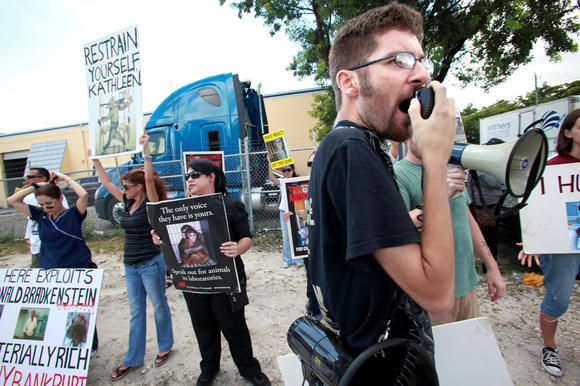
Gary Serignese, Executive Director of South Florida Smash HLS, leads a demonstration outside Primate Products, Inc. in Doral, near Miami International Airport. (CRISTOBAL HERRERA / Sun Sentinel SoFlaShare / September 22, 2011)
A South Florida holding center for imported research monkeys [sic] that had been the target of animal rights protests has shut down, with the company moving its operations to a remote location north of the Everglades.
Primate Products Inc. has closed a fenced, cage-filled building near Miami International Airport that had been the focus of an animal rights campaign involving picketing, demonstrations against participating airlines and smuggled photos of bloody monkeys. The company has laid off 10 employees and moved its remaining operations to a complex near the Collier County town of Immokalee.
Dr. Thomas Rowell, a veterinarian who is the company’s president, said the closure represented a long-planned consolidation that had nothing to do with the demonstrations. He said Primate Products had obtained federal permission to quarantine monkeys at its other facility and planned to reduce its import and sales business in favor of service and support.
Gary Serignese, of Boca Raton, executive director of the animal rights group South Florida Smash HLS, said he doubted this explanation.
“We know that they would not have made this change without our aggressive protest campaign,” he said. “An import company would not abandon a facility close to the international airport unless it felt it had no choice.”
During the campaign, activists held demonstrations at the Pembroke Pines home of the company’s previous president. Using email, phone calls and picketing, they pressured local freight airlines into refusing to carry primates. They obtained photos of injured monkeys from inside the facility and provided them to the news media.
In arguing for the company to close, they said the monkeys were headed for lives of boredom, pain and fear, with dubious benefit to human health. Primate Products has said its work provides essential research subjects to scientists, who are the best judges of their biomedical value.
“We are here to assure you and others that PPI is committed to our mission to serve the biomedical research community and to provide products and services specifically designed to enhance the conservation, care, and use of nonhuman primates for advancing public health,” Rowell wrote in an email.
Elsipogtog Blockade Halts Seismic Testing

25 June 2013 Community Member Hit by Car, Sovereignty Summer Campaign Calling for National Solidarity Actions
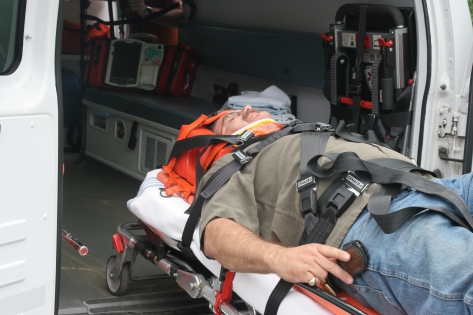
25 June 2013 Community Member Hit by Car, Sovereignty Summer Campaign Calling for National Solidarity Actions
By Sunday, June 23rd, SWN Resource Canada’s highly contested and protested seismic testing along highway 126, in Kent County, New Brunswick, had almost wrapped up.
But the seismic test along the highway is only one of several planned testing lines, and the company’s attempts to begin another line of seismic testing – this time along the back roads of Kent County – was yesterday halted in its tracks by community members living in the vicinity of Browns Yard.
SWN’s seismic testing of the back roads areas of Kent County – conducted with All-Terrain Vehicles known as ‘Bombadiers’, and dynamite charges – is slated to be extensive, with approximately 150kms of testing expected to take place.
Yesterday’s resistance, conducted firstly by local families and the action group known as ‘Upriver Environment Watch’, suggest that SWN’s task in the woods of New Brunswick, where there is local knowledge, deep forests and intense opposition to the testing, will be a tough slog indeed.
At about 2pm, an SWN-contracted truck with a trailer parked itself along highway 490. The truck was abandoned by the SWN-contracted workers, but it was an announcement of their presence to the vigilant community.
A small group of local familities – about 15 people in all, including young children – then gathered. A Bombadier, two geophones, a surveyor’s tripod and a SWN antenna, were spotted. Whoever had positioned the equipment had done so on a private piece of land adjacent to the dirt highway.
The driver of the Bombadier approached the surveying equipment, potentially to recover it from the gathering crowd, only to be chased away from the equipment by the crowd. The driver sped south along a dirt road and did not return to the scene.
An SWN-contracted security truck appeared on the scene about ten minutes later. The driver of the truck did not speak to the gathered crowd, but as he was driving away he struck local resident Dave Morang hard enough with his driver’s side mirror to bend the mirror backwards. The driver did not stop.
Morang, injured, requested that an ambulance needed to be called. An Emergency Response team later took Morang to hospital on a spinal board and a stretcher. His condition is currently unknown.
“I can’t believe they didn’t stop,” Morang told the Halifax Media Co-op before the ambulance arrived. “They hit me hard enough with his mirror that it bent it. He would have known that. How many laws can they break?”
About 20 minutes later, RCMP appeared in force, with 26 officers and 14 cars and paddy wagons stationing themselves along the dirt road. The call through social media, however, had beaten them to the punch, and by the time they arrived the gathered crowd had swelled to about 100 non-Indigenous and Indigenous people.
RCMP consulted for about twenty more minutes, before apparently deciding that the best course of action would be to pick up SWN’s antenna and geophones. Photographs indicate that SWN’s equipment appears to have been somehow bent and otherwise broken.
With nothing left to do, and with a gathered crowd which now included Chief Aaren Sock of Elsipogtog First Nation, the police packed up and retreated down the dirt road from which they had appeared.
Chief Sock, whose band council late Saturday night issued a Band Council Resolution inviting United Nations Observers to Elsipogtog, was not impressed with SWN’s unwanted incursions into Kent County, or the arrests of his people while in ceremony.
“Message for SWN: You’re not welcome in my territory,” Sock told the Halifax Media Co-op. “Nothing personal.”
After the RCMP departed with SWN’s equipment, those gathered continued to cheer and drum. They then began to slowly trickle back to their respective communities.
It was later discovered that SWN’s abandoned truck – the original sign of their presence – had had its windows smashed, doors dented and bumpers knocked off. As of press time, it is not known how this damage might have happened.
A packed community hall meeting in Elsipogtog, open to the general public, took place later in the evening. The topic of the meeting was not only how to stop SWN, but how to get shale gas out of New Brunswick, and all of the Maritimes. With UN observers now in place, representatives from various Warrior societies from across the Maritimes have been welcomed to Elsipogtog. They were greeted at the meeting with a standing ovation.
Local man Dave Morang was injured by an SWN-contracted security truck, who failed to stop after hitting him. [Photo: Miles Howe]
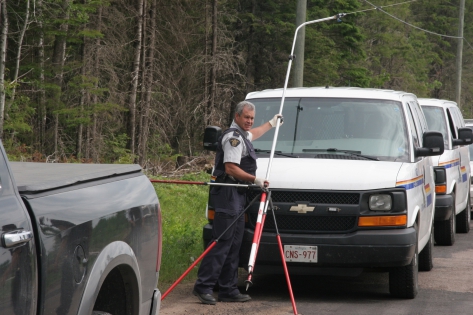
Police removing SWN equipment, which seems to have been bent somehow.[Photo: Miles Howe]
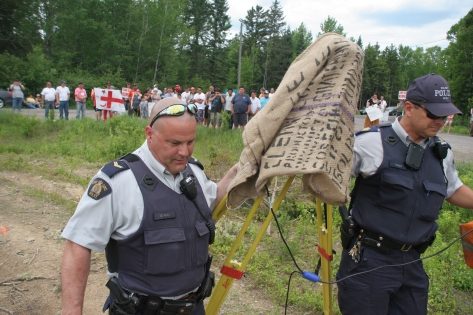
RCMP moving SWN equipment. [Photo: Miles Howe]
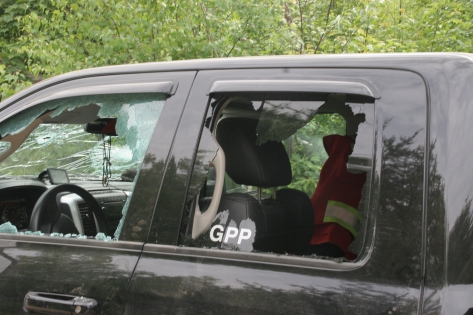
Not sure how this happened. SWN-contracted truck gets trashed. Last seen being towed away.[Photo: Miles Howe]
——————————
Cross Posted from Idle No More
This is an official notice and “Call Out” to all Idle No More & Defenders of the Land – Sovereignty Summer – activists, allies and supporters, and partnership organizations to act in aid and in the defence of grassroots Elsipogtog First Nation, families, community members, and supporters near Moncton, New Brunswick.
In the last few weeks, Elsipogtog First Nation community members and allies have taken peaceful action to prevent seismic testing vehicles and workers from testing for shale gas deposits for purposes of resource exploitation on Indigenous territories.
The protestors have remained strong and peaceful for numerous days and the RCMP have become more aggressive and violent; arresting a man as he held a sacred pipe in his hand, as well as arresting community members at the site of the sacred fire. SWN contractors have also threatened to run over Mi’kmaq youth at the site.
In total, this past weekends Aboriginal Day’s 12 arrests brings the total number of arrestees to 29 from both the Mi’kmaq and non-Indigenous communities at the location of a sacred fire being kept (located at the junction of highways 126 and 116 west) in Kent County near Moncton. These arrests included the arrest of a eight and a half month pregnant Mi’kmaq woman as well as local man, Dave Morang. Mr. Morang was injured by an SWN-contracted security truck, who failed to stop after hitting him.This peaceful resistance is on-going to prevent SWN Resources Canada from fracking in the immediate area.
INM organizers have been in contact with Elsipogtog First Nation community members and have requested further support.
Sovereignty Summer Campaign-Idle No More & Defenders of the Land
FBI Chases Anti-GMO Activists While Ignoring Monsanto’s Transgressions
25 June 2013 Some experimental GMO crops were torn out of a field in Oregon this month. That means it’s time for the federal government to freak the fuck out and do its best to clamp down again on eco-activism.
25 June 2013 Some experimental GMO crops were torn out of a field in Oregon this month. That means it’s time for the federal government to freak the fuck out and do its best to clamp down again on eco-activism.
The sugar beet plants, which were genetically engineered by Syngenta to survive applications of the herbicide Roundup, were uprooted in the middle of the night from a couple of fields, presumably by anti-GMO activists. The destruction of the experimental crops occurred in the same state where a strain of Monsanto’s illegal herbicide-resistant wheat recently showed up in a farmer’s field, threatening America’s multibillion-dollar wheat export market.
Guess which crime the FBI is desperate to crack?
That’s right: The sugar beet one. The agency announced that it “considers this crime to be economic sabotage and a violation of federal law involving damage to commercial agricultural enterprises.” According to the FBI, a $10,000 reward is being offered for clues by Oregonians for Food and Shelter, a corporate forestry and agriculture group that lobbies for pro-GMO and pro-pesticide legislation.
The Oregonian reports that 1,000 genetically engineered sugar beet plants were uprooted from land leased by Syngenta on June 8:
“Three nights later, the destruction continued on another property, where another 5,500 plants were ruined.
“It doesn’t look like a vehicle was used. It looks like people entered the field and destroyed the plants by hand,” said Paul Minehart, head of corporate communications in North America for Syngenta, a global agriculture corporation based in Basel, Switzerland.
Estimates for the damage were not specified but the financial losses are significant, according to FBI spokeswoman Beth Anne Steele.”
Meanwhile, Monsanto is continuing to push its claim that its genetically engineered wheat turned up on an Oregon farm because of an act of sabotage. That claim is drawing skepticism from the expert whose tests first confirmed that the rogue wheat was developed by Monsanto. From a report in The Guardian:
“While Monsanto’s chief technology officer suggested eco-activists were to blame, [Oregon State University weed sciences professor Carol] Mallory-Smith said deliberate contamination was the least likely scenario:
‘The sabotage conspiracy theory is even harder for me to explain or think as logical because it would mean that someone had that seed and was holding that seed for 10 or 12 years and happened to put it on the right field to have it found, and identified. I don’t think that makes a lot of sense.’”
We may learn more about the cause of the GMO wheat contamination after the U.S. Department of Agriculture completes an investigation.
But let’s get back to the sugar beets case. If you happen to know who uprooted those plants, The Oregonian has a request for you:
“Ring the local offices of the FBI at (541) 773-2942 during normal business hours or call the FBI in Portland anytime at (503) 224-4181
Tips may also be emailed to portland@ic.fbi.gov.”
Yeah, right.
Charges Dropped Against Honduras Dam Opponent

Members of COPINH, an indigenous campesino movement defending lands and rivers in Honduras against dams and other threats
Members of COPINH, an indigenous campesino movement defending lands and rivers in Honduras against dams and other threats
June 25 2013
After an eight-hour hearing on June 13, a court in Santa Bárbara, the capital of the western Honduran department of the same name, suspended a legal action against indigenous leader Berta Isabel Cáceres Flores for the alleged illegal possession of a weapon. According to Cáceres’ lawyer, Marcelino Martínez, the court found that there was not enough evidence to proceed with the case. Cáceres, who coordinates the Civic Council of Grassroots and Indigenous Organizations of Honduras (COPINH), is now free to travel out of the country, although the case could still be reopened. Representatives from some 40 organizations came to the city on June 13 in an expression of solidarity with the activist.
Cáceres was arrested along with COPINH radio communicator Tómas Gómez Membreño on May 24 when a group of about 20 soldiers stopped their vehicle and claimed to find a pistol under a car seat [see Update #1178, where we gave the date incorrectly as May 25]. Cáceres and Gómez Membreño had been visiting Lenca communities that were protesting the Agua Zarca hydroelectric project. The leader of the military patrol, First Battalion of Engineers commander Col. Milton Amaya, explicitly linked the arrests to the activists’ political work: the Honduran online publication Proceso Digital reported that Amaya “accused Cáceres of going around haranguing indigenous residents of a border region between Santa Bárbara and Intibucá known as Río Blanco so that they would oppose the building of the Agua Zarca hydroelectric dam.”
According to SOA Watch—a US-based group that monitors the Western Hemisphere Institute for Security Cooperation (WHINSEC), formerly the US Army School of the Americas (SOA)—Amaya has studied at the school on two occasions. (Proceso Digital 5/26/13; Adital (Brazil) 6/14/13; Kaos en la Red 6/14/13 from COPINH, Radio Mundo Real, Honduras Libre, Derechos Humanos; SOA Watch 6/21/13)
Lockdown Starts Against Line 9
 25 June 2013, 4 people are locked down at the Enbridge Pump Station near Hamilton, Ontario.
25 June 2013, 4 people are locked down at the Enbridge Pump Station near Hamilton, Ontario.
We are appalled that Enbridge is attempting to resolve this situation with an injunction when we know that this conflict is rooted in their refusal to meaningfully consult and seek consent from impacted communities. First, Enbridge tried accomplishing this reversal through stealth, then through trickery, and now, finally, they are trying to do it through force.
Trish Mills is one of the individuals currently contained within the structure. She issued the following quote this morning:
“This isn’t Enbridge’s land to order us off of. It’s stolen. Even if it wasn’t, this company and this industry exploit and destroy land. It is our responsibility to stop this exploitation. While a spill might not be on purpose, when it does happen — 1 every 5 days — they look at it only as a monetary figure; I look at it as the irreversible massacre of an ecosystem.”
Another individual named Sigrid, who is seated on top of the barricade, has issued the following statement:
“I’m doing this because I have to, for the future. Because someone has to do something now.”
Swamp Line 9 was started by a group of 60 regional activists concerned with the Line 9 pipeline expansion. Over the past 6 days it has caught the attention of activists and tar sands resisters across Turtle Island and become part of something much bigger.
Since taking this site last Thursday, we have seen Enbridge spill 750 barrels of oil into a fresh water stream in Northern Alberta. To the East we have seen a brutal police crackdown on anti-fracking protestors in New Brunswick. Our struggle here in Westover is part of a broader picture. We stand in solidarity with all communities who are resisting against endless resource extraction and the destruction that these companies cause.

2 of 3 people locked inside the barricade
Today’s country-wide day of solidarity has been declared as the first official action of the Sovereignty Summer called for by Idle No More and Defenders of the Land; Enbridge’s Westover Terminal is on the territory of the Haudenosaunee Confederacy and there have been individuals from 6 Nations on site all week. We demand that Enbridge acknowledge this land as Haudenosaunee territory, and that no construction can take place until they have received free, prior, and informed consent from the Confederacy.