
 11th November
Pipeline Solidarity: Informal Anarchist Front Attacks Bank of Canada, Chevron
11th November
Early morning, on Wednesday November 6th a Royal Bank Of Canada had all 2 of their ATMs smashed and 4 of their windows. This was an easy target as it was far on East Hastings in Burnaby. The RBC was attacked because they help fund the most destructive project on earth, the Alberta Tar Sands.
The next early morning, a Chevron on 1st and Nanaimo had 9 of its 12 pumps smashed, effectively shutting it the fuck down. This has no doubt cost Chevron tens of thousands of dollars due to damages and lost revenue. It was easily done with a hammer and took about 1-3 swings each pump. Chevron was attacked because it is a majority shareholder of the Pacific Trail Pipeline. The Pacific Trail Pipeline (PTP) is an already approved Natural Gas pipeline but the Unist’ot’en have built a blockade right on the path of this pipeline. As anarchists we have nothing but solidarity for the Unist`oten and will do everything we can to assist them in their struggle against all corporations who wish to destroy their land and the colonial governments who wish to assist the corporations as it runs parallel with the anarchist struggle.
To other activists and environmental groups[:] this anti-pipelines movement will either be anti-capitalist or nothing. It will either be a mix of violent tactics and peaceful ones or it will be ineffective. It will either be against this colonial government or unsuccessful. We understand the misery and despair of this society and capitalism can be very uninspiring and depressing but there is nothing more liberating, while this society exists, than to smash, burn, loot and bomb something that is smashing your life everyday.We hope these actions inspires you to take some risks. Find your comfort zone and then challenge it.
We understand that it can be scary to commit illegal acts so its best to start small and gain your confidence and skills. Try posturing around your city and move on to paint bombing to targeted graffiti. So on and so forth. The best way to break a window is on the corner where there is less flex. An ATM takes one or two strikes with an hard object. Be careful with ATMs through they usual have high definition cameras so cover your whole face. Glasses or snow goggles would work great. Dress is loose black clothing bearing no log[o]s. If you use other clothing ditch it right after. Black shoes work great. You can also wear different colour shoes and wear socks over them and ditch the socks after you caused some havoc.
FUCK PACIFIC TRAIL PIPELINE! FUCK THE NORTHERN GATEWAY PROJECT!
DESTROY WHAT DESTROYS YOU!
NO PIPELINES ON STOLEN NATIVE LAND!
FAI – Informal Anarchist Front
LONG LIVE ANARCHY!
SOLIDARITY FROM OCCUPIED COAST SALISH TERRITORY TO COMRADES WORLDWIDE
La Parota Opponent Charged With Terrorism

The Land is Not for Sale!
The Land is Not for Sale! A community in resistance to La Parota dam.
11th November
In line with recent statements indicating a resumption of efforts to force through the construction of La Parota Dam, the Mexican government has also launched a new campaign of repression against the dam’s opponents.
First, dam opponents warned of increasing paramilitary activity in the region. Then came word that the federal government is seeking to relocate entire villages to hamstring the opposition to the dam. Now Marco Antonio Suástegui Muñoz, spokesperson for the Council of Ejidos and Communities in Opposition to La Parota Dam (CECOP), said the state government of Guerrero has issued a warrant for his arrest on false charges of terrorism, kidnapping and “attacks on federal roads.” He denounced these as blatant acts of repression related to his organizing work against La Parota.
Suástegui told a CECOP assembly that police set up three separate roadblocks in an attempt to detain him, with orders to immediately transport him to the maximum security prison in Tepic, Nayarit. Suástegui was forced to change vehicles to evade the roadblocks and reach the assembly.
In recent months, Suástegui said, he has been threatened by ranking state official Humberto Salgado Gómez. “Salgado Gómez told me: calm yourself, or we’ll put you in jail. Bad people are watching you. Either we put you in jail, or your life ends,” he said.
Suástegui accused Guerrero Governor Ángel Aguirre Rivero of violating the 2012 Cacahuatepec Agreement, which committed him to cease criminalizing or using force against opponents of La Parota dam, and to seek a meeting with Mexican President Enrique Peña Nieto and inform him that La Parota dam will not be approved.
Suástegui also said that in spite of the warrant, he will remain in his home village. “If the government wants to come for me, I will not leave my pueblo [village/community/people]. We will wait for them, ladies and gentlemen.”
Fierce Infrastructure Battles in Peru
 8th November Indigenous protesters m
arch against Minas Conga mine in defense of their water and lands
8th November Indigenous protesters m
8th November Indigenous protesters march against Minas Conga mine in defense of their water and landsCajamarca: Conga occupation not moved
Campesinos from some 40 pueblos across Celendín province, in Peru’s northern region of Cajamarca, held a meeting at Huasmín village Oct. 23 to announce a cross-country march that would arrive in mid-November at the planned site of the Conga gold mine, where marchers would join the encampment that has been established there [for almost two years]. … (Servindi, Oct. 25; Celendin Libre, Oct. 23)
Comuneros (communal peasants) in Celendín’s Yagén pueblo, Cortegana district, weeks earlier announced their readiness to resist the Chadín II hydro-electric project, to be built by Brazilian firm Odebrecht in the headwaters of the Río Marañón, a major tributary of the Amazon—with much of of the energy generated slated for local mining operations. In a statement, the Defense Front for the Interests of Pueblo Yagén said they would reject the “canon” of funds offered to local communities for development of the project in their area. The statement also rejected offers of new roads for local communities, saying they would only facilitate the despoiling of their lands by Odebrecht’s heavy equipment. … The statement closed with the slogan: “Neither Conga nor Chadín! Respect the people!” (Celendin Libre, Sept. 30)
Read the full story.
Cuzco: unrest over water mega-diversion
In a popular assembly Nov. 6, residents of Espinar village in Peru’s Cuzco region declared themselves on a “war footing,” pledigng to resist imminent construction of the Majes Siguas II irrigation mega-project, which would divert water from indigenous communities in the highlands to agribusiness interests on the coast. … Later that day, Espinar’s mayor Oscar Mollohuanca announced that some 100 police troops had attacked local villagers at Urinsaya in Coporaque district, beating five. The whereabouts of one villager has been unknown since the attack. … (Radio Universal, RPP, Nov. 6)
Read the full story.
Peru: government ultimatum to illegal miners
Peru’s government has issued an “ultimatum” to small-scale artisanal miners in southern Puno region, saying that if they do not remove their dredges and other equipment from the watersheds of the Ramis and Suches rivers (which both flow into Lake Titicaca), they will be dynamited. …
The statement follows weeks of protests by informal miners in several regions of the country, demanding “formalization” of their claims. A clash with National Police troops was reported Oct. 2 from a miner roadblock at Huamachuco, La Libertad region. The Regional Federation of Artisanal Miners and Small Producers of La Liberatd (FREMARLIB) said two miners were killed in the confrontation, and several wounded and detained.
Read the full story.
Mi’kmaq Warrior Society Members Beaten in Jail
 1st November
 1st November
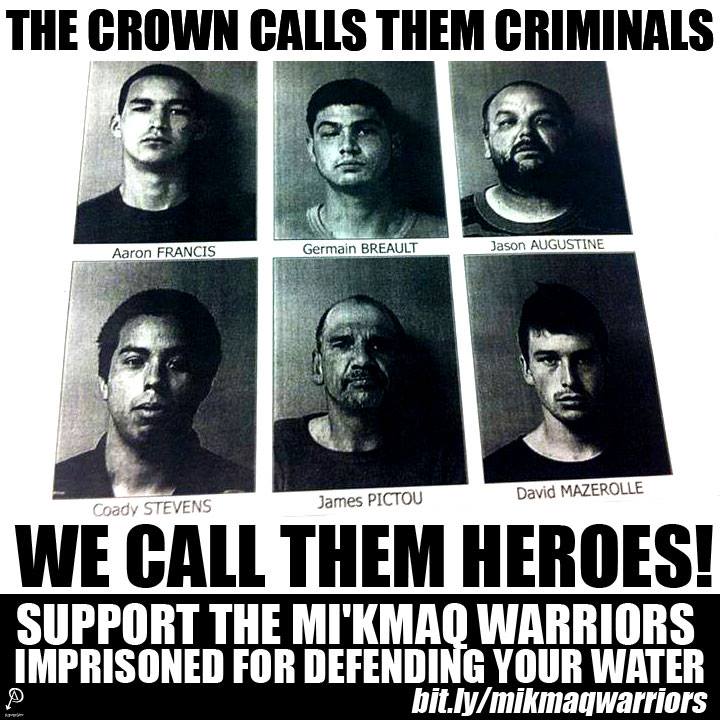
Two members of the Mi’kmaq Warrior Society say they were roughed up and beaten by RCMP officers and jail guards after they were arrested following a heavily-armed raid on a Mi’kmaq led anti-fracking camp in New Brunswick earlier this month.
Jason Augustine, Warrior Society district chief, said he was kicked in the head by an RCMP officer after he was cuffed and arrested during the Oct. 17 raid.
Augustine said he was later diagnosed with a concussion at the hospital in Moncton, NB.
“I was kicked in the head three times when I was taken down,” said Augustine. “I wasn’t resisting arrest, I had my hands behind my back, and this one RCMP started bashing my head in.”
Augustine said he was nodding-off while he was held in one of the cells with other warriors at the Codiac RCMP detachment in Moncton. He claimed his head was hit against the wall as he was being taken to the ambulance.
“One of the guys called the guards up and said I needed an ambulance,” said Augustine. “The RCMP picked me up, they roughed me up and hit my head against the wall when they were taking me to the hospital.”
David Mazerolle, another Warrior Society member, claimed in a YouTube video that Aaron Francis was beaten while handcuffed as he was being taken to a cell at the South East Regional Correction Centre in Shediac, NB.
Augustine and Mazerolle, who were released from custody last Friday, both said they were denied use of the telephone.
Augustine said all six of the warriors kept in custody following the raid were put into solitary confinement.
An official at the correction centre referred queries on the allegations to New Brunswick’s Public Safety department. The department did not return telephoned and emailed requests for comment.
RCMP spokesperson Const. Jullie Rogers-Marsh said she would look into the issue before providing a response.
A total of 40 people were arrested the day of the raid which spiralled into chaos after members of the Elsipogtog First Nation clashed with police.
The RCMP raid, which included tactical unit members wearing camouflage and wielding assault weapons, freed several vehicles owned by a Houston-based company doing shale gas exploration work in the region. The anti-fracking camp was blocking SWN Resources Canada’s trucks from leaving a compound in Rexton, NB.
Augustine and Mazerolle face several charges including forcible confinement, mischief, assaulting a peace officer and escaping lawful custody.
Augustine also denied RCMP allegations that the warriors forcibly confined security guards employed by Industrial Securities Ltd in the compound holding SWN’s vehicles.
Augustine said the security guards were escorted by the RCMP at the beginning and end of their shifts.
“They were not held unlawfully,” he said. “They stayed there until their shift changes.”
Augustine also denied RCMP allegations that the warriors uttered death threats or brandished weapons at the security guards.
“There were no death threats, we had nobody in confinement and we had no weapons,” he said.
The RCMP held a press conference following the raid where they displayed three rifles and ammunition seized during the raid. The RCMP said officers also found crude explosive devices.
Augustine claimed the guns and explosives were planted after the raid.
“I do believe they were planted, they knew we wanted peace,” said Augustine. “They had a one track mind to hurt the warrior society.”
Augustine said the warriors were prepared to negotiate the release of SWN’s vehicles.
“They kept telling me, ‘we just want the trucks out’ and I said I was going to our War Chief to tell him to get the trucks out,” said Augustine.
Augustine said he was shot four times by RCMP officers using bean-bag rounds.
He said two RCMP officers presented the warriors with tobacco bundles the night before the raid.
Augustine said his main defence against the charges will be to demand a hearing before an international court.
“Under our treaty laws we have to go to international court,” said Augustine. “We can’t be under the Crown because we are not under the Indian Act, we are treaty people.”
Since spring 2013, RCMP in New Brunswick arrested 82 people in connection with anti-fracking related protests
Rising Tide Protests TD Bank in Seattle
 31st October Our friends with Rising Tide Seattle and South Soun
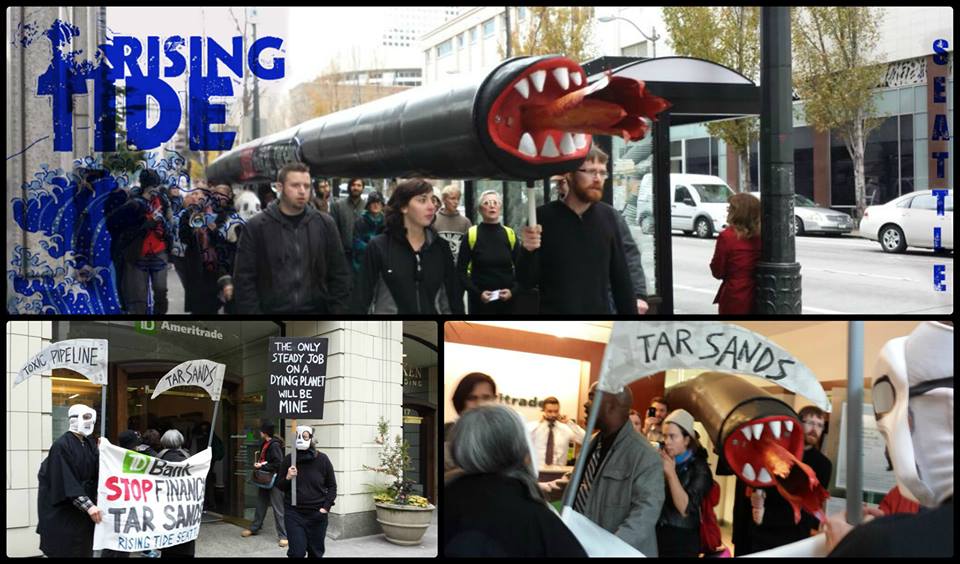 31st October Our friends with Rising Tide Seattle and South Sound Rising Tide arrived at a TD Bank office with a 35-foot-long mock pipeline and a funeral procession to demand they stop bankrolling the Keystone XL and tar sands extraction.
TD Bank is one of the largest shareholders in the Alberta Tar Sands, and was also protested by Rising Tide Philly earlier this year.
After the TD Bank office, they marched to the federal building to put President Obama on notice; they have pledged to resist along with over 80,000 people organized by The Other 98%,CREDO Mobile and Rainforest Action Network.
Unist’ot’en Camp Site of Late Night Bombing

29th October
29th October
An attempt to destroy the main Unist’ot’en sign with a home-made explosive accelerant occurred last night at approximately 10:20 p.m.
The Unist’ot’en camp located around 70 kilometres south of Houston has been in place since 2010 in response to proposed pipelines such as Enbridge’s Northern Gateway and Pacific Trails’ liquid natural gas line.
Last night individuals living at the camp heard what sounded like a gunshot and they immediately took steps to make sure they were protecting themselves.
“We were in the main cabin and a soon as we heard the bang we shut off our lights, grabbed firearms, went outside and fired a warning shot,” Toghestiy (Warner Naziel) said.
Toghestiy investigated the scene on the north side of the bridge where he could see fire burning. He found a few canisters of ‘accelerant’ bound together with bright green surveyor tape and a long trail of ‘accelerant’ leading north along the road away from the bridge, which was used to reach the canisters, he said.
“When I was approaching the site I could see headlights heading away from the bridge,” Toghestiy said.
The Unist’ot’en have renewed the traditional protocol of free, prior and informed consent in regards to accessing Unist’ot’en territory for any reason.
To accomplish the protocol a soft blockade has been employed on a bridge crossing the Morice River, where every person wishing to enter Unist’ot’en land has to answer questions. One such question is: How will your visit benefit the Unist’ot’en? Failure to give satisfactory answers gives the Unist’ot’en grounds to prevent access for whatever purpose sought.
One group of young men from the Houston area have reportedly taken issue with the Unist’ot’en protocol, Freda Huson, Unist’ot’en member and resident of the camp, said.
“A group complained to the RCMP about our protocol,” Huson said, but she’s not sure if it’s the same group responsible for last night’s event.
RCMP have yet to investigate the scene.
A hunter from the Tumbler Ridge area, who answered the protocol questions properly, shared that he heard a group of young men were angrily talking about the Unist’ot’en and the group claimed they were going to ‘do something about it’, Huson said.
“It may have been the people who honked at the bridge but didn’t wait for us to come ask the protocol questions,” Huson said. “I believe it’s the same group that destroyed our sign at the 44 kilometre mark.”
The Unist’ot’en are asking anyone with information about who is responsible for last nights events to please contact the Houston RCMP at 250-845-2204.
Mi’kmaq Anti-Fracking Update: Two Warriors Released on Bail, Four Others Remain in Jail

One of some 40 people arrested b

One of some 40 people arrested by RCMP on Oct 17, 2013. CBC News,Oct 25, 2013
Bail hearings for 3 others continue; 1 denied bail Thursday
Two of six protesters who were held in custody following the shale-gas protest confrontation near Rexton, N.B., last week have been released on bail.
Jason Augustine and David Mazerolle were released on a number of conditions and will be back in court next month to enter a plea. The pair face various charges, including mischief, unlawful confinement, escaping lawful custody, obstructing a peace officer and assaulting a peace officer.
Thursday another protester, Coady Stevens, was denied bail. He remains in custody and is to enter a plea on November 1.
The six men — Stevens, Augustine, Mazerolle, Aaron Francis, Germain Junior Breau, and James Sylvester Pictou — face 37 charges in all.
Bail hearings are continuing for the other three jailed protesters. They’ve been in custody since their arrest eight days ago.
The six were among 40 people arrested when RCMP broke up a weeks-long protest against shale gas exploration on Route 134 in Rexton. The protesters were preventing SWN from accessing seismic-testing vehicles and equipment in its compound in the area. The exploration company had obtained a court injunction ordering that it be allowed access to its vehicles and be allowed to carry out exploration work without harassment.
‘No means no’
After being released, Augustine hugged his wife and mother outside the Moncton Law Courts.
“It’s good to be out,” he said. “It’s not good to see my bros that are still in there be incarcerated for something that we believe is right to save.”
Augustine said he and his fellow warriors were arrested trying to save the province from the dangers of shale gas development.
“We are there for our Mother Earth. We’re not there to uphold politics. Politics this, politics that. No way. Just say no, and no means no.”
Aboriginal leaders have not said they are absolutely against shale gas development, however.
“They’re not saying no to all resource development,” Assembly of First Nations National Chief Shawn Atleo said during a visit to Elsipogtog First Nation on Thursday. “Just saying not yes at all costs.”
Meanwhile, Elispogtog Chief Aaron Sock said the issue of resource development should be dealt with after going to court to deal with aboriginal land claims.
Augustine said his opinion hasn’t changed.
“Shawn Atleo and Aaron Sock have to understand — this is a Mi’kmaq territory land. You can’t destroy our Mi’kmaq territory land, no matter how much people are trying.”
Remove Your Machinery Within Three Days, Baram Natives Warn Dam Builders
 25th October Native communities from Malaysia’s remote Baram district on the island of Borneo have warned state-owned electricity provider Sarawak Energy t
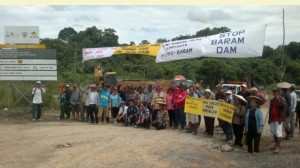 25th October Native communities from Malaysia’s remote Baram district on the island of Borneo have warned state-owned electricity provider Sarawak Energy today to remove its construction machinery from their lands within three days. The machinery had been transported to the Baram region in order to prepare the construction of a 1200 MW dam that would displace up to 20’000 natives and flood a rainforest area of 400km2.
According to Sarawak’s Save Rivers network, a group of 30 workers had been found to conduct rock testing activities at the planned dam site at Long Naah. The workers were told to pack up and leave the native lands immediately. “The workers tried to negotiate but were told in no uncertain terms that there was no need for further negotiations as the communities rejected the dam project.”
Sarawak Energy was given a three-day ultimatum to remove its machinery from the native lands. A group of villagers set up a camp at the planned dam site to monitor the implementation of their demands.
Villagers upholding a second road blockade site near Long Lama today informed that their blockade was successful and no new construction equipment had been transported into the interior.
Further information on the dam protest would be released by Radio Free Sarawak (www.radiofreesarawak.org) on SW 15420 KHZ between 7 pm and 8.30 pm local time.
The Bruno Manser Fund calls on the Malaysian government and on Sarawak Energy to halt all works on the planned Baram dam and to create full transparency on the costs and contracts related to the construction of the Murum dam.
A Growing Movement Against Plantations in West Papua
“We, the indigenous people of Yowied Village reject corporations coming on to our land in Tubang District for the following reasons:
There is not so much land around Yowied Village.
“We, the indigenous people of Yowied Village reject corporations coming on to our land in Tubang District for the following reasons:
There is not so much land around Yowied Village.
Our lives are dependent on what our environment can provide.
Where will the future generations go?”
The sign is tied with coconut leaves, a signal that it is a ‘sasih’ marker, a traditional means to forbid passage. Similar signs can be seen in almost all villages in the area. They are backed up by an agreement between all villages in the area that no-one should give up their land, under pain of death. It’s a desperate first act of defiance to a modern world they know has no place for them. A plantations mega-project has been imposed on Merauke, West Papua, and 2.5 million hectares of forest, grassland and swamps – the ancestral lands of the Malind people – are being targeted for oil palm, industrial timber and sugar cane.
For now, the natural ecosystem in remote Tubang District is still in good condition, and the Malind Woyu Maklew people who live in the area can easily find all they need from the forest by hunting, gathering and fishing. The former chief of Yowied village has claimed that he could easily live on only $2 a month, which he would use to buy tobacco and betel nut – everything else could be got from the forest.
Throughout Merauke Regency in the southern part of West Papua, a land controversially annexed by Indonesia 50 years ago, indigenous communities are having to learn fast how to resist corporate manipulations. In 2009 ambitious local politicians proposed Merauke as Indonesia’s new centre for industrialised agricultural growth. This was in the aftermath of the 2008 global food crisis, when governments worldwide got preoccupied about national food security, prompting a wave of land-grabbing globally. The Merauke Integrated Food and Energy Estate (MIFEE), as it became known, was officially launched three years ago in August 2010. Around 50 provisional permits have been issued to around 20 corporate groups, mostly from Indonesia or South Korea.
Starvation and rebellion as the companies move in.
They claimed that MIFEE would ‘Feed Indonesia, then feed the world’. But in the end, it brought hunger. In Zanegi, one of the first villages to be caught up in MIFEE-related development, five children have died in the first half of 2013 from malnutrition and preventable diseases thought to be linked to pollution. Medco, the company involved, is not even producing food. Its industrial forestry plantation is currently turning the Zanegi people’s ancestral forest into wood chips. These are then loaded onto ships and exported to Korea by Medco’s joint venture partner LG International, to be burnt in power stations or turned into fibreboard.
Zanegi too has had to learn to resist. Villagers were tricked out of their land by Medco, who gave them a ‘Certificate of Appreciation’ and US$33,400. The people had no idea that they were signing away their forest, their means of subsistence, their identity. Then the company started taking away the timber, giving people a fraction of the price the logs were worth and breaking their promise to leave intact forest around sago groves and sacred sites. Eventually the people decided to block the company’s access. If they heard chainsaws then they would come running, and in this way they successfully managed to keep the company from operating on their land for over a year.
Despite their resistance, Zanegi has suffered. The forest is gone and the village is empty nowadays as people regularly abandon the village, staying in temporary camps to try to hunt the few remaining forest animals. Others work for the company, but their daily pay is only enough to buy a day’s food for a family. Swamps are poisoned with pesticide residues from the tree nurseries, fish swim erratically as if drunk and then die. People do not have enough to eat, especially the women who always feed their husbands and children before themselves. Traditional beliefs in this area mean that deaths are thought to be linked to black magic. This has led to a conflict which has left several community leaders imprisoned, accused of killing someone who was believed to be a sorcerer. Three of the men have died in prison in the last year, deaths which are also put down to black magic.
The story of Zanegi village has become well known around the Merauke area: it is a warning of what happens when villagers sell their land, and that prompts people in other villages to hold out against the companies. Another company, Rajawali, is trying to set up a sugar cane plantation near the coast. The company successfully bought up land belonging to Domande village, but other villages, Onggari and Kaiburze, have been resolute in their refusal to sell. This is despite intense pressure from the Rajawali corporation, which has also been accused of illegally felling trees on Onggari village’s territory.
In Domande Village, in June 2013, local people angry about unpaid timber compensation set up a blockade, and some days later ordered Rajawali’s loggers to leave the area. As in Zanegi, they had already been tricked out of their land, but were still fighting to get fair compensation for the trees at least. Previously the villagers had taken action after Rajawali cleared a burial ground. Living in the plantation zone means you must be on constant alert to companies overstepping the line.
Fear and conflict is only ever one step behind the company. Back in Yowied, company guards working for PT Mayora, the company which is trying to gain access to plant sugar-cane, accused people of being separatist rebels, fighting for West Papuan independence. Seeing that villagers were preparing to run to the forest in fear, some community leaders felt forced to sign a document PT Mayora were presenting them. In nearby Woboyu, villagers were scared a deadly conflict would break out after rumours spread that people from another village were collaborating with PT Astra to survey customary land boundaries. Both companies are planning sugar-cane plantations.
Local community activists involved in the SSUMAWOMA forum recorded video interviews in these two villages which they then took to Merauke city. After discussing the issue one Sunday afternoon, about 100 people decided to take action, and the next day occupied PT Mayora’s office in the city, demanding that if companies want to propose new plantations, they approach people in a reasonable way, and not just show up causing chaos, divisions, intimidation and confusion. The local regency leader agreed to meet with representatives after the action and agreed to order PT Mayora to temporarily leave the land, but it is known that the company is still looking for a new strategy to convince villagers.
The SSUMAWOMA Forum is a group that has emerged in recent months, made up mostly of university graduates who have roots in the western part of Merauke Regency. With the backing of the communities, they are articulating their opposition to all plantation plans, at least as long as the people lack the skills or experience to get meaningful employment with companies, meaning they end up marginalised on their own land. They bring the voice of the villagers to the public and government, showing how the people have nothing to gain from plantations and, at the same time, have so much to lose: their forest, their livelihood, their culture and their identity.
The Malind people are not just dependent on the forest for their daily needs. The forest defines every aspect of who they are. In Malind cosmology mortal humans are the third generation; the first two generations of their ancestors remain immortal in the environment around them, and the Earth is seen as mother. Each clan is intimately connected to their dema or totem – a part of the ecosystem: Gebze with coconut, Mahuze with sago, Basik-Basik with wild pigs, Samkakai with tree kangaroos. It is incomprehensible for Malind people that the forest might be gone, if it is their culture becomes no more than a sad symbol, their sense of being torn apart.
“The Malind Anim culture is not just a dance, a ritual or a carving. It is not a mere representation of a culture, decorated in mud, leaves and vines” (SSUMAWOMA forum)
When Oil Palm wears a Uniform
In the eastern part of Merauke is the border with Papua New Guinea. The area is militarised, under the pretext of protecting the border zone. For decades local people have had to live with constant intimidation from the troops at dozens of outposts strung along the border. Here traditional society has faced even more challenges; many women have been raped, and subsistence becomes more difficult when military personnel have hunted many of the forest animals.
The military is a source of terror and trauma in West Papua, having waged a war on its people over the last 50 years, protecting its own interests and Indonesia’s economic agenda. Shooting incidents are common, independence movements are brutally crushed, torture, imprisonment and random beatings are everyday hazards. Racist attitudes towards black-skinned Papuans prevail. The climate of fear and resentment has long been established throughout Papua. Even though Merauke has not been a zone of intense pro-independence activity recently, this is why living alongside the military still means constant tension.
All MIFEE companies use the military (or police mobile brigade) as security, adding to the pressure on people to hand over their land, but in this eastern strip, near the border, the military presence is felt more strongly. This area has been allocated for oil palm, with at least four corporate groups wanting to develop big plantations. Unsurprisingly, the companies have found it easier to gain access in this area, and several are now clearing the forest. Nevertheless, a few clans are still resisting, refusing to sell their land, and there have been blockades here too.
The going rate for compensating indigenous people for the annihilation of their world works out at about US$30 per hectare. This amount is pitiful if it is seen as a replacement for the many lifetimes which a forest could sustain, especially once that amount is shared out between different families. But at the moment when the cash is handed over for a few thousands of hectares, for the communities, as people who are desperately poor in terms of the money economy, it seems a huge amount In several cases, this cash handover has been the cause of conflict between villages, clans or individuals, wrenching the community apart.
Far away in Jakarta, Indonesia’s national development master plan still tells the official story: MIFEE is a well-planned and structured development which will provide food crops such as rice, corn, soybeans and beef for the nation. It totally ignores reality, which is that the land is being gobbled up by the same oil palm, sugar and forestry multinationals that have devastated many of Indonesia’s other islands. And as investment fever spreads, oil palm companies are also lining up to establish or expand their plantations elsewhere in West Papua.
Indigenous resistance sometimes seems desperate – what chance do forest people stand against multinationals and the military? But companies remain cautious about entering West Papua, fearing local anger, and many ambitious investment plans have failed here. Standing up to these companies costs the Malind so much, but really it is their only chance to survive as a people, and protect their land.
—-
This is the first of three essays written to give an overview of the MIFEE project, three years after it was officially launched on August 11 2010. The second article is a more in-depth analysis of how plantation companies have affected indigenous communities over the last three years.
The third article is a much longer analysis of the mismatch between the original plan of a food estate to “feed Indonesia, then feed the world” and the reality: vast oil palm, sugar cane and industrial forestry plantations. It also examines how this food estate myth has persisted,providing legitimacy to a national development plan which ignores communities, and to a policy for West Papua which is promoting development while doing nothing to address the underlying causes of West Papua’s problems.
List of key companies involved in MIFEE:
- Medco (Indonesian oil and gas company)
- LG International (Korean TNC, best known for its electronic products)
- Rajawali (Indonesian business conglomerate)
- Daewoo International (Part of South Korean Posco TNC)
- Korindo (Korean business conglomerate with diverse businesses in Indonesia)
- Wilmar International (Asian plantation and grain trading giant, and biodiesel producer, also owns the company which markets CSR Sugar in Australia)
- AMS Plantations (The plantation company belonging to the younger brother of Wilmar’s co-founder)
- Astra Agro Lestari (Indonesian plantations company, ultimately owned by British-registered corporation Jardine Matheson)
- Mayora (Indonesian food company)
- China Gate Agriculture Development (little known company, also South Korean)
- Moorim Paper (Korean paper company)
- Central Cipta Murdaya (Indonesian conglomerate – boss is in prison for paying bribes for plantation permits elsewhere but business goes on regardless)
- Texmaco (Indonesian conglomerate focusing on forestry)
Solidarity Protests and Blockades Ignite Across Turtle Island in Solidarity with Mi’kmaq
 18th October
 18th October
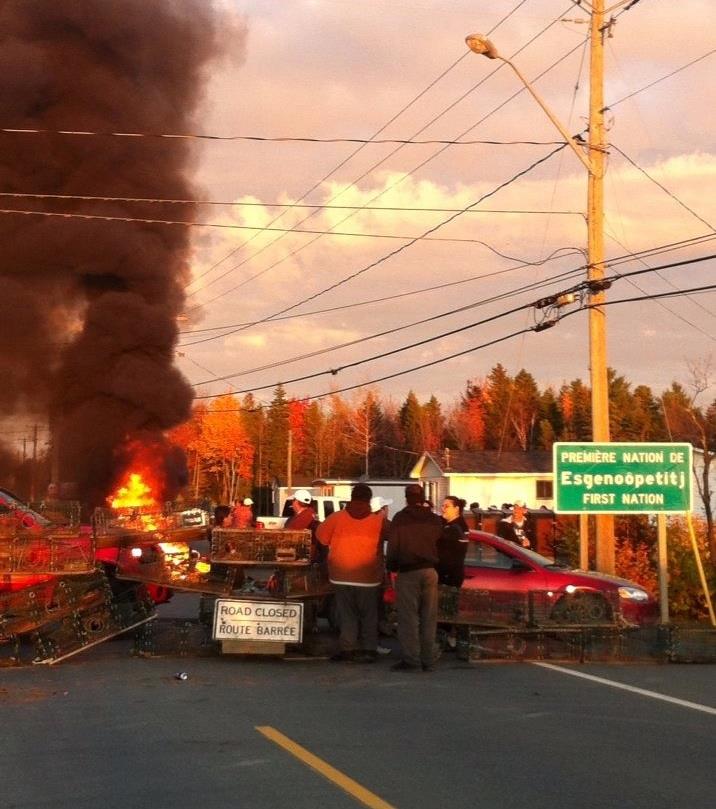
The RCMP retreat from the Mi’qmak blockade has not stemmed the outrage against the Canadian government’s ruthless attack yesterday on the peaceful Mi’qmak blockade. As Southwestern Energy attempts to extend the injunction against the Mi’qmak, solidarity protests are spreading throughout Turtle Island.
Numerous infrastructure points throughout Canada were snarled by indigenous blockades in the immediate aftermath of the state invasion of the Mi’qmak. At least 30 solidarity protests are also being undertaken according to Idle No More.
According to Santa Cruz Indigenous Solidarity, by 3pm yesterday six peaceful highway and bridge blockades had been errected at Roads in Burnt Church (NB), Tobique (NB), Esgenoopetitj (NB), Hamilton (ON) and Six Nations (ON).
The Listuguj Mi’Gmaq built a tipi on the VanHorne bridge, blocking traffic on the Quebec-New Brunswick border.

In Winnipeg, protestors tied up traffic at the intersection of Portage and Main, burning a Canadian flag to protest against the Crown’s historic betrayal of First Nations treaty rights. Police appeared to be clearing the way for the march, halting traffic at numerous points.
In Montreal, members of the Mohawk nation gathered to show solidarity. During the RCMP crackdown on the Mi’kmaq Blockade, many observers compared the state’s repressive response to the 1990 Oka Crisis, which saw the Mohawk resist development on their lands for months.
New York, Washington, DC, and numerous other cities across the US have also seen solidarity demonstrations.
There is a call for solidarity for today and tomorrow, which happens to be an international day of action against fracking (the #globalfrackdown http://www.globalfrackdown.org/). The day of solidarity will use the hash tag #INDIGENIZE, with organizers sending report backs and media updates to ReclaimTurtleIsland [at] gmail [dot] com.
