(USA) Sunrise Intervention at Gas Industry Convention

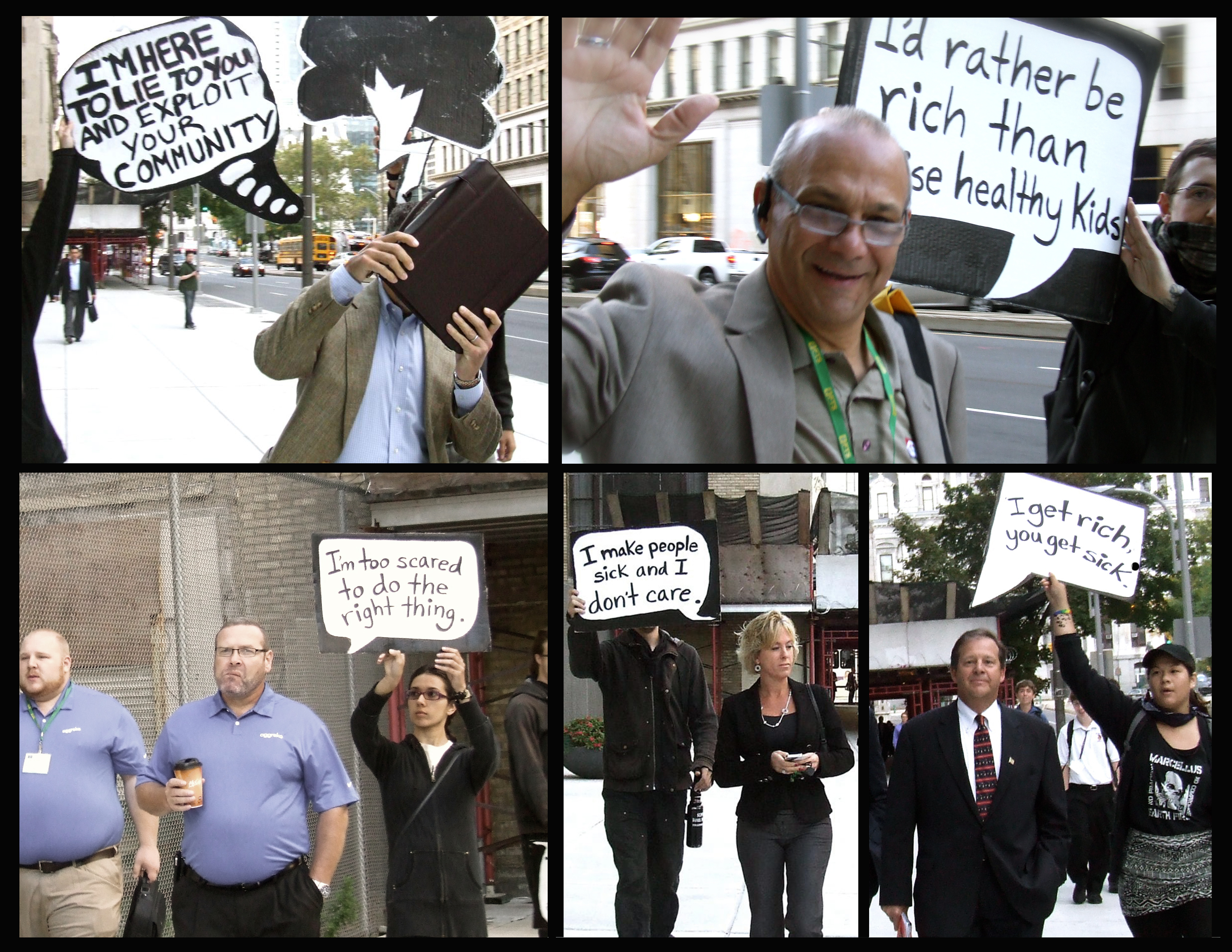
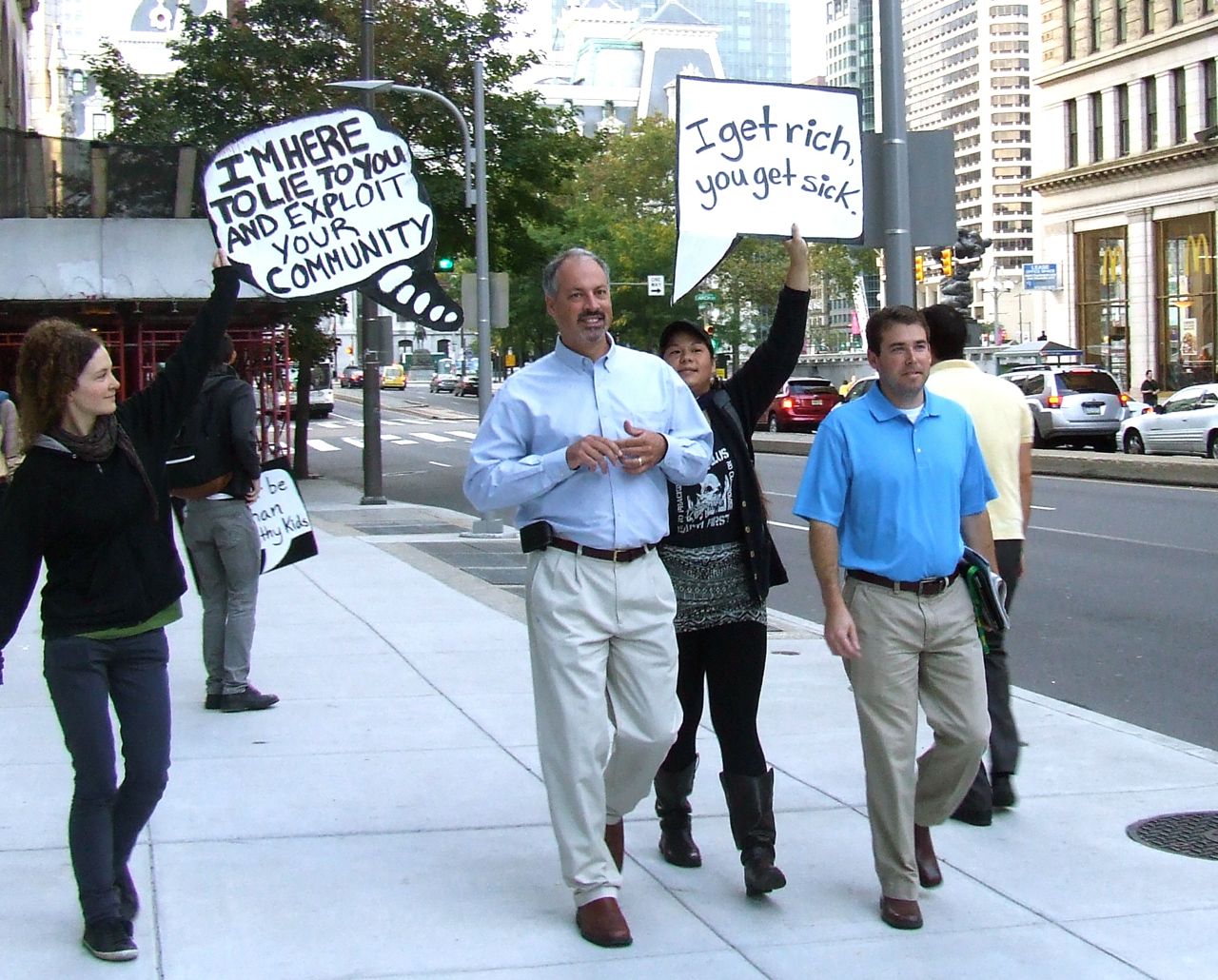
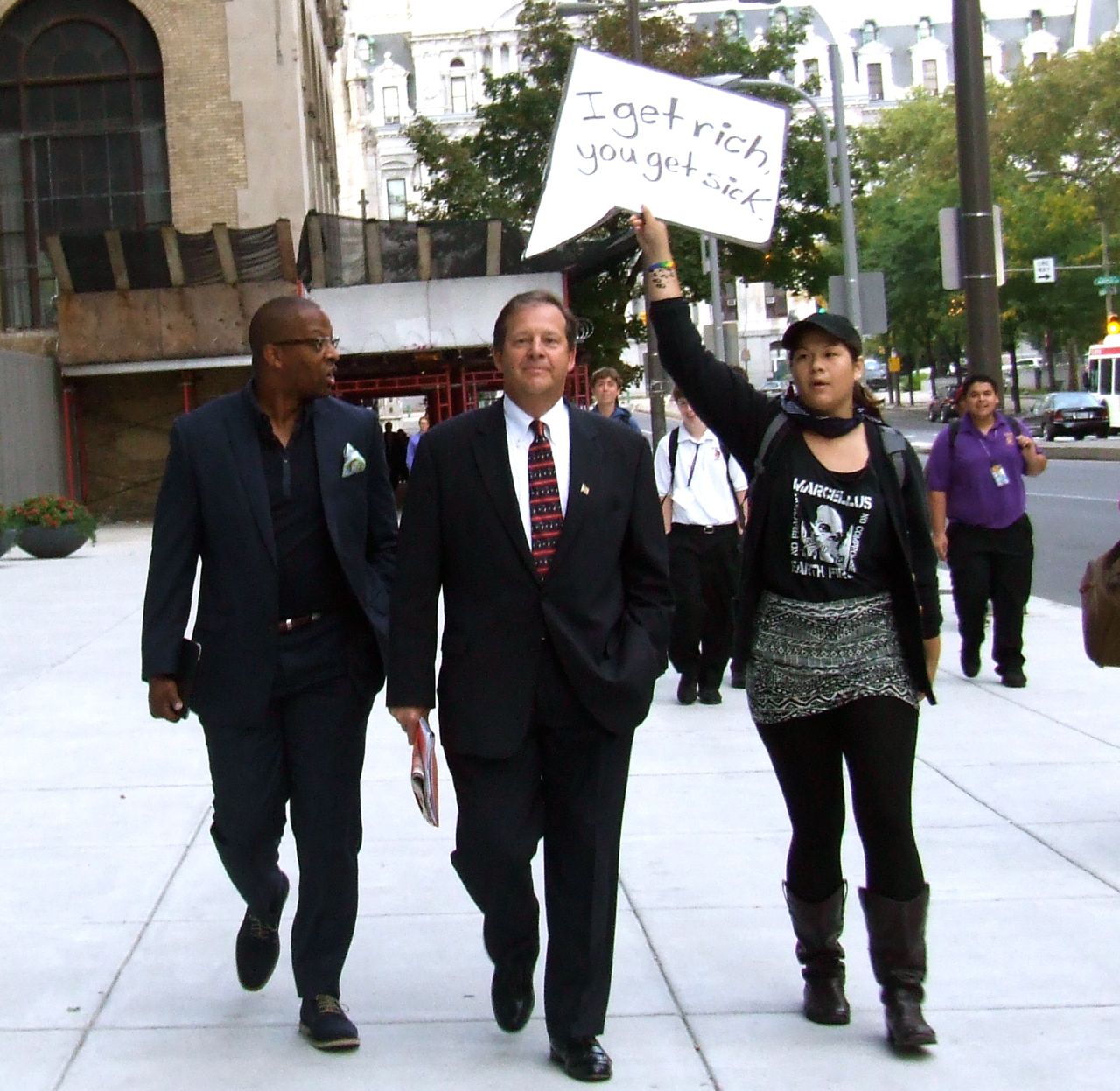
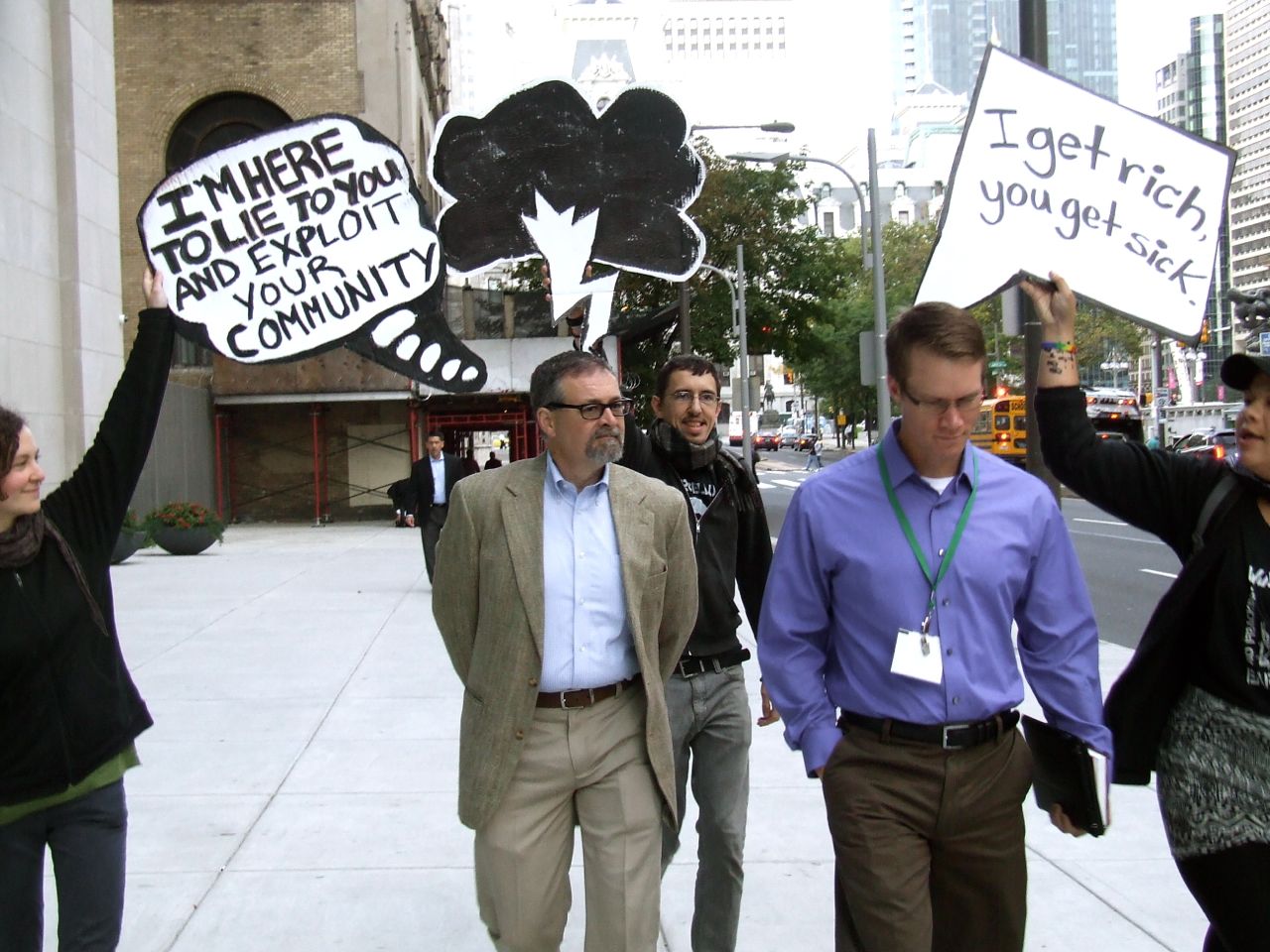
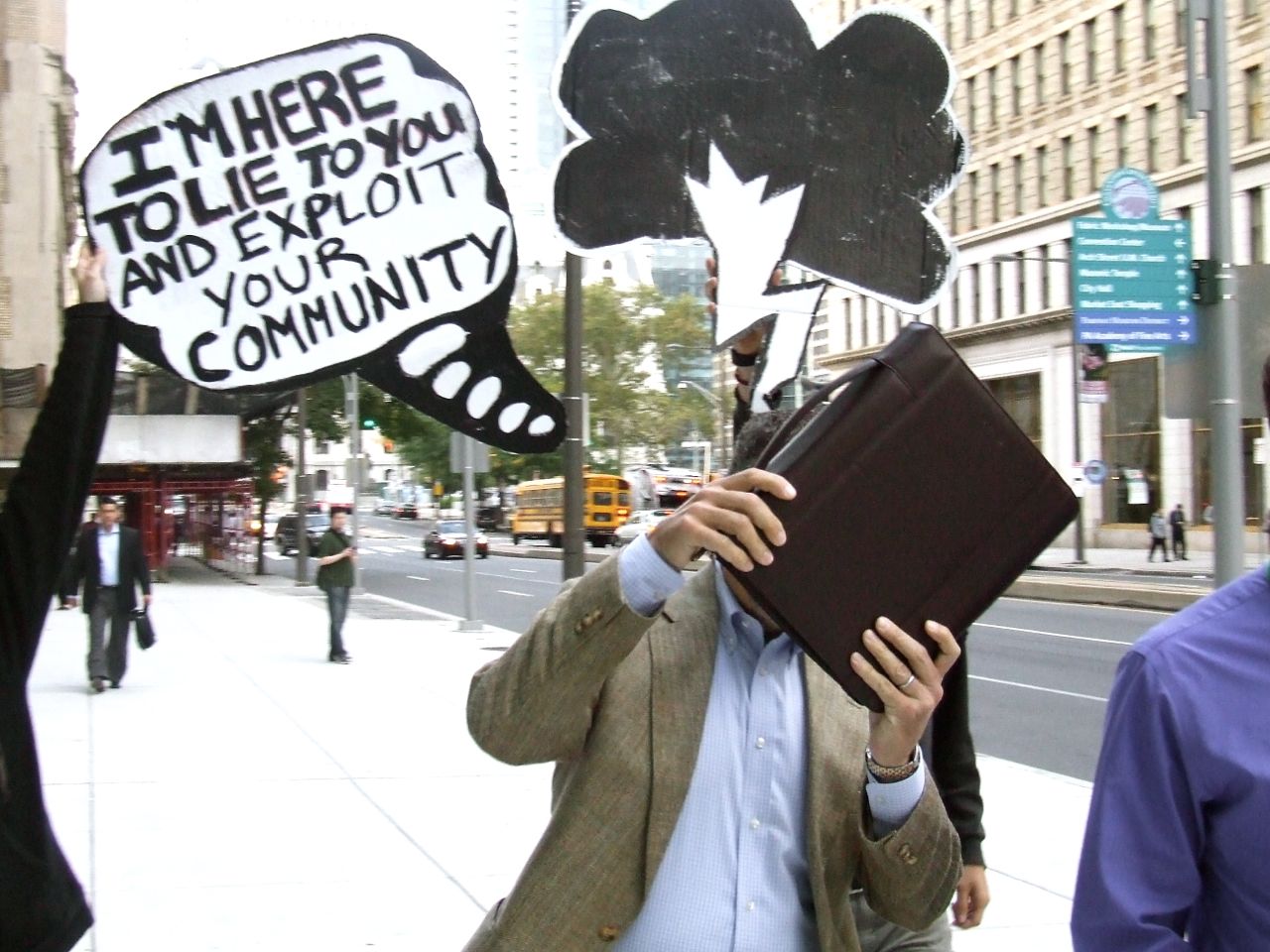
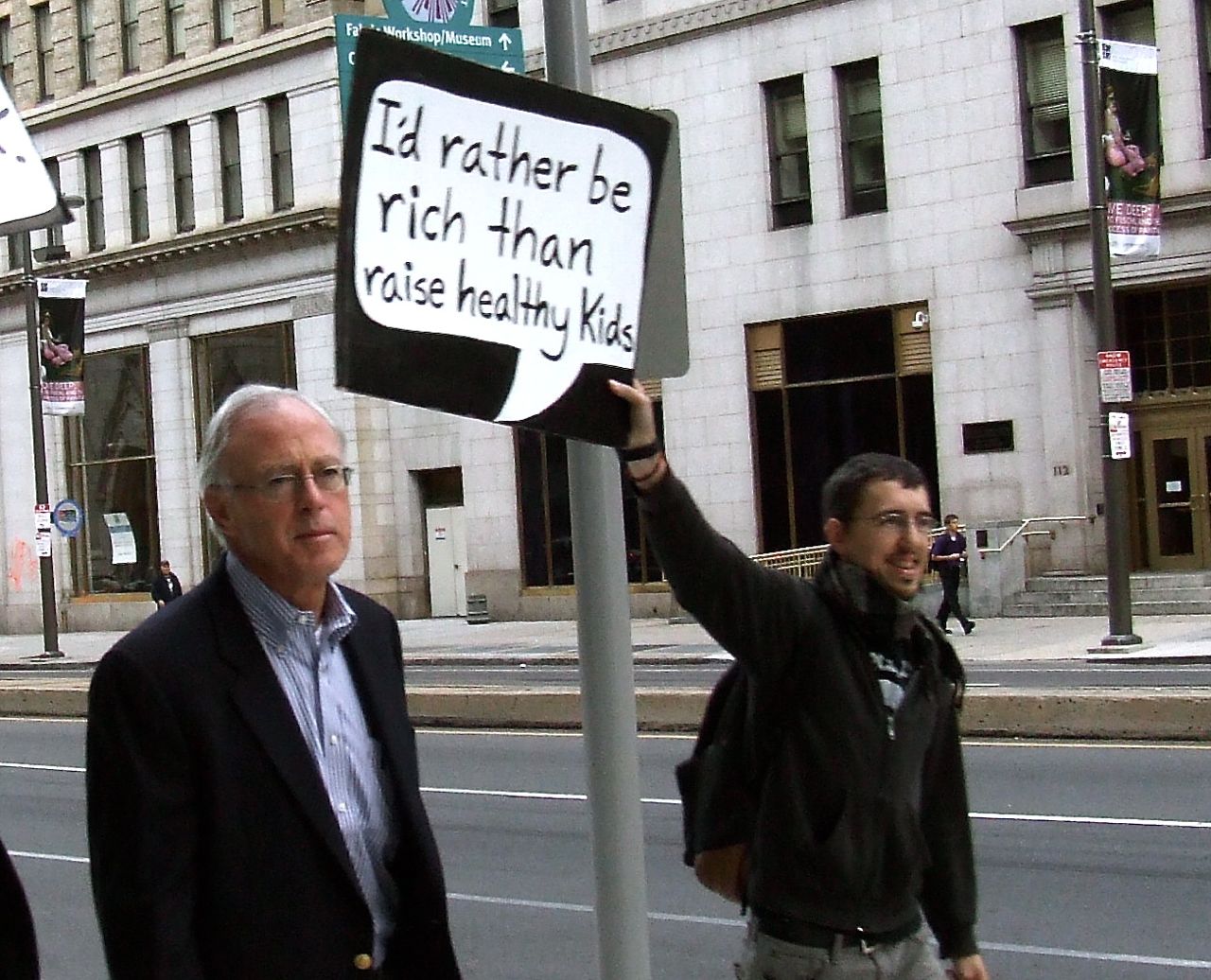
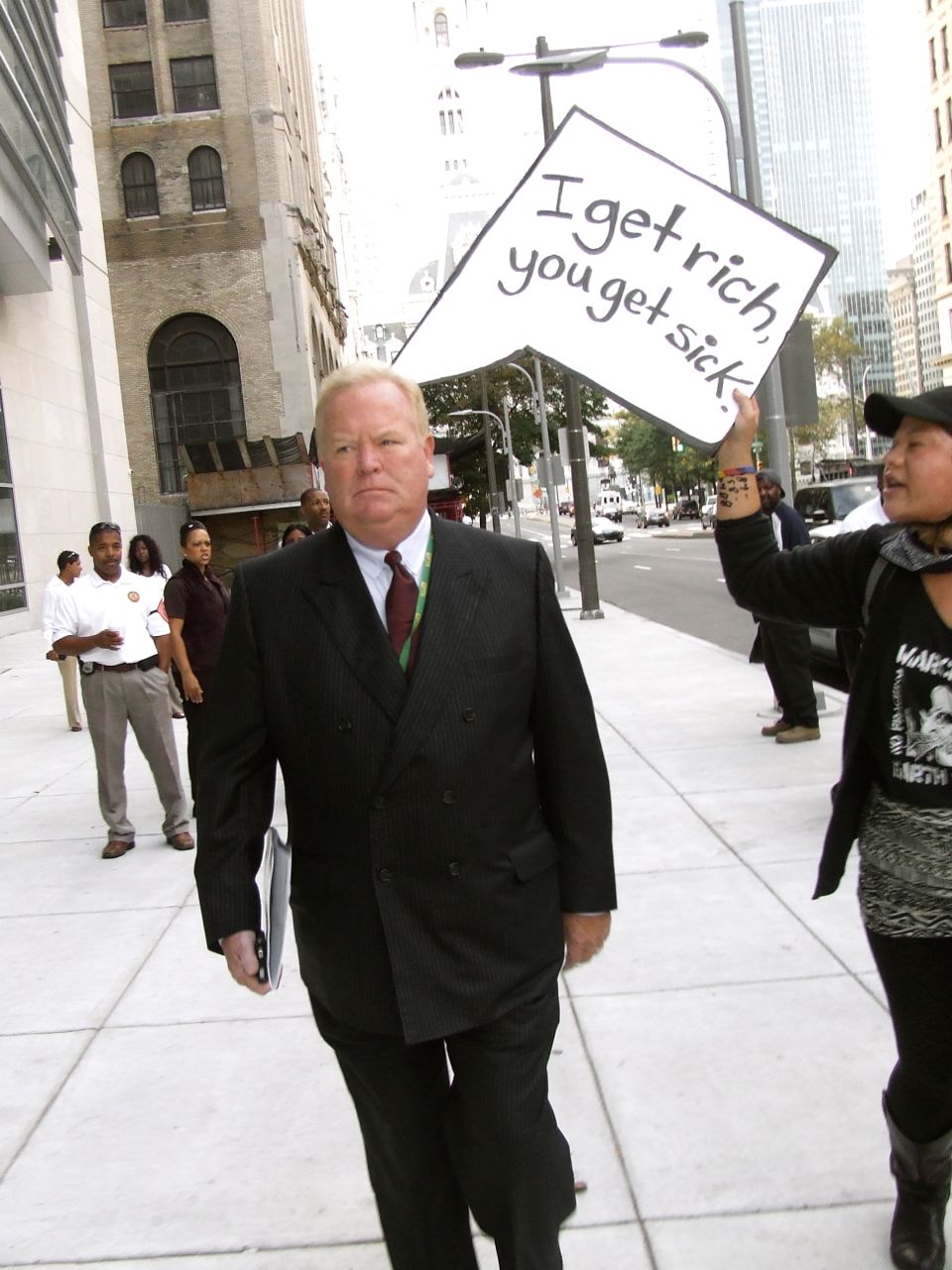
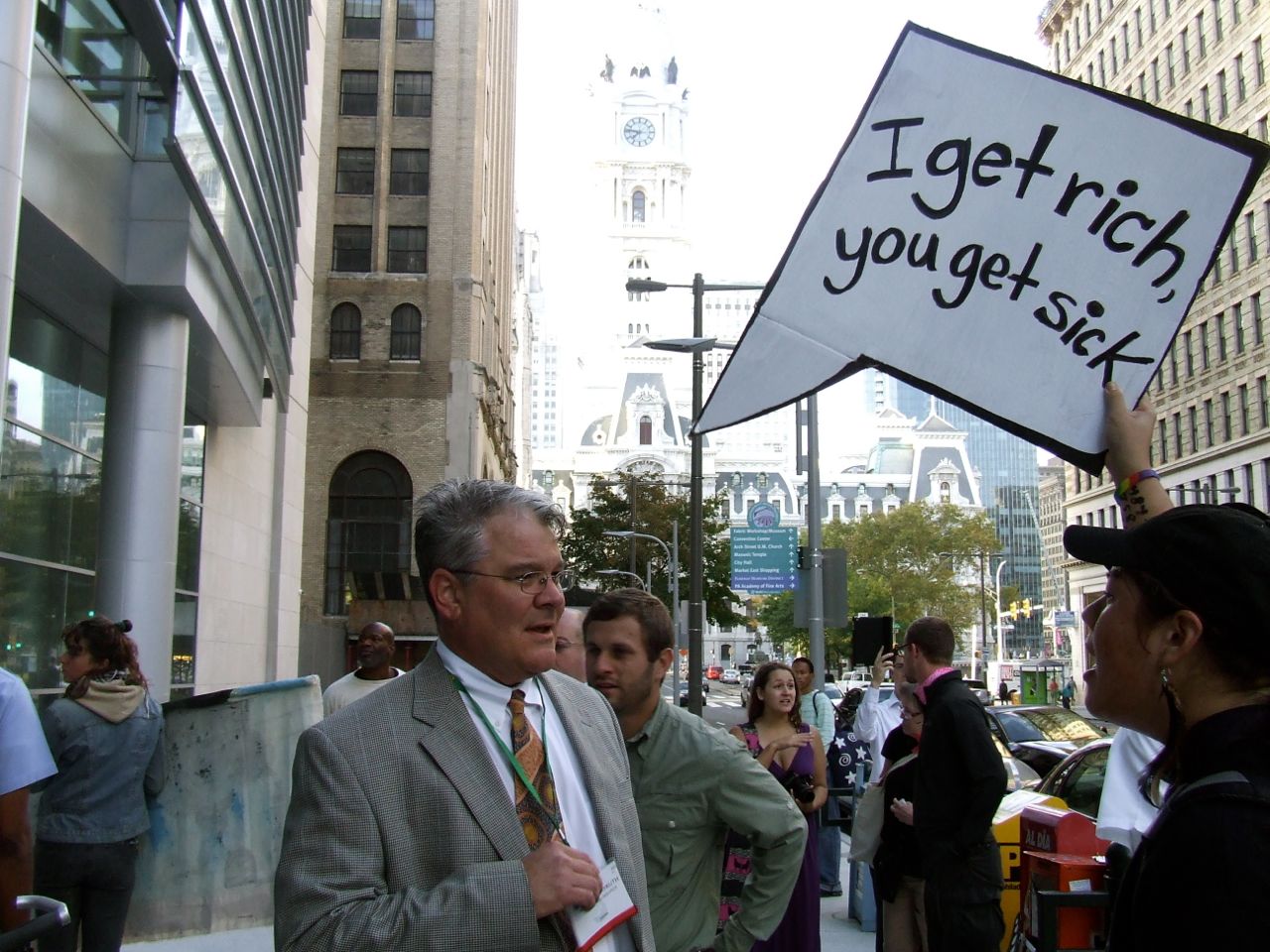
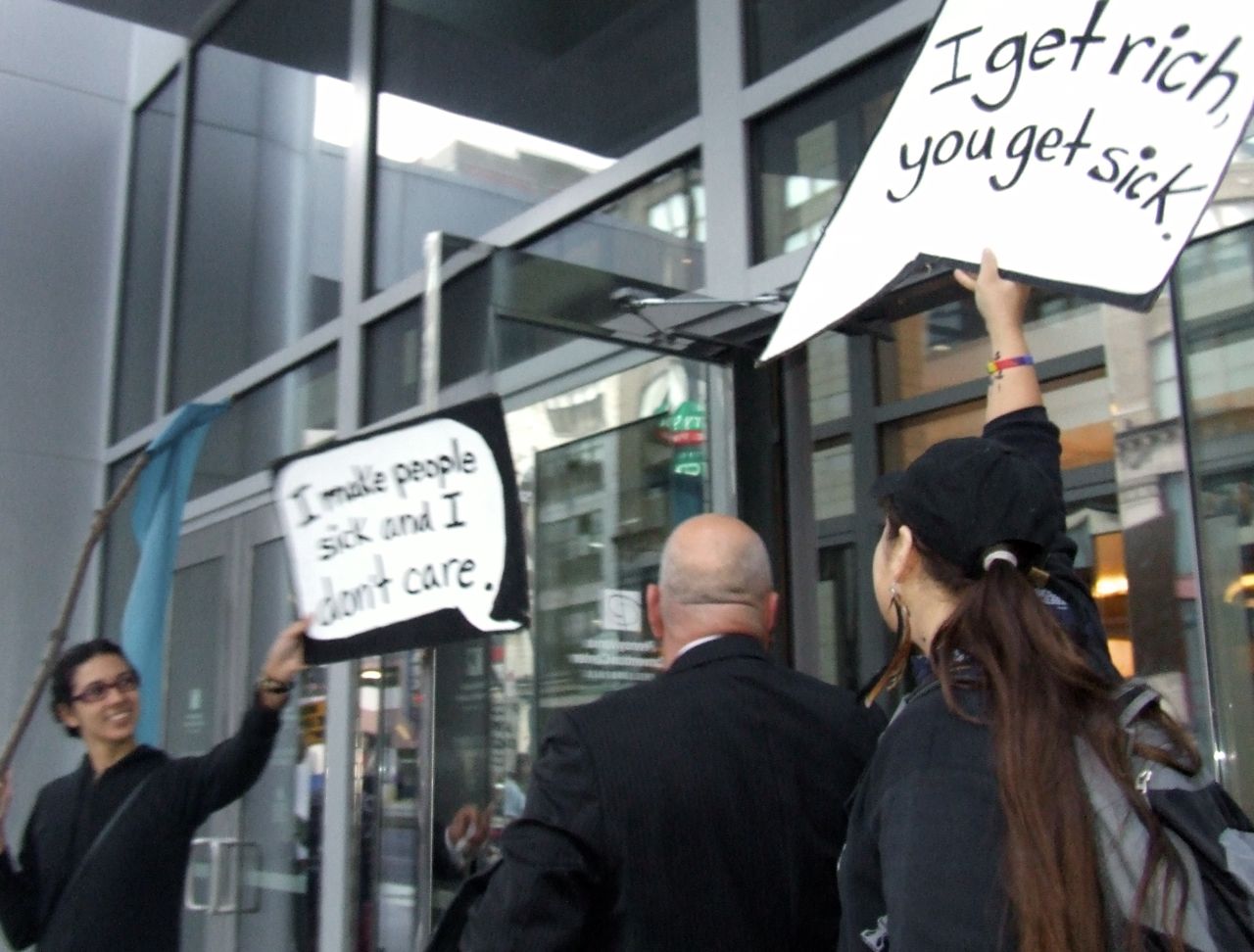
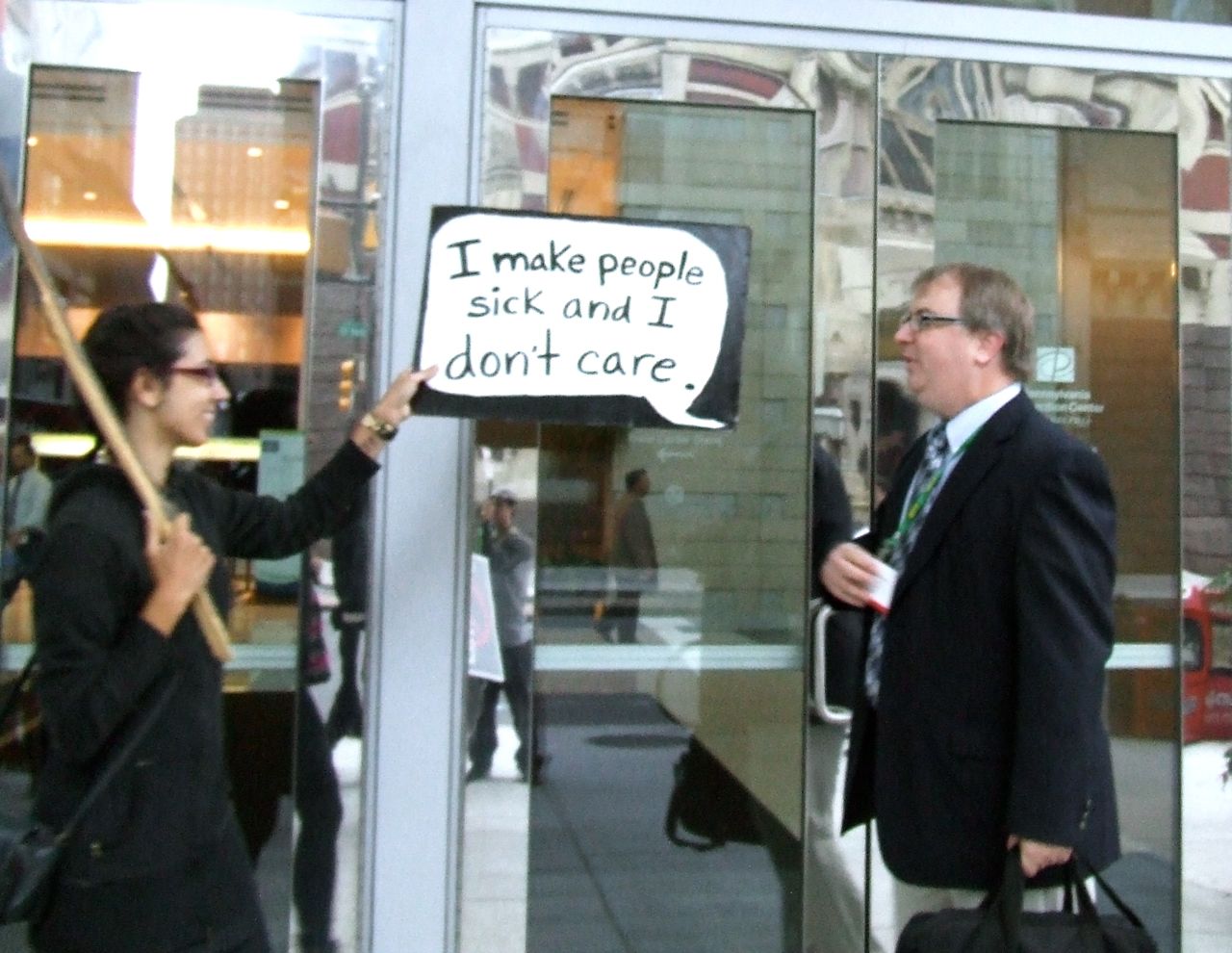
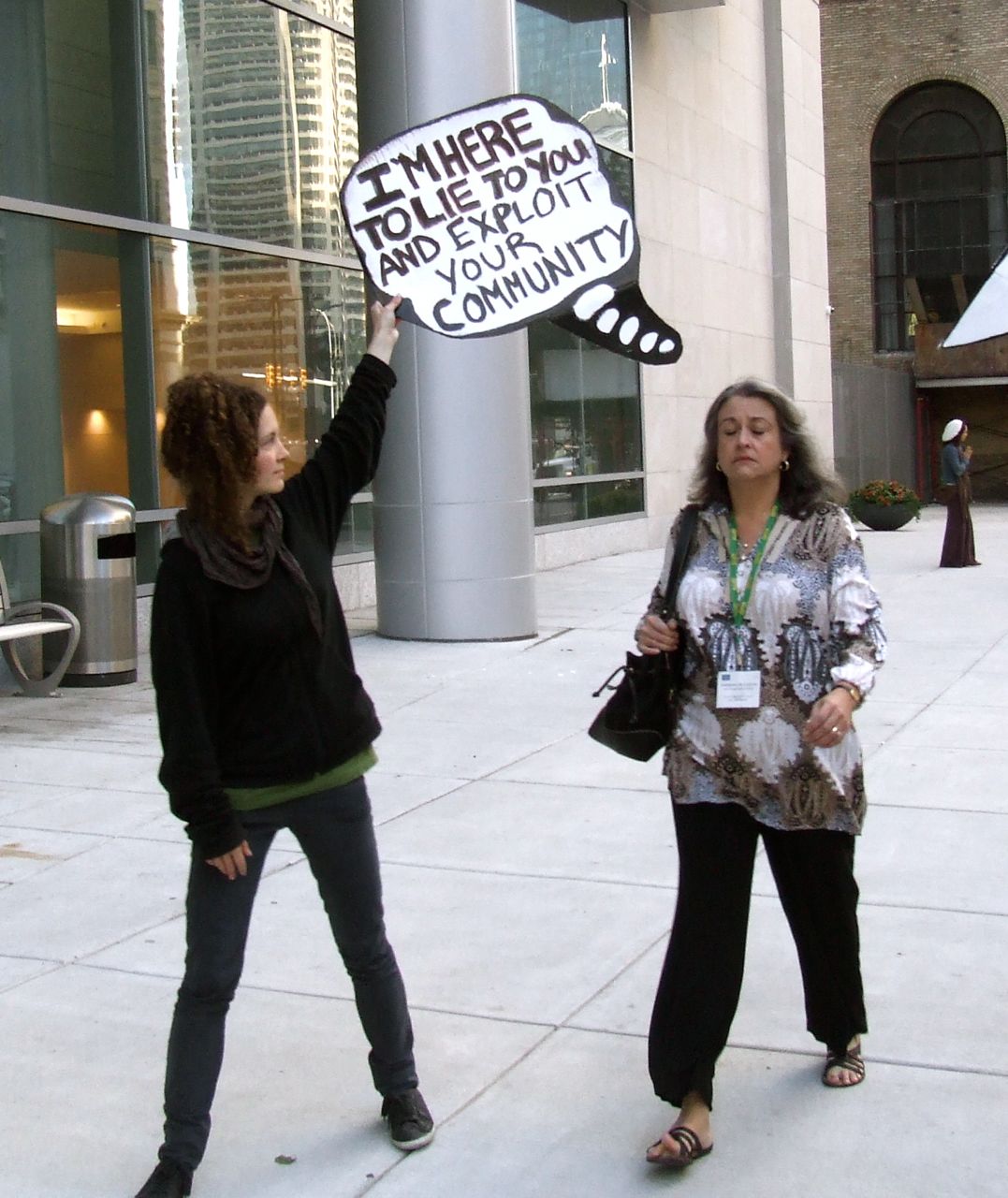
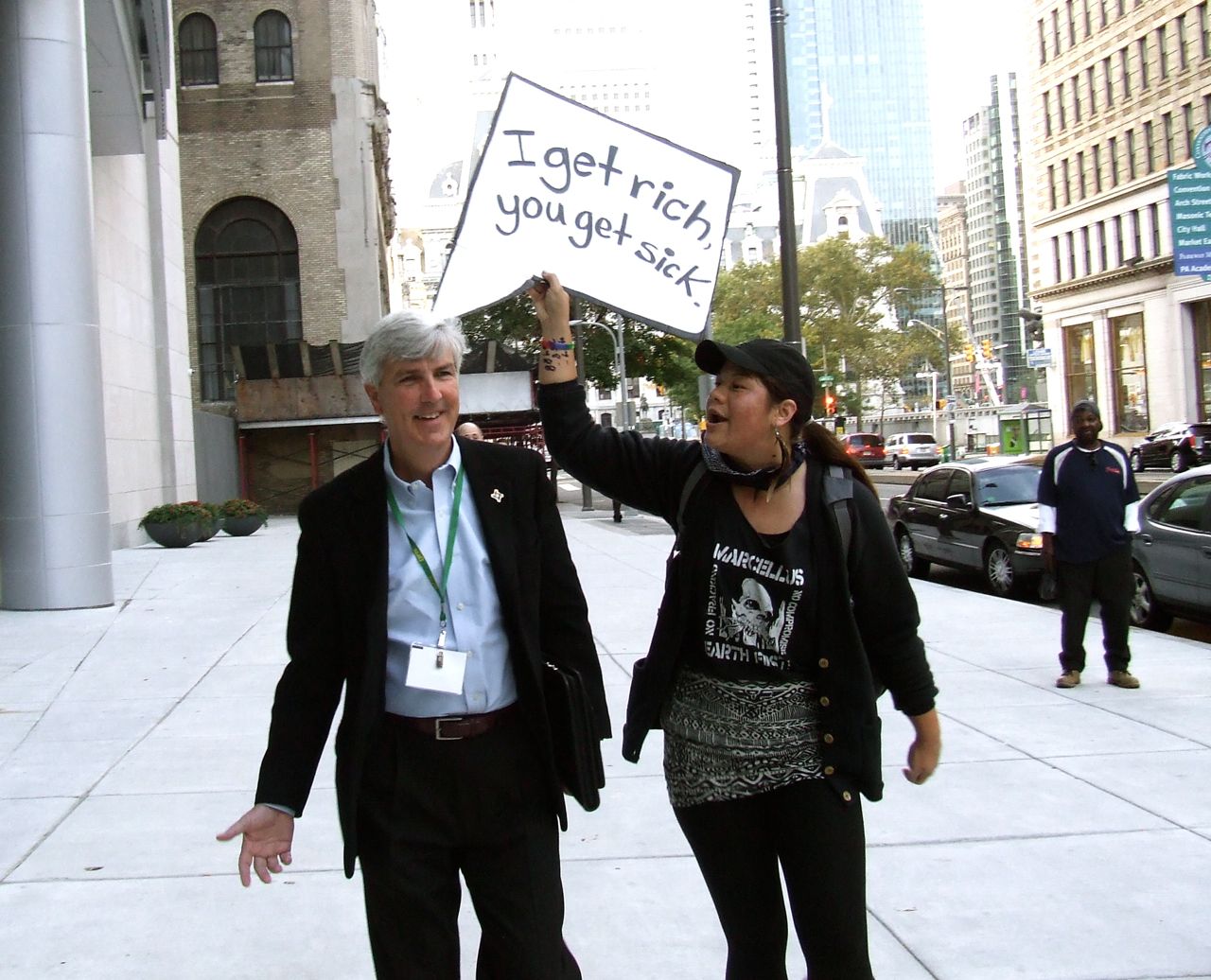
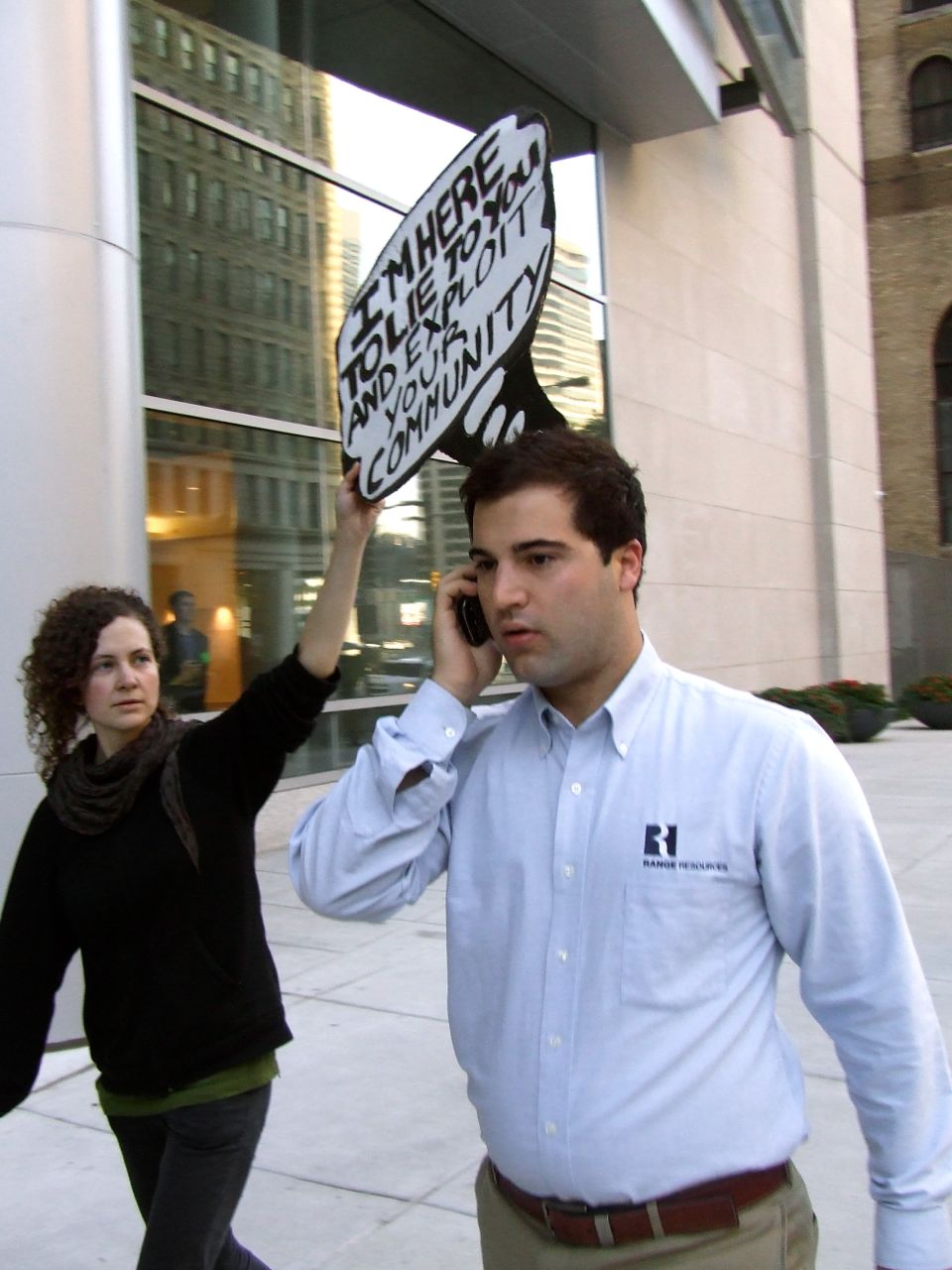
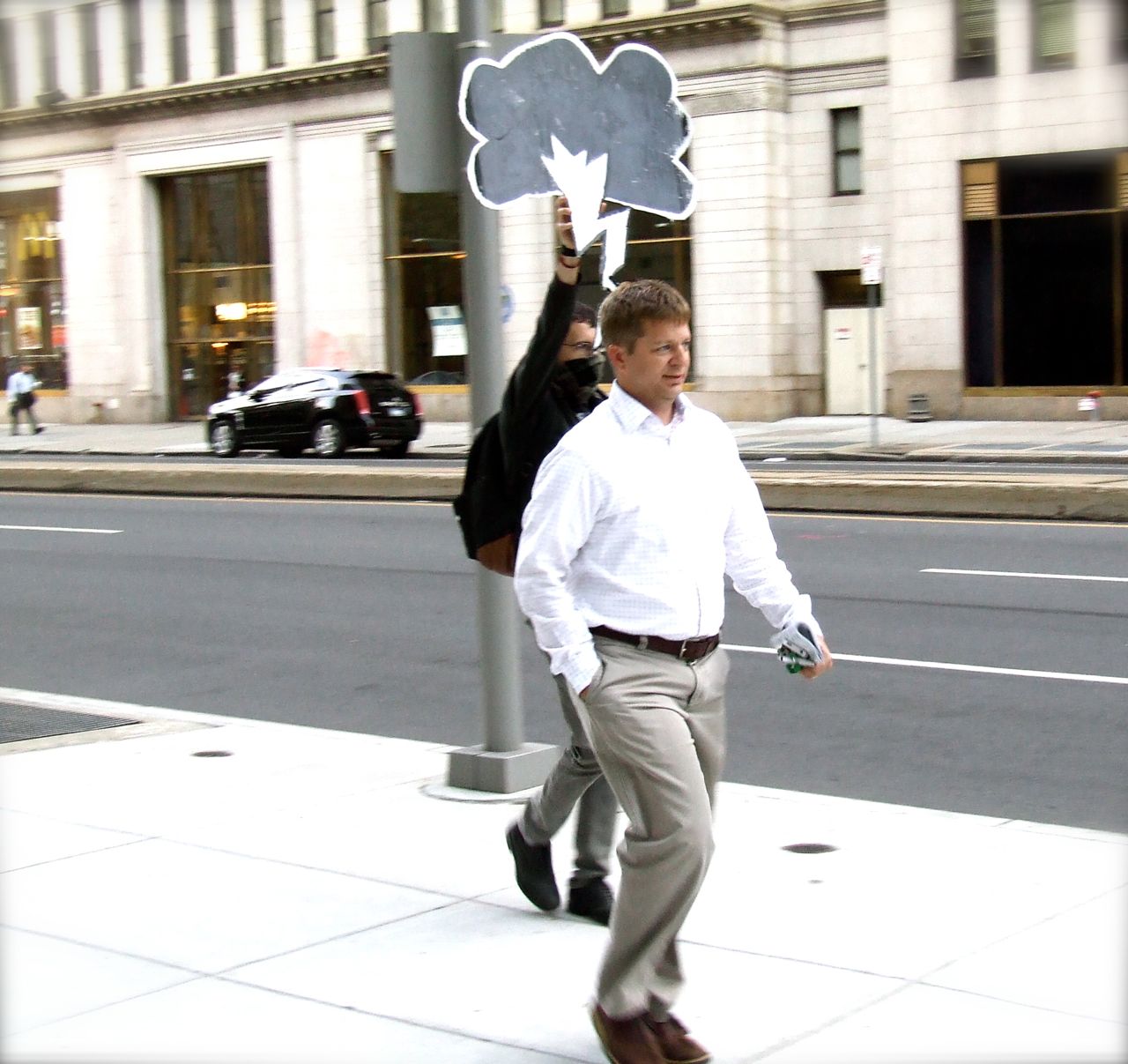
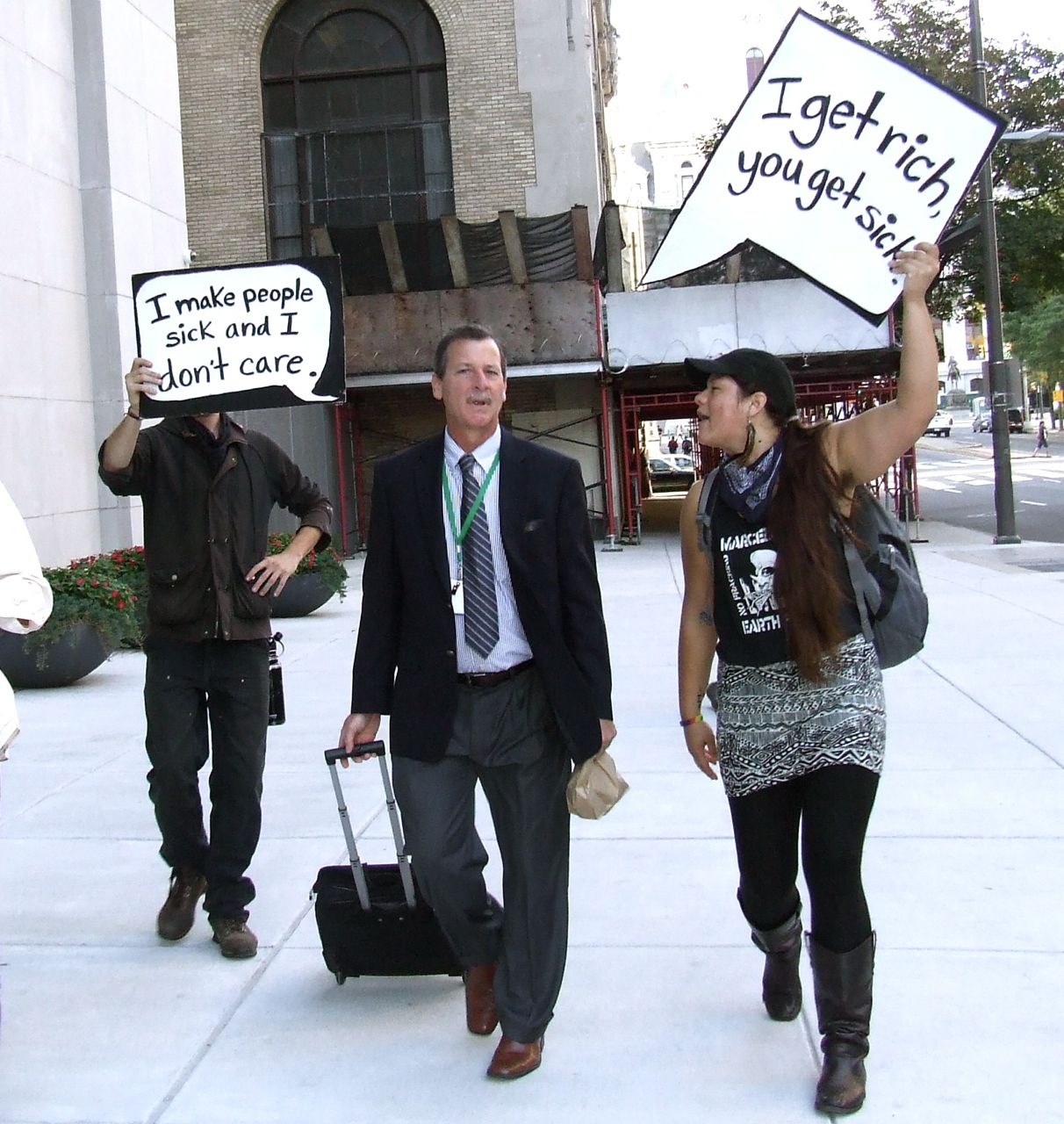
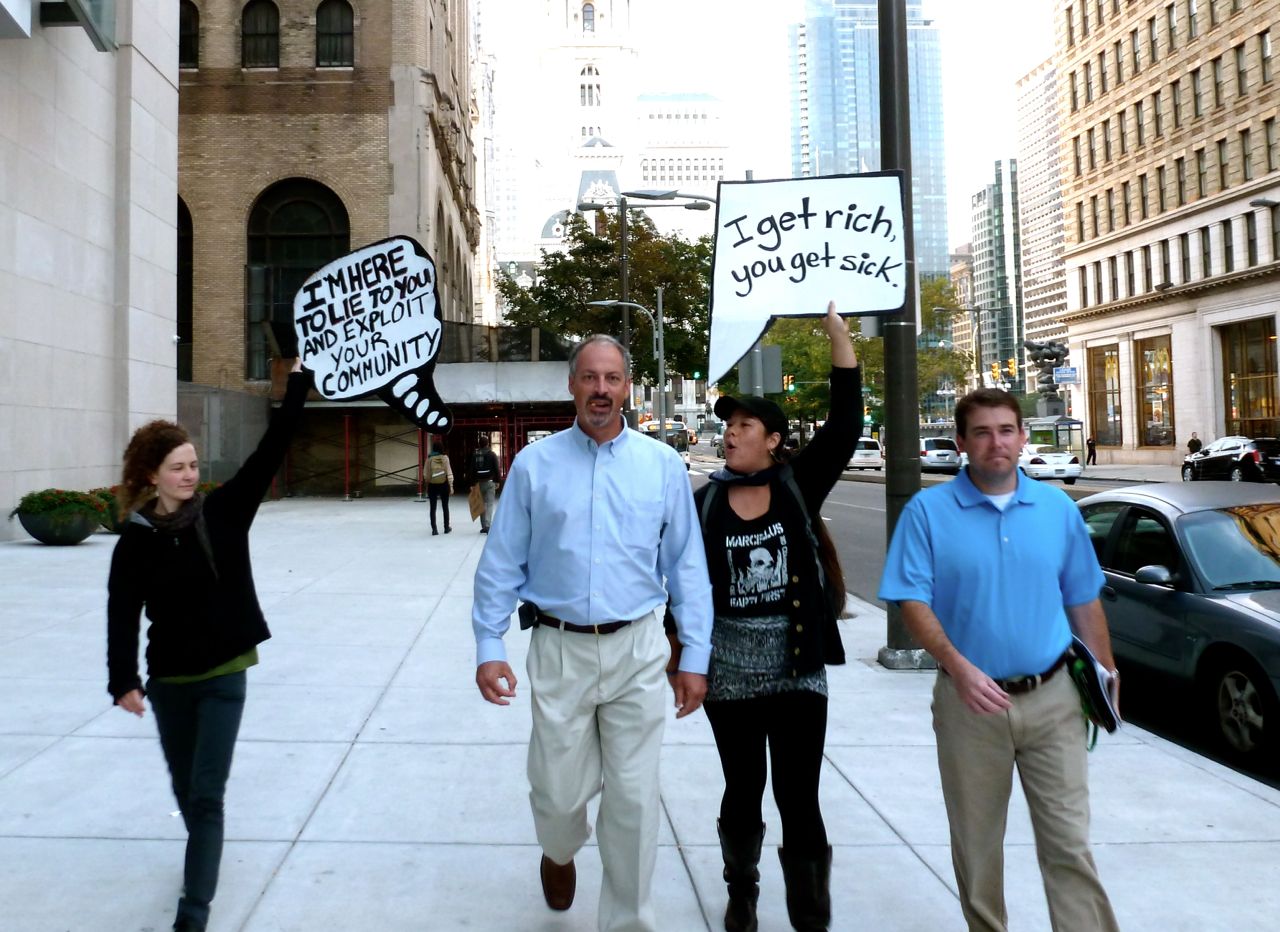
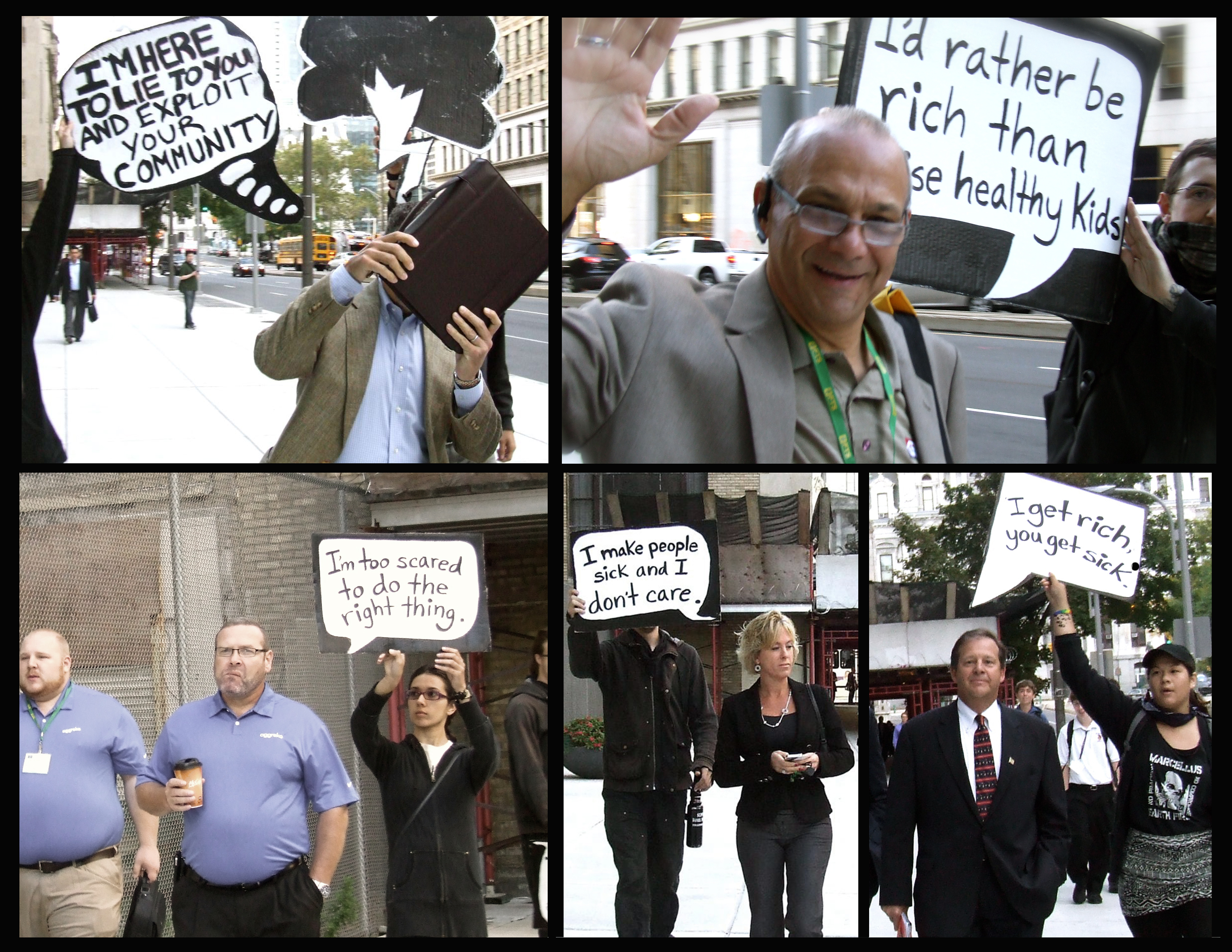
It was 7:00 am, the last day of the Marcellus Shale Coalition’s annual convention in Philadelphia, when a group of 40 or so people gathered to meet the gas industry face to face. “We just wanted to see what they had to say for themselves” said one of the protesters.

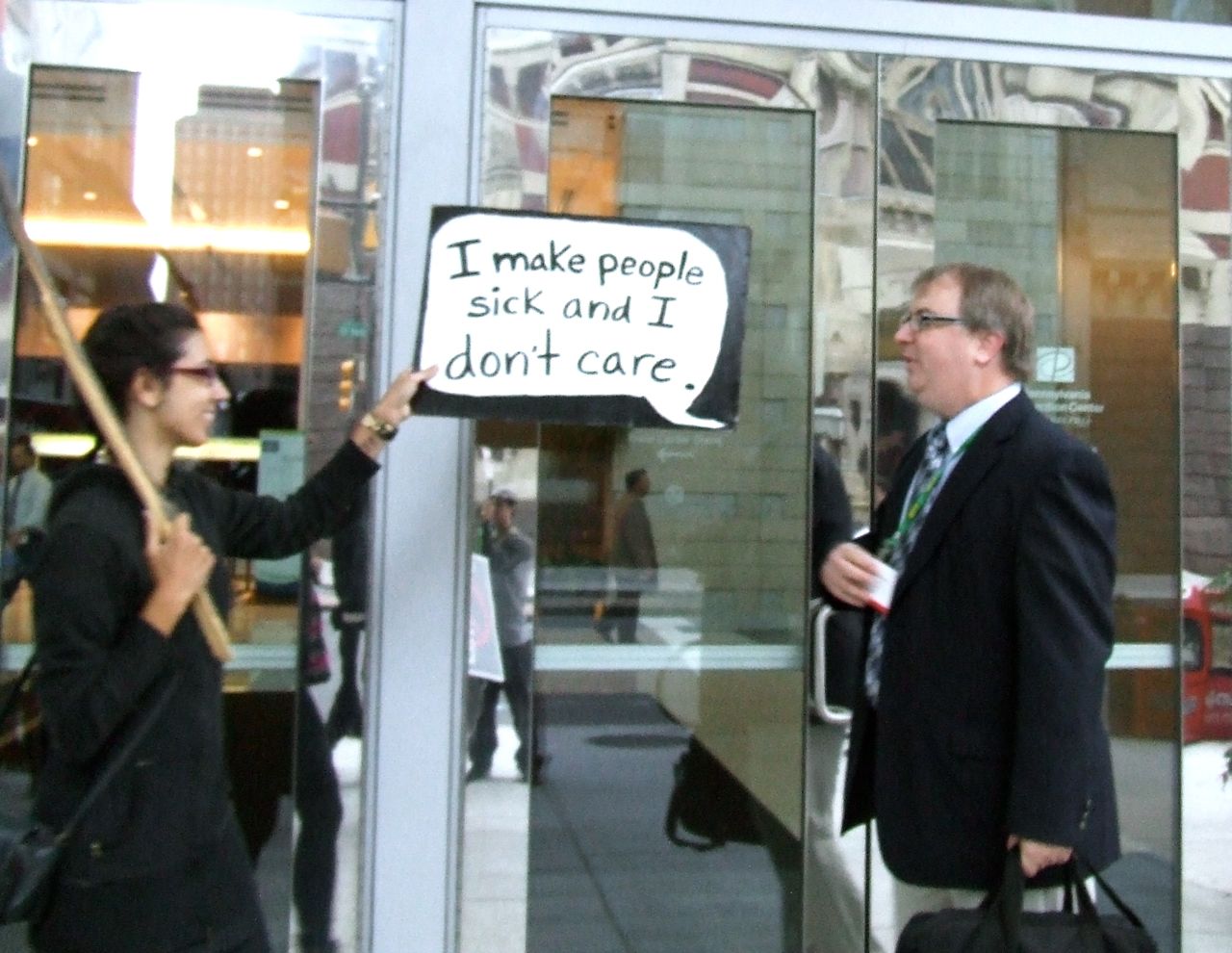
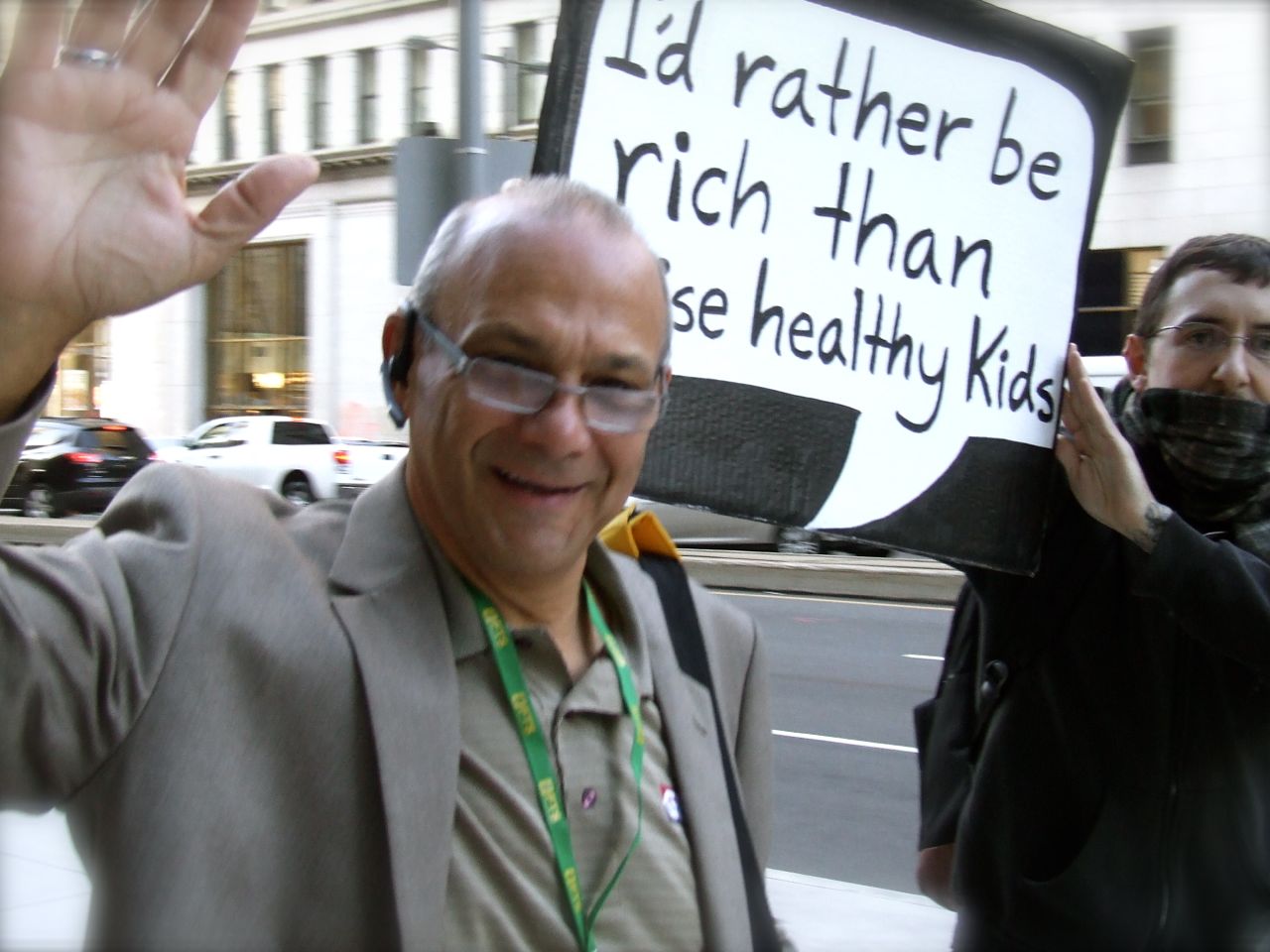
It was 7:00 am, the last day of the Marcellus Shale Coalition’s annual convention in Philadelphia, when a group of 40 or so people gathered to meet the gas industry face to face. “We just wanted to see what they had to say for themselves” said one of the protesters. It turned out the industry delegates weren’t so shy for talking after-all.

(scroll down for full gallery)

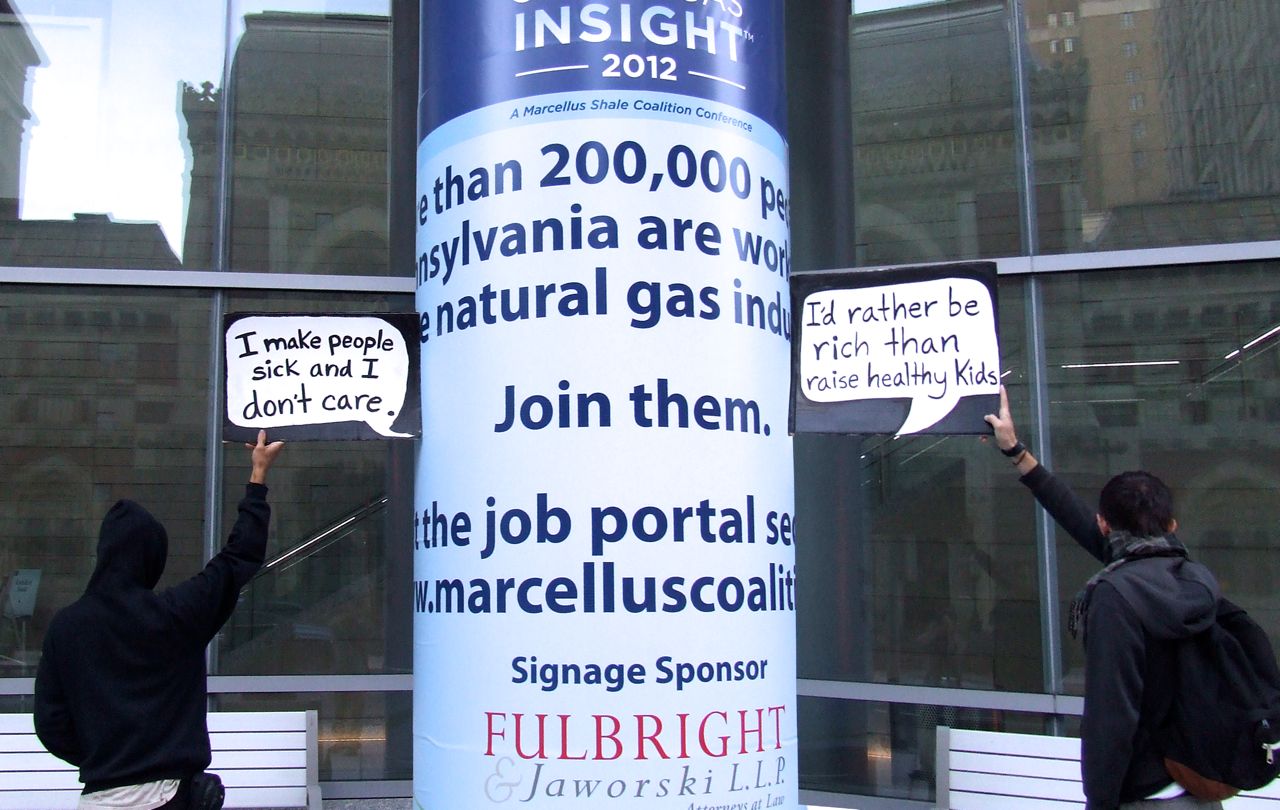
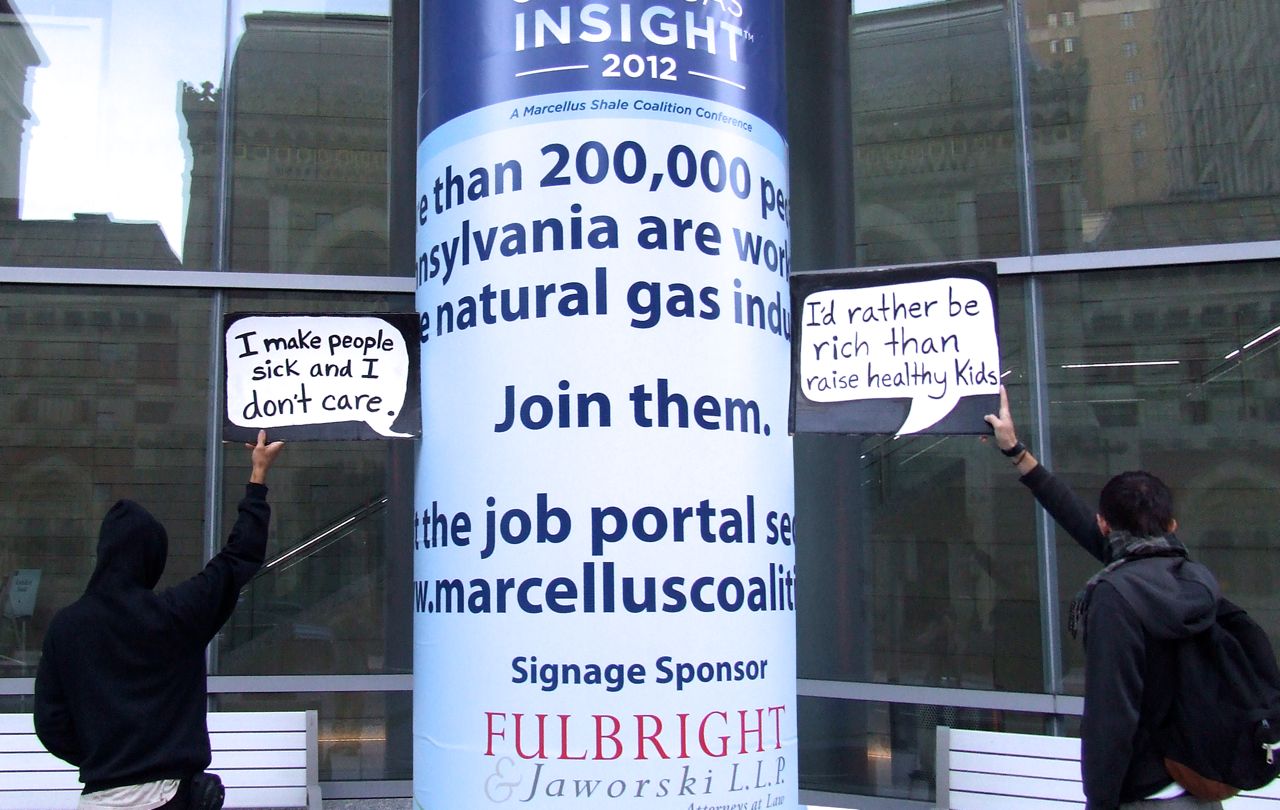
The convention was called “Shale Gas Insight” and took place in the fortified Philadelphia Convention Center in downtown Philly. The convention  hosted hundreds of vendors and representatives from just about every company involved in hydraulic fracturing, or “Fracking” as some call it. You can read about the workshop titles here; http://shalegasinsight.com/conference-schedule/

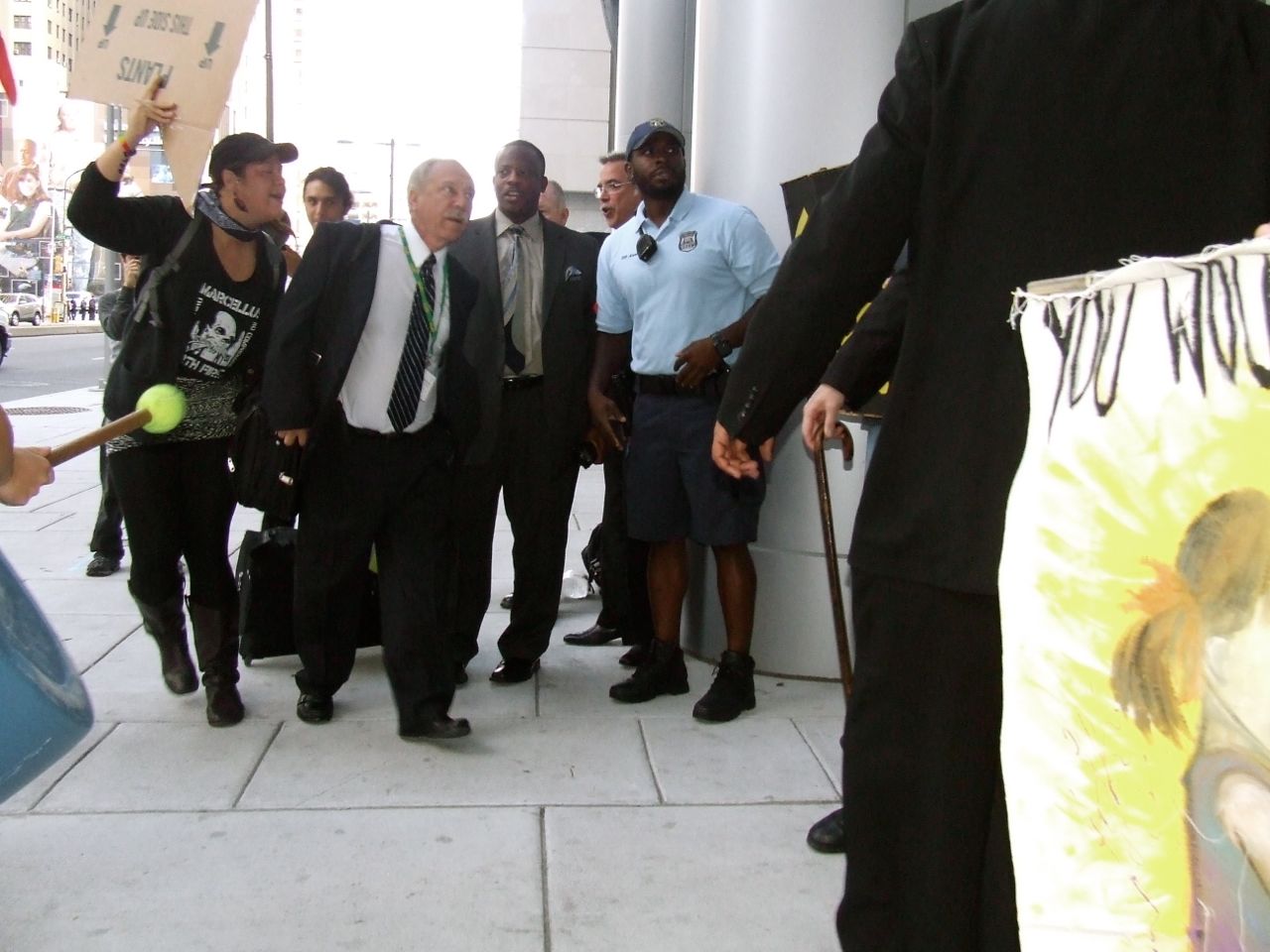
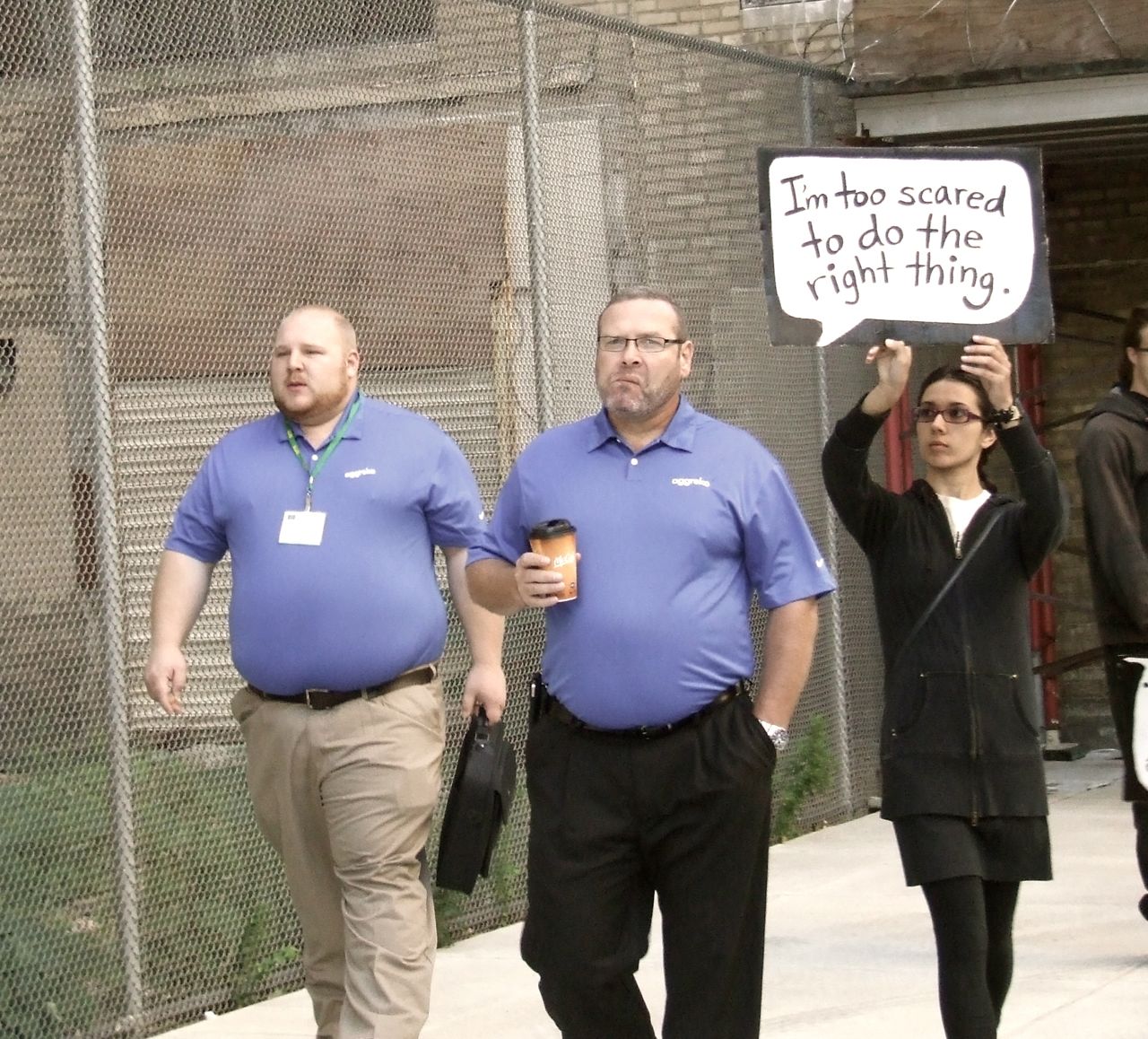
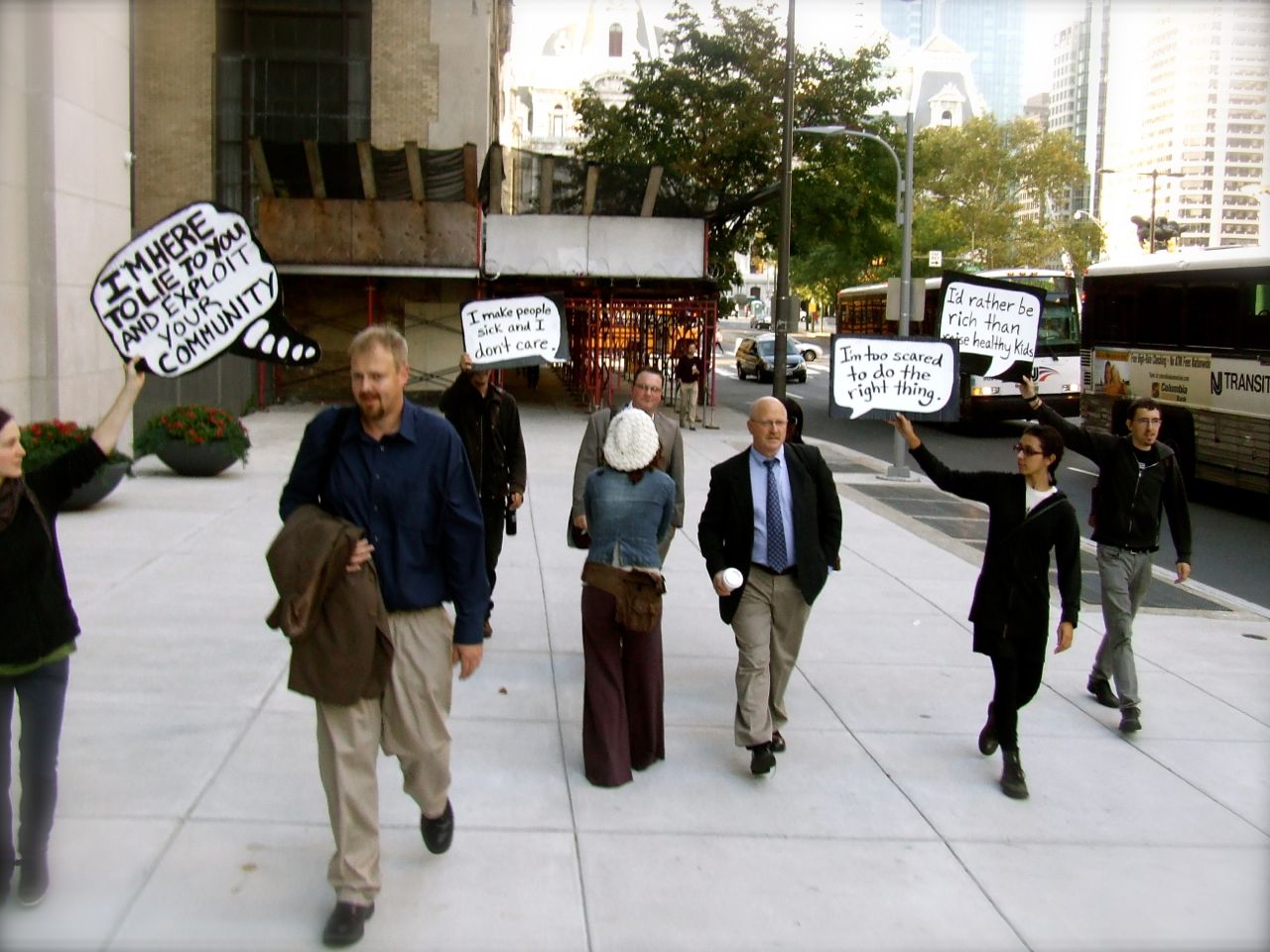
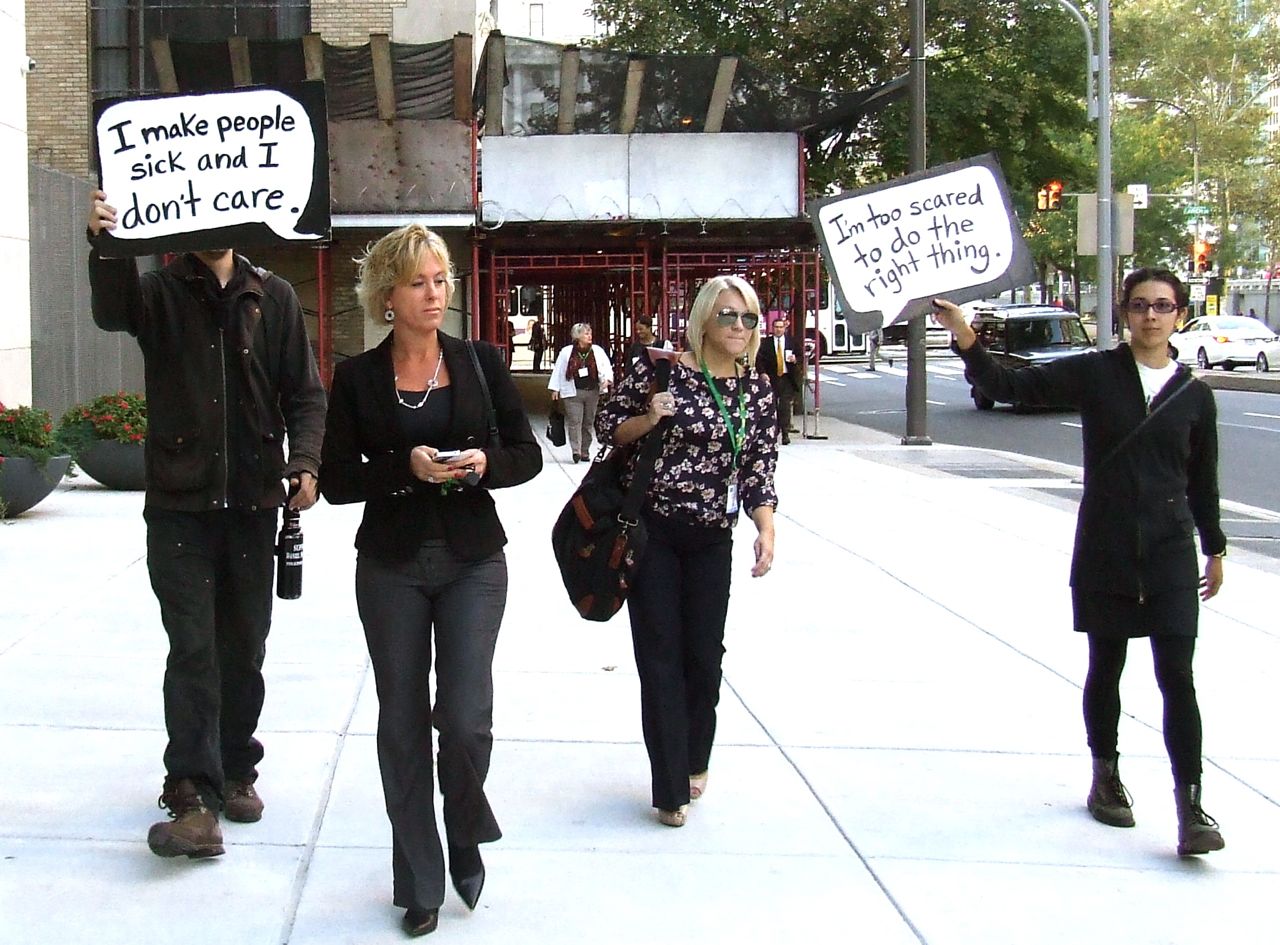
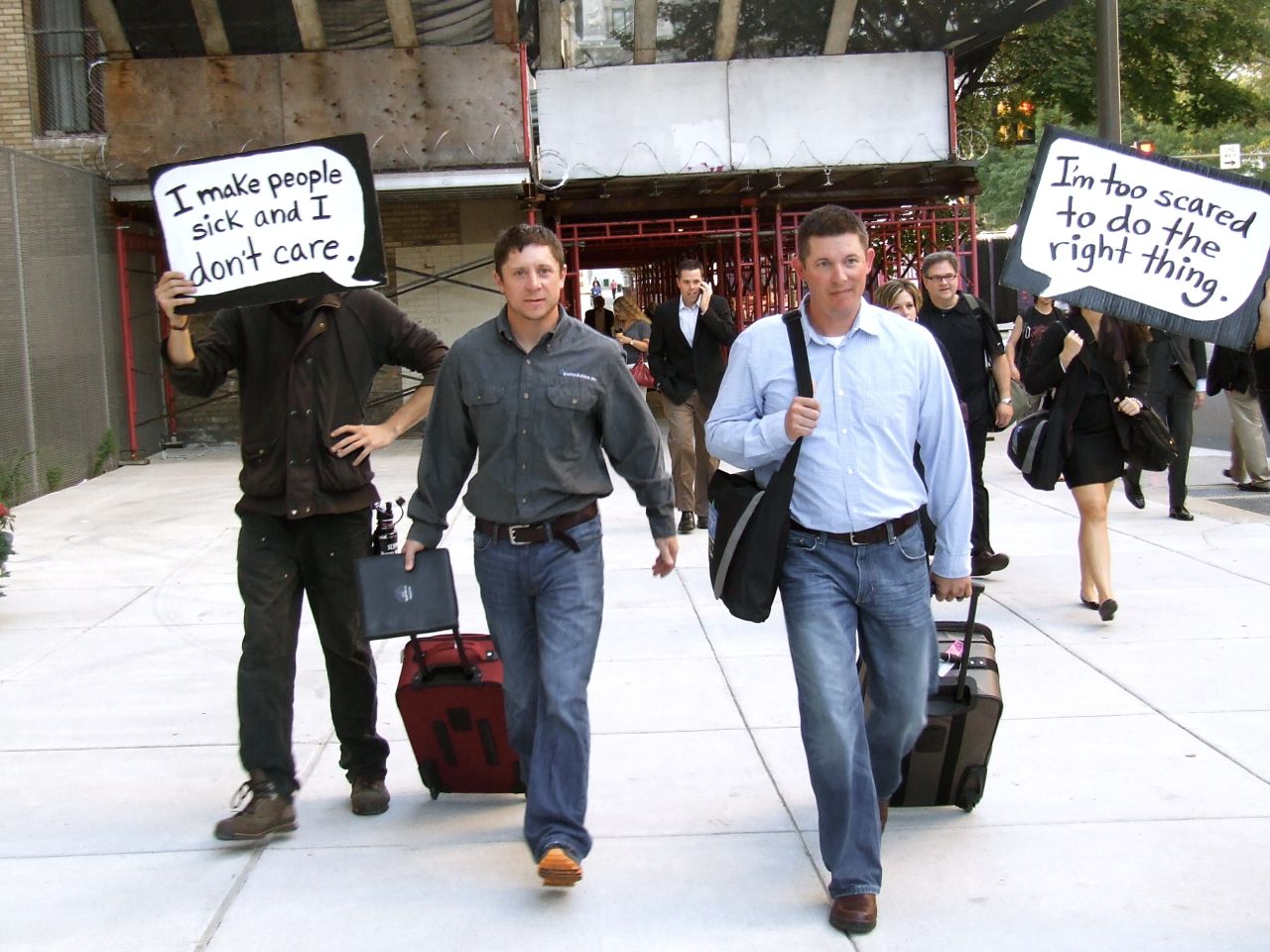
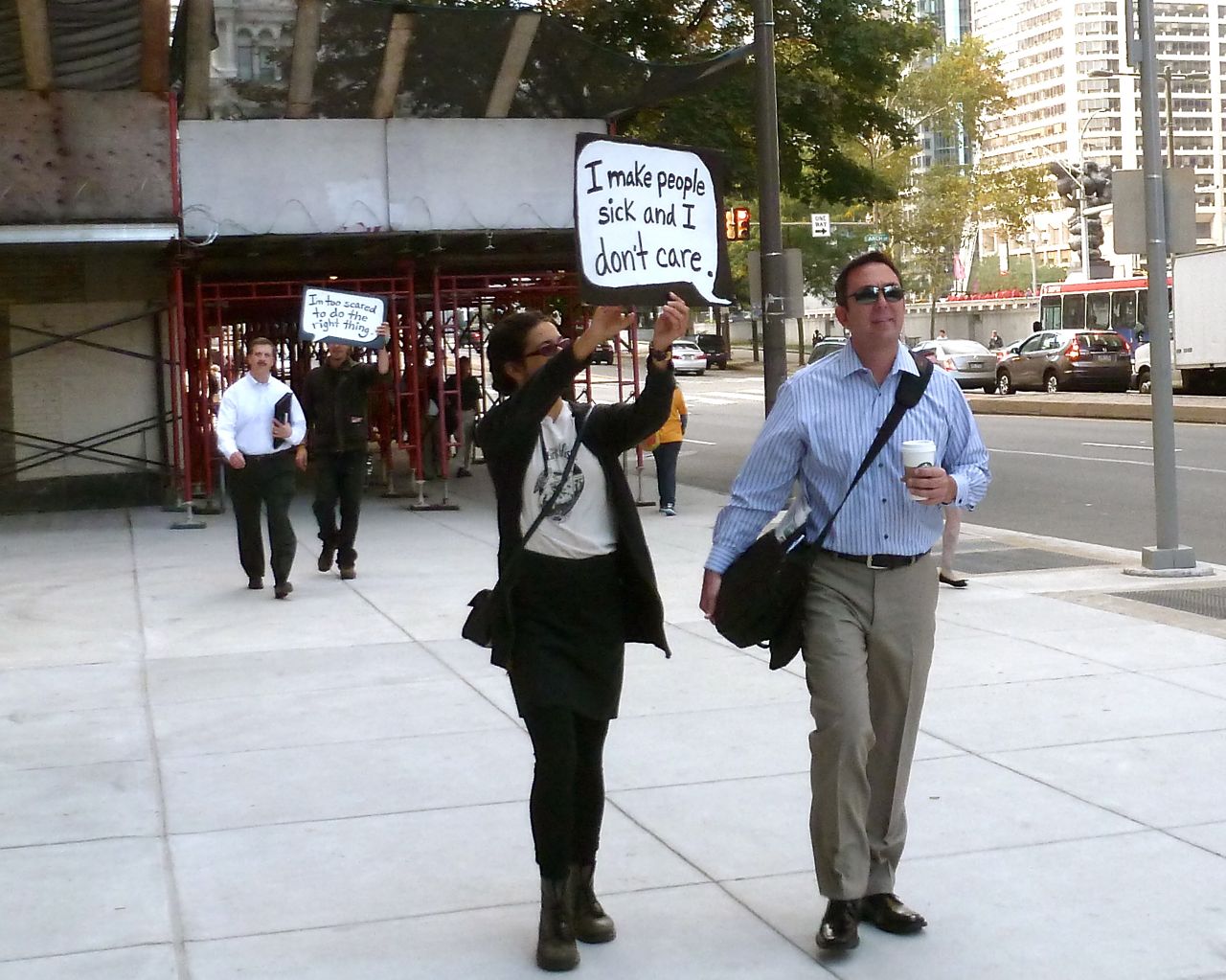
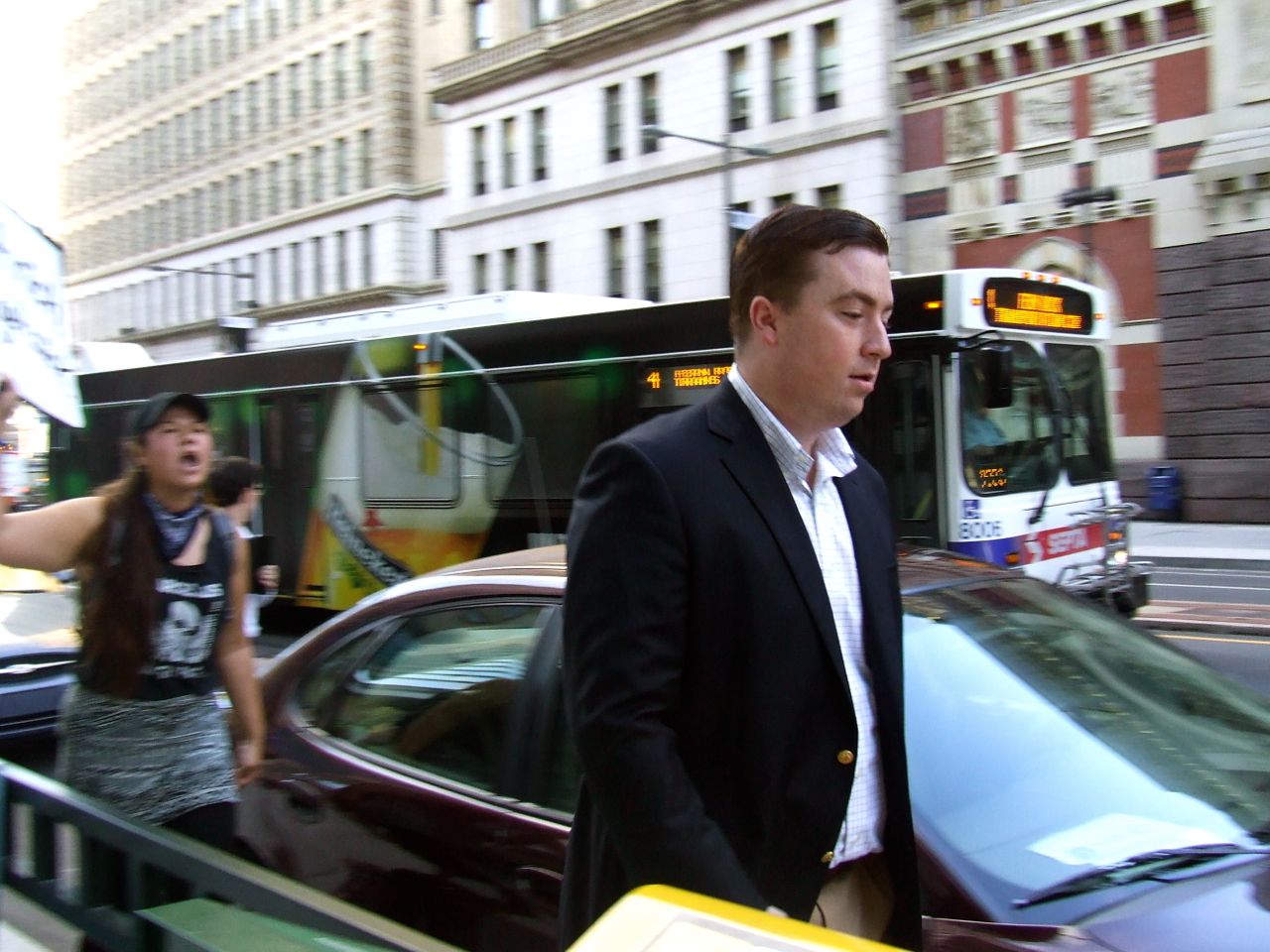
The action, called “Sunrise Intervention” by local organizers, succeeded in bringing people together to face the industry on their own terms. For hours, industry representatives were forced to pass through an aggressive picket at the front entrance with banners, flags, drums, and chants. This was preceded by a “walk of shame” in which the delegates were verbally confronted for an entire city block in public view. As they approached the convention center, people physically blocked them from entering. To say the least, it became a venue for interesting conversation.

“I really valued the honesty on behalf of the delegates” said a bystander. At one point a group of uniformed charter school kids joined in the fun, taking pictures–laughing and pointing.

“We were hoping the delegates would get arrested for collaborating in environmental crimes” said one of the picketers when the police arrived. But they didn’t.

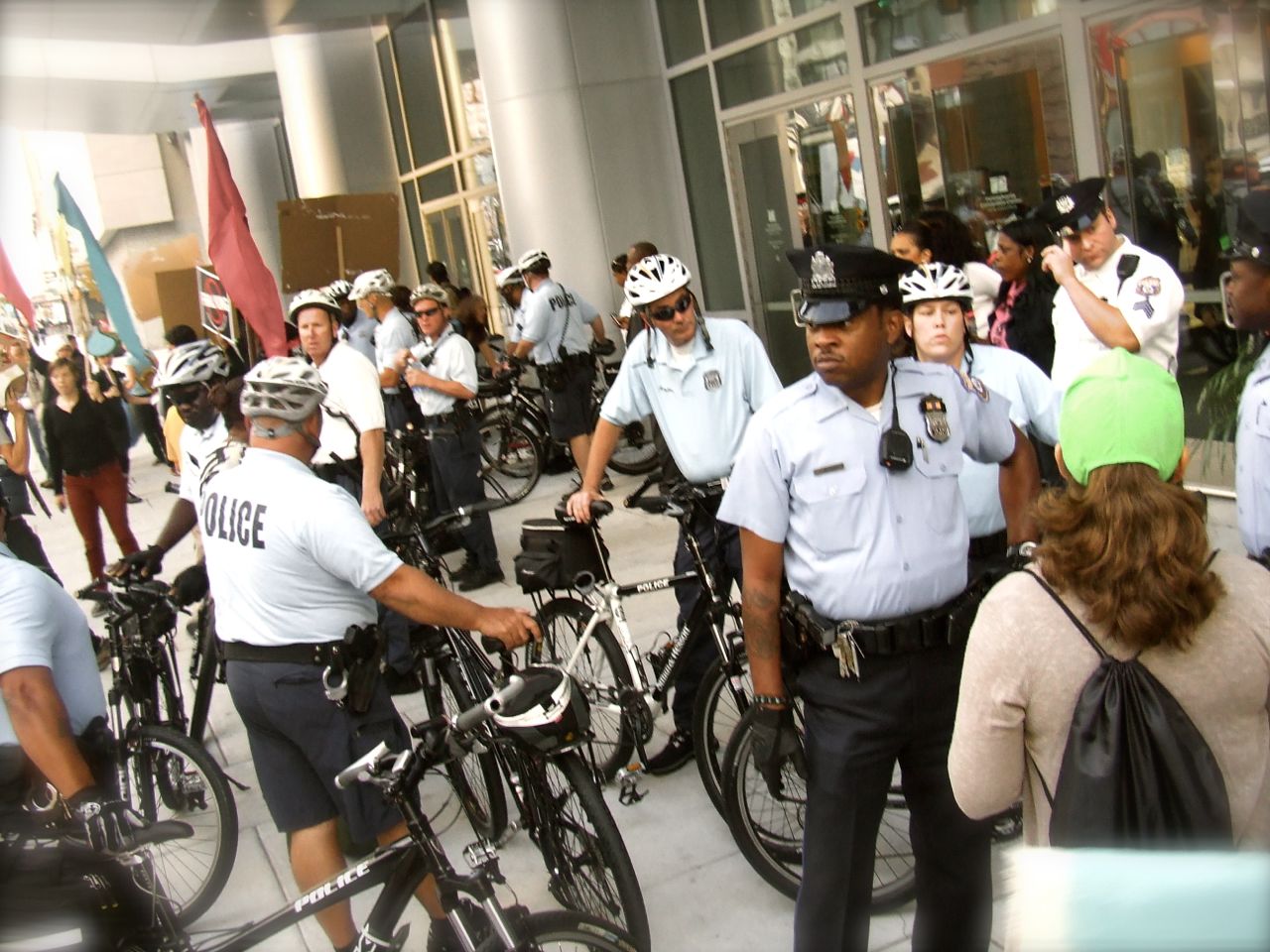
“I’m too scared to do the right thing” whispered an officer from his car. The police then separating the picket onto either side of the main entrance, ushering delegates off the sidewalk into the road.

Although the police established a ritualistic presence, they didn’t do much to protect the delegates from the angry crowd. Perhaps they weren’t too impressed with the gas industry’s policy on public health.

The protest lasted a couple more hours, police & all, making it difficult for delegates to reach the door. Once most of the delegates were inside, the protest ended in an un-permitted march through downtown Philadelphia to meet up with an ACT UP rally and street theater performance.


(USA) Tar Sands Blockade Launces 8-Person Treesit

Gandalf hates tar sands.

The ongoing Tar Sands Blockade campaign has launched an 8-person treesit in the planned path of the under-construction Keystone XL tar sands pipeline. “Construction cannot proceed until tree-sitters descend and TransCanada clear-cuts through hundreds of trees to make way for the toxic tar sands pipeline,” Tar Sands Blockade announced.

The treesitters have announced their intention to remain in the trees until the Keystone XL pipeline is stopped for good.

Tar Sands Blockade is an ongoing campaign to stop the construction of TransCanada’s Keystone pipeline through Texas and Oklahoma. The pipeline is meant to carry oil from Alberta’s tar sands to the US.

There are still plenty of ways to get involved in this campaign. Follow news of the treesit here. For some ways to get involved, read this call to action or visit Tar Sands Blockade.


(Brazil) Fishermen Paralyze Construction of the Belo Monte Dam

Fishermen form a line to block

Fishermen form a line to block access to the construction site of a coffer dam on the Xingu River, Sep. 2012

From International Rivers:

On Wednesday [Sep. 19], a group of about 50 fishermen prevented a ferry from transporting machines and workers to a coffer dam being built for the Belo Monte Dam Complex, setting up a protest camp on one of the main islands of the Xingu River near the construction site.

After assembling, the protesters decided to remain indefinitely in place, and called on Norte Energia and IBAMA to immediately negotiate compensation for the loss of ecologically sensitive fish species that the fishermen have suffered as a result of the coffer dam’s construction.

"The fishermen have seen a 50% reduction in fisheries production. The river is drying up. Several species failed to spawn over the last year due to Norte Energia's intervention in the river.  A lot of fish are dying, and in some locations the company wants to impede the fishermen from accessing the river," explained Ana Barbosa Laide of the Movimento Xingu Vivo, who has accompanied the mobilization.

On Wednesday night, a group of fishermen who depend on ornamental fish from the river joined the group, demanding that environmental agency IBAMA guarantee the survival of species that are endemic to the area where the dam is being built, saying that otherwise, the species will go extinct. "They argue that if these species die off, IBAMA should release its population of collected ornamental fish in order to save the economic livelihoods of the fishermen," explained Laide.

According to the movement leaders, the occupation protests the decision of IBAMA to allow Norte Energia to permanently close the river. During this process, the fishermen were not consulted nor informed about how they could continue their economic activities, or how they could continue to transport their boats on the river past the dam. "The river is ours and we came to fish. You can't just prohibit fishing, we have to work, "says Lucio Vale, President of the Fishermen's Colony of Altamira.

On the evening of the 19th, civil police officers, accompanied by members of Norte Energia, were at the demonstration site. According to agents, they were assured that the protest was non-violent.

(Peru) Despite Promised Reforms, Another Mine Resister Killed in Peru

Peruvian pol

Peruvian police are becoming notorious for using lethal force against protesters. In this picture, police respond with force to protests which rocked the Amazon region in 2009.

Despite government promises of reforms in the way natural resource concessions are handled, another anti-mines protester has been killed in Peru. This marks the 19th person killed in a natural resource-related conflict since President Ollanta Humala took office in July 2011.

Clashes between police and protesters broke out in the Ancash region on Wednesday Sep. 19, when police tried to break up a blockade of a road leading to Barrick Gold’s Pierna mine.  Locals blame the mine for contaminating their drinking water and using up their water supply.

The company temporarily shut down the mine following the killing.

The violence came even as Peru’s Congress debates reforms to the way mining concessions are handled, including the creation of a new oversight body to evaluate mining concessions, separate from the agency responsible for promoting them.

The government has also been touting its new policy of consulting with affected communities regarding oil and gas concessions in the Amazon, but communities in resistance to such projects have expressed skepticism about what such consultation will actually mean.

“Which communities will be consulted? What are the terms and conditions? Indigenous peoples need answers to these questions, because there is a great deal of mistrust,” said congressmember Verónika Mendoz.

“We think it is good that they will hold a consultation. But how can they remedy all of the damage they have done to us in the last 40 years in just a short time? They need to explain that to us first,” said Achuar indigenous leader Andrés Santi, president of the Federation of Native Communities of Corrientes.

Mining Company and Government Thugs Attack Guatemalan Mine Resisters

On September 17 and 18, community members from Mataquescuintla, Jalapa and San Rafael Las Flores, Santa Rosa, Guatemala protested against the ongoing development of a mining project in their communities. In response to the first of these protests, provocateurs attacked both police and community members with stones. In response to a peaceful blockade outside the mining site, protesters were “attacked without warning by members of the mine’s private security agency, the National Civil Police and the army, using tear gas cannons, firearms and rubber bullet guns. Security agents attacked from inside the mine, with trained attack dogs. The Police cornered the unarmed protestors, and the army surrounded them, crouched and at the ready. The display of repressive force had all the characteristics of military counter-insurgency tactics that we had thought belonged to the past, including the bad intentions, brutality and cowardice that so characterize the tactics of the National Army.”

Following the attack, military helicopters began flying over the resisting communities, “like in the old days of the armed conflict.”


Energy Industry Crackdown, Global Protest Frackdown

Yesterday, while Shell announced suing Greenpeace International in an attempt to have the organization banned from protest within 500 meters of any Shell property in the Netherlands,  New York activist Susan Walker was sentenced to 15 days in jail after she refused to pay a fine for blocking the entrance to Inergy gas facility in New York earlier this month. 

But judges and jails aren’t enough to stop a world-wide movement against the energy empire, and today marks the “Global Frackdown” with more than 100 protests against gas fracking scheduled to take place around the world. So get out there in the streets and raise some hell…

Shell sues Greenpeace to block environmental protests in the Arctic

The suit against Greenpeace Int’l argued at Amsterdam’s District Court Friday showed Shell aggressively taking the offensive to protect its $4.5 billion investment in drilling for oil in the icy Arctic waters off the coast of Alaska. A verdict is not expected for two weeks.

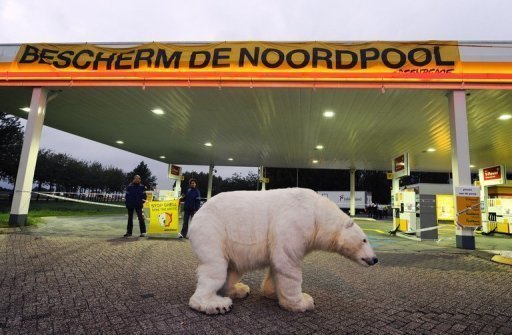
A protest at a Shell gas station in the Netherlands — with stuffed polar bear. (AFP/ANP, Marcel Antonisse)

Greenpeace has protested Arctic drilling with other stunts around the world, but the trigger for Friday’s lawsuit was a Dutch demonstration on Sept. 14, in which Greenpeace protesters blocked more than 70 Shell gas stations in the Netherlands for several hours, draping banners and clamping gas pump handles together with bike locks.

Fifteen people were arrested. Shell has not put forward any estimate of how much damage it suffered.

“Because Greenpeace International doesn’t operate alone, but is the spider in the web of national and local organizations, our request includes that Greenpeace inform its satellite organizations that it no longer supports protests that are solely directed at causing Shell economic damage or that bring human lives and the environment in danger,” Shell’s complaint said.

Protest backs jailed environmental activist in Inergy Blockade

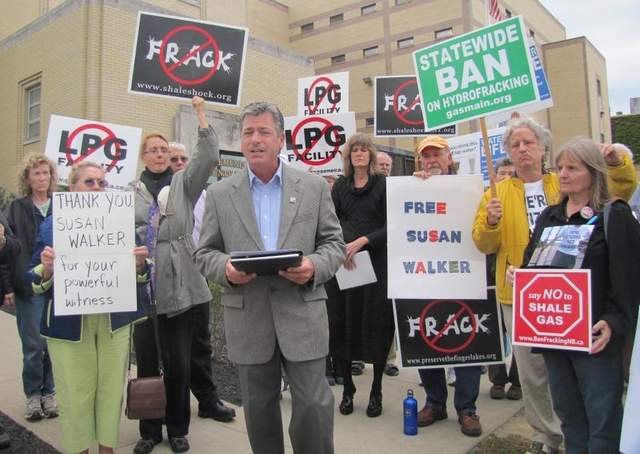
Joseph Campbell, president of Gas Free Seneca, speaks Friday outside the Chemung County Jail. He said local residents turned to civil disobedience because their petitions, letters and attending hearings failed to get their voices heard on Inergy Midstream’s proposed storage facility.

Nearly 30 people slammed the energy industry outside the Chemung County Jail on Friday but praised the Dundee woman held inside for refusing to pay a fine for trespassing at a proposed gas storage facility.

They demonstrated in support of Susan Walker, 53, who pleaded guilty to trespassing Wednesday night before Reading Town Justice Raymond H. Berry and got 15 days in jail after she refused to pay the $275 fine.

“We’re in agreement with Susan’s words when she spoke in the courthouse, ‘If I were a corporation, I would not be going to jail,’” said one of four speakers, Sandra Steingraber, an Ithaca College scholar in residence who co-founded the coalition New Yorkers Against Fracking.

Fracking Protests Planned Around The World By GlobalFrackdown Campaign

More than 100 protests against the natural gas drilling process known as fracking are scheduled to take place around the world on Saturday, building on public concerns but also using an overly simplified message to spur outrage.

The GlobalFrackdown website and campaign was developed by Food & Water Watch, a Washington, D.C. nonprofit that was once part of Ralph Nader’s Public Citizen group. The campaign claims that fracking “has already damaged communities and ruined lives. It pollutes water and makes people sick.”

(USA) Another Lockdown Against the Keystone Tar Sands Pipeline!

Protesters locked to equipment clearcutting forests to make way for the Keystone tar sands pipeline. Winnsboro, TX, Sep. 19 2012

Tar Sands Blockade protesters have locked themselves to a wood chipper and skidder being used to clear-cut trees near Winnsboro, TX to make way for the Keystone XL tar sands pipeline. This is the fourth action to date in the Tar Sands Blockade campaign.

The Tar Sands Blockade campaign is active and ongoing. Calls to join the action have been put out both by the main group and by “a small crew of Earth First!ers and eco-anarchists engaged in tactical elements of the larger Tar Sands Blockade campaign.”

To find out more, watch this Tar Sands Blockade action video, and visit tarsandsblockade.org and stoptarsands.org.


BBC Investigates Opencast Mining

THE  LOOSE ANTI OPEN-CAST NETWORK

BBC’s COUNRTYFILE PROGRAMME INVESTIGATES WHY A REMOTE HAMLET IS ON THE FRONT LINE OF A PLANNING BATTLE OF NATIONAL IMPORTANCE.

THE  LOOSE ANTI OPEN-CAST NETWORK

BBC’s COUNRTYFILE PROGRAMME INVESTIGATES WHY A REMOTE HAMLET IS ON THE FRONT LINE OF A PLANNING BATTLE OF NATIONAL IMPORTANCE.

A small village, of just 75 households, is all that may stand between preserving large sections of the English countryside and the expressed desire of the UK Mineral Extraction Industry to see more permissions given to exploiting England’s mineral resources in areas that are more environmentally sensitive and / or are closer to where people live.

The unfortunate village is Halton Lea Gate, located on the Cumbria / Northumberland border and near an Area of Outstanding Natural Beauty. A team from the BBC’s Counrtyfile programme was filming there recently to investigate why this spot now finds itself on the front line of a national planning controversy.

 In early August, after a Public Inquiry into an Appeal to grant permission for an Opencast Mine, the Inspector found in favour of the Applicant. The sting in the tale, for all other communities in England, is the reasoning given by the Inspector to allow the Appeal. His reasoning set a new case law precedent, it is argued, which affects all future mineral planning applications in England.

 What the Applicant has to replicate in the future, is the argument used here: that there is a national need for the mineral in question, in this case coal. If they can persuade the Planning Authority (or the Inspector, if the Application has gone to an Appeal) that this is the case, then ‘great weight’ has to be attached to this claim. So much weight it seems, that this factor alone may override all other considerations.  (1)

This situation has arisen as a consequence of the Government implementing the new National Planning Policy Framework. In the time leading up to the 2010 election, lobbying organisations such as Coalpro and the CBI lobbied long and hard for a relaxation of the planning rules for mineral extraction. (2) It seems, from this example, the first Public Inquiry for mineral extraction to be held under the new rules, that their efforts have been rewarded. The advice of the Inspector has now gone to the Department of Communities and Local Government to be confirmed or rejected by a Minister.

The BBC came to investigate the issue and explore why local people have taken on the task of raising £40,000 so that they can mount a Judicial Review over the decision. If local people are successful in raising the money and mounting a successful action, they may have prevented the floodgates from opening and saved England from experiencing a rash of mineral planning applications for developing swathes of the countryside. This is now a Public Appeal, and donations can be made payable to The North Pennines Protection Group, who have been one of the local groups who have opposed this Application

An e petition to the Government has been started about this planning decision and its implication for similar planning decisions elsewhere which can be signed by following this link:

http://epetitions.direct.gov.uk/petitions/36985

Steve Leary for the Loose Anti Opencast Network commented

“ LAON was contacted by the BBC in the lead up to filming for the Countryside programme. We are delighted to be able to cooperate in the making of the programme and show why we argue that this is an issue of national importance which will affect other communities up and down the Country if the decision is not changed.

We know of five other opencast mine applications, near Smally in Derbyshire (George Farm) , Kirklees, Sth. Yorkshire (Dearne Lea), Trowel in Nottinghamshire (Shortwood Farm) , Whittonstall in Northumberland ( Hoodsclose) and Gateshead  (Birklands) that will be affected by this decision if it stands.

In addition, we are aware of three other sites where a potential applicant is making the final decision to proceed with a full application in Gateshead,   Marley Hill Reclamation) , Derbyshire ( Hill Top Project near Clay Cross) and Northumberland  (Ferneybeds near Widdrington Station, Northumberland) which might also be affected.

The issue here though, we believe, goes way beyond opencast mining. It’s about relaxing the rules around all forms of mineral extraction from pits for sand, gravel and clay to quarries for granite and limestone to opencast mines for coal. This is what the industry lobbied for and now, it seems, the Government has delivered, if it upholds the Inspector’s recommendation to approve the Application and the Judicial Review fails. We therefore urge people everywhere, who cherish and love our countryside, to support both the petition and the public appeal for money to take this case to a Judicial Review.”

The Counrtyfile edition of the programme is to be broadcast on Sunday 30th September 2012. It will include a 12 minute section on the Halton Lea Gate issue.

———————————————————————————-

References

1)   For more information on the significance of this decision as far as opencast mine applications are concerned see  LAON PR7 here

http://nottingham.indymedia.org/articles/2754

2)   Evidence about the lobbying to relax these planning rules can be found here.

Briefing Note E2 “Energy Policy and the Proposed National Planning Policy Framework,” MOPG 2011  @

http://www.leicestershirevillages.com/measham/mopg-briefing-notes-series.html

——————————————————————-

ABOUT LAON

The Loose Anti-Opencast Network (LAON) has been in existence since 2009. It  functions as a medium through to oppose open cast mine applications through which any person / group can communicate ideas, information, requests for information and possibly concerted actions if we find a target. In addition feel free to invite any other person / group who oppose opencast mining applications, to join the network so that it grows. At present LAON links individuals and groups in N Ireland, Scotland, Wales, Northumberland, Co Durham, Leeds, Kirklees Nottinghamshire, Derbyshire, Leicestershire and Walsall.

You can now follow LAON on Twitter @ https://twitter.com/Seftonchase

Anti Opencast Coal March in Clay Cross

A march is taking place on Saturday 22nd September to show the strength of opposition to any proposal to seek to opencast mine on the Hilltop Project site. For more info see

http://nottingham.indymedia.org.uk/events/2774

A march is taking place on Saturday 22nd September to show the strength of opposition to any proposal to seek to opencast mine on the Hilltop Project site. For more info see

http://nottingham.indymedia.org.uk/events/2774

(India) Police Kill Anti-Nuke Protester in India, Resistance Continues to Grow

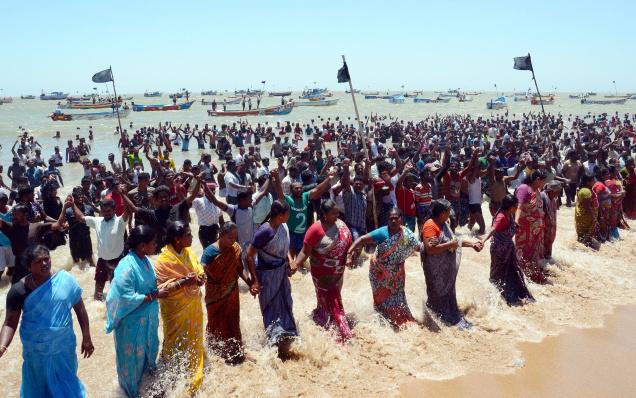
A group of fisherfolk staging “jal satyagraha” in the sea, against the Kudankulam nuclear power project at Veerapandianpattinam coast in Tuticorin district on Friday. (Photo: N.Rajesh)

Despite the killing of an anti-nuclear protester by police on Monday, hundreds of protesters forming a human chain stood in sea waters today, for the second day in a row, demanding a halt to preparations for fuel loading into the reactor of Kudankulam Nuclear Power Project (KKNPP) in Tuticorin district.

The Hindu.com reported that women and men would stand in the sea waters for two hours in turns. Pushparayan, leader of the People’s Movement Against Nuclear Energy (PMANE) has been spearheading the year-long agitation.

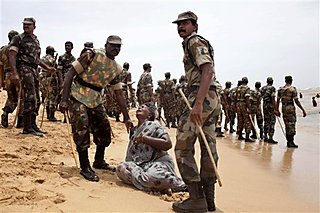
Indian police officers detain a protestor after they baton charged residents protesting against the Russian built Kudamkulam nuclear plant on the Bay of Bengal coast at Kudamkulam, Tamil Nadu state, India, Monday, Sept. 10, 2012. (AP Photo)

The Coast Guard aircraft and ships maintained surveillance at sea off nearby Idinthakarai as the villagers stood in waist and neck deep water.

Taking cue from a similar protest demanding land as compensation and reduction of Omkareshwar Dam recently by villagers of Khandwa district in Madhya Pradesh, PMANE launched their jal satyagraha (water civil disobedience) on Thursday, marking a new turn in their agitation, which was intensified after preparations for fuel loading into the plant was announced.

More than 4,000 police personnel, bolstered by the paramilitary Rapid Action Force, continued to maintain a strict vigil, having almost sealed the entire Kudankulam town.

Meanwhile, police have been seeking to arrest S.P. Udayakumar, the convener of PMANE, in attempt to quell the protests. They have already arrested a close associate of Udayakumar in Chennai last week for trying to “instigate” the fishermen to join the stir against Nuclear Power Project.

Mr. Udayakumar had allegedly announced that he would surrender on Tuesday night, but seems to have changed his mind.  Police said they would continue their search.

Earlier this week, state officials say Indian police fired at protesters near this nuclear power plant being constructed in southern India, killing one person.

The Tamil Nadu state government says police fired Monday to disperse about 2,000 people who were demonstrating against the loading of nuclear fuel in the Russian-built reactor. It says the protesters threw stones and sticks at police near the Kudankulam Project, and five officers were injured.

Construction of the plant has been delayed by protests in the past year by residents and anti-nuclear groups concerned about safety following the Fukushima nuclear power plant disaster in Japan last year.

The government says the plant, about 700 kilometers (440 miles) south of Chennai, the state capital, will meet safety standards.

The following video shows recent coverage of the jal satyagraha actions against hydroelectric dams which have become an inspiration to movements throughout the region: