Armed indigenous community forces Petroamazonas to abandon oil project in Ecuador

An indige­nous com­mu­ni­ty in the Ecuado­ri­an Ama­zon has won a reprieve after build­ing up an arse­nal of spears, blow­pipes, machetes and guns to fend off an expect­ed intru­sion by the army and a state-run oil com­pa­ny.

An indige­nous com­mu­ni­ty in the Ecuado­ri­an Ama­zon has won a reprieve after build­ing up an arse­nal of spears, blow­pipes, machetes and guns to fend off an expect­ed intru­sion by the army and a state-run oil com­pa­ny.

The res­i­dents of Sani Isla expressed relief that a con­fronta­tion with Petroa­ma­zonas did not take place on Tues­day as antic­i­pat­ed, but said the firm is still try­ing to secure explo­ration rights in their area of pris­tine rain­for­est.

“We have won a vic­to­ry in our com­mu­ni­ty. We’re unit­ed,” said the com­mu­ni­ty pres­i­dent, Leonar­do Tapuy. “But the gov­ern­ment and the oil com­pa­ny won’t leave us alone. “

The Kich­wa tribe on Sani Isla, had said they were ready to fight to the death to pro­tect their ter­ri­to­ry, which cov­ers 70,000 hectares. More than a quar­ter of their land is in Yasuni nation­al park, the most bio­di­verse place on earth.

Petroa­ma­zonas had ear­li­er told them it would begin prospect­ing on their land on 15 Jan­u­ary, backed by pub­lic secu­ri­ty forces.

Before the expect­ed confrontation,the shaman, Patri­cio Jipa said peo­ple were mak­ing blow­pipes and spears, try­ing to bor­row guns and prepar­ing to use sticks stones and any oth­er weapons they could lay their hands on.

“Our inten­tion was not to hurt or kill any­one, but to stop them from enter­ing our land,” he said.

It is unclear why Petroa­ma­zonas hes­i­tat­ed. The com­pa­ny has yet to respond to the Guardian’s request for a com­ment.

Locals spec­u­lat­ed that it was due to a reaf­fir­ma­tion of oppo­si­tion to the oil com­pa­ny at a marathon com­mu­ni­ty meet­ing on Sun­day.

“They’ve heard that we are unit­ed against the explo­ration so they have backed off,” said Fredy Gualin­ga, man­ag­er of the Sani Lodge. “We’re hap­py they haven’t come. Life is going on as nor­mal.”

The relief may not last for long giv­en the huge fos­sil fuel resources that are thought to lie below the for­est.

“It was a close thing, but we’re not out of the water. The oil com­pa­ny has not giv­en up. They will con­tin­ue to hound us and to try to divide the com­mu­ni­ty. But at least we have a few days respite,” said Mari Muench, a British woman who is mar­ried to the vil­lage shaman.

The elect­ed lead­ers of Sani Isla have pledged to resist offers from Petroa­ma­zonas for the dura­tion of their term.

“This pol­i­cy will remain in place dur­ing our peri­od in office. We’re com­mit­ted to that and we will do what we can to make it more per­ma­nent,” said Abdon Gre­fa, the speak­er of the com­mu­ni­ty.

The bat­tle has now moved to the judi­cial sys­tem and the court of pub­lic opin­ion. Their appeal for an injunc­tion went before a judge on Wednes­day and they are call­ing on sup­port­ers to help them build a long-term eco­nom­ic alter­na­tive to fos­sil fuels.

“We hope peo­ple will write protest let­ters to Petroa­ma­zonas, come and vis­it our lodge, pro­mote Sani, donate mon­ey to our school and projects, vol­un­teer as teach­ers or pro­vide funds to stu­dents to trav­el over­seas so they can learn what we need to sur­vive in the future,” said the com­mu­ni­ty sec­re­tary, Klid­er Gualin­ga.

18 Jan: Unevicted! Third Road Protest Camp Still in Place

PLEASE NOTE: We’re cur­rent­ly expe­ri­enc­ing prob­lems with our (out­go­ing) text mes­sag­ing.

PLEASE NOTE: We’re cur­rent­ly expe­ri­enc­ing prob­lems with our (out­go­ing) text mes­sag­ing. Until fur­ther notice, please direct all texts and calls to 07926 423 033, and check your email (assum­ing you’ve signed-up to our email list), this web-site and the Face­book page to keep up to speed on what’s hap­pen­ing.

VIDEO: https://www.indymedia.org.uk/media/2013/01//505637.3gp

The third of three protest camps (“Decoy Pond”) against the Bex­hill-Hast­ings Link Road (BHLR) remains unevict­ed today (Fri­day 18 Jan). Sup­port­ers and vis­i­tors are wel­come! See maps above and below for loca­tion and direc­tions.

Two cam­paign­ers occu­py­ing trees at the now-evict­ed “Base Camp” were arrest­ed yes­ter­day (Thurs­day 18 Jan­u­ary), bring­ing the total num­ber of arrests since the peace­ful protests began on 14 Decem­ber to nine­teen.

Please note: “Decoy Pond” camp is a bit trick­i­er to get to than the (now evict­ed) main camp was. In par­tic­u­lar, at present you need to be fair­ly steady on your feet to nav­i­gate the rough and icy ter­rain.

Press release Combe Haven Defend­ers [1]
Fri­day 18 Jan­u­ary
Con­tact 07926 423 033

UNEVICTED! THIRD ROAD PROTEST CAMP STILL IN PLACE, AS LOCAL GRANDMOTHERS MOBILISE TO SUPPORT PROTESTS
Cam­paign­ers still in trees as total num­ber of arrests reach­es nine­teen

Fri­day 18 Jan­u­ary, Crowhurst: The third of three protest camps (“Decoy Pond”) against the Bex­hill-Hast­ings Link Road (BHLR) remains unevict­ed today (18 Jan), as local grand­moth­ers mobilise to show their oppo­si­tion to the Road and sup­port for the peace­ful protests.

Fol­low­ing their suc­cess­ful “Grannie Tree” action – pho­tos from which appeared in the Dai­ly Tele­graph among oth­er places [2] – local grand­moth­ers are organ­is­ing a sec­ond “Grannies Pho­to­shoot” against the Road this Sat­ur­day (19 Jan), meet­ing at 12.45pm by the Recre­ation Ground near The Plough pub in Crowhurst (TN33 9AW) [2].

Two cam­paign­ers occu­py­ing trees at the now-evict­ed “Base Camp” were arrest­ed yes­ter­day, bring­ing the total num­ber of arrests since the peace­ful protests began on 14 Decem­ber to nine­teen.

Like the two camps that have already been evict­ed this week, “Decoy Pond” is locat­ed on the pro­posed route of the BHLR (see foot­note [3] for maps and loca­tion).

The peace­ful protests against the road– which have now been run­ning for over a month – have seized nation­al atten­tion over the past week [4]. Tree-felling work for the road start­ed on 14 Decem­ber 2012 and rep­re­sents the first sig­nif­i­cant work on the high­ly-con­tro­ver­sial 3 mile £100m road, one of over forty “zom­bie roads” that were declared dead years ago but have now been resus­ci­tat­ed as part of as part of Britain’s largest road-build­ing pro­gramme in 25 years [5, 6].

Gabriel Car­lyle, a spokesper­son for the Combe Haven Defend­ers: “Despite the freez­ing tem­per­a­tures – and the mas­sive resources deployed against them by East Sus­sex Coun­ty Coun­cil – cam­paign­ers are still occu­py­ing the trees along the route of the BHLR. The last month of protests are only the begin­ning of a sus­tained cam­paign of peace­ful resis­tance to this envi­ron­men­tal­ly dis­as­trous £100m white-ele­phant project.”

Con­tact 07926 423 033

NOTES
[1] www.combehavendefenders.org.uk
[2] https://combehavendefenders.wordpress.com/2013/01/17/sat-19-jan-grannies-photoshoot‑2/
[3] Near­by post­code TN33 9AY. See maps above.
[4] http://combehavendefenders.wordpress.com/recent-media-coverage/
[5] See ‘Con­tro­ver­sial ‘zom­bie roads’ scheme to be resus­ci­tat­ed’, Guardian, 10 Octo­ber 2012, http://tinyurl.com/zombieroads
[6] http://bettertransport.org.uk/media/26-Oct-roads-report

17 Jan: Protest camp eviction enters second day!

[Update, 5pm, Thurs­day 17 Jan­u­ary: “Base camp” final­ly evict­ed this morn­ing. “Decoy Pond” camp still unevict­ed and acces­si­ble.]

[Update, 5pm, Thurs­day 17 Jan­u­ary: “Base camp” final­ly evict­ed this morn­ing. “Decoy Pond” camp still unevict­ed and acces­si­ble.]

The sec­ond day of the evic­tion of the anti-road protest camps in Crowhurst (“Base Camp” and “Decoy Pond” camp – see maps below) has begun this morn­ing, with activists still locked-on up trees and down tun­nels.

Please protest, sup­port and pub­li­cise!

As at 9.33am: access to the “Decoy Pond” camp is still pos­si­ble; “Base Camp” is now sur­round­ed by fenc­ing, but activists are on the periph­ery and a legal observ­er is still on site inside the cor­don. Five peo­ple were arrest­ed yes­ter­day (Wednes­day 16 Jan­u­ary), of whom 4 have now (9.33am, Thurs­day 17 Jan) been released.

Please note: This is only the end of the begin­ning for the protests against the Bex­hill Hast­ings Link Road (BHLR)! We urgent­ly need to replen­ish our finances fol­low­ing the last month of protests, so please con­sid­er giv­ing a dona­tion, using the “donate” but­ton on our web-site and Face­book page, if you are able.

Press release Combe Haven Defend­ers [1]
Thurs­day 17 Jan­u­ary
Con­tact 07926 423 033

ROAD PROTEST EVICTION ENTERS SECOND DAY AS LAWYERS SEEK 1066 INJUNCTION
Cam­paign­ers in trees and tun­nels as total num­ber of arrests reach­es sev­en­teen

Thurs­day 17 Jan­u­ary, Crowhurst: The evic­tion of two protest camps against the Bex­hill-Hast­ings Link Road (BHLR) enters its sec­ond day today, as lawyers seek a halt to prepa­ra­tions for the Road on the grounds that Combe Haven (where the camps are sit­u­at­ed) may be the site of the Bat­tle of Hast­ings.

Five cam­paign­ers were arrest­ed dur­ing the first day of the evic­tion yes­ter­day, Wednes­day 16 Jan­u­ary. Oth­er cam­paign­ers are still locked-on up trees and down tun­nels at the two camps.

The camps, which have been in place since 21 Decem­ber, are locat­ed on the pro­posed route of the BHLR close to Adam’s Farm, Crowhurst [2].  The peace­ful protests against the road– which have now been run­ning for a month, with 17 arrests – have seized nation­al atten­tion over the past week [3].

Tree-felling work for the road start­ed on 14 Decem­ber 2012 and rep­re­sents the first sig­nif­i­cant work on the high­ly-con­tro­ver­sial 3 mile £100m road, one of over forty “zom­bie roads” that were declared dead years ago but have now been resus­ci­tat­ed as part of as part of Britain’s largest road-build­ing pro­gramme in 25 years [4, 5].

In an inter­est­ing par­al­lel devel­op­ment, Bex­hill-based anti-road group BLINKRR yes­ter­day pub­li­cised legal moves seek­ing an injunc­tion to halt the road based on evi­dence that Crowhurst is the true site of the Bat­tle of Hast­ings [6].

Con­tact 07926 423 033

NOTES
[1] www.combehavendefenders.org.uk
[2] Near­by post­code TN33 9AY. For map see http://combehavendefenders.wordpress.com/camp-groundrules-directions/
[3] http://combehavendefenders.wordpress.com/recent-media-coverage/
[4] See ‘Con­tro­ver­sial ‘zom­bie roads’ scheme to be resus­ci­tat­ed’, Guardian, 10 Octo­ber 2012, http://tinyurl.com/zombieroads
[5] http://bettertransport.org.uk/media/26-Oct-roads-report
[6] http://www.blinkrr.org/downloads/ESCC-15.1.13.pdf. For more info con­tact BLINKRR on  07989 781199


‘Idle No More’ protest in London UK as movement vows to target tar sands

This morn­ing, British and Cana­di­an sup­port­ers joined Clay­ton Thomas-Muller, from the Math­ais Colomb Cree First Nation in Man­i­to­ba, to present a peti­tion in sup­port of the Idle No More move­ment to the Cana­di­an gov­ern­ment at its High Com­mis­sion in Lon­don. A group of around 20 gath­ered on the steps of Cana­da House in Trafal­gar Square. Clay­ton from the Cana­di­an Indige­nous Tar Sands Cam­paign opened with a tra­di­tion­al song and spoke, fol­lowed by Melis­sa Adams from the Nis­ga First Nation in British Colum­bia, Jess Worth from the UK Tar Sands Net­work and James Ather­ton from Lush Cos­met­ics.

The Idle No More move­ment has seen mass protests, road and rail block­ades and upris­ings across Cana­da in recent weeks, and con­tin­ues to grow. Inspi­ra­tional Attawapiskat Chief There­sa Spence remains on hunger strike after more than a month, deter­mined to keep fast­ing until she is able to meet with Prime Min­is­ter Stephen Harp­er and Gov­er­nor Gen­er­al David John­ston. She wants to dis­cuss the ways in which First Nations’ treaties are being under­mined by a series of Bills pushed through by the Cana­di­an gov­ern­ment, which aim to make it eas­i­er for indus­tries, such as those oper­at­ing in the con­tro­ver­sial tar sands, to extract nat­ur­al resources from Indige­nous lands. On Fri­day, Chief Allan Adam of the Athabas­ca Chipewyan First Nation whose health and tra­di­tion­al liveli­hoods are being dev­as­tat­ed by pol­lu­tion from the tar sands indus­try upstream, vowed to block­ade the main high­way to the tar sands if their demands for a reasser­tion of Indige­nous rights over those of indus­try are not met.

Today’s sol­i­dar­i­ty protest in Lon­don involved hand­ing in a peti­tion to Prime Min­is­ter Harp­er signed by Oxford res­i­dents at a protest in Oxford last Sat­ur­day. The peti­tion called on the Harp­er gov­ern­ment to ‘stop putting the inter­ests of the tar sands indus­try and oth­er envi­ron­men­tal­ly destruc­tive com­pa­nies above the rights of its First Nations’, to uphold the Treaties orig­i­nal­ly signed by First Nations and the British Crown, and to set aside any leg­is­la­tion that under­mines them.

The protest then vis­it­ed Buck­ing­ham Palace, to acknowl­edge the his­tor­i­cal colo­nial rela­tion­ship between Britain and Cana­da. As Clay­ton said: “2013 is the 250th anniver­sary of the Roy­al Procla­ma­tion which helped set the bound­aries of Cana­da and estab­lished the legal rela­tion­ship with Indige­nous com­mu­ni­ties. We felt that it would be very sym­bol­ic to take a ban­ner to the Queen Vic­to­ria stat­ue, giv­en she was the sig­na­to­ry to the treaties in Cana­da which the Harp­er gov­ern­ment con­tin­ues to under­mine.”

Clay­ton con­tin­ued: “The com­plete gut­ting of all envi­ron­men­tal approval, reg­u­la­to­ry and enforce­ment mech­a­nisms in Cana­da, through the pass­ing of a series of Bills by the Harp­er gov­ern­ment, mean that the reasser­tion of Abo­rig­i­nal & Treaty rights are the last best hope to pro­tect both First Nations’ & Cana­di­ans’ water, air and soil from being poi­soned for­ev­er by big oil and min­ing cor­po­ra­tions. We have a respon­si­bil­i­ty to stand up and fight against this threat, not just for us but for all those across the earth who are feel­ing the effects of cli­mate change and water inse­cu­ri­ty.”

Jess Worth, from the UK Tar Sands Net­work, said: “We are stand­ing in sol­i­dar­i­ty today with Indige­nous peo­ples in Cana­da who are see­ing their right to a healthy life in a clean envi­ron­ment on their tra­di­tion­al ter­ri­to­ries auc­tioned off to the high­est cor­po­rate bid­der. As the Cana­di­an tar sands indus­try seeks to squeeze every last drop of ever-more-pol­lut­ing oil out of a plan­et that can no longer take it, we all have an inter­est in the suc­cess of the Idle No More move­ment which seeks to uphold First Nations’ rights and pro­tect Moth­er Earth.”

James Ather­ton, from Lush Cos­met­ics, said: “It is great­ly impor­tant to sup­port and encour­age move­ments like Idle No More, which acknowl­edge human rights and envi­ron­men­tal issues as inter­linked. For too long, the voic­es of Indige­nous peo­ple around the world have been sup­pressed by colo­nial, dom­i­neer­ing mind­sets that live on in polit­i­cal and indus­tri­al sys­tems. The Idle No More move­ment calls for change which is well over­due, and we sup­port the rev­o­lu­tion that is need­ed to cre­ate this pos­i­tive change.”

For more infor­ma­tion, see:
www.no-tar-sands.org
www.idlenomore.ca
www.ienearth.org/what-we-do/tar-sands
www.climaterevolution.org.uk

The peti­tion text in full:

To:
Prime Min­is­ter Stephen Harp­er, c/o the Cana­di­an High Com­mis­sion, 38 Grosvenor Street, Lon­don W1K 4AA

We request that the Gov­ern­ment of Cana­da stops putting the inter­ests of the tar sands indus­try and oth­er envi­ron­men­tal­ly destruc­tive com­pa­nies above the rights of its First Nations. The gov­ern­ment is cur­rent­ly putting through eight Bills that vio­late exist­ing treaties and will have the effect of under­min­ing and destroy­ing First Nations’ rights, tra­di­tions and ter­ri­to­ries. In par­tic­u­lar, Bill C‑45 will have sig­nif­i­cant impli­ca­tions for the abil­i­ty of First Nations to con­trol what hap­pens on their tra­di­tion­al ter­ri­to­ries. This Bill is a mas­sive, com­plex doc­u­ment and needs prop­er review and con­sul­ta­tion with the peo­ple that it will direct­ly affect. This has not hap­pened.

This has pro­voked a coun­try-wide grass­roots upris­ing, Idle No More, which we sup­port.

We request that the Gov­ern­ment of Cana­da upholds all treaties signed between First Nations and the Crown, and imme­di­ate­ly sets aside any leg­is­la­tion that could under­mine these treaties. We fur­ther request that the prin­ci­ples of free, pri­or and informed con­sent, as recog­nised in the UN Dec­la­ra­tion on the Rights of Indige­nous Peo­ples, are adopt­ed by the gov­ern­ment of Cana­da when deal­ing with all issues that impact First Nations.

The world is watch­ing you.

Indigenous protests sweep Canada

17 Jan­u­ary 2013

17 Jan­u­ary 2013

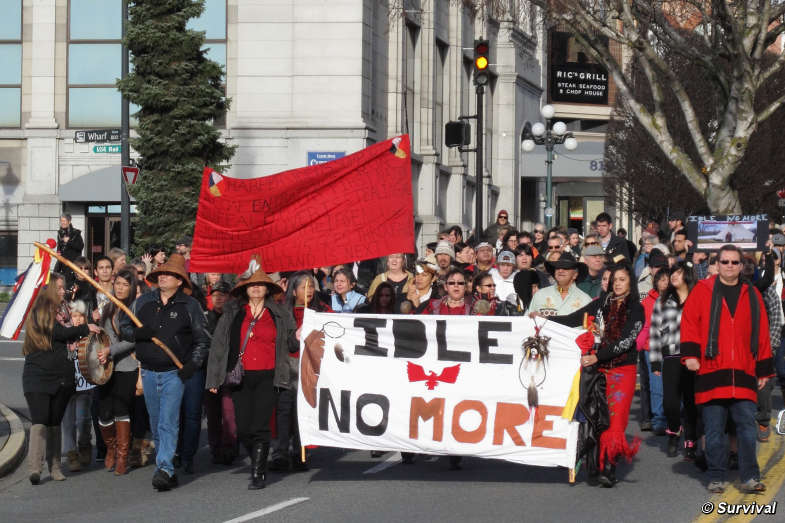
Idle no more protesters marching in Victoria, BC, December 21, 2012.

Native peo­ple across Cana­da have block­ad­ed roads, bridges and rail­way lines as part of the grass-roots indige­nous move­ment Idle No More.

From British Colum­bia, where dozens of pro­test­ers demon­strat­ed out­side hear­ings for a pro­posed oil pipeline, to Ontario, where bor­der cross­ings to the USA were blocked, the scale of the protests strong­ly sug­gest that the move­ment is show­ing lit­tle sign of dying down.

The Idle No More move­ment began in Novem­ber 2012, when four women from the province of Saskatchewan held a ‘teach-in’ about the like­ly effects of Bill C‑45, a large and com­plex bill pro­posed by Prime Min­is­ter Stephen Harp­er, which would seri­ous­ly weak­en many envi­ron­men­tal reg­u­la­tions.

On 4 Decem­ber, a group of chiefs from the Assem­bly of First Nations (AFN), Canada’s prin­ci­pal indige­nous orga­ni­za­tion, were pre­vent­ed from enter­ing the Par­lia­ment build­ings to lob­by MPs over the bill. News of the snub, using the Idle No More hash­tag, quick­ly spread across the coun­try.

Anoth­er impor­tant ele­ment of the protests has been a hunger strike by There­sa Spence, chief of the Attawapiskat First Nation in north­ern Ontario. This Cree com­mu­ni­ty, despite being the loca­tion of De Beers’s Vic­tor dia­mond mine, is riv­en by social prob­lems, includ­ing poor hous­ing and chron­i­cal­ly inad­e­quate edu­ca­tion pro­vi­sion.

Chief Spence declared that her hunger strike would con­tin­ue until the Prime Min­is­ter and the Gov­er­nor Gen­er­al (the Queen’s rep­re­sen­ta­tive in Cana­da), agreed to meet her to dis­cuss Abo­rig­i­nal rights.

On Jan­u­ary 11 a del­e­ga­tion of First Nations lead­ers, under the aegis of the AFN, held a meet­ing with Mr Harp­er and var­i­ous oth­er min­is­ters. The Gov­er­nor Gen­er­al, how­ev­er, did not attend. The meet­ing was incon­clu­sive, with the Abo­rig­i­nal Affairs Min­is­ter report­ing that ‘it would be fol­lowed by high-lev­el dia­logue between the Prime Min­is­ter and Shawn Atleo’, leader of the AFN.

As described by the native writer Lisa Charley­boy, the objec­tives of Idle No More are ‘to build indige­nous sov­er­eign­ty, to repair the rela­tion­ship between indige­nous peo­ples of Cana­da (First Nations, Métis, and Inu­it), the crown, and the gov­ern­ment of Cana­da from a grass­roots frame­work, and to pro­tect the envi­ron­ment for all Cana­di­ans to enjoy for gen­er­a­tions to come.’

Idle No More has called for a World Day of Action on Jan­u­ary 28th.


Six People Arrested Inside Enbridge Hearings

Van­cou­ver, BC / Coast Sal­ish Ter­ri­to­ries – This morn­ing (15th Jan), six peo­ple direct­ly inter­vened in the Enbridge pipeline joint Envi­ron­men­tal Assess­ment and Ener­gy Board hear­ings and put cli­mate change on the agen­da.

Van­cou­ver, BC / Coast Sal­ish Ter­ri­to­ries – This morn­ing (15th Jan), six peo­ple direct­ly inter­vened in the Enbridge pipeline joint Envi­ron­men­tal Assess­ment and Ener­gy Board hear­ings and put cli­mate change on the agen­da. The group man­aged to make their way past police unde­tect­ed and into the secured 4th floor of Vancouver’s Sher­a­ton Wall Cen­ter. Once inside they revealed shirts embla­zoned with mes­sages like “Stop the Pipelines” and pro­ceed­ed to use police tape to cor­don off the hear­ing area as a “cli­mate crime scene.”

“Cli­mate change is killing thou­sands of peo­ple every year, pri­mar­i­ly in devel­op­ing coun­tries and Indige­nous com­mu­ni­ties that are the least respon­si­ble for cre­at­ing this prob­lem. Despite this fact, the Joint Review Pan­el has instruct­ed those par­tic­i­pat­ing in the hear­ings not to talk about cli­mate change. This is a shock­ing­ly irre­spon­si­ble move con­sid­er­ing Canada’s tar sands con­tain twice the amount of car­bon diox­ide emit­ted by glob­al oil use in our entire his­to­ry. New fos­sil fuel pipelines are an irre­spon­si­ble step in the wrong direc­tion.” said Sean Devlin.

The impacts of cli­mate change have been draw­ing glob­al atten­tion recent­ly, between Hur­ri­cane Sandy, unprece­dent­ed dead­ly typhoons in the Philip­pines and pre­vi­ous­ly unimag­in­able tem­per­a­ture records in Aus­tralia. In this urgent con­text the JRP has des­ig­nat­ed cli­mate change and the car­bon emis­sions of Canada’s tar sands “out­side of the panel’s man­date,” a move that offi­cial­ly dis­cour­ages inter­ven­ers from rais­ing these crit­i­cal issues dur­ing their oral state­ments.

“Enbridge and the fed­er­al gov­ern­ment are using their posi­tion of author­i­ty with­in this process to coerce mem­bers of the pub­lic into silence on these issues. The major­i­ty of First Nations and set­tler com­mu­ni­ties in the province oppose fos­sil fuel pipelines. We respect those who are voic­ing their oppo­si­tion to the pipelines inside the hear­ings, but the hear­ing process is mean­ing­less, espe­cial­ly since Harp­er has changed the law, giv­ing his cab­i­net final say on pipeline projects,” said Fiona De Bal­asi Brown.

Today marks the sec­ond day of the Joint Review Pan­el hear­ings in Van­cou­ver and the sec­ond day that the mem­bers of the pub­lic have crossed police lines to make their oppo­si­tion heard. On Mon­day more than a thou­sand pro­test­ers peace­ful­ly forced their way past police onto the Sher­a­ton prop­er­ty drum­ming so loud­ly the noise could be heard inside the hear­ings. Pub­lic out­rage has been embold­ened by a deci­sion to exclude the pub­lic from the hear­ings in Van­cou­ver, a move the BC Civ­il Lib­er­ties Asso­ci­a­tion crit­i­cized yes­ter­day as “poten­tial­ly unlaw­ful.”

The Economics of Insurgency — Thoughts on Idle No More & critical infrastructure

News reports are ablaze with reports of loom­ing Indige­nous block­ades and eco­nom­ic dis­rup­tion.

News reports are ablaze with reports of loom­ing Indige­nous block­ades and eco­nom­ic dis­rup­tion. As the Idle No More move­ment explodes into a new ter­ri­to­ry of polit­i­cal action, it bears to ampli­fy the incred­i­ble eco­nom­ic lever­age of First Nations today, and how fright­ened the gov­ern­ment and indus­try are of their capac­i­ty to wield it.

In recent years, Access to Infor­ma­tion (ATI) records obtained by jour­nal­ists reveal a mas­sive state-wide sur­veil­lance and “hot spot mon­i­tor­ing” oper­a­tion coor­di­nat­ed between the Depart­ment of Indi­an Affairs, the Roy­al Cana­di­an Mount­ed Police (RCMP), the Cana­di­an Secu­ri­ty Intel­li­gence Ser­vice (CSIS), local secu­ri­ty forces, nat­ur­al resource and trans­porta­tion min­istries, bor­der agen­cies, and indus­try stake­hold­ers. These efforts have been explic­it­ly mobi­lized to pro­tect “crit­i­cal infra­struc­ture” from Indige­nous attack.

What is crit­i­cal infra­struc­ture? Accord­ing to an RCMP inter­nal doc­u­ment con­cern­ing the risk of Abo­rig­i­nal protest, “crit­i­cal infra­struc­ture refers to infra­struc­ture, both tan­gi­ble and intan­gi­ble, that is essen­tial to the health, safe­ty, secu­ri­ty or eco­nom­ic well-being of Cana­di­ans and the effec­tive func­tion­ing of gov­ern­ment.” RCMP Nation­al Secu­ri­ty Crim­i­nal Inves­ti­ga­tions have pri­or­i­tized four crit­i­cal infra­struc­ture sec­tors: finance, trans­porta­tion, ener­gy, and cyber-secu­ri­ty.

On Jan­u­ary 5 alone, INM protests includ­ed five bor­der cross­ing block­ades, bridge block­ades, and rail line dis­rup­tions span­ning the coun­try.

And it’s not only intel­li­gence ser­vices that are warn­ing of threats to crit­i­cal infra­struc­ture.

Con­ser­v­a­tive mil­i­tary ana­lyst Dou­glas Bland has also long warned that Canada’s eco­nom­ic vul­ner­a­bil­i­ty is based on the “crit­i­cal infra­struc­ture that trans­ports nat­ur­al resources and man­u­fac­tured goods from mines, oil fields, hydro-elec­tric facil­i­ties and fac­to­ries to inter­na­tion­al mar­kets.” With­out these crit­i­cal sys­tems, he cau­tions, “Canada’s econ­o­my would col­lapse.”

Though Bland has coun­seled a con­cil­ia­to­ry approach to Abo­rig­i­nals in order to stave off the com­ing cri­sis, his alarmism – and that of oth­er right-wing pun­dits – simul­ta­ne­ous­ly jus­ti­fies the state’s secu­ri­ty and sur­veil­lance appa­ra­tus by man­u­fac­tur­ing a fear of native upris­ing. But for Bland and oth­ers, a com­ing “Native Spring” is less feared for its poten­tial “vio­lence” and all the more grave for its threat to prop­er­ty rights.

In Bland’s fic­tion­al book Upris­ing, he pre­dicts coor­di­nat­ed attacks by secret native cells on key instal­la­tions and urban hubs, such as the James Bay hydro-elec­tric dam and the down­town core of Win­nipeg. This attack on crit­i­cal infra­struc­ture telling­ly ends in a blaze of hero­ic Cana­da-US mil­i­tary attacks on the rebel army. (The US gets involved only when they real­ize their source of elec­tric­i­ty, oil, and gas is at stake.)

Here­in lies the real role of right wing alarmists in the INM move­ment: to main­tain the eco­nom­ic sta­tus quo, because ter­ri­to­ry is cap­i­tal. Land is mon­ey. And the cir­cu­la­tion of goods, resources and ener­gy through ter­ri­to­ry is the very essence of cap­i­tal­ism today.

The fact is that crit­i­cal infra­struc­ture in Cana­da is at the mer­cy of Indige­nous peo­ples, who are more rur­al than Cana­di­ans and have access to impor­tant arter­ies for eco­nom­ic flows: trans­porta­tion cor­ri­dors, ener­gy sec­tors, and sites of nat­ur­al resource extrac­tion.

This vul­ner­a­bil­i­ty is dead­ly to the logis­tics indus­try. Logis­tics is a busi­ness sci­ence con­cerned with the man­age­ment of goods and infor­ma­tion through glob­al sup­ply chains. As the World Bank has declared: “A com­pet­i­tive net­work of glob­al logis­tics is the back­bone of inter­na­tion­al trade.” For an indus­try depen­dent on main­tain­ing open chan­nels for cap­i­tal cir­cu­la­tion, a block­ade means mas­sive loss­es: the truck­ing indus­try alone is worth $65 bil­lion and employs more than 260,000 dri­vers.

In the ener­gy sec­tor, Cana­da has oil reserves sec­ond in the world after Sau­di Ara­bia, though less acces­si­ble – 98 per cent of this oil is in Alber­ta and 95 per cent of it is in the tar sands, where effec­tive Indige­nous resis­tance by Treaty 8 and oth­er First Nations has led to glob­al boy­cott cam­paigns and fierce resis­tance.

In north­ern BC, the Unist’ot’en Clan, with sup­port from grass­roots Wet’suwet’en, have built a com­mu­ni­ty of resis­tance direct­ly on the GPS co-ordi­nates of the pro­posed pipeline route from the Alber­ta tar sands to the Kiti­mat port. From this camp they have evict­ed sur­vey­ors work­ing for Pacif­ic Trails Pipeline. Mean­while, in Ontario, Enbrdige’s Line 9 has been has been opposed by the Onei­da, the Hau­denosaunee Devel­op­ment Insti­tute, and Aami­ji­waang First Nation, who have all vowed to fight the pipeline to pro­tect their lands and waters.

In terms of nat­ur­al resource extrac­tion, over 10 per cent of Canada’s econ­o­my is com­prised of the nat­ur­al resources sec­tors and earth sci­ence indus­tries, which direct­ly employ close to 763,000 peo­ple. The great­est con­cen­tra­tion and cor­re­la­tion between Indige­nous lands and min­er­al claims are being cur­rent­ly devel­oped in the north­ern mod­ern treaties and ter­ri­to­ries, such as Nunavut; Yukon; the James Bay region of Que­bec, and the Que­bec-Labrador bor­der; on unced­ed north­west­ern BC lands (e.g. on Nakazdli, Tzal­ten, and Tlin­git tra­di­tion­al ter­ri­to­ry); and in north­ern Ontario’s “Ring of Fire” on his­toric treaty lands, par­tic­u­lar­ly Treaties 3 and 9.

In addi­tion to min­er­al resources, over half of large intact for­est land­scapes are found on lands in his­tor­i­cal Abo­rig­i­nal treaty areas. More specif­i­cal­ly, as Glob­al For­est Watch reports, “Treaties 8 and 9 con­tain about a quar­ter of all of Canada’s intact for­est land­scapes and close to half of all the intact for­est land­scapes that occur with­in treaty areas. Mod­ern land claim set­tle­ments con­tain about a quar­ter of Canada’s intact for­est land­scapes.”

That is not to say mean­ing­ful con­sul­ta­tion con­cern­ing crit­i­cal infra­struc­ture has not been tak­ing place. The prob­lem is that it has exclu­sive­ly been between indus­try and gov­ern­ment, instead of between Indige­nous peo­ples and the state. Jour­nal­ists have been uncov­er­ing mul­ti­ple inci­dents of high-lev­el co-ordi­na­tion between indus­try and gov­ern­ment offi­cials. For exam­ple, Access to Infor­ma­tion requests revealed that the gov­ern­ment has been shar­ing infor­ma­tion with the oil indus­try on envi­ron­men­tal­ists and Indige­nous groups twice a year since 2005 at secret brief­in­gs, even on such seem­ing­ly irrel­e­vant activ­i­ties such as par­tic­i­pa­tion in anti-G20 demon­stra­tions.

The irony is that many cor­po­ra­tions are tired of hav­ing oper­a­tions held up by Indige­nous protest and are will­ing to go fur­ther than gov­ern­ments to rec­og­nize Indige­nous rights. The log­ics of colo­nial­ism and cap­i­tal­ism divide here around con­flict­ing objec­tives of ter­ri­to­r­i­al acqui­si­tion ver­sus the cir­cu­la­tion of goods. But more often than not, the state and indus­try con­verge around the com­mon inter­ests of the rul­ing class. For Indige­nous peo­ples, this becomes a ques­tion of co-ordi­nat­ing lever­age.

In con­clu­sion, I want to high­light three main con­cerns expressed in the risk assess­ments under­tak­en by RCMP, CSIS, Indi­an Affairs, and right-wing thinkers on Indige­nous upris­ing that fore­ground Indige­nous eco­nom­ic pow­er.

The first is that a mis­han­dling of con­flict will gal­va­nize co-ordi­nat­ed efforts of First Nations across the coun­try; hence the rel­a­tive­ly hands-off approach tak­en until now. In the Fed­er­al Coor­di­na­tion Frame­work for the AFN Day of Action in 2007, the pro­posed solu­tion in the case of co-ordi­nat­ed mobi­liza­tion is to “iso­late the splin­ter group.”

Sec­ond, the eco­nom­ic cost of even a few hours of such co-ordi­nat­ed efforts would be crip­pling and impos­si­ble to police giv­en cur­rent resources.

Third – and this is one of the most wor­ri­some trends to observers – sol­i­dar­i­ty and co-ordi­na­tion between non-Natives and Indige­nous peo­ples will encour­age the move­ment to build.

As a final thought, while the gen­er­al pop­u­la­tion might have been tak­en by sur­prise by the strength of Idle No More, the gov­ern­ment had long pre­pared for this inevitabil­i­ty. As far back as 2008, when changes were first pro­posed to the Nav­i­ga­ble Waters Act, CSIS’s Inte­grat­ed Threat Assess­ment Cen­tre warned about “poten­tial unrest.”

Cana­da cre­at­ed the cri­sis of insur­gency. Canada’s greed cre­at­ed a sit­u­a­tion where Indige­nous peo­ples stand with almost noth­ing to lose. There­fore, the fight is theirs to take. It is also ours to sup­port.

Read the full arti­cle here.

Anti-road campaigners peacefully resisting camp evictions (16 Jan)

The evic­tion of the two remain­ing camps (“Base camp” and “Decoy Pond Wood” – see here and below for maps) has begun, and cam­paign­ers are resist­ing peace­ful­ly in tree­hous­es and tun

The evic­tion of the two remain­ing camps (“Base camp” and “Decoy Pond Wood” – see here and below for maps) has begun, and cam­paign­ers are resist­ing peace­ful­ly in tree­hous­es and tun­nels. Please protest, sup­port and pub­li­cise!

Bailiffs arrived just before 8am, and the evic­tion prop­er began around 8.15am. As at 8.37am there were 30+ bailiffs on site with more secu­ri­ty arriv­ing, focussing main­ly on the tunnel(s). As at 8.59am it was no longer pos­si­ble to access the camp via the access road to Adam’s farm (though oth­er cross-coun­try routes may still be avail­able), and Har­ris fenc­ing was being brought in.

Please note: This is only the end of the begin­ning for the protests against the Bex­hill Hast­ings Link Road (BHLR)! We urgent­ly need to replen­ish our finances fol­low­ing the last month of protests, so please con­sid­er giv­ing a dona­tion, using the “donate” but­ton on our web-site and Face­book page, if you are able.


Press release Combe Haven Defend­ers [1]
Wednes­day 16 Jan­u­ary
Con­tact 07926 423 033

EVICTION OF ANTI-ROAD CAMP NEAR HASTINGS HAS STARTED
Pro­tes­tors resist­ing peace­ful­ly in tree­hous­es and tun­nels

Wednes­day 16 Jan­u­ary, 8.16am: Oppo­nents of the Bex­hill-Hast­ings Link Road (BHLR) are defend­ing trees and  occu­py­ing tun­nels at their main protest camp in Crowhurst. Secu­ri­ty guards and bailiffs, sup­port­ed by police, began attempts to evict the camp at 8am today.

The main camp, which has been in place since 21 Decem­ber, is locat­ed on the pro­posed route of the BHLR close to Adam’s Farm, Crowhurst [2]. Fur­ther trees on route are occu­pied by pro­tes­tors at near­by “Decoy Camp”.

The peace­ful protests against the road– which have now been run­ning for a month, with 12 arrests – have seized nation­al atten­tion over the past week [3].

Tree-felling work for the road start­ed on 14 Decem­ber 2012 and rep­re­sents the first sig­nif­i­cant work on the high­ly-con­tro­ver­sial £100m road, one of over forty “zom­bie roads” that were declared dead years ago but have now been resus­ci­tat­ed as part of as part of Britain’s largest road-build­ing pro­gramme in 25 years [4, 5].

Con­tact 07926 423 033

NOTES
[1] http://www.combehavendefenders.org.uk
[2] Near­by post­code TN33 9AY. For map see http://combehavendefenders.wordpress.com/camp-groundrules-directions/
[3] http://combehavendefenders.wordpress.com/recent-media-coverage/
[4] See ‘Con­tro­ver­sial ‘zom­bie roads’ scheme to be resus­ci­tat­ed’, Guardian, 10 Octo­ber 2012, http://tinyurl.com/zombieroads
[5] http://bettertransport.org.uk/media/26-Oct-roads-report

Ecuadorian Indigenous Village Threatens to “Die Fighting” Against Oil Company — 15th Jan


An indige­nous com­mu­ni­ty in the Ecuado­ri­an rain­for­est says they “will die fight­ing to pro­tect the rain­for­est” after they say they were swin­dled by an oil com­pa­ny into sign­ing away rights to 70,000 hectares of one of the most bio­di­verse areas in the world.


An indige­nous com­mu­ni­ty in the Ecuado­ri­an rain­for­est says they “will die fight­ing to pro­tect the rain­for­est” after they say they were swin­dled by an oil com­pa­ny into sign­ing away rights to 70,000 hectares of one of the most bio­di­verse areas in the world.

But the state-backed oil com­pa­ny, PetroAmazonas—backed by the Ecuadore­an army—plans to begin prospect­ing the Kich­wa vil­lage on the Napo Riv­er on Tues­day, The Guardian reports.

PetroA­ma­zonas, one of the biggest oil com­pa­nies in South Amer­i­ca, orig­i­nal­ly offered the vil­lage a new school, uni­ver­si­ty places for vil­lage chil­dren and bet­ter health­care, but dropped those pro­vi­sions before the chief of the vil­lage signed away the rights to the land for $40 per hectare.

But the com­mu­ni­ty sec­re­tary, Klid­er Gualin­ga, said 80 per­cent of the vil­lage oppos­es the deal, which he says has not yet been final­ized. “Peo­ple think it is dis­hon­est and the oil com­pa­ny is treat­ing them like dogs. … They’re very upset and wor­ried. We have decid­ed to fight to the end. Each land­hold­er will defend their ter­ri­to­ry. We will help each oth­er and stand shoul­der to shoul­der to pre­vent any­one from pass­ing.”

“If there is a phys­i­cal fight, it is cer­tain to end trag­i­cal­ly,” Shaman Patri­cio Jipa said. “We may die fight­ing to defend the rain­for­est.”

He con­tin­ued:

It makes me feel sad and angry. Sad because we are indige­nous peo­ple and not ful­ly pre­pared to fight a gov­ern­ment. And angry because we grew up to be war­riors and have a spir­it to defend our­selves. I wish we could use this force to fight in a new way, but our men­tal strength is not suf­fi­cient in this mod­ern world.

[…]

There is huge con­cern the oil com­pa­ny will move quick­ly to clear the land. When that hap­pened else­where, they used armed troops, beat­ings and abduc­tions to remove those who stood in their way.

Jipa and his wife, Mari Muench, a British busi­ness­woman, are fight­ing the plan.

Sci­en­tists say a sin­gle hectare in this part of the Ama­zon con­tains a wider vari­ety of life than all of North Amer­i­ca. The Ama­zon rain­for­est and oth­er trop­i­cal forests are also among the earth­’s best defens­es against cli­mate change, absorb­ing some 20 per­cent of car­bon diox­ide pro­duced by burn­ing fos­sil fuels.

“Pro­tect­ing the Ama­zon basin, which con­tains the largest trop­i­cal rain­for­est on the plan­et, is crit­i­cal to our plan­et’s cli­mate sta­bil­i­ty,” accord­ing to Ama­zon Watch.

Police say camps to be evicted this week, as 400-year-old oak felled

Con­trac­tors moved in in force on Mon­day (14 Jan­u­ary) to evict the “Three Oaks” camp near the rail­way line opp.

Con­trac­tors moved in in force on Mon­day (14 Jan­u­ary) to evict the “Three Oaks” camp near the rail­way line opp. Upper Wilt­ing Farm in Crowhurst (see press release below), and police have told activists that they plan to evict the remain­ing two camps (“Decoy Pond Wood” and “Base Camp” – see map below) this week.

So if you want to come and help peace­ful­ly stop the felling (whether in an arrestable or non-arrestable role): now’s the time! See here for more info re. the Camp.

[Update at 12.30pm: Despite being heav­i­ly out­num­bered by secu­ri­ty and con­trac­tors, activists at the “Three Oaks” protest camp were able to delay the felling of the 400-year-old oak by 3–4 hours this morn­ing. Two peo­ple were final­ly evict­ed from high-up in the oak, and a third per­son, locked-on near the base, was also removed. No arrests were made, and the trees in ques­tion are now being felled.]

Press Release
14 Jan­u­ary 2013
Combe Have
n Defend­ers

CHAINSAWS MOVED IN TO FELL 400-YEAR-OLD OAK AT HASTINGS TREE PROTEST

9am, Mon­day 14 Jan­u­ary, Crowhurst:  Con­trac­tors prepar­ing the way for the Bex­hill-Hast­ings Link Road (BHLR) are believed to be felling a 400-year-old Oak Tree as they evict the “Three Oaks” protest Camp near the rail­way line opp. Upper Wilt­ing Farm (TN38 8EG) in Crowhurst (see map below).

Police, secu­ri­ty, chain­saw oper­a­tives, and a dig­ger moved in on the tree-protest Camp (one of three along the route of the BHLR) this morn­ing, short­ly after 7am. Despite being heav­i­ly out­num­bered by police and secu­ri­ty, as at 8.30am sev­er­al activists were in the trees and at least one was locked-on.

Accord­ing to a recent report in the Guardian: “When the landown­er signed the com­pul­so­ry pur­chase order for the land at Three Oaks, where a fly­over is to be built above the rail­way, he per­suad­ed the coun­cil to spare one tree thought to be 450 years old (not a promise the pro­test­ers expect to be kept).” [3]

Two more protest camps (“Decoy Pond Wood Camp” and “Base Camp”) have not yet been evict­ed.

The BHLR is one of over forty “zom­bie roads” that were declared dead years ago but have now been resus­ci­tat­ed as part of Britain’s largest road-build­ing pro­gramme in 25 years [4].

[2] See map here: www.combehavendefenders.org.uk
[3] “Road protests return: a new gen­er­a­tion takes on the bypass builders”, Guardian, 12 Jan­u­ary 2013, http://www.guardian.co.uk/environment/2013/jan/12/combe-haven-green-protesters-trees
[4] http://bettertransport.org.uk/media/26-Oct-roads-report