Indigenous group threatens collective suicide in Brazil 29th March

Una carta firmada por los líderes de la comunidad indígena Guarani-Kaiowá de Mato Grosso do Sul, anuncia el suicidio colectivo de 170 personas, (50 hombres, 50 mujeres y 70 niños), si se hace efectiva la orden de la Corte Federal para despojar a la tribu de la ‘cambará granja’ donde se encuentran temporalmente acampados.

Translation: A letter signed by the leaders of the indigenous Guarani-Kaiowá of Mato Grosso do Sul, announces the collective suicide of 170 people (50 men, 50 women and 70 children), to be effective if the Federal Court orders to strip the tribe of ‘cambará farm’ where are temporarily camped.


El territorio, que ellos llaman ‘tekoha’, que significa ‘cementerio ancestral’, ha sido sembrado con grandes plantaciones de caña de azúcar y soja, y está preparado para la cría de ganado.

Multa por vivir en su tierra

En caso de que los indígenas no desalojen la granja la orden federal estipula que la Fundación Nacional de Indios (Funai) tendrá que pagar una multa de aproximadamente 250 dólares por cada día que permanezcan allí.

Nosotros los indígenas tenemos el derecho constitucional a ocupar nuestra tierra, y vamos a seguir luchando“, enfatizó el jefe tribal guaraní, Vera Popygua, que exigió respeto para su pueblo, porque “ha sido masacrado“. “Han matado a nuestros líderes, y eso es triste e inaceptable. Somos una sociedad avanzada que vive en el siglo XXI. Esto no puede suceder, no debería ocurrir“, sostiene.

Si la orden judicial no fuera revocada, los indígenas amenazan con darse muerte ante el propio tribunal brasileño, después de lo cual exigen ser enterrados en su territorio sagrado, a orillas del río Hovy.

Los indígenas pidieron desde hace varios años la demarcación de sus tierras tradicionales, ahora ocupada por ganaderos y custodiado por hombres armados. El líder de la energía fotovoltaica en la Cámara de los Diputados, Sarney Filho, envió esta carta al ministro de Justicia, solicitando medidas para evitar la tragedia.

The territory, which they call ‘tekoha’ meaning ‘ancestral graveyard’, has been planted with large plantations of sugarcane and soybeans, and is ready for growing.

Penalty for living on their land

To avoid eviction from the indigenous farm, a federal order stipulates that the National Indian Foundation (Funai) has to pay a fine of approximately $250 for each day they remain there.

“We Indians have a constitutional right to occupy our land, and we will keep fighting,” emphasized Guarani tribal chief, Popygua Vera, who demanded respect for his people, because “it has been slaughtered.” “They killed our leaders, and that is sad and unacceptable. We are an advanced society living in the XXI century. This can not happen, should not happen,” he says.

If the court order is revoked, the Indigenous group threatened to commit collective suicide before the Brazilian court itself, after which it demands to be buried in sacred ground, the river Hovy.

Stop Tar Sands Profiteers Week of Action a Huge Success

Mosiac_bigger-590x1024

Mosiac_bigger-590x1024

Over 50 grassroots organizations across the US and Canada held 50 actions from March 16th to March 23rd to demonstrate that TransCanada’s Keystone XL tar sands pipeline is a toxic investment.

Here’s an overview of what happened every day along with details at the bottom of this post:

March 16, 17: Week of Action Kicks Off With Creativity Across The Country
March 18: Blockades and Bikes From Coast to Coast
March 19: TD Bank Slammed as Tar Sands Profiteer
March 20: TransCanada Office Shut Down – Big Banks Called Out For Bankrolling Coal & KXL
March 21: Twenty Arrested at Two Separate KXL Protests in DC – Hundreds March with Idle No More in Seattle
March 22: Asheville Protesters Shut Down TD Bank, Four Arrested. Two arrested at TC office in Westborough
March 23: Over 60 People Blockade Chevron Tar Sands Refinery in Utah — NYC and DC Call Out TD Bank

Over 50 actions and events happened this week to directly confront the corporate profiteers bankrolling the Keystone XL pipeline and the broader tar sands industry. These actions come at a critical time as investor confidence in Alberta’s tar sands is waning due to major delays and resistance to Keystone XL’s construction timeline.

The Keystone XL project has become a flagship issue for the U.S. climate movement and has spurred dozens of acts of civil disobedience and the largest climate rally in U.S. history. But while 45,000 marched on the White House President Obama was golfing with oil executives and the southern segment of KXL in Texas and Oklahoma was still being built.

It’s becoming increasingly clear that we cannot rely on corporation-funded politicians to oppose corporate excess; we must engage this destructive industry directly. That’s what we’ve done in Texas, and it’s working: in February, TransCanada reported lower fourth-quarter earnings and admitted that the southern portion of Keystone XL (the Gulf Coast Project) was way behind schedule and only 45 percent completed. By showing up at their offices and putting a stop to “business as usual,” we can show tar sands investors that their lives would be easier and their businesses more secure if they invested in projects that don’t endanger our communities’ health and the chance for a livable climate.

We’ll be posting links and updates here throughout the Stop Tar Sands Profiteers Week of Action as actions happen!

Grassroots activists from over 50 organizations are uniting to send a strong message to the industry that TransCanada and its financial backers must rethink their investments in tar sands, the dirtiest fuel on the planet. We will demonstrate to companies bankrolling KXL that their investments are as toxic as the tar sands they want to pump through the pipeline. Activists are marching, holding rallies, giving trainings, and physically disrupting “business-as-usual” for those who seek to profit from the exploitation of marginalized people and the destruction of our collective future.

Some of the top tar sands profiteers facing protest this week: TransCanada, TD Bank, Valero Corp., and John Hancock Life Insurance Co., to name a few.

Week of Action Updates:

Saturday and Sunday, March 16 & 17 – Week of Action Kicks Off With Creativity Across the Country

  • Activists in New Orleans blockade two bus-loads of oil executives including BP, Shell, Valero, and other investors in tar sands and extraction industries.
  • Stunning tar sands banner drop in Grand County, Utah
  • Over 100 people hold “Funeral for Our Future” in TransCanada’s Westborough office – 25 arrested
  • Overpass light brigade in Wisconsin sends a bright message with lights: “Block Keystone XL!”
  • Organizers hold “Stop the Pipeline” banners and march in the traditional St. Patty’s Day Parade in Boston
  • Trainings and presentations on tar sands in Salt Lake City, Utah
  • Musicians sang #NoKXL themed songs in the Boston subway and passed out literature

Monday, March 18th – Day 3: Blockades and Bikes From Coast to Coast

  • Direct action training camp in Oklahoma to stop KXL hosted by Great Plains Tar Sands Resistance
  • Twelve people arrested for blockading a fracking pipeline in upstate New York
  • Portland, Oregon takes bike tour of the city’s worst polluters
  • Dozens rally outside National Geographic building where Secretary Kerry was speaking in Washington, DC
  • Over 40 rallied outside Michels Corporate office in death costumes in Kirkland, WA

Tuesday, March 19th – Day 4: TD Bank Slammed As Tar Sands Profiteer

  • Three people lock themselves inside a TD Bank in Washington, DC
  • Over three dozen rally at TD Bank in Upstate New York this last weekend
  • Banner drop promoting the Week of Action appears in Oklahoma City
  • Dallas-Fort Worth community teach-in hosted by local Unitarian Universalists
  • Concerned citizens in Houston pressure the City Council to sue Valero for pollution violations
  • Organizers rally next to rail line transporting tar sands in Newark, Delaware for refining
  • Community teach-in and film screening in Houston’s toxic East End

Wednesday, March 20th – Day 5: TransCanada Office Shutdown. Big Banks Called Out For Bankrolling Coal and KXL

  • Activists shut down work at TransCanada office in Omaha, Nebraska
  • Dozens of climate justice activists in Montpelier, Vermont rally at TD Bank and close their accounts
  • Rainforest Action Network Boston Fights BAC (Bank of America Corporation)!
  • Hudson Valley Earth First and the Green Team TD Bank Action in White Plains, New York

Thursday, March 21st – Day 6: Twenty Arrested for #NoKXL Actions in Washington, DC – Hundreds March with Idle No More in Seattle

  • About 15 interfaith leaders arrested for civil disobedience at the White House
  • Five arrested for occupying the lobby of Valero in Washington, DC
  • Creative solidarity banner drop in Vancouver
  • Overpass light brigades in Gainesville and Tampa Bay, Florida display messages “No Keystone XL”
  • Hundreds march with Idle No More Seattle against coal export terminals
  • Banner drop in Cushing, Oklahoma at the iconic “Pipeline Crossroads of the World” sign
  • Houston rallies at the courthouse to put Valero and TransCanada on trail alongside polluters like BP
  • North Texas Light Brigade lights up an overpass with a message against tar sands
  • Idle No More Portland drops banner at ESCO headquarters

Friday, March 22nd – Day 7:  Six Arrested for Actions At TransCanada, TD Bank, John Hancock Life Insurance Offices

  • Over 60 people shut down a TD Bank branch in Asheville, NC
  • Veterans For Peace and others enter TransCanada’s Westborough Office – Two arrested
  • Dozens rally at John Hancock Life Insurance in Los Angeles
  • Protestors outside Dallas, Texas call out John Hancock Life Insurance for funding a deadly pipeline
  • Newark, Delaware rallies to “Move Your Money” from TD Bank
  • Activists in Boulder, Colorado did a banner hang over an overpass
  • Bike brigade in Portland, Oregon tours the city’s worst polluters
  • Activists in Denver rallied outside the Governor’s mansion and held a nonviolent direct action training
  • Gathering for World Water Day in Portland, Oregon to protect it the Sacred Water from tar sands
  • Valero Corporate HQ in San Antonio taken over by the community

Saturday, March 23rd – Day 8: Over 60 People Blockade Chevron Tar Sands Refinery in Utah — NYC and DC Call Out TD Bank

  • Over 60 Salt Lake City residents blockaded the entrance to a Chevron tar sands refinery and turned away six trucks
  • Dozens in New York City hold a “Divest from TD Bank Day of Action!”
  • Activists in Washington, DC close off another TD Bank branch
  • Organizers with Red Lake Blockade of Enbridge in Northern Minnesota observe solidarity
  • Memphis, Tennessee residents rally outside a Valero refinery that exploded several months ago
  • New Haven, Connecticut Takes Action at Their Local TD Bank
  • Banner drops in New Orleans
  • Idle No More and other organizations hold a big nonviolent direct action training in San Francisco


Field liberation trial coming up in Belgium

Next GM potato-trial: April 2nd 2013, from 8 A.M. on, Justitieplein in Dendermonde. You are warmly invited to come and support the 11 activists that are resisting the unjust sentences in the ‘GM potato trial’. This time, you are not only welcome to show your support, but also to contribute with all your experience, knowledge…

Next GM potato-trial: April 2nd 2013, from 8 A.M. on, Justitieplein in Dendermonde. You are warmly invited to come and support the 11 activists that are resisting the unjust sentences in the ‘GM potato trial’. This time, you are not only welcome to show your support, but also to contribute with all your experience, knowledge…

Criminalisation of Activism for a Sustainable Agriculture

11 activists have been accused of belonging to a criminal gang, and were being asked to pay €200,000 damages to pay for the pro-GM campaign! 

The accused and their defence lawyers walked out of the first trial en masse, the first time in Belgian history.

More info at

http://www.fieldliberation.org/?lang=en

Indigenous Panamanians Protest Dams Which Could Displace Thousands

25 March 2013
photo

25 March 2013
photo

Last week, indigenous groups in western Panamá once again clashed with police while protesting the construction of the Barro Blanco dam. In 2012, similar protests resulted in the deaths of several protesters and alleged human rights abuses perpetrated by the police. As the Panamanian government aggressively expands its hydro capacities over the next few years, they will face more indigenous resistance. How can they pursue their economic interests without trampling the rights of their largest indigenous population?  

With around 200,000 people, the Ngäbe (pronounced “naw-bey”) are the largest indigenous group in Panamá. Like most indigenous groups around the world, they have a long history of being bullied, cheated, and displaced by the government.

In 1997, the Panamanian government signed Law 10, which gave the Ngäbe a semi-autonomous region in western Panamá, the Comarca Ngäbe-Buglé. Non-Ngäbes are not allowed to own or develop land within the Comarca. However, after discovering a gigantic copper deposit and sizable gold deposits, the government began claiming that the indigenous owned the land, but not what was beneath it. Mining efforts began and protests escalated until last year, when a multi-day protest and ensuing crackdown resulted in two dead protestors and multiple alleged human rights abuses, committed by police. The United Nations scolded the president for the abuses and he signed a promise not to continue mining efforts during his term (which ends next year). None of the police were tried for the alleged human rights abuses.

With the mining threat temporarily subdued, the Ngäbe have turned their attention to the Barro Blanco dam, which they claim will flood several towns and displace up to 36,000 people. They additionally claim that they were never properly consulted or given a choice in the matter. The Panamanian government and GENISA, the company responsible for the construction, claim that no displacement or destruction of native species will occur. The facts surrounding the true environmental impact are highly disputed and difficult to verify, but it seems clear that the true number of affected people probably lays somewhere between 0 and 36,000 – a fairly ridiculous range.  

Al Jazeera did a special “People and Power” report on the situation last year, which is clearly biased in favor of the indigenous; GENISA claims that it contains “inconsistencies” and that Al Jazeera never contacted them for comment.

However, the report does highlight a dubious validation process that barely included indigenous participation or consultation, a process which has since been questioned by the International Rivers Network, as well as the United Nations Special Rapporteur on the Rights of Indigenous Peoples, who claims that only 58 non-indigenous near the dam’s affected area were interviewed; these 58 were used as the basis for validation of the project.

As a Peace Corps volunteer who lived with the Ngäbe for two years and experienced the protests first-hand, I can tell you that the Ngäbe are certainly motivated by the potential environmental impacts of these projects, many of which threaten to ruin their way of life. But they are almost just as motivated by a simple desire to be treated with respect. As more projects are proposed, the Ngäbe continue to be treated not as adversely affected citizens, but as obstacles to development.

The Panamanian government plans to add 30 more hydro projects by 2016, several of which will affect indigenous territory. The mining issue may be dormant for now, but I guarantee that it will resurface after the next election.

Before the next development project on or affecting indigenous territory, the Panamanian government should define a protocol for including the indigenous in their validation processes, as well as compensate them for the inevitable environmental damage to their land. While this sounds earthy-crunchy, it would simply be more efficient for the government. They would not have to spend time and money quelling protests and addressing the United Nations, and they could use the ensuing stability to attract more foreign investors.

If not, we will be hearing about many more abuses in the next few years.

The Penan Blockade Against a New Gas Pipeline in Borneo – 22nd March

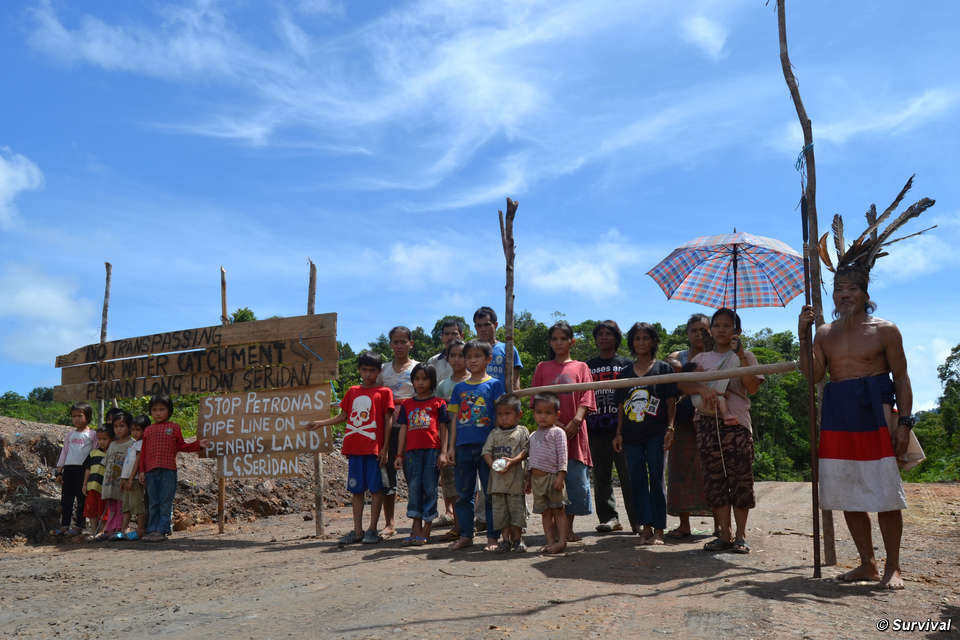
The Penan in Long Seridan are protesting against the building of a gas pipeline which is cutting through their ancestral land.© Survival

The Penan in Long Seridan are protesting against the building of a gas pipeline which is cutting through their ancestral land.© Survival

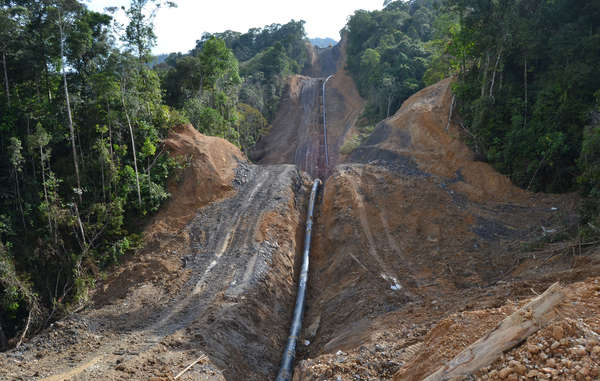
Penan from the Long Seridan region have mounted a blockade to protest against the building of a gas pipeline which is cutting through their ancestral land and destroying their source of drinking water.

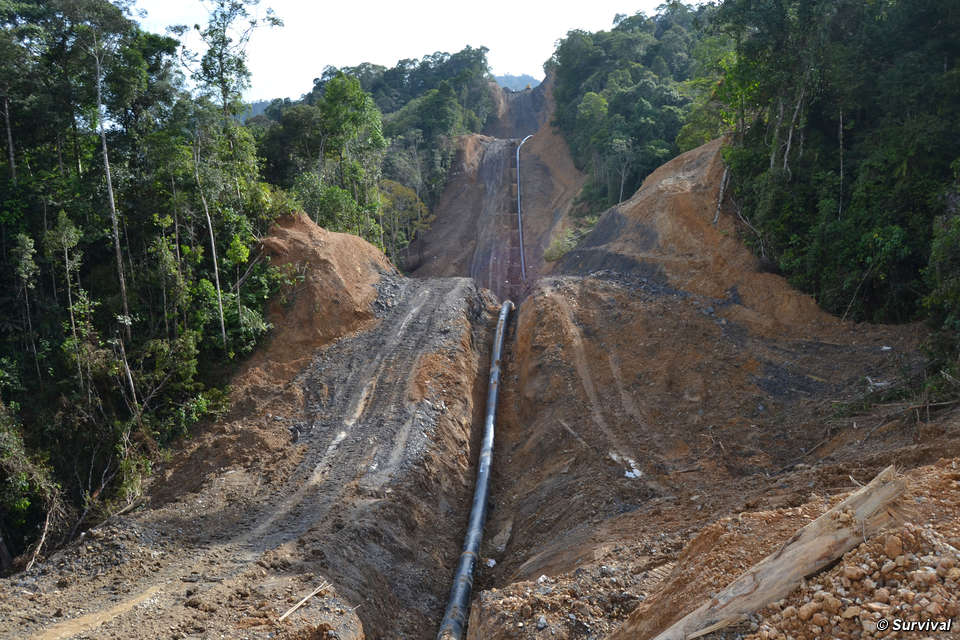
The 500km pipeline is being built by the Malaysian national oil company Petronas and is nearing completion. It will transport natural gas from the Malaysian state of Sabah, south to the coast of Sarawak.

The pipeline cuts through the forest of many Penan communities. It will make hunting and gathering even more difficult for the tribe, which is already facing grave hardship after years of logging have devastated their land.

The construction of the gas pipeline has affected many communities. One Penan man told Survival, ‘If they build this pipeline through our land it is a way of killing us. How are we to survive if they build this pipeline and we’re not able to move freely in our area – from one side to another?’

The 500km pipeline, built by the Malaysian national oil company Petronas, is cutting through the Penan's forest, making hunting difficult.© Survival

The Penan in Long Seridan began their blockade against the pipeline almost three weeks ago and have vowed to continue until their concerns are met.

At the same time, another group of Penan from Long Daloh, more than 60 km away, have also been protesting against logging on their land and the Baram dam which threatens to flood their homes and the forest they rely on for their survival.

If it goes ahead, the Baram dam will displace approximately 20,000 tribal people. Many Penan, and other indigenous communities, have already protested against the Baram dam and called for it to be cancelled.

Penan protest against pipeline, logging and dam

22 March 2013

22 March 2013

The Penan in Long Seridan are protesting against the building of a gas pipeline which is cutting through their ancestral land.

Penan from the Long Seridan region have mounted a blockade to protest against the building of a gas pipeline which is cutting through their ancestral land and destroying their source of drinking water.

The 500km pipeline is being built by the Malaysian national oil company Petronas and is nearing completion. It will transport natural gas from the Malaysian state of Sabah, south to the coast of Sarawak.

The pipeline cuts through the forest of many Penan communities. It will make hunting and gathering even more difficult for the tribe, which is already facing grave hardship after years of logging have devastated their land.

The construction of the gas pipeline has affected many communities. One Penan man told Survival, ‘If they build this pipeline through our land it is a way of killing us. How are we to survive if they build this pipeline and we’re not able to move freely in our area – from one side to another?’

The 500km pipeline, built by the Malaysian national oil company Petronas, is cutting through the Penan's forest, making hunting difficult.

The 500km pipeline, built by the Malaysian national oil company Petronas, is cutting through the Penan's forest, making hunting difficult.

The Penan in Long Seridan began their blockade against the pipeline almost three weeks ago and have vowed to continue until their concerns are met.

At the same time, another group of Penan from Long Daloh, more than 60 km away, have also been protesting against logging on their land and the Baram dam which threatens to flood their homes and the forest they rely on for their survival.

If it goes ahead, the Baram dam will displace approximately 20,000 tribal people. Many Penan, and other indigenous communities, have already protested against the Baram dam and called for it to be cancelled.


Katuah Earth First! Shuts Down TD Bank in Protest Against Kesytone XL

22nd March 2013taking over the lobby

Four arrested at lively protest against fossil fuel infrastructure

22nd March 2013taking over the lobby

Four arrested at lively protest against fossil fuel infrastructure

More pictures here

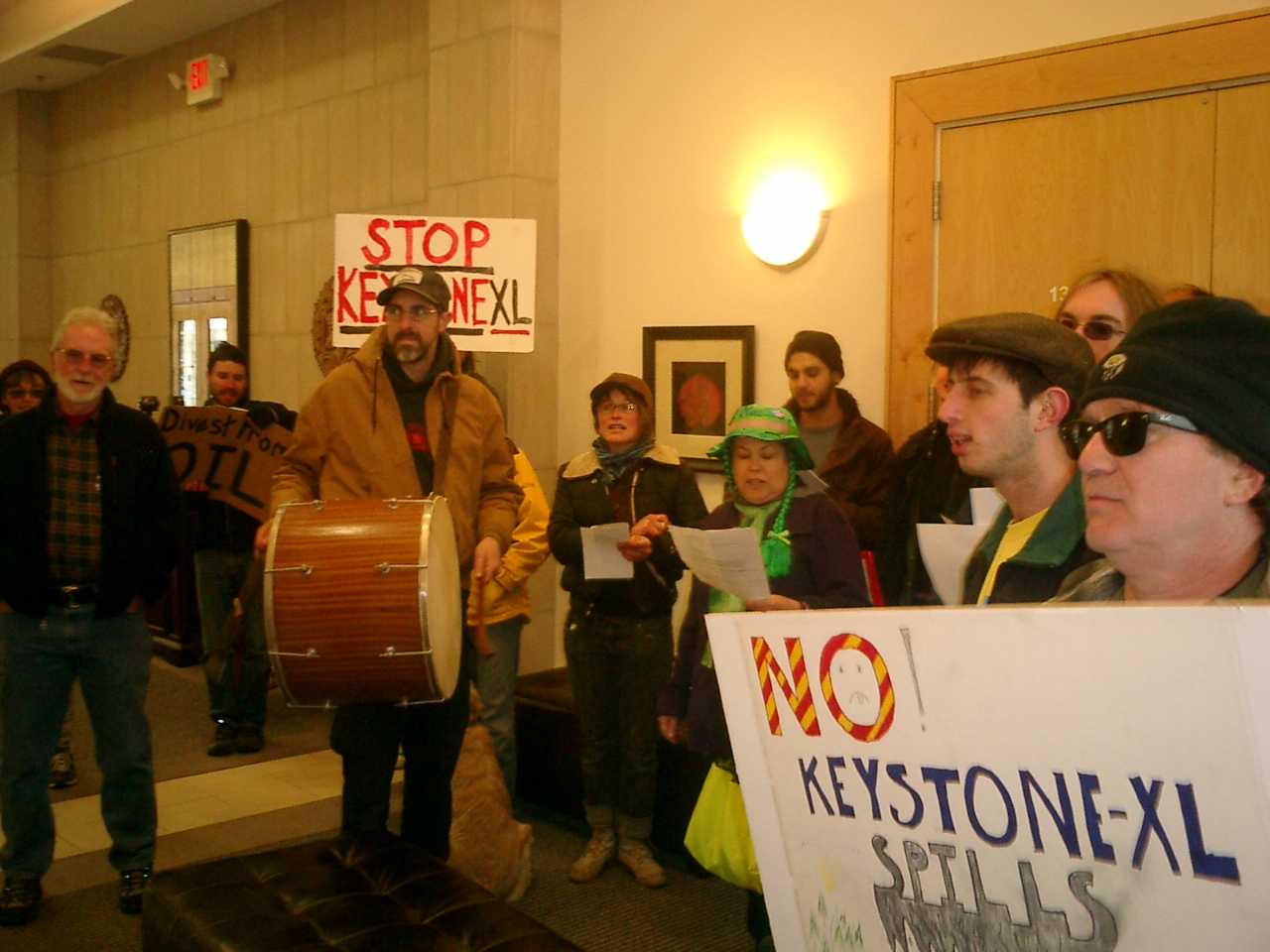
Asheville, NC –  60 people took to the streets today to protest the Keystone XL pipeline in downtown Asheville. After a rally in Pritchard Park, the march made its way to TD Bank, a major investor in the Keystone XL pipeline and occupied the lobby, forcing the bank to close for the rest of the day. Protestors carried banners reading, “Obama, Your Pipedream is a Nightmare” and “TD Bank, divest from dirty oil.” Police arrested four protesters who refused to leave until TD Bank agreed to divest from the tar sands industry.

The action was organized by Asheville based Katuah Earth First! and is part of a week of nationwide protests called for by Tar Sands Blockade  a coalition of Texas landowners and environmentalists fighting the southern leg of the pipeline.

“We are going to hold accountable the companies that threaten our future with their dirty investments. With every dollar TD Bank invests in the Keystone XL pipeline we can feel the noose tightening around our necks,” said Patty Petroluse, a student in Asheville. TD Bank holds over 13 million shares in Transcanada, the company building the Keystone XL pipeline.

“In a time of escalating drought, wildfires, and super-storms fueled by climate change it is suicidal to invest billions of dollars in new fossil fuel infrastructure. The Keystone XL pipeline would be delivering the dirtiest fossil fuel imaginable, tar sands oil”, said Henry Lowry.

If built, the pipeline would tear through thousands of miles of sensitive ecosystems, farmland, and Native American tribal lands in order to deliver Canadian tar sands oil to Gulf Coast refineries. Contrary to industry claims, the vast majority of the oil would be destined for export, not for US consumption. Canada’s tar sands oil has been labeled by environmental groups as the “dirtiest project on earth.” Extraction of tar sands requires massive strip mines that have already destroyed hundreds of square miles of Canada’s boreal forest. Tar sands oil production is extremely energy intensive and produces far more greenhouse gas emissions than conventional oil.

The week of protest has seen protests in over 30 cities around the country and over 40 arrests as activists express their opposition to the Keystone XL Pipeline. Katuah Earth First! is proud to contribute to the nationwide movement against new fossil fuels infrastructure.

Breaking News: Cops Move in on Willits Treesit; Cutting and Construction to Follow

21 March 2013
If you are anywhere near Mendocino County, get out there and help!

21 March 2013
If you are anywhere near Mendocino County, get out there and help!Warbler_treesit_9045_1000p_WEB
Willits, CA-Opponents of the Caltrans Willlits Bypass through endangered wetlands are converging on the site to protect a tree-sitter as dozens of California Highway Patrol vehicles arrived at the Bypass protest area in Willits in Mendocino County at 7 a.m. this morning. CHP officers began cordoning off the access roads to the area, keeping a gathering number of protesters and witnesses away from the tree-sit and Caltrans’ proposed construction area. The 24-year old local farmer in the tree who calls herself “the Warbler” has been aloft next to Highway 101 since January 28.
 
Four arrests have been made of Willits residents, and the situation is still actively unfolding. Another Bypass protester has been standing in front of the brush crushing machine that is in the jurisdictional wetlands and has repeatedly blocked it after having been removed several times without arrest. Caltrans’ permit process is not complete with regard to the Migratory Bird Act, in effect until September 15 for the nesting season.
 
Updates will be released as the situation unfolds.

Caltrans Bypass Battle in Willits Heats Up As Activists Sit Down to Block Equipment

16 March 2013

16 March 2013

Willits, CA-Local residents say Caltrans tried to bulldoze their way through Federal and State regulations again in what has become a running battle over the planned Bypass highway around Willits in Mendocino County. Activists sat down in front of moving equipment and called Cal-tip to report violations of the International Migratory Bird Act after bird nests were found. This was the third time activists have blocked equipment since Jan. 28, when a tree sitter named Warbler Warblerwent aloft in a tall ponderosa pine at the southern end of the proposed construction site on Hwy. 101 just outside Willits to protest Caltrans’ Bypass.

At issue is protocol regarding required surveys for nesting birds in compliance with the Migratory Bird Act and a “jurisdictional wetland” damaged when Caltrans workers drove an excavator into the boggy area and it became stuck.
 
When Caltrans arrived at 7:30 a.m. Wednesday, they were accompanied by Arrow Fencing Company and their consulting biologists, who walked ahead of the noisy machine in case nests were again found in its path. Caltrans and Arrow Fencing employees on site claimed they had been told they could proceed by Joann Dunn, California Department of Fish and Wildlife’s (DFW) regional liaison to Caltrans. No proof was available that revised protocols for the bird surveys required before starting construction had been approved by DFW.
 
Reached by phone, DFW Joann Dunn said she had not seen the protocols but that the Department had agreed Caltrans could continue fencing in the previously disturbed area, despite being under an “active investigation”. Last week it was revealed that Caltrans did not have the approved protocols from DFW needed prior to performing bird surveys.  State DFW ordered Caltrans to submit revised protocols and do new bird surveys.
 Excavator tracks flat jurisdictional wetlands
The Bypass would raise a  thirty-foot high earthen wall on either end of the small northern California town, connected by an elevated two-lane, high-speed viaduct spanning the Little Lake Valley. Sensitive wetlands and Coho salmon in the two longest tributaries to the Eel River would be severely impacted.  Moreover, safety concerns about the viaduct, which has no exits, have been raised repeatedly. Caltrans’ EIR says the safety standards will be met in Phase II of the plan, which opponents suspect may never be funded, leaving them with a statistically predictable higher rate of serious and fatal accidents.
 
State Senator Noreen Evans last week sent a letter to Caltrans with some “pointed questions” about Caltrans’ design plans after her aide visited the site and met with those opposed to the Caltrans’ Bypass, according to the Willits News.  That letter can be found on the Willits News site at https://www.facebook.com/WillitsWeekly/posts/493170500739029.
 
During the sit-down blockade, activist Jaime Chevalier said, “We told Caltrans we’d leave if they’d stop all work and sit down and talk with Senator Noreen Evans.”

Deutsche Bags, the Keylime XL Pipeline and a Week of Eco-Action to Remember

16th March 2013

16th March 2013

“…It was later learned that the group’s actions relate to their protest against the construction of the Keylime XL pipeline and finances for the project emanating from Deutsche Bank.”

—Officer Rodriguez, Palm Beach Police Probable Cause Affidavit
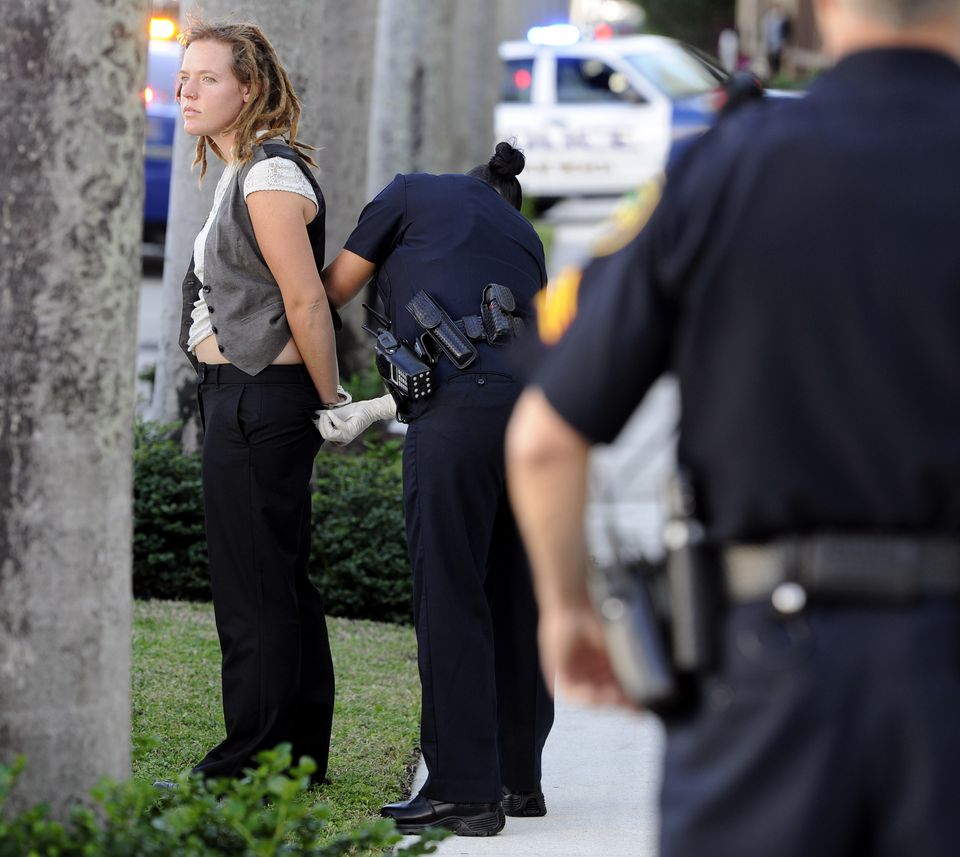
What a bunch a Deutsche Bags

No Officer, that ain’t Keylime emanating from Deutsche Bank.

Today kicks off a Week of Action to Stop Tar Sands Profiteers. As you may have heard, the good folks on the front lines of the tar sands resistance have called for solidarity with their ongoing effort of blockades along the route of Keystone XL construction.

What we have below are some lessons learned from an action in Florida last November, where amidst a call for solidarity with Tar Sands Blockaders fighting the Keystone XL pipeline, four people were arrested at Deutsche Bank (one of KXL’s many financiers). The protest took place on Palm Beach Island, a bastion of obscene wealth and elitism in south Florida.

No Officer, that ain't Keylime emanating from Deutsche Bank...

What a buncha Deutsche Bags! Click here to read document

About two weeks ago, the final case of the four folks who got popped on “the Island” was resolved, resulting in a handful of community service hours and a few measly months of probation. More importantly though, arrestees gained access to police records from the action during the pre-trial process (available to you by clicking the images on the right) and they have the freedom to talk more easily now that a few sketchy charges are no longer hanging over their heads. 

We hope some of these seven lessons may come in handy for the folks, both newbies and well-seasoned, who are planning to have an action-packed week: 

Lesson #1. Press Releases: Its a good idea to wait ’till after the action is in place before you send a press release out far and wide. Especially if a local newspaper shares an office building with a bank you’re targeting. (The paper in this case being the Palm Beach Daily News, known around here as “The Shiny Sheet” because they pride themselves on using glossy un-recyclable paper for their front page. Every day.) Otherwise, kiss your element of surprise good-bye, and say hello to that beefy mustached undercover cop wandering the park at your deployment site.
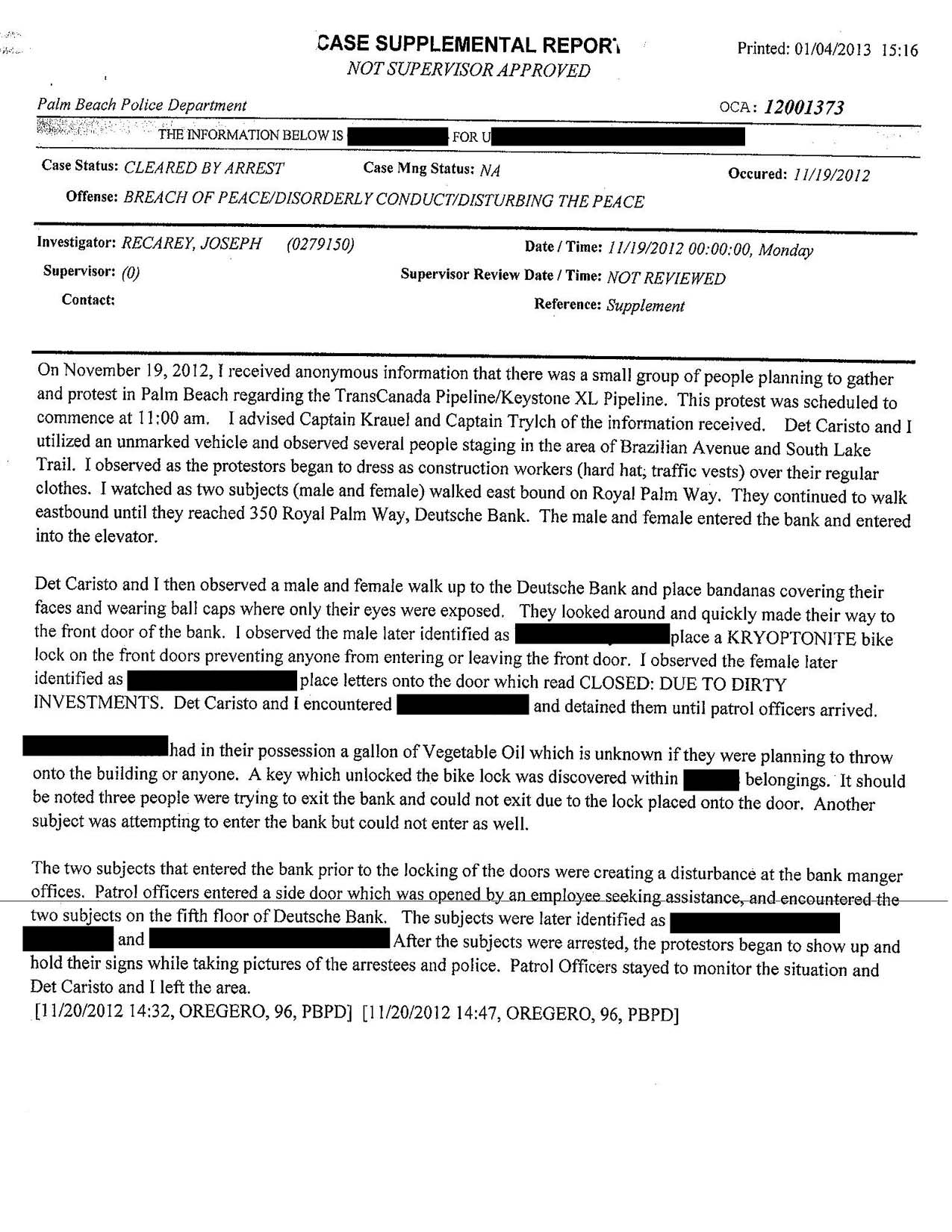
Closed due to dirty investments KXL

Click here to read the Document.      Extra Credit Lesson, SEO 101: Did you know that the more times we write corporate names like Deutsche Bank, TransCanada or Michels in a news post, the higher a story like this ranks in online searches for them, helping expose them, cast doubt from their shareholders and clients and possibly drive up the cost of their PR firm contracts and insurance policies? For extra fun let’s add an individual’s name, like James Zahringer of Deutsche Bank, so this will come up in searches for him as well. “Tagging” them helps do this too.

Lesson #2. Masks: Wearing a bandana around your face can be helpful at times functional for both its theatrical and security qualities—cool-looking even. But there are additional elements to take into consideration here. For example, like an ostrich hiding its head in sand, sometimes wearing a mask in small group makes you stand out more than, say, a shave and some penny-loafers might. And then there’s the whole being-accused-of-trying-to-rob-a-bank thing (Yes, even if that bank deals only in managing investments.) While this charge got thrown out of court, we found it hard convincing news outlets to retract their false allegations. On that note…

Lesson #3. Media: Don’t expect fair or accurate coverage, especially from a newspaper sharing an office with a bank your protesting. Even if you write up a good solid press release (as we thought we had done.) A potentially-thwarted bank robbery probably trumps an eco-radical office occupation in the corporate news pretty much every time.

Lesson #4. Criminal charges: If, in assessing your action plan and potential criminals charges you could be accused of, you realize they are most likely to be some overly-broad hokey non-sense like “disorderly conduct” or “breach of the peace,” then plan to make them count. For example, u-locking front doors (where there is still an available fire exit), defacing windows with stickers saying “Closed Due to Dirty Investments” and dumping a messy, sticky substance that looks like tar sands oil (but smells like brownie batter)… Those all fall under a single charge, so why skimp? On a side note related to legal strategy, one of the ways in which bogus charges were beaten was in preparing for trial by subpoenaing evidence and witnesses which would further expose and inconvenience our target business establishments, thus sweetening the plea deals offered.

Lesson #5. Pictures: If you end up with a camera which has photos that could be used against someone in court, its a good idea to take precautions that avoid them being confiscated or subpoenaed as evidence. Its a bad idea to hide them so well that you no longer have any pictures from the action to show what happened, leaving you using a message-less picture of someone getting arrested from that stupid corporate newspaper which you will be complaining about, possibly for months to come, instead of the funny-ass pictures of your friends getting tackled in front of a Deutsche Bank looking like 1920s-era bandits.

Lesson #6. Stories: We have to tell our own. While it might be easier to let the police documents do it for us, its not always as reliable as it has been here. And if you can’t publish your story in a timely manor due to pending legal obstacles or other hurdles, then come up with a timeless way, or a new-timelyness, or some other original and/or funny way to present it (like this… Yes. This that you’re reading right now. Click here to start again from the top.) After all, the world changes according to the stories we tell about our actions. Good actions are vehicles for good stories; good stories are a path to all-out-revolution. Conversely, good actions accompanied by boring overly-ideological stories are paths to Joe Stalin’s dinner party (like the one that prompted his wife Nadya to kill herself). Brutal, and totally b-o-o-o-o-r-r-r-i-n-g.

Lesson #7. Winning: We are winning. If you don’t believe the hyperbolic rhetoric on your favorite overzealous anarchist social media webpages, then check out the financial sector’s news on occasion, like Bloomberg’s take last month on Deutsche Bank “re-trenching” on oil and gas investments (“The bank posted a fourth-quarter loss of $2.9 billion… due to “reduced client activity,” according to a Jan. 31 earnings statement”) or Platts’ report a few years back on Deutsche’s doubt that KXL could meet its deadlines. Our enemies feel pressure.

The last take-home messages

This fight is growing. Here’s one small example: When this article was started, Credo—that strange activist-phone company combo deal—had just announced a well-crafted, ambitious “pledge of resistance” for mass civil disobedience against the KXL tar sands pipeline coinciding with the State Department’s release of a pathetic environmental assessment which moved it one big step closer to full approval. By the time we hit “publish,” Credo has already gotten well over 50,000 commitments from people looking to plug in… possibly on your plans for next week—plans that will become a part of the victory story.
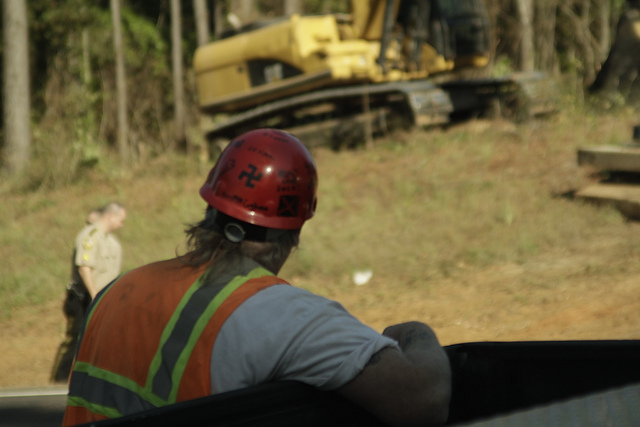
Let's see if

The picture of this neo-nazi was taken by a Tar Sands Blockader along the KXL route in east Texas recently. Alright, now let’s see if we can get the words “Nazi,” “Michels” and the CEO’s name, “Richard Kinder” to come up together in a search engine. Woo! Isn’t this exciting!?

Oh, wait. A few more things. In case you missed it, there are some great lists of action targets where you can show your solidarity with folks fighting the pipeline, including addresses for all the Michels offices in the US. Michels is the contractor constructing the KXL pipeline (not to mention the Tennessee fracked gas pipeline being fought in Pennsylvania right now). Michels’ CEO is Richard Kinder. He lives at 2929 Lazy Lane Boulevard, Houston, TX 77019-1301. Add to the repulsion, he apparently has no problem hiring nazis.