Avaialble from your local radical bookshop, ecological direct action group or http://www.activedistributionshop.org/shop/zines/4209-whirlwind-earth-first-zine-winter-201617.html
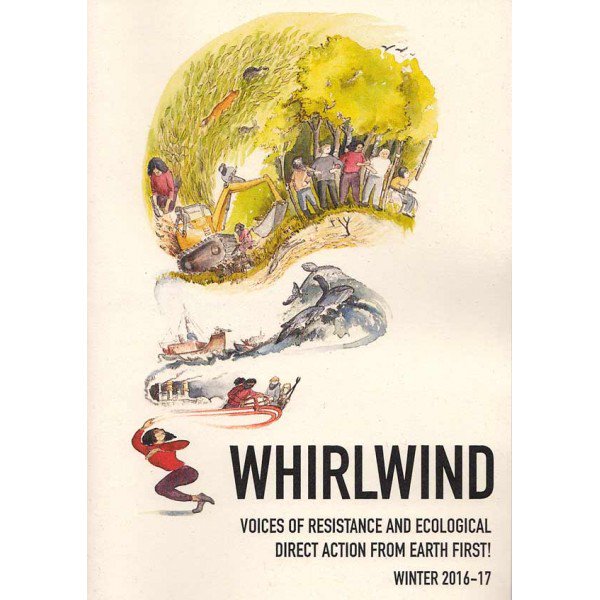
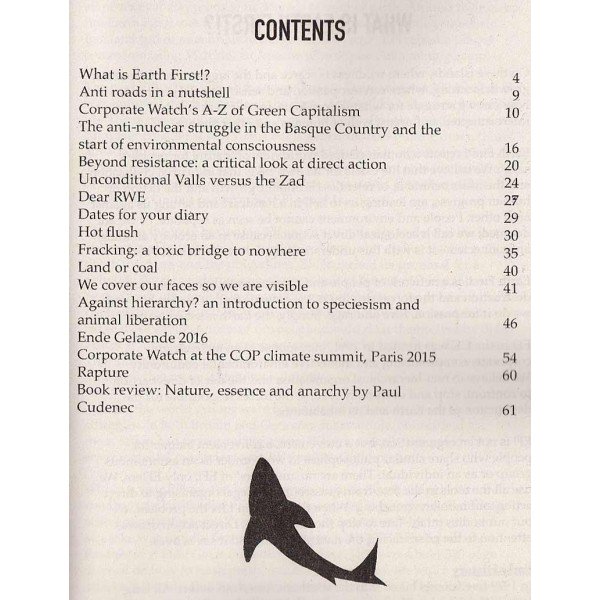
Whirlwind, Voices of Resistance and Ecological Direct Action from Earth First! A5 zine. The first issue!


Avaialble from your local radical bookshop, ecological direct action group or http://www.activedistributionshop.org/shop/zines/4209-whirlwind-earth-first-zine-winter-201617.html
In blizzard conditions (well a little light snow anyway) we went to the Pevensey Marsh Beagles, who hunt hares, this week. It didn’t take too long for them to realise they had no chance of hunting with us around. They went back to the meet and hung around looking grumpy while we practiced cracking whips and cracked open the brandy coffee.
On the way to the hunt we took a diversion to East Sussex WRAS with an injured pheasant we found.
Our friends at South Coast Hunt Sabs had their Landrover stolen this week, so if you can spare a few quid to help them get another, then head to the Go Fund Me page below. In the meantime, they are still getting out – we even let some of them into our treasured Landy!
https://www.gofundme.com/new-sabbing-vehicle-for-scoast-sabs
Earth First! Winter Moot 24-26 February 2017, Manchester – plot and plan for ecological direct action.
A weekend of campaign updates, networking, planning, solidarity and socialising in the North West – the fracking frontline. Involved or want to get involved in ecological resistance in the Britain & Ireland? Whether you are fighting fracking, opencast coal, fracking, GM, nuclear power, new road building or quarries. The Winter Moot is for you.
Full details here
Biofuelwatch, Coal Action Network and others will be demonstrating at Drax Power Station, to celebrate ten years of climate action (since the first UK climate camp at Drax) and calling for Drax to be shut down and replaced with genuine renewables.
webpage here
http://www.biofuelwatch.org.uk/2016/axedrax-october-22/
and fb event here
https://www.facebook.com/events/1667993586852396/
It will be a fine day out.
We want your writing!

We want your writing!
For a semi-regular zine of activist reflections and actions.
This is an invitation for articles offering a critical analysis and reflections on Earth First! and related environmental and social justice direct action movements, how we organise and the actions we take. Contributions can be about actions in the UK or international. We also welcome book reviews, activist resources, short rants, illustrations, cartoons, poems and photographs. We suggest 500 – 2000 words for articles, but contact us if you want to do something longer.
We aim to have a zine in print and online by the Earth First! winter moot 2017. All articles will be copyleft and you can choose whether to write anonymously. Deadline November 30 2016.
Also contact us if you want to join our editorial collective or offer us funding.
zine@earthfirst.org.uk or contact us if you want to send an article by snail mail.
Just now we’ve sent out the PDF versions of our recent releases, for downloading and printing (for past issues, see 325).
https://en-contrainfo.espiv.net/2016/06/05/uk-4-new-releases-from-green-anarchist-zine-return-fire-pdfs/ for links to the PDFs
Just now we’ve sent out the PDF versions of our recent releases, for downloading and printing (for past issues, see 325). To summarise, there’s the full length edition of Return Fire vol.3 (Winter 2015-2016), full of news, theory, poetry and antagonism (download in low-res here); a companion piece consisting of our ‘glossary’ entry for the issue, on Colonisation; an imposed and print-ready version of ‘Smarter Prison?’ as a supplement to vol.3, which we received from ‘Radical Interference’ and released for December of 2015; and lastly, we’ve uploaded one of the feature texts from vol.3, ‘The Veil Drops’, to theanarchistlibrary.org as a separate file for reading and reproduction. Also, there is both colour and black-and-white versions of the cover included, in case some comrades want to do their own printing.
Return Fire vol.3
A continuation of our project to bring incisive anarchic content from around to world to an anglophone readership. New editorial content, reprints of things we’ve found useful, artwork, action listings, foraging information, the usual.
There’s a few previously-untranslated articles in this issue. For example, one is an extract from the latest cover story of Italy’s eco-insurrectionary periodical Terra Selvaggia, on ‘The Advance of Urbanisation’ and, simultaneously, cracks opening in the concrete which we could utilise… Annie Archet meanwhile tells a life-story of evading identity, in Portrait of the Invisible Woman in Front of Her Mirror. To name some out of the texts we’ve assembled from selections of pre-existing ones, David King looks at the reductionist and patriarchal implications of modern reproductive technologies in ‘Into Her Inner Chambers’, and Nicola Gai speaks to acting within ‘The Maximum That Our Abilities Allow’ (from his contribution to the founding issue of the Croce Nera Anarchica).
The content we have harvested whole includes The Intensification of Independence in Wallmapu, John Severino’s poignant reflections on a project within an indigenous Mapuche community; The ‘Wild’ as Will and Representation, about commodified and alienated approaches in the urgent need for land reconnection, simply signed M.; and Sean Dunohoe’s harrowing (if limited) polemic against the Close Supervision Centres within the British prison system. (We note that this year the organising collective for the June 11 project of solidarity with long-term anarchist prisoners has called for a focus on such units wherever they are in the world; hence we’d like to dedicate this version in that direction.)
As for our usual columns… We take a retrospective look at some Global Flash-Points of insurgent activity in the months following our last volume. Rebels Behinds Bars covers the State’s aggressions against our comrades, and the latter’s thoughts on topics from surviving incarceration or repression to (anti-)organisation for the attack on authority. ‘To Create & Maintain Their Wealth’ and ‘Sensuality, Magic & Anarchist Violence’ address gendered and speciesist domination through reviews of Silvia Federici, Arthur Evans and Jason Hribal.
The Poems for Love, Loss & War are from Rydra Cosmo, Henry Zegarrundo, Natasha Alvarez and other appreciators of all things feral. For our Memory as a Weapon segment, we’ve used Unsettling America’s spellbinding telling of civilisation’s spread through Europe from the south and beyond, and subsequent trajectory, in The Witch’s Child.
And of course, much more! (All prisoner addresses and also some court-case news is now up to date in the PDF version.)
Colonisation
This time, we ended up printing the ‘glossary’ separately to the main body of the zine. This sizeable essay could be a stand-alone on the subject (one which we feel to be both key and misunderstood by anarchists in much of the world) and distributed as such, but is also relevant to several items in contents of vol.3.
‘Smarter Prison?’
Newly laid out in A5 imposed format, this exploration of the ‘Internet of Things’ and the technological ideology which it advances was first submitted to us during the Black December mobilisation. (We’re happy that since then, Silvia, Billy and Costa, who are referenced in ‘Smarter Prison?’, have been told they will not face trial again for their thwarted attack on the IBM facility.) The struggle against the nano-world continues…
‘The Veil Drops’
This is a reader on counter-insurgency through the lens of ‘crisis’, the social and de-civilising. It’s the longest editorial piece from vol.3, and up on The Anarchist Library for wider accessibility.
Until next time,
R.F.
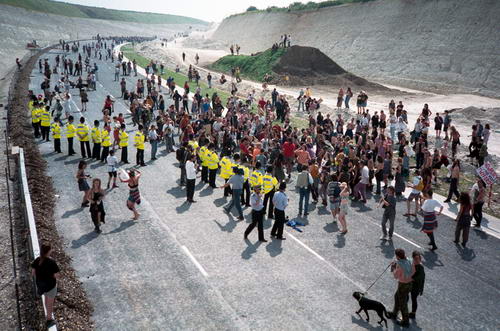
Today (22/5/16) is the 23rd anniversary of Operation Greenfly at Twyford Down – one of the most exciting and audacious direct actions of the 1990s. Twenty-one years ago, the govt were trying to bulldoze a road through the most protected landscape in England and a massive direct action campaign erupted to stop them, which kickstarted the 1990s roads protest movement.
Today (22/5/16) is the 23rd anniversary of Operation Greenfly at Twyford Down – one of the most exciting and audacious direct actions of the 1990s. Twenty-one years ago, the govt were trying to bulldoze a road through the most protected landscape in England and a massive direct action campaign erupted to stop them, which kickstarted the 1990s roads protest movement. We had an anonymous tip off that the road builders would have to close the whole of the M3 motorway over night to erect a ‘bailey bridge’ over it, to move the huge quantities of ‘spoil’ (chalky guts of Twyford Down) and spread it all over the water meadows below. They called this hugely important and strategic manoeuvre ‘Operation Market Garden”. So we launched “Operation Greenfly” to counter them.
They hired security guards from all over southern England, surrounded the site with razor wire, and had 100s of police protecting the site. However, as night fell and the motorway was about to close, some 200 protesters eluded police, went cross country and approached the site from an unprotected angle, miraculously trampling down the razor wire, and flooding onto the site, occupying the bridge!
For many people it was one of the most miraculous and empowering actions we’d ever pulled off. We occupied that bridge all night, drumming on the metal structure to keep our spirits up and warding off the “forces of darkness”, with the noise echoing across the water meadows and the silenced motorway. Fire breathers added extra drama. Hugely stirring and unforgettable. They had to draft in cops from all over southern England, and prise everyone off the bridge, cutting all the lock ons, taking hours. Over 50 arrests resulted with all of us being spread across police stations in the south.
They managed to just about get the bridge across the motorway before it reopened at 7am. However, they couldn’t complete the job and had to re-close the motorway 2 weeks later, causing major delays to their construction programme.
Were you there? What are your memories of that night?
“Mining is going on a hundred meters away. When they started blasting, all the dust was brought to our vegetable gardens. Vegetables got covered with the coal dust which is impossible to wash out. Now I don‘t want to harm myself by eating anything from this garden,” a resident of Kazas, Siberia, Russia, describes the impact of coal mining.
The London Mining Network and the Coal Action Network are heading off on tour with a Russian environmental activist who has witnessed first hand the impacts of the UK’s burning of coal on indigenous people.
“The consequences of coal mining in Russia are terrible. There are environmental and economic disasters happening in mining regions, especially in Kuzbass where the most of coal reserves located. Public health is getting worse and worse, indigenous people being forced out of their land, air and water poisoned.” Vladimir Slivyak, Ecodefense.
The UK imports two thirds of the coal it burns in the remaining nine coal fired power stations. In 2015, 24% of our electricity came from burning coal. Just under a third of this coal comes from Russia.
Vladimir, a Russian anti-coal activist is visiting the UK for a speaking tour starting on the 25th May in Brighton before touring around the UK and finishing on the 10th June in London. Full details of the tour can be found www.coalaction.org.uk/tour. He will discuss the problems caused by mining for the UK’s power stations in his home country, while the Coal Action Network discuss how we can act to end the destruction.
The tour is part of the launch of Ditch Coal, a new report from the Coal Action Network released earlier this year. It tells the human and localized environmental story of the coal burnt in UK power stations. The climate change impacts of burning coal are well documented, but somehow hard to relate to in a concrete manner. By contrast the stories of those living in the shadows of the mines are somehow more tangible, being direct human experiences being felt already.
The tour will be joined by local community campaigners fighting opencast coal operations in Sheffield, Newcastle and Edinburgh. Speakers from Colombia Solidarity Campaign will join at Brighton, Newcastle, Cambridge and London.
The problem in Russia
The Siberian village of Kazas was surrounded by opencast coal mines and had a population of predominantly indigenous Shor people. Kazas was entirely destroyed in 2014 to make way for the expansion of the mines although the villagers did not all consent to leave. The problems of this village are not unique. For each tonne of coal produced six hectares of land is disturbed, land which was home and habitat to both people and wildlife before the mining companies’ encroachment.
Prior to the destruction of Kazas, pressure was applied to get families to move. Infrastructure was no longer maintained – roads were not cleared of snow in winter and clean drinking water was no longer provided. With only 6% of water from the mines being treated, filthy water killed the fish and the wildlife dispersed, preventing the traditional economic activities of the Shor people – hunting and fishing.
Communities in the coal mining regions struggle to have their objections heard as the system is stacked against them. Decisions about mining applications are heard away from the ancestral lands which are threatened so those affected cannot attend hearings.
The worsening situation for the residents meant that many agreed to leave. For those who didn’t the outcome was more sinister, their homes were destroyed by arson.
The village of Kazas now only exists in the memories of the people who lived there. “Chuvashka is the Shors’ only village in this area. In the 1990s, about 16,000 Shors were living here. Today, there are just between 4,500 and 5,000 people here” said a Shor woman in Ecodefense’s film Condemned. Eight other villages in the area have been destroyed.
The mining exploits in the Kemerovo region have left many of the indigenous Shor homeless, or displaced to other areas, which severs their spiritual, cultural, and practical attachments to the land. No adequate substitute land, nor compensation has been offered to them. The Kemerovo Oblast, where most of the Shors and Teleut live, produces 60% of Russia’s coal for export.
The Russian coal industry also has the most dangerous working conditions of any industry in terms of risk to life and welfare, with 40-50 fatal accidents each year, killing 180-280 people annually, mainly in the deep mines.
Why is the UK burning Russian coal?
In the year to August 2015, 31% of all thermal coal burnt in the UK came from Russia. Since 2005, Russia has supplied the UK with more coal than any other country – coal is cheaper from Russia than anywhere else, which is why we burn so much of it. There is little transparency in the coal supply chain and large volumes.
Where else does coal come from?
32% of the coal used in the UK was extracted in Britain in the year to September 2015. Here opencast mining operations have continually faced resistance from those living in the shadow of mines and proposed sites. At the end of March 2016 there were 21 opencast mines working, a number which is decreasing. There are no longer any underground coal mines in this country.
Colombia is known for its human rights abuses, yet it supplies 23% of the coal imported to the UK. Over 90% of Colombian coal production occurs in three large-scale open cast mining operations in the northern departments of La Guajira and Cesar. Communities close to the mines suffer the same problems in terms of forced relocations as those neighboring Russian mines, additionally there have been links made to assassination attempts on those who speak out against the mines, mass killings and violence.
Most of the 14% of coal coming to the UK from the USA is from damaging longwall mining systems – where the material over the coal is intentionally collapsed as the mine progresses – or from opencast or mountaintop removal mines. Both of these methods destroy huge areas of land, displace people and damage the water table. During mountaintop removal coal mining is destroying entire mountain ranges in Appalachia.
The Coal Action Network is working with grass roots groups on campaigns to close the UK’s remaining coal fired power stations. Come along to one of our tour dates to find out why we must close these power stations and to see how you can get involved.
Full tour details www.coalaction.org.uk/tour
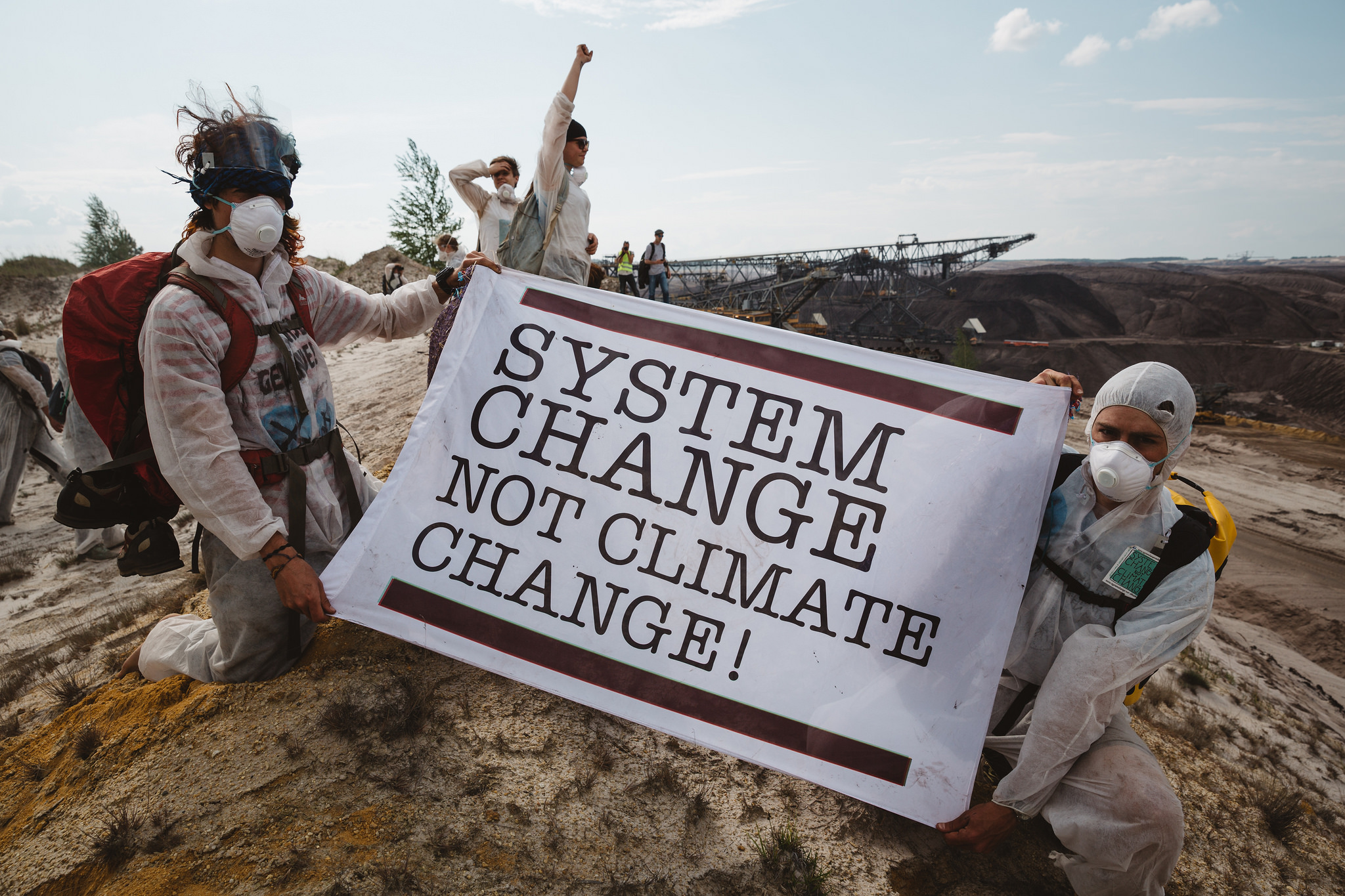
Between 13-15 May 2016 more than 3,500 people took part in a huge series of Ende Gelände (literally: ‘here & no further’) direct actions to shut down Europe’s biggest source of CO2 emissions, following a climate camp.
The Welzow-Süd opencast coal mine in the Lusatia coal fields in Germany was shut down and the power plant Schwarze Pumpe – Europe’s 10th largest emitter of CO2 – was cut off from all coal supplies.
Many entered the mine, others blocked coal trains and conveyor belts transporting coal to the power plant. Swedish energy company Vattenfall reduced the power plant’s capacity by 80 per cent. After more than 48 hours, the activists stopped the blockade on Sunday 15 May 2016.
The mass action Ende Gelände (‘here and no further’) demands an end of coal now.
Next German climate camp in the Rhineland (note clash with EF! Summer Gathering)
We think that anyone serious about confronting domination as it stands today will sooner or later come to the questions of science and technology.
We think that anyone serious about confronting domination as it stands today will sooner or later come to the questions of science and technology. It’s clear how both have an increasingly vital role to the ruling order by creating, managing and spreading control within society and over the rest of an earth we’re falsely separated from. By investigating the development of these powers in the region and who makes it possible, we came to Vinci.
In the U.K, the French multinational energy and construction giant Vinci carry out specialist construction services for the police, Ministry of Defence and prisons, earthworks for motorways, railways and quarrying, power stations, offshore rigs and nuclear new-builds, as well as shopping centres and the like. Worldwide this corporation and its subsidiaries are active in many fields: dam building, private security, airports, uranium mines; these scum have no problem with inflicting carnage on the earth and us as part of it, raising an industrial cage around us both figuratively and literally, and feeding off the labours of their workforce while the bosses line their pockets and move on to the next contract.
In these respects we attack Vinci anyway, but one of our main motives for targeting them is because they’re responsible for building the new Biological Life Sciences Centre soon to open at the University of Bristol.
We set off an explosive at Vinci’s offices at Vantage business park, north of Bristol, at approximately 3:45 yesterday morning (6th January). It was placed with the aim of cutting off power lines, scorching the exterior and starting a fire inside. We considered the resident company in the next-door part of the unit a worthy secondary target in any damages (Whitehead, another construction and building servicing group who do commissioned work for Vinci).
A £54 million facility, the Biological Life Sciences Centre will offer courses for “the next generation of biologists” as well as current specialists, aiming to improve collaboration with the university’s nanotechnology centre and just across from the Medical School’s genetic engineering, vivisection and animal breeding labs. The world capitalist system sees advances in fields like this as key to the next round of discovery, enclosure and wealth creation. As the area around Bristol and Bath houses the biggest hi-tech design cluster in the world after America’s Silicon Valley, this “revolution” is happening on our doorsteps, “with Bristol being an exciting and ideal place to carry out research over the coming years.” (This is in the words of Professor Gary Foster, whose work at the University of Bristol in genetic-modification and other biotechnologies feeds the noxious pharmaceutical industry such as GlaxoSmithKline. The university breeds genetically-altered mice, for example, then morbidly subjects these living creatures to extensive nerve damage and hand the results to drug companies.)
One of the main thrusts of this drive is synthetic biology, a disturbing practice using the latest technology for “rewriting and rebuilding natural systems to provide engineered surrogates.” In 2012 a conference at the University of Bristol stated that synthetic biology “could become a driving force of the national economy,” and the government have declared it a top research priority. The European Union has now awarded £3.3 million to the University of Bristol just to create “public awareness” promoting the practice.
The logic of these kind of sciences has, as its primary goal, attempted control over everything. They reduce knowledge, that might be more deeply gained in wild relationships of interaction and interdependence, to a detached universe of obsessive measurement and objectification, arrogantly separating parts from the whole that gives them meaning as if everything were merely a machine to dismantle. This scientific tradition is closely tied up with the worldview that emerged during the early formation of commercial capitalism, which sought and still seeks to adapt lifeforms to the drive for profits, justify the domination and destruction of the living world, and implement a macho uber-rationalism scornful of everything fragile and organic on which all species depend. Right now, plant and animal genes are broken down and optimised in labs so they suit productive standards and to create new private property through patents. Where we might see the unique leaves, seeds, bodies and minds of ourselves and our fellow creatures, this science (if not necessarily each scientist, the results are the same) just sees lifeless objects to pick apart, study and sacrifice on the altar of economic usefulness to their paymasters who reap the benefits from this sick and sickening society.
For instance we can see the current push for genetically-modified (G.M) food in the U.K by the media, industry and government, for which these research institutions play an important part: such as advances in biotechnology for crops thanks to the Long Ashton Research Station run by the University of Bristol in the past. Scientists like Gary Foster are well aware of the dangers from G.M genes “leaking into the natural world” (again, his own words) but apparently the money and prestige from their mastery are worth more than our insignificant lives. A decade ago the first wave of G.M trials was slowed here by sustained pressure and crop-trashing; today sabotage continues from Holland to the Philippines, and others like us also won’t be accomplices to these developments or their agents through inaction. It’s necessary to attack the new wave of so-called ‘life’ science facilities at the root (those who design them, those who construct them) not just criticize the more well-known products of their research: because to these institutions all knowledge becomes another opportunity for control and exploitation, so extending the scope of a system that’s in reality annihilating and artificialising life in all it’s beauty.
Abroad, plant and animal die-offs as well as increased allergies and intolerances are already being attributed to G.M. With the bio-tech industry nonchalantly unleashing its monsters, especially across lands in the global south where patented G.M seeds that must be re-bought yearly exert a stranglehold, it many take generations to show some of their effects on infinitely complex webs of life that evolved over millions of years. That is, before civilised cultures began intensively manipulating them, today even down to the nano-scale. With the like of synthetic biology we’re moving fast into a future where even lifeforms “in nature” are the products of laboratory experiments, and nothing remains that isn’t engineered somewhere along the line by a human-centred system of scientific totalitarianism.
For obvious reasons as people turning against laws and domination in more than words we also stand against new policing and identification controls enabled by more forensics, biometrics etc. and the introduction of their common use in the information-age social prison (mobile fingerprinting, facial recognition systems, D.N.A swabs etc. – they didn’t stop us yet though…).
This isn’t Vinci’s only U.K venture into this lucrative field either. They’ve also undertaken future expansions in science, technology and engineering departments at Swansea University. They’ve commissioned Whitehead for the job too, their neighbours at Vantage business park, who are now also marked by our attack. This will be the result for as long as society steps in line to realise the fantasies of a despotic science, reaching for their dreams which are our nightmares.
So what about the ‘benefits’ that these hi-tech institutions want to sell us, founded as they are on massive energy consumption and resource extraction, on the authority of a specialist caste’s somehow-unreproachable meddling with our environments, and on the domestication of wild spaces and the torture of other animals? They promise us advances in (human) health, food and technology, fostering the illusion that science can fix all the damage incurred by the dominant ways of living. They expect us to forget how many of the diseases, disorders and cancers are directly caused by the same industrial output, globalised mass society, psychologically and physically unhealthy habitats and toxic workplaces of a culture which goes toward these labs and more in the first place. They expect us to forget that agri-monoculture production led to an anti-nutritious diet of manipulated short-term energising/comfort food at an escalating cost to the land, while diverse wild plant and animals species we used to coexist with get wiped out by the system’s endless expansion and pollution. (Vinci’s works being a prime example.) They expect us to forget how it’s precisely the advances in complex technological systems that generate our dependance on their designers and manufacturers, alienation from ourselves as well as the earth as a whole and each other at the personal level, and increased efficiency in achieving the goals of society’s rulers: profit and power, through misery and exploitation, pushing the planetary ecology toward collapse.
In short the sickness is civilisation itself, including its false solutions to its chronic problems steadily impoverishing survival for human and non-human populations alike, an unacceptable transgression on our intent to live freely.
Choosing direct action over despair we declare our part in a low-intensity urban war in its early stages across Bristol against the many faces of the system, with stones, paint or fire and with the plans, debates and daily refusals; sometimes almost imperceivable, sometimes devastating. In Britain’s ugly cities and intensively-managed countryside a determined minority of rebels and wilderness-lovers sporadically take the offensive: some striking anonymously, some forming one-off action groups, and some having tested the open proposal of the Informal Anarchist Federation; not only in the south-west but Nottingham, Cambridge, London and now Glasgow.
Everything is at stake to us and we ourselves have no time to waste. Toward recovering our own volition and finding affinities for rebellion, our methods shall include intractable conflict without pause or negotiation: and much more besides, breaking with this miserable civil order with a wide variety of experiments and the full scope of our imaginations. Destruction is just another indispensable side of creation (and vice versa) not an opposite, we’re now sure of that. Our insurgency would be justified as an end in itself in the face of this life we’re raised into, but it’s beyond only being reactive. It acts to solidify that we’re already taking back in our face-to-face encounters and in our minds. It allows potential space for new and stronger relationships chosen by aware individuals mindful of all lifeforms, through actively weakening the current modes. Until some point of breakdown where whatever comes next is out of any society-wide control and reasoning, and so beyond society. Liberation can mean nothing less; tending toward the wild.
The international and internal battleground between anarchy and domination holds both losses and gains, of which some are known and some unknown to us. With this is mind we start the new year by celebrating the release of Braulio Duran (an unrepentant eco-anarchist who was held by the Mexican State) last October, albeit into the wider prison-society. When we discover solidarity with a locked-up comrade through their attitude and words, it doesn’t diminish when they get ‘out’; it just creates more grounds to keep fighting toward our mutual goals. Still ‘inside’, we remember the total-liberationist Adrian Gonzales and anarchist bandits of the Kozani case as well as Babis Tsilianidis; and Marco Camenisch, denied parole once again. Respect to the Mi’kmaq Warriors engaging the Canadian State/petro-industry aggressors in incendiary clashes, a renewed phase of indigenous militancy, and to the ones consistently defending both Khimki forest and the land of Notre-Dames-Des-Landes from Vinci’s developments. A raised fist above the prison walls for Nicola Gai and Alfredo Cospito aka F.A.I/F.R.I Olga Nucleus, until cellblocks are rubble and jailers are ash.
On a sadder note, 2012 ended with the anarchist Sebastian Oversluij being fatally shot in Santiago while trying to collectively seize back some of what the banks extract every day from the exploited. Neither a victim or a martyr, we simply see someone who didn’t bow their head and accept the system’s rules, and we are glad to have such people as comrades. Even within this nonsensical, resigned and cynical modern culture, every action demands a reaction. When they kill one of the resisters, our enemies must pay in any way. This is how our struggle leaves behind empty gestures and keeps the dead from falling into oblivion. Blackened offices won’t replace split blood, but they signal that same social war isn’t finished, and our grief births rage.
Informal Anarchist Federation (F.A.I) Insurgents: Bristol North