Notes from the UK Squatters’ Meeting 9/10 February 2008

This, the first attempt to coordinate a national meeting for some time, was held in a beautiful old nursing home with extensive grounds at Headingley in Leeds.

This, the first attempt to coordinate a national meeting for some time, was held in a beautiful old nursing home with extensive grounds at Headingley in Leeds. There was a good mixed turn out with squatters represented from many of the major towns in the uk, some protest sites and some travellers attending. All in all perhaps 30-40 people.

Overall the meeting was constructive and positive with a lot of things discussed with a good party on Sunday night, of which the local residents were very accomodating once we explained it was a one off. It was a different matter with the local constabulary who were miffed to say the least, but unable to act because of a secure building and the number of people present. (apart, that is, from a bit of harrassment, including an isolated piece of brutality/assault). They finally got their vindictive revenge by confiscating the van taking the rig away on monday by claiming that the driver was not allowed to use a german driving license in this country!! We managed to save the rig though: Ha!

What follows is the basic agenda, followed by rough notes from each meeting highlighting points raised, ideas and criticisms put forward and general information concerning the different aspects of squatting around the uk.

BASIC AGENDA (of general topics)

1. Builing a stronger network between squats/autonomous spaces (aut. spaces) in the uk.

2. Initial planning for days of action.

3. How can we make better use of squats/aut. spaces in terms of connecting them to wider issues such as increased surveillance, housing problems, gentrification, ghettoisation and the fundamental issues of who controls our land , spaces and ultimately lives.

4. The impact of non-squatted autonomous spaces (ie rented/bought/legal social centres) on the squatting movement.

5. Breaking out of the ‘squatting scene’.

6. The impact of drugs on the movement.

7. Repression facing autonomous spaces in the uk and how we can resist effectively.

Saturday: first meeting

Introductions

What is happening in places in the uk?

BRISTOL: A new squatted social centre is in the process of opening. There is Magpie, a long term squat/autonomous space. The local social centre is Kebele, which has now been there nearly eleven years. It was originally squatted, the eviction was resisted and then the building was rented with a housing co-op in it to cover the rent. The building is now owned, but the housing co-op have moved out as they found it difficult to co-exist with activities taking place. The building now accomodates free space for workshops, a cafe, a library, internet and other amenities. Kebele has also, slowly, become recognised as part of the local community.

NORTH EAST LONDON: A squatters’ network has been started in the area around hackney consisting of approx. 11 squats resulting in better solidarity and response to eviction threats. There has been some more social centre organising, with one currently by Lower Clapton Roundabout (info: 07506095491). Ramparts have possibly 2 more months, but have opened a new building.

LEEDS: A few residential squats round Chapeltown, no organised network, no squatted social centres, there is also a partially working ‘Common Place’ legal social centre

NOTTINGHAM: Sumac social centre (not squatted), a few squats, not many activists. City has lots of potential but needs injection of energy.

EXETER: Not much happening, trying to set up a place for temporary autonomous arts (TAA) and skill share. Big regeneration at moment, lots of empty spaces but not much action.

SCOTLAND: There are squats but they tend to be evicted quickly and legally. ESRA- Edinburgh Squatters’ Rights Association.

BRADFORD: There has been a squat on Westgate for 3 years and a block of flats has been squatted down Manchester Rd.

MANCHESTER: Not much squatting happening. There are legal social centres, the ‘Basement’ recently closed down due to a fire/water damage but there is a gay/lesbian/transgender one and a mainstream/straight one which is a bit of a problem.

BRIGHTON: Very difficult to squat. squats last on average 6 weeks, sometimes can be moved on 3-4 times a week. IPOs (Interim Possession Orders) used more and more (gives cops instant eviction power). Illegal evictions with bailliffs, police or both commonplace. Police have gone on record in local paper saying that ‘squatting will not be tolerated in Brighton’. There is a legal social centre, the Cowley Club, bought with a mortgage through Radical Routes, with a housing co-op to pay off the mortgage. Club has cafe, bar, gigs, free English lessons, library, bookshop and internet access as well other activities. Luckily there are two long term squats at the moment.

PROTEST SITES

Tara- Nr Dublin, Ireland: been there over a year, about 15 people on 2 sites. Historical sites threatened, strong local campaign, need more people to help build stockades and fences.

Faslane, Scotland. Punx picnic on 2-4 May.

Rossport, county Mayo, Ireland. Need support. Have good local support. Action camp from where direct action is done.

9 Ladies, Derbyshire- have technically won campaign, waiting on papers. Some of site tatted down.

Bilston Glen- against a road funded by biotech corporations, need more people, council haven’t got money to evict.

Camp Bling- near Southend, anti-road campaign, been there 2 years.

Titnore Woods, nr Worthing- against supermarket and urban sprawl, strong local support, 2 camps

GENDER AND SEXISM

Machismo- there is often a competition of male vs male over dominance, sometimes between female. Is this Alpha male/female complex a purely biological effect or is it reinforced by societal conditions?

Is homophobic/queer/transgender ‘abuse’ a problem?

Does creating ‘queer fiendly’ nights encourage segregation? Maybe we should focus on anti-homophobic issues instead? However queer fiendly nights allow an expression of their culture not always tolerated by mainstream society. Or, in other words, there is a temptation to ghettoize yourself in order to feel comfortable and fit in with like minded people around you.

Maybe there is not such a problem within the alternative/squatting scene itself, but at free parties when people from outside the scene come there can be problems. How can we educate them and break down these discriminatory barriers?

Ghettoisation occurs on many levels, not just with queers, eg anarchists, travellers. Plus in wider society ghettoisation is occuring more and more, asian, black, white working class and middle class gated communities- we need to bear this in mind.

Is it less about gender and more about role playing? Do certain people take on certain roles in squats- someone does electricity, someone does locks, plumbing, security etc.

But do certain people just take on roles or fall into them- ie does a certain dynamic grow, where people are doing the same jobs because only they have the skills?

To counter this perhaps skill sharing workshops could be an option, or an apprentice approach where people watch and learn locks being changed, plumbing being fixed etc.

Do gender stereotypes take over? Males change locks, fix plumbing, electricity/ females cooking, cleaning etc? How can we address this?

In order to challenge gender/role stereotypes people should not follow the easiest efficient path-i.e. someone does the locks, someone does the plumbing as this perpetuates role entrenchment/division of labour.

THE IMPACT OF DRUGS ON THE MOVEMENT

Both Bristol and Brighton split between drugs squats/creative squats. However, is this true or can a positive squat happen when the squat is filled with munters (drug taking idiots smashed out of their face talking shit)?

Some squats are just party squats and attract bad press.

It can be difficult for families/children to squat because of the presence of drugs.Squatting could be made more attractive to families.

Drugs have divided the squatting scene, or is it that they have invaded all of it?

A lot of people get into squatting through the free party scene and then continue to squat just to party, especially those who have just left home and wish to express themselves and not take responsibility. Is it possible to politicise this element without being patronising?

If squats have a short shelf life, like in Brighton, then there is not so much motive to maintain it by some people and a hedonistic attitude can take over.

There is the problem that some people will come to visit a squat and think, ‘oh, it’s just a squat’ and will get pissed or off their head. This can be a problem inside the squat but more so outside in the public eye.

It is down to individual squatters what they want to do with their space and how they want to live.

Not all squats should be seen as places to go and be entertained.

How do drugs effect autonomous spaces policy wise? How do you, or should you, draw a line on ‘acceptable’ behaviour, to say ‘wait a minute, everyone is getting battered’ and yet maintain the ability for people to be autonomous and express themselves individually?

Should drugs be seen as a societal symptom and not just concerned with the squatting movement?

Is there sometimes a difference between the type and quantity of drugs used by the people who break the squats and then those who move in later, or is this a false dichotomy?

NETWORKING AMONGST SQUATS

What is networking? An e-mail list? More meetings?

It should be more than this, it should be active solidarity.

The network in London was created by having meetings once a month. They also have a phone with everybodys’ numbers on it, but no names, so that if there is an emergency a text can be sent to everyone.

Having Squatters’ dinners, rotating around each squat in an area.

N

ational network- how can we make it happen?

Create a riseup list in conjunction with an e-mail account which sends no mail but info is placed in a draft folder.

Have 2 national meetings a year.

Make a newsheet of ongoing news from the draft folder in the e-mailm account and distribute as printed or PDF.

News about squatting actions can also be sent to 325collective(at)hush.com and will be compiled on the web site.

What do we want out of the network?

People could work out local/specific skills and network them nationally.

People should be responsible for contacting people/ finding out what’s going on, not waiting for news to be sent to them.

There can be problems with communication when living on site.

What is the point of the network?

To be a social movement which threatens the status quo, yet without diluting our fundamental political beliefs.

‘Recruitment’, getting people on board- facilitating our skills to demonstrate a more valid image of squatting than is currently represented.

Not all squatters represented at the meeting, we need to remember that not all people squat for ideological purposes. How can we get over our political meaning without alienating people?

We should reach out to immigrants/refugees/vulnerable people, but handing out info isn’t enough- there must be a support network in place.

Perhaps a local meeting/info point for people to come and get help.

Possibly visit local housing offices and hand out info?

SOCIAL CENTRES

Practical aspects of occupying/setting up a centre were discussed.

What is the effect of legal social centres on the movement? Do they detract from the squatting aspect or are they a good half way house?

It can take a long time to set up relationships with people in the local are, so long term legal centres can be good for this. It means that the centre can be for the local community rather than being moved on all the time and centred on the scene.

There is a danger of cliques/closed groups occurring.

There can be problems with security with squatted social centres, in case the owner turns up.

It is possible to file an injunction against the owner, but only with reasonable grounds- i.e. he has tried to breach section 6. If done file it using someone on benefit so that it is covered by legal aid.

There can be problems if the fire brigade come and check safety. Do a personal public liability assessment covering health and safety aspects.

New social centre london- hackneysocialcentre.blogspot.com

If industrial buildings are left empty for 3 months or more then the owners can lose money on a tax break, so it is in their interrests for them to be occupied. For a commercial property to be lived in it must be partly residential-ie have a shower, toilet and kitchen.

Different ways of occupying social centres are: squatting, squat and then get in touch with owner and get permission, get permission first, rent, or mortgage

It is perhaps better to engage with people on a practical level in the local community and not just on an idealogical level.

Outreach/word of mouth with local community. Ask local community, ‘what do you want?’. Make it clear that they have just as much say in the running of things as everyone else.

DAYS OF ACTION

Dijon, France- the days of action concept was thought of and it was decided that people should do things relevant to their own country.

Should groups concentrate on their own area or do a centralised action?

Perhaps lots of decentralised actions as well as a big squat to make a statement, as just one big action on its own would maybe detract from the idea that squatting happens everywhere.

Some kind of manifesto/press release explaining international character of actions, showing that our strength lies in our network/diversity.

Maybe don’t concentrate on the press too much so our actions aren’t twisted into a publicity stunt.

Is the fact that we have to rely on the press a sign of our weakness? Should we therefore rely on our own alternative press, or is it possible that we can manipulate the mainstream press?

Put any ideas into the e-mail account draft folder.

There is a London wide co-ordination meeting on the 23rd Feb.

Press release will focus on national/international nature and then local groups can add their own relevant details.

People could decide to stay in their own town or a few towns close to each other could co-ordinate.

Possibly a solidarity action around what is happening in Berlin?

Perhaps clandestine direct actions with/without a press release.

SQUATTING AND RESISTANCE.

what successful ways work to resist evictions?

Does it depend on individual situation?

Why should we resist? This depends on personal reasons and this meeting is not about ideology.

Are there times that we shouldn’t resist? When it is too difficult to secure the building. If electricity is abstracted and can’t be covered up.

There should be less focus on resisting evictions that have been to court and more focus on automatic all round defence in case of illegal evictions. We should defend our space without relying on the legal process.

It is relatively rare that evictions are resisted when due process has been carried through the courts.

As soon as we become illegal in a space, ie after a possession order is granted we move on, when really this is the point where we should be attacking. We should resist because for some of us the point of squatting is to attack the system.

Bigger squats rather than lots of smaller ones may be better option. But what about internal politics? Division destroys our cohesion

If we generally believe that we are doing the right thing and these are our homes then we should be prepared to defend them.

Local support- If the community saw something positive in a squat/social centre and then we defended it, it would look good in terms of encouraging pro-active action and not relying on authority.

It should not be about images though, we should not become just another spectacle.

Is it the building that matters or is it the community that matters?

We shouldn’t have an image of the local population being totally apathetic and passive. They may be open to pro-active participation.

We shouldn’t be so wary/scared of authority, we should refuse to let the police in. Or does this give them an excuse to use Section 17 of PACE (suspicion that an offence is taking place) to kick down the door.

Supportive acts at the time of eviction in the surrounding area?

Once bailiffs get in should you fight back or declare non-violence?

Police tactics- Psychological: react to the police/bailiffs on their own terms. If they shout, shout back, if they start to be violent and attack the door then proactively defend it.

Have an action plan ready in case of surprise eviction attempt.

Knowledge of the law is not a defence on its own, ie- just because you know the law don’t expect the police to respect it. But it is very useful to know your basic rights, like not having to give your name.

However a knowledge of the law is crucial in any form of resistance as it facilitates an area of conflict where tactical advantage may be gained.

We should concentrate on actually defending squats and not fall into the legal game, yet it is important to know some.

If you resist an eviction the first time and the bailiffs leave, then you can’t be sure when the bailiffs/police will come back and you will have to stay in the building.

If people actually resist and confront authority they will be more aware of why they squat.

Moving on all the time just perpetuates a transient situation where no connection can be made with the local community. This also causes ‘the scene’.

When you have a situation where heavies want you out but have been unable to get in to evict you it can make it dangerous to go out.

In terms of illegal evictions you do have the right to defend the building using ‘reasonable’ force, but not with a legal eviction where you only have the right to defend yourself.

Resisting squats in UK will give a boost to the European network.

Tactics: Mattresses behind the door frame to counteract kinetic/pneumatic battering rams; braces across doors/windows; trapdoor on stairs with weights (eg- hardcore/rubble) on top; ring in false witness sightings/crime reports to misdirect police to false incidents; use paint bombs;create confusing conditions on the ground for the police/bailiffs.

Use a video camera and get in the cops/bailiffs face with it.

If police confiscate/destroy video evidence go to court to retrieve it. Not sure if entitled to legal aid for this.

Have more than one film/memory card for camera and swap them over frequently so that if the police get one you will still have some evidence.

Turn it from a private situation into a public situation by creating noise/ a spectacle outside. Fireworks?

Press coverage can be beneficial (if represented properly).

Use injunctions against owners if they have used threatening language outside (get a recording).
Shell Shuts Up in Nottingham

7.03.2008

7.03.2008
Student activists raised issues such as corporate corruption and climate change at a Shell-run event. Shell employees only commented “I do not have an opinion on this subject” when asked how they respond to these polemical matters.

Leaflet used on the night

A hugely successful disruption/complete domination of the Shell “Recruitment Event” took place last night.

A group of seven Nottingham student activists utilised the event’s exercise of identifying “risks” Shell might face when drilling for oil of the coast of a West African island to raise awareness amongst potential Shell graduate employees and send a message to Shell that they are not welcome in Nottingham. The activists employed varying tactics with some preferring to employ a highly effective “Yes Men” style, some sporting anti-shell clothing, others distributing leaflets about the corporation and others still opting for outright, heated debates with (rather disheartened and dispirited) Shell employees. Despite the fact that students tackled Shell differently, an impressive sense of unity was achieved as four out of the five groups’ presentations ended with harsh criticism of the corporation. Such criticism included a condemnation of Shell’s previous brutal, corrupt, murderous and polluting history in West Africa, the corporation’s implication in peak oil, climate change and the necessity of the rejection of the global economic system which has led to climate change and absolute poverty in the first place. During the question and answer section at the end of the presentations the need for real solutions to the climate change challenges was raised – not “green wash”, not “Corporate Responsibility” and not bio fuels. Despite there being a bio-fuels “expert” from Shell present, whilst all of these issues were being raised by the students the corporation’s employees remained strangely quiet.

Along with the environmental discussions, the student activists highlighted the fact that corporations like Shell are content to fund violent dictatorships and private armies (e.g MoPol in the case of Nigeria) to repress local opposition to their exploitation of natural resources. The response from the majority of students attending the corporate event was one of interest, as they did not know of Shell’s sinister past, whilst Shell employees almost universally denied knowledge of the corporation’s links to the hanging of innocent environmental activists in the Niger Delta.

Before leaving, the activists made it clear that a better world is possible citing the environmentalist/anti-globalisation, non-hierarchical, grass-roots movements springing up all around the world that “will continue to grow until corporations like Shell do not exist”.

Numerous other harsh threats to the corporation’s multi-billion pound existence were met with silence from the corporate employees. Surprising as it may seem, Shell consistently rejected the opportunity to put a corporate spin on the charges made against them – even when directly asked to do so.

International Women’s Day: anti-GM occupation & trashing, Brazil

On March 7th – International Women’s Day – dozens of Brazilian women occupied a research site of the U.S.-based agricultural biotechnology giant Monsanto in the state of Sao Paulo, Brazil, destroying the greenhouse and experimental plots of genetically-modified (GM) corn.

On March 7th – International Women’s Day – dozens of Brazilian women occupied a research site of the U.S.-based agricultural biotechnology giant Monsanto in the state of Sao Paulo, Brazil, destroying the greenhouse and experimental plots of genetically-modified (GM) corn. Participants, members of the international farmers’ organization La Vi­a Campesina, stated in a note that the act was to protest the “Brazilian government’s decision in February to legalize Monsanto’s GM Guardian® corn, which came just weeks after the French government prohibited the corn due to environment and human health risks.”

La Via Campesina also held passive protests in several Brazilian cities against the Swiss corporation Syngenta Seeds for its ongoing impunity for the murder of Valmir Mota de Oliveira. Mota was a member of the Movement of the Landless Rural Workers (MST) — the largest of the seven Brazilian movements in La Via Campesina — who was assassinated last October in the state of Paran during these organizations’ third occupation of the company’s illegal experimental site for GM soybeans. While Brazil already has a high number of land activist murders, “Mota’s was significant because it was the first to occur during an occupation organized by La Vi­a Campesina, and the first assassination in Brazil to occur on the property of a multinational agribusiness.”

The expansion of agricultural biotechnology into Brazil is increasing agrarian conflicts and exacerbating historic tensions over land. The movements in La Vía Campesina reject seed patenting, claiming the practice traps poor farmers in a cycle of debt to corporations that own the seed patents, and undermines small farmers’ autonomy to save and share seeds. They claim that “GM technology threatens biodiversity and native seed varieties, and violates the rights of consumers and small farmers by contaminating conventional and organic crops.”

Japanese Open Fire on Sea Shepherd Crew: Three Injured

07/03/2008
At 1545 hours (0445 GMT), a clash between the crew of the Sea Shepherd vessel Steve Irwin and the Japanese whaling ship Nisshin Maru turned violent when the Japanese Coast Guard began to throw flash grenades at the crew of the Steve Irwin.

Paul Watson with bullet & bent badgeJapanese coast guards with flash grenades07/03/2008
At 1545 hours (0445 GMT), a clash between the crew of the Sea Shepherd vessel Steve Irwin and the Japanese whaling ship Nisshin Maru turned violent when the Japanese Coast Guard began to throw flash grenades at the crew of the Steve Irwin.

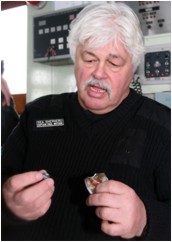
Captain Paul Watson was struck by a bullet in the chest. Fortunately, the bullet was stopped by his Kevlar vest. The bullet struck just above the heart and mangled Captain Watson’s anti-poaching badge, which was worn on his sweater underneath the Kevlar vest.

Dr. David Page was videotaped prying the bullet from Captain Watson’s Kevlar vest. “You have been hit by a bullet,” he said.

The Kevlar vest and anti-poaching badge effectively saved Captain Watson’s life.

Additional injuries were sustained by crewmembers Ashley Dunn and Ralph Lowe. Dunn, 35, from Launceston, Australia suffered a hip injury when he tried to get out of the way of the exploding grenades. Lowe, 33, from Melbourne, Australia received bruises to his back when one of the flash grenades exploded behind him.

The Japanese Coast Guard was retaliating against Sea Shepherd crewmembers for tossing rotten butter onto the decks to discourage their illegal whaling activities. The clash came after a week long pursuit by the Steve Irwin of the Nisshin Maru, in an effort to stop illegal whaling activities in the Southern Ocean Whale Sanctuary.

Earlier in the day at 0800 hours (1900 GMT), the Steve Irwin had ordered the Nisshin Maru to leave French territorial waters. The Japanese whaler complied and turned around, heading back west into Australian waters.

The confrontation occurred inside the Australian Territorial Zone at the position of 63 Degrees, 41 Minutes South and 133 Degrees, 27 Minutes East.

Video of the incident

Japanese Scramble to Spin Shooting Story

In the aftermath of a confrontation between the crew of the whaling ship Nisshin Maru and the crew of the Sea Shepherd ship Steve Irwin, the Japanese public relations flacks are working overtime to get the spin right.

First, they admitted that warning shots were fired, then they corrected themselves and said that only flash grenades were fired at the crew of the Steve Irwin. Then they changed the story again and described the flash grenades as “warning balls.” By tomorrow morning, they may have it spun it again and may be describing them as “marshmallows.”

The Japanese Coast Guard and the Japanese Fisheries Agency have stated to the media that the devices were flash grenades and that warning shots were fired. Only the Institute for Cetacean Research is denying that warning shots were fired and describing the flash grenades as “warning balls.”

“I think the video tells the story,” said Sea Shepherd volunteer Laurens De Groot, a former police officer from Rotterdam. “I’m familiar with the devices thrown. They are the type of flash grenade that specially trained SWAT teams used to combat armed and dangerous criminals.”

The Japanese claim that Captain Paul Watson is lying about being shot was expected. When Giles Lane and Benjamin Potts were tied to the mast of the Yusshin Maru No. 2, the Institute for Cetacean Research claimed it was a lie until the video images were released.

Dr. David Page, the ship’s medical officer, has examined and verified that there were three injuries sustained, all severe bruises. Ralph Lowe from Melbourne was bruised on the back by an exploding flash grenade, and Animal Planet cameraman Ashley Dunn from Launceston, Tasmania injured his hip while trying to avoid a flash grenade. Captain Watson has a large bruise and a cut on the upper left side of his chest.

Dr. Page pried a bullet from Captain Watson’s Kevlar vest and examined the bruise where the bullet impacted. Watson’s Sea Shepherd anti-poaching badge took up some of the force of the impact, but it also cut the skin beneath after it was mangled by the bullet.

Japan claims there were only two Coast Guard officers on the Nisshin Maru, but Sea Shepherd photos and videos clearly show at least four uniformed Coast Guardsmen.

Japanese Chief Cabinet Secretary Nobutaka Machimura was quoted as saying to the media, “Is it all right to hurt humans in order to protect whales? I think whales are cute and important creatures, but even so, hurting humans is unforgivable.”

That is quite the spin–accusing Sea Shepherd crew, who did not injure anyone, of hurting humans after Japanese whalers and the Coast Guard deliberately injured human beings to protect an illegal whaling operation.

The Japanese Coast Guard admitted to the media only a few days ago that its officers were armed with rifles and sidearms. Now they are denying they have rifles.

The Japanese keep changing their story.
The most important fact remains that the Japanese whaling fleet is illegally killing endangered whales in a whale sanctuary in violation of international law and an Australian Federal Court order.

Eithinog and Brewery Fields victory (Bangor, Wales)

BREWERS TROOP

North Wales campaigners who have fought a fourteen year battle to stop plans to develop a 50 acre council-owned wildlife haven and community space on the edge of Bangor, Gwynedd are nearing victory.

BREWERS TROOP

North Wales campaigners who have fought a fourteen year battle to stop plans to develop a 50 acre council-owned wildlife haven and community space on the edge of Bangor, Gwynedd are nearing victory.

Rare fungi found recently at Eithinog and Brewery Fields by a veteran of two camps evicted violently by police in 1998 (See SchNEWS 172/173 & 178) have finally brought Gwynedd Council’s proposed housing plans to a halt. This turnabout comes shortly after their development had been given the green light by the UDP Inquiry Inspector last November. Campaigners are now awaiting a formal announcement by the council, which would mean 83% of the original area being preserved, hopefully to be managed as a Nature Reserve by a local community trust.

The long campaign, conducted variously by Gwynedd and Môn Earth First! in conjunction with and other groups and the local community, has seen many twists and turns: direct action against the council and developers, community marches, nature events, Bangor councillors giving evidence to undermine residents’ town green applications, and use of violence by North Wales police to break lock-ons and a bulldozer to evict a tunnel. This culminated in a 1998 Gwynedd Council commitment to establish a nature reserve being reversed in 2004 and the reinstatement of large-scale housing plans.

However, community anger at this last council U-turn persuaded it to agree to conduct an ecological appraisal of the site – which found that much of Eithinog & Brewery Fields crossed the grassland fungi SSSI threshold. In consequence, a large part of the proposed development was dropped in 2005, although seven acres of ecologically sensitive grassland recommended for conservation were still earmarked for housing. The council’s own biodiversity team acknowledged that its development would jeopardise the integrity of the whole site.

The Countryside Council for Wales has now stepped in, and although some further development will happen, it says it should be confined to five acres of degraded land. All the open space used for generations by the surrounding community is to be preserved and the land possibly transferred to a local trust, who – if this comes about – would manage it in conjunction with conservation bodies. A big SchNEWS thumbs up to the people concerned for their efforts in saving Eithinog & Brewery Fields to be a community asset for future generations.

* For a campaign history lesson, see –

http://www.eithinog.org.uk/history.html

Leeds street medic training, 28th-30th March

The UK Action Medics are running a 2 1/2 day street medic training in Leeds at the end of this month. This is a 20 hour course that will teach you the basics of general First Aid, as well as skills to deal with medical situations specific to direct action, such as dealing with chemical weapons and the police. The course will involve scenarios and hands-on practice and, although we cannot offer you any official accreditation, the 2 1/2 day training is the minimum standard for membership of the Action Medics, and will equip you for a wide range of situations, from hypothermia to baton wounds.

The UK Action Medics are running a 2 1/2 day street medic training in Leeds at the end of this month. This is a 20 hour course that will teach you the basics of general First Aid, as well as skills to deal with medical situations specific to direct action, such as dealing with chemical weapons and the police. The course will involve scenarios and hands-on practice and, although we cannot offer you any official accreditation, the 2 1/2 day training is the minimum standard for membership of the Action Medics, and will equip you for a wide range of situations, from hypothermia to baton wounds.

The training will be on the 28th-30th of March, which is Friday to Saturday. There will be 3 or 4 hours on Friday evening and two full days on Saturday and Sunday. Food will be provided, as well as accommodation if needed – we ask for a donation of £30 to cover costs, although this will be less if we can find a venue for free.

The venue is as yet unconfirmed, but the training will take place in central Leeds, and we can give you directions from the train/bus station. It is essential to book a place so we know how many people are coming – please email iloveavocado@hotmail.com to do this, or with any questions.

Also, we are planning to organise a 4 hour certified ‘Emergency Life Support’ course on the Friday (28th March) afternoon. This will cover CPR as well as a bit of other stuff, like how to control bleeding and deal with an unconscious person. We don’t teach CPR in the 2 1/2 day course, although we cover everything else, but having certification is useful. We’d recommend that people coming on the 2 1/2 day course try to attend this too, but it isn’t mandatory, and it is open to people who can’t commit to the weekend. As we will be bringing in an outside trainer, please email if you want to come on this so we can work out if we have the numbers.

www.actionmedics.org.uk

Wominspace now open!

6.03.2008
Womin only space is now open in North East London. The space is open for all womin to use. We will be holding lots of different workshops and having cafe and bar. Come and visit us and get involved. All references to womin are trans friendly.

6.03.2008
Womin only space is now open in North East London. The space is open for all womin to use. We will be holding lots of different workshops and having cafe and bar. Come and visit us and get involved. All references to womin are trans friendly.

Wominspace is an autonomous womin created, womin organised space in north east london. Wominspace aims to challenge capitalism and patriarchy, by transforming an empty building and creating space to share skills, learn, make friends, create dialogue, find alternative ways of living, being and doing, and be an example of co-opperation, transformation, respect and love.

After a busy week preparing the space and fighting an attempted illegal eviction, we have already had some exciting workshops. We have lots more workshops planned for the weeks to come including welding, bikeology, feminist singing, vegan cake- making, language exchange, herbal skillshare…..

We are looking forward to all the events in london this weekend celebrating international womins day and would like to invite self defined womin who would like to use the space before and during the events to chill or to crash to come to the space.

There will be a vegan cafe and kidspace this thursday from 3- 6 with an open meeting to follow at 7. The meeting is open to any womin who would like to be involved in the space in any way. On friday we have a bar and cinema from 7pm. The next weeks workshops and events will be up on indymedia soon.

We are in court this Monday 10th at 3pm at Gee Street court, Shoreditch and would welcome support. If anyone has pictures of the attempted illegal eviction please could they send them to marg_musella@yahoo.co.uk

This space belongs to all womin so please come and check it out this amazing place and be a part of this amazing journey.

For more information call 07939381562 or email womenorganise@yahoo.co.uk

Treesit last ditch attempt stop bushland destruction

2008-2-29
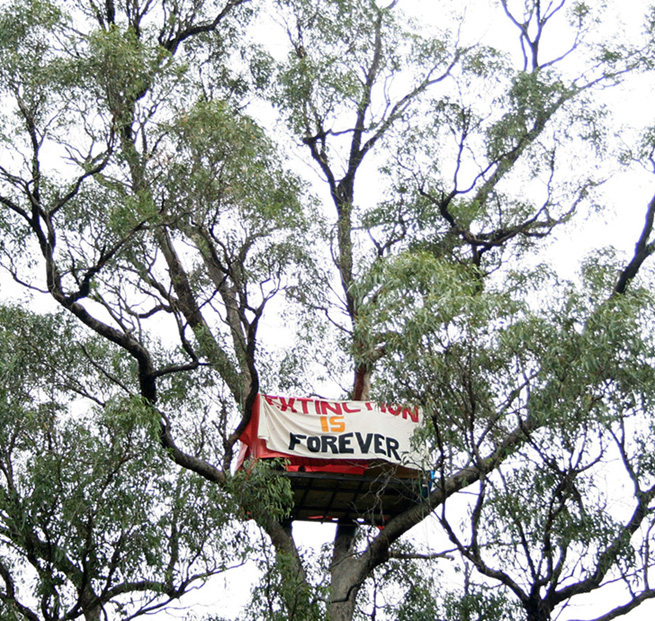
A group of Concerned Independent Activists (CIA) have placed a platform occupied by an activist, high up a tuart tree in bushland at College Grove in Bunbury. It is hoped this will delay destruction of this contentious forest.

College Grove tree-sit2008-2-29
A group of Concerned Independent Activists (CIA) have placed a platform occupied by an activist, high up a tuart tree in bushland at College Grove in Bunbury. It is hoped this will delay destruction of this contentious forest.

The bush, which forms part of a valuable nature corridor, is under threat of being bulldozed by Landcorp for a hosing development. CIA spokesperson Simon Peterfly said “this is the last nature corridor on the Swan Coastal Plain that connects the ocean to a river”…
The platform is a last ditch attempt to save the bush, which includes a rare population of ring-tailed possums. He said that Landcorp’s project was contrary to all good sense and showed a total lack of moral standing in the world of conservation.

“We want to expose Landcorp’s intent to destroy this vital section of the corridor to all Western Australians”, he said. “This is more than just a piece of bush to be flattened. It contains the rare tuart transition zone and provides habitat to a protected species which relies upon the bush for its ongoing existence”.

Mr Peterfly said that the independent activists hoped that their remaining actions would help educate people about the fragility of the remaining bushland at College Grove. “If people log onto Google Earth, they will see just how thin the nature corridor has become… It is just so fragile and too valuable to lose”.

Mr Peterfly said that the platform would stay in place as long as possible to focus people’s attention on the plight of remnant bushland on the Swan Coastal Plain.

CONTACT Simon Peterfly – 0422 540756

South West Environment Centre

Brixton Reclaim Your Food Collective, 2 Arrests.

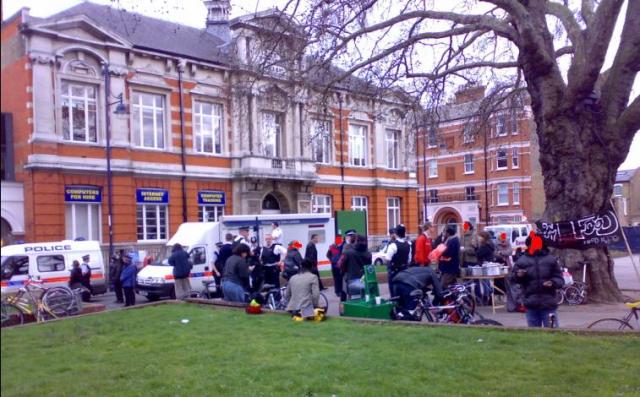
People taking part in Brixton’s Reclaim Your Food weekly action faced arrest on Sunday (2nd March 2008 ) as they challenged the legitimacy of a Dispersal Order issued by the Lambeth branch of the Metropolitan Police.

Reclaim your FoodPeople taking part in Brixton’s Reclaim Your Food weekly action faced arrest on Sunday (2nd March 2008 ) as they challenged the legitimacy of a Dispersal Order issued by the Lambeth branch of the Metropolitan Police.

The weekly vegan open picnic has recently faced growing repression from Police and consistent support in the community. Police (which constituted a mix of PCs, CSOs and higher-ranking officers) were waiting for the collective before they even arrived. They came equipped with a mobile surveillance van, 2 regular Police vans and 2 Police cars. Disproportionate? Make up your own mind…

The first arrest came as a result of a refusal to comply with the Dispersal Order placed upon the group, the second for attempting to establish the legal basis for such an arrest.

The Dispersal Order, made possible by the controversial Anti-Social Behaviour Act, was issued in response to an alleged Section 5 Public Order offence – defined as causing harassment, distress or alarm. However, when questioned, the Police failed to provide adequate evidence to suggest that such an offence was taking place. What followed was a series of convoluted and dubious explanations as to why they had reason to believe an offence was being committed:

1) By giving out free food, a climate was being created that enabled drug-dealing – which in itself could promote harassment, distress and/or alarm. Case Law contradicts the use of this Public Order law ‘by proxy’ (as it were) and it has previously been ruled that if a Section 5 offence is being comitted, it is unlawful to arrest anyone other than the alleged perpetrator of the offence.

2) “Local Businesses” – such as the nearby McDonalds & KFC restaraunts – were claiming that the actions of the collective were inhibiting their ability to make a profit. No law that explicitly states the interests of said businesses are to take precedent over the interests of the other parties involved was invoked. However, it’s hardly a shocking revelation that profit comes before people.

3) The concentration of Brixton’s drug users and dealers in Brixton Town Square, allegedly as a result of the Reclaim Your Food collective’s project, was making the ‘problem’ more difficult to Police. This isn’t even worthy of a witty retort.

Thankfully, the long arm of the law did not stretch to the Bicycle Repair Workshop or those making Puncture Repair Kits and Wallets from recycled and sustainable materials. These were welcome additions to the Town Square, which was reclaimed as a fully-functional public space for all…with room for a bit of a dance to the chilled reggae/dub soundsystem!

Despite all the Police intimidation and generally not fantastic weather, a good time was had by most people who turned up or happened to be passing by!

Sunday’s events also demonstrate the power of solidarity and engagement with the community, after Police abandoned initial threats to arrest everyone present because they thought those involved had ‘learnt their lesson’ and would not be back the next week. This, of course, had nothing to do with the logistical difficulties that would’ve arisen from arresting up to 50+ people with limited resources – and having to justify that to the largely supportive members of the public present…honest, sarge! There were many people on hand to photograph and film the behaviour of the Police and to record the identity numbers of the officers involved. The action was not only fully completed and largely unimpeded by Police intervention but also took to the streets afterwards, marching to Brixton Police Station and standing in solidarity with the two arrestees. The Reclaim Your Food banner was unfurled accross the Metropolitan Police logo at the front of the station, generating public interest and support. Tea and Biscuits were also on offer, giving the whole proceeding an uncharacteristically twee vibe!
Many Brixton residents approached the collective, sharing their own experiences of dealing with Police intimidation and brutality. Whilst this may appear incredibly doom-and-gloom, the atmosphere was more conducive to a sense of mutual support and a desire to challenge the state apparatus than of feeling downtrodden or apathetic, which left many people feeling positive about the possiblity of resisting the ever-creeping Police state.

The collectives involved in Sunday’s action are keen to welcome anyone who is interested in any aspect of the project to come along. The project will continure to meet at Brixton Town Square

(by Coldharbour Lane, opposite the Ritzy Cinema) from around 2/3pm every Sunday. The town square is well on it’s way to being a free public space, for anyone to use. This does not figure in the plans of the Police and Local Government, who are intent on seeing through gentrification of the area. Let’s show them whose streets they really are!

Video and Report: http://indymedia.org.uk/en/2008/03/392723.html
Previous Encounters: http://www.indymedia.org.uk/en/2008/02/391653.html?c=on#c189534

International Anti Nuclear Festival

Invitation to join International Anti Nuclear Festival –
– FINLAND – Midsummer – June 2008 –

Due to the increasing nuclear threat developing in Finland and indeed globally, a coalition has formed to promote discussion, networking, education, skill development, and action for international civil society to oppose and resist nuclear power developments.

Invitation to join International Anti Nuclear Festival –
– FINLAND – Midsummer – June 2008 –

Due to the increasing nuclear threat developing in Finland and indeed globally, a coalition has formed to promote discussion, networking, education, skill development, and action for international civil society to oppose and resist nuclear power developments.

We are in the initial stages of planning the first Finnish International Anti Nuclear Festival, to be held during Midsummer (mid to late June) 2008, in the vicinity of Olkiluoto, construction site of the world’s largest nuclear reactor.

Finland is currently setting a president for Europe and the world. After years of denial and inaction on climate change, governments and industry are now promoting nuclear power as the solution to ‘clean’ energy production and the reduction of greenhouse gas emissions. We believe civil society must also set a president by opposing the construction of this prototype reactor, thus send a message to policy makers that we will not allow our world and our future to be contaminated by a dangerous
radioactive legacy.

Our objectives are numerous. We wish to bring people together to speak, learn and act about problems associated with the nuclear power process – from mining on indigenous people’s lands, to ore processing and its use in reactors, to waste disposal and military applications. We seek to learn of other people’s struggles, victories and setbacks.

We also seek to develop a coordinated international strategy. Increase skills; in civil democracy / consensus decision making, research, media, fundraising, sustainable living, non-violent communication, action and civil disobedience. We hope to involve ourselves in the decisions which affect our lives and those of future generations, from consumer choice to climate change, Chernobyl to Hiroshima.

Most of all, we want to invite you to a festival to celebrate the beautiful possibilities of life, to dance, sing and share…and to make it very, very difficult for them to keep building nuclear death machines. We would hope that anybody possibly affected by the growing nuclear threat would feel inspired to participate, indeed help organise this festival.

We are inviting speakers, trainers, logistical and monetary support, musicians, medics, clowns and others.

More information at www.olkiluoto.info and www.nuclearmadness.info

if you would like to get involved, have ideas or want to be updated, e-mail camp@olkiluoto.info or jsun@rbgi.net