Pacific Island Warriors Blockade World’s Largest Coal Port

October 25th, 2014

Climate Change Warriors from 12 Pacific Island nations paddled canoes into the world’s largest coal port in Newcastle, Australia, Friday (October 17th) to bring attention to their grave fears about the consequences of climate change on their home countries.

The 30 warriors joined a flotilla of hundreds of Australians in kayaks and on surfboards to delay eight of the 12 ships scheduled to pass through the port during the nine-hour blockade, which was organised with support from the U.S.-based environmental group 350.org.

The warriors came from 12 Pacific Island countries, including Fiji, Tuvalu, Tokelau, Micronesia, Vanuatu, The Solomon Islands, Tonga, Samoa, Papua New Guinea and Niue.

Mikaele Maiava spoke with IPS about why he and his fellow climate change warriors had travelled to Australia: “We want Australia to remember that they are a part of the Pacific. And as a part of the Pacific, we are a family, and having this family means we stay together. We cannot afford, one of the biggest sisters, really destroying everything for the family.

“So, we want the Australian community, especially the Australian leaders, to think about more than their pockets, to really think about humanity not just for the Australian people, but for everyone,” Mikaele said.

REUTERS / David Gray

Speaking at the opening of a new coal mine on Oct. 13, Australian Prime Minister Tony Abbott said that “coal is good for humanity.”

Mikaele questioned Abbott’s position, asking, “If you are talking about humanity: Is humanity really for people to lose land? Is humanity really for people to lose their culture and identity? Is humanity to live in fear for our future generations to live in a beautiful island and have homes to go to? Is that really humanity? Is that really the answer for us to live in peace and harmony? Is that really the answer for the future?”

Mikaele said that he and his fellow climate warriors were aware that their fight was not just for the Pacific, and that other developing countries were affected by climate change too.

“We’re aware that this fight is not just for the Pacific. We are very well aware that the whole world is standing up in solidarity for this. The message that we want to give, especially to the leaders, is that we are humans, this fight is not just about our land, this fight is for survival.”


Mikaele described how his home of Tokelau was already seeing the effects of climate change,

“We see these changes of weather patterns and we also see that our food security is threatened. It’s hard for us to build a sustainable future if your soil is not that fertile and it does not grow your crops because of salt intrusion.”

Tokelau’s coastline is also beginning to erode. “We see our coastal lines changing. Fifteen years ago when I was going to school, you could walk in a straight line. Now you have to walk in a crooked line because the beach has eroded away.”

Mikaele said that he and his fellow climate change warriors would not be content unless they stood up for future generations, and did everything possible to change world leaders’ mentality about climate change.

“We are educated people, we are smart people, we know what’s going on, the days of the indigenous people and local people not having the information and the knowledge about what’s going on is over,” he said.

“We are the generation of today, the leaders of tomorrow and we are not blinded by the problem. We can see it with our own eyes, we feel it in our own hearts, and we want the Australian government to realise that. We are not blinded by money we just want to live as peacefully and fight for what matters the most, which is our homes.”

Tokelau became the first country in the world to use 100 percent renewable energy when they switched to solar energy in 2012.

Speaking about the canoes that he and his fellow climate warriors had carved in their home countries and bought to Australia for the protest, he talked about how his family had used canoes for generations,

“Each extended family would have a canoe, and this canoe is the main tool that we used to be able to live, to go fishing, to get coconuts, to take family to the other islands.”

Another climate warrior, Kathy Jetnil-Kijiner, from the Marshall Islands, brought members of the United Nations General Assembly to tears last month with her impassioned poem written to her baby daughter Matafele Peinam,

“No one’s moving, no one’s losing their homeland, no one’s gonna become a climate change refugee. Or should I say, no one else. To the Carteret islanders of Papua New Guinea and to the Taro islanders of Fiji, I take this moment to apologise to you,” she said.

The Pacific Islands Forum describes climate change as the “single greatest threat to the livelihoods, security and well-being of the peoples of the Pacific.”

“Climate change is an immediate and serious threat to sustainable development and poverty eradication in many Pacific Island Countries, and for some their very survival. Yet these countries are amongst the least able to adapt and to respond; and the consequences they face, and already now bear, are significantly disproportionate to their collective miniscule contributions to global emissions,” it says.

Pacific Island leaders have recently stepped up their language, challenging the Australian government to stop delaying action on climate change.

Oxfam Australia’s climate change advocacy coordinator, Dr Simon Bradshaw, told IPS, “Australia is a Pacific country. In opting to dismantle its climate policies, disengage from international negotiations and forge ahead with the expansion of its fossil fuel industry, it is utterly at odds with the rest of the region.”

Dr. Bradshaw added, “Australia’s closest neighbours have consistently identified climate change as their greatest challenge and top priority. So it is inevitable that Australia’s recent actions will impact on its relationship with Pacific Islands.

“A recent poll commissioned by Oxfam showed that 60 percent of Australians thought climate change was having a negative impact on the ability of people in poorer countries to grow and access food, rising to 68 percent among 18 to 34-year-olds,” he said.

Visit IPS news for fresh perspectives on development and globalization

Construction of Areng Dam Continues Despite Natives Protests

Regardless of the dam's progression, Chong inhabitants continue to express their discontent.

October 21st, 2014

Regardless of the dam’s progression, Chong inhabitants continue to express their discontent.

The detention and release of 11 environmental activists in Cambodia’s Areng Valley in mid-September ended the last major protests of the controversial Stung Cheay Areng hydro dam project.

Activists had been detaining and blocking convoys of vehicles into the valley since March of this year, but their makeshift roadblock has since been commandeered by the country’s Royal Cambodian Armed Forces.

The valley’s native Chong inhabitants have watched the dam project grow with a mixture of fear and bitterness. The Chong have dwelt along the Areng for over 600 years but soon, if the dam is completed, it will flood at least 26,000 acres of land. Mother Jones writes that the estimates range between 40 and 77 square miles.

This will displace more than 1,500 people, and is already inviting the rape of the Central Cardamom Protected Forest. To begin the dam project, new roads had to be built to transport equipment back and forth, providing free access to unscrupulous timber companies. At least 20,000 cubic yards of rosewood (worth an estimated $220 million in timber) have been illegally logged since the dam project began.

The dam itself is being constructed by Sinohydro Resources, China’s largest dam-building contractor and its third firm to take on the task. Initially, China Southern Power Grid was to build the dam, but relinquished its contract with the Cambodian government in 2010 on purportedly “moral” grounds.

A report from the Japanese International Cooperation Agency on the project later pointed out that the dam would only generate an output of 108 megawatts – too little for so high a monetary and environmental cost.

China Guodian Corporation was the next firm to take up the project, but pulled out in 2013. They, too, found the dam to be economically unviable.

Though the dam would be hypothetically capable of generating enough power for 87,000 homes, International Rivers argues that “the dam will only operate at 46 percent capacity during the dry season, precisely when Cambodia most needs the electricity.”

In addition to this low energy output, the dam is projected to be more of a burden to Cambodia than a blessing – even without taking the valley’s 31 endangered animals into account. Areng is just one of 17 dams the country wants to build over the next two decades, but most of their power will be exported to neighboring countries. What’s worse, Sinohydro will own the dam for the next 40 years before turning it over to the Cambodian government, at which time the dam’s maintenance costs and environmental impacts will potentially make it worthless to the country.

Despite all this, Cambodia’s Minister of Mines and Energy and Minister of Environment have both stated that the Areng dam is on schedule for completion by 2020.

But that hasn’t stopped natives from protesting.

“Even if they piled money one meter above my head, I don’t want their Chinese money,” one villager told Mother Jones’ Kalyanee Mam. “I want to stay in my village. Even with all this money, I could only spend it in this life. I wouldn’t be able to pass it on to my grandchildren. I just want my village and my land for the future of my grandchildren.”

by Planet Experts

Wrexham Borras drill site occupied – Please support the camp

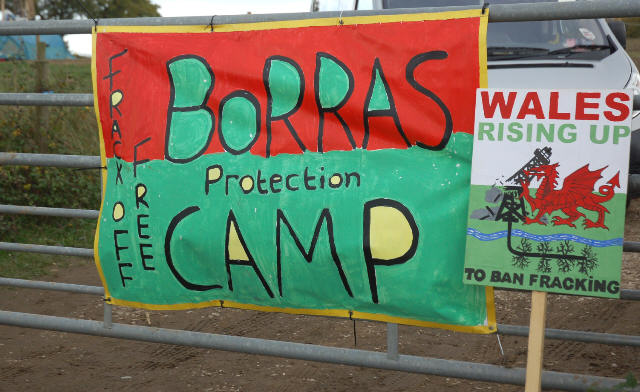
Camp banner19.10.2014

Camp banner19.10.2014

GP Energy (who were bought out by Dart who in turn have been bought out by IGas) applied for planning permission to do an exploratory drill for coal bed methane (CBM) at Borras, Wrexham. Frack-off describes coal bed methane as the evil twin of shale gas. Wrexham council refused the application back in March after at lot of work by local people to educate the planning committee on the dangers of unconventional gas extraction. The success of this was at least in part due to increased awareness of the issues as a result of a test drill happening at the same time in nearby Farndon. Unfortunately, the Wales Planning Inspector overturned the council's decision earlier this month – on some distinctly dodgy grounds – and the site is now under imminent threat of test drilling, even though it is in an area where the government's own report has indicated CBM extraction isn't feasible due to the geology.

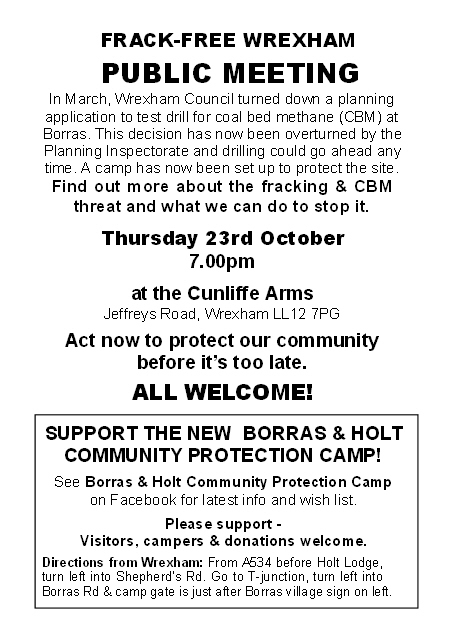
A public meeting has been called for 23 October in Borras but, in advance of that, the site has been occupied this weekend and a community protection camp set up. Support (including more campers) and supplies needed. Please get there if you can. Postcode LL13 9TG. There's a camp Facebook group or you can contact Frack-Free Wrexham for more information.

an idyllic spot - let's keep it that way

Camp flier
Camp flier

Flier for meeting and camp info

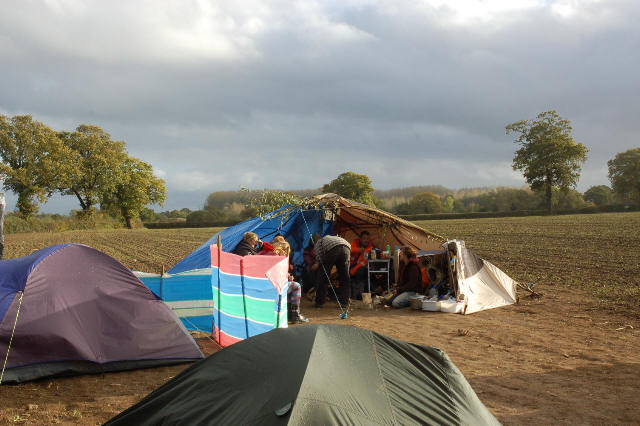
Around 25 people were on site this afternoon. Those who had been camping since Friday said they were overwhelmed with the number of people who'd called round to the camp to wish them well and drop off supplies, water, building materials, camping gear and all sorts of other useful stuff. As well as a group of tents in the middle, a compost toilet had already been built, as well as a shelter by the fire and a kitchen under construction.

Community Protection Camps can only succeed with the support of the local community, so if you live locally, or further afield, and care about protecting the countryside, air, water, food… (property owners might also care about their property values which are liable to plummet in areas where drilling goes ahead), please call in to the camp and see what's needed. There's a warm welcome for all friendly visitors – just turn up. Police presence so far has been low key.

The site is quite muddy, particularly around the gate, so bear that in mind if you're planning to go into the field. If you're driving, parking is possible on the verge alongside the gate and if you're travelling by bus, the site is about 1 mile from the Holt Lodge Inn. Take the turning nearly opposite the Holt Lodge into Shepherds Rd. Follow this road right to the end, turn left at the T-junction and the site is on the left just after the Borras village sign. The C56 bus from Wrexham or Chester, both of which have railway stations, stops at the Holt Lodge Inn. A camp phone number will be available soon.

Frack Free Wrexham
- e-mail: frackfreewrexham [AT] riseup.net

Manitoba Hydro Evicted from Northern Dam Station by Protesters

pimicikamak-first-nation-protest-2

October 17th, 2014

Protesters have forced employees of Manitoba Hydro out of the Jenpeg generating station in northern Manitoba.

The protesters, from Pimicikamak Cree Nation, delivered an oversized evicted notice on Friday to staff at the station and the employee housing complex, both of which are located on the Nelson River in Pimicikamak territory.

“The building is empty, locked, undamaged and under the Pimicikamak flag,” states a release from the Cree Nation, which is located approximately 525 kilometres by air north of Winnipeg.

A few hydro personnel remain inside the dam itself to monitor the facility. Pimicikamak guarantees the safety and well-being of these people, and ensures that hydro facilities will not be damaged.”

The protesters want compensation for damages caused by flooding from the dam, which opened in 1979.

“The hydro system floods 65 square kilometres of Pimicikamak land and causes severe damage to thousands of kilometres of shoreline,” Chief Cathy Merrick stated in the press release. “Outlying grave sites have been washed away; Pimicikamak people have died as a result of semi-submerged debris from eroding shorelines and unsafe ice conditions caused by hydro.

“The project has turned a once bountiful and intimately known homeland into a dangerous and despoiled power corridor.”

Jenpeg, which Manitoba Hydro uses to control outflows from Lake Winnipeg into the Nelson River system, is located about 20 kilometres from Cross Lake, which is the main Pimicikamak settlement with some 8,000 residents.

“This is our home; we will not let it be trampled,” said Merrick. “This dam has been great for the south but for us it is a man-made catastrophe. Hydro needs to clean up the mess it has created in our homeland. Hydro needs to treat us fairly.”

She said the provincial government has spoken about reconciliation with all hydro-affected peoples, and a “new era” of “partnership” but so far none of that has happened.

The hydro system produces $3.8 million worth of power on its five Nelson River dams every day, according to Merrick, who noted it “has not contributed to ‘the eradication of mass poverty and mass unemployment’ as was contemplated in the 1977 Northern Flood Agreement.

“The NFA says affected people will be dealt with fairly and equitably,” she said, adding, “In many parts of Canada, governments and companies are realizing that everyone benefits when the tremendous wealth and opportunity of the land is shared fairly.”

Pimicikamak’s road map to positive change includes:

  • A public apology from Premier Greg Selinger for past and present harms suffered​ by all hydro-affected peoples and their lands.
  • A commitment from Manitoba and Manitoba Hydro to engage in a good-faith process to fulfill promises in the NFA, including measures related to community development, environmental mitigation and maximum employment opportunities.
  • A revenue sharing agreement and/or water rental arrangement with Pimicikamak.

“​The Pimicikamak people will not leave Jenpeg until Manitoba and Hydro make substantive commitments to follow the course outlined above,” Merrick said.

The chief and council will be meeting with provincial and hydro officials at the Jenpeg station on Friday.

Hambach: Trees with Platforms Felled

Noname

October 17th, 2014

Noname

October 17th, 2014

The daily madness continues.
This morning activists from the tree ocupation “Grubenblick“ reported about an unpleasent visit beneath their platforms:
RWE, Kötters Security and the Police with a cherrypicker. The occupation is directly at the edge of the clearcut, no more than 100 meters distance to the hole of the [open cast coal] mine. Some pictures from Grubenblick
The workers of the landmurdering company RWE cut down trees which had platforms on them. Soon after the police came by and examined the occupied trees of “Grubenblick“. Presumably they made preparations for an eviction.

Now it is quiet again, the activists of Grubenblick stay in the trees and have a hideous look on the deepest hole of europe and uncountable treestumps.

Fracking Protest Camp Set Up to Protect Horse Hill, UK

Campaigners at the Horse Hill site near Horley, photo credit: Marina Pepper

October 16th, 2014

Campaigners at the Horse Hill site near Horley, photo credit: Marina Pepper

October 16th, 2014

A protest group has set up camp near Horley to protect a site from possible fracking following news that oil ‘shows’ at Horse Hill after weeks of exploration.

Horse Hill Developments has been drilling at the Horse Hill site since the beginning of September with a promise to campaigners that it would not be fracking there, but Frack Free Surrey fear the company is testing the ground for future projects in the Weald.

The company does not currently have a license to frack, but stated on September 18 that “the information gained through these activities will provide valuable insights into the technical and economic viability of unconventional development elsewhere in the Weald Basin”.

More than 80 people attended a meeting held by Redhill Greens and Frack Free Surrey on Monday (October 13), to discuss the drilling and the possible threat of fracking across the weald.


Rob Basto, from Frack Free Surrey, said:If fracking goes ahead in the area it could result in thousands of wells in the south-east with disastrous consequences – for our local environment and the global climate. We are utterly opposed to any new fossil fuel development in our area.”

Brenda Pollack, from Friends of the Earth, said campaigners are concerned as many companies are now “salami slicing” their applications, in order to have a greater chance of success. Exploratory licences are granted in the first stage, which means a fracking licence can be easier to get once industrial work has already taken place on the land.

But Ms Pollack said campaigners were keen not to scare monger.

She said: “We are concerned that ultimately the company wants to extract shale oil. The site is in the Weald Basin – an area known to contain oil trapped in shale rock. While they may be using conventional techniques at this testing phase, there is every reason to believe it could lead to fracking.

“Chasing difficult to reach fossil fuels is not the answer to our energy problems. Surrey should be investing in cleaner renewable energy projects to help reduce the impacts of climate change.”


Campaigners have set up camp at the Horse Hill site near Horley

Ms Pollack said many people are concerned as Magellan Petroleum

Corporation, who have a 35% stake in Horse Hill Developments, are also partnered with Celtique Energy who recently had an application turned down to drill at Nine Acre Copse in Fernhurst.

In September, Scott Bradley, chief executive of Horse Hill Developments Limited, said: “We are delighted with the progress being made and the drilling performance to date. We now look forward to the next phase of this conventional project and await our target evaluation results eagerly.”


Hambach Treesitter Suffers Fall

Noname

October 16th, 2014

Noname

October 16th, 2014

Helicopter rescues fallen climbing activist – climbing partner arrested without reason

On Monday, a French activist fell down from a 8 metre high platform at a forest occupation near the clearcut border of the open cast mine Hambach. A helicopter brought the conscious accident victim to the nearby hospital. Another forest occupant was arrested by the police during the rescue mission and was held at the police station in Düren for several hours without reason. For 3 years, activists have been protesting in the Hambach Forest against Europe’s biggest open cast mine, which is located between Cologne and Aachen.

“Our yearlong experience, tutorials, training sessions and international security standards, show: We are professionals. The security of the activists is our first priority.“, explains Nina Wagner, climbing trainer and forest occupant. The activists now want to clear the case completely and search for failures in the security procedures. It’s the first serious accident since the start of the protest, which is held daily in the forest, elevated from at least 8 metres. “Our activists know, why they do their protest in the top of the trees. We are determined to resist the climate killer brown coal, even at high personal risk.” continues Wagner.

Though the rescue was successful, the activists are very concerned about the accident. “She’s in our thoughts, and we hope that she will recover from her injuries.” says Wagner. After the fall, the occupants reacted quickly and started to immediately perform first aid. While one team took care of the emergency call, another removed the barricades, which are normally in place to prevent an eviction by police forces, to clear the way for the rescue team. In the future, more stringent security measures will be in place in order to avoid another rare incident like this. The victim, which was able to speak directly after the fall, was brought by helicopter to the university hospital in Aachen.

Ts’ka7 Warriors Burn Down Imperial Metals Ruddock Creek Mine Bridge

fire-handSecwepemc Ts’ka7 Warriors deactivate Imperial Metals Ruddock Creek mine road.

Inter

fire-handSecwepemc Ts’ka7 Warriors deactivate Imperial Metals Ruddock Creek mine road.

International Statement, October 14, 2014

With much discussion with Elders Councils and around Sacred fires and ceremonies the Secwepemc Ts’ka7 Warriors have acted out their collective responsibility and jurisdiction to and in the Ts’ka7 area by deactivating the Imperial Metals Ruddock Creek mine road.

Imperial Metals Corporation never asked for or received free, prior and informed consent to operate in Secwepemc Territory.  The Imperial Metals Mount Polley mine disaster, in the area known as Yuct Ne Senxiymetkwe, the absolute destruction and devastation of our Territory has never been answered for.  No reparations have been made.    Instead Imperial Metals continues to force through another mine in our Territory while criminalizing the Klabona Keepers of the Tahltan Nation also exerting their jurisdictional and withholding consent from the same company.

The genocidal displacement of the Secwepemc from their Homelands through starvation, fear and assimilation by the state and industry being acted out by Imperial Metals stops now.  We are committed to the ongoing protection of our Territory.  Our salmon is sacred, our land is sacred, our Women are sacred, our water is sacred and we the Peoples, the rightful title holders are the decision makers and we will protect them.

Agreements made by elected chief and council do not have authority and do not represent us.  This is a warning to Imperial Metals Corporation:  Leave our Lands and do not come back.  This is a warning to the provincial government: You do not have jurisdiction on this Land to issue permits to any corporation.  This is a warning to investors (including the province), contractors, suppliers and subsidiaries:  Divest from Imperial Metals Corporation.  We the Secwepemc, united, will not allow Imperial Metals Corporation to continue. Secwepemc Law will prevail in our Territory.
Secwepemculecw wel me7 yews, wel me7 yews
Secwepemc Ts’ka7 Warriors

Portland Oil Terminal Blocked, USA

rally-wide-shot

rally-wide-shot

Activists form blockade against oil trains at Arc Logistics, crude oil-by-rail terminal

NW Portland, Oregon: 100 people gathered in protest this afternoon (9/10/2014) at Arc Logistics, Portland’s only crude oil-by-rail terminal. Five activists risked arrest by sitting directly on the rail tracks to prevent an oil train from reaching the oil terminal. Information leaked from a worker at the facility revealed that due the controversial protest, oil shipments had been halted for the day. Protesters, including those blocking the tracks have dispersed peacefully.

Crude oil trains have caused a great deal of controversy across the county. Nearly a dozen derailments have occurred in the past two years, many ending in fireball explosions that have killed 47 people and caused hundreds of millions in property damage. Event organizers say these trains represent an unacceptable threat to our communities: risking explosive train derailments, dangerous spills and leaks, degrading air quality, and destabilizing the climate.

“I am an obstetrician, gynecologist with a degree in public health. I have devoted my career to protecting mothers and babies and worked internationally in almost 40 countries. I have taught at Harvard and Stanford. The importance of these efforts now pales,” said Kelly O’Hanley, MD, MPH, one of the five activists willing to risk arrest if an oil train attempted to enter Arc Logistics. “I have never gone to jail but the specter of climate change has moved me out of my clinic, out of the hospital and out of my comfortable living room – onto the streets and into jail if necessary.”

Portland is a choke point for fossil fuel transport in the Northwest. We are drawing the line to support all those affected from extraction to the climate-destabilizing combustion,” says organizer Mia Reback, “today’s action is intended to send a strong message that the community will not allow these dangerous oil trains to come through Portland.”

Today’s protest continues a series of direct actions and resistance against Northwest oil-by-rail projects. In June, activists with Portland Rising Tide blocked the Arc Logistics site in Portland when a woman locked herself to a concrete filled barrel on the tracks. Following that action, community members across the Northwest have set up blockades at oil facilities in Anacortes, Washington, Everett, Washington and most recently Port Westward, Oregon.

Arc Logistics currently ships crude by rail from fracked oil shale in Utah. The first US tar sands mine is under construction in Utah and Arc could soon be accepting this controversial fuel. The Arc Logistics terminal can also receive explosive Bakken crude oil from North Dakota without notifying Portland residents.

The Climate Action Coalition demands that the city of Portland halts the operations of Arc Logistics and imposes a ban on all new fossil fuel infrastructure that puts our climate and communities in jeopardy.

###

The Climate Action Coalition is: Portland Rising Tide, NoKXL, 350 PDX, Portland Raging Grannies, First Unitarian Universalist Community for Earth Team, PDX Bike Swarm

Legal Fund Here

Kinder Morgan Surveyor Office Blocked by ‘Pipeline’, Canada

mappipe2

October 7th, 2014

mappipe2

October 7th, 2014

Activists installed a “pipeline” early this moring in front of the downtown offices of McElhanney mapping. The adhoc group says the company was tageted for its part in surveying for the controversial Kinder Morgan pipeline expansion plan on Burnaby Mountain.

The group erected a pvc pipeline, complete with dripping ‘bitumen’ and notices to “Get off Burnaby Mountain.”

From the group’s release:

“Early this morning the entrance to McElhanney’s downtown Vancouver office was blockaded. The doors were locked, a “bitumen pipeline” blocked the stairs and posters were pasted. The action is in response to McElhanney’s participation in surveying for the Kinder Morgan pipeline expansion project in Burnaby .


mappipe6_0

“The proposal aims to increase the number of barrels of Alberta bitumen delivered to Burnaby and the Salish Sea from 300,000 barrels a day to 890,000 a day. This would result in an astronomical and dangerous increase in tanker traffic through the Burrard Inlet. The expansion crosses the unceded territory of many Indigenous nations and is evidence of continued oppressive colonization and rampant capitalist greed.  Resistance to this project is strong and unwavering!

“The Secwepemc Women Warrior Society has been vocally opposed to the projects’ intrusion through the heart of their territory, the Tsleil-Waututh Nation has launched a legal battle as well as created a treaty with surrounding nations vowing to protect the Salish Sea, even local mayors are standing up in opposition. Despite the resounding no from affected communities, Kinder Morgan is continuing with the project and hiring companies to do invasive studies that are against Coast Salish law and even “Canadian” colonial bylaws. No means no and the people, led by Indigenous resistance are not backing down to corporations!

“This disruption has been brought to you by a group of friends who refuse to accept, and are committed to resisting, the continued colonization of indigenous territories by corporations and government.  We oppose the oppressive nature of the oil and gas industry in our fight for climate and social justice. We stand in solidarity with frontline communities who are fighting destructive and oppressive resource extraction projects.”

The office entrance has now been blocked off by Vancouver police.

mappipe1