ELF Mexico Sabotage Machines

“December 30:

“December 30:

The exploiters with their big machines lap up the earth leaving deforestation and environmental destruction, replacing the little nature that is left with pavement and monstrous constructions, but the resistance still exists, we have not stopped the wild ones from existing and while the abusers don’t stop wanting to dominate the earth and its inhabitats, we the Frente de Liberación de la Tierra will continue hitting hard.

This time an urban construction machine was sabotaged with most of the cables cut, leaving it unusable and blocking the street until they moved it by other means.

Green anarchists for total liberation!

Wild and radical sabotage!

FLT – Mexico”

anonymous report from http://DirectAction.info

Animal Rights Case Concern to Environmentalists & call out for 19th January – updated with CW analysis

While the case of 4 animal rights campaigners found guilty on “conspiracy to blackmail” charges in relation to contract testing company Huntingdon Life Sciences (HLS) that tests on animals may seem unrelated to the environmental movement the case has direct relevance to all radical environmentalists.

While the case of 4 animal rights campaigners found guilty on “conspiracy to blackmail” charges in relation to contract testing company Huntingdon Life Sciences (HLS) that tests on animals may seem unrelated to the environmental movement the case has direct relevance to all radical environmentalists. The activists were convicted for their part in the now famous SHAC (Stop Huntingdon Animal Cruelty) campaign that’s stated aim is to close down the company.

Following their convictions the media lambasted the activists for numerous unlawful and intimidating actions taken against Huntingdon and associated companies. Many of these actions will be distasteful to some and there are many differing views on animal research in the environmental movement however this case has wider implications for activists across the board.

After a recent national media article claiming a lone extremist might be planning an attack aimed at population reduction was published, which NETCU appear to have had a hand in, some feel that NETCU (National Extremism Tactical Co-ordination Unit) could be turning their spotlight on the environmental movement. Additionally the policing tactics experienced at Climate Camp indicate that animal rights campaigners aren’t the sole focus of NETCU. If the environmental movement is the new target of NETCU this judgement should be taken seriously by all environmentalists.

This case seems to imply that the “organisers” of radical campaigns are fully responsible for everyone that targets the company that they are campaigning against. Indeed it is the case some campaigners acting against HLS and associated companies used direct action and it’s true that the defendants did not necessarily condemn this type of action either. However what is being said is there is no evidence that the defendants were involved in or even incited the actions listed in the media and which it seems they have been held liable for in court.

So what is to be understood by this case is that a radical campaign, such as SHAC, Earth First or Climate Camp is fully responsible for the actions of all its supporters. It seems that a campaign is expected to ‘control’ activists and speak out against every illegal action they make or be faced with responsibility for the other activist’s actions.

This will be a problem for networks and groups like Earth First and Climate Camp the police need only arrest the group organising the EF! gathering, the people who promote Climate Camp etc. and then hold them responsible for the actions of anyone campaigning on the same issue or using the campaign name, anyone taking action against GMOs or who attacked the power station during Climate Camp.

The police no longer need to find and arrest the person who committed the relevant action but can simply imply that the campaign is responsible especially if the campaign supports direct action or carries reports on such actions on their website.

On Monday 19th January there has been a call out for a National Anti-Vivisection Day of Action/Freedom to Protest Day of Action in support of the SHAC activists that are being sentenced on that day. Because of the direct relevance of this case to environmentalists I ask that regardless of your individual viewpoint on the SHAC campaign or animal testing you do something to support the freedom to campaign. This could be as simple as dedicating an already planned environmental action to the campaigners or holding a small protest.

FREEDOM TO PROTEST NOW!

————–

State repression of Anti-Corporate Dissent: Animal right activists convicted of ‘conspiracy to blackmail’

On December 23rd, 4 out of 5 activists on trial at Winchester Crown Court were found guilty of ‘Conspiracy to Blackmail’ at Winchester Crown Court after a 3 and a half month long show trial. The world’s media, prompted by police press officers, were quick to condemn activists by pointing to harassment against the employees of Huntingdon Life Sciences (HLS) and their customers, shareholders and investors. Actions against HLS, not linked to those convicted, such as hoax bombs, letters alleging paedophilia, and threats were pointed to as evidence of the defendants’ extremism. Police spokesmen and the National Extremist Coordination Unit (NETCU), the branch of the police set up to deal with the AR movement and other expressions of the public’s dissent, hailed the convictions as a victory. (For more information on NETCU see here and here.

What was not examined in the media was the worrying development of the repressive use of the law which lead to the conviction of the four defendants.

Corporate Watch has followed the progress of the trial at Winchester since the beginning. The reason we were concerned about the trial is that we see it as part of a larger attack on the animal rights movement motivated by the state’s desire to protect private corporations against dissent. Since the animal rights movement began to effectively challenge the profits of those involved in vivisection and the pharmaceutical industry the state has repeatedly responded with new repressive measures. In May this year Sean Kirtley, an activist involved with Stop Sequani Animal Torture (SSAT), was sentenced to four and a half years in prison for updating a website with news about a legal, nonviolent campaign to close down Sequani laboratories in Ledbury. Kirtley was convicted of ‘Conspiracy to interfere with the contractual relations of an animal research facility under section 145 of the Serious Organised Crime and Police Act’ (SOCPA 145) . His only crime was to protest lawfully against the lab and to update a website.

NETCU, however, was not satisfied with seeing animal rights activists banged up for four and a half years and chose to charge campaigners associated with Stop Huntingdon Animal Cruelty (SHAC) with ‘conspiracy to blackmail’, an offence carrying up to 14 years in prison. In May 2007, police arrested 32 people in raids dubbed ‘Operation Achilles’. Since then, 15 people have been charged with ‘conspiracy’ and are being tried in two separate trials, of which this was the first.

The charges relate to over four years of concerted campaigning against HLS, the largest contract testing laboratory in Europe. The defendants included people who had been involved in SHAC from the outset. However, two of the defendants, Gerrah Selby and Dan Wadham, had been in their early teens at the beginning of the period concerned and had only been involved for a short time. Wadham was only 17 when his part of the alleged conspiracy allegedly occurred.

SHAC, an international campaign group calling for the closure of HLS, has been painted by the police and the press as a ‘criminal organisation’ duping members of the public concerned with animal abuse into donating their money to further ‘a campaign of blackmail’. SHAC’s activities, however, have been overwhelmingly lawful: the campaign publishes information about animal abuse inside HLS labs, reports campaigning activities and issues action alerts calling on supporters to write polite letters to companies working with HLS and ask them to desist. If those companies continue to do business with HLS, protests would usually follow. All material on the SHAC website is checked by a barrister and police are given prior notice of their demonstrations.

Customers, suppliers and shareholders in HLS have also been the subject of some direct action. Slogans have been daubed at company premises and employees homes; cars have been painstrippered; hoax bombs have been sent and employees have been accused of being paedophiles. However, these actions are not directly linked to the SHAC campaign and have only tenuous links to the defendants, whose faces were spashed across many tabloid front pages after their convictions at Winchester.

During the summer, three defendants, committed campaigners against HLS, plead guilty to charges of ‘conspiracy to blackmail’. During the trial, evidence recovered from the campaign PCs and activists’ personal computers was presented. Police had found many documents believed to have been permanently deleted or shredded by their authors. This included a spreadsheet detailing names and addresses of people working for companies linked to HLS, details of direct actions carried out against them and a document containing a private chat between activists apparently talking about direct action. This evidence may suggest that some activists had decided to take direct action against companies linked to HLS, but the evidence linking the defendants found guilty on 23rd December to these documents was circumstantial and, in some cases, non-existent. Even if some activists linked to SHAC did decide to take direct action, this does not make everybody associated with the campaign guilty by association. The prosecution case was that that the entire SHAC campaign was aimed at closing down HLS, which is true, and that SHAC campaigners attempted to persuade companies not to work with HLS, which is also true. The prosecution argument, however, went on to imply that, when companies did not agree to cease trading with HLS, they were the subject of direct action. Often direct action did occur but this was not under the banner of SHAC. Moreover, SHAC did not publish any information about companies that was not already in the public domain. But because some activists, sometimes under the banner of the Animal Liberation Front (ALF), did take direct action, the prosecution argued that the SHAC campaign was facilitating direct action and giving it its tacit appoval. The police went one step further and said SHAC and the ALF were one and the same thing!

Much of the evidence in the three-month trial was in relation to lawful demonstrations against companies linked to HLS. This was particularly important in the instances of defendants who could not be linked to the uncovered computer evidence. In several cases, the only evidence was what they had said at demonstrations. Comments made by defendants during protests in earshot of the police were portrayed as linking them to the ‘conspiracy’. Comments, such as “we know where you live”, were taken as proof that defendants were party to the conspiracy. In any other context, such spur-of-the-moment comments would have, at most, lead to minor charges in the Magistrate’s Court. Equally important was the fact that some of those convicted were linked personally to the defendants who pleaded guilty. Heather Nicholson and Gerrah Selby had both shared houses with them. This was obviously a factor in finding them guilty by association.

So what does this mean for free speech and anti-corporate dissent in the UK? By the same logic, an anti-war campaign that publishes information on the whereabouts of a military base or arms factory and calls for its closure could be put in the frame for the same crime if that base was then the subject of an arson attack. All it would take would be for the police to imply that the people running the public campaign are linked to those involved in direct action. Consequently, campaigners might feel compelled to publicly distance themselves from acts of direct action lest they find that, unbeknown to them, those responsible for the covert actions are involved in public action too and the whole movement is charged with ‘conspiracy’. In fact, the use of such charges is a classic police tactic aimed at spreading paranoia and convicting as many activists as possible for acts carried out by only a few. The aim is also to minimise public support for illegal actions by harrassing and criminalising those who speak up in solidarity.

NETCU have already intimated, for example in the recent Mark Townsend article on ‘eco-terrorists’, that environmental or anti-gm protesters might be their next target.

The convicted activists are now long periods in jail, they will be sentenced on January 19th. Heather Nicholson, who was remanded after her arrest in May 2007, has already spent over 19 months in jail, longer than some convicted of serious assaults or sex crimes would spend in prison. In May this year, Sean Kirtley, who was imprisoned for his role in another animal rights campaign, was sentenced to four and a half years in prison on the same day that men who beat a man until he was blind received two years. Since ‘Operation Achilles’, the police have been patting themselves on the back for putting the animal rights movement into ‘disarray’. A NETCU source told the Observer in November 2008 that the animal rights movement’s ‘ringleaders’ had ‘either been prosecuted or were awaiting prosecution.’ One may suspect that comments like these are more to do with maintaining NETCU’s funding than reality (see this Corporate Watch commentary for more details).

In fact the attack on animal rights campaigners does not seem to have limited their capacity to take action. Regular demonstrations are still taking place against companies linked to HLS, with one planned for 29th December.The ALF, which does not seem to be in need of ‘leaders’, has recently freed 70 turkeys from a UK farm. If anything, the global animal rights movement seems to be growing steadily.

The decision to try these campaigners for ‘conspiracy to blackmail’ was evidently a political one. Huge amounts of police resources have been poured into this prosecution, and others like it, at the behest of the Labour government. This is due to the effectiveness of the animal rights movement in confronting and challenging the power of corporations involved in animal abuse. The demonisation of animal rights campaigners in the media, facilitated by NETCU press releases, only makes it easier for the state to repress them without public outcry. The conviction of the defendants at Winchester is yet another nail in the coffin of the public’s right to voice their anger and dissent against corporate crime.

For more info see Stop Huntingdon Animal Cruelty – www.shac.net

NETCU Watch – http://netcu.wordpress.com/

SCHnews – www.schnews.org.uk

Attacks against cars & luxury developments in Germany

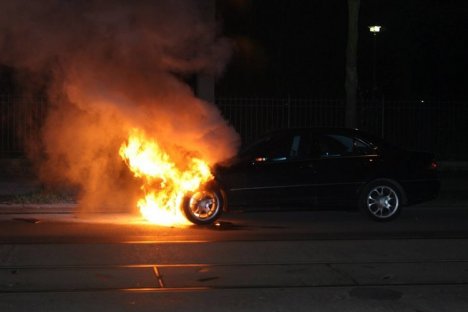
Unknown persons set on fire two luxury cars

Berlin, December 19th 2008

Burning carBurnt carUnknown persons set on fire two luxury cars
Berlin, December 19th 2008

In the night to Friday two upperclass cars were put on fire in Berlin. About 1.20 a.m. two people walking by Eldenaer Strasse saw fire coming out of the engine compartment of a mercedes. It was severely damaged by the flames.

About 20 minutes later an inhabitant of Hornstrasse reaslized a Chrysler burning. A Golf standing next to was also damaged by the heat. In both cases the Berlin Fire Brigades extinguished the flames.

The political police Staatsschutz took over investigations, as a political motive for the arsons can not be excluded. This year already more than 60 cars had been burned in the capital, presumably for political reasons.

—————

Luxury Condo-project attacked

Berlin, December 19th 2008

In the night to Friday a luxury condominium project was attacks with stones and colour bags in Kreuzberg. Some windows were smashed, the attackers got away unrecognized.

About 20 person dressed in dark clothes attacked a luxury condo building under construction in Kreuzberg withn stones and colour bags in the night to Friday. According to the police 12 windows were broken in the building in Liegnitzer Strasse. Then the unknown persons ran away to Görlitzer Park. The political police took over investigations.

In the Paul-Linke-Yards socalled Carlofts are being build, said the owner. This means that the flats have their parking lot right in front of their door. The cars will be brought to the respective floor by a lift. The condos in the scene district will cost up to 1.6 million Euro. A demonstration against increasing rents was banned from walking past the object by the police.

—————

A car and a Digger set on fire
Berlin 16 Dezember 2008

Unknown persons have undertaken two arson attacks in the early morning of Tuesday in the district of Friedrichshain-Kreuzberg. A taxi driver noticed a car, a luxurious mercedes, burning in the Wienerstrasse and called the cops.

Meanwhile a Digger got torched in the Kreutzigerstrasse in Friedrichshain.

—————

“Land Rover” set on fire
Berlin 14 December 2008

Unknown individuals put a „Land Rover“ on fire today early in the morning in the district of Mitte. A taxi driver noticed the car burning on the corner Choriner strassae/Fehrberliner strasse and called the cops. The State security investigates.

—————

„Hummer“ burned down

Berlin 8 of December

A car got burned early in the morning in Friedrichshain. Around 0.45 a police patrol noticed the burning“Hummer“ in the Frankfurter Allee.

Since a political motivation can not be excluded, state security investigates.

More burning of luxury cars throughout this autumn in Germany, at http://directactionde.blogspot.com/search/label/English, plus anti-militarist, anti-fascist and Greek solidarity actions

Sea Shepherd Clashes With Whaling Fleet in Australian Waters

December 26th, 2008
The Sea Shepherd Conservation Society ship Steve Irwin closed in on one of the vessels of the Japanese whaling fleet at 0730 Hours GMT (1930 Hours Sydney Time) on December 26th off the coast of the Australian Antarctic Territory north of the Mawson Peninsula.

Steve Irwin clashes with Kaiko MaruDecember 26th, 2008
The Sea Shepherd Conservation Society ship Steve Irwin closed in on one of the vessels of the Japanese whaling fleet at 0730 Hours GMT (1930 Hours Sydney Time) on December 26th off the coast of the Australian Antarctic Territory north of the Mawson Peninsula.

The Kaiko Maru emerged from dense fog in front of the Steve Irwin. The Sea Shepherd crew pursued and delivered 10 bottles of rotten butter and 15 bottles of a methyl cellulose and indelible dye mixture.

“That is one stinky slippery ship,” said Sea Shepherd 2nd Officer Peter Hammarstedt of Sweden.

The Japanese ship was ordered out of the territorial waters of Australia by Australian citizen Jeff Hansen from Perth, Western Australia. The message was delivered in Japanese.

As the Steve Irwin came alongside the starboard side of the Kaiko Maru, the whaler steered hard to starboard and struck the Steve Irwin lightly crushing part of the aft port helicopter deck guard rails on the Sea Shepherd ship. There was no serious damage to either ship.

The Sea Shepherd crew’s objective was to intimidate the Japanese fleet and to keep them moving Eastward out of Australian Territorial waters. The Sea Shepherd crew have been pursuing the fleet eastward for a week. There is only 90 miles left before the fleet enters the New Zealand Zone.

“Our objective now is to chase them out of Australia’s Economic Exclusion Zone,” said Captain Paul Watson. “I have a chart here and it clearly states that these waters are Australian EEZ. There is an Australian Federal Court Order specifically prohibiting these ships from whaling in these waters. We have informed the whalers they are in contempt of this Court ruling.”

There is no doubt that Japanese whaling in Australian waters has been severely disrupted. Since Saturday, the Sea Shepherd crew have chased the Japanese fleet for 400 miles through heavy fog, dense ice and nasty weather. During that time they have not been able to kill any whales.

“We still have them on the run and we intend to keep them on the run for as long as our fuel resources allow,” said Captain Watson.

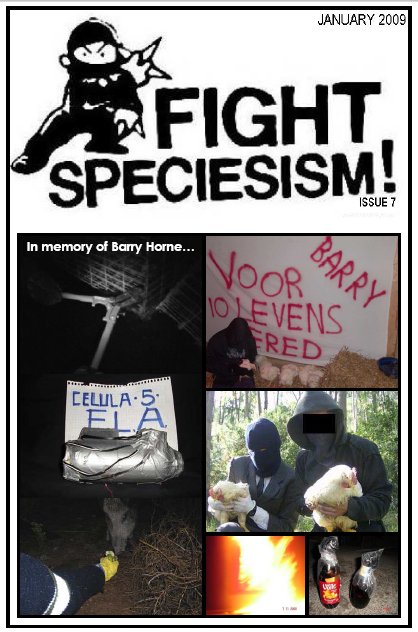
Fight Speciesism! #7 – Out Now

January issue of the latest anti-speciesist, anti-capitalist, abolitionist direct action news is out now. Antispeciesist Action is a collective of militant antispeciesists and animal rights activists committed to confronting animal abuse, suffering and exploitation of non-human beings through the use of direct action.

Fight Speciesism! #7 - Out Now January issue of the latest anti-speciesist, anti-capitalist, abolitionist direct action news is out now. Antispeciesist Action is a collective of militant antispeciesists and animal rights activists committed to confronting animal abuse, suffering and exploitation of non-human beings through the use of direct action.

We believe in the ‘No Compromise’ philosophy, veganism and actively support the Animal Liberation Front (ALF) and animal rights prisoners.

We are opposed to capitalism and the state, understanding that without both entities, the universal exploitation of animals would not be possible.

Until Every Cage Is Empty!

Articles:

– In Memory of Barry Horne
– NYSE:LSR Under Attack
– Hunt Sabbing News
– Mink Released
– Insurrection in Mexico
– Letter from Sean Kirtley
– Whalers On The Run
– Global Roundup
– Telmex Campaign
– Uprising in Greece

FS! #7 – http://www.indymedia.org.uk/en/2008/12/416034.html

Civilian Uprising against Barrick Gold in Tanzania

Mine security shoots young man, villagers respond by destroying $7 million in equipment

December 24th, 2008

Mine security shoots young man, villagers respond by destroying $7 million in equipment

December 24th, 2008

Last week, reports surfaced in the mainstream press that thousands of villagers had raided a gold mine in Northern Tanzania, setting fire to $7 million* worth of mine equipment. Most reports blamed problems with crime in the area, calling the intruders "gold-seekers."

While the spokesman for Barrick Gold** Tanzania, Teweli Teweli, describes these villagers as "well-organized groups" who attacked the pit following the blasting of high-grade ore, others paint Barrick as the aggressor in this event, citing immediate and historic causes that have been largely ignored by the international community.

According to several witnesses, the immediate cause of the civilian uprising was the killing of a young man named Mang’weina Mwita Mang’weina. Human rights lawyer Tundu Lissu, who represents many of the villagers, explains that Mang’weina and some friends were engaged in an argument with Barrick security when one of the guards shot Mang’weina, who was unarmed at the time. This incident caused an uproar within the community, which immediately took up stones, overpowered mine security (who then fled), and attacked the mine, setting fire to millions worth of equipment.

Mang’weina himself is a part of the legacy of the North Mara mine. He was one of the thousands of unemployed locals in the area, angry over the mine’s recent history of forced displacement, loss of livelihoods, human rights abuses and ongoing repression. He is the seventh person killed at the hands of mine security since July 2005, when the killing of a local boy sparked a similar uprising that resulted in the destruction of mine equipment and the subsequent detention of over 200 villagers.***

Eyewitnesses to the 2005 killing told The Guardian (Tanzania) that "the boy who was shot dead was walking past the company premises when company security guards, suspecting him of stealing oil, stopped him. When the boy failed to heed the order, the guards called the police who, before even questioning him, shot him in the chest."

Not one year later, security guards employed by Barrick Gold allegedly shot – five times in the back – another villager who was alleged to have illegally entered the mine complex, bringing the death toll to six.

According to Lissu in a letter written in June 2006:

The killings represent a major shift in Barrick’s strategy for dealing
with the troublesome locals who have always opposed the Mine. In the
period after the forced evictions of the villagers in August 2001,
hundreds of villagers, particularly community leaders and prominent
locals were targeted for illegal arrests, criminal prosecutions and
long term imprisonment. Numerous local leaders including the area’s
[late] Member of Parliament Chacha Zakayo Wangwe and elected Member of
the Tarime District Council Augustino Nestory Sasi were harassed this
way, with the latter being sentenced to 30 year jail before we got him
out on appeal to the High Court of Tanzania in December 2004.

Calculating from media reports, Lissu estimates that over 10,000 artisanal miners, peasant farmers and their families were kicked out of the area to make way for the North Mara mine in 2001. Since that time, there has been ongoing tension between the mine and the local communities.

According to Allan Cedillo Lissner, a Toronto-based photojournalist who recently interviewed families surrounding the North Mara mine, "Ongoing conflict between the mine and local communities have created a climate of fear for those who live nearby." Since the mine opened in 2002, one family told Lissner that they live in a state of constant anxiety because they are repeatedly harassed and intimidated by the mine’s private security forces and by government police. "There have been several deadly confrontations in the area and every time there are problems at the mine, the Mwita family say their compound is the first place the police come looking. During police operations the family scatters in fear to hide in the bush, ‘like fugitives,’ for weeks at a time waiting for the situation to calm down," Lissner explains.

The Mwita family explained that they used to farm and raise livestock, telling Lissner that "now there are no pastures because the mine has almost taken the whole land … we have no sources of income and we are living only through God’s wishes. … We had never experienced poverty before the mine came here." They also told Lissner that they would like to be relocated, but the application process has been complicated, and they feel the amount of compensation offered was merely "candy."

According to Tanzanian journalist and community advocate Evans Rubara, this latest uprising "is a sign to both the government of Tanzania and the International community (especially Canada) that poor and marginalized people also get tired of oppression." He hopes that the recent conflict will inspire Barrick "to start another strategy that will bring a good and constructive relationship with the local communities by implementing programs that do not enhance more looting and belittle Tanzania, leaving thousands in destitution."

Since this most recent uprising, dozens of villagers have been arrested. According to Lissu, who plans to represent those arrested, "They have arrested dozens of people; [Barrick is] on a war path; these people have been denied bail, they are targeting the youth and repression is on."

Lissu also spoke about reports of weapons making their way into the North Mara area. "Two days ago, we got information that [Barrick is] importing weapons: a ton and a half of tear gas, and hand grenades were transported to the mine on Thursday. The hand grenades were seized by customs on the way to the North Mara Gold Mine, but have since been let through," he told ProtestBarrick.net on the phone from Tanzania.

Sakura Saunders is an editor for protestbarrick.net, an all-volunteer news site that networks organizations and community groups organized against Barrick Gold around the world.

* On December 17, 2008 Barrick Gold said it had revised down the damage to its North Mara Mine in Tanzania during an attack last week to about $7 million from an earlier estimate of $15 million.

** In January 2006, Barrick Gold merged with Placer Dome, who previously owned the North Mara mine.

*** By mid 2006 all of the villagers detained after the 2005 uprising had been released by the courts after the authorities failed to prosecute them.

Actions in India and the Philippines

I’m not sure whether the following reports are ‘ideologically acceptable’ but over the last year there has been a rash of direct action attacks against corporations and in defence of the environment and the indigenous peoples that live there, undertaken by Maoist forces in both India and the Philippines.

I’m not sure whether the following reports are ‘ideologically acceptable’ but over the last year there has been a rash of direct action attacks against corporations and in defence of the environment and the indigenous peoples that live there, undertaken by Maoist forces in both India and the Philippines. The following reports and communiques are taken from a variety of web-sites (supportive and hostile).

India

1. Naxals attack in Gadchiroli [December 2007]

CHANDRAPUR: Naxalites set ablaze three vehicles – two tippers and a truck – of a contractor on Wednesday evening. The incident took place near Haldwahi Tola village in Chamorshi tehsil of Gadchiroli district, said the police.

According to sources, the Naxals came to the village and after identifying the vehicles of the construction company – Sainath Constructions – set those ablaze. The Naxalites then disappeared into the jungle.

Sanjay Latkar, SDPO of Chamorshi division, said, “The Naxals have burnt the three vehicles owned by Raju Biyani, director of Sainath Constructions on Wednesday evening.”

(http://maoistresistance.blogspot.com/2007/12/naxals-attack-in-gadchiroli.html)

2. Maoists attack Essar Steel plant in Chhattisgarh

Raipur, Apr 25 [2008]: About 300 heavily armed Maoists on Friday attacked an iron ore beneficiation plant of Essar Steel in Chhattisgarh, and set 53 trucks and three heavy machines on fire, a senior police officer said.
The attack was carried out near Kirandul in the state’s Dantewada District where the insurgents have been running a de-facto administration for years.
“Armed rebels attacked Essar Steel’s iron ore facility and created havoc for hours, by setting at least 53 trucks and three heavy machines on fire, in a raid that ended in the early hours of Friday,” R. K. Vij, Inspector General of Police of Bastar range, told media.
The plant supplies high quality iron ore from its 8 million tonne per annum (MTPA) unit to the pellet plant at Visakhapatnam in Andhra Pradesh.
According to police, rebels overpowered a few employees working in the plant during night shift and then sprayed diesel on vehicles and set them on fire.
The rebels later slipped into the nearby forest. The rebels left pamphlets at the attack site saying their act was to protest transportation of local rare natural resource iron ore to outside the state and the country.
Congress General Secretary Rahul Gandhi is on a four-day visit to tribal pockets in Madhya Pradesh and Chhattisgarh.

(http://www.thaindian.com/newsportal/business/maoists-attack-essar-steel-plant-in-chhattisgarh-2_10042081.html)

3. In September 2008 a photo essay about the anti-Maoist militia the Salwa Judum appeared on the Internet. Part of the essay read as follows:

The conflict sits on top of one of the most valuable iron mines in Asia [in Bacheli, Chhattisgarh]….. Some people allege that Salwa Judum only exists to free up land for mining contracts, and is not really a fight against communism.

[A] massive steam shovel was attacked by Naxals a month before I arrived. Naxals target mining infrastructure because they say local people don’t reap any benefit from the multi-billion dollar industry. (Unfortunately the damage was temporary and the machine has been repaired)

Christopher Kindo is the Deputy Director of Mining in Chhattisgarh. he says that he doesn’t understand why Naxals keep attacking his equipment. (Aaahhh …. the innocence dripping from his face could melt anyone’s heart)

The mining machinery in Chhattisgarh comes from an American company and sells for half a million dollars per truck. [A] massive load puller can hold several tons of top grade iron which eventually ends up in building projects across India and Japan. The mines are a central target of Naxal militants.

(http://naxalrevolution.blogspot.com/2008/09/salwa-judum-photo-essay.html)

4. Naxalites set eight vehicles on fire

Sunday November 30 2008

Raipur (PTI): Eight vehicles were set on fire in two separate incidents by suspected Naxalites in Dantewada and Bijapur district, police said today.

Naxalites stopped the road construction work between Kamalur and Kundeli in Dantewada district and set three tippers, two dozers, a pokelene machine and a trailer on fire late last night, police said.

In another incident, about three dozen Naxalites led by Ursa Bodhra, a hardcore Naxalite, set a vehicle on fire for allegedly carrying supplies meant for security forces at Gangalur region of Bijapur last night….

http://naxalwatch.blogspot.com/2008/11/naxalites-set-eight-vehicles-on-fire.html
Philippines

5. communique published by the New Peoples Army, republished on the website of the Negros Chronicle

….September 15, 2008
The NPA Mt. Talinis Front Command based in southeast Negros island implemented last September 9 a directive from the Provisional Revolutionary Government to punish the Tamlang Valley Agricultural Development Corporation (TVADC) for promoting and planting jathropa and cassava in the said area.
According to Ka Dom Pantaleon, spokesperson of the NPA Mt. Talinis Front Command, Red fighters seized and immediately burned three tractors owned by the TVADC late Tuesday night in Sitio Cuadra, Barangay Mantikil, Siaton town in Oriental Negros.
The punitive action was implemented after it was proven that the year-old TVADC project has gravely dislocated the planting of the traditional corn, rice and other food crops in Tamlang Valley, he said.
Lands previously used by farmers for own-consumption food production were now forcibly used for bio-fuel purposes, and a succession of Army battalions were employed to actively harass and dupe farmers to plant jathropa and cassava, he added……

(http://www.negroschronicle.com/?p=379)

6. Red Army’s anti-biofuels campaign continues
October 28, 2008

The NPA will implement more preventive measure against private agri-business corporations like the Tamlang Valley Agricultural Development Corporation (TVADC) for worsening the food supply problem and causing numerous military abuses in southeast Negros.
Thus said Ka Dom Pantaleon, spokesperson of the NPA Pulang Mt. Talinis Front Command, as he announced yet another punitive action against the TVADC biofuels company mainly based in barangay Casalaan, Siaton, Oriental Negros.
In a press release, Pantaleon said the countryside-based people’s democratic government ordered an NPA team last October 3 to confiscate and burn two TVADC-owned tractors in sityo Tamlang, barangay Talalak, in Sta. Catalina town. No one was harmed in the incident, he added.
It was the second such operation in as many months by the Red army to protect upland peasants from the intrusive and harmful biofuels company co-owned by the family of ex-Congressman Herminio Teves and their Korean business partners….
Pantaleon revealed that the NPA will continue implementing similar orders for punitive actions from the countryside-based people’s democratic government that are meant to block the widespread growing of jathropa and cassava in and around the vast Sta. Catalina-Siaton-Valencia-Pamplona border barangays of Oriental Negros known as Tamlang Valley.
More importantly, it will impose armed punitive actions against the 302nd Brigade for providing protection and even colluding with TVADC in forcing ordinary farmers to plant jatrhopa and cassava, instead of their traditional food crops like upland rice and corn, he added.
The NPA spokesperson said the mercenary AFP has become the biofuels campaign’s most visible “errand boys” for the agri-business company and the Teves family in southeast Negros.
This has resulted to numerous human rights abuses, including the enforced disappearances of ordinary farmers Flaviano Arante and Reynold Yanoc – both residents of barangay Talalak, Sta. Catalina town – who have been missing and feared salvaged since early this year, he added…..

http://www.philippinerevolution.net/cgi-bin/statements/statements.pl?author=npasn;date=081028;language=eng

7. December 23, 2008

[extract]…..The NPA also burned six (6) multi-million heavy equipments of SRMI as punishment for their considerable transgressions against the environment, indigenous Filipinos, workers and people affected by their mining operations.
SRMI is owned by the Amante political family and has wrought environmental destruction to the municipality of Tubay, paid low wages and unjustly treats its workers, disrespects the rights of the indigenous Filipinos to their ancestral lands and deprives them of their ”royalty share”. SMRI’s unquenchable greed is forcibly put over and above the interests of the indigenous Filipinos, small miners and the masses through the hiring of Ret. Col De Lara and establishing a big security force whose members include abusive criminals.

http://www.philippinerevolution.net/cgi-bin/statements/statements.pl?author=ndfnm;date=081223;language=eng

ALF & ELF Continue Telmex Sabotage

“On December 11 the Frente de Liberacion Animal in Mexico sabotaged 25 telephones of the disgusting company Telmex in an act of direct support for our fighting comrades in Colombia, we are glad to know that the attacks that are badly needed in Latin America have this continuity, we hope that the flame will not go out in Colombia and that they continue on!

“On December 11 the Frente de Liberacion Animal in Mexico sabotaged 25 telephones of the disgusting company Telmex in an act of direct support for our fighting comrades in Colombia, we are glad to know that the attacks that are badly needed in Latin America have this continuity, we hope that the flame will not go out in Colombia and that they continue on!

Continuous, well-planned sabotage is the worst nightmare of the exploiters.

A fighting embrace!

For animal, human and earth liberation!

FLA Mexico”

———–

“On December 18 we sabotaged 20 phones of the destroyer of the planet, the Telmex company, in the same manner as before (with bolt cutters and other tools).

We will not stop …

FLT México”

———–

Previous actions

ELF sabotage phone booths in Columbia & Mexico
http://www.earthfirst.org.uk/actionreports/node/21875

Telmex phone booths sabotaged in Mexico City
http://www.earthfirst.org.uk/actionreports/node/21813

Source http://www.directaction.info

Invitation to the Northern Climate Rush – January 12th

On Monday 12th January 2009 at 7pm the Northern Climate Rush will hit Manchester Airport Terminal 3 (Domestic Departures).

Climate suffragette small groupOn Monday 12th January 2009 at 7pm the Northern Climate Rush will hit Manchester Airport Terminal 3 (Domestic Departures).

Everyone is welcome to join us. Come in Edwardian dress if you can (think long skirts, coats and tails, and silly hats, all hidden under a big coat!) with hampers of food to have our ‘Dinner at Domestic Departures’, to the strains of our very own string quartet! It will take place on the day that the MPs return from their winter holiday, and at exactly the same time as the main Climate Rush, at Heathrow.

Our protest will be against airport expansion and domestic flights. In a time of recession and climate crisis, government money should be spent on improvements to rail, trams, and buses, not on subsidies and infrastructure for the aviation industry.

For an accessible report on the latest climate science, check out http://climatesafety.org/

We have waited too long and been misled too many times. It is time for us to take control and to lead social change.

northernclimaterush@googlemail.com

Radley Lakes saved

Following years of campaigning through legal channels, and the squatting of a building by the side of Thrupp Lake at the beginning of 2007, the Save Radley Lakes campaign is victorious – hoorah! Use the search above for old stories and photos from the campaign – stories about the recent victory and future plans are below.

Thrupp Lake at sunsetFollowing years of campaigning through legal channels, and the squatting of a building by the side of Thrupp Lake at the beginning of 2007, the Save Radley Lakes campaign is victorious – hoorah! Use the search above for old stories and photos from the campaign – stories about the recent victory and future plans are below.

End of an Era

Yesterday’s (17.12.08) announcement by RWE Npower brought to an end a 41 month campaign to save the last remaining Radley Lakes, Thrupp and Bullfield Lakes, from destruction by being filled with waste pulverised fuel ash (PFA) from the Didcot A Power Station.

It also brings to an end 23 years of filling of old gravel pits in Radley with power station ash, which began in 1985, when the Power Station was run by the nationalised Central Electricity Generating Board and when the environment figured less highly in popular concerns. The choice back then was between landfill with general waste, commercial exploitation, or ash. Local people voted for the ash, which is probably what they would have got anyway.

The ash had been pumped into the gravel pits as a slurry via an underground pipeline. Many gravel pits were filled in this way over the intervening years and people did not seem to mind, though eyebrows were being increasingly raised, and there were objections to the filling of Lakes H and I, which had become a spectacular haven for wildfowl. In 2005, RWE npower sought permission to fill the the two remaining gravel pits. These were the oldest excavations, which had, over the half century or so of their existence, become restored into beautiful lakes and had been given names by local people.

How the Lakes Were Saved (in a nutshell)

The smaller Bullfield Lake was rescued from this fate following protests back in 2005, but the much larger and more important Thrupp Lake has remained under threat ever since, as planning, legal and other battles raged around it. As a last resort, local people even applied to have the area turned into a Town Green. This too failed, but it remains the subject of a Judicial Review, which was due to be heard in the High Court in February 2009. In February 2007, having got all necessary planning permissions and removed the protestors who’d occupied the lakeside building, npower went ahead with clearance work on the site, and many trees were destroyed. Work then had to stop until the Autumn, because of nesting birds. After carrying out some preliminary work in October 2007, npower suddenly ceased their activities on the site.

Then, in February 2008, events took an unexpected turn: npower announced an interim reprieve for Thrupp Lake. A little later, Waste Recycling Group (WRG) openly came forward with a proposal that would save Thrupp Lake for ever. It has taken until now to bring this to fruition. Planning permission was needed, technical problems had to be resolved, a commercial agreement had to be reached; then there was the question of what to do with Thrupp Lake. Many delicate negotiations, it seemed, were going on in the background, culminating in yesterday’s momentous announcement.

Triumph at Last!

To mark the occasion, the Power Station operators invited press and public into the grounds of Sandles, the house on the shore Thrupp Lake. There, Mr John Rainford, the Power Station manager, announced that, because the power station had found better and more sustainable ways of disposing of its ash, there would be no need to destroy Thrupp Lake, not now, not ever. He made it clear that RWE npower was offering The Lake to the local community as a nature conservation area and that discussions were underway with the Northmoor Trust to provide for its management. It was hoped that the house could be converted into an educational centre.

Representatives of the community, Jenny Standen, chairman of Radley Parish Council, and Basil Crowley, chairman of Save Radley Lakes, expressed their satisfaction and delight, thanking npower for their magnanimity and looking forward to working with them in restoring the area to create something to be really proud of. Both expressed gratitude to all the people who had supported the campaign and whose support and tireless efforts had helped bring this about.

With the late December afternoon sunshine casting long shadows across the vestiges of Sandles’ lawn, a jubilant party atmosphere prevailed. Champagne flowed, hands were shaken, cameras clicked and, in a touch of surreality, a man in a frog suit played a solo trombone fanfare at the lakeside to herald the lake’s salvation.Radley Lakes saved trombone fanfare

Where the Ash Will Go

The ash that was to have gone into Thrupp Lake will now go to Waste Recycling Group’s Sutton Courtenay landfill site next to the power station where it will be used for engineering, capping and landscaping of the landfill operations. Surplus ash will be stockpiled in a planned new storage facility, which received planning permission back in July, and will maintain WRG’s essential supply of ash after 2015 when the power station will have closed. Because the power station and the waste site are immediately adjacent, the ash can be transported directly across the fence and put into the stockpile, which is not far from the power station boundary. At no time will this ash be transported on public roads, which means there will be no adverse impact on the residents of Sutton Courtenay. Indeed, it will remove the need to import over half a million tonnes of substitute materials after 2015, which would have had an impact!

http://www.saveradleylakes.org.uk/
http://www.radleyvillage.org.uk/news/News0009.htm