The Outdoor Skillshare a success

23rd June 2010
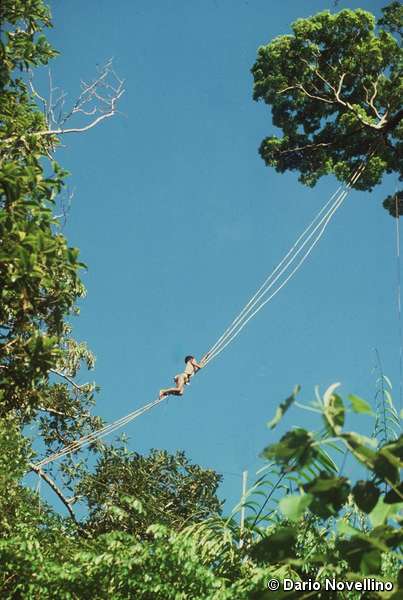
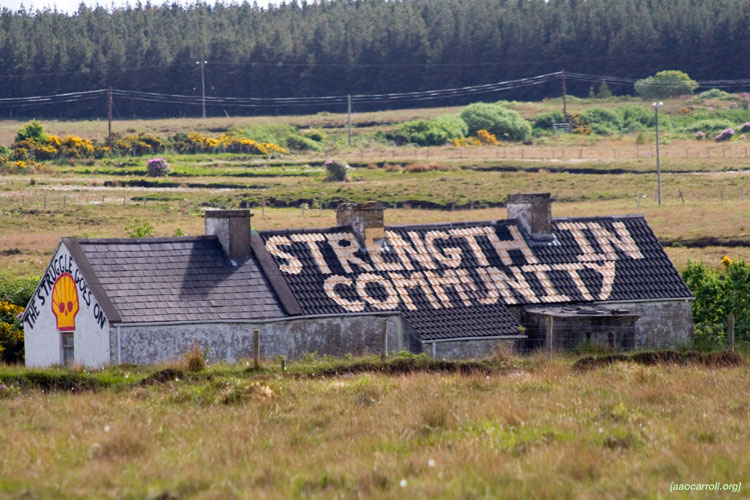
Over a hundred people came together last weekend for the Outdoor Skillshare. Held at Talamh Housing Coop in South Lanarkshire, the weekend aimed to bring people together to share the skills needed to occupy land and defend it from eviction. Workshops covered varied topics including cooking for the masses, digging tunnels, radio communication and climbing trees.

23rd June 2010
Over a hundred people came together last weekend for the Outdoor Skillshare. Held at Talamh Housing Coop in South Lanarkshire, the weekend aimed to bring people together to share the skills needed to occupy land and defend it from eviction. Workshops covered varied topics including cooking for the masses, digging tunnels, radio communication and climbing trees.

The weekend also had sessions on skill-sharing and running workshops to share the skills to facilitate participatory workshops. It is hopped that more skill-sharing and events of this type will happen across the UK in the future.

Lewis from Leeds who travelled up for the weekend said: “It was a really amazing event and I really learned a lot. I’d never put on a harness or cooked on a giant gas burner before so it was a great opportunity to practise these things. I really feel like all of us who came to this weekend will be able to go to a protest camp and actually chip in.”

Laura, part of the group that organised the event said: “We were surprised at the number of people who came and the atmosphere and peoples attitude was amazing. People organised spontaneous sessions and those of us giving workshops learned new ways of doing things. It was such a great weekend and I hope we get a chance to do it again.”

The temporary camp over looked the former site of the Mainshill Solidarity Camp, now a functioning open cast mine, and was surrounded by Broken Cross and Poniel open cast coal mines. South Lanarkshire has been blighted by open cast coal mines for decades and has also been a hive of resistance by the community and environmentalists. Over the weekend people from the local communities visited the event, including some local young people who took part in the kids climbing workshop.

outdoorskillshare [at] riseup.net
http://outdoorskillshare.noflag.org.uk

Greenwash spill at the BP-sponsored National Portrait Gallery

On Tuesday night (22 June 2010) at 6.07 PM the London brigade of the Greenwash Guerrillas got a call from a panicked pedestrian outside the National Portrait Gallery.

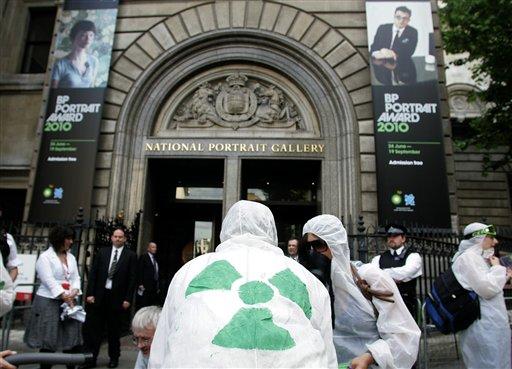
BP Portrait Gallery greenwash guerrillasOn Tuesday night (22 June 2010) at 6.07 PM the London brigade of the Greenwash Guerrillas got a call from a panicked pedestrian outside the National Portrait Gallery. It seemed that the prizegiving ceremony for BP Portrait Award was about to start, and toxic greenwash had begun to gush uncontrollably from the gallery’s front doors.
Arriving on the scene, armed with the latest in greenwash detecting equipment and wearing protective biohazard suits, the Guerrillas
immediately identified several sources of the leak. Greenwash levels appeared to be the strongest anywhere a bright green BP logo was to be
found: from the massive banners fronting either side of the grand entrance, to the microscopic embroidery on a security guard’s lapel. The
Guerrillas were given the run-around by gallery security and the Metropolitan police, who escorted Britain’s cultural establishment into
the awards ceremony first at the front, then around the side, then back at the front entrance again. By 7 PM, everyone had convened at the front entrance, and the Guerrillas set to work to contain the leak, quarantine the area, and warn attendees against entering the building.

Many clean-up efforts were tried, from throwing golf balls and old tires at the leak to trying to plug it with mud, but for some reason the spill just kept gushing. Meanwhile, some Guerrillas attempted to arm the attendees – most of whom, inexplicably, were determined to enter the
contaminated building – with information about BP, oil industry sponsorship of the arts, and the best way to protect themselves from
greenwash.

Despite the best efforts of the Guerrillas, greenwash unfortunately continues to spew forth from the BP-sponsored National Portrait Gallery
and countless other oil-sponsored arts institutions across London. But resistance is growing, and this summer might just be remembered as the
tipping point in the campaign to free art from oil.

More info:
http://www.risingtide.org.uk
http://www.artnotoil.org.uk

WHAT’S THE PROBLEM?
BP’s sponsorship of the National Portrait Award is greenwash – a way of cleaning up BP’s tattered public image and covering up its shocking
environmental and human rights record.

Greenwash is as toxic as oil. With it, BP buys our approval, and hopes we’ll forget about the gusher in the Gulf, the 300 000 lives already lost each year due to climate change, and the fact that the company is poised to enter the Canadian tar sands – the most destructive project on earth.

Every pound the National Portrait Gallery accepts from BP is tainted. In response to changing public opinion, cultural institutions eventually
decided that it was no longer in their best interests to take money from the tobacco industry. It’s high time we kicked Big Oil out of our
galleries too.

Check out a brilliant video here:
http://www.youtube.com/watch?v=-adx5mS2klA

london@risingtide.org.uk
http://www.risingtide.org.uk

Protest against BP – This Saturday 26/06 1pm at Tottenham Hale BP Garage, London

Against climate crimes in the name of profit and in solidarity with workers exploited by giant corporation BP, come and protest this Saturday 26 June, 1pm at Tottenham Hale BP garage.

Haringey Solidarity Group have organised a protest against giant corporation BP this Saturday 26 June, from 1pm at Tottenham Hale BP Garage (map here: http://tiny.cc/28p38)

Against climate crimes in the name of profit and in solidarity with workers exploited by giant corporation BP, come and protest this Saturday 26 June, 1pm at Tottenham Hale BP garage.

Haringey Solidarity Group have organised a protest against giant corporation BP this Saturday 26 June, from 1pm at Tottenham Hale BP Garage (map here: http://tiny.cc/28p38)

We aim to draw attention to the many climate crimes BP is responsible for, all in the name of profit, show solidarity with workers exploited by the corporation and encourage people to build collective and local alternatives to the climate crisis.

See the text of the leaflet below.
An on-line version is available here: http://dl.dropbox.com/u/4403399/BP_Protest.pdf

Please circulate widely, come along, bring banners, placards, etc…

—–

BP – Guilty of Climate Crimes!

Called by Haringey Solidarity Group as part of Haringey Sustainability Month

The dangerous greed of BP has seen them trashing the planet in pursuit of profit – across the world, BP is guilty of climate crimes that should all be front page news.

The Gulf of Mexico: BP’s faulty drilling results in one of the worst oil spills in history, killing workers, endangering wildlife across the region and leaving a massive clean-up operation.

Canada: Extraction of millions of barrels of tar sands oil, producing 3-5 times the greenhouse gases of conventional oil, causing mass deforestation and polluting indigenous communities.

Colombia In January, industrial action organised by trade unionists in the region of Casanare was severely repressed by BP, with the help of a special police force known for anti-worker violence.

Baku–Tbilisi–Ceyhan pipeline: This crude oil pipeline, running through Turkey, Georgia and Azerbaijan, was financed by BP, visibly scarring the landscape and wrecking areas of great natural beauty, including natural spring water reserves.

Not to mention communities across the world! While adding to the wealth of a few, BP is destroying the common wealthe of the many. We need to act locally to resist companies like BP dictating the way our economies are structured – for profit and against the environment.

See over for how we can take action collectively in our communities to fight climate change and create a future sustainable society.

——————————

Building Alternatives to the Climate Crisis

Oppressive and destructive corporations like BP do not serve the general interest. We need to end our dependency on oil and fossil fuels, which gradually destroys the planet and our lives, and aim for the development of renewable energy managed by the community.

We can organise locally and take back control of our lives and environment by building sustainable communities for the benefit of all. People in Haringey are getting together to form collective, grassroots alternatives and solutions to the climate crisis.

See below for how to get involved!

Haringey Solidarity Group

We are a group of local people who want to get rid of the current system which places profit and power before people’s real needs. To do this, we believe we all need to get organised, fight back and take over the decision-making in communities and workplaces. We support and participate in local campaigns, spread ideas and help create effective opposition to the powers that be.

www.haringey.org.uk, email info@haringey.org.uk, write to PO Box 2474, London N8 or call 0845 223 5270

Sustainable Haringey

An independent informal network for everybody wanting to make Haringey more sustainable. It brings together groups and individuals already making positive contributions and welcomes those who would like to find out how to do more. In June there are events happening across the borough as part of Sustainability Month.

See www.sustainableharingey.org.uk for further details

Oil execs gather – we besiege ( + video link)

As oil executives gathered at a London hotel for their annual strategising conference on Monday 21st June, up to 200 climate activists crossed the river from BP-sponsored Tate Modern to converge on the front entrance with a samba band and a giant p

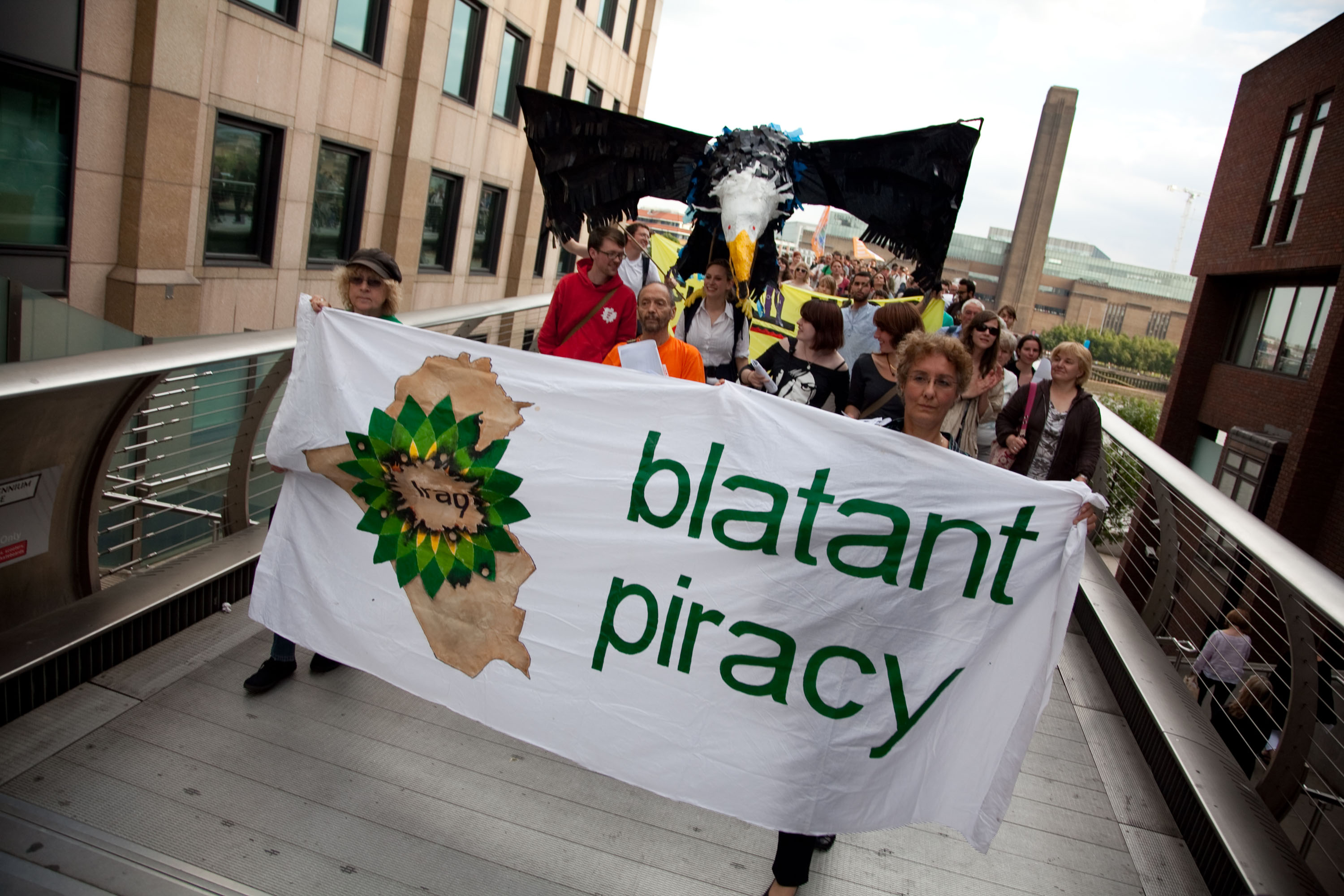
Drum it Out 1Drum it Out 2As oil executives gathered at a London hotel for their annual strategising conference on Monday 21st June, up to 200 climate activists crossed the river from BP-sponsored Tate Modern to converge on the front entrance with a samba band and a giant paper-mache oil-covered seabird.
Titled “Drum It Out”, the protest also put the industry on trial before a People’s Court which loudly found it guilty of crimes of pollution, war crimes, climate crime, and more.

The court heard live testimony by witnesses not only from the Gulf, but from Nigeria, Ghana, Colombia, Peru, from Iraq which has suffered the devastation of a war for oil, from Canada where indigenous people are resisting the Tar Sands oil project destroying a land as large as England, and from Kenya and China which are suffering droughts as a result of the changing climate. “The Gulf of Mexico is not the only disaster,” the protesters said – “in fact it’s not even the largest, and in some places this destruction of life has been going on for decades. The oil industry is not sustainable. They think they rule the world, but they are facing resistance everywhere. They cannot come to this hotel and think they will carry on business as usual”.

A dead fish award was presented to Bloody Oil in its various company guises, and a “fish” was delivered to the hotel to be passed on to Congress delegates.

Following the trial, the main and back entrance were besieged by the drumming crowd, with no injuries and no arrests. Two activists who had succeeded in penetrating the building were unceremoniously ejected. The Drum Out will be followed this Saturday by a Teach In, at the School of Oriental and African Studies, where campaigners will learn more about the ongoing resistance by workers and communities in oil regions, will link-up live with organisers in Ghana, and will discuss how to work together to bring the industry down. One protester commented, “If even half the money invested in subsidising oil, cleaning up its disasters and funding its wars were devoted to alternative forms of energy, people wouldn’t be suffering these outrages, and the planet would be safe.”

london[at]climatecamp.org.uk

Watch the Video http://www.youandifilms.com/2010/06/bloody-oil-drum-em-out/

Camp for Climate Action 2010 – Break the Bank!

Saturday 21 August – Tuesday 24 August 2010
Edinburgh, Scotland

* Occupy and set up the basecamp: 19–20 August
* Four days of training and direct action: 21–24 August
* Day of action against RBS: 23 August
* Return basecamp to nature: 25 August

The Camp for Climate Action is a grassroots movement taking direct

Saturday 21 August – Tuesday 24 August 2010
Edinburgh, Scotland

* Occupy and set up the basecamp: 19–20 August
* Four days of training and direct action: 21–24 August
* Day of action against RBS: 23 August
* Return basecamp to nature: 25 August

The Camp for Climate Action is a grassroots movement taking direct
action against the root causes of climate change. After mobilising and
helping stop the proposed third runway at Heathrow and a new coal fired
power station at Kingsnorth, we’re growing into a mass movement to
reclaim our future from government and profit-hungry corporations.

This year we’re targeting the Royal Bank of Scotland, and their global
headquarters in Edinburgh.

Last year RBS were bailed out with £50 billion of public money. This
bank is one of the world’s largest investors in oil, gas and coal. From
tar sands extraction in Canada to coal infrastructure here in the UK,
we’re paying to trash our future. These projects are not just causing
catastrophic climate change, but destroying the lives and livelihoods of
people across the globe. Meanwhile, we’re told there is no money left
and we should be braced for decades of public sectors cuts.

Ecological destruction is built into the mechanics of the financial
system, with communities disenfranchised from their own futures. This is
why, in August, people from across the UK will be converging to take
back the power and Break the Bank!

Our sustainable and collectively-organised basecamp will give you the
chance to learn, train up, and meet like minded individuals. Exciting
action plans are currently in the plotting stages, so watch this space.

The Camp for Climate Action is made up of people like you – check out
http://www.climatecamp.org.uk to find out how to get involved.

———————————————————————

SPREAD THE WORD
– Please forward this email!
– Invite your friends to the facebook event:
http://www.facebook.com/event.php?eid=134368843242381
– All-new flyers and stickers for the camp are here:
http://www.climatecamp.org.uk/actions/edinburgh-2010/rbs-flyers-and-stickers
– The just-out ‘Never Mind the Bankers’ RBS newspaper is here:
http://www.climatecamp.org.uk/actions/edinburgh-2010/never-mind-the-bankers

COME TO THE NEXT UK GATHERING
– The next planning gathering for this summer’s camp will be in
Edinburgh from 3-4 July. Gatherings are a chance to make decisions about
the camp and get involved in the working groups that make the camp
happen. Everyone’s welcome – full info here:
http://www.climatecamp.org.uk/get-involved/national-gatherings/next

COME TO THE RBS TEACH-IN
– Tool up on RBS at our teach-in in Leeds on 17 July:
http://www.climatecamp.org.uk/actions/edinburgh-2010/rbs-teach-in-17-july

GET INVOLVED IN YOUR LOCAL GROUP
– We’ve got groups and neighbourhoods around the country. Details here:
http://www.climatecamp.org.uk/get-involved/local-groups

GET IN TOUCH WITH WORKING GROUPS
– Working groups are the way we organise things, and they need you.
Details here: http://www.climatecamp.org.uk/get-involved/working-groups

QUESTIONS?
– Try info@climatecamp.org.uk or process@climatecamp.org.uk

Sea Shepherd Attacked in Libyan Waters again (+ eye-witness account)

19th June 2010

Sea Shepherd vessel, the Steve Irwin, was attacked today in Libyan waters as it attempted to free Bluefin from cages. Their Operation Blue Rage has gone swimmingly until now, and the Steve Irwin is currently heading up to International waters.

19th June 2010

Sea Shepherd vessel, the Steve Irwin, was attacked today in Libyan waters as it attempted to free Bluefin from cages. Their Operation Blue Rage has gone swimmingly until now, and the Steve Irwin is currently heading up to International waters.

This latest attack is ominous, considering Captain Bethune’s recent trial in Japan. Bethune was found guilty of several charges after he boarded the ship of a captain responsible for ramming and sinking a Sea Shepherd vessel under his command.

To make matters worse, former allies with the WWF and Greenpeace have turned tail on the international whaling ban that has been in effect for over two decades, leaving Sea Shepherd, which employs direct action on the side of International law by using aggressive methods to deter whaling vessels, in the lurch.

Steve Irwin Attacked in Libyan Waters
Operation Blue Rage: Day Twelve of the Mediterranean Patrol

Saturday, June 19th, 2010
Location: Off the Coast of Libya

At 0900 Hours the Sea Shepherd ship Steve Irwin moved into Libyan waters to inspect the remaining cage being towed by the Italian vessel Cesare Rustico. With the Sea Shepherd helicopter overhead, our inflatable Delta boat and dive team approached the cage.

The Cesare Rustico dropped the tow line and turned to defend the cage. At the same time the fishing vessels the Tagreft and the Rabbah 1060, along with the trawler Misurate 96, moved in quickly to defend their illegal catch of Bluefin.

Immediately and without warning, the Steve Irwin was attacked with a barrage of flares aimed at the wheelhouse and the crew on deck. The Cesare Rustico issued a May Day distress signal saying they were under attack by the Steve Irwin even though the our crew had merely approached the cage to inspect the catch. Most worrying was the fact that the Sea Shepherd helicopter piloted by Chris Aultman was painted by the Libyan airborne radar system.

At that point, in the interest of safety, I ordered the Delta inflatable and helicopter to return to the Steve Irwin. We then retreated to a safe distance away from the waters claimed by Libya. The two vessels Tagreft and the Rabbah 1060 pursued and continued to fire flares at the us. We were able to lose them quickly.

The Captain of the Cesare Rustico radioed the Tagreft and Rabbah 1060 to, “do whatever you can to damage them so they will never return.”

The Captain of the Cesare Rustico said that the Libyan Navy was within a few miles and closing in. However there were no Libyan naval vessels within thirty miles on the radar.

Yesterday the Steve Irwin requested the assistance of the Greenpeace ship Arctic Sunrise to liberate the estimated 800 Bluefin tuna in this cage but they declined to assist. A contact within Greenpeace informed us that under no circumstances was Greenpeace to enter waters claimed by Libya..

The Steve Irwin is now heading towards Cyprus and Turkey in search of Bluefin poachers.

—-

This is an eyewitness account from an action by the Sea Shepherd Conservation Society, which set out onto the Mediterranean Sea last month in search of bluefin tuna poachers. As one of the most valuable fish in the world, the bluefin populations in the Mediterranean region have been reduced by over 85% in the last 50 years due to relentless industrial overfishing. Crew member Wietse van der Werf reports.

It is night when we enter Libyan waters. Everyone on the ship is excited, yet somewhat anxious about what is coming. We are the first to enter these waters in search of illegal bluefin tuna fishing. Neither observers from the International Commission for the Conservation of Atlantic Tunas (ICCAT), which ‘manages’ the fishery, nor French or Maltese navy vessels operate here. We are determined to find a floating cage full of illegally caught bluefin tuna, by now an endangered fish, and release them.

Our helicopter has been out for some time when it spots a target. Two tugs, towing a cage each, both full of tuna and headed for the tuna fattening farms in Malta. Down in the engine room we work to get the ship the extra thrust it needs to arrive at the target as soon as possible. Having a quick look up on deck, I can spot two vessels on the horizon. Around here you don’t have to look far to find illegal fishing.

Closer to the vessels we request permission to inspect the fish. Only a certain percentage of undersized fish, known as juveniles, are allowed. This is often where the violations occur. Our request is refused. The fishermen state that the fish were caught on the last day of the allowed fishing season and that the cage contains the catch from eight different fishing ships. The story doesn’t add up. The bad weather conditions in the fishing grounds we have witnessed in the last few days, which make fishing virtually impossible, and the relatively short distance the boats are from the fishing grounds make us highly suspicious of their story.

The engine room phone rings. ‘Hold on, we’re putting the bow over the cage to see what’s inside’. We hold on and feel a shudder going through the ship as we park it against the cage. At that moment one of the fishing vessels, Rosaria Tuna, moves at speed towards us. Unhindered by our larger size, it smashes its bow into our port side. With a loud bang, steel bends and paint flakes off. One of the fishermen threatens us by swinging a pole with a large hook on its end across the deck. We respond by dropping a few bottles of rotten butter on their deck and they retreat. By now our ship is nosed in the pen and when it’s clear that there are many tuna inside, our divers get ready for a closer inspection.

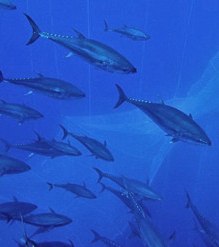
We move away from the pen and to our disbelief the Rosaria Tuna starts moving away from the scene. Once we have moved about a mile off and our divers are ready we turn and re-approach. This is our chance. With Rosaria Tuna moving off in the distance and the other tugboat Cesare Rustico standing by, our divers jump in the pen. Meanwhile the other tug has turned and approaches at full speed. The divers report back that they can see a large number of juveniles inside. We decide to intervene. The divers descend and start cutting the net. Within minutes the gigantic net is starting to move and the first tuna are curiously moving out through the new opening. As we stand on the bow we can see a few fish swimming away from the cage, then more and more until it is entirely empty. Eight hundred fish escape.

Everyone on the ship is in a state of euphoria. High fives, hugs and smiles all around. It is the first time anyone has managed to free bluefin tuna out of one of the numerous floating cages in the Mediterranean. With a market value exceeding seven figures, this is a big deal. As the tug is getting close to our starboard side and our divers are back in the inflatable boat, we turn sharply and start heading off. Repeated MAYDAY calls from the dumbfounded fishermen come through the radio as we haul up our little boat and head north at full speed. Within the hour rumours are circulating that the Libyan navy is on its way, but with us nearly out of their waters there is little they can do. On the Libyan front it stays quiet. Perhaps the country isn’t willing to give attention to our action because they don’t want the world to see that they have let poachers operate within their waters unhindered for so long. A surveillance plane circles over us the next day as we continue on a steady course back to land.

With more than 85% of the Mediterranean bluefin tuna populations killed off in the last 50 years, the stakes are higher than ever. The spawning bluefin tuna females could be wiped out as soon as 2012. Since the failure to add the threatened fish to CITES (the UN threatened species list) due to intense lobbying from Japan, the issue has been in a political deadlock. The need for action is more acute than ever. The bluefin tuna stands as a symbol for the way in which we continue to use the oceans as an inexhaustible resource without regard for the consequences which inevitably lie ahead. The oceans are in crisis. As the most important life support system on earth we simply cannot afford to let it be damaged any further.

Steve Irwin Attacked in Libyan Waters

Steve Irwin Rammed by Bluefin Fishery Vessel;
Sea Shepherd Crew Repel Violent Assault by Fishermen;
Libyan Navy in Pursuit of the Steve Irwin

Bluefin tuna nets - Blue Rage campaignCutting tuna netsBluefin tuna swim to freedomSteve Irwin Rammed by Bluefin Fishery Vessel;
Sea Shepherd Crew Repel Violent Assault by Fishermen;
Libyan Navy in Pursuit of the Steve Irwin
Operation Blue Rage: Day Ten of the Mediterranean Patrol

Thursday, June 17th, 2010
Location: Off the Coast of Libya

Report by Captain Paul Watson, Steve Irwin

Sea Shepherd’s helicopter reconnaissance flight this morning found two fishing vessels. One was engaged in transferring bluefin tuna into one of the two nets being towed by the other vessel.

The bluefin fishery vessels were inside waters claimed by Libya and about 42 miles off the coast of North Africa.

At 1300 hours, the Steve Irwin came upon the Italian vessel Cesare Rustico towing two cages; one contained about 800 fish (the other was empty).

The Captain of the Cesare Rustico said when questioned that the tuna were caught on the morning of the 14th by the Libyan vessel Tagreft. When we replied that the number of tuna in the cage exceeded the quota for the Tagreft, the Captain said the cage also included tuna from seven other Libyan seiners. All the catches were caught on the 14th, the last legal day, according to the Captain. The other seven seiners named were the Khandheel 2, Hanibal, Ozul 2, Almadina, Morina, and Khaleej Eltahadi and one other that he had no name for. The problem with this explanation was that we had observed the Khandheel 2 on the 13th and 14th of June, and it was not fishing. In addition, weather conditions for those two days made fishing virtually impossible. The extremely difficult conditions, coupled with the position of the cages only 40 miles off the Libyan coast, when they should have been moving 25 miles a day, suggested to us that the fish were freshly caught within the last three days at the most.

Their statement that all the catches were caught on the 14th sounded much too convenient, so we asked to examine the fish for juveniles. We were refused. I then put the bow of the Steve Irwin onto the cage so we could look into the cage from the bow to examine it further.

Suddenly, the Maltese vessel Rosaria Tuna rammed the Steve Irwin on the aft port side and slid alongside the port rail, as a fisherman tried to violently gaff Sea Shepherd crewmembers with a long, sharp-hooked pole.

The Steve Irwin crew retaliated with 8 liters of rotten butter forcing the fishing vessel to retreat and to stand off.

At 1530 hours, the two fishing vessels circled their cages defensively and the Sea Shepherd ship Steve Irwin stood off to notify ICCAT (International Commission for the Conservation of Atlantic Tuna) of possible violations. They did not respond.

The Jean Charcot, the ICCAT inspection vessel will not venture south of 33 Degrees 40 Minutes North.

With two fishing vessels containing angry Italian crews, there were risks involved with getting into the water to assess the bluefin catch. But if the catch was illegal, Sea Shepherd divers knew they must cut the nets and free the bluefin tuna.

Sometimes it is necessary to do what needs to be done despite the risks. The risk of losing the bluefin tuna as a species is far more important than the risks to our own lives and freedom.

And so we decided to free the tuna.

At 1600 hours, a five-person dive crew entered one of two cages being towed by the Italian fishing vessel Cesare Rustico.

As the Steve Irwin held off the Cesare Rustico and the support ship Rosaria Tuna, the Sea Shepherd crew dove into the net to identify the size, age, and quantity of the bluefin tuna within. Once it was clearly established that the cage was overstocked and that a high percentage were juveniles, Sea Shepherd divers freed the 700-800 tuna.

It is our position that the bluefin tuna we freed from that cage held a large number of juveniles and that the fish were caught after the official closure of the season. It is also our position that the fish that we freed exceeded the quota.

A large percentage of the tuna were juveniles and from the position of the cages and the fact that the entire Mediterranean bluefin tuna fishery closed at midnight on June 14th, Sea Shepherd is convinced that this catch was caught after June 14 and therefore Sea Shepherd holds the position that this operation by these two vessels was illegal.*

The Sea Shepherd Conservation Society is not a protest organization. Sea Shepherd is an anti-poaching organization and these two seiners are poachers.

A Sea Shepherd cameraman filmed the release of the fish from the centre of the cage and swimmers confirmed that all 700-800 tuna inside the enclosure were freed.

“They shot out of that net like racehorses,” said Canadian cameraman Simon Ager.

After freeing the bluefin tuna, the Steve Irwin headed north and out of the waters claimed by Libya. The Maltese media reported that Libya had dispatched warships to pursue the Steve Irwin.

There are claims in the Maltese press that a bluefin tuna fisherman was injured by our actions. No one on the Steve Irwin, in the helicopter, or in the Delta saw any incident where a fisherman was injured. We saw one man dive into the water from the side of the cage. Then, we saw him get up and give us the rude Italian arm signal. Another fisherman slashed at the crew with a hook on the end of a long pole, and one of the vessels rammed us in the port stern area.

* Notes

Given the very bad weather conditions in the zone north of Tripoli until the closure of the legal fishing season on June 14th, it is impossible that this catch was taken during the legal season. The tuna were caught post-closure, during a period of very calm weather that has predominated over the area since the 15th.

Legal Season:
Wind speed 12th June: 20-35 knots / Seas 1-2 meters
Wind speed 13th June: 20-25 knots / Seas 1-2 meters
Wind speed 14th June: 10-20 knots / Seas 1-2 meters

Post closure:
Wind speed 15th June: 10-15 knots / Seas 1 meter
Wind speed 16th June: 15 knots / Seas <1 meter Wind speed 17th June: 10 knots / Seas <1 meter

The Steve Irwin passed the Khandeel 2 (one of the vessels on the BCD document read over the VHF radio) on the 13th at 1230 at 33*36 / 13*55, less than 20 miles from where we encountered the cages towed by Cesare Rustico and Rosario Tuna on the 17th, and it was not fishing. The weather was rough.

Given the location of the capture, and the location of the tow vessel, it is impossible the catch was made 3 days ago. Heading towards Malta with an average 25 miles per day, the vessel and cage would have been much further north (the vessel was in very calm weather sitting still waiting a second vessel).

Visit our Operation Blue Rage Campaign site – http://www.seashepherd.org/blue-rage/

Titnore developers back down – protest cancelled, meeting & walk

MORE good news in the battle to Save Titnore Woods!

The would-be developers have now announced they will NOT be appealing against the historic refusal of their plans for 875 homes by Worthing council back in March.

Below is the Argus report.

MORE good news in the battle to Save Titnore Woods!

The would-be developers have now announced they will NOT be appealing against the historic refusal of their plans for 875 homes by Worthing council back in March.

Below is the Argus report.

So is this it? Are Titnore Woods saved? Where next for the campaign and the camp? This will be the timely topic of discussion at the next Worthing Alliance meeting, which is on Thursday June 24, 8pm, at The Jolly Brewers in Clifton Road, Worthing – not far from the main station.

As ever, all are welcome!

Decision on Titnore plans will not be appealed
Developers will not appeal against a decision to reject plans to build 875 homes which would have seen the destruction of ancient woodland.

Worthing Borough Council rejected proposals for a development at Titnore Woods, near Worthing, in March, because of its impact on wildlife.

Yesterday the West Durrington Consortium said it would not appeal and would now be looking at alternative plans on the outskirts of Worthing.

Protesters set up camp in the treetops in Titnore Wood in May 2006.

The consortium first submitted proposals in 2003 which included the straightening of Titnore Lane, with the loss of 275 trees.
They were later changed to save 200 existing trees, with 2,350 more being planted across the site.
Speed management measures were also proposed rather than the straightening of Titnore Lane, with 20mph limits in the housing areas.

But councillors still feared the plans would cause unacceptable damage to ancient woodland and overdevelop the site.

Yesterday the consortium said it was working on new proposals but would not appeal the council’s decision.
It stated: “We will not appeal against Worthing Council’s decision to refuse planning permission for 875 homes.
“In a positive response to the terms of this decision the consortium has now elected to progress alternative proposals over coming months which will very clearly exclude any proposed development of the western area and any direct access to Titnore Lane.”
Council leader Paul Yallop said future development of the area was “up in the air” following a change in Government.

The Conservatives had pledged, prior to the general election, to scrap housing targets which had meant 1,000 houses might still have to be built in West Durrington.

Coun Yallop said: “I am pleased to hear that the consortium is not appealing.
“I am not sure where it is going to go from here because the Government is scrapping targets.
“It is difficult to say what will happen. We do have long waiting lists for housing, but until it is a bit clearer where Government legislation is going I think it’s all up in the air.”

http://www.eco-action.org/porkbolter

—–

Titnore victory means protest is off

THE Titnore on Tour campaign has achieved its aim of persuading the would-be developers at Durrington, West Sussex, not to appeal against the surprise council refusal of their plans.

And it only took one visit!

Because of this victory the planned protest on Saturday June 26 outside developer Persimmon Homes’ regional HQ in Fareham has been cancelled.

Please spread the word to anyone who might have been planning to come.

We are not complacent and know there is still a threat to local green space, though it appears the woodland may now be safe.

A special meeting is being held at 8pm on Thursday June 24 at The Jolly Brewers pub in Clifton Road, Worthing (not far from main station) to discuss where the Titnore campaign goes next.

Anyone who cares about Titnore Woods is encouraged to come along and have their say.

Meanwhile, Sussex countryside lovers are urged to support new pressure group Worthing Downlanders’ Midsummer circular walk from Highdown to Patching Hill on Sunday June 20 with local historian Chris.

Meet Highdown car park, up the hill from Goring by Sea rail station, at 11am to return 3pm to 4pm. Pub lunch or picnic en route. Suggested donation £3. www.worthingdownlanders.org.uk

http://www.eco-action.org/porkbolter/Titnoretour.html

We broke open Breaky Bottom!

14.06.2010
A bunch of walkers from as far away as Dorset and the Chilterns walked the forbidden Access Land site of Breaky Bottom farm and vineyard, near Rodmell, East Sussex, on Saturday.

And they said “two fingers to the selfish landowner who wishes to remove a right of access that has taken 130 years to secure”.

14.06.2010
A bunch of walkers from as far away as Dorset and the Chilterns walked the forbidden Access Land site of Breaky Bottom farm and vineyard, near Rodmell, East Sussex, on Saturday.

And they said “two fingers to the selfish landowner who wishes to remove a right of access that has taken 130 years to secure”.

They had with them Kate Ashbrook, Gen. Sec. of the Open Spaces Society and doughty fighter against Nicholas Hoogstraten’s footpath stopping antics, and Marion Shoard, the author whose books highlighting the destruction of the countryside and the inequities of landownership have turned around the politics of the countryside in the last generation. Sixty walkers and their children, with folk from the Ramblers Association, *Red Rope, and The Land Is Ours, watched as we symbolically fenced the steep slope of a tiny chalk pit which the landowner has been using as his excuse for excluding the public from this statutory Access Land site. We decorated the new fence with our ribbons, banners and placards.

Despite owning ‘the most fenced farm on the entire South Downs’, with every tiny paddock and vine row fenced or hedged, this landowner so far refuses to fence this chalk pit because its presence as a safety hazard constitutes the excuse he needs to secure a Restriction Order forbidding us access to this ancient flowery pasture.

Kate Ashbrook in her speech said: “It is outrageous that we are banned from this lovely site. The Access Land on the Downs is pitifully sparse in any case. Breaky Bottom is the entry point to a delightful but very under-used part of the Downs, and is only a short distance from the South Downs Way.

All the landowner needed to do was to put about 70 metres of fencing[v]around the quarry to comply with the requirements for making
Access Land safe for the public”.

Marion Shoard called for “a right of respectful access everywhere in the countryside, as already exists in Scotland[vi].”
Dave Bangs, of Action For Access, said “The landowner wants his right to privacy, even though he already lives in one of the remotest and most under-visited parts of the South Downs. Yet what about the rights to enjoy the countryside and nature which all those millions of us cooped up in our cities, towns and villages need for our health and recreation ? Wealth and land ownership should not be what determines our right to enjoy the countryside.”

Our campaign is determined to return and return again to Breaky Bottom until we see Lewes District Council and Natural England secure the permanent fencing of this little chalk pit and the consequent re-opening of this site to public access.

——————————

The campaign for the right to roam has been going since the 1880-90s and the first Parliamentary Bill was put forward by James Bryce in 1884. In 2000 the CROW Act (Countryside and Rights of Way Act) was passed, which gave walkers a limited right of access over ‘mountain, moor, heath, down and common’. In practice the amount of Access Land on the South Downs increased by only 2 %. Breaky Bottom was one of the ‘precious fragments’ of old Downland which was given this statutory right of access.

Action for Access
action4access@googlemail.com

Innu block access to mining projects on their territory

June 14, 2010

Innu communities are blocking access to two mining projects in northeastern Quebec and western Labrador in an attempt to protect their Indigenous rights and ensure no mining can proceed on their territory without their prior consent.

Innu blockadeJune 14, 2010

Innu communities are blocking access to two mining projects in northeastern Quebec and western Labrador in an attempt to protect their Indigenous rights and ensure no mining can proceed on their territory without their prior consent.

At the moment, roughly 100 Innu from the communities of Matimekush-Lac John and Uashat mak Mani-Utenam are attending the blockade, which officially began on Friday, June 11.

That number could easily swell if the governments and the two mining companies, New Millennium Capital and Labrador Iron Mines Holdings (LIM), fail to act responsibly. Both communities are members of the Innu Strategic Alliance (ISA), which represents some 12,000 people or 70% of all Innu in the province of Quebec. The ISA supporting the blockade.

On June 9, the Alliance chiefs said they have no choice to set up a blockade, which “complies with the existing Innu traditional juridical system,” because the Provincial and Federal governments are undermining their rights.

“We are open to constructive dialogue with the governments and the companies as long as our cultural, economic, social, environmental and spiritual aspirations are respected. We are not against all forms of development of the territory but we are against all development held without our consent,” stated the Chiefs in a joint statement.

Matimekush-Lac John Chief Real McKenzie and Uashat mak Mani-Utenam Chief Georges-Ernest Grégoire also reaffirmed Innu ownership of the natural resources within their territory, stating, “We have never ceded, abandoned or renounced our Aboriginal rights or our Aboriginal title. The governments therefore have the constitutional obligation to consult us and to accommodate our rights and interests.”

The ISA notes that, in 1927, the Quebec-Labrador border was imposed on them by the British Crown, which created an “artificial division of Nitassinan (Innu territory)”.

The division opened the floodgates for Canada’s standard aboriginal policy, including residential schools, the banishment of hunting Caribou (which the Innu heavily rely on) and, ultimately, the exploitation of Nitassinan.

The region was stripped of its resources in the 1950s and 60s; the Innu barred from exercising their rights and benefiting in any way meaningful.

“Our community will not be fooled like in the 60s. For many years, our territory was stripped of its resources without our consent and without any benefit for our community. When the governments completed their mining operations, [Schefferville] was destined for doom; the governments left it deprived of economic activity and resources and without taking account of our presence and without concern for our rights. If they now wish to take up mining again, they have to do so under our conditions,” said Chief McKenzie, prior to a general meeting last month held to discuss the future of Innu lands.

More recently, Chief McKenzie said the blockade will stay up as long as it takes for the governments and the companies to act. “It’s up to them.”