
 30th June This morning, climate justice activists with
 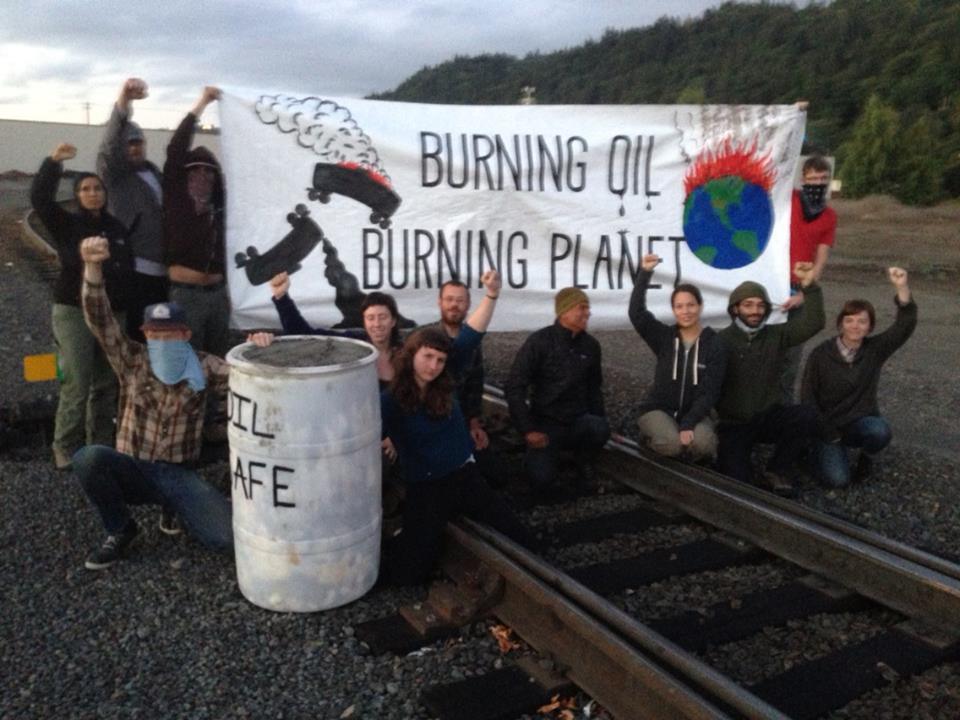 30th June This morning, climate justice activists with Portland Rising Tide shut down the ArcLogistics crude oil terminal in Northwest Portland.
Portland resident Irene Majorie, 22, locked herself to a 55-gallon barrel filled with concrete that was placed on the railroad track leading into the facility.
Train cars enter from a nearby yard to offload oil into 84 storage tanks, before it is piped onto oceangoing ships bound for West Coast refineries. Majorie’s arm was locked to a piece of metal rebar embedded in the concrete, stopping trains for four hours before being cut out by police.
Attempts by law enforcement to move her and the barrel simultaneously risked grave injury; likewise, any train traffic threatened her life.
“This is about stopping the oil trains,” said Majorie. “But beyond that, it is about an industry and an economic system that places the pursuit of profit before the lives and relationships of human beings seeking survival and nourishment, and before the communities, ecosystems, and planet of which we are a part.”
Oil trains are coming under increasing scrutiny recently owing to their propensity to derail in fiery explosions. Portland Rising Tide, however, disputes the notion that an oil train is ever safe, since crude oil is only transported to be burned. Whatever the risk of explosion, the guaranteed result is a worsening of the climate crisis, which is already wreaking ecological havoc and claiming human lives.

US crude oil production has risen from ~5 million barrels per day in the late 2000s to ~7 million barrels per day currently. Increased extraction is North Dakota’s Bakken Shale has resulted in a dramatic rise in oil train traffic, with 250 percent more oil trains traveling Oregon rail lines in 2013 than in the previous year.
Governor Kitzhaber has expressed “deep concern” about oil trains but thus far done nothing to stop them. “Society should be engaged in a rapid, radical decline in fossil fuel use,” said David Bennett. “Instead, policymakers—even those who claim to understand the magnitude of the climate crisis—are forcing us to engage in an absurd conversation about creating ‘safe’ oil trains and building more fossil fuel infrastructure.”
The ArcLogistics terminal, which began operation in January, is one piece of infrastructure facilitating increased oil production. When ongoing construction is completed, the facility will have the capacity to transport 16,250 barrels of oil per day.
In April, Portland Rising Tide entered the Oregon Department of Environmental Quality’s offices in downtown Portland, issued termination letters to employees at their desks, and announced the formation of a new People’s Agency, which would carry out DEQ’s mandate free of corporate influence. This is the first enforcement action of the nascent agency.
“If our policymakers listened, we would demand an immediate halt to oil train traffic in Oregon and the closure of all crude oil terminals,” said Emma Gould. “Since they don’t, we’re halting oil trains ourselves.” High resolution photos are available for download and may be used with attribution
Today’s action saw activists from across the continent joining together to say no to oil trains, showing that oil trains are an international issue of concern for people and nonhuman animals everywhere.