
Around Bristol between June 9th-10th, we left 7 mobile phone antennae in flames. Daily continuation of capitalist society is dependent on uninterrupted flows (of goods, people, data, and energy) and the communications grid is no exception. The limited uses most of us can make from these flows only mask the way they are mainly used to oversee and impose the dominant order, and increase its' reach and control. You need only look to how the values of connectivity, speed, and mobility that are embodied in a mobile phone (for example) facilitate a relentless consumer culture and the requirement to be available and flexible at all times: as much for the benefit of the boss and the advertiser as for your family or friends. This is fully consistent with the modern restructuring and decentralisation of the gigantic productive system which this society subjects us to. Hindering all this was our objective.
2 antennae went up simultaneously, in Hambrook and outside Ram Hill business park in Coalpit Heath, both owned by O2. This is also not the first time O2 have been singled out for damage acts because of the contracts they hold in the migrant detention industry, with cops, and tagging for the probation service. Some hours later a 3rd O2 antenna went up in Coombe Dingle, at the same time as a 4th fire was lit after gaining access to transmission units connected to the huge BT telecommunication tower in Lockleaze. Signals that will have been affected are those of O2, T-Mobile, Orange and Vodaphone. These corporations variously are connected to the field of military equipment and armament, use prison labour, and are famous for readily collaborating with electronic policing by the secret services (now that widespread data-surveillance is well known) while not even stopping at financing Oxford university with its' extensive animal experimentation labs. This has already led to their interests being attacked in Berlin (T-Mobile's parent company*), Paris (Orange*), and Banbury (Vodaphone*).
For all above reasons it is always good to harm these corporations, structurally and economically, and then there is the issue of the antennae themselves radiating who knows how much harmfulness to nearby species. There were the publicised cases in Bristol even some years ago of a woman in Shirehampton who complained of the affects of an antenna put up on her high rise flatblock and later died from a brain tumor, while an antenna nicknamed The Tower of Doom was withdrawn from Staple Hill after cancer rates soared. Evidence has mounted up that prolonged use of mobile phones damages the immune system, decreases fertility, and causes brain tumors and cancers: especially in the young. We should mention that the antenna we burned in Coombe Dingle is one of three on the grounds of a university sports pitch also marketed for schools, as are many others. Additionally, twisted lab technicians claim to have deduced from experimentation on other mammals (built on torture like so much scientific research) that exposure while still in the womb "significantly damages brain function, structure and behaviour and suggested that these exposures could contribute to children's behavioural disorders".
These products were and still are pushed on us as harmless, although nearly every study that claims this was funded by the industry itself, when we had no idea of the long term affects, similarly to the marketing of asbestos or smoking before they began to show their deadly toll (to use only 2 better known examples among thousands). These days even researchers at Bristol university concede the dangers of cellular use. What a surprise….the permanently wired environment turns out to be toxic, while companies make a killing in profits and the government receives billions in taxes and licensing. For most people prolonged contact with mobile phones or wireless networks in general seems unavoidable, for work or to avoid social marginalisation, in the street, on public transport, or at home: we are soaking in one more accumulative barrage in a poisonous, anti-human and anti-life civilisation that grows by the day.
A recurring feature of the estrangement that technologies such as mobile phones actually cultivate between individuals, is how many addicted to their constant use now prefer to text message or to "tweet" to avoid the prospect of real life contact, and how many only feel safe communicating from behind a device. It is now completely standard for people to spend the majority of their waking hours interfacing with one screen or another. Up and coming inventions such as Google Glass attempt to make this enclosure near total (although also dependent in part on uninterrupted transmission infrastructure). As a society that lives through highly complex technologies, we no longer fully inhabit our bodies and environment but instead some part of the techno-hive: and it is no longer only nerds and the young who practically call this virtual reality their home. As the sphere dominated by information technology expands, what is considered socially of importance in our actual lives shrinks to what can be conveyed and received by the device, and so narrowing human emotion and experience. Or think about the obsessive urge to treat modern life as something less to be lived than to be documented in each detail for passive consumption on the "social" networks, as another example of colonisation by capitalism and its' technology.
Planning and carrying out your existence digitally also allows the possibilities of unprecedented surveillance, and it hinders active rebellion or even questioning of the dominant order by flagging up "abnormalities" in what you often voluntarily share with your friends or "Friends." At the same time, concerted exploitation of the base populations around the world and ecological pillage to the point of collapse continues to fatten the same rich parasites' pockets, and technological immersion helps people neither relate nor care. On the contrary millions now hunger for their part in the way of life that is killing everything.
With an anarchist perspective in search of free and fulfilling existence, we fight to do away with all technologies born from the toxification and slavery of mines, factories, and industrial infrastructures, and for our daily communication to be as unmediated as possible. Taking down these few nodes was not enough for us, it is not a case of simply abandoning the uses of a particular device alone, but it is erasing the whole social system which first trapped us in its' "necessity" which is the challenge. We found antennae an easy way to start: it is simply a matter of burning tires between the exposed cables and away you go. In North Lanarkshire, Scottish villagers even felled one. By reflecting on radical and anti-industrial history in Britain (such as the Swing and Luddite insurrections), as well as contemporary anarchist guerrilla praxis, we can see the advantage of low-tech, cheap, and easily reproducible tactics to wreck machinery that encloses and impoverishes us, on an even more intimate level presently than ever before. These ubiquitous (and highly expensive) structures are spread around every town or city and further industrialising the countryside, where they are sometimes painted green in the attempt to camouflage them: and disgustingly even have bird and bat nesting boxes mounted on some. Their guardians cannot always be watching them all so it is up to our ingenuity to remain a step ahead and stretch their forces thin. This and every network has its' weak points, in these cracks in the architecture of control that afford us leverage: a destructive capacity we are appropriating. As the promises of hyper-technified modern culture continue to show their shallowness, rebels will carry on acting against the noxious installations and the way of life they feed.
"….Resistance against the Technological-Industrial Machine lives only through the path of liberation from every power and order, runs towards an event horizon where nothing has been written yet." -letter from Gianluca Iacovacci, from C.R. San Michele prison
Our attack is not separate from overall anarchist subversion by all means, which naturally includes solidarity with our prisoners in enemy hands. A wild greeting from Bristol to Adriano Antonacci, no less than to his friend and comrade Gianluca (FAI/IRF Subversive Anti-Civilisation individuality) whose brave lone acts in Rome he is also accused of. Hello to the new anarchist and anti-colonial groups in Hong Kong and Australia, and solidarity to the Paris ten accused of sabotaging prison profiteers.
Our attack came at a time when the networks are already set to be overloaded by the World Cup hysteria, to show our complicity with the insurgent fighters in Brazil as they answer massive dispossession and militarised slum clearances for the opulence of the games with street battles and arson. Because it should be remembered that the enthralling spectacle, that is staged to make the rich yet more money and to distract us from our daily humiliations, is based on the State and Capital's violence against resisters, the indigenous, and the poorest in Brazilian society.
Let's not forget Marie Mason and Eric McDavid: both are still behind bars after State repression and entrapment which followed an early string of Earth Liberation Front strikes in the USA. Years later the earth liberation struggle is not defeated either in spirit or in practice. The fight goes on with fur farms raided and emptied across North America, and our incendiary-minded sisters or brothers prowling the besieged Turkish forests, the streets of the Costa Rican metropolis, or the techno-industrial developments in Switzerland (on the last note: a quick reminder that the continuing legal threats against the released anarchists Silvia, Costas and Billy, and also the latest vindictive treatment of Marco Camenisch around his prison transfer, have not gone unnoticed by the international fire-starters).
Down with the society based on dominating earth and all its' creatures. Live Wires, FAI/ELF
(14th contribution to the international Phoenix Project, one more part of a war that will never be contained by a legal code)
* http://en.contrainfo.espiv.net/2013/01/08/berlin-incendiary-attack-on-deutsche-telekom-vehicle-in-friedrichshain/
* http://nantes.indymedia.org/articles/28902
* http://www.directaction.info/news_mar12b_06.htm
 10th June Long-standing trespass charges against Mark Herbert, aka “Falcon,” who perched in an old oak tree in April, 2013, above the hill west of Highway 101 that Caltrans is now
 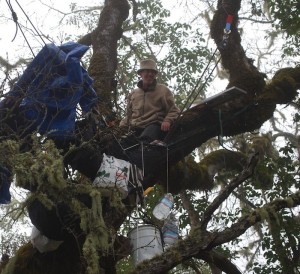 10th June Long-standing trespass charges against Mark Herbert, aka “Falcon,” who perched in an old oak tree in April, 2013, above the hill west of Highway 101 that Caltrans is now excavating for soil to construct the much-protested Willits Bypass, where he observed and reported on developments, were dismissed entirely on May 29th by Judge Ann Moorman in Ukiah Superior Court. Falcon was charged with trespass 602K, “entering any lands, whether unenclosed or enclosed by fence, 1) for the purpose of injuring any property or property rights or with the intention of interfering with a lawful business…”
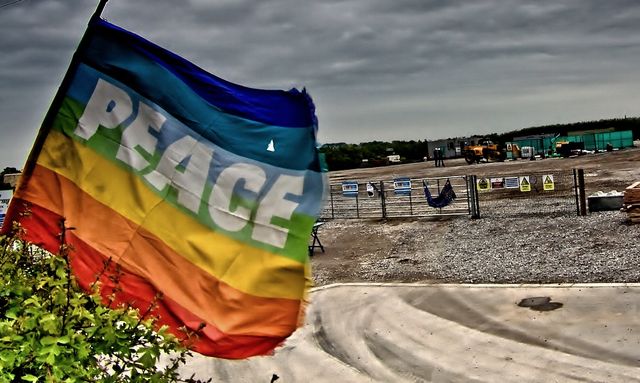 29th May 2014 Rathlin Energy caught activists napping today when lorries arrived at Crawberry Hill site in East Yorkshire.
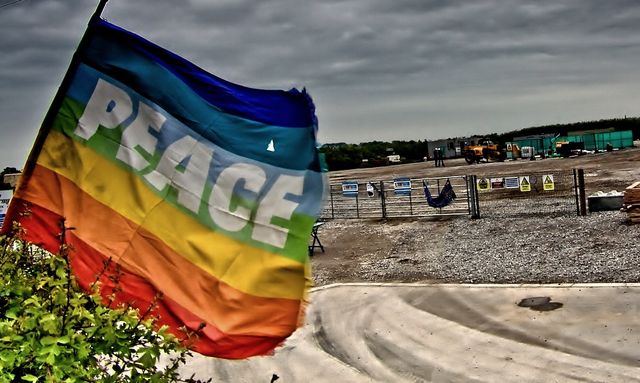 29th May 2014 Rathlin Energy caught activists napping today when lorries arrived at Crawberry Hill site in East Yorkshire. The police had allowed Rathlin to ignore (no right turn) traffic signs to gain access without the knowledge of the activists waiting further down the road.
 24th May Following on from the arrests of two local residents last week, a further arrest has been made of an activist playing music in Beverley (near Hull.) A flotilla of Police, from the Humberside division, armed with tazers and dogs, swooped into Beverley, town centre, as the
  24th May Following on from the arrests of two local residents last week, a further arrest has been made of an activist playing music in Beverley (near Hull.) A flotilla of Police, from the Humberside division, armed with tazers and dogs, swooped into Beverley, town centre, as the busker and anti fracking activist known as Daznez was playing and singing music in Beverley town centre. Local people who were watching and listening to the musician remarked at the heavy handedness of the arrest as at least six police personnel and their dogs took the musician into custody. The musician has been taken to Clough Road, Police Station in Hull but has not yet been charged with an offence.
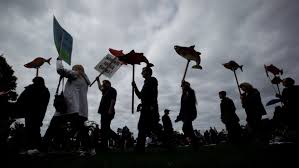
 20th May 2014. A group of area residents have blockaded the access road to an exposed section of Enbridge’s Line 9 pipeline, beginning at 7am this morning.
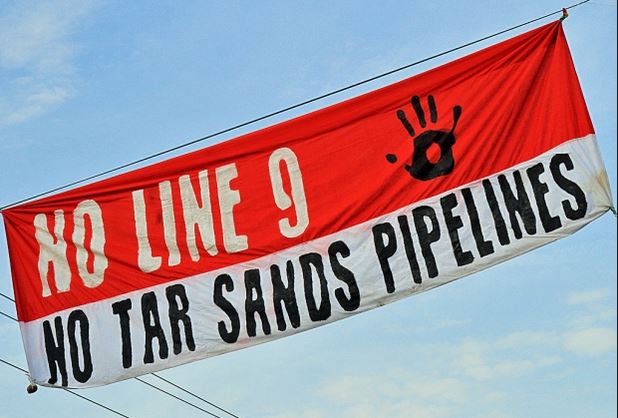 20th May 2014. A group of area residents have blockaded the access road to an exposed section of Enbridge’s Line 9 pipeline, beginning at 7am this morning. They say they will stay for at least twelve hours, one hour for every thousand anomalies Enbridge has reported to exist on the line. These community members turned away Enbridge employees who were scheduled to do work on Line 9 in preparation for it to carry toxic diluted bitumen from the Alberta Tar Sands. This particular work site is adjacent to the Bronte creek, a major waterway flowing to Lake Ontario, the water source for more than ten million people.
 15
15
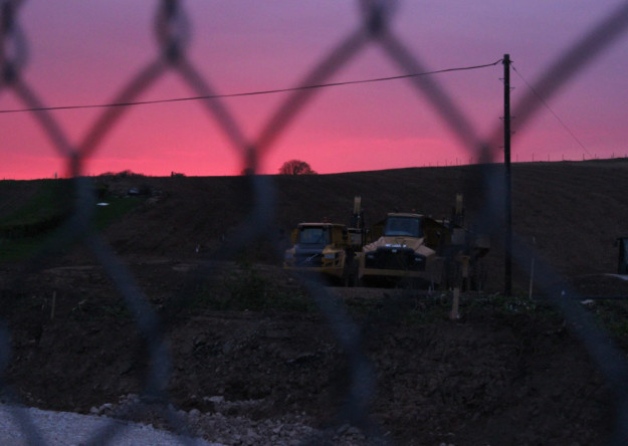 15th May 2014. About a little over week ago we snuck into a condo development in Seattle and poured a gallon of bleach into the gas tank of an excavator. This was a small but easily reproducible attack against the expansion of gentrification in Seattle.
 12th May 2014 FORTUL, COLOMBIA–Holding down an occupation for five months isn’t easy. Doing so in Colombia, even less so.
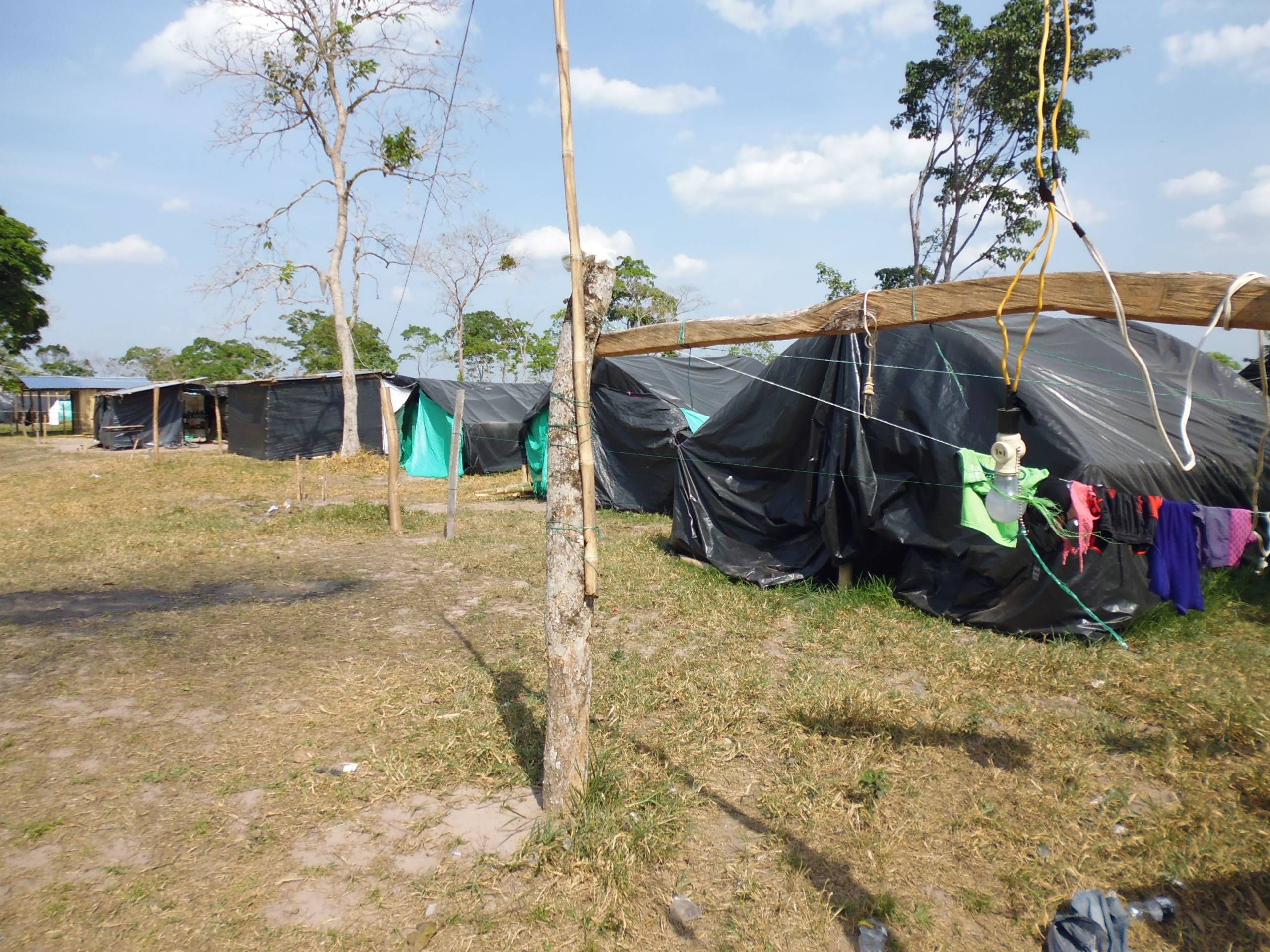 12th May 2014 FORTUL, COLOMBIA–Holding down an occupation for five months isn’t easy. Doing so in Colombia, even less so. But members of the community of Héctor Alirio Martínez in the municipality of Fortul, near the border with Venezuela, have raised the stakes even higher: they’re occupying land owned by the Ministry of Defense. The 100 hectare terrain now spotted with wood and plastic homes was slated to become a large military base.
 10th May 2014 Protesters in eastern China clashed with police at a rally against plans to build a huge waste incinerator that residents fear will be harmful to their health and add to pollution.
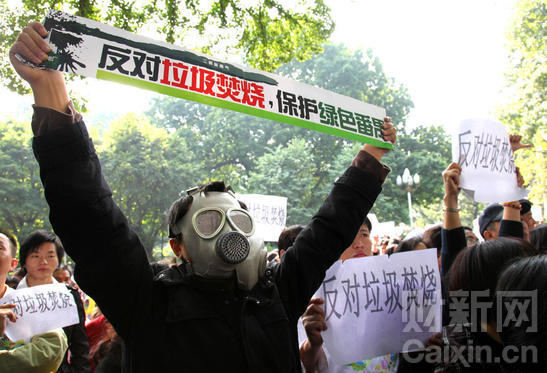 10th May 2014 Protesters in eastern China clashed with police at a rally against plans to build a huge waste incinerator that residents fear will be harmful to their health and add to pollution.
 9th May 2014 A young Tibetan stabbed himself and jumped to his death from the roof of a building in Tibet’s Chamdo prefecture on Wednesday after authorities tried to halt his protest against a Chinese mine being built in the area,
  9th May 2014 A young Tibetan stabbed himself and jumped to his death from the roof of a building in Tibet’s Chamdo prefecture on Wednesday after authorities tried to halt his protest against a Chinese mine being built in the area, Tibetan sources in exile said.