Indigenous protests sweep Canada

17 Jan­u­ary 2013

17 Jan­u­ary 2013

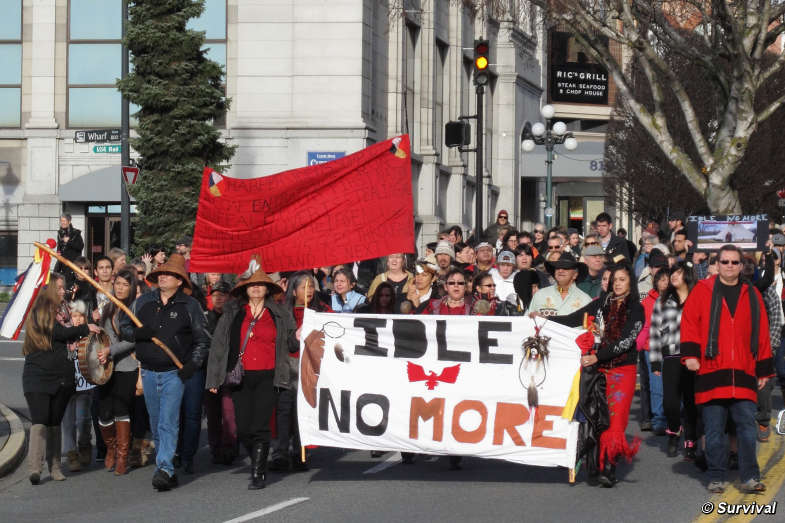
Idle no more protesters marching in Victoria, BC, December 21, 2012.

Native peo­ple across Cana­da have block­ad­ed roads, bridges and rail­way lines as part of the grass-roots indige­nous move­ment Idle No More.

From British Colum­bia, where dozens of pro­test­ers demon­strat­ed out­side hear­ings for a pro­posed oil pipeline, to Ontario, where bor­der cross­ings to the USA were blocked, the scale of the protests strong­ly sug­gest that the move­ment is show­ing lit­tle sign of dying down.

The Idle No More move­ment began in Novem­ber 2012, when four women from the province of Saskatchewan held a ‘teach-in’ about the like­ly effects of Bill C‑45, a large and com­plex bill pro­posed by Prime Min­is­ter Stephen Harp­er, which would seri­ous­ly weak­en many envi­ron­men­tal reg­u­la­tions.

On 4 Decem­ber, a group of chiefs from the Assem­bly of First Nations (AFN), Canada’s prin­ci­pal indige­nous orga­ni­za­tion, were pre­vent­ed from enter­ing the Par­lia­ment build­ings to lob­by MPs over the bill. News of the snub, using the Idle No More hash­tag, quick­ly spread across the coun­try.

Anoth­er impor­tant ele­ment of the protests has been a hunger strike by There­sa Spence, chief of the Attawapiskat First Nation in north­ern Ontario. This Cree com­mu­ni­ty, despite being the loca­tion of De Beers’s Vic­tor dia­mond mine, is riv­en by social prob­lems, includ­ing poor hous­ing and chron­i­cal­ly inad­e­quate edu­ca­tion pro­vi­sion.

Chief Spence declared that her hunger strike would con­tin­ue until the Prime Min­is­ter and the Gov­er­nor Gen­er­al (the Queen’s rep­re­sen­ta­tive in Cana­da), agreed to meet her to dis­cuss Abo­rig­i­nal rights.

On Jan­u­ary 11 a del­e­ga­tion of First Nations lead­ers, under the aegis of the AFN, held a meet­ing with Mr Harp­er and var­i­ous oth­er min­is­ters. The Gov­er­nor Gen­er­al, how­ev­er, did not attend. The meet­ing was incon­clu­sive, with the Abo­rig­i­nal Affairs Min­is­ter report­ing that ‘it would be fol­lowed by high-lev­el dia­logue between the Prime Min­is­ter and Shawn Atleo’, leader of the AFN.

As described by the native writer Lisa Charley­boy, the objec­tives of Idle No More are ‘to build indige­nous sov­er­eign­ty, to repair the rela­tion­ship between indige­nous peo­ples of Cana­da (First Nations, Métis, and Inu­it), the crown, and the gov­ern­ment of Cana­da from a grass­roots frame­work, and to pro­tect the envi­ron­ment for all Cana­di­ans to enjoy for gen­er­a­tions to come.’

Idle No More has called for a World Day of Action on Jan­u­ary 28th.


Six People Arrested Inside Enbridge Hearings

Van­cou­ver, BC / Coast Sal­ish Ter­ri­to­ries – This morn­ing (15th Jan), six peo­ple direct­ly inter­vened in the Enbridge pipeline joint Envi­ron­men­tal Assess­ment and Ener­gy Board hear­ings and put cli­mate change on the agen­da.

Van­cou­ver, BC / Coast Sal­ish Ter­ri­to­ries – This morn­ing (15th Jan), six peo­ple direct­ly inter­vened in the Enbridge pipeline joint Envi­ron­men­tal Assess­ment and Ener­gy Board hear­ings and put cli­mate change on the agen­da. The group man­aged to make their way past police unde­tect­ed and into the secured 4th floor of Vancouver’s Sher­a­ton Wall Cen­ter. Once inside they revealed shirts embla­zoned with mes­sages like “Stop the Pipelines” and pro­ceed­ed to use police tape to cor­don off the hear­ing area as a “cli­mate crime scene.”

“Cli­mate change is killing thou­sands of peo­ple every year, pri­mar­i­ly in devel­op­ing coun­tries and Indige­nous com­mu­ni­ties that are the least respon­si­ble for cre­at­ing this prob­lem. Despite this fact, the Joint Review Pan­el has instruct­ed those par­tic­i­pat­ing in the hear­ings not to talk about cli­mate change. This is a shock­ing­ly irre­spon­si­ble move con­sid­er­ing Canada’s tar sands con­tain twice the amount of car­bon diox­ide emit­ted by glob­al oil use in our entire his­to­ry. New fos­sil fuel pipelines are an irre­spon­si­ble step in the wrong direc­tion.” said Sean Devlin.

The impacts of cli­mate change have been draw­ing glob­al atten­tion recent­ly, between Hur­ri­cane Sandy, unprece­dent­ed dead­ly typhoons in the Philip­pines and pre­vi­ous­ly unimag­in­able tem­per­a­ture records in Aus­tralia. In this urgent con­text the JRP has des­ig­nat­ed cli­mate change and the car­bon emis­sions of Canada’s tar sands “out­side of the panel’s man­date,” a move that offi­cial­ly dis­cour­ages inter­ven­ers from rais­ing these crit­i­cal issues dur­ing their oral state­ments.

“Enbridge and the fed­er­al gov­ern­ment are using their posi­tion of author­i­ty with­in this process to coerce mem­bers of the pub­lic into silence on these issues. The major­i­ty of First Nations and set­tler com­mu­ni­ties in the province oppose fos­sil fuel pipelines. We respect those who are voic­ing their oppo­si­tion to the pipelines inside the hear­ings, but the hear­ing process is mean­ing­less, espe­cial­ly since Harp­er has changed the law, giv­ing his cab­i­net final say on pipeline projects,” said Fiona De Bal­asi Brown.

Today marks the sec­ond day of the Joint Review Pan­el hear­ings in Van­cou­ver and the sec­ond day that the mem­bers of the pub­lic have crossed police lines to make their oppo­si­tion heard. On Mon­day more than a thou­sand pro­test­ers peace­ful­ly forced their way past police onto the Sher­a­ton prop­er­ty drum­ming so loud­ly the noise could be heard inside the hear­ings. Pub­lic out­rage has been embold­ened by a deci­sion to exclude the pub­lic from the hear­ings in Van­cou­ver, a move the BC Civ­il Lib­er­ties Asso­ci­a­tion crit­i­cized yes­ter­day as “poten­tial­ly unlaw­ful.”

The Economics of Insurgency — Thoughts on Idle No More & critical infrastructure

News reports are ablaze with reports of loom­ing Indige­nous block­ades and eco­nom­ic dis­rup­tion.

News reports are ablaze with reports of loom­ing Indige­nous block­ades and eco­nom­ic dis­rup­tion. As the Idle No More move­ment explodes into a new ter­ri­to­ry of polit­i­cal action, it bears to ampli­fy the incred­i­ble eco­nom­ic lever­age of First Nations today, and how fright­ened the gov­ern­ment and indus­try are of their capac­i­ty to wield it.

In recent years, Access to Infor­ma­tion (ATI) records obtained by jour­nal­ists reveal a mas­sive state-wide sur­veil­lance and “hot spot mon­i­tor­ing” oper­a­tion coor­di­nat­ed between the Depart­ment of Indi­an Affairs, the Roy­al Cana­di­an Mount­ed Police (RCMP), the Cana­di­an Secu­ri­ty Intel­li­gence Ser­vice (CSIS), local secu­ri­ty forces, nat­ur­al resource and trans­porta­tion min­istries, bor­der agen­cies, and indus­try stake­hold­ers. These efforts have been explic­it­ly mobi­lized to pro­tect “crit­i­cal infra­struc­ture” from Indige­nous attack.

What is crit­i­cal infra­struc­ture? Accord­ing to an RCMP inter­nal doc­u­ment con­cern­ing the risk of Abo­rig­i­nal protest, “crit­i­cal infra­struc­ture refers to infra­struc­ture, both tan­gi­ble and intan­gi­ble, that is essen­tial to the health, safe­ty, secu­ri­ty or eco­nom­ic well-being of Cana­di­ans and the effec­tive func­tion­ing of gov­ern­ment.” RCMP Nation­al Secu­ri­ty Crim­i­nal Inves­ti­ga­tions have pri­or­i­tized four crit­i­cal infra­struc­ture sec­tors: finance, trans­porta­tion, ener­gy, and cyber-secu­ri­ty.

On Jan­u­ary 5 alone, INM protests includ­ed five bor­der cross­ing block­ades, bridge block­ades, and rail line dis­rup­tions span­ning the coun­try.

And it’s not only intel­li­gence ser­vices that are warn­ing of threats to crit­i­cal infra­struc­ture.

Con­ser­v­a­tive mil­i­tary ana­lyst Dou­glas Bland has also long warned that Canada’s eco­nom­ic vul­ner­a­bil­i­ty is based on the “crit­i­cal infra­struc­ture that trans­ports nat­ur­al resources and man­u­fac­tured goods from mines, oil fields, hydro-elec­tric facil­i­ties and fac­to­ries to inter­na­tion­al mar­kets.” With­out these crit­i­cal sys­tems, he cau­tions, “Canada’s econ­o­my would col­lapse.”

Though Bland has coun­seled a con­cil­ia­to­ry approach to Abo­rig­i­nals in order to stave off the com­ing cri­sis, his alarmism – and that of oth­er right-wing pun­dits – simul­ta­ne­ous­ly jus­ti­fies the state’s secu­ri­ty and sur­veil­lance appa­ra­tus by man­u­fac­tur­ing a fear of native upris­ing. But for Bland and oth­ers, a com­ing “Native Spring” is less feared for its poten­tial “vio­lence” and all the more grave for its threat to prop­er­ty rights.

In Bland’s fic­tion­al book Upris­ing, he pre­dicts coor­di­nat­ed attacks by secret native cells on key instal­la­tions and urban hubs, such as the James Bay hydro-elec­tric dam and the down­town core of Win­nipeg. This attack on crit­i­cal infra­struc­ture telling­ly ends in a blaze of hero­ic Cana­da-US mil­i­tary attacks on the rebel army. (The US gets involved only when they real­ize their source of elec­tric­i­ty, oil, and gas is at stake.)

Here­in lies the real role of right wing alarmists in the INM move­ment: to main­tain the eco­nom­ic sta­tus quo, because ter­ri­to­ry is cap­i­tal. Land is mon­ey. And the cir­cu­la­tion of goods, resources and ener­gy through ter­ri­to­ry is the very essence of cap­i­tal­ism today.

The fact is that crit­i­cal infra­struc­ture in Cana­da is at the mer­cy of Indige­nous peo­ples, who are more rur­al than Cana­di­ans and have access to impor­tant arter­ies for eco­nom­ic flows: trans­porta­tion cor­ri­dors, ener­gy sec­tors, and sites of nat­ur­al resource extrac­tion.

This vul­ner­a­bil­i­ty is dead­ly to the logis­tics indus­try. Logis­tics is a busi­ness sci­ence con­cerned with the man­age­ment of goods and infor­ma­tion through glob­al sup­ply chains. As the World Bank has declared: “A com­pet­i­tive net­work of glob­al logis­tics is the back­bone of inter­na­tion­al trade.” For an indus­try depen­dent on main­tain­ing open chan­nels for cap­i­tal cir­cu­la­tion, a block­ade means mas­sive loss­es: the truck­ing indus­try alone is worth $65 bil­lion and employs more than 260,000 dri­vers.

In the ener­gy sec­tor, Cana­da has oil reserves sec­ond in the world after Sau­di Ara­bia, though less acces­si­ble – 98 per cent of this oil is in Alber­ta and 95 per cent of it is in the tar sands, where effec­tive Indige­nous resis­tance by Treaty 8 and oth­er First Nations has led to glob­al boy­cott cam­paigns and fierce resis­tance.

In north­ern BC, the Unist’ot’en Clan, with sup­port from grass­roots Wet’suwet’en, have built a com­mu­ni­ty of resis­tance direct­ly on the GPS co-ordi­nates of the pro­posed pipeline route from the Alber­ta tar sands to the Kiti­mat port. From this camp they have evict­ed sur­vey­ors work­ing for Pacif­ic Trails Pipeline. Mean­while, in Ontario, Enbrdige’s Line 9 has been has been opposed by the Onei­da, the Hau­denosaunee Devel­op­ment Insti­tute, and Aami­ji­waang First Nation, who have all vowed to fight the pipeline to pro­tect their lands and waters.

In terms of nat­ur­al resource extrac­tion, over 10 per cent of Canada’s econ­o­my is com­prised of the nat­ur­al resources sec­tors and earth sci­ence indus­tries, which direct­ly employ close to 763,000 peo­ple. The great­est con­cen­tra­tion and cor­re­la­tion between Indige­nous lands and min­er­al claims are being cur­rent­ly devel­oped in the north­ern mod­ern treaties and ter­ri­to­ries, such as Nunavut; Yukon; the James Bay region of Que­bec, and the Que­bec-Labrador bor­der; on unced­ed north­west­ern BC lands (e.g. on Nakazdli, Tzal­ten, and Tlin­git tra­di­tion­al ter­ri­to­ry); and in north­ern Ontario’s “Ring of Fire” on his­toric treaty lands, par­tic­u­lar­ly Treaties 3 and 9.

In addi­tion to min­er­al resources, over half of large intact for­est land­scapes are found on lands in his­tor­i­cal Abo­rig­i­nal treaty areas. More specif­i­cal­ly, as Glob­al For­est Watch reports, “Treaties 8 and 9 con­tain about a quar­ter of all of Canada’s intact for­est land­scapes and close to half of all the intact for­est land­scapes that occur with­in treaty areas. Mod­ern land claim set­tle­ments con­tain about a quar­ter of Canada’s intact for­est land­scapes.”

That is not to say mean­ing­ful con­sul­ta­tion con­cern­ing crit­i­cal infra­struc­ture has not been tak­ing place. The prob­lem is that it has exclu­sive­ly been between indus­try and gov­ern­ment, instead of between Indige­nous peo­ples and the state. Jour­nal­ists have been uncov­er­ing mul­ti­ple inci­dents of high-lev­el co-ordi­na­tion between indus­try and gov­ern­ment offi­cials. For exam­ple, Access to Infor­ma­tion requests revealed that the gov­ern­ment has been shar­ing infor­ma­tion with the oil indus­try on envi­ron­men­tal­ists and Indige­nous groups twice a year since 2005 at secret brief­in­gs, even on such seem­ing­ly irrel­e­vant activ­i­ties such as par­tic­i­pa­tion in anti-G20 demon­stra­tions.

The irony is that many cor­po­ra­tions are tired of hav­ing oper­a­tions held up by Indige­nous protest and are will­ing to go fur­ther than gov­ern­ments to rec­og­nize Indige­nous rights. The log­ics of colo­nial­ism and cap­i­tal­ism divide here around con­flict­ing objec­tives of ter­ri­to­r­i­al acqui­si­tion ver­sus the cir­cu­la­tion of goods. But more often than not, the state and indus­try con­verge around the com­mon inter­ests of the rul­ing class. For Indige­nous peo­ples, this becomes a ques­tion of co-ordi­nat­ing lever­age.

In con­clu­sion, I want to high­light three main con­cerns expressed in the risk assess­ments under­tak­en by RCMP, CSIS, Indi­an Affairs, and right-wing thinkers on Indige­nous upris­ing that fore­ground Indige­nous eco­nom­ic pow­er.

The first is that a mis­han­dling of con­flict will gal­va­nize co-ordi­nat­ed efforts of First Nations across the coun­try; hence the rel­a­tive­ly hands-off approach tak­en until now. In the Fed­er­al Coor­di­na­tion Frame­work for the AFN Day of Action in 2007, the pro­posed solu­tion in the case of co-ordi­nat­ed mobi­liza­tion is to “iso­late the splin­ter group.”

Sec­ond, the eco­nom­ic cost of even a few hours of such co-ordi­nat­ed efforts would be crip­pling and impos­si­ble to police giv­en cur­rent resources.

Third – and this is one of the most wor­ri­some trends to observers – sol­i­dar­i­ty and co-ordi­na­tion between non-Natives and Indige­nous peo­ples will encour­age the move­ment to build.

As a final thought, while the gen­er­al pop­u­la­tion might have been tak­en by sur­prise by the strength of Idle No More, the gov­ern­ment had long pre­pared for this inevitabil­i­ty. As far back as 2008, when changes were first pro­posed to the Nav­i­ga­ble Waters Act, CSIS’s Inte­grat­ed Threat Assess­ment Cen­tre warned about “poten­tial unrest.”

Cana­da cre­at­ed the cri­sis of insur­gency. Canada’s greed cre­at­ed a sit­u­a­tion where Indige­nous peo­ples stand with almost noth­ing to lose. There­fore, the fight is theirs to take. It is also ours to sup­port.

Read the full arti­cle here.

Idle No More International Day of Action – January 28, 2013

14th Jan 2012.

14th Jan 2012. Indige­nous Resur­gence Explodes with Idle No More Day of Action

Idle No More grass­roots founders and orga­niz­ers from across Cana­da, in sol­i­dar­i­ty with com­mon caus­es – a new ini­tia­tive bring­ing togeth­er social jus­tice, envi­ron­men­tal, labour and oth­er Activist Groups…

- UNITED we are plan­ning IDLE NO MORE WORLD DAY OF ACTION on Jan­u­ary 28th, 2013 #J28.

This day of action will peace­ful­ly protest attacks on Democ­ra­cy, Indige­nous Sov­er­eign­ty, Human Rights and Envi­ron­men­tal Pro­tec­tions when Cana­di­an MPs return to the House of Com­mons on Jan­u­ary 28th. As a grass­roots move­ment, clear­ly no polit­i­cal orga­ni­za­tion speaks for Idle No More. This move­ment is of the peo­ple… For The Peo­ple! #IDLENOMOREFTP

The Vision of IDLE NO MORE revolves around Indige­nous Ways of Know­ing root­ed in Indige­nous Sov­er­eign­ty to pro­tect water, air, land and all cre­ation for future gen­er­a­tions.

The Con­ser­v­a­tive gov­ern­ment bills begin­ning with Bill C‑45 threat­en Treaties and this Indige­nous Vision of Sov­er­eign­ty.

The Goal of the move­ment is edu­ca­tion and the revi­tal­iza­tion of Indige­nous peo­ples through Aware­ness and Empow­er­ment.  IDLE NO MORE has suc­cess­ful­ly encour­aged knowl­edge shar­ing of Indige­nous Sov­er­eign­ty and Envi­ron­men­tal Pro­tec­tions. 

This mes­sage has been heard around the world and the world is watch­ing how Cana­da responds to the mes­sage sent by many INM Sup­port­ers.

INM urges the gov­ern­ment of Cana­da to repeal all leg­is­la­tion; which vio­lates Treaties, Indige­nous Sov­er­eign­ty and sub­se­quent­ly Envi­ron­men­tal Pro­tec­tions of land and water.

INM is grate­ful to many lead­ers who have sup­port­ed this vision and the move­ment of the grass­roots peo­ple.

“The Treaties are the last line of defense to pro­tect water and lands from destruc­tion,” stat­ed Oren Lyons, Faith­keep­er Tur­tle Clan, Ononda­ga Nation Coun­cil of Chiefs.

Please watch and share this video of the Idle No More action in Toron­to, and orga­nize events in sol­i­dar­i­ty with Idle No More with­in your local col­lec­tives:

Mass Action Targets TransCanada Offices

Jan­u­ary 7th, 2013

What: Tar Sands Block­ade pro­test­ers take over Tran­sCana­da Key­stone XL offices in Hous­ton, demand­ing account­abil­i­ty for abus­es by Tran­sCana­da

Jan­u­ary 7th, 2013

What: Tar Sands Block­ade pro­test­ers take over Tran­sCana­da Key­stone XL offices in Hous­ton, demand­ing account­abil­i­ty for abus­es by Tran­sCana­da

Where: 2700 Post Oak Blvd, Suite 400, Hous­ton TX 77056 (next to the Hous­ton Gal­le­ria)

When: Under­way now!

Who: 100+ pro­test­ers gath­ered to con­front pipeline com­pa­ny over land abus­es, tox­ic lega­cy and cli­mate change con­nect­ed to TransCanada’s Key­stone XL pipeline.

The Tar Sands Block­ade is a group of envi­ron­men­tal­ists and landown­ers work­ing to stop the Key­stone XL tar sands pipeline through direct action.

Why: This action kicks off a new phase of the Tar Sands Block­ade tar­get­ing the cor­po­rate and finan­cial infra­struc­ture behind the Key­stone XL pipeline. TransCanada’s pipeline uses seized land to trans­port tox­ic tar sands oil through Texas and Okla­homa com­mu­ni­ties, in order to export it from Hous­ton ports. These dan­ger­ous busi­ness prac­tices and the back­lash from com­mu­ni­ties across the coun­try make this pipeline a tox­ic invest­ment for our state and TransCanada’s cor­po­rate lenders.

First Nations may engage in economic blockades if Canada refuses treaty talks

First Nations lead­ers have dis­cussed plans to launch coun­try-wide eco­nom­ic dis­rup­tions by the mid­dle of Jan­u­ary if Prime Min­is­ter Stephen Harp­er doesn’t agree to hunger-strik­ing Attawapiskat Chief There­sa Spence’s demand for a treaty meet­ing

First Nations lead­ers have dis­cussed plans to launch coun­try-wide eco­nom­ic dis­rup­tions by the mid­dle of Jan­u­ary if Prime Min­is­ter Stephen Harp­er doesn’t agree to hunger-strik­ing Attawapiskat Chief There­sa Spence’s demand for a treaty meet­ing

Dur­ing three days of meet­ings and tele­con­fer­ences, chiefs from across the coun­try dis­cussed a plan set­ting Jan. 16 as the day to launch a cam­paign of indef­i­nite eco­nom­ic dis­rup­tions, includ­ing rail­way and high­way block­ades, accord­ing to two chiefs who were involved in the talks who request­ed anonymi­ty.

“The peo­ple are rest­less, they are say­ing enough is enough,” said one chief, who was involved in the dis­cus­sions. “Eco­nom­ic impacts are immi­nent if there is no response.”

Chiefs were still final­iz­ing details of their plans Mon­day evening and it remained unclear to what extent their dis­cussed options would trans­late into the offi­cial posi­tion.

Assem­bly of First Nations Nation­al Chief Shawn Atleo is expect­ed to write Harp­er a let­ter out­lin­ing the chiefs’ posi­tion.

Spence launched her hunger strike on Dec. 11 to force a meet­ing between Prime Min­is­ter Stephen Harp­er, Gov­er­nor Gen­er­al David John­ston and First Nations lead­ers to dis­cuss the state of the treaties. Spence said in a state­ment issued Mon­day that the aim of the meet­ing was to “re-estab­lish” the treaty rela­tion­ship and final­ly put First Nations peo­ple in their “right­ful place back here in our home­lands that we all call Cana­da.”

The plan of action comes as the Idle No More move­ment con­tin­ues to sweep across the coun­try through round dances, ral­lies along with high­way and rail block­ades.

The Tyen­d­i­na­ga Mohawks briefly block­ad­ed a main CN rail line between Toron­to and Mon­tre­al Sun­day, strand­ing about 2,000 Via Rail pas­sen­gers. The Mi’kmaq from the Lis­tuguj First Nation, Que., con­tin­ue to hold a rail block­ade on a CN line along with mem­bers of the Aamji­w­naang First Nation who have shut a CN line in Sar­nia, Ont. In British Colum­bia, the Seton Lake Indi­an Band end­ed a rail block­ade on Sun­day.

How the chiefs’ action plan will mesh with the Idle No More move­ment remains to be seen. Idle No More orga­niz­ers issued a state­ment Mon­day that dis­tanced the move­ment from the chiefs.

“The chiefs have called for action and any­one who choos­es can join with them, how­ev­er, this is not part of the Idle No More move­ment as the vision of this grass­roots move­ment does not coin­cide with the visions of the lead­er­ship,” said the state­ment, post­ed on the Idle No More Face­book page. “While we appre­ci­ate the indi­vid­ual sup­port we have received from chiefs and coun­cil­lors, we have been giv­en a clear man­date by the grass­roots to work out­side the sys­tems of gov­ern­ment and that is what we will con­tin­ue to do.”

One of the chiefs involved in action plan dis­cus­sion said the lead­er­ship want­ed to be sen­si­tive to the grass­roots-dri­ven move­ment and make clear that their plans are being devel­oped in sup­port and as a response to Idle No More.

“Chiefs are stand­ing firm in sup­port of Idle No More and grass­roots cit­i­zens,” said the chief. “We now need to uni­fy.”

New Keystone XL Aerial Tree Blockade Halts Construction in Diboll, TX, 3rd Jan

Unprecedented “dump platforms” protected by intricate 100 ft perimeter web of safety lines to protect sitters; action declared in solidarity with “Idle No More” in Canada

From a TSB state­ment released at 9:00AM this morn­ing — Late last night, block­aders set up two &ldqu

Unprecedented “dump platforms” protected by intricate 100 ft perimeter web of safety lines to protect sitters; action declared in solidarity with “Idle No More” in Canada

From a TSB state­ment released at 9:00AM this morn­ing — Late last night, block­aders set up two “dump plat­forms” in trees out­side of Diboll, Texas which would oth­er­wise be cleared to make way for TransCanada’s Key­stone XL tox­ic tar sands pipeline. These spe­cial “dump plat­forms” are shield­ed by an unprece­dent­ed 80–100 ft perime­ter of life-lines arranged, which if dis­turbed would cer­tain­ly dump the two block­aders nest­ed in them rough­ly 50–60 ft in the air. The Block­aders are sit­ting in sol­i­dar­i­ty with the now glob­al “Idle No More” cam­paign for First Nation’s human rights and trib­al sov­er­eign­ty that very recent­ly start­ed in Cana­da.

This new tree block­ade comes just a cou­ple weeks after the end of Tar Sands Blockade’s 85-day tree-sit near Winns­boro, TX. Tran­sCana­da rerout­ed the tar sands pipeline to go around the Winns­boro tree-sit, despite hav­ing told count­less landown­ers, includ­ing Dou­glass res­i­dent Mike Bish­op, that the route was set in stone and could not be altered to avoid bull­doz­ing their crop­land, or to go around schools, neigh­bor­hoods, or eco­log­i­cal­ly sen­si­tive areas.

This new site is sur­round­ed by bar­ri­ers like High­way 59, rail­road tracks, and Ryan Lake. With these near­by, block­aders have found a loca­tion around which the pipe can­not eas­i­ly be rerout­ed.

The via­bil­i­ty of this block­ade depends entire­ly on the safe con­duct of Tran­sCana­da and local police forces. They could eas­i­ly end it by cut­ting ropes and seri­ous­ly injur­ing or killing the tree sit­ters. Block­aders Audrey and Mike know the risks. They are pre­pared to stay on their plat­forms, just big enough to lie down on, indef­i­nite­ly, to defend their col­lec­tive home from the expan­sion of tar sands exploita­tion that Key­stone XL would ush­er in.

“Pro­tect­ing the liv­ing sys­tems which we’re a part of is a moral neces­si­ty,” shared Audrey, who is sit­ting in a sin­gu­lar tree left in a new­ly-cleared field. “Extrac­tion of the tar sands is the most destruc­tive project on the con­ti­nent. It threat­ens the integri­ty of the entire bios­phere, not to men­tion the First Nations depen­dent upon access to clean water, land, and air for the health and food for their trib­al com­mu­ni­ties.”

Mike, the oth­er sit­ter sus­pend­ed in a 50 ft sky­pod between two trees, agreed, “That their plight has been so long ignored by indus­try and pol­i­cy-mak­ers is a clear vio­la­tion of their human rights and a crime of con­science. That’s why we are enthu­si­as­ti­cal­ly sup­port­ing the Idle No More move­ment!”

Tar Sands Block­ade is a coali­tion of Texas and Okla­homa landown­ers and cli­mate jus­tice orga­niz­ers using peace­ful and sus­tained civ­il dis­obe­di­ence to stop the con­struc­tion of TransCanada’s Key­stone XL tar sands pipeline.

“Insti­tu­tion­al meth­ods of address­ing cli­mate change have failed us,” explained Ron Seifert, a Tar Sands Block­ade spokesper­on. “Ris­ing up to defend our homes against cor­po­rate exploita­tion is our best and only hope to pre­serve life on this plan­et. We must nor­mal­ize and embrace direct, orga­nized resis­tance to the death machine of indus­tri­al extrac­tion and stand with those like Idle No More who take extra­or­di­nary risk to defend their fam­i­lies and liveli­hoods.”

Pho­tos of the action are avail­able on Tar Sands Blockade’s Flickr account here: http://flickr.com/photos/tarsandsblockade/

[Block­ade is locat­ed two miles south of Diboll, TX on north­bound High­way 59, a mas­sive ban­ner deployed there is high­ly vis­i­ble to high­way traf­fic.]
See TarSandsBlockade.org for more info.

Idle No More — First Nation blockade of Sarnia CN Rail track

Dec 25th, 2012

A south­west­ern Ontario First Nation is plan­ning a ral­ly in Sar­nia today — the fourth day of its block­ade of a CN Rail line in the city.

Dec 25th, 2012

A south­west­ern Ontario First Nation is plan­ning a ral­ly in Sar­nia today — the fourth day of its block­ade of a CN Rail line in the city.

The Aamji­w­naang (AWN’-ja-nong) First Nation says both the demon­stra­tion at Sar­nia city hall this morn­ing and the ongo­ing block­ade are part of the nation­al Idle No More protests.

The may­or of Sar­nia, Ont., says city police do not plan to shut down a CN Rail block­ade by First Nations activists as long as no one is hurt in the protest.

Mike Bradley says CN obtained a court injunc­tion that leaves it to police in the south­west­ern Ontario city to decide whether to end the three-day-old block­ade.

Block­ade spokesman Ron Plain says the protests are being led by young Aamji­w­naang First Nation mem­bers, who met Sun­day with rep­re­sen­ta­tives from CN, as well as Bradley and Sarnia’s police chief.

Dozens of demon­stra­tors set up tables, tents and vehi­cles on and around the track Fri­day as part of the nation­al Idle No More protests.

Orga­niz­er Vanes­sa Gray says the ral­ly aims to bring the com­mu­ni­ty togeth­er “to stand up for what your rights are and what you believe in.”

Mean­while, there’s no indi­ca­tion when the block­ade will come to an end.

They say the block­ade of the com­mer­cial-rail cor­ri­dor will con­tin­ue until Prime Min­is­ter Stephen Harp­er meets with Atti­wapiskat Chief There­sa Spence, who is on a hunger strike to bring atten­tion to abo­rig­i­nal issues.

CN Rail spokesman Jim Fee­ny says the rail com­pa­ny is urg­ing gov­ern­ments and police to step up nego­ti­a­tions to come up with a peace­ful set­tle­ment.

He says the stop­page is start­ing to affect CN cus­tomers, for exam­ple it’s pre­vent­ing propane ship­ments from get­ting to Cana­di­an con­sumers.

First Nations blockade Alberta tarsands highway near Fort McMurray

Decem­ber 21, 2012. FORT MCMURRAY, Alta. — The leader of an abo­rig­i­nal com­mu­ni­ty near the Alber­ta tarsands says the fed­er­al gov­ern­ment is clear­ing the way for devel­op­ment on tra­di­tion­al land.

Chief Alan Adam of the Athabas­ca Chipewyan First Nation says Ottawa’s omnibus bud­get leg­is­la­tion weak­ens envi­ron­men­tal pro­tec­tion in Cana­da.

Decem­ber 21, 2012. FORT MCMURRAY, Alta. — The leader of an abo­rig­i­nal com­mu­ni­ty near the Alber­ta tarsands says the fed­er­al gov­ern­ment is clear­ing the way for devel­op­ment on tra­di­tion­al land.

Chief Alan Adam of the Athabas­ca Chipewyan First Nation says Ottawa’s omnibus bud­get leg­is­la­tion weak­ens envi­ron­men­tal pro­tec­tion in Cana­da.

He says tarsands projects have already sul­lied rivers and lakes in the area and the bud­get bill — quote — “gives the green light to destroy the rest.”

Adam’s com­ments came as he joined a high­way block­ade north of Fort McMur­ray that was part of the abo­rig­i­nal Idle No More move­ment.

Protests and march­es have been held coun­try-wide in recent weeks to demand the Con­ser­v­a­tive gov­ern­ment reverse the leg­is­la­tion that First Nations say will affect treaties and tra­di­tion­al land use.

A nation­al protest is planned for Fri­day.

“The peo­ple are stand­ing up and say­ing enough is enough,” Adam said Thurs­day. “The Harp­er gov­ern­ment is cre­at­ing leg­is­la­tion that aims to weak­en our rights and pave the way for indus­try on our lands.

“As a leader I plan to stand with my peo­ple and reject this bill and any oth­er bill that does not have our con­sent and any such law will not apply on our reserve lands and tra­di­tion­al ter­ri­to­ries,” he added.

The Athabas­ca Chipewyan band has been rais­ing con­cerns for years about the impact of the oil­sands on the envi­ron­ment and on the health of peo­ple liv­ing in the area.

“Our Nation has been fight­ing for bet­ter pro­tec­tion of rights and lands right here in Alber­ta for over a decade. Instead of lis­ten­ing to us, they have cre­at­ed laws to try and silence us,” Adam said.

“We will not be silent any longer.”

Band mem­ber Les Car­di­nal said the issue goes beyond abo­rig­i­nal peo­ple.

“This is not just for First Nations peo­ple, Metis peo­ple, indige­nous peo­ple,” he said. “This is all of Cana­da. The gov­ern­ment is lit­er­al­ly sell­ing your democ­ra­cy away to the cor­po­ra­tions.

“And this is only the start. They’re doing what they want to do.”

Tar Sands Blockaders still in jail, and on hunger strike

Today hunger strik­ers in Hous­ton hit day 20 with­out food and the three activists who locked down inside the Key­stone XL pipe on Dec 3rd are still in jail, fac­ing exor­bi­tant bail.

While jail is oppres­sive, dehu­man­iz­ing, and bor­ing, your mes­sages of love and sup­port will help lift their spir­its. Please send a let­ter today… And start mak­ing your plans to get out to Texas next month for the TSB Mass Action camp, Jan 3rd – 8th.

For mail to Matt and Glen:

Inmate’s Full Name (1 per let­ter: Matt Almonte, or Glen Collins)
C/O Smith Coun­ty Jail
206 E. Elm
Tyler, Texas 75701

*Note: Let­ters can­not exceed 12” by 15”. Return address with full name is required. Be mind­ful that the author­i­ties will like­ly read your let­ter. Keep it pos­i­tive and avoid inflam­ma­to­ry lan­guage – oth­er­wise it might not be deliv­ered. As a gen­er­al rule: if in doubt, leave it out.

To write Isabel:

Isabel Brooks
PO Box 849
Kauf­man, TX 75142