Drax AGM targeted over biomass conversion plans 25th April

50 people took part yesterday in a demonstration and rally outside the annual general meeting of Drax Plc, at the Grocers’ Hall in London, organised by Biofuelwatch and supported by 16 other groups.

50 people took part yesterday in a demonstration and rally outside the annual general meeting of Drax Plc, at the Grocers’ Hall in London, organised by Biofuelwatch and supported by 16 other groups. The protest opposed Drax power station’s plans to convert half of its generating capacity to biomass, and highlighted the impacts that this will have in terms of increased deforestation, land-grabbing and carbon emissions.

50 people took part yesterday in a demonstration and rally outside the annual general meeting of Drax Plc, at the Grocers’ Hall in London, organised by Biofuelwatch and supported by 16 other groups [1]. Demonstrators chanted “Drax Drax, what do you say? How many trees have you killed today?” and holding banners reading “Big Biomass: Fuelling Deforestation, Land-grabbing and Climate Disaster”, “Big Biomass is Greenwash not Renewable Energy” and “Drax the Destroyer!”. Biofuelwatch called the demonstration to oppose Drax power station’s plans to convert half of its generating capacity to biomass, and to highlight the impacts that this will have in terms of increased deforestation, land-grabbing and carbon emissions.

The protest coincided with the publication of an open letter to Drax Plc signed by 49 different organisations and networks worldwide, including Friends of the Earth International, the Global Forest Coalition and World Rainforest Movement [2]. The letter concludes: “We oppose commercial and industrial scale bioenergy, and demand that the UK halt coal conversion plans and force these coal plants to shut down. Meanwhile focus must be redirected towards a serious reduction of energy consumption and dramatic measures to protect and restore forests and other ecosystems.”

Drax’s biomass plans will require pellets made from 15.8 million tonnes of wood each year, making it the biggest biomass-burning power station in the world. By comparison, the UK’s total annual wood production is only 10 million tonnes. Overall, energy companies in the UK are planning to burn up to 10 times as much wood as the UK produces ever year. Wood burned by Drax increasingly comes from whole trees felled for this purpose [3].

In addition to issues of deforestation and land-grabbing, recent scientific studies have shown that biomass used for electricity generation is actually more carbon intensive than burning coal [4]. Duncan Law from Biofuelwatch said: “Burning biomass on the scale proposed will be even more carbon intensive than the coal it will replace, and result in a massive carbon debt stored just where we don’t want it, in the atmosphere. Far from being a low-carbon fuel, it’s a total climate disaster!”.

For local communities, coal to biomass conversions will mean decades more of high levels of pollution, since the conversions allow power stations to continue operating when they may otherwise have to close down [5].

Notes:

[1] The following organisations are formally supporting Taking DRAXtic Action: Campaign Against Climate Change; Carbon Trade Watch; Christian Ecology Link; Climate Justice Collective; Coal Action Network; Coal Action Scotland; Colombia Solidarity Campaign; Corporate Watch; Frack Free Somerset; Fuel Poverty Action; Gaia Foundation; London Mining Network; London Rising Tide; Occupy London Energy, Equity and Environment Group; Rising Tide UK; World Development Movement.

[2] The Open Letter to Drax can be found at http://www.biofuelwatch.org.uk/2013/drax-signon-letter/

[3] The Dogwood Alliance, a nonprofit organization working to protect forests in the Southern US, released a report entitled “The Use of Whole Trees in Wood Pellet Manufacturing,” in November 2012 documenting the fact that the top exporters of wood pellets in the region rely heavily on cutting down whole trees to satisfy demand from European power stations. Scot Quaranda, Campaign Director for Dogwood Alliance said “Energy companies in the UK, including Drax, RWE and E.On are converting large, old, dirty and inefficient coal power stations to biomass all in the name of reducing carbon emissions, but the reality is that this shift will accelerate climate change while also driving destructive industrial logging in the world’s most biologically diverse temperate forests.” Through direct investigation and research, the report documents the use of whole trees from Southern forests by the largest wood pellet manufacturers and exporters in the Southern US. Pellet manufacturers such as Georgia Biomass, a wholly owned subsidiary of RWE, and Enviva, a major supplier of Drax and E.On are highlighted in the report as using or if not open, planning to use, whole trees. The report can be found here  http://www.dogwoodalliance.org/2012/11/new-report-discredits-uk-energy-company-claims-that-pellets-come-from-wood-waste/

[4] For a list of studies into the carbon impacts of biomass electricity, see www.biofuelwatch.org.uk/resources-on-biomass. In addition, the report “Dirtier than coal?” published by RSPB, Friends of the Earth and Greenpeace can be found here www.rspb.org.uk/Images/biomass_report_tcm9-326672.pdf

[5] According to a briefing by Department for Energy and Climate for the House of Lords on 14th February 2013, “the conversion of existing coal generating plant to biomass or higher levels of biomass co-firing is a way of keeping open some existing coal plant that would otherwise close before 2016 under environmental legislation, and therefore improve capacity margins over this decade.” ( http://www.publications.parliament.uk/pa/ld201213/ldselect/ldsecleg/123/12306.htm)

Animal Activists Destroy Years of Research in Italy

Activists occupy and barricade themselves on the fourth floor of a Pharmacology Dept of a vivisection lab in Milano (Italy).

Activists occupy and barricade themselves on the fourth floor of a Pharmacology Dept of a vivisection lab in Milano (Italy).

Over the weekend animal rights activists entered a laboratory conducting animal studies, set loose some of the animals and switched cages, ruining years worth of research, according to lab officials.

Nature reported that the unauthorized entering of the laboratory in the pharmacology department at the University of Milan was part of a protest staged by people with the group Fermare Green Hill (or Stop Green Hill).

Pharmacologist Francesca Guidobono-Cavalchini, who works in the building, said, according to Nature, that they believe five activists obtained a keycard to enter the building illegally. Once inside, the activists set free some animals and mixed up cages and labels. Two even put chains around their necks, attaching the other end to the main double doors of the facility, which could cause bodily harm if the opened by authorities.

“These animals did not choose to be there and have no chance to leave,” the activists stated on their website (translated via Google Translate). “With this unprecedented action we want to document the conditions in which animals live and experiments that are conducted, showing them to the whole society with photographs and films; give visibility to the problem of vivisection and the places where it is practiced, thus giving a name also those who practice it, to start a siege peaceful inside and in front of the laboratory with the request that the animals are released and that the Ministry and the Palaces of an end to the false promises and really started to take steps towards the abolition of animal testing.”

After 10 hours, activists from Contro Green Hill who had occupied the laboratory in the pharmacology department of Milano, RESCUED HUNDREDS OF MICE AND ONE RABBIT. These animals are now safe from the hands of vivisectors.

Nature reported Paola Viani, the deputy director with the pharmacology department, saying he had to work with police to reach a compromise with the activists. They ended up taking almost 100 animals with them and were supposedly told they could take more from the facility later.

“It will take three people at least a year to build up the colonies we had of mouse models of different psychiatric diseases,” neurobiologist Michela Matteoli said.

Guidobono-Cavalchini told Nature the university intends to press charges for the damage done.

On Sunday, scientists issued a letter (translated by Google) stating that the activists damage “goes far beyond the loss of animals illegally removed,” but extends to a loss of scientific discovery and hundreds of thousands of euros.

Acknowledging that there is a controversial component to animal research, the scientists continue in the letter stating that it can be of service to humanity and thus ask that the activists be brought to justice for “the agencies, individuals and families of patients who fund our research.”


Harvard Announces Closure of Primate Research Center April 24th

Harvard Medical School has issued a statement announcing that the New England Primate Research Center will be closing within 24 months. Harvard’s New England Primate Research Center has been embroiled in an ongoing controversy following the negligent deaths of at least 4 primates.

Harvard Medical School has issued a statement announcing that the New England Primate Research Center will be closing within 24 months. Harvard’s New England Primate Research Center has been embroiled in an ongoing controversy following the negligent deaths of at least 4 primates. The facility is currently under investigation by the USDA and faces a potentially major federal fine for multiple violations of the Animal Welfare Act. “Harvard wants the public to believe that this closure is due to economics,” said Michael A. Budkie, A.H.T., Executive Director, SAEN (Stop Animal Exploitation NOW!). “That is simply not true. The only way Harvard could quash this scandal is to close the primate center, because even last year’s resignation of the Center’s Director could not end their ineptitude. This closure is the direct result of pressure from activists led by SAEN.” “The closure of Harvard’s Primate Research Center is the best news I have ever heard,” added Budkie. “The potential exists to bring freedom to many monkeys and to redirect millions of dollars into clinical and epidemiological research which will more directly benefit humans.” SAEN has announced plans to contact the Harvard Medical School’s administration to explore the possibility of placing at least some of the primates in sanctuaries. “These primates have suffered enough,” added Budkie. “They deserve a chance to have a new life in another environment where their needs will be put first.”

Philippine climate activists expose risks of dirty coal. 24th April

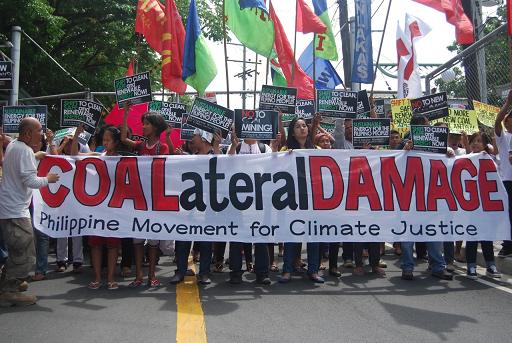
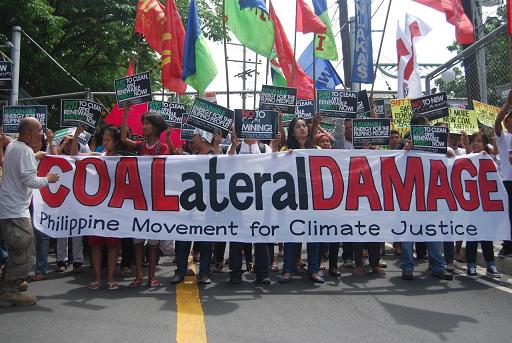
300-strong climate activists and anti-coal advocates stormed the Department of Energy to voice out their opposition to coal mines and coal-fired power plants promoted by the government and to launch the group’s Campaign Against Dirty Energy and for People’s Access to Safe, Renewable and Democratic Energy Alternatives.

This is in celebration of Earth Day and the group’s National Day of Action against Coal.

Led by the Philippine Movement for Climate Justice (PMCJ), the groups brought body bags, gas masks and paper-made Philippine Cockatoos wearing masks to avoid the pollution from coal and highlighted how coal damages not only the environment and biodiversity but our lives, literally taking lives -, thus, the statement: COAL KILLS.

COAL KILLS—Why is coal dirty, toxic

Gerry Arances, national coordinator of PMCJ explained: “The promotion of coal as a major source of energy of Filipino communities is not the right solution to the alleged power crisis in several parts of the country. First of all, coal emits a large amount of heavy metals such as mercury and arsenic – contaminating our waters; generates 500 tons of small airborne particles which cause asthma, bronchitis, and aggravate heart disease; coal ash disposal poses a very high risk of causing cancer to those exposed.

Second, coal plant emissions in surrounding areas kill the livelihoods of host communities as the studies in coal plants in Masinloc, Zambales, and Naga, Cebu, among others, have clearly shown.

Third, coal burning is the major cause of global warming and further promoting it will aggravate the climate crisis that we are facing now. This I believe is a greater damage to the present and future generations who will have to suffer the intensified impacts of climate change.“

RESIST COAL—Increasing local opposition to coal

Two of the major proposed projects now include the coal plants in Cebu and Palawan.

In Cebu, ash samples tested from a coal plants in Naga, Cebu, revealed presence of heavy metals such as mercury and arsenic (carcinogen),both hazardous substances. Despite this, more projects are still underway. Naga is home to two coal plants.

“Health records in Naga for 2009-2012 reveal cancer as one if not the leading cause of mortality incidence in the area. Though could not be directly linked to the coal plant operations, that its incidence in Naga is higher than national averages should be sufficient basis for alarm. While we debate as to whether or not coal is the culprit for the deaths, cancer-related deaths in the area continue to rise,” said Atty. Aaron Pedrosa of Sanlakas.

“The same could be said of communities in Toledo City, Cebu where another coal plant operates. But instead of addressing the health concerns and conducting a probe into the situation, the government intends to put up another plant in the province”, Pedrosa added.

Cancer is among the many diseases that could be attributed to continued exposure to coal combustion wastes

Also threatened by coal projects is our Last Frontier, Palawan—where a 15MW coal-fired power plant project is being proposed to respond to a projected looming power shortage in the province. Environmentalists and conservationists in the province are strongly opposing as the plant is to be set up 1.5-kilometers away from Rasa Island, home to the critically endangered Philippine Cockatoo.

Katherine Leuch of Palawan Alliance for Clean Energy asserts that “The superficial cheapness of coal should not be the only consideration for allowing a coal-fired power plant in Palawan because the risks of such far outweighs the benefits given that Palawan is an ecologically rich and sensitive province. The negative effect of coal is as dark as it is.

What is saddening is that based on our study the projected power shortage is unfounded. It is mainly due to distribution problems and not because of the existing supply. Palawan can also provide cleaner and safer alternatives like mini hydro, and other renewable energy sources.”

RE-ENERGIZE ALL—Shift to REnewable, sustainable energy for all Filipino communities

The Philippine Energy Plan (PEP) 2008-2030 reveals that coal production will continue to escalate. From 39 coal operating contracts (COCs) in 2007, there are now 76 COCs—16 of which were awarded -– last February by the government.

Arances concluded: “The PEPs massive promotion of coal-based power is alarming and is a major cause of concern for our fragile ecosystem and the Philippine population. – Coal is far from the best or even good solution to our power crisis.

Studies show that the country’s potential renewable energy can provide as high as more than 200,000 MW even without tapping solar power. It is about time that we look at this and do away with large-scale, dirty and environmentally-destructive projects.

If the government is as serious about using renewable energy as it claims, it had best do away with contradictory policies. Government needs to revise its Philippine Energy Plan to ensure that vulnerable communities stop suffering from the harmful effects of coal; start investing in RE sources to make clean power accessible and affordable to our people.”

Local actions against coal

Anti-coal groups in host communities also led different information-awareness campaign activities locally, including Cebu City, Davao City, General Santos City, Palawan, Bataan, Leyte, and Quezon.

In Cebu, around 100 activists dumped coal on a life-size map of the Philippines symbolizing the government's rabid promotion of carbon-intensive technology and activities treating its adverse effects on the community's health, ecosystem and livelihoods as collateral damage.

Last Sunday, April 21, Suportado Movement and PMCJ also organized a Bike Tour para sa Abot Kayang REnewable Energy in Marikina, also in celebration of Earth Day.

In Palawan, advocates from Palawan Alliance for Clean Energy (PACE) installed streamers and COAL KILLS posters around Puerto Princesa, while in Panacan, Narra, Palawan several dirty coal educational activities were held Members of PACE also campaigned via local radio and a local forum the call against coal and opposition to the proposed coal plant in Narra, Palawan.

Anti-Mining Activist Daniel Pedro Mateo Kidnapped and Murdered in Guatemala 23rd April

Anti-mining community leader Daniel Pedro Mateo

Anti-mining community leader Daniel Pedro Mateo

Anti-mining community leader Daniel Pedro Mateo

Anti-mining community leader Daniel Pedro Mateo

In the midst of an ongoing genocide trial against a former president of Guatemala, which is now being suspended by the current president who is also implicated in the war crimes, violence against indigenous environmental activists continues, with another person found dead last week in Huehuetenango.  

On April 16, 2013, the body of Qanjob’al community activist Daniel Pedro Mateo was found murdered in Santa Eulalia, Huehuetenango, Guatemala.   He had been kidnapped for 12 days and his body showed signs of torture. Haz clic aquí para la versión en español.

Daniel, a founder of the community radio station Snuq Jolom Konob, disappeared on Sunday, April 7th  in the village of El Quetzal, Huehuetenango on his way to host a workshop on Indigenous rights in the community of Santa Cruz Barillas. His family was contacted by kidnappers and demanded a ransom of Q150,000 in return for his safety. Despite the efforts of his family and community to gather money to pay the ransom, Daniel’s body was found last night in his village of Santa Eulalia.

Daniel Pedro Mateo was a painter, teacher, a founder of Radio Snuq Jolom Konob, and a leader in the community resistance to mining and hydroelectric activities in Huehuetenango. Childhood experiences that exposed him to the grave inequalities and injustices confronting poor and indigenous communities in Guatemala motivated his lifelong commitment to work for a more just and humane society.  After the armed conflict ended, he joined with other Qanjob’al Maya leaders in Santa Eulalia to start a radio station that would give voice to their community that formed the majority of the local population, but were nonetheless marginalized and silenced. Daniel was no longer involved in the day-to-day work of the station, but maintained close ties with many of the current volunteer staff and leadership.

Many in the community believe this violent act to be a repercussion of Daniel’s environmental activism. Lorenzo Fransisco Mateo, Daniel’s cousin and fellow member of Radio Snuq Jolom Konob stated, “The only crime he was ever guilty of was fighting in defense of the environment.” Daniel was an outspoken organizer against the Hydro Santa Cruz dam in Santa Cruz Barillas, a dam in his town of Santa Eulalia, and a logging company Maderas San Luis that had forced evictions of local Indigenous peoples. He was a member Cultural Survival’s partner organization Asemblea de Pueblos de Huehuetenango, and a member of the political party WINAQ, founded by Nobel prize winner Rigoberta Menchu.

Daniel’s death comes in a series of recent murders in Guatemala of Indigenous activists. Just last year, anti-dam activist and community leader, Andres Fransisco Miguel, was shot and killed by security guards of Hydro Santa Cruz in Barillas, where Daniel was headed to host a workshop. In March, Exaltación Marcos Ucelo, an Indigenous Xinca leader active against Canadian Tahoe Resources’ silver mine in Jalapa was found beaten to death, after being abducted alongside three other Xinca leaders. Six months ago, seven Indigenous protestors were shot and killed by Guatemalan military in Totonicapan.These events reflect the dangerous state that Indigenous leaders and environmental activists find themselves in Guatemala.

Community organizations in Santa Eulalia are calling for contributions to cover funeral expenses and to support Daniel’s family in this difficult time. He leaves behind an ailing wife and eight children.

RECLAIM THE POWER

Join No Dash for Gas for a 4 day camp and

Join No Dash for Gas for a 4 day camp and
protest at West Burton power station

17th — 20th August 2013

Big decisions are being made now about how we're going to power the UK. The government's policy of increasing our reliance on gas is pushing millions into fuel poverty. This – coupled with ruthless cuts to essential services – leaves many with an impossible choice between heating and eating. And the same policy guarantees that we'll miss even our modest carbon reduction targets. Both the financial and the climate crises are related to the pursuit of profit above all else, in the interests of the few and at the expense of the many.

We need a win. And one win we need is a secure future for generations to come, where profits don't trump the public interest and where we have safe, clean energy to meet our needs.

Be part of creating something BIG this summer, get involved now and Reclaim The Power.

We can fight back, as the student, trade union, women's, disabled rights and anti-cuts movements have shown us. There has never been a more critical time to take action. The solutions are there to be grasped.

21 people went up two chimneys but 64,000 came down

Last October, 21 environmental activists shut down EDF's West Burton power station for a week in protest at the government's Dash for Gas. West Burton is the first of up to 40 new gas fired power stations being planned. With your help, including a solidarity petition signed by 64,000 people – they fought off EDF's attempt to sue them for £5 million.

This summer, inspired by their action, we are building a wide coalition of groups and individuals who will be coming together to Reclaim the Power. We'll plan together. We'll put forward solutions. We'll cross the border from anger to action. It was people power that stopped new coal and stalled plans for a third runway at Heathrow, that made bankers' greed and tax avoidance toxic and that is now fighting austerity attacks on workers, women, pensioners and the disabled. Together, we will stop the dash for gas.

Want to be part of creating Reclaim The Power? Wondering where we'll be, how you can get there or what you need to bring? More info to come soon, keep up to date at:

www.nodashforgas.org.uk
info@nodashforgas.org.uk
@nodashforgas

Earth Day Action – Part Two 23rd April

San Mateo County Residents Protest Toxic Jail 

In commemoration of Earth Day, community members from around San Mateo County gathered outside of the new jail site and the County Center wearing hazardous materials suits and gas masks to illustrate the toxic nature of the new jail. Carrying a giant banner that read “Jails are Socially and Environmentally Toxic,” they spoke about the ways a new jail will harm communities and the environment as well as draining the county’s budget of desperately needed resources. The new jail project will cost $160 million to build and $30 million each year to operate, and the county has not yet secured the needed construction funds.

Click here for more

Quakers Protest Against MTR

A Quaker group and other protesters on Tuesday asked PNC Bank to stop funding projects that use mountaintop removal to produce coal and, if it doesn’t, asked investors to divest from the sixth-largest bank in America.

Click here for more

Barricades for Earth Day in the Philippines

After the number of police swelled and a truck barred the gate at the Provincial Capitol, about 1,000 activists held a barricade for a few hours in the main road of Mati Tuesday morning. They were earlier blocked several times by the police and military in two separate incidents.

“We were forced to set up the barricade because they didn’t allow us to hold the rally yesterday.  We could just not leave with our quest for justice compromised,” said Karlos Trangia, spokesperson for Barug Katawhan, a movement of Pablo victims.

Earth Day Protests – Part One 23rd April

Meadville group protests against oil and natural gas well fracking

Meadville group protests against oil and natural gas well fracking

While chanting “DEP, can’t you see you’re the case of all this misery?” and “No fracking way,” a crowd marched peacefully from Diamond Park down Chestnut Street on Monday while carrying a coffin to the Pennsylvania Department of Environmental Protection’s northwest regional office in Meadville.

Check out more here


Pittsburg environmentalists protest DEP in honor of Earth Day

Protestors came by land and by sea to the Pennsylvania Department of Environmental Protection Southwest Regional Office on Monday.

About 15 protestors kayaked down the Allegheny River to the DEP office, joining with nearly 100 other protestors in a march to the DEP office, part of a statewide protest of the agency’s regulatory actions regarding hydraulic fracturing — or fracking — activity in the state.

Check out more here

Protest against battery plant in China

SONGJIANG District officials said they are still evaluating the environmental impact of a battery factory planned for the district this year after residents concerned over safety protested its construction.

Residents in more than 40 cars traversed the district on Sunday in a protest that lasted over two hours over the battery factory. Plans for the factory call for it to be one of China’s biggest.

More than 10,000 residents living in the district have signed a petition against the construction, which will be sent to the local government, one of the campaign organizers said.

Click here for more

Utah protests get down at the governor’s mansion

Activists feted Earth Day with a part-celebration, part-protest outside the Utah Governor’s Mansion.”People want clean air, clean energy, a clean future,” said the Sierra Club’s Tim Wagner, standing before a banner festooned with blue ribbons bearing messages for Gov. Gary Herbert and other state leaders.”That’s what people want. That’s what people are demanding.”

Click here for more

Activist Locks Himself to Keystone XL Heavy Machinery Launching a “Red River Showdown” Over KXL South 23rd April

On Earth Day 2013, to mark the close of the State Department’s public comment period for TransCanada’s proposed Keystone XL Northern Segment (KXL North) pipeline’s Environmental Impact Statement (EIS), an activist with the Great Plains Tar Sands Resistance has locked himself to a piece of Keystone XL heavy machinery in Oklahoma, temporarily halting work site construction. Alec Johnson, a 61-year old climate justice organizer from Ames, Iowa took direct action to defend the Red River in solidarity with the Mayflower, Arkansas community, which is currently reeling from last month’s massive tar sands spill. The disaster, due to a 22-foot long gash in ExxonMobil’s ruptured Pegasus tar sands pipeline, has resulted in chronic health problems for nearby residents and has left Lake Conway dangerous polluted.

“This is our environmental impact statement,” stated artist/activist and Great Plains Tar Sands Resistance spokesperson Richard Ray Whitman. “TransCanada claims its technology will prevent spills, but that same technology was used on the Pegasus line, too. That didn’t work, now, did it? We are taking a stand to protect our access to clean water. KXL South is already being constructed with or without the North, and the destruction of our waterways in its path is not a question of if, but when. No toxic pipeline is worth the gamble and no communities in Texas or Oklahoma deserve the fate of Mayflower, Arkansas.”

While the current fate of KXL North rests upon U.S. Presidential approval, KXL South’s now lies in the broad-spectrum opposition it has garnered in the form of legal cases as well as the grassroots civil disobedience campaigns by groups like Great Plain Tar Sands Resistance and Tar Sands Blockade. Should KXL North be permitted to start construction, these groups along with grassroots indigenous organizations, several Lakota Nation tribal councils, and over 60,000 others have pledged resistance in the form of non-violent direct action to halt pipeline construction.

International treaties like the Treaty to Protect the Sacred and strongly-worded tribal council resolutions like those recently passed by the Oglala and Ihanktonwan Oyate/Yankton Sioux General Councils pledging resistance to KXL North “by all means necessary” indicate a tremendous unity amongst Great Plains indigenous nations. The strong reactions come after years of inadequate consultation on the part of TransCanada with regards to impacts on the Lakota Nation communities by its toxic tar sands pipeline. In recognizing the dire threat to their first medicine, sacred water, the communities are also embracing the spirit of international solidarity with First Nation communities downstream from tar sands mining sites. After years decrying the chemical pollution and resulting destruction of traditional life ways from tar sands exploitation in what some affected indigenous peoples refer to as a “slow industrial genocide,” Cree and Dene Nations are experiencing an upsurge in sympathy and solidarity with their plight.

“I am personally amazed at how resistance to the Keystone XL tar sands pipeline and education as to what tar sands exploitation looks like continues to grow every day,” Johnson wrote in a statement prior to his action. “Because it would be irresponsible, we’re not stopping until the industry stops poisoning our futures with lies, unnecessary risks, and death for their profit. As long as the tar sands industry promises it will kill, we will blockade.”


UPDATE 7:30PM – Correction – Friends are being held on a combined $9,000 bail and will be spending the night in jail.

Sorry for the confusion, as charges and associated bail change.  Our friends are in high spirits and would like to be bailed out together.  Hopefully tomorrow!

Donations have been pouring in and we really appreciate the support!  However, we still need some help to get our friends out of jail together…

Help GPTSR get our friends out of jail here!


UPDATE 5:30PM – Four activists are currently being held on a combined $14,000 bail

Alec has been charged with criminal trespass for shutting down the KXL construction site today and is being held on a $3,000 bail.  The charges for the 3 other activists also include criminal trespass.

UPDATE 1:00PM – Rally at the Atoka County Courthouse – Celebrate Earth Day and support our brave activists

Dozens are gathering after the KXL construction site shutdown. Come join a rally happening right now with local indigenous leaders and KXL pipeline activists @200 E Court St. Atoka on this beautiful Earth Day.

See more photos from today’s action here.

UPDATE 11:30AM – Alec has been extracted and arrested for shutting down a KXL construction site – 4 arrests on Earth Day so far

UPDATE 11:00AM – Fire Department trying to remove Alec from KXL machinery – Construction shut down on both sides of road

UPDATE 10:30AM – Two arrests so far at site of Keystone XL construction shut down – Alec still locked to heavy machinery 

Activists with Idle No More Southern Oklahoma rally in solidarity with Alec and Mayflower residents living with the health affects of toxic tar sands.

UPDATE 10:00AM – LIVE VIDEO: Alec locks himself to Keystone XL heavy machinery

Watch this live footage shot by live streamer @jak_nlauren of Alec locking himself to Keystone XL heavy machinery.  10 minutes into the video local police show up and arrest Jak for his coverage of the story.


Video streaming by Ustream

Dodgy deals and corporate collusion: SNP still selling communities out to Scottish Coal

inc002Whilst a lot has happened in the past few days –

inc002Whilst a lot has happened in the past few days – secret meetings for MSPs, the liquidation of the UK’s largest opencast operator – a picture of the deal that Fergus Ewing and Russel Griggs are trying to strike to save the opencast industry is increasingly coming to light. Announcements of a new trust for restoration make clear our suspicions that there isn’t anywhere near enough money for restoration, or even the will to use any of it. Rumblings from the Scottish Government and mining companies such as Hargreves indicate that potentially profitable mines will be sold, whilst spent ones lie unrestored and forgotten. The question is: what deal will be struck that will allow other mining companies to operate these mines profitably? And more importantly in the grand scheme of things, what lengths will this SNP government go to save one of the most despised companies in the central belt?


We don’t need another trust – restoration bonds and more broken promises

Something funny has happened since Scottish Coal announced they’d gone belly up – a new Trust to restore opencast sites materialised seemingly out of nowhere. Ewing and Griggs must have been thinking on their feet, because there was no mention whatsoever of a new trust at the “private” briefing to MSPs on the future of the coal industry last Wednesday, 17th April. Surely that was the opportune moment to announce the new plans? Obviously, the briefing was a charade. But what else were they keeping from MSPs and therefore the rest of us?

Questions need answering about this new trust: Where will the money come from? Which sites will be restored and when will restoration start? Will communities have any control over it? But the biggest of all: what about the bonds that were in place for each site? Opencasts gain planning permission on the condition that (and this is bound by a legal agreement) sites will be fully restored afterwards. Surely therefore there’s insurance money waiting to be accessed. Bonds can be called in either by the local authority, or by the developer in the instance that they go bust. Surely now is exactly the time that they should be called in, and if they’re not, then was it all a hoax in the first place?

The announcement of a new trust reveals other truths too. The insurance companies responsible for the bonds apparently consider them high-risk now that the mining companies have gone under, and won’t issue any more bonds. Therefore, for mining operations to resume in the future, a new system for restoration needs to be created. This new trust isn’t some benevolent act to help the environment or give communities what they want, it’s about covering the backs of the mining companies in the future, and just another dirty trick.

Fergus Ewing had this to say: “We have been working closely with the key stakeholders over the past six months to address the issues facing the coal industry in Scotland and we share the concerns raised by local communities around the responsible restoration of open cast coal sites.” We’d like to know who these key stakeholders are, and why communities living next to sites and ultimately bearing all the negative impacts of them aren’t considered “key stakeholders”.

He also said: “I am, therefore, pleased to announce that we are setting up a new trust to help facilitate the restoration of old open cast coal mines across Scotland.” Yes, but what about the bonds, and the fact that they were a condition of approval for every single mine application?

He then said: “…the restoration process itself is expected, over time, to create hundreds of jobs across the country – as well as restoring the local environment.” Well we wonder where he got that idea from.

Last minute extensions

Scottish Coal bosses were up to their usual tricks right up until the last minute. At two sites in particular, Mainshill in South Lanarkshire and St Ninnians in Fife, Scottish Coal applied for wee extensions by extending excavation areas slightly and into bits not mentioned in original applications. The tonnage in both cases was 70,000. Mainshill was all but exhausted of its reserve, and St Ninnians was finished apart from the consented extension. These tiny extensions aren’t worth another mining company buying the site, but are worth at least a year in terms of restoration commitments. With these extensions the sites aren’t finished any more, so there’s no requirement to begin restoration until the extensions are worked. Smooth. Looking at the state that Mainshill and St Ninnians are currently in one wonders whether they’ll ever get restored.

Worse still, the local authorities must have known that Scottish Coal wouldn’t survive, as they’d supposedly been involved in the negotiations for months now. What local authority would accept an application that they knew would deliberately delay restoration obligations? Ah wait – local authorities that have been colluding with Scottish Coal since day one would do that.

The future for opencast sites

And then there’s the really massive holes in the ground, such as at Broken Cross, in South Lanarkshire. Whilst it might be worthwhile for another company to buy the site – there’s at least 2 million tonnes of coal left and most of the earth moving has been done – there’s no way that the pits at Broken Cross will get filled in with trust money or bond money, if it even exists that is. What do we think will happen to Broken Cross? Landfill site – the taxes will generate income to eventually restore once the hole has been filled in with rubbish, and South Lanarkshire has a solution to its waste problems. This could very well be the fate of most opencast sites, and a final injustice imposed on near-by communities.

Who is this Griggs character anyway?

Chair of the “Regulatory Review Group”, and chair of the new Restoration Trust apparently. He’s the go-to guy for deregulating industry. He’s also refused to meet with community members (so much for “representing each community”). Griggs said: “I am grateful for the support and constructive engagement I have had from local councils, landowners and the coal operators over the last few months in developing the new Trust. I look forward to working with them to launch the Trust and be ready to help with a fresh approach to restoring old mines.” Here he admits that they’ve been cooking up these new plans for months, but still not engaged with communities, and didn’t think it appropriate to mention this at his briefing to MSPs.

The scandal here is that a “fresh approach” and “new trust” is needed to restore old mines. How long have they known that existing measures wouldn’t be sufficient? Did they not think it important to mention to communities that, “by the way, you know the promises of restoration? Well, they’re not going to happen”. This means that either the bonds were never real or sufficient in the first place, or that local authorities have been failing in their obligations to monitor restoration progress. More likely though, it means both, and that we’ve been duped by the mining companies, local authorities and government for some time.

Put your money where your mouth is: call in the bonds

Maybe this is just flogging a dead horse now, but surely, surely some effort should be made to call in these restoration bonds. No one has even mentioned it! There must be at least a few of them that could make some money available? In theory there’s millions in them. Surely then, the equitable thing to do is to keep as many of the opencast workers on as possible to see the restoration of the sites, or at least as much as the finance will allow. The fact that no moves are being made to see to it that this is what happens just shows that there’s a bigger and worse announcement still to come, about a deal being struck between the Scottish Government, local authorities and whichever mining companies have their eyes on Scotland’s opencast sites.