Logging protests spread in Borneo as nomads block roads

24 August 2009
Protests by the Penan tribe in Borneo have escalated, with twelve villages coming together to mount new road blockades against the logging and plantation companies that are destroying their rainforest.

Penan blockade24 August 2009
Protests by the Penan tribe in Borneo have escalated, with twelve villages coming together to mount new road blockades against the logging and plantation companies that are destroying their rainforest.

Journalists covering at the blockades were intercepted by police with machineguns and taken away for questioning.

Hundreds of Penan have blocked roads at three new locations in the interior of Sarawak, in the Malaysian part of the island of Borneo. The protestors are demanding an end to logging and plantations on their land without their consent, and recognition of their land ownership rights.

BBC TV presenter Bruce Parry visited the Penan for his hit series, ‘Tribe’. One Penan told him, ‘It’s not true that we Penan do not want progress. Not the ‘progress’ where logging companies move on to the land. What we want is real progress. What we need is land rights first of all.’

The new protests come only weeks after blockades by two nearby Penan villages. The destruction of their forest robs the hunter-gatherer Penan of the animals and plants they eat and pollutes the rivers they fish in. Without the forest, many Penan have difficulty feeding their families.

The Penan have been struggling for more than twenty years against the logging companies that operate on their land with full government backing. In areas where the valuable trees have been cut down, the companies are clearing the forest completely to make way for oil palm plantations.

The blockades are aimed at forcing the Malaysian timber companies Samling, Interhill, Rimbunan Hijau and KTS to end their activities on the Penan’s land without the tribe’s consent. One of the earlier blockades, mounted in June at the settlement of Ba Marong, resulted in the withdrawal of a KTS subsidiary from the area – but the Penan fear that the loggers may return.

In another Penan area, the notorious company Samling is advancing on an area of the tribe’s forest that has never been logged before. Observers say that the road built by the company is likely to reach the remote Ba Jawi area within weeks.

Survival’s director Stephen Corry said today, ‘The logging and plantation companies are preventing the Penan from being able to feed their children. It’s no wonder they’re taking to the barricades. Penan in some areas are currently receiving food aid – before the loggers arrived, they would never have needed such hand-outs. The Malaysian government must recognize that this land is theirs and stops sanctioning its destruction.’

National and Global Calls for Tasmania’s Forests, World Heritage not Woodchips

MEDIA RELEASE 01.09.09
NATIONAL AND GLOBAL CALLS FOR TASMANIA’S FORESTS, WORLD HERITAGE NOT WOODCHIPS.

Conservationists around the nation and globe are protesting today against the continuing logging and the wood chipping of world heritage valued old growth forests of Tasmania.

Not Woodchips Tasmania banner hangMEDIA RELEASE 01.09.09
NATIONAL AND GLOBAL CALLS FOR TASMANIA’S FORESTS, WORLD HERITAGE NOT WOODCHIPS.

Conservationists around the nation and globe are protesting today against the continuing logging and the wood chipping of world heritage valued old growth forests of Tasmania.

Banners reading “TASMANIA’S ANCIENT FORESTS, WORLD HERITAGE NOT WOODCHIPS” and “THE WHOLE WORLD IS WATCHING” are being displayed across the country.

In Hobart 4 activists are displaying this message hanging from ropes off the roof of Parliament house.

In Melbourne the message has been painted onto silos on Lanridge St. in Collingwood.

In Canberra, the message is being displayed on banners unfurled from the roof of Federal Parliament house.

In Adelaide a banner displaying the message is hanging from buildings in the CBD.

In Newcastle conservationists have constructed an 84 metre tree. Only trees greater than 84 metres qualify for protection as “giants”. Ancient trees that do not reach the 84 metre marked are felled and wood chipped.

Actions across the nation today are supported by international actions in Scotland, Ireland, Switzerland, Italy and other solidarity actions are expected to roll on throughout the day.

“The Federal and Tasmanian State Governments are continuing well into the 21st century to decimate the very last unprotected areas of world heritage bordered old growth forest. These last stands of old growth have been deliberately left out of the World Heritage Area to facilitate their destruction.” Said spokesperson Ed Hill.

“Despite a unanimous IUCN (International Union for Conservation and Nature) decision of 21 countries to extend existing world heritage borders to include ancient forests located in the Upper Florentine, Styx, Lower Weld Valley and Middle Huon, These forests are currently subject to industrial scale clear felling.” Said spokesperson Ed Hill.

“The nation wants an end to the environmental madness that is taking place in Tasmania’s forests. The outright vandalism of old growth forests is a climate disaster that is happening right now.” Said Mr Hill.

“ A recent report* by Professor Brendan Mackey and Australian ANU scientists states Tasmania’s temperate old growth forests store far more carbon then was previously thought. The study found that temperate forests store more carbon than tropical forests and that Tasmania’s ancient forests are some of the most carbon rich forests in the world.”

“The protection of Tasmania’s ancient forests is a simple and effective strategy to help reduce the effects of catastrophic climate change and needs to be seriously considered by State and Federal Governments. The science on forests and climate change is loud and clear yet the Federal Government continues to twiddle their thumbs in the face of dangerous climate change as old growth forests are cleared daily.” Said Mr Hill.

Algonquins set for peaceful, indefinite blockade

The Algonquins of Barriere lake have announced plans to set up an indefinite roadblock on their land—beginning today, September 1, 2009.

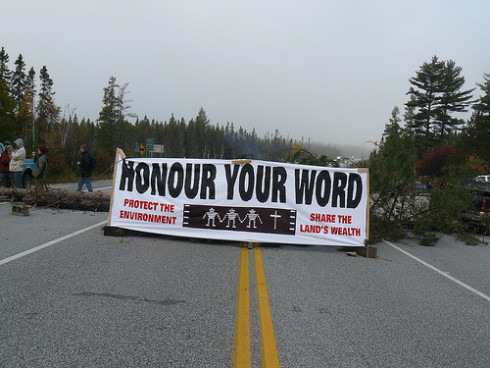
Algonquins - Honour Your WordThe Algonquins of Barriere lake have announced plans to set up an indefinite roadblock on their land—beginning today, September 1, 2009.

In a press statement (below), the northern Quebec First Nation says the roadblock, aimed at preventing logging on their traditional lands, will continue “until Quebec implements agreements covering forestry on Barriere Lake’s lands, and the Quebec and Canadian government’s recognize the First Nation’s legitimate leadership.”

For more information, contact Chief Jean Maurice Matchewan at 819-435- 2136 – or, if the line is busy, 514-398-7432

Algonquins peacefully block logging until agreements and leadership respected?

For Immediate Release
September 1, 2009

Algonquins place bodies in front of logging machines: prevent logging until Quebec and Canada respect agreements and leadership

Kitiganik/Rapid Lake, Algonquin Territory /- This afternoon members of the Algonquins of Barriere Lake will peacefully block the machines of Abitibi-Bowater forestry workers, preventing logging in their territory until Quebec implements agreements covering forestry on Barriere Lake’s lands, and the Quebec and Canadian government’s recognize the First Nation’s legitimate leadership.

“Our community has decided there will be no forestry activities or any new developments in our Trilateral Agreement Territory until the status of our leadership and the agreements we signed are resolved to our community’s satisfaction,” says Jean Maurice Matchewan, Customary Chief of Barriere Lake. “The Quebec government has acted in bad faith, giving companies the go-ahead to log while they ignore their legal obligations, leaving us with no choice but to stop forestry operations until Quebec complies with the agreement. We have waited more than 3 years for Quebec to implement it.”

Matchewan received no response to a letter he sent to Manager Paul Grondin of Abitibi-Bowater’s Maniwaki mill on August 25, requesting that the company suspend logging operations until the governments follow through on their obligations.

“Our plan is to peacefully put our bodies in front of their machines until we get some results. We expect they may use the police, because we are used to such tactics. This is our territory and they can’t push us off our lands,” says Matchewan.

Canada and Quebec have refused to acknowledge the results of a June 24, 2009 leadership selection process that reselected Jean Maurice Matchewan as the legitimate Customary Chief of Barriere Lake. National Chief Shawn Atleo of the Assembly of First Nations, however, met with Chief Matchewan on August 19, to discuss the Trilateral agreement and other community concerns. The
Algonquin Nation Secretariat, a Tribal Council representing three Algonquin communities including Barriere Lake, also recently reiterated their support for Chief Matchewan.

“Instead of acting honourably and cooperating with our Customary Council to implement these signed agreements, the federal and provincial governments have been working in unison to try and install a minority faction whom they can use to sign off on the cutting of our forest,” says Matchewan.

Barriere Lake wants Canada and Quebec to uphold signed agreements dating back to the 1991 Trilateral Agreement, a landmark sustainable development and resource co-management agreement praised by the United Nations and the Royal Commission on Aboriginal Peoples. Canada has been in breach of the agreement since 2001. Quebec signed a complementary Bilateral Agreement in
1998, but has stalled despite the 2006 recommendations of two former Quebec Cabinet Ministers, Quebec special representative John Ciaccia and Barriere Lake special representative Clifford Lincoln, that the agreement be implemented. The agreement is intended to allow logging to continue while protecting the Algonquin’s’ traditional way of life and giving them a $1.5 million share of the $100 million in resource revenue that comes out of their territory every year.

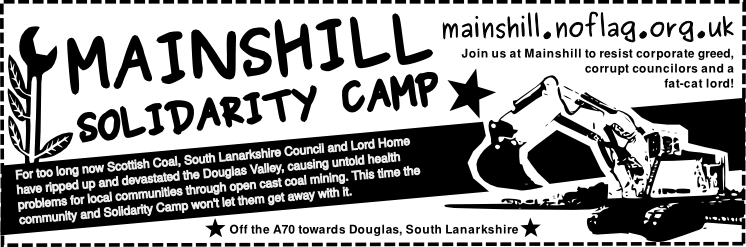
Mainshill Solidarity Camp Update: two and a half months on & 1st newsletter

Over two and a half months ago the Mainshill Solidarity Camp was set up on the site of a new open cast coal mine at Mainshill Wood, in support of the local communities efforts to oppose the project and Scottish Coal’s plans, and in defiance of planning approval granted by South Lanarkshire Council

Its the fort that countsOver two and a half months ago the Mainshill Solidarity Camp was set up on the site of a new open cast coal mine at Mainshill Wood, in support of the local communities efforts to oppose the project and Scottish Coal’s plans, and in defiance of planning approval granted by South Lanarkshire Council.

A lot has happened during the past few months: Scottish Coal and Strathclyde Police busted through barricades with a JCB and removed machinery, the Camp for Climate Action in Scotland set up in the field next to the camp, actions have happened, and finally an issue has been made of coal expansion in Scotland. Amazing work and research has been done into the health impacts of open cast coal mining for surrounding communities (see http://coalhealthstudy.org/) – an issue that Scottish Coal, Lord Home (the land owner) and South Lanarkshire Council can no longer silence.

So why have a group of people decided to live on the site of a relatively small open cast coal mine, that is mostly plantation forest and surrounded by only a few small communities, and why is this so important? Because it is places such as Douglas that direct action, rooted in community struggle, can be at its most effective. At Mainshill, the fight is against feudal land ownership and a fat-cat Lord, a corrupt Council that has removed local democratic processes, a multi-million pound mining company that stops at nothing for profit and government policy that prioritises cheap coal over community health and the environment.

Now the campaign is firmly established and is winning a lot of ground, pressure and momentum must be kept up and the struggle must be brought to other communities facing similar injustices as Douglas.
The camp will defend this liberated space and stand in solidarity with communities until the Wood is saved!

How you can help:
– Visit and stay at the camp! Even if its just for a day we’d love to have you
– Donations – both financial and anything from our wishlist here are much appreciated
– Spread the word – help distribute flyers, send emails and tell people about the struggle
– Take action – central Scotland is littered with coal infrastructure, corporate HQs, open cast mines and power stations

http://mainshill.noflag.org.uk/
http://coalactionscotland.noflag.org.uk/

—-
Mainshill header
Mainshill Solidarity Camp Newsletter no. 1 out now!

The story so far, uncovered health impacts from open casting, the Camp for Climate Action, assaulted by a councilor, and other coal struggles at Hunterston and Cousland – the Mainshill Solidarity Camp & Coal Action Newsletter is now out!

Download the pdf here: http://coalactionscotland.noflag.org.uk/?p=669

Please copy and distribute far and wide. We hope to make this a regular publication and welcome submissions – please email * mainshill@riseup.net * with any articles, stories or photos.

German anti-nuclear protests heat up ahead of 21 September election

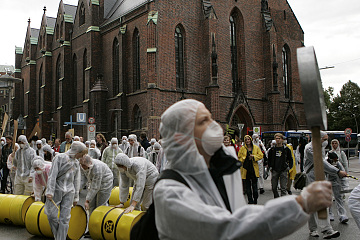
About one thousand Castor caskets full of nuclear waste are produced by just one atomic power station during its operative life without there being a final repository for it anywhere.

That’s a point the German anti-nuclear activist group Campact is making with demonstrations in 12 cities of the country, which goes to the polls on 27 September.

About one thousand Castor caskets full of nuclear waste are produced by just one atomic power station during its operative life without there being a final repository for it anywhere.

That’s a point the German anti-nuclear activist group Campact is making with demonstrations in 12 cities of the country, which goes to the polls on 27 September.

The conservatives of Chancellor Angela Merkel, keen backers of nuclear power, are tipped to win by a large margin.

Last Friday Compact put on its spectacular show in Berlin, the capital, on Saturday they were in Hamburg, the second-largest city.

Part of the action is a huge lifelike mock-up of a Castor casket, the kind of receptacle in which waste is transported and stored.

Meanwhile 30 farm tractors from the Gorleben waste dump area are rolling towards Berlin, to be joined by 100 more later, for a demo on 5 September expected to draw tens of thousands of protesters. More than 1,000 people and 120 tractors sent them on their journey of hundreds of kilometres. At this writing they had passed through Lueneburg, Uelzen and Braunschweig.

A leftwing newspaper, “taz”, reports that nuclear power companies are giving their apprentices time off work to attend a pro-nuclear demonstration at the Biblis power station, one of whose two blocks is to be shut down by the end of this year. It is situated in a heavily industrialised and populated central German area encompassing Frankfurt/Main, Darmstadt and Mannheim. The power companies deny that they’re pressuring the trainees, but one source in the RWE company said there’s a clear order to take part. If all do, that would make 10,000 pro-nuclear demonstrators.

Meanwhile the Federal Radiation protection agency reports that a lump of 20,000 tonnes is likely to drop 40 to 45 metres out of the ceiling of a former salt mine in Morsleben which is one of several dodgy nuclear waste dumps in Germany.

The agency says there’s even a possibility that the entire ceiling could collapse. People in the area would be able to feel it, glasses would wobble. Brine is running in the mine and has even formed stalagtites.

Morsleben used to be the nuclear dump of the former communist East Germany and Ms Merkel, then environment minister, allowed dumping to continue there despite warnings by scientists that it was unsafe. It was finally stopped by a court order, initiated by Greenpeace.Anti-nuclear demonstration in central Hamburg

Lammas Ecovillage, Wales gets Planning Approval (finally!)

Today the Lammas group won planning permission for their ecovillage project.

Today the Lammas group won planning permission for their ecovillage project.

Lammas is a new settlement of 9 eco-smallholdings, a campsite and a community hub building, to start construction this autumn. It will be sited on 76 acres of mixed pasture and woodland next to the village of Glandwr, Pembrokeshire. The site is on land currently belonging to Pont-y-gafel farm, next to the village of Glandwr, North Pembrokeshire. The site is currently used as farmland.

After their first application was turned down for insufficient detail, Lammas put in an amended application on March 17th 2008. The first application had filled an entire wheelbarrow (the second containuing 150 illustrations and 1200 pages of text would have requuired 2 barrows – so it was submitted electronically!) However, their second application was again turned down in September 2008. Further frustration was experienced when the Welsh Assembly refused them the right to appeal on the grounds that the application was invalid on some technicality. However, appeal they did, and the appeal into the refusal of the revised planning application was heard earlier this summer. The inspector, intrigued and unvonventionally, chose not to allow lamma’s expert witnesses to present their full cases in favour, preferring to open the debate about the application to the whole floor so that all voices in favour and against the application were heard. Insptector took a few weeks to reach his decision in considering the whole application.

Despite the launch of a pioneering low-impact policy by Pembrokeshire County Council in 2006 and years of meticulous groundwork, consciencious dedication and patient deliberation, the long exacting process sought for approval of the project has taken over 2 years since the initial application was first submitted. Emphasising the imbalance of the current planning system which doesn’t take account of climate change, Paul Wimbush of the Lammas project even suggested that it would have been easier to have applied for planning permission to build a power station! That it has succeeded is due to a tremendous drive to succeed born of an inspirational vision of low impact/low carbon living for the 21st century.

Lammas was conceived as the first large-scale low impact project that would work with the planning system, (ie: to apply for planning permission in advance of the construction and establishment of the project, or in other word, not retrospectively). The Lammas Ecovillage will be completely independent of all mains services. All water will be sourced from the site using a combination of an existing spring for drinking water and rainwater harvesting from rooftops. All electricity will be produced on site using renewables. Fortunately there is an existing water turbine system on site which Lammas plans to renovate. All organic waste will be composted on site using a combination of compost toilets, wormeries and compost heaps. Fuel, in the form of coppiced willow and elephant grass, will be grown on site.

The project will be managed by Lammas Low Impact Initiatives Ltd, a cooperative registered under the Industrial and Provident Society Act. A comprehensive management plan has been compiled which sets out how the project will be established and run.

The smallholdings will essentially be agricultural leaseholds which are conditionally tied to requirements as set out in the management plan. Thus the objectives of the project will be assured in the long term. The requirements will cover issues such as livelihood, transport, services and monitoring.

The people selected for the first phase of the project have developed well researched plans for their livelihoods. In addition to sourcing fuel, water, electricity and food from the site, the 9 households will also run small-scale farm businesses producing a wide range of quality goods including hazelnuts, smoked ham, soft fruit, woodland crafts, vegetables and cooked foods. The produce will be marketed through a variety of outlets including local shops and a Lammas market stall.

Common Land
Some areas of the project will be managed in common. There is an area of existing broadleaf woodland on site which will be conserved for its wildlife value. The existing conifer woodland will be managed and harvested as a resource for building. There will also be shared grazing and fuel crop areas as well as a millpond and village green.

In hindsight
As Larch Maxey has written: “Lammas softly-softly approach, seeking to work with the planning system, has led to huge delays while prospective residents living locally [have poured] savings into inadequate accomodation. Opportunities to harness people’s energy have been lost. Whilst it remains invaluable to have the Low-Impact Development movement broadened by projects seeking planning permission before moving on, the planning system is ill equipped for the speed and scale of the challanges we face. Until it is equipped, people must continue to take direct action towards the sustainability transition in every way they can {including} building low impact lives”.

More Info:
Ref: http://www.lammas.org.uk/ecovillage/news.htm Llamas Village Group

Land and Forest Occpation started in Lapland (Finland)

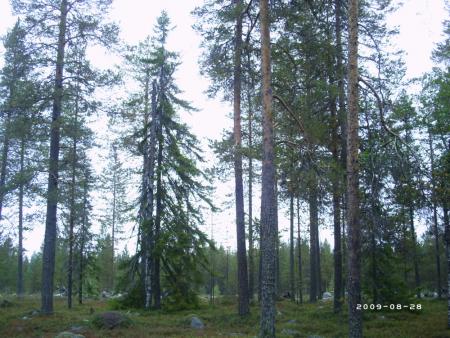
On the 26th of August an international occupationcamp has been started in Finnish Lapland, due to the planning of uranium mining and the planning of a new nuclear plant. Locals and participants from the climate camp finland, decided to combine powers and try to preserve the lappish nature and way of life.

Forest in FinlandOn the 26th of August an international occupationcamp has been started in Finnish Lapland, due to the planning of uranium mining and the planning of a new nuclear plant. Locals and participants from the climate camp finland, decided to combine powers and try to preserve the lappish nature and way of life.

latest news from the camp, Ranua ( FL)

August 31th, 2009
On August 26th a basecamp has been established for the Ranua Rescue Areva Mining Monitors. During the Lapland Nuclear Climate Camp in July we learned from locals that Areva has already began their uranium prospecting in Ranua, Lapland. We have come here to monitor Areva’s activities and help support the resistance to uranium mining here, and everywhere.
We have found a beautiful location for the camp, near a lake, within an old forest, on the edge of Areva’s massive prospecting claim area. We need thoughtful, respectful people, skills, supplies, support, laughter, and dedication!
You can check the http://www.nuclearfreefinland.org site, and the blog on http://www.ranuarescue.blogspot.com.
Soon we will be sending photos and directions to get here, we will also set up a schedule for when people are most needed, what is needed, and what events will be happening.
When you want to come to the camp, contact in advance (camp (at) nuclearfreefinland.org) and tell of your arrival time in Ranua. From there you can phone the camp work phone number +358 40 365 2041.[1]

——————————————————————–

So everybody who has some spare time on their hands is very welcome to come.

Another Website: http://www.greenkids.de/europas-atomerbe/index.php/Ranua_Uranium_Exploration_Action

Climate protesters scale Carbon Exchange

27th August 2009
Climate change protesters have scaled a building in the City to highlight their opposition to carbon trading.

Climate CasinoClimate casino - playing with police27th August 2009
Climate change protesters have scaled a building in the City to highlight their opposition to carbon trading.

Activists targeted the Carbon Exchange in Bishopsgate at about 0900 BST and unfurled a banner claiming carbon trading to be a “false solution”.

A Metropolitan Police spokesman said about 20 activists were at the site and that officers were “in attendance”.

Hundreds of protesters have gathered in London as part of Climate Camp – a week of “education on green issues”.

The site for the camp – Dartmouth Field in Blackheath, south-east London – was kept secret until the last moment and details were sent to activists by text.

Activists had repeatedly refused to reveal the final location, saying they did not trust the police.

It followed accusations that the Metropolitan Police were heavy-handed in policing the G20 protests.

The site was chosen because it is within view of the City and near the River Thames, organisers said.

A Climate Change spokeswoman said: “Some people are making huge profits from carbon trading, and politicians are telling us it’s cutting carbon emissions but it’s not.

“Carbon trading is a false solution that is doing nothing to tackle climate change. So businesses, bankers and governments are just gambling with our planet.”

The four key themes of the annual camp are education, direct action, sustainable living, and building a movement to tackle climate change.

Ch Supt Helen Ball, of the Metropolitan Police, said: “As yet we don’t know what camp participants intend to do in the days ahead.

“I’d like to repeat our request that they talk to us about any protests they are planning so we can ensure a proportionate policing response and minimise any further impact on Londoners.”

The campers have wind turbines on site and say they are composting their food and toilet waste.

Flood plains

Campaigners say that about 3,000 activists are expected to visit the camp over the coming week.

They will be invited to workshops on a range of subjects, from climate change, biofuels and the fight against Heathrow airport, to yoga, wooden pencil-making and pedal-powered sound systems.

Organisers said this year’s venue symbolised the financial and corporate centres of power, and was within the flood plains of the River Thames, which they warned was at risk of bursting its banks as climate change escalated.

The heath was the setting for the Peasant’s Revoltuion, which saw thousands of protesters demonstrate against taxes more than 700 years ago.

The site hosted Jack Cade’s Kentish rebellion against King Henry VI in 1450, which was followed by the Battle of Deptford Bridge in 1497 during which Cornish rebels camped at the site.

Irish climate camp & actions round-up

Peat power worse than coal for CO2 emissions

Climate Camp is up and running at Shannonbridge, Co.Offaly – started Saturday 15th August and goes on till Sunday 23rd August.

Peat power worse than coal for CO2 emissions

Climate Camp is up and running at Shannonbridge, Co.Offaly – started Saturday 15th August and goes on till Sunday 23rd August.

It’s about what we can do in the face of changing climate that will affect us all. Peat bogs are a living carbon sink – greater even than forestry. Burning peat releases more CO2 into the atmosphere than burning coal. The peat-fired powerstation beside the camp should have been shut down long ago – since our government and Bord na Mona still fail to see the urgency of reducing emissions, climate camp will be staging a major protest on Saturday 22nd August – this will be a day of action and fun, including street theatre, art, etc, which will hopefully bring media attention to this important issue.

Meanwhile, the camp has lots of great workshops every day this week about sustainable living, peat bogs, forestry, cycling, renewable energy, etc, etc. Come along to my Trees and You workshop on Wednesday ! I will be talking about trees as carbon sinks, as vital elements of biodiversity, as added value to farms and gardens, woodland gardens, agroforestry, CELT native tree nursery, CELT Weekend in the Woods (19 / 20 September) (another event not to be missed !) ………………………

So get yourself along to CLIMATE CAMP and be a part of it !

http://www.climatecamp.ie

Camp trailer

Newsletter, including next organising gathering
—–

Climate Campers take Direct Action on Bog Restoration
August 23, 2009

Hundreds participated in Climate Camp at Shannonbridge, which was held under the shadow of the peat burning powerstation.
The Climate Camp organised three events to create better awareness around the industrial use of peat in powerstations.

Fianna Fáil’s Garret Tubridy unknowingly contributed to the eco-conscious Climate Camp at Shannonbridge. Recent local election posters were reused as part of the men’s toilet facilities. Users did not have to look at his face. Gavin Harte gave a talk on communicating the media message with plenty of workshops on drumming, Rossport, permaculture, the endless dreamcatchers and there were more banners being made than you could shake a stick at. It was great for kids and parents alike.

Lentil Disorder provided the veggie food for the hungry masses with an oats crisis on the Saturday morning. Chocolate flapjacks sated the appetites of early risers.

Locals were bemused watching the parade which left the camp shortly after midday. The barmen from both locals – Killeen’s and Luker’s pubs – waved at some of their new customers. Another local said nothing like this had ever happened in Shannonbridge before. Paraders from the camp had dressed up as zombies and the dark forces of dangerous carbon emissions with a symbolic chimney stack. Biffo of course led the zombies through the village! Campers had made banners, placards, dream catchers and an eclectic sound system boomed, ‘Black Betty, Bam Alam’ and Marley.

Kayakers got onto the little island in the middle of the Shannon holding aloft a banner ‘Sponge Bog Stops Floods’, as the parade reached the bridge timed nicely with cyclists returning from another direct action from the bog.

A few different direct actions were planned and no one told me nuthin’.
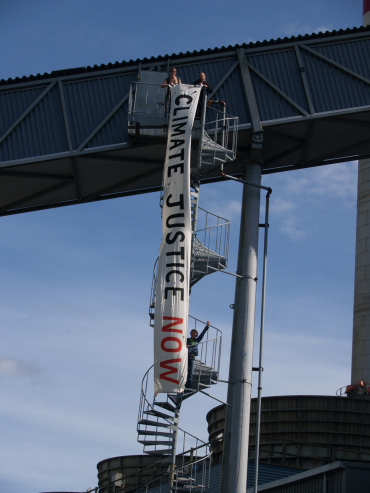
Climate Justice Now banner
There are three peat powerstations in Ireland, Lanesboro and Edenderry, where agile activists dropped banners from, and Shannonbridge where there was a parade and some scuffles broke out when the parade couldn’t go up to the powerstation.
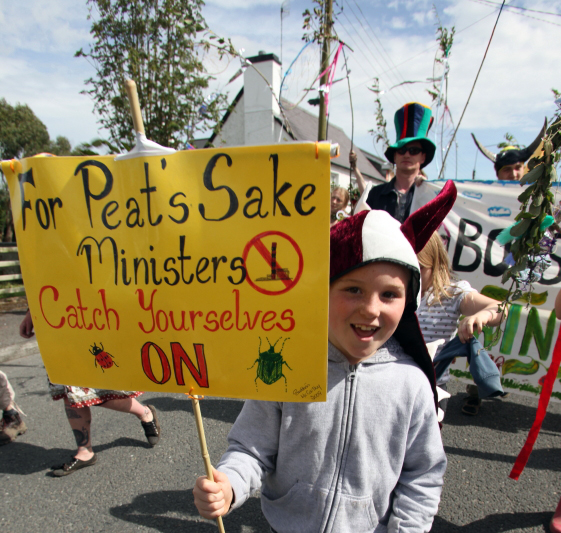
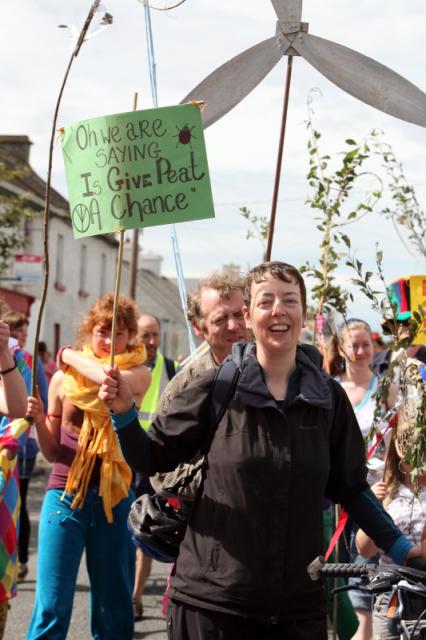
peat protest placardGive Peat a Chance placard
Look at ClimateCamp.ie for more information about the issues.

—–

Climate Campers take Direct Action on Bog Restoration
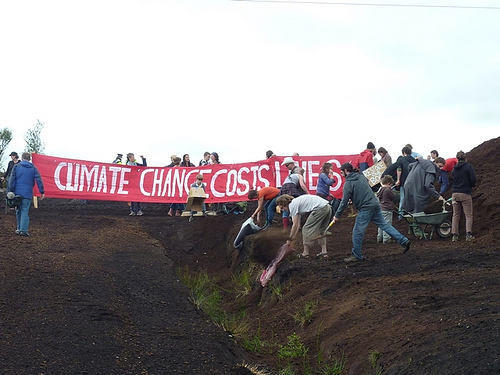
Filling in peat trenches
No time to waste – preserving Irish peatlands is essential

Climate campers of all ages at Shannonbridge took a direct action this morning August 18th, on a nearby bog by filling in trenches that are used to drain the bog for cutting. The peaceful demonstrations lasted 2 hours with police curiously onlooking at the hard working activists.
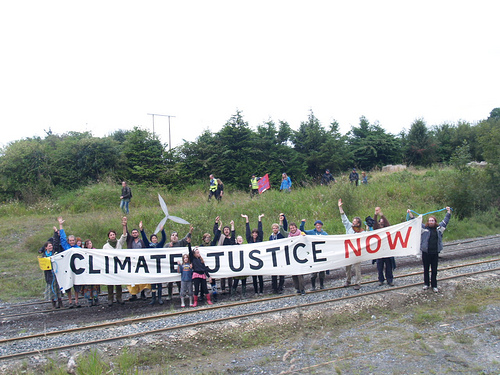
Peat train line trespass
This morning at 11.30am sixty odd Climate Campers of all ages strolled 2km from the camp beside the Shannonbridge Peat Burning Power Plant towards one of the Bord na Móna man-made brown deserts outside of the town. Equipped with some sacks, shovels, pillow cases, wheelbarrows, banners and good cheer, they started filling in the trenches made to drain the bogs with milled peat which was destined for burning at the power plant. The direct action continued for about 2 hours filling in a significant part of the trench. Local police watched as the climate campers, including many children, diligently set about their task and some engaged the police in conversation explaining to them the reasons for their actions.

This is the first step that’s needed to restore our bogs” said Molly Walsh, spokesperson for Climate Camp Ireland. “People don’t realise that when bogs are drained and dried, they release ample amounts of carbon dioxide, even before the peat is burnt. Degraded peatlands release 0.97 million tonnes of C02 annually in Ireland.” she added.
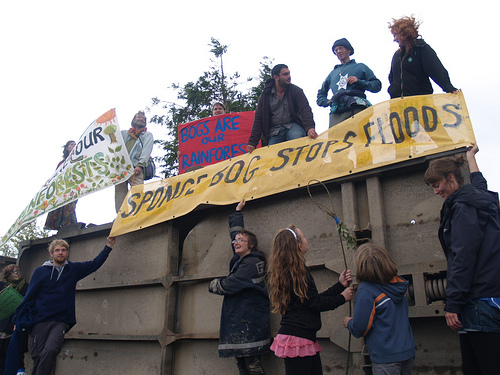
peat banners
Colourful banners and placards were unveiled on the bog saying “Climate Change Costs Lives” and “The bog is our rainforest”. One banner was mounted on a piece of peat-cutting machinery which said “Don’t Burn our Bogs”. Some of the activists boarded a bog train, while others pushed them along, symbolising that humanity is on the wagon towards climate chaos unless we halt these climate chaos causing activities immediately.

Come join us at the camp for more actions and workshops! Climate Camp Ireland continues at Shannonbridge until August 22nd with the main day of action. We call on everyone to come join us on a day of peaceful civil disobedience to stop peat burning at the Shannonbridge Power Station.

—–

Climate Camp shuts down two peat burning power stations
22nd August 2009

The Climate Camp culminated in Shannonbridge with a day of action. The unsustainability of the peat burning was successfully highlighted with actions at all three peat burning power plants. Activists suceeded in shutting down the two plants at Shannonbridge and Lanesborough. The Shannonbridge plant has been shut all week since the camp started, and the Lanesborough plant was shut down by activists today.

This morning a group of Climate Camp activists carried out a peaceful direct action at Lanesborough peat burning power plant. Some activists locked themselves to the gates while another group entered the plant and carried out a banner drop on one of the buildings which read “Give Peat a Chance.” The power plant’s chimney stack stopped bellowing its carbon emissions for most of the working day. Two activists were arrested.

Gerald Glynn, a spokesperson for Climate Camp said, “We took this peaceful direct action to highlight the urgency of climate justice issues. Our bogs are our rainforests and we need to protect them. We can’t wait for our governments to act. Let’s give peat a chance now.”

At midday another group of Climate Campers targetted a third power plant in Edenderry, owned by Bord na Mona. Five women dropped a banner from the power station’s conveyor belt which read “Climate Justice Now”. The workers at the plant came out and took an interest in the action. “Bord na Mona’s sustainability talk is nothing but that, talk, they are still extracting and burning the dirtiest fossil fuel. We are sending out a strong message of solidarity with communities in the Global South suffering from the impacts of climate change.” said Jerrieann Sullivan, a spokesperson for the group.

A lively colourful parade began at 12pm in Shannonbridge and made its way through the town, across the river and back towards the power plant. Many creative banners were carried by Climate Campers of all ages with slogans such as “Climate Change Costs Lives” and “Bogs are our rainforests”. People were dressed up as zombies and bog monsters as they paraded, chanted, danced and sang through the town while locals looked on with amused interest. Another group merged with the parade after taking more direct action filling in trenches which drain the bogs to start restoring our peatlands. A Climate Camp river crew also unveiled a banner saying “Sponge bog stops floods” to many cheers from the main parade.

“300,000 people are dying annually worldwide as a result of climate change, not to mention losses in wildlife and biodiversity.” said Nancy Serrano, spokesperson for Climate Camp. “People in the midlands deserve better community-oriented sustainable jobs. We need to think long-term and we need to start now.” she added.

ENDS

www.climatecamp.ieFor interview or further information contact the climate camp media phone 085 7851241
or for specific information on the action in Lanesborough – 085 1386675

http://www.flickr.com/photos/climatecampireland

—–
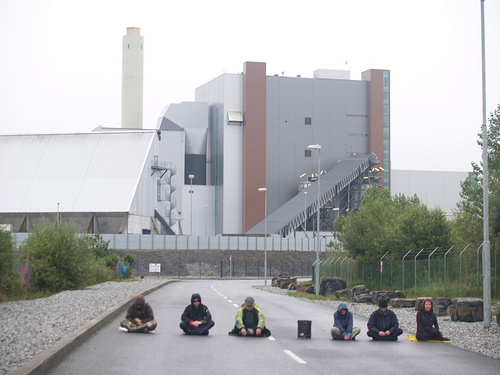
Daily Shannonbridge blockade
Daily peaceful blockade of Shannonbridge power station

site taken for Camp for Climate Action 2009, at Blackheath

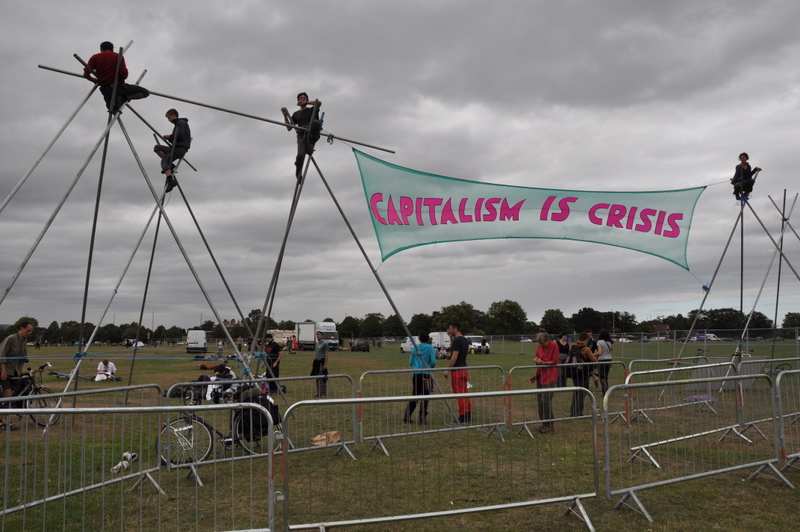
After a relaxed start to things, getting to the campsite seemed almost too easy. Only one videographer was hassled when an officer tried to grab his camera early on. After a first meeting, tents and marquees are going up all over the place.

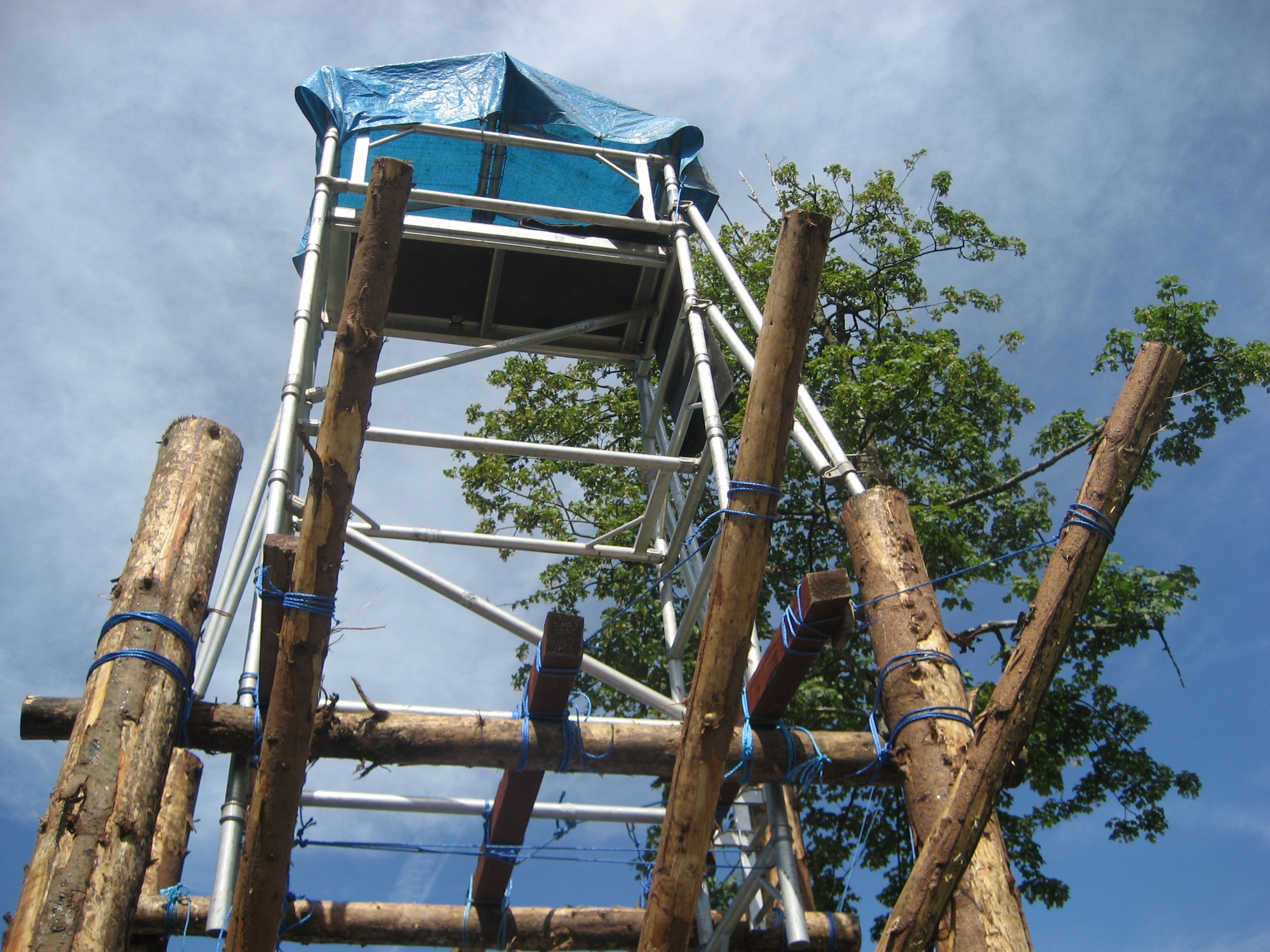
Tripod & banner at climate camp 2009climate camp 2009 tripod with banks behindAfter a relaxed start to things, getting to the campsite seemed almost too easy. Only one videographer was hassled when an officer tried to grab his camera early on. After a first meeting, tents and marquees are going up all over the place.

The weather is nice, albeit somewhat windy and the view over London is amazing. It’s almost hard to believe that we’re still in the city.

Swoop action timeline

Location, more photos and more at http://www.climatecamp.org.uk/