
 The Hunt for the Japanese Whale Poachers Resumes…
Press Release: 02/13/2008
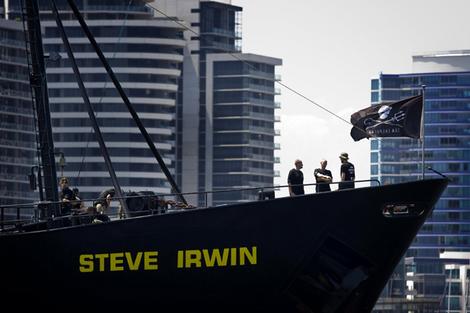
After twelve days of repairs, refueling, re-crewing, re-supplying and re-provisioning, the Sea Shepherd ship Steve Irwin is returning to the Southern Ocean. The estimated time for departure is 2000 hours Melbourne time on Thursday February 14.
“A special thank-you to Australia,” said Captain Paul Watson. “You helped to send the Steve Irwin back to sea as a Valentine’s Day gift to the whales.”
Donations of money for fuel, donations of food and supplies flooded onto the decks of the whale conservation ship during the brief stay in Victoria docklands.
“We are anxious to return to the coast of Antarctica,” said Sea Shepherd cook Amber Paarman from South Africa. “Every moment that we are not on the tail of the Japanese fleet means that the lives of the whales are in peril.”
The Steve Irwin intends to harass and intervene against illegal Japanese whaling for the next four to five weeks. This should stop them to the end of the whaling season. The fleet’s operations were shut down for more than three weeks in January. Sea Shepherd intends to shut them down again.
“In January we prevented them from slaughtering whales for three weeks, we cost the Japanese over two million dollars in fuel during the pursuit and we exposed their illegal whaling activities worldwide and most importantly we got the story into the Japanese media. This provoked a real debate in Japan on the cost of whaling to Japan’s reputation,” said Captain Paul Watson.
The Sea Shepherd Conservation Society does not intend to surrender the Southern Ocean Whale Sanctuary to the poachers. After this season, Captain Paul Watson is working to secure a 2nd ship with the objective of mounting a non-stop pursuit for the 2008/2009 whaling season.
The Steve Irwin dropped off 16 volunteer crewmembers in Melbourne on February 2nd and 19 volunteers have joined the crew. Eleven crewmembers have been with the campaign from the beginning.
The 32 crew, 8 women and 24 men returning to the Southern Oceans represent 10 different nationalities. In addition to 15 Australians, crewmembers have joined from New Zealand, Canada, the U.S.A., Sweden, South Africa, the Netherlands, the U.K. Spain, and Japan.
http://www.seashepherd.org
================================
Award winning documentary Sharkwater will have its theatrical release in the United Kingdom on February 22. In the film, shark conservationist Rob Stewart teams up with Captain Watson and Sea Shepherd to combat the shark fin mafia in Costa Rica and the Galapagos.
“This is a film that will forever shatter the stereotypical myths that surround sharks. Where Jaws taught people to hate and fear sharks, Rob Stewart’s passionate masterpiece will have people loving and caring for these important animals,” praises Captain Watson.
Full details: www.sharkwater.com www.seashepherd.org
UK THEATRICAL RELEASE SCHEDULE
ALL VENUES PREMIERING 22nd FEBRUARY
London
Apollo Cinema
19 Regent Street London, SW1Y 4LR
Regions
Birmingham Showcase
Kingsbury Road (A38) Erdington, Birmingham, B24 9QE
Bristol Showcase
Avon Meads, St. Phillips Causeway, Bristol, BS2 0SP
Cardiff Showcase
Heol-Yr-Odyn, Park Nantgarw, Trefforest Industrial Estate, Nr Pontypridd, CF15 7QX
Hull Odeon
Kingston Park, Kingston Street, Hull, HU1 2TX
Glasgow East Showcase
Barrbridge Leisure Centre, Coatbridge, Glasgow, G69 7TZ
Norwich Odeon
Riverside Leisure Park, Wherry Road, Norwich, NR1 1XA
Nottingham Showcase
Redfield Way, Lenton, Nottingham, NG7 2UW
Leeds/Bradford Odeon
Gallagher Leisure Park, Thornbury, Bradford, BD3 7AT
Manchester Showcase
Hyde Road (A57), BellVue, Manchester, M12 5AL
================================
Planktos Ocean Dumping Scheme Defeated by Anti-Whalers
News release: Sea Shepherd
02/14/2008
Our campaign against Planktos Inc. is over. The controversial plan to dump hundreds of tons of iron ore dust into the ocean in a bizarre scheme to seed plankton blooms has been abandoned by the Planktos corporation of California.
This is a victory against a corporate carbon trading scheme that had no scientific credibility.
This is from the February 13th, 2008 edition of the New York Times” ( http://dotearth.blogs.nytimes.com/2008/02/13/commercial-ocean-fertilization-project-
halted/index.html?ref=technology):
“Planktos, the California company trying to turn a profit by fertilizing the ocean with iron dust, pulled the plug on planned field tests on Wednesday, citing a lack of funds. At the company’s Web site, planktos.com, a simple notice blamed the shutdown on a “highly effective disinformation campaign waged by anti-offset crusaders.”
The business plan had been to sell “carbon offset” credits earned by triggering blooms of phytoplankton that, in theory, would absorb a predictable amount of the climate-warming gas carbon dioxide through photosynthesis and then sink to the seabed. The credits would be sold to companies or individuals trying to compensate for unavoidable emissions of carbon dioxide (from driving, flying, and the like).
Plankton blooms happen naturally when dust containing iron settles on ocean waters where a lack of iron otherwise prevents plankton from thriving. Huge blooms have resulted after dust from the Sahara Desert blows over the Atlantic, for example. But efforts to replicate the process artificially have met with strong opposition from environmental groups. The Sea Shepherd Conservation Society, which for years has confronted, and sometimes rammed, whaling and fishing vessels had threatened to block a fertilization effort by Planktos last summer near the Galapagos Islands, forcing it to change plans.
A number of marine and climate scientists have also opposed commercial fertilization efforts, for various reasons. In a “joint policy statement” published in the journal Science last month, a group of researchers from around the world said trade in carbon credits earned this way was premature “unless research provides the scientific foundation to evaluate risks and benefits.”
The Planktos vessel Weatherbird II has been stuck in port on the Portuguese island of Madeira after months of revised plans and failed efforts to attract more investors. Financial troubles had been mounting for months. On Wednesday, the company said it had called back the vessel and its crew.
The Planktos statement said:
“Management has also radically downsized the company’s staffing while the board of directors has formed a new committee to explore all options currently available. Options include a possible re-launch of planned marine operations, pending additional financing or new partnerships, as well as the possible pursuit of other promising business opportunities in the environmental sphere.
The board of directors continues to believe in the urgent ecological necessity of its ocean restoration plans and the scientific speciousness of objections voiced to date. However, ideological hostility to and misrepresentations of this work will continue to stymie progress until the true gravity of our climatic and ocean crises is more widely understood.”
The Sea Shepherd Position:
The Sea Shepherd Conservation Society opposed the iron ore dust dumping scheme because it was condemned by the Environmental Protection Agency of the United States and was in fact a violation of United States and International regulations on the dumping of materials at sea. The scheme was also opposed by the Galapagos National Park, the Charles Darwin Foundation and the Ministry of the Environment of Ecuador.
Sea Shepherd did not make any judgment on the scientific merits, if any, of the scheme. We acted because the dumping was a violation of Ecuadorian, American and International law.
In August of 2007, Sea Shepherd blocked the plan in the Galapagos. In November 2007, Sea Shepherd confronted the Planktos vessel in Bermuda forcing it to move onto Madeira.
The Sea Shepherd Conservation Society would like to thank Planktos for acknowledging our opposition as the reason for the abandonment of this scheme.
Will dumping iron ore dust into the sea stimulate plankton blooms? Will increased plankton blooms sequester more carbon dioxide? We don’t know but the answers need to be found in the lab before using the living ocean as a testing facility. The Sea Shepherd Conservation Society is not in a position to determine scientific merit. We can only act upon the recommendations of scientific bodies and law enforcement agencies. As a partner with the Galapagos National Park and the Ecuadorian National Environmental Police we acted in accordance to their opposition to this scheme and we agreed with the EPA in the USA, and the Darwin Research Centre in the Galapagos, that the Planktos scheme lacked sufficient scientific credibility.
The Sea Shepherd Conservation Society will continue to monitor this kind of activity and will intervene if the plans do not demonstrate tested scientific experiments that show such plans are safe for marine life.