
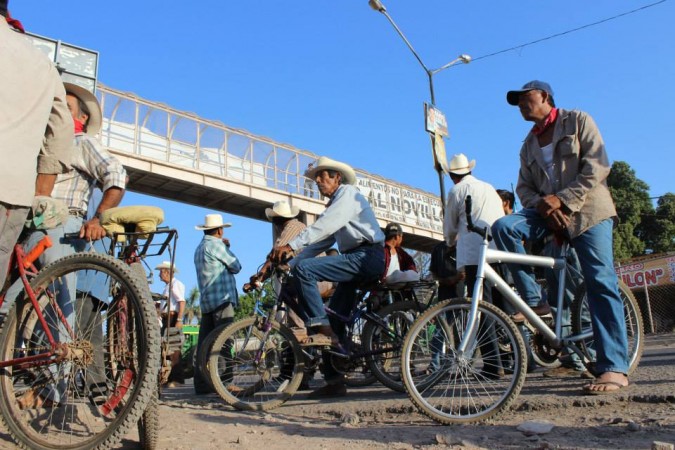
 14 July 2013 Vícam, Sonora, México – Traditional Authorities and the Yaqui people remain firm more than a week after the start of their road block of the international highway 15 (Mexico-Nogales) near the community of Vícam, announ
 14 July 2013 Vícam, Sonora, México – Traditional Authorities and the Yaqui people remain firm more than a week after the start of their road block of the international highway 15 (Mexico-Nogales) near the community of Vícam, announcing that they will take stronger actions. The action is in response to the state government’s refusal to stop the operation of the Independence Aqueduct that has illegally extracted the first volumes of water from the El Novillo dam.
Extraction began in early May, even though the state government did not have permission from the National Water Commission (CONAGUA) to transfer the water. There is also a Supreme Court (SCJN) resolution that ratified protection for the tribe pending the Environmental Impact Assessment (MIA), which is required to legally begin taking the water.
On May 8, the Supreme Court ruled in favor of the traditional authorities of Vícam, citing the dossier 631/2012 for violation of their right to consultation by the Ministry of the Environment and Natural Resources (SEMARNAT). However, neither the Sonora state government nor federal authorities have complied with the Supreme Court’s decision to stop construction of the Independence Aqueduct. On the contrary, they have concealed the continual operation of the water pumps that CONAGUA helped to install to suck water from the Rio Yaqui near the dam El Novillo.
Since the announcement of the construction of the project through the media – the Yaqui were never directly consulted – the tribe has denounced the theft of water necessary for its existence, the illegality of the work and, above all, what they consider an effort to exterminate them by the Governor of Sonora, Guillermo Padres Elias. Elias was backed by then-President Felipe Calderon and now has the tacit support of President Enrique Peña Nieto, who has not spoken out or visited the state despite his campaign promises.
In Sept. 2011 and Nov. 2012, the tribe exercised its right to protest, intermittently blockading roads. As time passed with no response from any authorities or responsible parties, the blockades became semi-permanent on the highways, local roads and trails that connect the south and north of the state.
Currently, the blockade is on a highway located in an area recognized as Yaqui territory by presidential decrees in 1937 and 1940. The roads that connect to it pass through privately leased land, but the territory remains in the hands of the tribe.
Protests south of Sonora began with the mega-march on May 28 in Ciudad Obregon, called “Respect for the rule of law” and led by the Tribe and the citizen movement “No to Novillo”. Ending the march, the tribe and supporters began the roadblocks in the municipality of Cajeme to demand restoration of the rule of law due to the constant violations committed by the governor of Sonora. After holding assemblies to discuss continued civil resistance in the Vícam Traditional Guard, the tribe announced the installation of a camp with the roadblock in case CONAGUA does not turn off the pumps at the Novillo dam.
The “Defense Brigades of the Yaqui River” called to protest near the 47-kilometer point on the highway, visible from the pedestrian bridge. They issued a statement and invitation, calling on, “All members of the Yaqui tribe, traditional authorities and people in general…to participate in the protest on the road in Vícam as Guillermo Padres illegally connects a pipe to the Novillo dam, stealing water that belongs to us. This is water that is lacking in our territory that is used to irrigate our lands, and to consume without getting sick. It is very, very important for us to revive the Yaqui River that is completely dry now. ”
The statement also emphasized that, “They have already stolen a lot of our water, so we shouldn’t allow them to continue to divert it to someplace else; it is here where we need it. They have caused us a great deal of damage, so let us join our efforts and together rescue the water for all Yaquis who inhabit this territory. You don’t need to be a governor, captain, commander or secretary to defend your right to a dignified life. We are Yaqui and that’s enough to make your voice heard and to act.”
From the footbridge, where the tribe has set up tarps to maintain the protest, there is a long line of trailers, trucks, buses and private cars waiting for the military to give the order to pass. But given the absence of dialogue with the federal government, a solution appears far off. Meanwhile, ambulances are allowed to pass.
The Yaqui remain alert. In 2011 the state and federal police suppressed a similar demonstration. Recent statements by the state attorney general, Carlos Navarro Sugich, threatened intervention of the police; state Secretary of Government, Roberto Romero, has ignored the authorities of the Tribe; and the delegate of the Sonora Department of Communications and Transportation, Javier Hernández Armenta has indicated the possibility of filing against protesters before the Attorney General’s Office under Article 533 of the Law of General Means of Transit (Ley de Vías Generales de Comunicación).
The Yaqui are confident that the only lawbreakers are Governor Guillermo Padres, the “YES Sonora Capital Fund” (Fondo de operaciones Sonora SÍ) that is the financial force behind the project and federal agencies. In the fight to save their water, the Yaquis are achieving what years of government intervention has sought to avoid: the unity of the “Eight Traditional Peoples”. The Yaqui authorities of Guamúchil Loma who have been pro-government in recent years (known as “torokoyoris”) have joined the blockades.
Social networks are also serving to expose and report what happens in Vícam, compared to little or no information reported in local media. The media has focused on sensationalist aspects such as violence, extortion, insecurity, and economic losses. They generally ignore the Yaqui perspective.
In the heat of summer with the high temperatures of the Sonora desert, day and night, women and men of all ages concentrate on the side of the road. They will announce stronger measures if they receive no answer. They say in the Jiak language: “Namakasia achaim kaabe amau tawabaane” (stay strong, friends. Nobody should stay behind). Women fix meals, people come in from other Yaqui villages, and the tribal flag waves, announcing that autonomy is lived every day and it is defended every moment.
Fernando, a Yaqui from the Yoeme group and a firm defender of water rights, makes a sign to remember the ancestors who died defending Yaqui territory. “The smell of rebellion fills the air here in Vícam. In the faces of my fellow brigade members, you can see the signs of our future victory. Namakasia ” he concludes.