
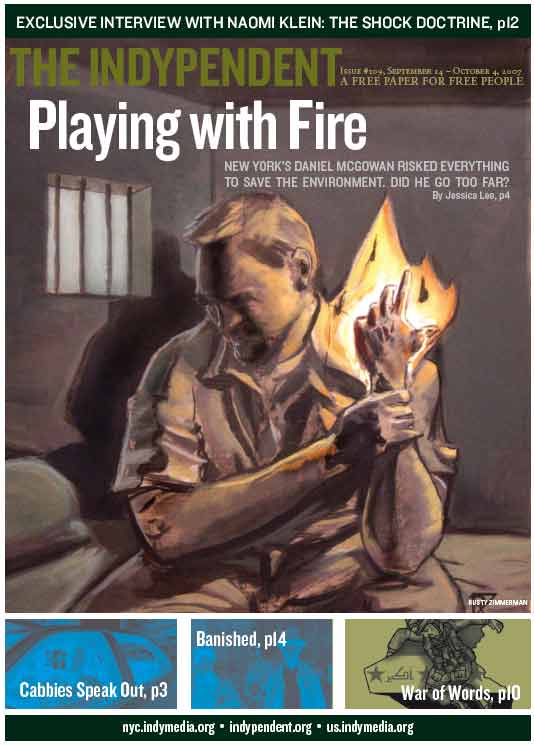
 Growing up in New York City, Daniel McGowan saw first-hand how pollution fogged the air and fouled the beaches in some of the city’s poorest communities, setting him on a lifelong path of environmental and social justice. But how he ended up drenched in gasoline and setting fire to Oregon’s Jefferson Poplar Farms in 2001 and was later targeted as a “domestic terrorist” is the story of someone who cared too much and didn’t know what else to do.
Born in Brooklyn and raised in Queens’ Rockaway Beach, Daniel McGowan grew up sandwiched between asphalt and the sky, in a forest of buildings and buzzing streets. Until Dec. 7, 2005, the 33-year-old with a round face and a chipmunk smile was mostly known in local circles for his involvement in a variety of activist projects. Today, after a nearly two-year legal battle that saw him labeled an “eco-terrorist” by the U.S. government, McGowan is serving a seven-year sentence at a federal prison in Minnesota on 15 counts of arson, attempted arson and conspiracy to commit arson against two private companies in Oregon in 2001.
McGowan, whose arrest shocked his family and friends, and his case was lumped together with nine others as part of the Federal Bureau of Investigation’s Operation Backfire, which produced 65 indictments for actions at 17 targets, including private companies, universities and government facilities across five states from 1996-2001, in what the FBI called a “campaign of domestic terrorism.” The actions were all claimed by the Environmental Liberation Front (ELF) or the Animal Liberation Front (ALF), an underground, decentralized movement of radical environmentalists, which McGowan participated in between 1999 and 2001 while living in Eugene, Oregon.
“At a certain point, I got involved in the ELF,” McGowan told The Indypendent at his Brooklyn home in June, a few weeks before reporting to prison. “At the time it seemed like a natural progression, but it also coincided with my increasing grief and rage I was feeling about the environmental destruction I saw. I went to Oregon and I couldn’t believe how okay people were with what was going on. We’d drive to the edge of town and you saw the logging mills, or you went into the forest and stumbled upon a clear cut. It just blew me away. I had to find a way to channel that grief and rage.” The dilemma McGowan faced has troubled activists for generations. When you try every form of “acceptable” advocacy to make change with little success, what do you do?
“A Campaign of Domestic Terrorism” In the middle of the night on May 21, 2001, McGowan found himself in the vehicle shop of Jefferson Poplar Farms in of Clatskanie, a small town in northwest Oregon on the Columbia River. He had just finished laying out soaked gasoline sheets and towels connected to a homemade incendiary device, designed to set fire to a fleet of SUVs and the company office. The privately owned facility had been selected as an ELF target because McGowan and his accomplices believed it was involved in genetic research by growing a hybrid variety of poplar-cottonwood trees that would help timber companies replace the region’s old-growth forests with commercial tree farms.
“We torched Jefferson Poplar because hybrid poplars are an ecological nightmare threatening native biodiversity in the ecosystem,” the saboteurs wrote in a communique that was released after the action. “Our forests are being liquidated and replaced with mono-cultured tree farms so greedy, earth-raping corporations can make more money.”
“At some level, I thought it [ELF actions] was effective,” McGowan said. “If I would have written a statement that I think genetic-engineered trees are bad and oldgrowth logging is bad and sent it to every media outlet in the country, it wouldn’t have been paid attention to,” he explained. “There is something really strange about when you attach a statement to an arson it suddenly becomes newsworthy … it is like propaganda with teeth.”
For McGowan, the actions were part of his search for the right mix of tactics to make positive change.
“For me, the actions were not grotesque or not about destroying things. I had a hard time getting into the mind set to destroy other people’s stuff or even living [genetically modified] organisms,” he said. “I would get sick before actions, get nervous — it was really difficult. But I did it because I felt that the other things weren’t working, and that while there was a preponderance of other tactics being tried, these tactics weren’t being tried and I thought that maybe there is something we can do to help the issue.”
Between 1996 and 2001, an underground cell of activists based in Eugene, Oregon, called “the Family” in government documents, targeted federal and university research facilities, meat and lumber companies, a car dealership, wild horse corrals and other “earth rapers,” as described by communiques released at the time.
According to the FBI, the string of high profile actions that hit 17 targets in the Pacific Northwest in the late 1990s caused nearly $80 million in property damage. These actions are only a few of the more than 600 incidents claimed by the ELF and ALF nationwide since 1996. “I think that’s really what all these actions are about — is really getting public attention to some of these issues,” said Jim Flynn, a Eugene-based environmentalist in a July 2007 USA Today article. “If we were able to affect policy change through more legal means, then certainly that’s the way these people would go. Nobody enjoys being underground, and that lifestyle.”
TO CONTINUE READING ARTICLE, VISIT: http://www.indypendent.org/2007/09/15/enemy-of-the-state/
SIDEBAR ARTICLES:
Why Green Makes the Right See Red
http://www.indypendent.org/2007/09/15/why-green-makes-the-right-see-red/
The Birth of a Buzzword: “Eco-terrorism”
http://www.indypendent.org/2007/09/15/the-birth-of-a-buzz-word-eco-terrorism/
NOTE: See Ron Arnold’s response)
The Net Widens: Free Speech on Trial
http://www.indypendent.org/2007/09/15/the-net-widens/
Underground Eco-defenders
http://www.indypendent.org/2007/09/15/underground-eco-defenders/
Please leave comments on the articles if you want!
THE INDYPENDENT is the newspaper of the NEW YORK INDEPENDENT MEDIA CENTER – www.indypendent.org
|||||||||||||||||||||||||||||||||||||||||||||||||
For his address to write to, other eco-prisoners, tips for writing etc, go to http://www.spiritoffreedom.org.uk