
 8th August 09.
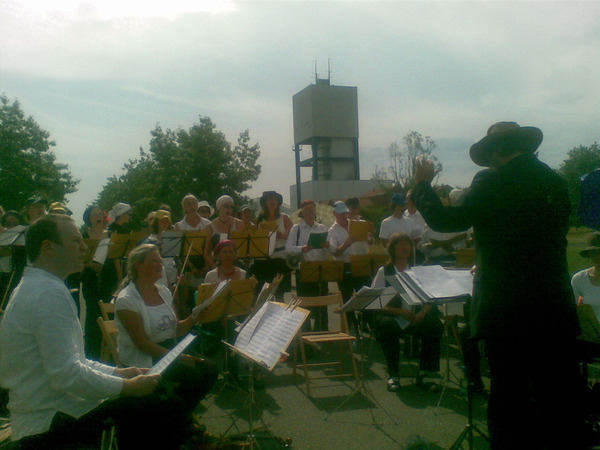
Today at 10:30am 60 musicians from the action group “Lebenslaute”, packed with instruments and music stands, climbed the four meter high wall around the site of the planned final storage site in Gorleben (Germany) and began a protest concert with mainly classical music.
The musicians surprised with their action, originally announced for Sunday. With this “musical inspection” the activists protest against the continued operation of nuclear power plants and against the continued exploration of the salt mine in Gorleben for use as a final nuclear storage site.
“The discussion about nuclear power is about the live of coming generations, but the public does not take the danger seriously enough”, says Berthold Keunecke, a protestant priest from Herford and one of the spokespersons of Lebenslaute. Today we overcame the fences and walls of Gorleben, to effectively protest against nuclear technology which is threatening our lives. We want to awaken, provoke, dramatise – and we all, each one of us individually, stand up for this provocation.”
“The nuclear lobby wants to continue the work to turn salt dome in Gorleben into a final storage site, although the scandals around the salt mine Asse finally made clear, that Gorleben too is not save”, declares Katja Tempel, midwife and Lebenslaute spokesperson from the Wendland. “In the light of the unsolved question of the final storage of nuclear waste, we demand an end to the production of nuclear waste, that is the shutdown of nuclear power stations. The use of renewable energies has to be promoted.”
Under the slogan “A-Moll statt A-Müll” (A-minor instead of A(tomic)-waste” a varied and ambitious programme for choir and orchestra is being performed: the works of Georg Philipp Telemann, Willy Burkhard and Fanny Hensel, performed by “Lebenslaute” celebreate the beauty of nature, which is to be preserved. As an accusation and call for urgent action against the deadly dangers of nuclear energy, “Lebenslaute” will perform Heinrich Schütz’ Choral „Wie nun ihr Herren, seid ihr stumm” (What now, you men, are you silent), as well as parts of symphony No 101 “Die Uhr” (The clock) by Joseph Haydn and a choir version of “It`s my life” (Bon Jovi). Chamber music in different instrumentations concludes the concert.
“The music is an expression of the energy of different generations. With this, our action fits well into the broad spectrum of creative resistance in the Wendland”, explains Katharina Dehlinger, Lebenslaute activist from the county of Paderborn. “It is better that lively music comes through the walls and fences of the mine in Gorleben, than deadly nuclear radiation. The salt dome in Gorleben is not suitable for a save final storage of nuclear waste. The project has to be abandoned.”
With the combination of actions of civil disobedience and mainly classical music the initiative “Lebenslaute” has been raising awareness for wrongs in society for more than 20 years. The initiative includes politically active musicians from all over Germany.
Up-to-date photos (also in printing quality) will soon be available at http://www.lebenslaute.net