
 8th May 2014 Nina Popravko, one of the few professional environmental lawyers in Russia, is defending in court a group of a dozen activists in the small town of Kozmodemiansk, in the Mari El Republic on the
 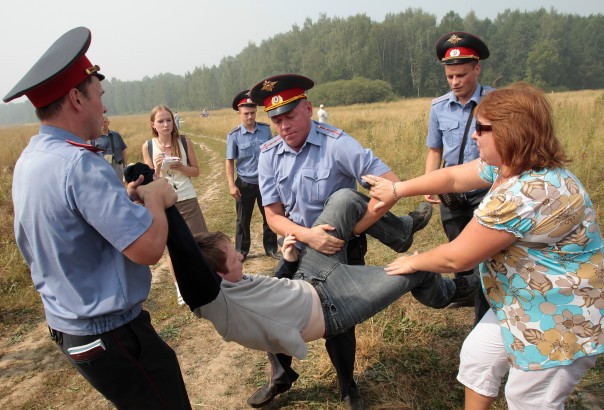 8th May 2014 Nina Popravko, one of the few professional environmental lawyers in Russia, is defending in court a group of a dozen activists in the small town of Kozmodemiansk, in the Mari El Republic on the Volga River. They have been fighting for years against plans to build a domestic waste landfill, which they say is too close to a residential block.
Straight after court hearings in the case, Popravko jumps on a train to Ufa, a city with more than a million inhabitants in the south Urals, where several hundred people are trying to organise an independent public hearing about the construction of a wood-processing factory.
Back at home near St. Petersburg, where Popravko lives and works for the environmental non-governmental organization Bellona, another fight is under way.
A group of activists are mobilising after the felling of almost 200 large pine trees to make way for a new luxury residential housing development. The activists are filing a lawsuit against the development company, which they believe acquired the plot of land illegally, as part of their drive to stop further logging in a larger forest area.
“I really notice the growing involvement of many ordinary people in the environmental movement,” Popravko says.
City dwellers across Russia are getting organised and fighting for their environmental rights at a more professional level than before, the lawyer says. They are learning to file lawsuits, organise public hearings, and work with journalists and social networks, as well as building protest camps and obstructing construction sites.
Many such local initiatives get support from larger and longer-established environmental non-governmental organisations such as Greenpeace and WWF Russia, but many also are fighting on their own – sometimes successfully, sometimes not.
WHAT WORKS
There is no clear recipe for victory, says Alexander Karpov, an expert with the ECOM centre, who has spent more than 10 years supporting local environmental and urban initiatives all over Russia and helping them grow.
He recently began working as a consultant with the St. Petersburg Legislative Assembly, drafting laws and other legal acts, and bringing needed insight and expertise to the work of the regional parliamentarians.
Karpov argues that the success of any environmental cause depends on the amount of time and energy activists are prepared to spend protecting their rights. He also maintains that expertise is crucial, and that the more ‘professionally’ activists interact with local administrators, draft legal documents and engage in high-quality lobbying for their cause, the better the chance of success.
Public interest in environmental issues has been rising in Russia over the last few years. Some experts link this with the growing financial wellbeing of the country’s population, which is giving more citizens the opportunity to travel abroad, and to plan their future and that of their children.
CORRUPTION AND GOVERNANCE LINK
Other experts say it is a reaction to mounting corruption and “bad” governance, often at a local level, involving local authorities building corrupt ties with a local or national company while neglecting local residents.
The push toward greater environmental activism has been met with a mixed response by Russia’s leaders.
Nikolay Gudkov, a spokesperson for the Russian Ministry of Natural Resources and Environment, said his ministry was “actively working with citizens, environmental initiatives and activists – both through our community liaison office and through further online resources” such as the website Nasha Priroda (“Our Nature”), which was launched in late 2013 and allows people from all regions of Russia to report environmental violations in their neighbourhoods, using geo-location technology.
He said ministry representatives also have organised a few meetings with environmental activists working on notorious local conflicts – such as the fight over the wood-processing facility in Ufa, and a situation in central Russia where residents are fighting plans for nickel and copper mining.
But the Russian parliament, the State Duma, has also recently initiated a number of legal acts potentially hindering the rights of local activists and opportunities for wider public participation in city planning and regional development.
In late December, members of parliament tried to pass a draft law cancelling public hearing procedures for a number of infrastructure construction projects. However, after a civil campaign initiated by activists and environmental lawyers, the draft “got hung up,” Popravko said.In mid-March, however, another bill significantly reducing the number of situations in which public hearings must be held passed in its first reading. Environmental lawyers argue the bill contradicts Russian and international rules of law.
“The Russian Parliament is moving forward draft laws which seriously limit public participation” a group of environmental lawyers said in their public appeal. A campaign against the bill is ongoing.
URBAN FOCUS
One of the most popular environmental issues in Russia at the moment is urban ecology – the environmental aspects of cities’ development. That includes clean transport, a focus on air and water quality, the protection of green zones and parks, and sustainable consumption and lifestyles.
Such interest is centred mainly in large cities with populations of over half a million people, but it has begin springing up in small towns as well.
Roughly speaking, most of these civil initiatives fall into two groups, experts say.
The first comprise protest actions – against new building of infrastructure or housing, or against the destruction of a park, for instance. Such groups form quickly, and their success often depends on the solidarity and energy of their participants, as well as on the resources they can invest, experts say.
Groups of this kind initiate legal cases or public hearings, work with media and social networks, and organise protests – and quite often the groups fall apart after the case is won or lost.
The most complicated efforts are long-running ones that last several years, and can result in activists becoming worn out, losing energy and losing interest in the case.
Activists face a variety of threats, including physical violence or legal prosecution. Recently, environmental activist Evgeny Vitishko, from Tuapse in southern Russia, was jailed for three years for writing protest slogans and attaching posters to a fence around the villa of the Krasnodar governor.
Vitishko alleged the villa had been built illegally in a forest reserve and its owner had fenced off a stretch of the coastline.
A Vitishko support campaign has been launched, and “it is particularly important that we also get international support for the case – both for Evgeny Vitishko himself and for the growing environmental movement in Russia”, says Dmitry Shevchenko, a Krasnodar-based activist with the NGO “Environmental Watch of the North Caucasus.”
FILLING THE VACUUM
Another part of of Russia’s growing environmental movement consists of community and civil society activists trying to put bottom-up initiatives in place to “substitute” for failing state regulation, given the absence of an environmental agenda and policy mechanism at both federal and regional levels, experts say.
These groups build up environmental and volunteer networks in areas such as separating garbage collection, recycling, planting trees, taking care of parks and shores, and promoting eco-friendly agriculture and a green lifestyle.
One of the best-known organisations is the movement Musora bolshe net (meaning “no more rubbish”) created first as a volunteer initiative to remove trash from forests and lake shores and developed later into a full-scale network organisation, active in many projects from community recycling to environmental education.
Many such groups gather annually at a Delai Sam (Do it yourself) Summit, first only held in Moscow but now in other cities as well, to exchange practices, technologies and skills.
It is not only the young and trendy who take part in such initiatives. In some cities, groups are led by female pensioners using their free time to build up community do-it-yourself groups to improve the urban environment.
Still, quite often activists float from one environmental focus area to another. Tatyana Kargina, originally from Irkutstk and now living in Moscow, is one of Russia’s best-known environmental activists.
She set up a first eco-housing project in Moscow, one of the first Russian networks for environmental-friendly living and consumption, as well as other initiatives. During the last couple of years she’s also been active in a civil society protest action against plans to begin nickel mining in Voronezh region, Central Russia, an agricultural region rich with black soils, nature reserves and biodiversity.
SUSTAINABLE CITIES
Growing environmental activism in Russia also is focused on the need for more sustainable and inclusive city and region development. An Open Urban Lab uniting around 30 young professionals involved in urban planning, architecture, public participation and sustainable development, has been trying to introduce participation principles into city and neighbourhood planning in Russian cities recently.
The organisation, while working with regional administrations and business, sees “participation as a technology to transform social groups earlier not included in decision making into included ones, in order to create and sustain public good,” said Oleg Pachenkov from the Open Urban Lab.
The process of civil society development is hardly smooth or quick – but the trend is there, experts say.
“Quite often ordinary citizens don’t really want to become activists, don’t want to spend all their free time campaigning, protesting, talking to media, promoting the case in social networks 24 hours a day,” said Popravko, the lawyer. “But after realising that they can’t really appeal to anyone, not to city authorities, not to control bodies, they just have to become activists themselves and try to influence the situation, which they reckon affects their lives and living environments.”