
An action report as promised.
All cameras were seized by police – instead sketches have been drawn to document the action.
A group of individuals who met through the Rising Tide network and were inspired to take direct action against the route causes of climate change. They maintain an 8-hour blockade of coal trains carrying fuel from Ffos-y-Fran open-cast coal mine to Aberthaw power station.
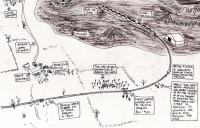
An aerial view of the mine, the protest groups and the police response
ACTION
On 26th April 2010 in the early afternoon a group of individuals made their presence known to staff and security at Ffos-y-Fran open-cast coal mine in Merthyr Tydfil. Having ensured their presence around the tracks was known and no trains would be leaving until they were removed, they proceeded to lock themselves to the train track using chains and super glue. This single track is used to transport train-loads of mined coal to Aberthaw power station, and the first and only train for the day was due to leave soon after. Legal observers and support were present.
It took a long time for police to make the lengthy journey from the nearest police station, however they sent their friendly neighbourhood helicopter on plenty of pointless gas-guzzling jaunts around the area. Once the police properly arrived they immediately arrested the four support people, placed them in handcuffs and made them wait beside the track while a cutting team arrived to remove the group who had locked on to the rails. Despite the handcuffs, the support team continued to provide food and water to the lock-on team. Later the police also arrested the legal observer who was clearly on the other side of the fence and not on the track. After approximately 4 and a half hours of lengthy response times and a paper-chain of police bureaucracy that group was removed and arrested.
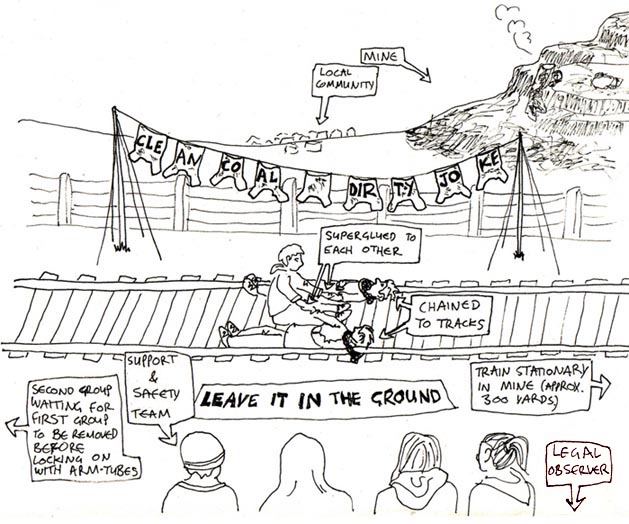 The first group locked on complete with washing-line banner
As this group of people were being led off the train tracks they informed the police of some incredibly irritating news. A second group had been hiding just round the corner and were as they spoke emerging and locking onto the tracks with heavy duty lock-on tubes. Clearly too exhausted from their hard work operating bolt croppers to take a quick stroll down the line to check this out, the helicopter took to the skies once more. One quick swoop confirmed what it had failed to notice on its many swoops earlier – four protesters with a legal observer and support, cheerfully waving from the train track before, now finally sure their presence had been noted, calmly taking their places on roll mats and rugs and locking on inside two lock-on tubes placed in convenient gaps under the railway line. By this point it was 5.00pm.
A network rail engineer ran a couple of hundred metres down the tracks to check upon the new group. The police drove. Again on arrival they immediately arrested the legal observer and support, who were cheerfully reading a novel to those locked. Despite failing to produce on demand a Risk Assessment of the cutting operation (but plenty of whinging about how dangerous it is) it took the cops until 8pm to cut open the tubes – one of which was multi-layered, and the other of which had a very thick metal layer. A special groan was reserved for when they realised the protesters had not just chained but also superglued their hands together inside the tubes and had to send for some industrial glue remover.
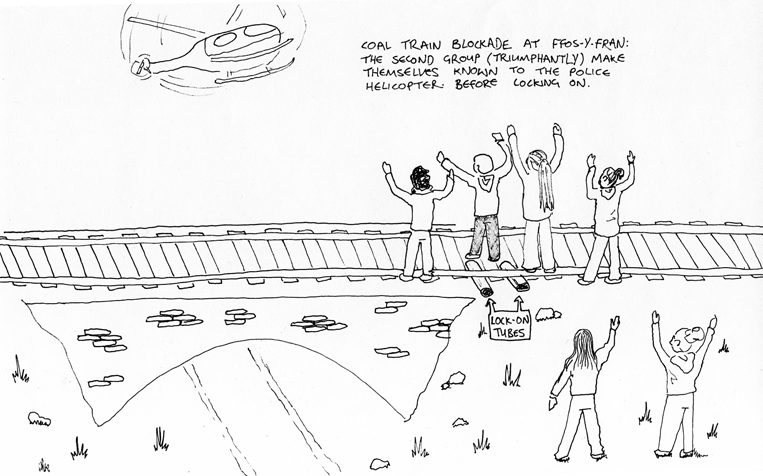 The second group flagging down the chopper before locking on
All arrested were taken to Ystrad Mynach Police Station. This included four people who were enjoying a nice day out in the beautiful surrounding countryside, who the police arrested out of some kind of belief that they were in some way involved. In total 18 were arrested and spent 24 hours in the cells. It is believed that no coal left Ffos-y-Fran that day.
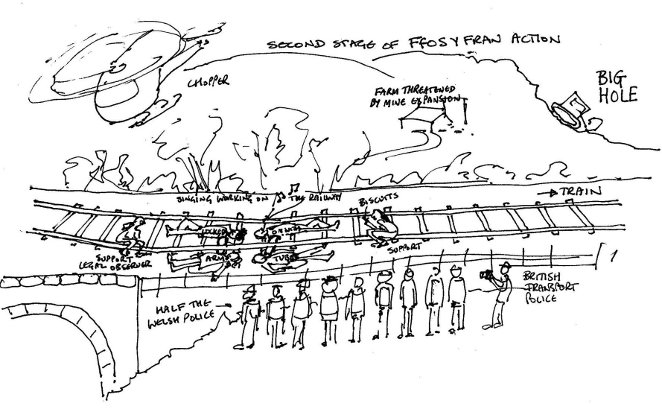 The second group in position
CONSEQUENCES
All arrested were taken to Ystrad Mynach Police Station. This included four people who were enjoying a nice day out in the beautiful surrounding countryside, who the police arrested out of some kind of belief that they were in some way involved. In total 18 were arrested and spent 24 hours in the cells.
It appears that legal observers and support roles were originally arrested on suspicion of conspiracy, however they were subsequently charged with the same charge as those who had locked on. All 18 were eventually charged with “Unlawful Act With Intent To Obstruct The Railways” contrary to section 35 of the Malicious Damage Act 1861. This rather quaint law designed to protect the interests of private landowners over 150 years ago carries a rather less quaint maximum sentence of life in prison. However the protesters have stated that they are not anticipating anything approaching that kind of sentence as the law is obviously out of date and ample safety measures were taken to ensure there would be no danger to the train, the train driver, the police or the protesters.
All were bailed to return to Merthyr Tydfil Magistrates Court at 10am on 10th May 2010. All were bailed “not to be upon or allow yourself to be upon any property owned, leased or rented by British rail network”. They were allowed to travel home by train that day however any future train trips had to be cleared by arresting officers. Those who gave fixed addresses were bailed to reside at those addresses. Those who did not give fixed addresses were bailed to reside at contact addresses, despite making it clear they did not have any permission to live there and had no connection with those addresses other than being able to receive post from those addresses. Some were also bailed to sign in regularly at local police stations. One of those arrested was bailed to reside in Cornwall but sign in daily at Bath Police Station without the use of trains!