
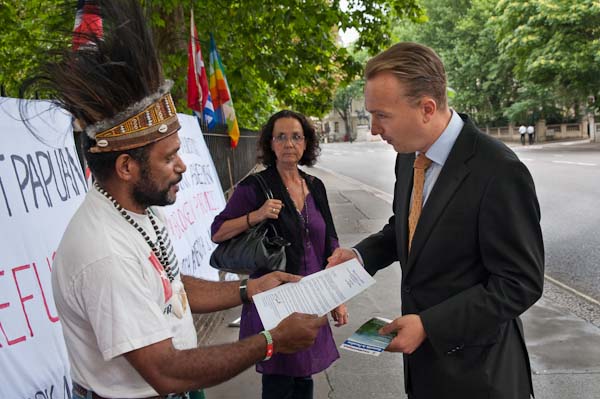
 Benny Wenda, West Papuan independence leader and chairman of the Koteka Tribal Assembly, and most of the rest of the small handful of West Papuans living in Britain demonstrated opposite the Netherlands Embassy in London on Fri 14 Aug, to mark the anniversary of the ‘Day of the Broken Promise’, 15 August 1962.
The western half of New Guinea became a Dutch colony in the nineteenth century, but by the 1950s they were moving towards giving it independence. However the Indonesian goverment claimed the country and threatened invasion after then Dutch set up an elected government of West Papua in 1961.
Indonesia was backed by military aid from the Soviet Union, and the Kennedy administration in the USA wanted to prevent further movement of the country towards the Soviet bloc, so pressured the Netherlands into signing the ‘New York Agreement’ with Indonesia in August 1962. This allowed Indonesia to take over the administration of the country but provided for all the adult population of West Papua to vote at a later date on whether they wished to become independent.
The Indonesian army moved in on 1 May 1963 and began a programme of repression and human rights abuse against the people. In 1969 they rounded up and detained just over a thousand West Papuans as representatives of the people and enusured that they voted for rule by Indonesia by threats, including at least in some cases that they and their families would be killed unless they did so.
The Indonesian government made it impossible for the UN represenatative who was supposed to oversee the election to operate properly, and banned most foreign reporters. Although it was clear that the vote did not reflect the will of the West Papuan people – and had failed to meet the terms of the agreement – which had been ratified by the UN – it was approved by the UN General Assembly.
Since then there have been many reports of repression by Indonesia in the country, including murder, political assassinations, torture, rapes, dissapearances and bombing. The government also had a programme of resettling migrants from Indonesia in the country, apparently aimed at producing an Indonesian majority population.
West Papuans have engaged in both civil disobedience – particularly around cermonial raising of the West Papua flag (the Morning Star) as well as armed resistance.
Wenda was jailed for displaying the West Papuan flag (on his chest and at top right of picture) but managed to escape and gain asylum in the UK. Estimates of the number of West Papuans killed by Indonesian repression are in the hundreds of thousands (400,000 according to the Free West Papua Campaign), and in 2006, 43 refugees landed in a traditional canoe in Australia, claiming the Indonesian military was carrying out a programme of genocide.
Despite a widespread recognition of what has been happening, there is little international support for West Papua. The country has the world’s largest copper and gold mines, largely owned by US Compnay Freeport-McMoRan with UK based Rio Tinto Group also involved.
Today’s demonstration was peaceful and tuneful, with Benny and Maria Wenda and others playing instruments and singing traditional West Papuan songs opposite the embassy.
A Dutch diplomat came across the road to talk to the demonstrators and receive a letter demanding that the Netherlands and other governments insist on the proper implementation of the 1962 agreement, with a free and fair independence referendum involving all West Papuans overseen by the UN. Papuans feel they were let down by everyone involved, but particularly by the Dutch; “We trusted you and we believed in you. But you betrayed us.”
The diplomat spoke for a few minutes with the demonstrators and was interested to see a feature on the rebel army there which appeared in today’s Independent on display.
http://www.independent.co.uk/news/world/australasia/bows-arrows-and-a-dream-of-liberation-1771884.html
After the demonstration at the Netherlands Embassy the protest was moving to the Indonesian Embassy in Grosvenor Square, where the West Papuans hold regular protests.