
 14th June
 14th June
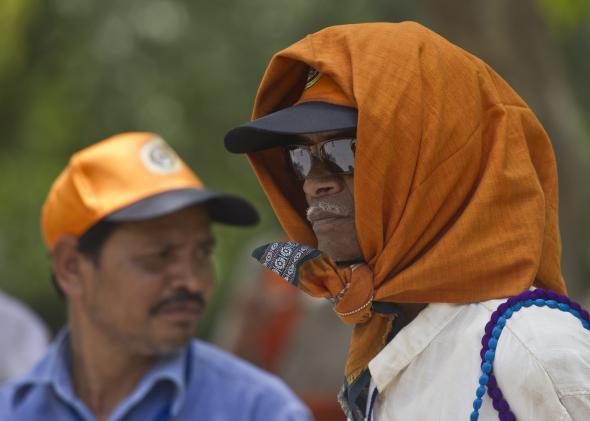
Under relentless heat, India is reaching the breaking point.
As the country tries to keep cool, the power grid is failing. Rioting protesters in the north of the country set fire to electricity substations last weekend and held power workers hostage, accusing the government of distributing scarce power resources based on political preference.
From Al Jazeera:
Residents had been particularly angry about the power cuts after receiving reliable supplies through the Indian elections, which ended May 16. Since then, only some regions have been guaranteed unbroken power supplies, while others have received little to none.
The High Court in the city of Allahabad is now hearing a petition alleging discrimination in power distribution, and has asked the government to explain why some regions appeared to be receiving preferential treatment.
Those regions include the city of Varanasi, the parliamentary constituency of new Prime Minister Narendra Modi, as well as constituencies held by Yadav and other top officials in Uttar Pradesh’s ruling party.
As Slate’s Joshua Keating reported recently, a study this year by Lakshmi Iyer of the Harvard Business School and Petia Topalova of the International Monetary Fund found a connection between extreme weather (particularly lack of rainfall) and increased crime in India.
Meanwhile, the heat continues. On Wednesday, New Delhi enters day 10 of a blistering heat wave that’s broken at least one long-standing record, with part of the city peaking at 118 degrees Fahrenheit (47.8 degrees Celsius) on Sunday. During that stretch, the average high temperature at the airport in New Delhi has been 109.9 Fahrenheit (43.2 Celsius), with the average low an astonishing 84 Fahrenheit (28.9 Celsius). Days upon days with nighttime low temperatures above 80 Fahrenheit can be deadly, especially for those without a way to keep cool.
If there’s any consolation, at least that’s a dry heat. The dewpoint—the amount of moisture in the air—has been low all week across northern India, with dry air helping to boost the effectiveness of built-in human air conditioning (evaporation of sweat) and making the temperature feel somewhat cooler in the shade.
Areas farther south, near where the monsoon was advancing, were even more unbearable. Just after midnight Wednesday local time, the heat index was still 110 Fahrenheit (43.3 Celsius) in Mumbai. Yep, 110 degrees. At nearly 1 in the morning. I simply can’t fathom existence in those kinds of conditions. Hindu priests thereperformed special prayers for rain to relieve the sweltering country of its misery.
The good news: The end of this scorcher is in sight as the monsoon continues to advance northward. The bad news: In some of the hardest-hit places, like Delhi, that end is still a week away. High temperatures there are expected to stay above normal until next Tuesday.
A developing tropical cyclone is helping to surge monsoon moisture northward along India’s West Coast this week, though it’s still going to be quite some time before the cooling monsoon breezes break this heat wave for good. India’s monsoon was five days late and is expected to bring below normal rainfall this season, in part because of a building El Niño.
Since the forecast of a weak monsoon, India’s government has initiated a contingency plan designed to relieve pressure on its overtaxed power grid, reported the Times of India on Tuesday. Two years ago, India suffered the worst blackout in world history, putting some 600 million residents in the dark. Much of India’s electricity generation comes via hydroelectric power. The monsoon season in 2012 was also below average, and demand for electricity is soaring as a burgeoning middle class buys more and more air conditioners.
As the New York Times’ Elisabeth Rosenthal wrote at that time, “We can’t live with air-conditioning, but we can’t live without it.” In a more temperate climate, Americans use more electricity on air conditioning than the rest of the world combined. Rapidly expanding use of air conditioning in tropical countries will further boost global warming through the release of heat trapping gases. It’s a Catch-22.
India, for one, is warming to air conditioning. In 2007, only 2 percent of India had air conditioning, but that number is rapidly increasing. The hot weather of the past few weeks has boosted sales of air conditioners by 15 to 20 percent compared with last year.
This month’s oppressive heat wave already bears the fingerprint of global warming. Over the last 100 years, India’s average temperature has warmed by about half a degree Celsius (PDF), and monsoons are getting more extreme. The warmest time of the year is typically just before the monsoon hits, when temperatures routinely top the triple digit mark in the otherwise semi-arid north.
This year, though, has been anything but routine.