
 May 23, 2010
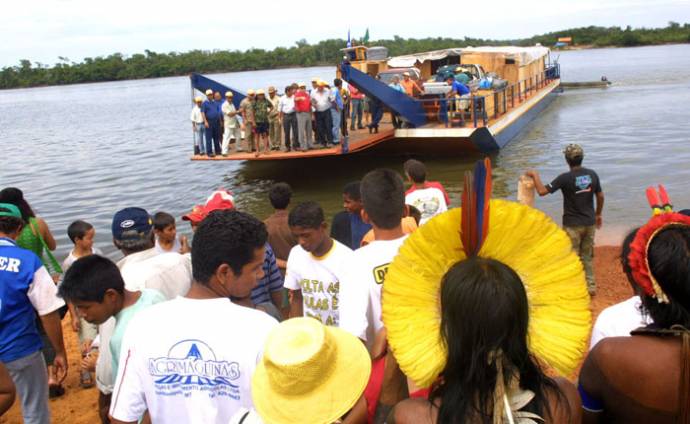
It’s been exactly one month to the day since a group of Kayapo set up a ferry blockade across the Xingu River in an ongoing protest against the controversial Belo Monte hydro dam.
The Kayapo were dispatched to the site on April 22, the same day Brazil’s government granted out rights to build the dam
Sadly, the effort has received little media coverage since then, even with a constant reference to celebrity activists Sting and James Cameron.
Nevertheless, as the front line effort heads into its second month, the Kayapo warn that they have no intention of backing down unless the government cancels the project.
The Kayapo Continue Blockades in Protest of the Belo Monte Dam
by International Rivers and Amazon Watch
For Immediate Release
May 21, 2010
The Kayapo Continue Blockades of Amazon Highway for the 28th Straight Day in Protest of the Belo Monte Dam
Brazil’s Indigenous Peoples Vow to Block Dam Construction or “Die Fighting for our Rights”
Piaraçu, Xingu National Park, Brazil – A group of Kayapo indigenous people led by Chief Megaron Txukarramãe have been blockading the Xingu River crossing of the BR-80 – a major Amazon highway in Mato Grosso State – since April 23 in protest of the government’s plans to build the massive Belo Monte Dam. Dozens of Kayapo warriors have been blocking the ferry crossing over the Xingu River for four weeks and are determined to remain there. Their actions have disrupted a major transportation artery for commercial goods in the region.
In a statement issued from the blockade, Chief Megaron referred to President Lula as “enemy number one” to Brazil’s indigenous peoples, and vowed to maintain the blockade until Belo Monte is canceled or “die fighting for our rights.”
Chief Megaron has been joined in these protests by Kayapo Chief Raoni Metuktire, an emblematic leader for over 20 years of indigenous resistance to the Brazilian government’s plans to dam the Xingu River. In a May 1st interview with the French channel TF1, Chief Raoni said “I have asked my warriors to prepare for war and I have spoken of this with other tribes from the Upper Xingu. We will not let them [build this dam].”
Leaders of the Arara, Xipaia and Juruna indigenous peoples of the Lower Xingu echo the vociferous opposition of the Kayapo to the Belo Monte Dam, and have also vowed to lay down their lives to stop the project, which would destroy their communities and livelihoods. “We are firm in this struggle, and continue more strong and determined than ever to stop Belo Monte,” said the leader Sheyla Juruna. Attempts to stop the Belo Monte Dam became known around the world last month when filmmaker James Cameron and members of the cast of Avatar joined protests in Brasilia and visited villages on the Xingu River and its tributaries to hear about the plight of the region’s indigenous people.
Slated to be the 3rd largest hydroelectric project in the world, Belo Monte would divert over 80 percent of the Xingu River’s flow through artificial canals, flooding over 500 sq km of rainforest while drying out a 100 km stretch of the river known as the “Big Bend,” which is home to hundreds of indigenous and riverine families. Though sold to the public as “clean energy,” Belo Monte would generate an enormous amount of methane, a greenhouse gas 20 times more potent than carbon dioxide.
Despite legal injunctions against the project’s auction, the Brazilian government announced that the auction’s winning consortium, “Norte Energia,” would proceed with plans to dam the Xingu River. President Lula’s insistence that the project move forward at all costs – in spite of serious social, environmental and financial concerns, as well as a massive local and international outcry – continues to be met with fierce denouncements from indigenous people of the Xingu Basin.
“The destruction that would be caused by the massive Belo Monte Dam in the globally essential Amazon Basin would have worldwide ramifications that can’t yet be fully comprehended. Indigenous people are determined to disrupt the ‘business as usual’ model of destructive development projects that ruin the environment and their traditional ways of life,” said Atossa Soltani of Amazon Watch. “Indigenous groups from the Xingu Basin have sent the Brazilian government a clear and resounding message that they will not allow the Belo Monte Dam to move forward. A Brazilian and international coalition of organizations and social movements stands in solidarity with these groups, and is mobilizing further social and legal actions.”