Ecuador round-up: indigenous blockades, kidnappings & other protests against mining

Indians Block Ecuador Highways to Protest Mining
January 20, 2009
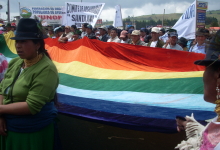
QUITO — Indian groups in Ecuador started blocking highways before dawn Tuesday in protest against the new mining law, while Interior Minister Fernando Bustamante asked that the demonstrations be carried out peacefully.

Indians Block Ecuador Highways to Protest Mining
January 20, 2009
Ecuador marchesQUITO — Indian groups in Ecuador started blocking highways before dawn Tuesday in protest against the new mining law, while Interior Minister Fernando Bustamante asked that the demonstrations be carried out peacefully.

The Confederation of Indigenous Nationalities of Ecuador, or Conaie, and some environmental groups called for nationwide protests against the new law, which they believe will harm the environment and favor multinational mining companies.

According to media accounts, indigenous groups began blocking highways at sunrise, above all in the country’s Andean region, although government officials said that these demonstrations were not really significant.

North of Quito some 1,000 Indians stalled traffic before dawn on the Pan American Highway with tree trunks and stones, witnesses said.

Those blockades and similar actions have not resulted in any serious clashes with police, authorities said.

Miguel Torres, an Indian leader in the northern province of Imbabura where the police have kept the road to the capital from being cut off, said on Radio Quito that “the blockades will be progressive.”

Another Indian leader said on the Teleamazonas network that police stopped demonstrators from entering the capital for a planned demonstration and march to Congress.

“Groups that want to protest against the mining law or anything else can do so, they have the right, they have freedom of expression and can give their points of view, but we are going to require that they do so with respect for law and order,” the interior minister said in an interview on Sonorama radio.

“If they block highways or take any other action that keeps people from carrying on with their normal lives, we’ll have to intervene and do what the law requires in such cases,” Bustamante said.

After the statement President Rafael Correa made Monday that there are groups out to destabilize the government, the minister said that “some leaders” of these groups may have such an intention, but he doesn’t believe “that together the demonstrators have that idea.”

Correa, a left-leaning, U.S.-trained economist, says the new mining law includes environmental safeguards and accuses the measure’s opponents of engaging in “childish leftism and environmentalism.”

———

Ecuador Anti-Mining Blockades Met With Repression, National Mobilization Called for January 20
9 January 2009

The ongoing conflict over mining in Ecuador escalated this week as blockades shut down highways throughout the country’s Southern Andean highlands and Amazon rainforest, while nationwide protests have been called for January 20.

The government of President Rafael Correa has assumed an aggressive posture, insulting indigenous and environmental activists and pledging to secure approval for a controversial new Mining Law. Canadian companies hold the majority of mining concessions in Ecuador and are pressing for a new law that would allow for large-scale, open pit metal mining.

A number of leaders have been arrested and other protesters were beaten and shot at by police. Campesino and indigenous protesters, who depend on clean water to farm and for drinking water, are demanding that the government shelve President Rafael Correa’s proposed Mining Law, saying that it would be a social and environmental disaster. The rural blockades follow months of regular protests in Quito and other parts of the country.

Protesters also argue that the law contradicts important provisions of the new constitution protecting water, the environment and indigenous peoples’ rights. The document drew international attention for awarding legal rights to nature. The new constitution, approved by popular referendum in September, is the centerpiece of Correa’s first term.

After emergency meetings on January 7, the Confederation of Indigenous Nationalities of Ecuador (CONAIE) called for a national mobilization on January 20, calling the government “dictatorial.” It is unclear whether the January 20 mobilization will spread road blockades to other provinces in central and northern Ecuador. Protesters are demanding a dialogue with central government leaders and for a broad national discussion on mining before any legislation is passed.

Some protesters in the Southern provinces of Zamora Chinchipe and Morona Santiago suspended their blockades for 24 hours in response to the provincial governor’s promise to reach out to Francisco Cordero, the President of the Congresillo, Ecuador’s interim legislature. Other blockades were suspended in anticipation of the nationwide actions.

The blockades began on Monday January 5 in the Southern province of Azuay, cutting off much of the traffic into and out of Cuenca, Ecuador’s third largest city. Over the next few days, the protests spread to the neighboring Andean province of Loja and to the Amazonian provinces of Zamora Chinchipe and Morona Santiago.

In Giron, Molleturo, Tarqui (Azuay), Limon Indanza (Morona Santiago) and in El Pangui (Zamora Chinchipe) protestors have been beaten or shot by police. Police officials and journalists were released after being briefly detained by campesinos.

On January 6, campesino leader Vicente Zhunio Samaniego was arrested in the Southern province of Morona Santiago, showing up 16 hours later in a hospital with bullet wounds to the head. On January 7, protest leader Miguel Ángel Criollo and his son Orlando were arrested in an early morning raid on the village of Pueblo Nuevo in Azuay province. The newspaper El Universo reports that over fifty police officers from the Special Operations Group (GOE) took part in the raid. When villagers tried to defend the Criollos from arrest, police fired tear gas, forcing the evacuation of a local school.

In the city of Cuenca, police violently repressed protests at the Court of Justice. As six leaders began a hunger strike inside the building, the police attacked a press conference taking place outside the building, arresting Water Board leader Carlos Pérez Guartambel. Police used tear gas to disperse protesters attempting to defend Pérez. Police then forced hunger strikers and four women supporting them out of the Court building, dragging them by their necks. The governor of Azuay denied that Pérez was arrested, and he was freed later that day. The six hunger strikers are now in Cuenca’s San Roque Church.

According to the newspaper El Comercio, Minister of Mines and Petroleum Derlis Palacios said that the government would push forward with the Mining Law. Palacios said that Ecuador “was a poor country that could not afford to just sit on these large resources.” He added that protests were the result of manipulation by indigenous leaders who mislead community members by claiming that mining would harm their access to clean water. Palacios said that the new law would ensure that water sources are protected. Congresillo President Cordero told El Comercio that protesters were using the demonstrations to advance electoral ambitions.

The CONAIE condemned the government’s description of protesters as “criminals and subversive terrorists,” saying that “the only thing we are fighting for is life and dignity for all of Ecuador’s citizens.” The CONAIE that such comments are aimed “to stigmatize [protesters] and prepare public opinion for even more severe repression.”

Correa is coming into increasing conflict with social and indigenous movement activists. On Thursday January 8, the United Labor Front (FUT), Ecuador’s largest labor federation, announced mass protests for a higher minimum wage increase for January 15. They say that Correa’s proposed increase of $18 a month, to $218, is a step back and fails to meet provisions in the new constitution ensuring that all Ecuadorians are paid a living wage.

———

Ecuador Protesters Release Police Doctor

8 January 2009
QUITO — Peasants protesting in southern Ecuador against the approval of a new mining law drafted by the government on Wednesday freed police Capt. Eduardo Castillo, a doctor who had been taken hostage at the beginning of the week, Ecuadorian media reported.

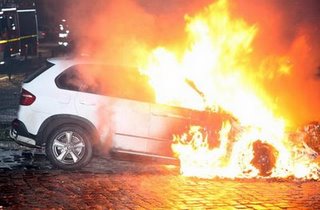
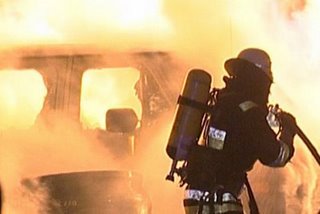
Castillo was taken hostage on Monday when demonstrators burned the ambulance he was riding in.

After spending 35 hours in captivity, Castillo is now in a clinic in Cuenca, in the southern mountainous part of the country, where he is recovering from bruises and cuts in several places.

“They kept me in a type of hole. I spent all morning there. They tied me up and beat me,” Castillo told reporters.

On the third day of the protests, small miners, peasants and environmental groups continued to block roads and engage in confrontations with police in the country’s southern provinces.

The demonstrators are asking that the mining law – which this week is being debated in the Legislative Committee – be shelved because they feel that it threatens the environment and favors the large-scale exploitation of mineral resources at the expense of small mining operations.

More than a dozen police have been injured and a like number of demonstrators have been arrested during the protests, which have been centered in the provinces of Azuay, Zamora Chinchipe and Loja, especially near the Andean city of Cuenca.

———

Ecuador Residents Protest Against Mining Without Environmental Protection
January 07, 2009
QUITO — Hundreds of peasants in Ecuador’s southern Andean region blocked roads on Monday to protest lawmakers’ expected approval of a new mining law that opponents claim doesn’t do enough to protect the environment and rural communities.

The militants piled sticks, rocks and piles of burning tires on the three main routes into Cuenca, the biggest city in the southern highlands.

Four protesters were arrested, three police officers injured and an ambulance set on fire in Molleturo, near Cuenca, reporters said.

The president of the Union of Water Systems in Azuay province, Carlos Perez, told journalists that the roadblocks will continue until Ecuador’s Congress either shelves the proposed legislation or sends a commission to the region to see the environmental harm done by existing mining projects.

The 120 police deployed to Cuenca were unable to clear the roads.

Separately, scores of independent miners arrived in Quito to demand that the congressional committee now reviewing the bill amend the text to include provisions legitimizing small mining cooperatives.

President Rafael Correa’s leftist government says the peasants’ objections to the proposed law are unwarranted, as the measure includes strict environmental safeguards.

The administration criticizes the demonstrators as “childish,” asserting that mining, if properly regulated, can be part of lifting Ecuadorians out of poverty.

Though the Andean nation produces nearly 600,000 barrels of oil per day, roughly 70 percent of the population remains poor.

———

Indigenous anti-mining protests hit Ecuador
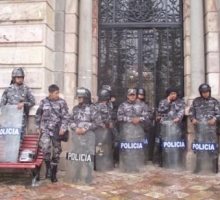
Ecuadorian policeOn Dec. 21, more than a thousand indigenous and campesino activists marched to the Ecuadorian National Assembly in opposition to President Rafael Correa’s proposed mining law. In the Southern Province of Azuay, campesinos blocked a number of highways, resisting police efforts to dislodge them. Protesters said that large-scale mining would damage Ecuador’s environment and pollute rural communities’ water.

The Mining Law, currently under debate in the provisional National Assembly, or Congresillo, would replace the Mining Mandate passed in May of this year. The Mandate froze mining operations and revoked a number of concessions to foreign corporations. The law would create a National Mining Company and increase state control over foreign corporations, which are largely Canadian. But the law would also allow mining to take place anywhere, including in protected areas and sharply limit community input.

In Quito, buses arrived from throughout the country to protest the mining law. Marching to the National Assembly, protesters clashed with police, who used pepper spray to push back activists intent on meeting with legislators. A small delegation was allowed to enter in the afternoon. The protests were organized by the Confederation of Indigenous Nationalities of Ecuador (CONAIE) and the Coordinator for the Unity of the Left and for Life, a new organization dedicated to regrouping social movements to confront Correa.

The march is possibly a prelude to a nation-wide uprising. While the protest was not large by Ecuadorian standards, representatives from many communities were present. Earlier this month, more than 30 organizations gathered in the Amazonian city of Coca and agreed to oppose Correa’s business friendly policies. Former Correa spokesperson and Assembly Member Monica Chuji said, “Today is a first step in a broader process of unifying social movements. Today we don’t have quantity, but we have unity.” Chuji, an Amazonian Kichwa, broke with Correa’s Alianza País Party in September, accusing the president of opposing indigenous rights.

Correa insists that responsible mining is necessary for Ecuador’s development. In November, Correa accused the indigenous movement of “losing their compass and playing into the hands of sectors that they have historically criticized, such as the Right, which the current administration is combating.” Correa has threatened to send the Mining Law to a national referendum if the indigenous movement alters it or blocks its approval, accusing the CONAIE of being anti-democratic.

But Dr. Byron Real López, an expert in environmental law, wrote in a recent report that the Mandate “is concerned with solving important issues. … such as the corruption surrounding the indiscriminate granting of concessions. But the proposed law ignores the ecological and social conflicts that mining activity causes. … and thus would tend to aggravate them.” López argues that the proposed law would violate a number of provisions in the new constitution, such as those protecting the rights of nature and indigenous communities.

Juan Francisco, a young Kichwa, traveled from the Southern province of Cañar. “We will never let them into our territory, which provides our water. Responsible mining is a miserable lie that the government wants to sell to us.” Juan Francisco said that the government should instead support sustainable and organic farming.

Despite Correa’s dismissive comments, it appears that the government is taking the movement seriously. Two days after the protests Ecuador’s interim legislature, the Congresillo, announced that they were considering extending discussion on the law by seven days – potentially pushing back a vote until Jan. 12. On Dec. 26, Congresillo President Francisco Cordero began a series of meetings with social movement leaders opposed to the project. The stated objective is to incorporate critics’ perspectives before the proposal undergoes a second debate, the last step before a vote.

But the CONAIE demands that the law be shelved so that a national debate on mining can take place. And protesters were adamant in their opposition to large-scale mining.

Carmen, a Saraguro Kichwa woman from the Southern province of Loja, said, “We oppose the Mining Law because we love nature. Mining will kill us, it will poison the water with chemicals. We all drink this water and we all will die. Water doesn’t belong to anyone. It belongs to us all.”

Campesino Jorge Marin traveled hours by bus from the Southern Amazonian province of Morona Santiago. “We’re here to stop the Mining Law, a law that will make it impossible for us to be owners of our land. We are here to defend nature and let the Congress know that we depend on the Amazon for life.”

Leaders of the CONAIE were scheduled to meet in a special assembly the first week of January to discuss a possible national uprising.

Salvador Quishpe, a Kichwa leader from the Southern Amazonian province of Zamora Chinchipe, told the crowd that mass mobilization would be necessary to stop the Mining Law. “If we have to celebrate Christmas in the streets to stop this law, we will!” Quishpe said that while it was impossible to bring thousands of people from Zamora Chinchipe to Quito, 1,500 delegates met in his province earlier this month and declared their support for nation-wide mass mobilizations.

———

10,000 Indigenous People Mobilize in Ecuador

24th November 2008

In Ecuador, more than 10,000 indigenous people mobilized last week to protest a new water law introduced by government of President Rafael Correa, which they say could lead to privatization, pollution and depletion of this most precious resource.

The protest took place on November 19, “two days after thousands of campesinos and coastal fishers staged nation wide protests and road blockades against Correa’s draft Mining Law and support for large-scale shrimp farms”, says”>http://intercontinentalcry.org/tag/protests/’);”>says Daniel Denvir, an independent journalist in Quito. “Activists contend that the law would allow companies to undertake damaging large-scale and open pit mining in ecologically sensitive areas, contaminating the water supply with heavy metals. Fishers demanded that Correa overturn Decree 1391, passed on October 15th, which handed thousands of marine hectares over to large-scale shrimp farmers. This will lead to the further destruction of mangrove forests, critical habitat for the area’s fish, crabs and conchs.”

During the protest, indigenous people converged on the Pan-American Highway, “blocking the country’s central artery for over six hours.”

For the Transformation of Ecuador

More importantly the protest marked the beginning a definitive change in Ecuador.

It was organized by CONAIE, the Confederation of Indigenous Nationalities of Ecuador, who has suffered many setbacks due to internal divisions and various political losses.

Needless to say, the protest marked an end to all of that, and the beginning of a renewed CONAIE.

This can only mean change. After all, CONAIE has played a major role in “overthrowing three presidents in the past decade,” as”>http://intercontinentalcry.org/tag/protests/’);”>as Duroyan Fertl notes for the Green Left. “Their renewed strength means they are likely to demand meaningful change” — and, if need be, bring it themselves.

The mobilization also marked something important — “growing social movement unity and independence from the government of President Rafael Correa,” says Denvir. “Activists say that this week’s mobilizations are the beginning of a larger movement to confront Correa’s environmental policies. Correa scored a huge political victory in September when voters overwhelmingly approved a new constitution, weakening the traditional political parties and business elites. Social movements, and the indigenous movement in particular, were instrumental in mobilizing their members to vote ‘yes.’”

It’s an irony heard ’round the world, since Correa says indigenous people aren’t a part of any ‘real’ political body–a view he holds for anti-mining activists as well.

As far as he’s concerned, they’re all just a bunch of irrational troublemakers, or, to be more precise: lunatics, terrorists, extortionists, foreigners, romantic environmentalists, and “childish leftists who want to destabilize the government.”

Somebody should tell him the meaning of democracy. His job may very well depend on him knowing it.

For more information, visit ecuador.indymedia.org (Spanish) and ecuador-rising.blogspot.com (English)

———

Background – Ecuador: Mining, debt and indigenous struggles
Green Left Weekly, 22 November 2008

On November 17, thousands of indigenous and environmental activists rallied across Ecuador in protest against the introduction of a new mining law by the government of President Rafael Correa.

The protests, organised largely by the Confederation of Indigenous Nationalities of Ecuador (CONAIE — Ecuador’s largest indigenous federation), marked the beginning of a week of protests by social, environmental and indigenous movements against the potentially environmentally destructive consequences of a number of proposed new laws — including laws relating to mining, water and the introduction of large-scale shrimp farming.

Ecuador’s weak economy is heavily dependent upon mineral extraction — especially oil — and this has had a catastrophic effect on the environment and communities in affected areas.

A large part of the Ecuadorian Amazon is now being described as an “Amazonian chernobyl” after 18 billion gallons of polluted water were released into the water system by oil-giant Chevron Texaco. This has resulted in thousands of deaths, cancer, birth defects and massive environmental collapse.

Affected communities are currently pursuing Chevron in court.

Mining companies are also known to frequently employ tactics of intimidation and violence to silence local protest, including the hiring of armed thugs and occasionally killing people.

While Correa has condemned the action of the mining companies, he has also been critical of anti-mining groups that employ direct action tactics, attempting to shut down mining operations.

Correa, elected in 2006 on a promise to spend more on social need, has pledged to use money from mining on improving the well-being of the 50% of the country’s population living in poverty.

Nonetheless there is, however, a strong sentiment in Ecuador to have the country declared “mining-free”.

Alberto Acosta, who has been one of Correa’s closest advisors, has advocated a total ban on open-cut mining, and CONAIE have demanded that indigenous and other affected communities have a power of total veto over mining operations in their areas.

Correa, however, has opposed both a mining ban and the inclusion of a veto in the country’s recently adopted new constitution. He has declared that Ecuador will pursue only “sustainable” mining.

The new mining law increases government control over the sector, requiring companies to negotiate payment of royalties of at least 5% to the government, as well as placing stricter environmental safeguards on all mining operations, including regular site inspections.

However, CONAIE president Marlon Santi rejected the new law on the basis that social sectors did not participate in its design.

Jose Cueva, a community leader from Intag — a region heavily affected by mining — called for a delay in the mining law.

“The president needs to first pass a food sovereignty law, a water law and a biodiversity law. Then we can have a national dialogue over what to do about mining”, said Cueva.

On November 19, CONAIE led a further 10,000 people in a march from Ecuador’s northern highlands in protest against the draft water law, which they are worried could lead to privatisation and pollution by mining companies.

Activists invoked the country’s new constitution — approved by nearly 70% of the vote in September — in defence of water rights for communities. The new constitution specifically grants legal rights to the environment and protection from being spoiled.

The protests are already being seen as a resurgence of Ecuador’s social movements, which had fallen into disarray over the past few years.

While they have offered more or less critical support to Correa, especially in getting the new constitution passed, many social movements — especially CONAIE — are sceptical about getting too close to government.

However, the victory over the right-wing opposition in the constitutional referendum has emboldened the social movements to reorganise and demand more of the government.

Meanwhile, Ecuador, which relies on oil exports for almost half of its foreign exchange income, is already suffering from the recent fall in global oil prices as well as aging infrastructure in urgent need of replacement.

After a recent review into its foreign debt found that a significant portion is “illegal”, Correa delayed a US$30 million interest repayment on the country’s debt.

Ecuador’s total foreign debt is $10.3 billion, equal to 21% of Ecuador’s gross domestic product. This was all accumulated under previous administrations — when Ecuador was renowned for its systemic corruption.

Both Correa and finance minister Maria Elsa Viteri have refused to rule out a complete default on all debts. Only one fifth of them were taken out for development projects, with the rest used for debt refinancing.

Correa has also announced that Ecuador is seeking a $1 billion loan from the Inter-American Development Bank to finance key infrastructure projects.

Ecuador’s electoral council is expected to call the 2009 elections on November 23, the first elections under the new constitution. All 5993 elected positions in Ecuador will be up for re-election, including the presidency.

While Correa has maintained strong support for his policies, he cannot afford to further alienate the indigenous population in the lead-up to the elections.

CONAIE and other social movements have been responsible for overthrowing three presidents in the past decade. Their renewed strength means they are likely to demand meaningful change — and a break from the current economic system that is destroying their communities.

———
Against mining & water laws
Mass Indigenous Protest In Defense of Water Caps Week of Mobilizations in Ecuador
20 November 2008

Over 10,000 indigenous people from hundreds of Ecuador’s Northern Sierra (highlands) communities gathered to present the native movement’s proposed Water Law. Protesters chanted, “Water is not for sale, it is to be defended,” as speakers excoriated President Rafael Correa’s draft Water Law, saying that it could lead to privatization and pollution by mining companies.

The protest was organized by the Confederation of Peoples of the Kichwa Nationality (Ecuaranari), the Sierra regional block of the Confederation of Indigenous Nationalities of Ecuador (CONAIE). Marches left from the North, South and West to converge on the Pan-American Highway, blocking the country’s central artery for over six hours.

The march also showed the indigenous movement’s capacity to mobilize large numbers of people, a sign that the CONAIE is recovering from past internal divisions and political defeats. Correa has regularly insulted indigenous leaders and anti-mining activists, claiming that they do not represent a real political base. But indigenous people at
Wednesday’s protest were passionate about defending their access to clean water.

Maria came to the march from the community of Santa Anita, in the Central Sierra province of Chimborazo: “We are here to defend the water. We take care of the páramos (Andean wetlands) to get our water. We don’t get our water for free. They say they’re going to take away our water, and we’re not going to let them.”

The protest came two days after thousands of campesinos and coastal fishers staged nation wide protests and road blockades against Correa’s draft Mining Law and support for large-scale shrimp farms. Activists contend that the law would allow companies to undertake damaging large-scale and open pit mining in ecologically sensitive areas, contaminating the water supply with heavy metals. Fishers demanded that Correa overturn Decree 1391, passed on October 15th, which handed thousands of marine hectares over to large-scale shrimp farmers. This will lead to the further destruction of mangrove forests, critical habitat for the area’s fish, crabs and conchs. Participants in all of this week’s marches have emphasized the importance of natural resources to their communities.

Five people were arrested during Monday’s protests, including Jorge Sarango, a former Constituent Assembly member from the indigenous party Pachakutik. While Sarango has been released, the other four activists remain in jail.

Ceaser Quilumbaquin came to Wednesday’s march with over 400 people from San Miguel del Prado, a community in the province of Pichincha.

”We’re fighting for our water because they want to privatize it. We are indigenous people and the majority of water comes from our páramos. Water is life, and the government wants to sell water to private entities,” said Quilumbaquin.

This week’s mobilizations are an important demonstration of growing social movement unity and independence from the government of President Rafael Correa. Activists say that this week’s mobilizations are the beginning of a larger movement to confront Correa’s environmental policies. Correa scored a huge political victory in September when voters overwhelmingly approved a new constitution, weakening the traditional political parties and business elites. Social movements, and the indigenous movement in particular, were instrumental in mobilizing their members to vote “yes”—but they have
in recent months increasingly distanced themselves from the government.

Although the Left has been in conflict with Correa since he took office in January 2007, September’s defeat of the right wing has emboldened social movements in taking on government social and environmental policies. Indeed, water and anti-mining activists invoke the new constitution’s strict environmental provisions in demanding local control over community territory.

Ivonne Ramos of Acción Ecologica, said, “The constitution prioritizes the use of water to ensure food sovereignty, for small livestock and agriculture, and for human consumption. Water for industry comes last.”

And, in an interesting move, legislators usually close to Correa—from the Popular Democratic Movement (MPD) as well as Correa’s own party, Alianza País (AP)—showed up to speak in support of the Water Law. While the MPD has become increasingly critical of Correa in recent weeks, it seems likely that AP lawmakers’ presence has more to do with posturing than a real political shift.

Indigenous delegates from Bolivia, Peru, Guatemala and Mexico addressed the crowd and, recounting their own struggles in defense of water, expressed their solidarity with Ecuador’s indigenous people.

———
In Ecuador, Mass Mobilizations Against Mining Confront President Correa
19 November 2008

In Ecuador, thousands of indigenous, campesinos, Afro-descendants and environmentalists took to the streets on Monday, protesting the pending mining law and government failure to fully apply a mining mandate passed by the National Constituent Assembly in April.
With strong turnout in five different parts of the country, the day of action was an important demonstration of growing social movement unity and independence from the government of President Rafael Correa. Activists call Monday’s mobilization the beginning of a broader movement to confront Correa’s environmental policies. The Ecuadorian Left has increasingly distanced itself from the government after broadly supporting the approval of a new constitution in September.

In Quito, hundreds of people from rural communities threatened by mining throughout Ecuador’s Northern highlands, especially from the northwestern area of Intag, participated. Intag has blocked the entrance of mining companies since the early 1990s and is currently fighting the Canadian-financed transnational Ascendant Copper.

Jose Cueva, a community leader from Intag, said, “They need to shelve the mining law. The President needs to first pass a food sovereignty law, a water law and a biodiversity law. Then we can have a national dialogue over what to do about mining.”

Metal mining has been promoted in Ecuador since the early nineties, however, no large-scale project has yet to reach production.

Growing alliances were in evidence as hundreds of coastal campesinos or montubios and Afro-Ecuadorians joined anti-mining activists in Quito, protesting Correa’s support large-scale industrial shrimp farming.

In the southern highlands city of Cuenca, the country’s third largest, some 600 people participated.

The march, which wove through the colonial city streets, was led by the Unified Community Water Systems of Azuay (UNAGUAS) and the Federation of Campesino Organizations. More than nine rural communities were represented.

These communities are directly affected by various mining concessions in the hands of companies such as Toronto-based IAMGOLD, as well as other companies listed on Toronto Stock Exchange, including International Minerals, Andean Gold and Channel Resources.

A member of the rural water system from Victoria-Tarqui said, “We have come out in defense of water which is life for the entire country. It is Correa’s fault that we are out here. We are defending the wetlands of Quimsacocha, our water.”

———

———
Ecuador marches

CLIMATE ACTION NEWS SHEET 85, December/January 2008/2009

————————-
UPCOMING/ONGOING EVENTS AND ACTIONS:
————————-

1. Camp for Climate Action Gathering, 31.01.09-01.02.09
2. Earth First! Winter Moot, 6-8.02.09
3. Mobilising for the COP, 13-15.03.09
4. Do It Yourself! Course, 22-27.03.09
5. Fossil Fools Day 2009, 01.04.09
6. Coal Caravan, April 2009

————————-
UPCOMING/ONGOING EVENTS AND ACTIONS:
————————-

1. Camp for Climate Action Gathering, 31.01.09-01.02.09
2. Earth First! Winter Moot, 6-8.02.09
3. Mobilising for the COP, 13-15.03.09
4. Do It Yourself! Course, 22-27.03.09
5. Fossil Fools Day 2009, 01.04.09
6. Coal Caravan, April 2009
7. Earth Activist Training, 11-26.07.09
8. Nonviolence for a Change Training, Jan-Dec 2009

—————-
RECENT HAPPENINGS:
—————-
1. Case collapses against E.On blockaders, 14.01.09
2. Heathrow’s third runway gets the go-ahead and activists respond, January 2009
3. Plane Stupid shut down Stansted Airport, 08-12.08
4. 48 hours of action against E.on and new coal, 28-29.11.08
5. Scottish coal rail terminal shut down, 15.12.08
6. E.ON forced to abandon recruitment tour, November 2008
7. Kelsterback Forest Occupation (Frankfurt Airport), ongoing

————————-
UPCOMING EVENTS AND ACTIONS:
————————-

1) Camp for Climate Action New Year Gathering, 31.01.09 – 01.02.09
2008 saw the biggest Climate Camp to date and the most incredible array of direct action against climate change on record. But what does 2009 hold in store? Regardless of whether you’ve been to a climate camp, all are welcome to come along to this exciting weekend gathering. We will be asking ourselves whether there should be another big summer event and, if so, what it should be. Already there have been many possibilities raised, ranging from another rural camp to a singular day of action. Other ideas include an urban convergence or a climate caravan. The gathering will also provide a forum to talk http://climatecamp.org.uk/?q=node/468

2) Earth First! Winter Moot, 6-8.02.09
The Earth First! Winter Moot is a weekend to reflect on where we are as a radical ecologist movement and on where we are going. The moot will be about discussing strategy, strengthening the EF! network, security and communications, and action planning. A session is also reserved for discussing a UK mobilisation for the UN climate conference in Copenhagen late 2009. The moot will be held in Brighton (t.b.c.). Please check the website nearer to the time for further details and email any items you would like to add an item to the agenda to moot2009 at earthfirst.org.uk.
http://earthfirst.org.uk/actionreports/node/21557

3) Mobilising for the COP, 13-15.03.09
The UN Climate Conference of Parties number 15 is set to take place in Copenhagen on the 30th of November 2009, and it will be the biggest climate summit ever to have taken place. More than 12,000 delegates – business leaders, politicians, diplomats and lobbyists – are going to be discussing an international treaty to replace the failed Kyoto Protocol.

Tens of thousands of activists and protesters will be making their way to Copenhagen for this major event. In September 2008 people from more than 23 countries met in Copenhagen and agreed on a Call to Action, calling for people to start mobilizing and to carry out actions locally as well as coming to Copenhagen for mass actions.
Another international planning meeting will take place in March (13th-15th) 2009 where the concepts and strategy for action will be discussed. http://climateaction09.org/

4) Do It Yourself! 22-27.03.09
A course exploring tools for empowerment and grassroots social change, at the Findhorn Foundation

Can we manage our own lives and communities at the grassroots rather than retreating into fear, blame and stereotypes or looking to others to solve the problems? Many people believe that the answers to the big questions lie in community empowerment, bottom up organising. This course provides a chance to become confident using a range of techniques designed to this end and to clarify our visions for the potential of these approaches. We will also put aside time to deal with the emotions and doubts raised and include a range of short films and contemporary case studies.

The main aims of the course are to share with participants tools, knowledges, and initiatives which can be used to empower themselves and their communities, and inspire positive social change, based on co-operation and solidarity. The course will draw on the book DO IT YOUSELF – A Handbook for Changing Our World edited by TRAPESE (see handbookforchange.org) Email for more info: trapese@riseup.net

5) Fossil Fools Day 2009, 01.04.09
Just in case you missed the news – Fossil Fools Day is back! On April 1st, join the global day of resistance and pull a prank that packs a punch. Call-out now available on the website, so help spread the word. If you would like leaflets and/or posters send us an email and we’ll post you some – info@risingtide.org.uk
www.risingtide.org.uk/fossilfoolsday2009

6) Coal Caravan, 17.04.09 – 04.05.09
The fabulous climate caravan lives on. This time we will be the COAL CARAVAN, walking and cycling between the sites for proposed open cast mines and new power stations in the Midlands, Yorkshire and North East. On our route we’ll be talking to local people, organising bicycled power films and events, holding public discussions and displays, and linking groups from different areas to help strengthen isolated campaigns.

Precise details of the route are to be confirmed, but put the dates in your diary now! Meet up Friday 17th April (W. Midlands), to start our journey on Saturday 18th. The Caravan will end two and a half weeks later with a grand finale on Bank Holiday Monday (4th May).
The caravan itself will not involve direct action (although we may offer training, if local groups so request).
http://earthfirst.org.uk/actionreports/node/21915
/caravan@climatecamp.org.uk.

7) Earth Activist Training, 11-26.07.09
Learn the skills to transform a piece of land, a community, and our political and economic systems. Spend two weeks in rural Devon learning: Nature and wilderness awareness, Diversity in ecosystems and social movements, Solutions that exist: alternative energy; organic farming; natural building; bioremediation & restoration, Soil and woodland ecology and much, much more …

On completion participants will receive a permaculture design certificate. The course will be held at Landmatters Permaculture Cooperative in Devon. Costs: £200 – £650 sliding scale according to income. http://www.landmatters.org.uk / earthactivisttraining@riseup.net

8) Nonviolence for a Change Training, 2009
Turning the Tide will offer monthly workshops in nonviolent methods and strategies for social change. You can participate as a member of the year-group (committing to all eleven sessions) or only come to those workshops which interest you.
http://www.turning-the-tide.org

—————-
RECENT HAPPENINGS:
—————-

1) Case collapses against E.On blockaders, 14.01.09
Two environmentalists, arrested following a blockade of E.On’s Nottingham offices on Fossil Fools Day 2008, had the case against them dismissed on Wednesday 14th January. The case collapsed after it emerged that the prosecution had offered no evidence to support the charge of aggravated trespass. The Crown Prosecution Service (CPS) were found to have been negligent in their administration of the case and were ordered to pay the defence’s costs.
http://www.indymedia.org.uk/en/2009/01/419126.html

2) Heathrow’s third runway gets the go-ahead and activists respond,
January 2009
Both Heathrow and Manchester airports were targeted Monday 12th January with the domestic departure lounges of both airports simultaneously occupied by protesters. In London over 500 people defied airport bylaws by staging a sit-down dinner, forcing airport operator BAA to close 18 check-in desks. In Manchester police used powers under Section 14 of the Public Order Act to contain up to 100 protesters on the ground floor of Terminal 3, with one arrest.

Meanwhile, Greenpeace revealed that a plot of land within the proposed expansion site had been purchased in an attempt to delay the construction.

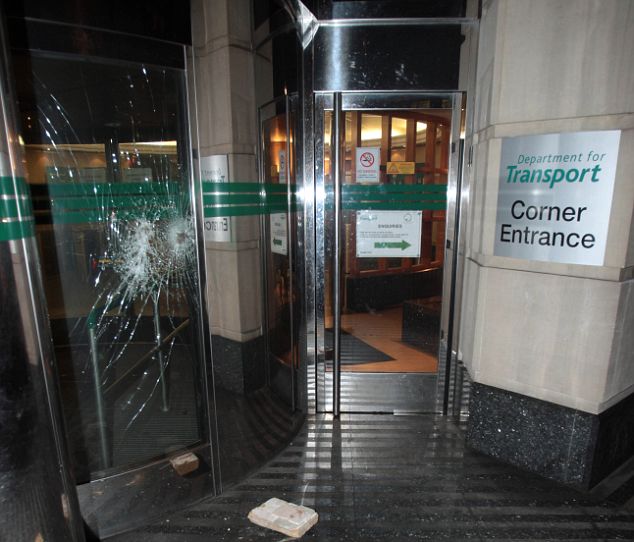
When the announcement came on Thursday 15th, ‘climate suffragettes’ smashed the windows of the Department of Transport (http://www.indymedia.org.uk/en/2009/01/418697.html) and on Saturday 17th Jan, 500 flash mobbed at Heathrows terminal 5.

For all the details, pictures, videos and more visit –
http://www.indymedia.org.uk/en/2009/01/418105.html

3) Plane Stupid shut down Stansted Airport, 08-12.08
50 activists from Plane Stupid shut down Stansted Airport by camping on the runway and surrounding themselves with fortified security fencing. Plane Stupid announced ‘We are genuinely grateful for the level of support from people who have agreed with us that desperate times call for desperate measures. We have used this action to ask for everyone to ‘please, do something’. We hope that all those that have expressed support for today’s action will now think about what they are going to do to ensure the survival of our planet and people on it’.
http://www.planestupid.com/?q=content/plane-stupid-shuts-stansted-airport

4) 48 hours of action against E.on and new coal, 28-29.11.08
The 48 hours of action was a great first shot across the bows. E.On were rattled, local and national media took an interest, resources were gathered and are now ready to go, a new website is now up and running (http://www.e-onf-off.org.uk/), a list of targets has been compiled and E.on know that if they try to build a new coal fired power station at Kingsnorth then they will face a barrage of direct action – both towards their daily operations and their supply chain. E.on be warned. Actions took place in: London, Brighton, Bristol, Norwich, Coventry, Nottingham & Coventry and at Kingsnorth itself. http://risingtide.org.uk/node/309

Plus, ‘Green Banksy’ invades Kingsnorth during the 48 hours: An
unidentified group allegedly penetrated Kingsnorth security and switched off almost 500 megawatts of generating capacity, cutting almost 2% off the nation’s power supply for about four hours.
http://www.indymedia.org.uk/en/2008/12/414463.html

5) Scottish coal rail terminal shut down, 15.12.08
30 campaigners from Coal Action Scotland together with local residents peacefully blockaded the entrance to the Scottish Coal-operated Ravenstruther coal rail terminal in South Lanarkshire for 8 hours. The protestors were acting to oppose the five open cast coal mines that deliver coal to the rail terminal and in resistance to the thirteen new open cast coal mines due to open in Scotland. Protestors erected and scaled a 15ft scaffolding tripod, blocking trucks from entering the terminal. Others locked themselves by their necks to a conveyor belt and a bulldozer, preventing coal stockpiles from being loaded onto trains. An
estimated 6,380 tonnes of coal were stopped from being transported from the coal mines to power stations, preventing the equivalent to 11,675.4 tonnes of CO2 from being released into the atmosphere.
http://coalactionedinburgh.wordpress.com/

6) E.ON forced to abandon recruitment tour, November 2008
Anti-coal protests at graduate careers fairs around the UK forced E.ON to cancel its recruitment tour. The energy company, which is planning to build a new coal power station at Kingsnorth, Kent, saw seventeen of its careers events disrupted. This was a co-ordinated national effort from students involved in People & Planet, the Coal Action Network, and the Camp for Climate Action. Leaflets, banners, fancy dress, conversations with attendees and eye-catching stunts were used to embarrass E.ON and dissuade graduates from joining the company. The Royal Bank of Scotland, one of E.ON’s main financial backers, were also targeted at the fairs over their role in providing loans to build the proposed new power station.
http://leaveitintheground.org.uk/?p=185

7) Kelsterback Forest Occupation (Frankfurt Airport), ongoing Resist Frankfurt Airport Expansion – defend the forest camp. After Heathrow, Frankfurt is the largest airport in Europe. Fraport (the company running the airport) and the German government are trying to build a new runway, to massively increase flights. To build the new runway, Fraport need to clear 250,000 m2 of protected forest. For seven months, activists have been squatting the forest, building tree platforms and floating rafts to resist attempts to chop down the forest. January 2009 is bringing threat of eviction – and they need all the help they can get.
http://waldbesetzung.blogsport.de/english-information/ or
http://waldbesetzung.blogsport.de/photos/

—————–
Rising Tide UK,
c/o 62 Fieldgate Street,
London E1 1ES
www.risingtide.org.uk
www.artnotoil.org.uk
www.fossilfoolsday.org
Tel: 07708 794665

See also the Camp for Climate Action (www.climatecamp.org.uk), Network for
Climate Action (www.networkforclimateaction.org.uk) and Climate Indymedia
(www.climateimc.org)

———-

Please send anything you’d like included in this news sheet to:
newssheet@risingtide.org.uk

To view previous editions of the Rising Tide News Sheet, visit the News
Sheet Archive at http://risingtide.org.uk/newssheet

This News Sheet was brought to you by Rising Tide, a grassroots network
of groups and individuals committed to taking action and building a
movement against climate change.

For more information…
email: info@risingtide.org.uk
Phone: +44 (0)845 458 8923 / +44 (0)7708 794665
Address: 62 Fieldgate St, London, E1 1ES
Web site: http://risingtide.org.uk

PLEASE FORWARD THIS TO A FRIEND AND INVITE THEM TO JOIN THE LIST

To subscribe or unsubscribe visit:
http://risingtide.org.uk/mailman/listinfo/rt-news

To receive this News Sheet monthly, send an email to news-subscribe at
risingtide.org.uk with the subject line ‘subscribe’ (without the quotes
and replace at with @).

North East Open Cast Conference 31st Jan

North East Regional Conference
A chance for campaigners, past and present, to meet and learn from our successes and failures and plan how we can all help each other

St John Baptist Church – Grainger St – Newcastle
1:30pm – 4pm Saturday 31st Jan

NE Opencast conference flierNorth East Regional Conference
A chance for campaigners, past and present, to meet and learn from our successes and failures and plan how we can all help each other

St John Baptist Church – Grainger St – Newcastle
1:30pm – 4pm Saturday 31st Jan

Speakers and workshops on the diverse range of options to oppose open casting

Toon Climate Action
http://www.toonclimateaction.tk/

EDO smashed – Gaza solidarity action

17-01-2009
Anti-militarist activists entered the ITT/EDO MBM arms factory in Moulescombe, Brighton in the early hours of this morning, where they are believed to have caused extensive damage to the offices, and to equipment used to make arms, including the ‘zero retention force arming units’ and ‘ejector release unit 151’ which the Smash EDO/ITT campaign says are supplied to the Israeli Air Force. The campaign became aware of the action when they received a phone call from those inside the factory this morning who said that they were ‘decommissioning’ the factory in solidarity with the people of Gaza, who are currently at the receiving end of the factories products.

17-01-2009
Anti-militarist activists entered the ITT/EDO MBM arms factory in Moulescombe, Brighton in the early hours of this morning, where they are believed to have caused extensive damage to the offices, and to equipment used to make arms, including the ‘zero retention force arming units’ and ‘ejector release unit 151’ which the Smash EDO/ITT campaign says are supplied to the Israeli Air Force. The campaign became aware of the action when they received a phone call from those inside the factory this morning who said that they were ‘decommissioning’ the factory in solidarity with the people of Gaza, who are currently at the receiving end of the factories products.

The arms factory has been targetted by the Smash EDO Campaign for a number of years. In 2005 EDO MBM took High Court action in an attempt to curtail protest at the factory. They lost the action, which proved to be an expensive own-goal as it gave the campaign increased exposure, and brought it to national attention. In 2008 the factory was taken over by ITT.

Weekly protests have been held outside the factory since 2004, and there have been a number of national demos, at the factory and on the streets of Brighton. On October 15th, the SHUT ITT Demo succeeded in shutting the factory for the day.

According to reports in the national media, todays action may have the effect of shutting down the factory for some time. The BBC quotes Det Ch Insp Graham Pratt as saying: “Windows had been smashed and offices turned over in what I would describe as wanton vandalism, but with machinery and equipment so targeted that it could have been done with a view of bringing business to a standstill….The damage is significant and the value substantial.”

Prior to entering the factory, the activists made a video (attached) in which they explained their reasons for the action. One commented: “Israel are committing a gross crime now in Gaza. Israel have killed hundreds of children. I think its absolutely disgusting that weapons made in our cities and in our country are being used to kill innocent women and children. They have been used indiscriminately. If the law and the police cant do anything about it its about time somebody else did.”

About 30 police are believed to have attended the factory, where they witnessed computers and office equipment being thrown out of first floor windows. Nine people are believed to have been arrested and taken to the Hollingbury and Worthing Police Stations, where police say they are being held on ‘suspicion of burglary’. One protestor is believed to have required hospital treatment.

– from IMC UK

Decommissioners – video/mpeg 127M

For other reports of direct action and protests in solidarity with the people of Gaza, see the Indymedia Palestine topic pages

Five hundred flashmob at heathrow

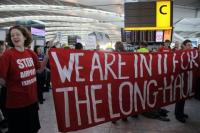
[London,Sat 17] Midday today, five hundred people flashmobbed Heathrow’s Terminal 5 in protest at the governments decision to give the go-ahead on building a third runway and yet another terminal. Among the mob were four naked women, lots of red ‘no expansion’ t-shirts, umbrellas and Heathrow’s largest conga dance.

Heathrow Terminal 5 Decision Day Flash mob[London,Sat 17] Midday today, five hundred people flashmobbed Heathrow’s Terminal 5 in protest at the governments decision to give the go-ahead on building a third runway and yet another terminal. Among the mob were four naked women, lots of red ‘no expansion’ t-shirts, umbrellas and Heathrow’s largest conga dance. It was all finished within an hour.
The flashmob had been called for the first Saturday after the decision on the airports expansion plans and comes at the end of a packed week of protests which has already seen the domestic departures lounge of terminal three occupied by a Climate Rush dinner, a plot of land purchased by campaigners in the middle of the propose new runway and suffragettes escalating the militancy of the campaign by smashing windows at the governments Department of Transport.

The week also saw twenty four Plane Stupid activists quietly sentenced for their part in the blockading of Stansted airport late last year.

Many more actions are expected and the Climate Camp is holding a national gathering in Oxford next weekend at which proposals to shut down Heathrow airport down completely for a day are expected to be discussed.

——–

Attracting most press attention were four brave young ladies who had saved the ten quid for a red ‘STOP AIRPORT EXPANSION’ t-shirt and instead opted for red body paint with a black message across their midriffs, ‘Simply No Slaughter’ and a pair of strategically placed gold sticking plasters proclaiming ‘art’ and ‘port’ (port was indeed on the left.)

Among them were many of the locals who have led the long term opposition to the project, including some I photographed on the march in 2003 in Sipson and Harmondsworth, as well of course as John Stewart of HACAN and local MP John McDonnell who many were congratulating for his seizure of the mace in the House of Commons when the announcement was made.

For three-quarters of an hour the demonstrators chanted, threw red balloons in the air and red tennis balls at an ‘Aunt Sally’ of Transport Secretary Geoff Hoon and conga’ed around the area and had there pictures taken by a large squad of photographers including some from the national press and some TV crews.

They were watched by a few of those waiting to check in and rather more police and airport security staff who made a loose ring around event. But although the atmosphere before the demonstration had appeared a little tense, with police making continued patrols through the departure area presumably looking for trouble-makers, they seemed pretty relaxed – and some were clearly amused by what was happening.

Finally Stewart thanked us all for coming, and repeated the determination of all those involved to keep up the fight to ensure that despite the decision, the runway will never be built. McDonnell was given a cheer for his action in parliament and everyone was invited to take a last chance to pelt Hoon before we all slipped away to the undedrground and bus stations.

Climate Activists smash windows at The Department for Transport

16.01.2009
Climate Suffragettes smashed glass front doors at The Department for Transport early this morning in protest against the government’s decision to expand Heathrow.

Suffra-jet broken windows at Dept for Transport16.01.2009
Climate Suffragettes smashed glass front doors at The Department for Transport early this morning in protest against the government’s decision to expand Heathrow.

At 4 am, three women, wearing red climate sashes, hurled bricks and broke the glass doors of The Department for Transport, on Marsham Street, London. Echoing the protests of the Suffragettes, they wrapped their bricks in notes that read: ‘NO THIRD RUNWAY, THE SUFFRA-JETS ARE BACK before hurling them at the government building. They also hurled green paint to symbolise the greenwash they heard from the government today. They targeted the building as a direct response to yesterday’s decision to allow a third runway at Heathrow.

A spokeswoman said: “The government has opened the flood-gates for radical action. Yesterday they sacrificed all of our futures and spat in the face of democracy. The third runway is unwanted and is a global threat. When they make democracy meaningless what other
reaction could they expect?

“We have less than ten years to turn climate change around. Women cannot just stand by and let this government treat our futures as a joke. We fight for the safety of humanity, and if the government will only listen to the smash of windows, then so be it.”

Noting that their elected MPs had been refused a vote on this issue, she added;

“The government has bypassed democratic process for the sake of corporate profit. The Suffragettes died for the democratic rights that the government so sweeps aside. We take our lead from our past to defend our future.”

Bath Bomb #18 Out Now!

THE BATH BOMB

@nti-copyright: copy and distribute!
Issue #18
free/donation
Jan 09

“Steal this newsheet!”

Looking Back At A Busy Year

THE BATH BOMB

@nti-copyright: copy and distribute!
Issue #18
free/donation
Jan 09

“Steal this newsheet!”

Looking Back At A Busy Year

2009 promises to be a busy year for BAN and friends, but before we look forward, let’s look take a look back at 2008. The year started with a continuing spate of foie gras, forcing the sick dish off the menus of many a restaurant. The FreeShop went from strength to strength, distributing goods to thousands of satisfied anti-shoppers and spreading its monthly anti-consumerist (2nd Saturday of each month, 12-3pm, Stall Street, opposite Holland and Barrett). In a new twist, BANners also distributed free ethical, eco-friendly vegan food to hungry passersby at the ‘There is such thing as a free lunch!’ stall. Punters of the Porter were kept entertained at ‘Bubbling Under’, Bath’s ongoing free monthly radical film showings. Members of BAN also helped open ‘The 78’, Chippenham’s first squatted social centre, and joined dozens in Bristol to resist the eviction of ‘Ashley Road’.

Bath’s animals rights advocates have been equally busy, demoing Bath racecourse during a visit by Rolf Harris, travelling to Oxford Uni and Huntingdon for anti-vivisection events, sabotaging local fox hunts, travelling to Cardiff for an anti-badger cull demo and feeding hundreds at the first Bath Vegan Fayre. Bath activists also spent a fair bit of time in Bristol, helping organise the Bristol Anarchist Bookfair, several days of credit crunch-related workshops, the first Bristol Anarchist Games Day (highly recommended!) and also helped organise anti-capitalist demos around the opening of the monstrous Cabot Circus shopping centre, which was invaded by zombie protesters. Getting active for the environment, BAN joined 3,000 others at Kingsnorth Camp for Climate Action, helping to seize the site, and causing serious disruption to the coal plant by scaling the perimeter fence. Earlier in the year, members of BAN joined others from Bristol, Oxford and Wales to successfully blockade Aberthaw coal-fired power plant, whilst more recently, another BANner helped out at the Plane Stupid blockade at Stansted. We were also busy with No Borders/pro-asylum seeker events, like the anti-IOM demos in Bristol and ID cards protest at Cardiff, and joined the anarchist ‘Freedom of Movement’ bloc and 5,000 others at the Manchester anti-Labour Party Conference.

We’ve teamed up with Bath Mad Hatters to highlight the dangerous effects of forced medication, and our new pedal-powered sound system is justin about ready to go, after a year of hard work. Fascists failed to escape our attention, with local activists heading up north to oppose and confront the BNP’s annual Red, White and Blue festival (due to this year’s disruption, it is unlikely to happen again). Combined events and forces helped to delay the opening of Bathwick Hill Tesco for nearly a year, and BAN were there to greet them when they arrived. BANners celebrated Buy Nothing Day, and twice journeyed down to Brighton to join the ‘Smash EDO/ITT’ demos, aimed at closing down a weapons factory supplying genocidal states such as Israel and the US of A; after the demos (both of which got a bit ‘rioty’) and a four-year campaign, the factory is on its last legs – don’t miss the next demo on 04/05/09: www.smashedo.org.uk. BAN also launched its anti-credit crunch campaign, aimed at defending our communities against unemployment, bailiffs, corporate greed and recession. The campaign kick-started with a 35-strong, noisy demo in November and will continue on as recession deepens, with a focus on practically resisting recession and directly defending our rights and livelihoods. And we even managed well-earned group holidays at Tolpuddle festival and the beautiful Gower, too!

Opposition Increases As Attacks Intensify

On Saturday 3rd January, 400-500 gathered in Bristol to oppose the continued Israeli attacks on Palestine. The march, attended by young and old, anarchists, students, Muslims and socialists alike, took place on the afternoon of the day that Israel was reported to have begun its land incursion in Palestine. The demonstration coincided with various others around the country, and indeed around the world, including a 50,000-strong march in London. The following weekend 100,000 people attended a march in London in opposition to the continued devastating attacks which have since included the bombing of a school being used as a shelter for civilians, in which more than 40 people were killed. The IDF have also dropped leaflets over Gaza threatening to increase the ferocity of their attacks. In the five years that preceded the recent attacks, around 5,000 Palestinians are reported to have been killed by the Israelis’ advanced weaponry. In spite of the British Government’s renewed call for ceasefire, figures reported in the Guardian in 2006 tell a different story: the Government approved £22.5m of weaponry exports to Israel in the previous year. If you would like to get involved in opposing the attacks, there is a vigil in Bath every Saturday outside the Abbey between 11.30 and 12.30. In Bristol, there is a vigil every night at 5pm in the centre, opposite the Hippodrome, and Bristol’s also home to the ‘Raytheon Out’ campaign, who are now in the fifth week of their rooftop occupation of that arms manufacturer. And let’s not forget neighbouring deathdealers Boeing, who recently found all their windows smashed! In Frome too, 40 people recently occupied Lloyds TSB, who have ridiculously closed the account of human rights charity InterPal. Other corporate nasties with ties to Israel include M&S and Starbucks, and be sure to boycott Israeli supermarket goods, where many peppers, sweet potatoes and avocados are grown on stolen land.

http://www.bathstopwar.org.uk/index.html
www.stopwar.org.uk/
http://palsolidarity.org/
http://raytheonout.wordpress.com/
http://electronicintifada.net
http://www.maannews.net/en
http://www.freegaza.org
http://talestotell.wordpress.com

Bash Back Against Bath’s Bastard Bailiffs!

Recent articles in the Chronicle have starkly contradicted assertions by government and academic think tanks that Bath would “weather the worst effects of the recession.” At the last count, 1,542 people are claiming benefits in the Bath area, an increase of 59% on last year, with 600 people having lost their jobs in the city since last November – a dramatic rise. And how are we rewarded when we’re laid off and forced onto the dole? Do we enter a nurturing welfare system that caters for the needs and skills of the unemployed? No, it’s more authoritarian than ever – benefits have not risen with the increasing cost of living, and claimants are harassed into searching for non-existent jobs under the constant threat of benefit stoppage for failure to conform to the infuriatingly bureaucratic world of Jobseekers. As a direct result of this and the rise in bills, food and living costs, Bath residents are seeing a lot more of everyone’s least favourite parasite, the bailiff. Recent figures show that bailiffs chasing unpaid council tax visited 2,400 homes in Bath last year. With three/four people in the average household, that means that 8,000 (10% of Bath’s population) were visited for council tax alone! When we take into consideration bailiffs sent out by banks, loan companies and energy suppliers, we can realistically increase the number of Bathonians being harassed several times over. At this point the old reactionary cry that people who are unemployed or bailiff-ridden are ‘layabouts’ who have ‘brought it on themselves’ simply no longer holds true. The majority of us are now feeling the pinch, some harder than others, and it’s simply not our fault. If your boss fires you and the job market is empty, what choice is there but benefits? If you were going to pay your council tax, but had to spend the money on the 40% gas and electric bill increase and feeding your family, what would you do?

Bailiffs are famed for their ruthlessness – a recent court case tells of a bailiff who posed as an ambulance driver to gain entry to an elderly couple’s house to repossess goods, while the elderly occupant suffered a heart complaint. And this is the norm, not the exception. Parliament recently passed laws allowing bailiffs to break into your house, so without our elected representatives to rely on, it looks like it’s up to us! In Bath during the Poll Tax campaign of the early 90s, and today in Edinburgh, London and elsewhere, bailiffs have met community solidarity. Organising amongst your neighbours to face off bailiffs when they turn up on your street is a powerful way of defending yourself, your property and your community against these vultures. Bailiffs prey on the weak, the stranded and the vulnerable. Resisting bailiffs is to be a key part of BAN’s anti-recession campaign in the coming year, and they will be holding an informal day of discussion, networking and organising on Saturday the 28th of February; location TBC. To get involved in the campaign, if you need help organising resistance to bailiffs or if you can name and shame any bailiffs, e-mail BAN at bathactivistnet [at] yahoo.co.uk

EVENTS

Bath Hunt Saboteurs meetings, 2nd and 4th Monday of the month, 8pm, The Bell, Walcot Street

London Road Food Co-op, Wednesdays, 4-7pm, Riverside Community Centre, London Road

Bath Stop The War Coalition vigil, Saturdays, 11.30am-12.30, Bath Abbey Courtyard

Broadlands Orchardshare Wassailing, Saturday 17th January, 3pm, Broadlands Orchard, £2 entry

Israel Out of Gaza demonstration, Saturday 17th January, 12.30 start, Abbey Courtyard

Bubbling Under, Sunday 18th January, 1-5pm, Porter Cellar bar, George Street

Talk: ‘Eco Upgrading of Existing Houses – Challenges and Opportunities’, Monday 19th January, 7.30pm, Quaker Meeting House, Bradford on Avon, free entry

Seed Swap, Sunday 1st February, 3-5pm, St Marks Community Centre, Widcombe, £2 entry

Bath Friends of the Earth meeting, Monday 2nd February, 8pm, Stillpoint, Broad Street Place

Talk: ‘Composting – how to make it and when to use it’, Wednesday 4th February, 7.30pm, Grove St Church Halls

Bath Animal Action meeting, Wednesday 4th February, 7.30-8.30pm, back room of The Bell

Bath Activist Network meeting, Thursday 5th February, 7.30-9pm, downstairs Hobgoblin

Earth First! Winter Moot, Saturday 7th February-Sunday 8th, 10am start, Cowley Club, Brighton, e-mail: moot2009 [at] earthfirst.org.uk

Bath Greenpeace meeting, Monday 9th February, 7.30-9pm, Stillpoint, Broad Street Place

Transition Bath Forum, Tuesday 10th February, 7pm, Widcombe Social Club

Bath Green Drinks, Wednesday 11th February, 8.30pm, the Rummer, Grand Parade

Borders & Immigration workshop, Saturday 14th February, 1-3pm, Bristol venue tbc email trapeze [at] riseup.net

Bath FreeShop, Saturday 14th February, 12-3pm, outside Pump Rooms, Stall Street

‘Beat the Bailiffs’ listening post, Saturday 28th February, more details tbc

Talk: ‘Portrait of a Road Protest’, Sunday 1st March, 3-4pm, Bath Central Library, £6/£4 entry

Rescue Rangers

Apparently, a dog’s not just for Christmas, and neither is the rest of the four-legged furry world, too. Following the usual seasonal peak in little Timmy and Sarah’s passing whim for cute little caged pets, a huge number of unwanted rodents need re-homing. Whilst the majority of humankind can’t get over the crazed notion that other animals exist purely to entertain, feed and otherwise serve them, and pet breeders are always out to make a quick buck, official rescue authorities such as the RSPCA centres and Bath Cats & Dogs Home are full to bursting, with many hapless beasts not lucky enough to reach rescue centers facing lethal injection. If you can offer a loving and responsible home for any of four mice, 21 gerbils or 60 rats in the nearby area, please drop us a line.

www.fancy-rats.co.uk/

Greece Is The Word

Last month’s issue of the Bath Bomb carried a hastily-written report of the murder of a Greek teenager, and the night of riots following his death. Since then, the riots have given birth to a full-blown revolt and although (or probably more accurately, because) a genuinely revolutionary situation has emerged in Greece, the media has lost interest. Don’t let the subsidence of the sensationalist tabloid press’s ranting of ‘bomb-throwing youths’ fool you though, the insurrection in Greece is as alive as ever. Coinciding with a general strike, the riots expanded beyond the anarchist movement and became a coherent expression of anger at the deepening economic crisis. For three weeks, rioting involving hundreds of thousands raged across all of Greece, with symbols of capitalism and the state, such as police stations and banks, targeted by Molotovs, bricks and graffiti. Universities, schools and workplaces were occupied and self-managed by workers and students, and many districts of Greece remain in control of the residents, as no-go areas for the police. So why have the events in Greece fallen from the eye of the world’s media? It is because revolt and revolution almost always initially manifest themselves in rioting and ‘chaos’. It is the instinct of most people, when liberated from the oppressive yoke of their former masters to celebrate, revel, and attack the symbols of the old order – this makes exciting footage, which can easily be portrayed as misguided violence. The next step in a revolt is thoughtfulness, of organisation, of order, and of beginning to think about how to organise and practically manifest a liberated space. The media have given this phase no attention, as firstly, it’s less dramatic, and secondly, and most importantly, because it is against the ethos of the corporate media to report on radicals as rational people capable of, and serious about, organising a society free of leaders, poverty and capitalist greed. Make no mistake, Greece is still in revolt, and is proving that as the old saying goes “capitalism is chaos, anarchy is order.”

Welcome To The New Year

2008 finished with riots in Greece, as people on the streets fought back against the corrupt government and police who gunned down Alexandros-Andreas Grigoropoulos. 2009 has opened with a bloodbath in Gaza carried out by the Israeli Defence Force, while world leaders blame the victims and refuse to interfere like they did with Iraq and Afghanistan, all because Israel is their friend. Only ordinary people throughout the world have raised their voices against this new wave of killing. Meanwhile, over here, unemployment and house repossession are up because we pay for the crisis caused by policy makers and politicians. Let’s try to make 2009 a year when we can shake off these leaders who run this sick system. A year like England 1381, Great Britain 1640, France 1789, Europe 1848, Mexico 1914, Russia 1917, Kronstadt and the Ukraine 1921, Spain 1936, Hungary 1956, everywhere 1968 and Eastern Europe 1989. Most of these struggles fell just short, permitting dictatorships of the left and right, but these were still years in which ordinary people strived to bring about a better world, and will try again. (Oscar Nominee inspirational speech time:) the time is always now, and if you’re interested in joining the struggle in a movement where everybody is equal and valued, join us in Bath Activist Network. A better world is possible!

Bath Activist Network are a local umbrella group campaigning on issues as diverse as development, environmentalism, anti-war, animal rights, workers’ rights and more. Helping to produce The Bath Bomb, we are open to anyone, and our members range from trade unionists to anarchists, liberals to greens, and people who just want to change Bath for the better. For details on meetings, demos, or just to get in touch, ring us on 07949 611912, email bathactivistnet@yahoo.co.uk, or see our website: www.myspace.com/bathactivistnetwork

Earth First! Things First

During the coming Bath Book festival on the 1st of March, Bath Central Library will be hosting the exhibition ‘Portrait of a Road Protest,’ about the goings on at Solsbury Hill in the early 90s. It’s free entry to see the images, but a talk will take place from 3-4pm, £6 entry waged, £4 unwaged. Here’s a little history lesson. The direct action protest against the would-be Batheaston Bypass began in March ‘94, following the public enquiry several years before. Batheaston did have a traffic problem, and a small bypass, traffic calming or improved public transport (we’re still waiting) would have been acceptable, but the sheer scale of the road, destroying water meadows and slicing through the lower slopes of Solsbury Hill, was madness. The non-violent direct action that took place consisted of sitting on diggers, building tree camps, squatting, blockading, and standing up to the mostly brutal security guards (rumour has it that one was fed raw meat!). The protest brought many different people together: locals, Earth First!ers and Dongas, all fighting the Department of Transport. Over all, it went on for several months, with reunion actions the following year, received lots of coverage and, along with other road protests round the rest of the country, cut back around 90% of the UK road building programme started by the dreaded iron lady.

Bath Bomb Wordwatch: Donga, Donga Tribe (noun) – a group of semi-nomadic hippies and squatter-punks that joined to defend Twyford Down and other road protest sites

www.earthfirst.org.uk

Airport Expansion Is Plane Stupid

The runway of Stansted airport was invaded by activists from the group Plane Stupid at 3.15am on 8th December, while closed for maintenance work. Scheduled to be reopened at 5am, the runway was closed for three hours while confused cops and security guards struggled to remove 57 protestors. 56 flights were cancelled. The average flight out of Stansted releases 41.58 tonnes of CO2 into the atmosphere. We literally can’t go on like this – hopes of the UK meeting even the ridiculously low government-set targets for emissions are screwed if we don’t cut our reliance on aviation, yet Neo-Labour has approved the capacity increase of Stansted by ten million passengers a year. So yeah, this action no doubt pissed many people off, but nothing else has worked so far. Who now would deny the worthiness of the cause of the suffragettes, and the effectiveness of their tactics (which were far more disruptive than those of Plane Stupid, who’ve never turned to explosives)? Thousands of well-behaved protestors marched against the war in Iraq and got nowhere. The media claim that protestors disrupted working class families’ holidays, yet it is the poor who will be hit hardest by climate change – who generally lack the means to survive floods, famine and freak weather. Indeed, statistics show that the majority of flights are still taken by business people and rich holiday-makers. Plane Stupid’s stunt comes at a critical time when the government is soon to make their decision on Heathrow’s third runway, and desperate times call for radical measures. To protect the very near future, we must act now.

www.planestupid.com/

Review Corner: Off The Hoof

As we always say, going vegan is a way forward to save the world against climate change and to take a stand against the cruel and murderous meat industry, so we here at the Bath Bomb thought we’d take a look at this latest news agent addition. Off the Hoof is a magazine that purports to cater for “veggies, vegans and meat eaters everywhere.” However, a closer inspection reveals that this is unfortunately a vegan mag for vegan people, with some of the content sure to offend all but the thickest-skinned of meat eaters. This first winter issue has interviews with vegan celebs such as contortionist Rubber Richie, medal-winning body builder Pete Ryan, and musician Debbie Leigh Driver, and features on vegan stars like Natalie Portman and Chris Martin. Oh, and an article on non-vegan Harry Hill and his fair trade nuts. The magazine is generally a very good read with interesting articles, and a style all of its own. Why not give it a read?

www.offthehoof.co.uk/

Duck Tales

It may be a new year, but some things never change. The epic war between compassionate do-gooders and the arrogant animal-abusing restaurateurs of Bath over the issue of foie gras continues. But enough objective journalism. The production of foie gras is banned in this country and many others, and involves taking otherwise free-range ducks and geese and forcing them to spend the last 12 weeks of their lives in tiny cages, being force-fed corn mash up to three times a day via gavage pipes shoved down their throats. Eventually, as well as suffering throat lacerations and finding it painful to move, the birds’ livers become infected with the disease ‘hepatic steatosis’ and expand to up to ten times its natural size – which is then served up as pâte de foie gras. Haute cuisine this is not. Though restaurants present this as an exotic delicacy, the scale and ethic of production is closer to that of fast food, and then they just slap on a hefty mark-up.

Over the Christmas period, regular protests and visits from Bath Animal Action, Bath Activist Network and Bristol Animal Rights Coalition persuaded The Pinch and Bistro Number 5 to stop publicly selling, but they are both expected to resume the dirty habit soon. The Olive Tree and Royal Crescent Hotel both apparently only serve ‘faux gras,’ a seasonal, rarer dish, based on the natural over-eating tendencies of geese before migration, and involves much less animal torture. Bathampton Mill has been found to be selling foie gras, as have Beaujolais, who’ve been serving dodgily under the counter ever since previous protests; didn’t your mum ever tell you lying was wrong? Whilst around 800 members of the public have now added their signatures to a petition calling for a city-wide ban on the sale of the stuff, the offending eateries should be expecting mystery shoppers and more demos soon.

Here endeth the sermon.

www.banfoiegras.org.uk/
www.viva.org.uk/campaigns/foiegras/index.html

GOT A STORY? WANT TO RECEIVE THE BATH BOMB BY EMAIL? HOPING TO SUE? Contact us by e-mailing bathbombpress@yahoo.co.uk. Large print e-versions available on request.

For Fox Sake

Boxing Day saw hunt sabs from Bath teaming up with Pewsey and Wales to stop the cruel ‘sport’ of fox hunting – we followed the hunters with video cameras to ensure they obeyed the law, and used citronella spray to mask the fox’s scent. This jittery reporter was concerned by the hunt supporters’ history of violence towards saboteurs, yet the barbaric scum gave up after a pitiful hour and a half. Maybe it had something to do with the highly effective hunt sabbing seen on the day, or maybe the hunt master just realised he’d left his cousin handcuffed to the bed. It is illegal to hunt with dogs in the UK, although it is still legal to exercise hounds, chase a scent and flush out foxes to be shot, making the ban virtually un-enforceable. Police generally don’t give a shit, so saboteurs are needed as much as ever. To get involved contact Bath Hunt Sabs at bathhuntsabs [at] yahoo.co.uk, or find your local group at http://hsa.enviroweb.org/contact/index.html

And now, to the disclaimer: As anyone is free to contribute, the opinions expressed in each article are not necessarily reflective of each contributor. Naturally, any right-wing or corporate bullshit will be binned and spat on. Needless to say, the opinions of the author of this disclaimer does not necessarily represent the views of any other contributor…

For further info on any of our stories see www.myspace.com/bathbomb

Attacks against luxury cars in Germany

04/01/2009: Again two upperclass cars burned, Berlin

Direct Action Germany: 24th Dec - 4th Jan Direct Action Germany: 24th Dec - 4th Jan
Direct Action Germany: 24th Dec - 4th Jan Direct Action Germany: 24th Dec - 4th Jan 04/01/2009: Again two upperclass cars burned, Berlin
02/01/2009: Again another car burned down, Berlin
31/12/2008: 7 upperclass cars torched, Berlin
25/12/2008: Five posh cars damaged in Kreuzberg, Berlin

————————————-

Again two upperclass cars burned

Berlin 4th January 2009

The series of politically motivated arsons on cars keeps on going also in the new year.

In the night to sunday, two upperclass cars have been torched in Friedrichshain. In the Pettenkoferstr. a mercedes SLK went on flames shortly after midnight. Around 2am, another car, a BMW X5 went on flames around Frankfurter Tor. The state security took up the investigation.

Within last year, the police registered 87 politically motivated arson attacks, from which 67 have been on cars. About 98 cars have been damaged on the end from such arsons.

Source: Tagesspiegel

————————————-

Again another car burned down

Berlin, 2nd January 2009

The series of burned car keeps on. On the early hours of friday, a car of the upperclass has been burned in the Christinenstr. in Prenzlauerberg, as the police reports.
Since one cannot exclude a political motivation behind it, state security took up the investigations.

Source: Berliner Zeitung

————————————-

7 upperclass cars torched

Berlin, 31st December 2008

It is dangerous for cardrivers to park in Berlin.
Just a night before new year’s eve, several cars went on flames in three different distrcits of thw city. No trace of responsibles, state security investigates.

Unknown persons set up seven upperclass cars in flames. In the districts of Mitte, Friedrichshain and Prenzlauerberg, about 15 cars have been therefore damaged.

Inhabitants alarmed the cops around 2am having seen a car in flames in the Zionkirschestr.
Shortly afterwards, another car went off in the Fehrberlinerstr., while its flames daamges four cars parked nearby. Two further cars went on flames in the Ruppiner/corner Rheinsbergerstr. and in the Swinemünderstr, two cars parked nearby got also damaged.

Also in the Kastanienallee a car was set on fire, damaging a car parked nearby. In the Seumestr. and in the Krautstr. in Friedrichshain, two ore cars went on flames, damaging one other parked nearby.

Source: Tagesspiegel

————————————-

Five posh cars damaged in Kreuzberg

Berlin, 25th December 2008

Five posh cats have been damaged by unknwon persons on the 25th December, along the Paul-Licke-Ufer in Kreuzberg.
Witnesses found out that the tires of three mercedes and a bmw have been slashed off, while a jaguar have been painted with orange color.

„The cars were parked almost next to each other“, said a police spokesperson.
One of the mercedes had all its tires slashed off. Just few days before there has been an attack against a condo project, Carl Loft, very close to the place where the cars were parked at.

Source: Tagesspiegel

————————————-

direct action news from germany
e-mail: directactionde(at)riseup.net
Homepage: http://directactionde.blogspot.com/search/label/English

Heathrow runway ‘gets go-ahead’ – flashmob this Saturday

A flashmob action is planned for this coming Saturday:

Ministers have approved a controversial plan to build a third runway at Heathrow, the BBC understands.

Heathrow decision flashmobA flashmob action is planned for this coming Saturday:

Ministers have approved a controversial plan to build a third runway at Heathrow, the BBC understands.

Despite opposition from residents, environmental campaigners and many of its own MPs, Labour is set to confirm the decision officially on Thursday.

Leading business and union figures back the project, saying it will create jobs and boost the UK’s competitiveness.

But critics have said it will irreparably damage the UK’s credentials on tackling climate change.

Labour unease

The government has long argued, in principle, that it is in favour of the scheme, subject to noise and air pollution limits, and undertakings about access and traffic congestion.

Alongside the commitment to a new runway, Transport Secretary Geoff Hoon is expected to announce increased investment in public transport, including a new high-speed rail link from the airport to central London.

There has been deep unease within Labour ranks about the decision, with several cabinet members reported to be unconvinced about the project and more than 50 MPs openly opposed.

In an effort to appease its critics, BBC political correspondent Jo Coburn said the government would announce new safeguards for limiting emissions with airlines using the new runway required to use the newest, least polluting aircraft.

Business Secretary Lord Mandelson defended the government’s commitment to environmental concerns over Heathrow.

He said: “It’s a classic dilemma – we want to forge ahead in implementing our climate change ambitions when others are not but we don’t want to lose our economic competitiveness in the process. We want to do both these things.”

But backbench Labour MP John McDonnell, whose constituency includes the airport, said the fight against the expansion was only just “beginning” and opponents would “use every mechanism possible” including legal challenges, to stop the runway going ahead.

“If the government is not willing to listen to Parliament or the people then there is no other option but to mobilise the largest coalition of public opposition and protest to halt this disastrous proposal in its tracks,” he said.

The Conservatives say a new runway would be an “environmental disaster” and have pledged to reverse the decision should they win the next election.

Shadow transport secretary Theresa Villiers said approval of the scheme would show Gordon Brown was “deaf to the concerns of his own party and millions of people living under the flight path”.

The Liberal Democrats have urged ministers to invest in high-speed rail links instead.

Asked about the decision on Wednesday, Prime Minister Gordon Brown declined to guarantee MPs a vote on the issue.

Should the government give the go-ahead, he said there would be a debate in Parliament and that the scheme would have to be granted planning permission.

This is likely to be a lengthy process, with work on a new runway unlike to be completed before 2019.

Public protests

Protests have been growing in anticipation of a decision, which was due to be made in December but was delayed amid reports of divisions within government over the issue.

About 700 homes will have to be demolished to make way for the runway, which will increase the number of flights using Heathrow from about 480,000 a year now to 702,000 by 2030.

Campaigners have bought some land earmarked for the construction of the runway in an effort to frustrate the expansion plans.

Environmental campaigners say proceeding with the new runway will leave the government’s legal commitment to cut carbon emissions by 80% by 2050 in tatters.

“Expanding Heathrow would shatter the government’s international reputation on climate change,” said Andy Atkins, executive director of Friends of the Earth.

“We need bold and urgent action to create a low-carbon economy, not more backing for the climate-wrecking activities of the aviation industry.”

But the government believes the new runway will not violate its EU commitments on air and noise pollution, pointing out that new aircraft being built will reduce emissions significantly.

‘At risk’

Supporters of the runway say Heathrow is already operating at full capacity and the UK economy will lose business to the rest of Europe if it does not go ahead.

They point out that rival airports such as Paris, Frankfurt and Amsterdam already have at least four runways and that Heathrow is at risk of falling further behind.

Former Labour MP Lord Soley is the campaign director of Future Heathrow, which represents groups in favour of expanding the airport.

He told BBC News that Heathrow brought jobs and “prosperity” to the surrounding areas and in an “ideal world” the expansion would not be needed.

“But the ideal world doesn’t exist and it isn’t true to say that Heathrow isn’t at risk.

“It is at risk and if it continues to decline, then the consequences for west London and the Thames Valley will be very, very serious indeed,” he said.

British Airways, the largest airline at Heathrow, has said expanding the airport is the only “credible option”.

Leeds Social Centre in court next week

This article was written by volunteers at the Leeds-Bradford Independent Media Centre following interviews with volunteers from The Common Place, Leeds’ radical, autonomous social centre.

This article was written by volunteers at the Leeds-Bradford Independent Media Centre following interviews with volunteers from The Common Place, Leeds’ radical, autonomous social centre.

The CommonPlace is a social centre located in Leeds, accommodating a broad range of community groups. The CommonPlace has been open since 2005 when it received funding to establish a community resource in central Leeds. Since then, it has been entirely volunteer run. Despite having no wages to pay, The CommonPlace pays rent and bills just like any other city centre venue. More recently, The CommonPlace has been financed by bar sales at community orientated clubnights, supplemented by membership subscriptions and donations. Without income from the bar, they would be forced to close permanently.

As a democratic club, all major decisions are made at a general meeting, open to all members.

At the end of July 2008, The CommonPlace has its Club Premises Certificate (license) withdrawn by Leeds City Council (LCC), under Section 90 of the Licensing Act 2003. The club believe this was unfair and are appealing to have the licence reinstated. The CommonPlace cannot discuss the specifics of the appeal process at this time due to legal reasons: They are keen for their story to be told in due course.

The CommonPlace has met with LCC twice in court (30th September, 28th October), also delegates of The CommonPlace met with the Licensing department on 15th December 2008 with a view to resolving matters. On each occasion The CommonPlace has tried to deal with the council’s concerns in order to regain the original license.

A volunteer from The CommonPlace said, “We were sorry to hear after our last meeting with them, that they didn’t want to talk to us again before the hearing.” The appeal is due to be heard on 22nd to 26th January 2009 at Leeds Magistrates’ Court.

Another volunteer, from the Bar Committee said, “We’re puzzled by how much interest the Police have shown since we’ve never had any trouble or arrests when we’ve been putting on a night here … we just want to get things back to normal.”

The CommonPlace are adamant that they are a members club, and that LCC have withdrawn this license wrongly; The CommonPlace is grateful for the continuing support of members, donors and over 1000 Leeds residents who have signed a petition in support. To be kept informed, please see www.thecommonplace.org.uk where there are also instructions on joining the mailing list and getting involved as a member.