First Nation pushes back against ‘Ring of Fire’ mine, rail project

26th January 2010
A Thunder Bay mineral symposium of the Matawa First Nations tribal council in February could be a raucous affair.

Matawa camp26th January 2010
A Thunder Bay mineral symposium of the Matawa First Nations tribal council in February could be a raucous affair.

The aggressive push by Cliffs Natural Resources and Canada Chrome to develop a $1.5 billion chromite deposit in the James Bay ‘Ring of Fire’ and ore haul railroad has drawn heat from one remote community.

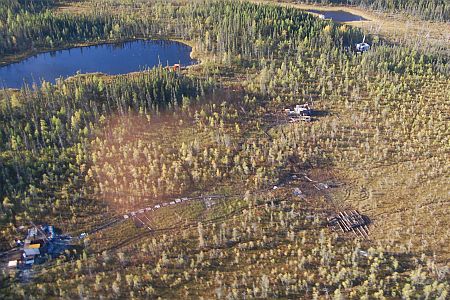
Last week about 15 protesters from Marten Falls First Nation pitched tents last week at Kopper and McFauld’s Lakes near the exploration camps of Noront Resources and Freewest Resources.

“We’re prepared to stay there as long as possible,” said Chief Eli Moonias, who isn’t pleased that Canada Chrome has staked mineral claims along a 350-kilometre long proposed rail corridor between McFauld’s Lake and the Town of Nakina in northwestern, Ontario.

He’s angry the staking was done in advance of the implementation of the Ontario’s Far North Planning Act and wants Northern Development, Mines and Forestry Minister Michael Gravelle to “claw back” those claims.

Moonias said his community of 300 was not consulted by Canada Chrome and claims the McFauld’s Lake deposits and most of the proposed railroad corridor falls within Marten Falls’ traditional territory.

We don’t like this underhanded business,” said Moonias. “They should have come to the community to do that.”

Moonias said he told ministry officials in December he wanted a community-based land use plan that will include their 10-year-old strategy for an access road running into the James Bay Lowlands and eventually linking up with Attawapiskat on the coast.

Moonias said his community’s position is to support the mine provided their corridor plan is adopted, but Canada Chrome has largely ignored this.

He said the mining companies and Queen’s Park must address a list of concerns and wants an agreement signed with the mining companies before the protest camps are pulled out.

Canada Chrome, a subsidiary of KWG Resources has been dealing with the Matawa First Nation, a tribal council representing nine area communities, including Marten Falls.

But Moonias said the council doesn’t speak for his community.
“They’ve got nothing to do with traditional territories. What happens there is our business.”
KWG Resources and Canada Chrome president and CEO Frank Smeenk chalked up the protest to an internal squabble inside the council.

“We were given to understand that we were to follow a protocol by the nine members of Matawa Council,” said Smeenk, referring to the Matawa Interim Mineral Measures protocol. “Now we are to understand that’s not necessarily the case.”

Moonias said he never agreed to any such protocol.

“I never heard of it. I’ve got nothing to do with that.”

Smeenk said it’s obvious Marten Falls wants to be consulted with separately.

“Eli’s trying to get attention to a cause and one of those is one that pre-dates all of us, a plan for a winter road.”

Smeenk said he met Moonias in Thunder Bay this month after hearing of the community’s plan to blockade of airstrips at McFauld’s and Kopper Lakes.

He said the protest may be a negotiating ploy to force the government to re-open an illegal airstrip in the Ring of Fire along the Muketei River closed down last November by the Ministry of Natural Resources.

Marten Falls had partnered with Wilderness North Air to provide a logistic support base for the exploration efforts.

The MNR said the development of this airstrip was not authorized and a warrant was authorized under the Public Lands Act prohibiting the use and occupation of this airstrip. A restriction remains in place until a final decision is made by the MNR regarding an ongoing investigation and review of the airstrip proposal.

Smeenk said his company has no objections to the airstrip being permitted for use.

Canada Chrome’s proposed rail route follows glacier eskers that run north-south through the swampy terrain between Nakina and McFauld’s Lake.

“If God had a place for a railroad to go that would be it,” said Smeenk.

With an adjoining service road, Smeenk said nearby communities could access it with branch roads as well as run fibre optics and power lines.

Moonias said he met privately with Smeenk in Thunder Bay before Christmas to discuss the transportation corridor and said the company president “made some overtures.”

Last September, Marten Falls signed a compensation agreement with Noront Resources for past exploration work already performed at their exploration camp. Moonias said it amounted to $2 per metre for holes already drilled, but added no agreements for future exploration work has been signed with Noront or any other company.

Noront said in a Jan. 18 statement,despite the inconvenience of a “logistics halt” at their ice airstrip” it was supporting the actions of Marten Falls.

Moonias said a meeting is scheduled next week with government officials and some mining players in Marten Falls.

He wants the mining companies to use their winter toll roads to haul fuel and bulk items, and for the government to allow them to finish construction of an airstrip to create a service hub for McFauld’s Lake.

“We’re saying let’s build this strip where the ground is good for the environment and let us build the camps there and do business.”

Moonias said some companies had been landing on the partially-completed airstrip last fall. “We told the MNR about it and they shut it down. We’re trying to finish that so we can start building our camps there to do business.”
He also wants jobs and contracts to service these camps instead of the companies bringing in outside suppliers and support personnel.

Moonias also wants an environmental clean-up and compensation at McFauld’s Lake for raw sewage, grey water, fuel and chemical spills dumped by exploration companies in the summer of 2007.

Smeenk expressed confidence the issue could be resolved to benefit all and doesn’t suspect the protest will raise any red flags with Cliffs Natural Resources.

“The First Nations just want to figure out how to get our attention.”

He said it may involve community ownership of the enterprise and didn’t rule out a First Nation equity stake in the project.

When asked if the Ontario government was actively involved helping in mediating the dispute, Smeenk paused and said he found he found MNDMF and MNR staff to be “exceedingly helpful and careful of everyone’s rights.”

Anne-Marie Flanagan, spokeswoman for Michael Gravelle, said the ministry is talking with all the parties toward resolving a “complicated situation” that involves the MNR, the air strip and how people in the Far North can all benefit.

“We’re looking into the whole situation because this is something that’s going to have to be sorted out big time and rather quickly when you look at what Cliffs is doing.

“There has to be reasonable decisions by the First Nation about what they want to go ahead with and how they want to do it.”

Gravelle is scheduled to deliver a speech Feb. 10 at the symposium.

Ontario’s newly revised Mining Act includes a dispute resolution mechanism for issues between First Nations and mining companies, but the details of how it is supposed to work has yet to be defined since the government is conducting another round of public consultation.

Police clash with protesters in China in land dispute

26th January 2010
Authorities in the southwestern Chinese region of Guangxi have sealed off a village and ordered a news blackout following violent clashes between local residents and police in a land dispute.

Land protesters in Pingle26th January 2010
Authorities in the southwestern Chinese region of Guangxi have sealed off a village and ordered a news blackout following violent clashes between local residents and police in a land dispute.

“The villagers put up some reports about what happened on the Internet, but they were taken down by the authorities very quickly,” said a resident of Tongle township near the scenic tourist city of Guilin.

“Right now the authorities have totally sealed off the area. The villagers are using text messaging to exchange news,” said Zhang, adding that he had been warned by other villagers that the police were still detaining people.

Zhang said riot police fired tear gas and used electric shock batons on elderly protesters trying to prevent the takeover of their farmland for development.

“Things got very serious at the scene,” he said. “The people trying to protect the land were all elderly, women, and children. How could they resist?”

“They were attacked by the riot police first, and a lot of those injured were then taken away by police.”

Photos posted online of the clashes showed crowds of people, many of them elderly, some of whom had sustained injuries to their arms and legs. Some showed people bandaged, and still bleeding from head injuries.

‘Handled according to law’

An employee who answered the phone at the Pingle county government, which oversees Tongle village, said the authorities had already issued the legally required amount of compensation to the villagers.

“Our leaders here have already dealt with this situation,” the employee said. “Everything we did went through the municipal level authorities for approval, and the entire affair was handled according to law.”

An official who answered the phone at the Guilin municipal politics and law committee confirmed the clashes had taken place as part of a land dispute.

“There was a land dispute there. But I haven’t got time to explain the details to you.”

An official who answered the phone at the Guilin municipal public security department declined to comment on the incident.

However, an officer at the Tongle village police station said: “We are currently dealing with this issue. If you want to know more, you’ll have to go to the [county level] public security department.”

Cut off

Local residents said around 700 riot police were dispatched to the village, and that the community was still cut off from the outside world.

An engineer surnamed Li at the Tongle Village Transformer Station said police had sealed off several entrances to the village, and blocked roads in the area.

“Right now, vehicles from outside can’t get into Tongle village. The roads have all been sealed off by the authorities,” Li said.

“They have blocked the exit for the village on the Chajiang Bridge highway.”

The dispute flared after villagers saw officials begin to move in to begin work last Tuesday on a plot of around 1,000 mu (67 hectares) of land in the village, which was requisitioned more than two years ago by the Pingle county government for redevelopment.

Local residents were angry because the authorities had sold the land for 10 times the amount of the compensation doled out to villagers, and because they have been promised 20,000-30,000 yuan (U.S. $4,394) per mu but have yet to receive it.

An open letter posted online by villagers cited guidelines issued by the central government, which “states clearly that it is not permitted to take possession of the land before the compensation has been paid.”

Rural communities ‘disempowered’

Yao Lifa, a civil rights activist from the central province of Hubei, said such land disputes involving violence between police and local residents are increasingly common.

“China rural communities have been a disempowered segment of the population all through the past 60 years of Communist Party rule in China,” Yao said.

He cited comments made publicly by cabinet-level official Cheng Xiwen, who said that around 80 percent of land disputes across China were the result of illegal actions by government officials.

“The people have no power to oversee the government,” Yao said.

“Official and commercial interests nowadays are the same thing, combining forces in an alliance which has a huge amount of power.”

“There is no evil that they will not stoop to.”

He called on central government officials to take note of events in Guilin and help protect the villagers’ rights and interests.

Land disputes have spread across China in recent years, with local people often complaining that they receive only minimal compensation when the government sells tracts to developers in lucrative property deals.

Attempts to occupy disputed land frequently result in violent clashes, as police and armed gangs are brought in to enforce the will of local officials.

Forced eviction of Mainshill Solidarity Camp under way – updates

Update, 6pm, Tuesday 26th:

This morning the tunnel team succeeded in clearing the expanding foam blockading the first door, inserted a camera into the tunnel, and removed one person.

Update, 6pm, Tuesday 26th:

This morning the tunnel team succeeded in clearing the expanding foam blockading the first door, inserted a camera into the tunnel, and removed one person.
A protestor outside site was arrested for breach of the peace.
The multilayered defence known as ‘the fort’ took all day to evict, with climbers bringing down the final two occupants as dusk fell.
Three more protestors held a pine plantation all day before being removed, with one man still occupying a tree there as the climbing team left for the night.
Although exact numbers aren’t available, there are still many protestors locked-on in the canopy.
The tunnel team will be working through the night again, but there are plenty of ways on to site for those wishing to help resist the eviction from the inside, and other roles for anyone wanting to support site from the outside. A total of 9 people were arrested today.

Update, 9am, Tuesday 26th:
Bailiffs & police worked through the night with only a two hour break – get up there today if you can.

Update, 4pm, Monday 25th:
19 arrests so far, of 60 people staying on site over weekend. Floodlights up around site, though camp is not secure.
The two main barricades, the bunker, and the ‘buckfast’ communal were JCB-ed, with the underground lock-ons in the bunker proving a challenge for the bailiffs.
Three treehouses at ‘buckfast’ gave the climbing team a run for their money, as protestors occupied walkways and climbed into the very highest branches of the trees.
Behind one of the barricades a double-layered tripod with a prism shaped skyraft hanging from its apex cost the NET another three or four hours. It was eventually defeated when they built their own walkway above the raft, attached ropes around it, cut the ropes which were suspending it, and lowered it to the ground. In a spectacular fit of risky behaviour, the NET then took down the double-layered tripod structure by kicking it.
A treehouse above a bunker, and the bunker itself (positioned above a tunnel) lasted another three hours. The tunnel team worked all night but only managed to expose the entrance to the tunnel.

Twitter
The people carrying out the eviction – the ‘national eviction team’.
Other contractors at Mainshill – dirty hands list
—-
25.1.2010
This morning at 08:30am around 25 private bailiffs, supported by 10 police, began their dawn assault to evict the Mainshill Solidarity Camp in South Lanarkshire.

The bailiffs are acting on behalf of landowner Lord Home (1) who is set to profit from allowing Scottish Coal to extract 1.7 million tonnes of coal from Mainshill Wood near the village of Douglas. Despite the formidable police and bailiff operation, camp members are staying put down their tunnels and behind their barricades, fortified towers and tree houses. Numbers at the camp have swelled over the weekend with people arriving from across the country. The eviction could take weeks and cost the land owner millions (2) and it is hoped that the delay to the mine and the price of eviction will deter those who want to develop new coal projects in the UK.

The camp was occupied 7 months ago in solidarity with communities in the Douglas Valley who have been fighting the plans for ten years. As such it was well received with many supplies donated by the camp’s neighbours including a full Christmas dinner. The setting up of the camp has heralded a campaign of direct action against the mining of Mainshill, a necessary step after the 650 letters of objection to the mine were disregarded when South Lanarkshire Council which granted permission to the application.

The communities have been blighted by the detrimental health impacts of the 4 existing open casts in the immediate area (3). Harry Thompson, former chairman of the Douglas Community Council (4), said:
“Despite massive community opposition to the mine at Mainshill, Scottish Coal and South Lanarkshire Council continue to disregard the interests of those living in proximity to the mines. The particulate matter released in the open cast mining process in this area has caused unusually high rates of cancer and lung disease. Granting permission to a new mine 1000 metres from the local hospital is the final straw”.

Mining in the Douglas Valley is intended to feed Britain’s increasing reliance on coal as an energy source. Coal taken from the proposed mine at Mainshill will result in the release of 3.4 million tonnes of carbon dioxide into the atmosphere if burned. If this and the other 18 proposed mines in Scotland go ahead it will be a massive contributor to climate change, and prevent Scotland’s climate bill from succeeding.

With the recent failure of the UN Framework on Climate Change in Copenhagen to reach a deal, communities worldwide will continue to be displaced and suffer from the mining and combustion of coal. One camper, Anna Key, expressed her determination to create positive change in the face of redundant political processes:
“I can’t do anything directly about the ocean becoming more acidic or melting icebergs but those things will only continue if we keep burning fossil fuels and accepting a culture that insists on the pursuit of profit through the exploitation of people and the environment. By acting in solidarity with community struggles we can stop this – there’s nothing else to be doing but digging up roads and building barricades.”

Those occupying the site have vowed to stay as long as possible, and resist any attempts to remove them. Doug Well, who is resisting eviction in a fortified tunnel, said:
“We’ve been here for so long now, and we really don’t want to leave. If this mine goes ahead it really will be a tragedy for the local people and for the climate. I’m going to do everything I can to make it as hard as possible for them to remove me.”

The eviction will take a few days, and there is still lots to do. The camp still needs your support, so try and make it to Mainshill if you can. Contact site phone 07806926040 .

For interviews from the camp including people in defences please ring: 07500163480
Website: http://www.mainshill.noflag.net

Notes:

(1) Lord Home is Chairman of Coutt’s bank, the corporate wing of RBS, and is currently being investigated for alleged fraud. See http://www.nowpublic.com/world/coutts-bank-chairman-lord-home-named-carr…
(2) A protest camp at Dalkeith in 2006 cost £1.9 million and took 11 days to evict.
(3) Information on the health impacts of open cast mines can be found in the Douglasdale Edition of the Coal Health Study online: http://coalhealthstudy.files.wordpress.com/2009/09/douglasdale_v42.pdf
(4) The Douglas Community Council has been staunchly against the open cast and has supported the Mainshill Solidarity Camp since the start, http://www.douglascommunitycouncil.info.

http://coalactionscotland.noflag.org.uk/?page_id=415
http://www.douglascommunitycouncil.info/index.asp?pageid=60854 (including maps of Mainshill mine proposal and other opencast sites nearby)

Stalled Korean Mining Operations Face Fresh Protests

Jan 21, 2010 – The Indian government’s grant of the final environmental clearance to a Korean giant firm, allowing it to acquire 3,000 acres of ‘forest lands’ in the eastern state of Orissa, has prompted a fresh spate of protests from more than 4,000 families that will be affected by a proposed mining project.

Jan 21, 2010 – The Indian government’s grant of the final environmental clearance to a Korean giant firm, allowing it to acquire 3,000 acres of ‘forest lands’ in the eastern state of Orissa, has prompted a fresh spate of protests from more than 4,000 families that will be affected by a proposed mining project.

Pohang Steel Company (POSCO) has been trying to set up operations in Orissa since 2005, which have been stalled since then due to a rash of sometimes violent protest movements, prominent among them being Posco Pratirodh Sangram Samiti (PPSS or Committee for Resistance against POSCO), against the company’s land acquisitions for the project.

The PPSS held its latest protest on Jan. 13 after the steelmaker obtained the much awaited clearance early this month. The group is composed of local indigenous or tribal folk whose combined population is estimated at 22,000.

In June 2005 the state government and POSCO signed a Memorandum of Understanding allowing the company to set up a steel plant .

POSCO, which has the largest foreign direct investment in India so far, at 51,000 crores (11 billion U.S. dollars), plans to build a 12-million-tonne steel plant with a ‘captive’ port in Jagatsinghpur district of Orissa, an integrated township with water supply infrastructure from two important barrages. The project is expected to generate some 45,000 jobs.

India’s government policy on mining, cautious till 1997, was amended in 2006 to allow full direct investment by foreign companies. It was seen as a means to ‘developing’ the country.

Since then, international firms like De Beers and Broken Hill Properties, both with controversial human rights and environmental company practice records in countries like South Africa and Papua New Guinea respectively, have acquired huge prospecting rights in Orissa as well as Madhya Pradesh state in central India.

Alongside China’s demand for iron and steel, fuelled by its furious pace of development , iron ore production in India jumped from 59 metric tonnes in 1993-94 to 154 million tonnes (mt) in 2005-06, bauxite from 5 mt to 12 mt in the same period, while coal-production increased from 267 mt to 437 mt.

Yet, this huge spiraling production has contributed a mere 2.5 percent to the country’s gross domestic product in the last 10 years and yielded much smaller revenues for the government than it should have, given its panoramic increase, according to the Centre for Science and Environment, a well respected New Delhi-based organisation that is campaigning against exploitative mining.

The Orissa state government’s no-holds-barred entry to POSCO gives the company 600 mt of iron ore at half its market price, enabling it to make significantly handsome profits. This was based on a study conducted by environmental researcher and social activist Manshi Asher of the National Centre for Advocacy Studies (NCAS), based in Pune district in Maharashtra, located on the western coast of India.

The government, which also gives the company tax-free status and incentives, will supply iron ore to POSCO at a discount of 2,000 rupees (approximately 44 U.S. dollars) per tonne, and allow it to export high-quality ore even while it imports low-alumina content ore.

Brazil and China had earlier turned down POSCO’s proposed deals due to the company’s refusal to buy iron ore at market prices. The company is now facing protests in Uruguay over land acquisition for a carbon sequestration project.

In Orissa, the company will also receive approximately 150,000 million litres of water, affecting water supply to the nearest city of Cuttack and irrigation to four districts. It will likewise get an unspecified number of ‘captive’ coal mines and over 6,000 acres of land (comprising the newly cleared forest areas for the Korean firm), excluding an unspecified acreage for establishing transportation, water and ‘any other project-related infrastructure facilities’, as per its agreement, according to Asher.

Official statistics indicate that merely 438 acres of the land involved is private, displacing 471 families. Government records, however, do not reflect that most of the approximately 3,000 acres of land belonging to the forest department have been under cultivation for generations, or used by communities for fodder and non-timbre forest produce.

Repeated calls by IPS to K.C. Sahu, who is in charge of mining operations in POSCO’s Indian arm at Bhubaneshwar, drew no response.

There are also environmental concerns over deforestation, destruction of coastal and estuarine ecosystems including the destruction of a natural drainage system by the construction of a captive port.

The Garhirmatha turtle sanctuary in Orissa, home to hundreds of nesting Olive Ridley turtles every year, faces significant risk by the construction of POSCO’s captive port.

The PPSS is also worried about the port affecting the livelihoods of nearly 30,000 fisherfolk.

“There are mangroves where the port is planned, and salt mounds that serve to stop seawater flowing in,” says Prashant Paikare, spokesperson of PPSS. ” What about natural disasters because of their destruction ?” he asks.

In 1999, a devastating cyclone killed thousands and displaced as many on this coastline, destroying 275,000 homes.

Concerns about health also hound the project. According to the NCAS study, the local tribal population also faces serious health problems, especially among mine workers in the region. Many others, having lost their lands and forests, appear to have migrated, with their whereabouts unknown.

“We will offer mass resistance,” warns Paikare. “We still don’t believe the rehabilitation package that the government has said POSCO must fulfill will take care of all the issues involved.”

POSCO has yet to announce the components of the package, but locals news reports said the company was willing to offer land to those who would be displaced by its project. No other details were given, however.

Soon after the PPSS’s Jan. 13 protest, the government of Orissa announced it was convening a rehabilitation and periphery development advisory committee. Steel and mines state secretary A.M.R. Dalwai said he would now focus on the rehabilitation package.

The Indian government’s environmental approval to POSCO comes with 15 riders, including compulsory afforestation; that lands remain with the government and that no damage be caused to flora and fauna. It also specifies that the project cannot be undertaken without the consent of the tribal community living in the area.

The proposed mining site in Keonjhar district, which will supply POSCO its iron ore, is already reeling under the negative effects of large-scale mining activity.

Protected against land alienation under India’s constitution because of its being a tribal area, Keonjhar still faces constitutional violations by even state-run organisations like the Orissa Mining Corporation, taken to court for land illegalities.

“We cannot have development which is only about extraction,” says activist Rosemary Vishwanath, believing it impoverishes the affected communities and destroys their culture.

London squatting news

Non Commercial House is Back!

Non Commercial House is Back!

The Non Commercial House was a squatted autonomous space on 165 Commercial Street, London, E1. The project  consisted of a giant Free Shop for people to share, recycle what they dont need and take what they need. After several attempts that were resisted, the space was finally evicted on 30th November 2009 by high court bailiffs, on behalf of the owner The City of London. 

But the place has been taken back!! and on Saturday 16th of January there was the Grand Re-Opening. Apart from the FreeShop itself and some free food and loads of cuppas, there was also skillsharing sessions and some music in the evening to enjoy the space at its best. [Event]

“We live in a society of over consumption and waste. Non Commercial House aims to offer an alternative based upon cooperation, mutual respect and sustainable living. It is not only about objects but about sharing!”

Address: 165 Commercial Street E1 (next to Bishopsgate, Liverpool st tube station)
Email: noncommercialhouse..at..riseup.net
Website: http://london.indymedia.org.uk/groups/non-commercial-house

Children are very welcome within the space. We are hoping to have a kids section of the free shop with free toys / clothes and hold family friendly events. The ground floor is wheelchair accessible. However, the only toilet in the building is on the top floor and not.

This is a non-profit, non-hierarchical space open to all and your input is valued so drop by some time to get involved and let us know what your ideas / thoughts are.

The Non Commercial House collective

Email Contact: noncommercialhouse@riseup.net

——

100 flowers [Belgrade Road] evicted
19 January 2010

The 100 flowers squat on Belgrade Road [Hackney] has been evicted this morning

There were about 30 people outside, and a number of people inside the place which had been barricated.

Several vans of riot cops came [in full gear] and eventually managed to remove the people outside, before breaking in and evicting the place.

No arrests that Im aware of.

Mainshill Eviction Date Given: Monday 25th January & research about expansion of open-cast mining in Britain

Mainshill Solidarity Camp has received a reliable tip-off that the site will be evicted on Monday the 25th of January.

Mainshill Solidarity Camp has received a reliable tip-off that the site will be evicted on Monday the 25th of January.

We’re taking this tip-off seriously and are preparing to resist any attempts to remove us from the area. Mainshill has stood in solidarity with the local community of Douglas for seven months and we’re not about to surrender to the wishes of fat cat landlords, scottish coal, or corrupt councillors any time soon!

Please come help us defend the woods! Come to the pre-eviction Gathering and find out how to get involved

For more info: http://coalactionscotland.noflag.org.uk/

For more info about coming to site please ring 07806926040.

——

150 NEW OPENCAST MINES ON THE CARDS FOR THE UK BETWEEN NOW AND 2025 CLAIMS NEW REPORT FROM THE MINORCA OPENCAST PROTEST GROUP

To meet Britain’s energy needs between now and 2025 a new study undertaken for the Minorca Opencast Protest Group argues that they are unlikely to be the only locality in the UK to experience the prospect of an opencast mine on their doorstep. This new report “Opencast / Surface Mining: It’s Role in Providing UK Energy Security” suggests that ten new opencast sites a year will need to gain planning permission between now and 2025, making 150 sites in all, if targets to ensure Britain’s Energy Security are to be met. Using Government and Coal Industry data the report highlights the following:

• Most British coal is already produced by opencast methods.

• In future, of an expected 20m tonne British coal production, 10 -12m tonnes initially is expected to be from current and future opencast mines, possibly rising to a 100% opencast production in the 2020’s.

• However there are no current projections for the need for coal if CCS technology does not prove itself to be viable practically or commercially.

• Nor do current estimates for the demand for coal take account of the possibility of developing new technologies that use coal such as Underground Coal Gasification.

• Only seven deep mine are left working in England.

• No new deep mine is likely without a public subsidy.

• Unless new investment is undertaken the existing deep mines have a limited life and all could be closed by the end of the next decade.

• To ensure energy security, a mix of energy sources including predominately opencast British coal is needed according to the Government.

• That the Coal Authority, responsible for promoting and safeguarding coal, argued in 2006 that to ensure energy security, 10 new ‘low impact’ opencast mines would be needed a year for the foreseeable future.

• In the opinion of those opposed to opencast mining, by increasingly relying on opencast coal to provide energy security for the UK the Government are condoning the creation of new coal supplies by methods which are not only extremely environmentally destructive but will blight the lives of thousands of people over the next 15 years. Coal produced by such methods. ‘Clean’ coal? It is hardly that.

• Numerous areas of the UK are at risk of being the victims of opencast mining in the future, 9 counties in England, 10 in Scotland, 3 in Wales and 1 in Northern Ireland. In addition 21 unitary authorities across England Scotland and Wales could also be affected.

This, the second of MOPG’s Research Reports reaches these conclusions after undertaking extensive research and analysing the results. It claims to be the first report of its kind on Britain’s Energy Policy written from the perspective of those who oppose opencast mining.

Steve Leary, the Report’s author and MOPG Spokesperson said

“This report demonstrates that those opposing the Minorca application in Leicestershire are not just engaged in a ‘Nimby’ issue. Opposing the Minorca application raises significant questions about the future energy policy the Government is being locked into – a growing reliance on opencast coal production. MOPG is to ask the House of Commons Select Committee on Energy and Climate Change to enquire further on the findings of this report and to ask questions about whether current policy is worth the desecration of 10 new opencast sites a year for the foreseeable future.”
Minorca Opencast Protest Group logo
This 32 page report can be downloaded from the following web page:
http://www.leicestershirevillages.com/measham/mopg-reports.html
It will be available on the MOPG web site shortly at this site address
http://mopg.co.uk/MOPG-Research-Reports.php

Philippine community blocks entry of large mining firm

January 19, 2010
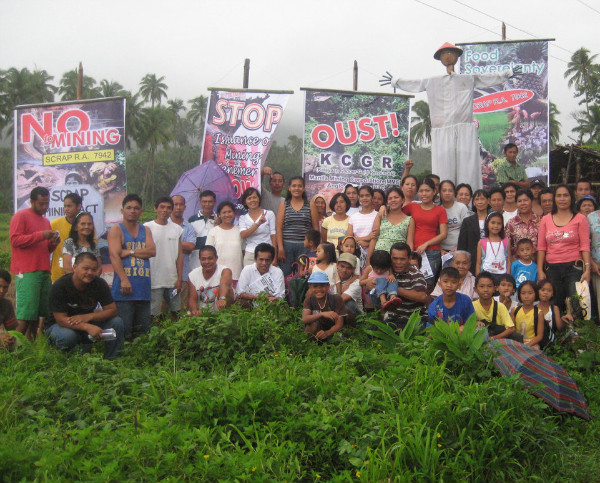
The community of Anislagan on the island of Mindanao has successfully blocked the Philex mining company from entering their lands.

Anislagan vs PhilexJanuary 19, 2010
The community of Anislagan on the island of Mindanao has successfully blocked the Philex mining company from entering their lands.

According to a press release from the Legal Rights and Natural Resources Center-Kasama sa Kalikasan (LRC-CdO), nearly the entire community gathered to greet Philex, the largest mining firm in the Philippines, with a makeshift checkpoint they put together, on January 11, 2010.

The company was planning to commence work on a “livelihood training center.” However, “The Philex 6-vehicle convoy backed out after they failed to pass through the thousand residents of Anislagan,” states the LRC-CdO.

To reinforce the checkpoint, the community formed into a human a human barricade, leaving the company with nowhere else to go

“Women and children here are ready anytime to defend our land. This land is where we survived. We should fight for it!” said Rizalina Lisbos, a mother of four, who was on the front line of the barricade.

Providing some background, the LRC-CdO explains: “Philex started its actual mining operation in the adjacent Barangay (village) of Timamana, Tubod, Surigao del Norte in the 1st quarter of 2009. Philex’s operation in Tubod, also known as the ‘Bayugo Project’, started as early as 1999 for their exploration activities. There was strong opposition from the Tubod people until the mining company started their community relations projects, like livelihood, drainage improvement, sports activities etc. After that people started to begrudgingly agree to the mining project.”

“However, the adjacent village of Anislagan sustained their opposition to mining for almost ten years, led by Anislagan Bantay Kalikasan Task Force (ABAKATAF), which is composed of multi-sectoral and interfaith groups in the village.”

“Anislagan provides irrigation to rice field in their village and to adjacent villages.We don’t need a livelihood training center inside our village from a mining company. What for?” states Mr. Ormega, the new president of ABAKATAF. “We have an existing self-sustaining and community livelihood here. The mining company already affected our irrigation, our rivers, and even to our water supply from their Bayugo project and now they are proposing a livelihood center.”

If the proposed “livelihood center” is the insult, than the mining project is the injury—and its bitterly ironic: If mining in the region goes ahead as planned, it would destroy the communities’ livelihood and their natural resources.

For more information, please visit: http://saveanislaganwatershed.blogspot.com and http://lrcksk.org

Drilling-Rig Sabotaged at Mainshill Woods

In the early hours of January the 13th an Apex drilling rig at Mainshill Woods was sabotaged.

The Machine was one of two drilling rigs working on the site of another opencast coal mine planned for South Lanarkshire.
Resistance is strong with a series of actions already this year.

See and take action against a list of contractors working in Mainshill Woods here: mainshill.noflag.org.uk

In the early hours of January the 13th an Apex drilling rig at Mainshill Woods was sabotaged.

The Machine was one of two drilling rigs working on the site of another opencast coal mine planned for South Lanarkshire.
Resistance is strong with a series of actions already this year.

See and take action against a list of contractors working in Mainshill Woods here: mainshill.noflag.org.uk

This action was taken by an autonomous group of people and is in solidarity with the Mainshill Solidarity Camp.

Pre-Eviction Gathering! Sat 23rd to Tues 26th January

*A long weekend of action, workshops and defence-building in preparation for the eviction of the Mainshill Solidarity Camp*

Pre-eviction gathering*A long weekend of action, workshops and defence-building in preparation for the eviction of the Mainshill Solidarity Camp*

With the long-awaited and highly-anticipated eviction of the camp surely drawing closer, join us for the weekend (and as much time after that as you can spare!) to add the finishing touches to defences, build new ones and fortify barricades. Ever wanted to build yourself a treehouse? Dig yourself a tunnel? Make yourself a lock-on? Now is your chance!

We’re asking anyone who wants to be a part of stopping this open cast coal mine, anyone who wants to fight corporate greed, corrupt government and the feudal land ownership, and anyone who wants to defend a community from the self-interest of the few, to come to the camp and help us build a viable alternative to the destruction that will otherwise ensue.

Asking nicely has failed. Its time to fight back!

What to bring:

* Warm clothes and waterproofs
* Sleeping bag

Tasty vegan food will be provided, but bring any supplies you can. Any building materials, tools, climbing equipment, bedding or anything on our wish list you can spare please bring it along.

Directions – http://coalactionscotland.noflag.org.uk/?page_id=415#How%20to%20Get%20There

http://mainshill.noflag.org.uk/

Eric McDavid Update – 1/13/10

Dear friends,

Today marks the fourth year of Eric’s incarceration. These are not the kind of milestones we would like to be writing about to you. While other people have been celebrating the New Year, we have been incredibly conscious of the passage of time in an entirely different way. For four years, New Years has served as a reminder to us – as it probably does to millions of others – of how long we have been separated from our loved one. While others are celebrating new beginnings, we are faced with the reality that, so far, there has been no new beginning as far as Eric’s physical freedom is concerned. Some things remain painfully the same. Eric is still locked away by the state.

Dear friends,

Today marks the fourth year of Eric’s incarceration. These are not the kind of milestones we would like to be writing about to you. While other people have been celebrating the New Year, we have been incredibly conscious of the passage of time in an entirely different way. For four years, New Years has served as a reminder to us – as it probably does to millions of others – of how long we have been separated from our loved one. While others are celebrating new beginnings, we are faced with the reality that, so far, there has been no new beginning as far as Eric’s physical freedom is concerned. Some things remain painfully the same. Eric is still locked away by the state.


Please remember that this time of year can be particularly difficult for folks who are locked up. Take a minute to write Eric – or another political prisoner – and let them know that folks on the outside are still thinking of them and supporting them.

Appeal Update
——————
Unfortunately, there’s not a lot of news about the appeal. The government’s response to Eric’s opening brief is currently due on Feb. 1 (they’ve now asked for two extensions). We will let you know as soon as we hear anything more. Once the government files their response, Eric’s lawyer will have two weeks to file his final response (more potential extensions notwithstanding ). Once everything is filed it could be more than a year before a decision is made.

How to Help
————
We recently added a PayPal button to Eric’s website (again). You can find it on the “Help” page: http://www.supporteric.org/howtohelp.htm Please consider making a donation to Eric’s support fund. Currently the majority of these funds are being used to help his partner cover the costs of going to visit him. These visits are incredibly important to Eric and his partner and are imperative for maintaining everyone’s sanity. They would not be possible without all of the support that Eric has received. Our sincerest thanks to everyone who has donated in the past. If you would like to donate but would prefer not to use PayPal, please let us know and we will send you the details about who to make the check out to and where to send it.

If you cannot donate money, there are other ways you can help. Eric is locked away from his loved ones and his communities and he doesn’t have access to a lot of information. Receiving news from the outside helps him feel a little more connected to the issues he cares about. If you run across a good article from an independent media source that you think Eric might like, please send it his way. Just keep in mind that Eric is still in the appeals process, and everything he receives is read by the authorities. Even unsolicited mail can result in sanctions against prisoners. Be prudent with your choice of material.

Our thanks to everyone for all of your support these last 4 years.

Yours,
Eric’s Support Crew

http://www.supporteric.org