
 18 April 2014 As recent protests against the construction of a PX refinery in Maoming attest, environmental issues are of greater concern than ever for the Chinese.
 18 April 2014 As recent protests against the construction of a PX refinery in Maoming attest, environmental issues are of greater concern than ever for the Chinese.
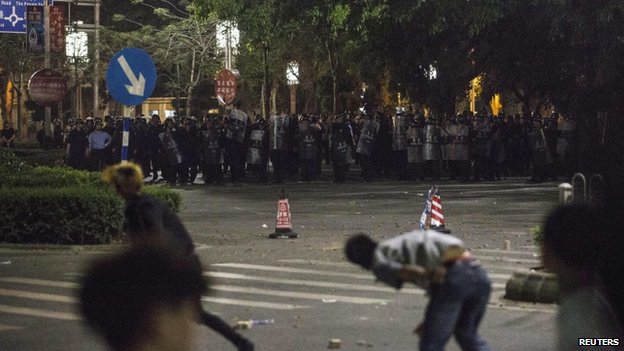
It began as an environmental protest of about a thousand people a few weeks ago on Sunday, March 30 in Maoming, southern China. By day five it had grown to over twenty times its initial size, with about a dozen deaths, scores of arrests and images of dozens of unarmed protesters scattered across the streets, lying in pools of their own blood. The government blamed protesters for the tipping over of police vehicles and attacking official buildings, while the protesters in turn accuse the police of attacking unarmed, peaceful citizens.
In an authoritarian state like China, where people are unable to let off steam on election day, protests are common — albeit risky and usually illegal. But what was behind this particular environmental protest, and how did it get so out of hand? We start by looking at the production of a chemical that is common, but seemingly misunderstood: paraxylene.
 Paraxylene, or PX for short, is made in large quantities for the production of plastic bottles and polyester. China is the world’s largest user of PX, and has to import about half of what it consumes. The government recently decided that a 500 million dollar factory would help make up the shortfall, and went into partnership with Sinopec, Asia’s biggest refiner, to open a factory near Maoming.
Paraxylene is dangerous to produce. It affects the nervous system if ingested through the skin or breathed in. Organs can be affected upon bodily exposure. It affects body development and reproduction — at least in mice. Pregnant women are told not go near it. It damages hearing, and can cause chemical pneumonia. And it is highly flammable, even explosive at warm temperatures. Local people became concerned that a dangerous behemoth on their doorstep could damage the environment and affect their health.
Still, the production of most chemicals carries an element of danger, and one might have thought that, if properly regulated, such a large factory would have enormous economic benefits for the community. Indeed, the local authorities believed just that, but when they sent ten thousand brochures to the public informing them of the economic benefits the factory would bring, it backfired — culminating in a popular protest shortly afterwards. Why the public didn’t trust the state to provide a safe, regulated factory is not difficult to see in the context of rapid capitalist development, widespread environmental irresponsibility and an authoritarian state apparatus.
Ahkok Wong is an activist and school lecturer from down the road in Hong Kong, potentially enjoying his last two days of freedom.
“Environmental problems are one of the main outcomes of a one party-ruled, corrupted, non-humane government,” he starts. “The citizens started discovering what harm the PX plant can bring, so there are [a lot] of protests, and then the police arrest and kill protesters, forcing people to sign agreements that they support PX plants,” he continues. “They control the media and the internet so the news cannot get across the country.”
Protesters like Ahkok are sentenced by a judiciary with links to the government, which in turn has links to big business — for example, the Maoming PX joint venture between Sinopec and the state. Ahkok is going to court in a few days, for his participation in a 300,000 person-strong anti-Chinese government protest in Hong Kong. Is he expecting a fair trial? “I’m expecting nothing, to be honest.”
The other context in which to see this disagreement is with regards to the catastrophic levels of pollution and environmental damage all over China, particularly in the north. For example, at any given moment the air in most Chinese cities is somewhere along a spectrum between mildly harmful and extremely unsafe. Furthermore, China produces nearly twice as much carbon dioxide as the second biggest emitter, the USA. On top of this, one quarter of China already is, or is rapidly becoming, desertified. This leads to silted rivers, floods, drought, dust storms and erosion. In addition, a wealthier population with a penchant for ivory, rhino horn and shark fin soup is leading to diminishing biodiversity, within its borders and beyond.

Most of China’s groundwater is so polluted that it can’t be used for drinking even if treated. Underground water supplies are also extremely polluted. Wildlife soon perishes upon contact with the water from many rivers. Last year thousands of dead pigs clogged up a river running through Shanghai which was contaminated by benzene through a factory spillage. Twenty people were hospitalized. Factories pollute rivers with impunity — and this has in many cases lead to cancer villages — areas so polluted as to now be uninhabitable. Animals in these villages die, the rivers change color, touching the water makes the skin itch, and as the name suggests, there are high levels of cancer.
With this in mind, it is not surprising that the state of the environment is up to fourth — and rising — on the list of Chinese public concerns, according to a Pew Survey carried out earlier this year, behind inflation, corruption and inequality. With growing environmental concerns comes a growing grassroots movement. No surprise, then, that environmental issues were at the heart of half of all the protests in 2013 that had over 10,000 participants. Meanwhile, the government is taking notice, and has taken steps to be seen to be paying attention.
“We shall resolutely declare war against pollution as we declared war against poverty,” Li Keqiang, China’s Prime Minister told parliament, live on state television, last month. This was followed by an increased budget to help prevent deforestation, a sizable clean water fund, and some modest pollution-culling targets. Fifteen thousand companies now have to declare all of their pollution levels to the environment ministry, which will make the information public.
This seems quite impressive, particularly as China didn’t even have an environmental ministry until 2008. Rules are all very well of course — the problem is implementation. Factory owners discharge waste at night, sabotage monitoring equipment, and easily skip around or bribe underfunded law enforcement agencies. They can quietly mix leftover chemicals with water and dump it into the nearest river. Still, the new laws show that the government is paying attention, so perhaps that ought to placate a restless public. Some give the government credit — others think it is mostly for show.
To understand where the government might really stand on this issue, we need to think in terms of how China values itself when comparing itself with the rest of the world. Economic indicators such as GDP seem to have a higher priority than harder-to-measure indicators of quality of living, especially when national pride vis-à-vis America comes into play. A paraxylene plant boosts business, jobs and output. As long as the state can be seen to be taking action with pollution, while doing relatively little, the government can help to maintain its position so long as the media remains compliant. And here seems to lie the Chinese contrast — what seems to be the case is sometimes quite the opposite.

Take the PX plant protests. At one point, authorities told the local newspaper that the building of the plant was being suspended. But it seems they told Sinopec no such thing, and work on the plant continued uninterrupted. While the authorities are now finally acknowledging the existence of cancer villages, they go into opaque partnerships with polluting industries. They allow protests in theory, but put so many restrictions into the ‘small print’ as to make them almost impossible in practice.
“If there are more than three people gathering in public and the police assume you are a threat to society, you can be arrested,” says Ahkok.
The government tell their own citizens they are listening to their environmental concerns. Meanwhile they block searches for “Maoming” or “PX” on search engines and on the popular social media site Weibo. People are told to trust the authorities. Meanwhile, on the very first day of the protests, seventy Maoming city officals were investigated for graft. A supposedly communist government represses the poor and benefits the wealthy. China starts to resemble a chemical spillage, public health deteriorates and those who speak out get arrested.
On a somewhat more optimistic note, however one may feel about the obvious human rights challenges that come with China’s one-child policy, there is no doubt it helped curb the country’s dangerously oversized population. With the help of a burgeoning economy and a strong inclination towards school success, an educated cadre is growing within the population; one that is more and more aware of the world, of their government, and of the quality of their lives. China’s hyperactive microblogger community are a byproduct of this, and are helping to heighten awareness for a lot of people.
But calling for the truth has its own risks. Xu Zhiyong, an anti-government activist, is halfway though a four-year prison sentence for calling on government officials to disclose their assets. “Those of you watching this trial from behind the scenes, or those awaiting for orders and reports back, this is also your responsibility. Don’t take pains to preserve the old system simply because you have vested interests in it,” he said as he was being sentenced. “No one is safe under an unjust system. When you see politics as endless shadows and reflections of daggers and swords, as blood falling like rain with its smell in the wind, you have too much fear in your hearts.”
Back to Ahkok Wong: “China does not have law and system,” he says. “They bribe, they arrest people who investigate truth, but there are no standards to follow. Only those who have absolute power and capital can change the situation, but then they benefit from all of this development and capital growth.”
“China is not meant to last,” concludes Ahkok. “It wouldn’t make any sense if this country could last.”
James Smart is from the South of England and is currently working as a university teacher and teacher trainer in Istanbul, Turkey.
