
 April 18 2014 On March 31st, a ruling by the International Court of Justice (ICJ) served a devastating blow to Japan’s whaling industry.
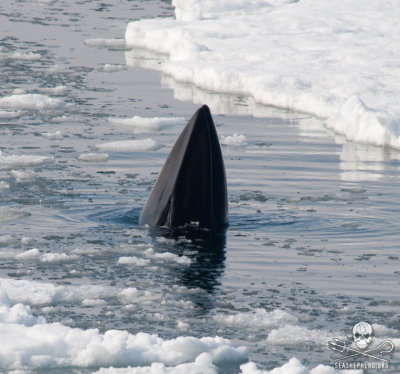 April 18 2014 On March 31st, a ruling by the International Court of Justice (ICJ) served a devastating blow to Japan’s whaling industry. The court’s landmark ruling stated that the Japan whale Research Program in the Antarctic (JARPA II) was not conducted for the purposes of scientific research. It ordered that Japan revoke the scientific permits given under JARPA II and refrain from granting any further permits under that program.
In a blatant show of defiance of this ruling, Japan’s Institute of Cetacean Research (ICR) last week filed court briefs stating that they intend to return to slaughter whales in the Southern Ocean for the 2015-2016 season with a newly designed “research” program and will seek a permanent injunction against Sea Shepherd.
Another example of Japan’s complete disregard for the wishes of the international community could soon unfold as the Japan whale Research Program in the Northwest Pacific (JARPN II) is scheduled to start this month. According to a Japan Times article of April 17: “The Japanese whaling fleet’s departure for the Pacific Northwest has been delayed to April 26 instead of Tuesday 22nd” because of disagreements between the Foreign Ministry and the Fisheries Agency after the International Court of Justice last month ordered Japan to halt its annual “research” hunts in the Antarctic Ocean after ruling they are not scientific in nature. The Foreign Ministry is concerned that if Japan whales in the Northwest Pacific immediately after the ICJ ruling, anti-whaling countries may sue to halt hunts there as well. The Fisheries Agency insists that whaling in the Northwest Pacific should continue, but at a reduced target catch of 60 whales. The delay “might be a side effect of U.S. President Barack Obama’s planned three-day visit to Japan starting Wednesday.”
Although the ICJ ruling does not include JARPN II, as Australia and New Zealand’s case centered on “their” whales in their “backyard”, even the Japanese government realizes, according to a NHK World article of April 10, that “the court’s ruling could be applied to those waters depending on methods used, including the number caught.”
The article continues: “The concern is prompting the government to assess its research procedures. It plans to decide as early as next week whether to go ahead with research whaling in the Northwestern Pacific. Some in the government claim that it should conduct the Pacific research whaling as planned. But others argue that Japan could be sued again if it continues the program without due consideration to the court’s ruling.”
Immediately after the ICJ ruling, the spokesman for the Japanese delegation to the court, Nori Shikata said: “Our program in the Northern Pacific is outside the scope of the proceedings before the court, and so they are two separate programs and this ruling is about the program in the Antarctic,”
On April 15th, before a meeting with the president of the ICR, Japan’s Agriculture, Forestry and Fisheries Minister, Yoshimasa Hayashi expressed willingness to continue whaling in the Pacific despite the ICJ ruling. He said he is determined to “maintain the solid policy of preserving whale-eating culture and securing supply of whale meat.”
On that same date, Kyodo Senpaku, which owns Japan’s whaling fleet, said it had urged Agriculture Minister Yoshimasa Hayashi to allow the Northern Pacific whaling to take place as usual. “The minister gave us strong encouragement by saying that he would firmly consider it, given that the research itself was not gainsaid.”
Aside from the geographic region and the whales targeted, the JARPN and JARPA programs are identical twins when you look at their goal, construction and history. Thus a large part of the ICJ’s motivation for the ruling on Antarctic whaling can be directly applied to the Northwest Pacific slaughter:
- A court would find no evidence of any studies of the feasibility or practicability of non-lethal methods, nor find evidence that Japan examined whether it would be feasible to combine a smaller lethal take and an increase in non-lethal sampling to achieve its research objectives.
- As with the evaluation of JARPA (1988-2005) and JARPA II (2005-2014) by the ICJ, a court investigation of JARPN (1994-1999) and JARPN II (2000-present) will reveal a considerable overlap between the two programs’ subjects, their objectives, and their methods.
- Both state identical goals such as improving knowledge on stock identity/structure and feeding ecology.
- As with JARPA II, which called for a significant increase in the minke whale “sample” size and the lethal “sampling” of additional species (humpback and fin whales) compared to JARPA, the Northwest Pacific kill quota escalated from the killing of 100 common minke whales annually under JARPN to 100 common minke whales, 50 bryde’s whales, and 10 sperm whales under JARPN II. In 2002 they increased the minke whale quota to 150 and added 50 sei whales. The next year, the minke quota became 160 and the sei whale quota was doubled to 100. In 2008 the program proposal was an annual take of 340 minke whales, 50 bryde’s whales, 100 sei whales and 10 sperm whales.
- The ICJ determined that weaknesses in Japan’s explanation for the decision to proceed with the JARPA II sample sizes prior to the final review of JARPA lend support to the view that those sample sizes and the launch date for JARPA II were not driven by strictly scientific considerations. The same applies to the transition from JARPN to JARPN II.
- The ICJ noted that there were three additional aspects of JARPA II which cast further doubt on its characterization as a program for purposes of scientific research: the open-ended time frame of the program, its limited scientific output to date, and the lack of cooperation between JARPA II and other domestic and international research programs. All of these aspects apply to JARPN II.
Given these examples, it becomes clear that if JARPN II were under the scrutiny of the ICJ or any other court outside of a whaling nation, the conclusion of that court would sound much the same as in the case of JARPA II: “The Court concludes that the special permits granted by Japan for the killing, taking and treating of whales in connection with JARPA/N II are not ‘for purposes of scientific research’ pursuant to Article VIII, paragraph 1, of the Convention.”
As a result, Japan would have violated the moratorium not only in the Antarctic, but also in the Northwest Pacific.
Beyond all the legal talk, it is of course clear to every rational person that just as Japan’s Antarctic whale program is a disguise for commercial whaling, the same goes for the program in the North Pacific.
Still in the court’s ruling there is this sentence: “The Court finds that JARPA II can broadly be characterized as ‘scientific research’.” How “broadly” exactly do you want to go?
Science thrives on our thirst for knowledge. All valuable research starts with a question. With that question as a foundation, scientists build a research program that might provide them with answers.
Japan has no questions; they had to disguise their continuation of commercial whaling as science. Deciding on an outcome was easy: the resumption of commercial whaling. Then they defined the desired conclusions: “there are plenty of whales” and “these whales eat our fish.” As whales in Antarctica migrate South to feast on krill and not fish, they had to come up with something else there: “minke whales have become too abundant and threaten the recovery of the blue whale and therefore have to be culled.”
Calling this science, even broadly, is an obscenity.
An important point that some might forget in this day and age, where for many science has replaced the gods of old, is that just because something is called science, be it as a guise, truly so or just broadly, that in itself justifies absolutely nothing! We only have to look at what is done to animals in laboratories all around the world to realize that science often lacks ethics and morals. In the definition of the ICJ, probably even the experiments of Nazi doctors in WW II concentration camps could “broadly be characterized as ‘scientific research’.” That doesn’t make it all right…
Regarding JARPN II there is another disguise within the disguise of commercial whaling as science. When Japan in 1988, under US pressure, lifted its objection to the moratorium on commercial whaling, this also ended Japanese Small-Type Coastal Whaling (JSTCW) for minke whales, as minkes are one of the 13 species of larger whales that fall under the jurisdiction of the International Whaling Commission (IWC). In response to the moratorium, four of the last nine JSTCW vessels from Abashiri (Hokkaido Prefecture), Ayukawa (Miyagi Prefecture), Wada (Chiba Prefecture) and Taiji (Wakayama Prefecture) stopped operating. The remaining ships continued killing short-finned pilot whales, Risso’s dolphins and Baird’s beaked whales in Japan’s coastal waters, as these “small cetaceans” are not covered by the IWC’s regulations.
Since 1987, Japan has tried to get a quota from the IWC to resume the killing of minke whales under a sort of aboriginal subsistence whaling scheme as exists for Alaskan Inuits, Northeast Siberian Chukchi, Greenlanders and for the natives of Bequia. The IWC has for all these years refused to grant a minke whale quota for JSTCW because they judge it to be a commercial proposal.
To get around this, the ICR added a coastal component to JARPN II in 2002. The ICR contracts Japan’s Small Type Whaling Association to provide vessels and crew to participate in whaling operations off Ayukawa, now part of Ishinomaki, (Miyagi prefecture) from April through May and off Kushiro (Hokkaido) in September and October to shoot 60 minke whales in each area. The ICR buys the whales from the whaling companies at a set price and then sells part of the meat at a subsidized price back to the JSTCW towns.
In this light, the ICR’s activities in the Northwest Pacific are an even bigger scam than those in Antarctica.
This is the hunt that is about to start on April 22nd, followed a month later by the offshore component that includes the last-of-its-kind floating abattoir, the Nisshin Maru and the familiar Yushins.
All this could just be underway before the annual meeting of the IWC scientific committee starting May 12 in Slovenia. The committee members are almost certain to question the legality of JARPN II in light of the ICJ ruling on JARPA II.
The international community cannot stand by and allow Japan to make a mockery out of its agreements and institutions. It’s time for the world’s leaders to pick up the phone and explain to Tokyo in no uncertain terms why they should keep their whaling ships in port