
 17th October, 2007
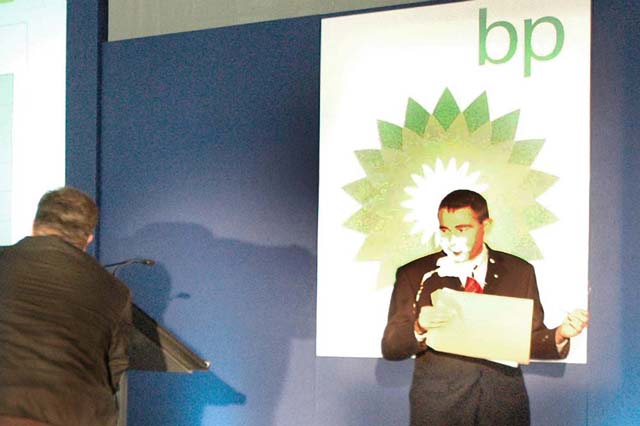
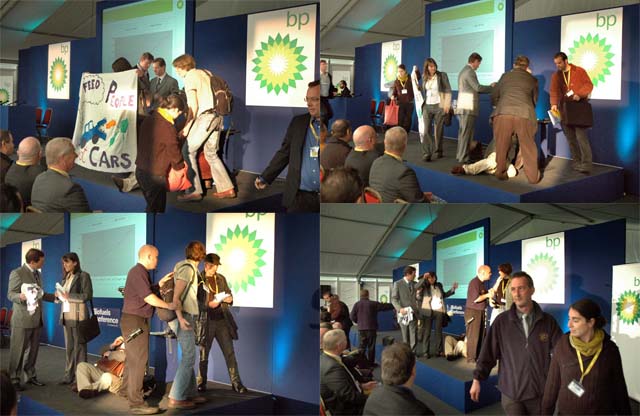
The exhibition, featuring over a hundred trade stands, ran alongside a conference which opened on Wednesday with a key note speech from BP Biofuels’ Europe & Africa Director Oliver Mace, but was quickly thrown into chaos when a number of people dressed in suits marched onto the stage to target BP’s ‘dangerous and dishonest’ greenwash and protest at the catastrophic effects of replacing climate-stabilising ecosystems with arable crops for biofuel feedstocks.
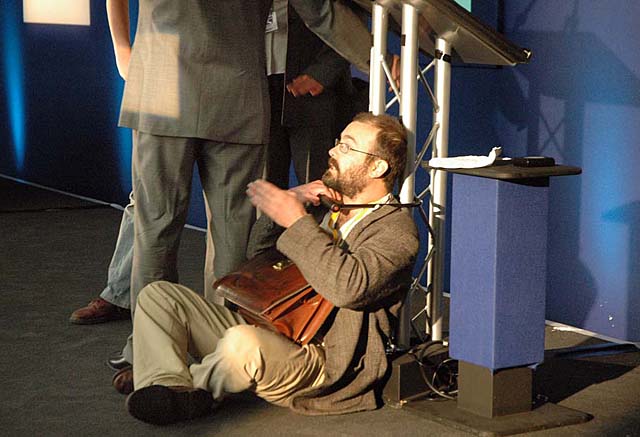
A stunned audience gasped as a cream-pie was launched at Mace, while activists swarmed the stage and handed out leaflets to attendees. One of the protesters D-locked himself to the podium, telling delegates “we need to reduce our consumption now – technological fixes are not the answer.” Panic alarms were then set off around the room and the conference was halted.
Later a press conference was held at which Eastside Climate Action gave a statement saying: “Biofuels are not part of the solution, they are part of the problem. We need lifestyle and economic change, a reduction in consumption and local production of all our own needs.”
BP, the main sponsor of the Biofuels conference, did not represent themselves at the press conference through fears that attention would be focussed on the protest. Oliver Mace was said to be ‘shaken’ by the morning’s events.
Richard Price, conference organiser and Biofuels Media director, said that one of the aims of the event was to have some debate which surrounds issues such as food versus fuel. He also offered a platform for those wanting to raise objections and concerns with the biofuels industry.
Price pointed to future biofuel technologies, known as second generation biofuels, which use plant matter such as Jatropha and algae, and do not normally enter the food chain. Price and others are claiming that these may offer advantages such as higher oil yields and the possibility of using otherwise unviable land.
Price admitted “we should be using less fuel, being more economical, as well as exploring biofuels. Next year we’ll see what the issues are, but clearly we need a much wider base.” Asked if the conference would accept sponsorship from BP in the future, Biofuels Media have so far declined to comment.
Later on there were further protests as campaigners gathered at the main gates to the Newark showground, where the conference was held. Activists from pressure group Biofuelwatch were in attendance to explain their concerns, and those attending the conference were engaged in discussions and handed leaflets explaining that deforestation -such as to make way for oil palms for fuel in Asia- is a major cause of climate change, accounting for up to 30 percent of global greenhouse gas emissions.
Biofuelwatch campaigner Deepak Rughani referred to a recent study by scientist Paul Crutzen, which found that Biofuels produced from arable crops are directly responsible for greenhouse gas emissions of up to 70% more than the equivalent of fossil-fuel. Rughani added, “when you add in elements of deforestation or land-use change, you are looking at massive further emissions due to the release of carbon stored in trees, plants and within the soil.”
Biofuelwatch campaigns against the use of bio-energy from unsustainable sources, namely biofuels that are linked to accelerated climate change, deforestation, bio-diversity losses, water and soil degradation, and the displacement and impoverishment of local populations and loss of food sovereignty and security. Aside from technological solutions, Biofuelwatch and other environmental groups believe cuts in greenhouse gas emissions must be based on overall demand reduction. This means reducing energy use and transport as opposed to replacing one type of fuel with another.
Biofuels Conference – Audio clip (intro & pie) – mp3 1.7M
———————————–
Press release –
Date: 17th October, 2007
Embargo: Immediate Release
CONTACT: 07880 937 511
Newark Showground, Newark, Nottinghamshire
This morning a group of 15 climate change activists from protest group Food Not Fuel entered the BioFuel Expo & Conference taking place at the Newark Showground and took over the keynote speech. Oliver Mace, CEO of BP Fuels, the lead sponsors of the event received a cream pie in the face. Another campaigner was D-locked to the podium and various alarms were placed around the place. The hall was emptied and talks were cancelled. There were no arrests.
They were protesting against planned expansion of biofuels citing its contribution to deforestation and the fact that it will continue to contribute to climate change. The activists complained that biofuels on a large scale is greenwash and companies such as BP are ignoring its negative impacts on the environment.
Protester Michelle Lynch said, “What they are promoting is a replacement to fossil fuels, but the reality is that they are little better. Large scale plantations are not the solution; reducing our consumption is the only realistic way forward.”
Another protester, Thomas Bradshaw pointed out, “Biofuels will be taking food from the mouths of the hungary when there are already 800 million people suffering from malnutrition. These corporations are effectively encouraging the erosion of valuable arable farmland and rainforests vital for combating climate change.”
-end-
Notes for editors:
1. The protestors can be contacted at 07880 937 511. Their critique argues that radical social change is needed to deal with the impact of peak oil and climate change, and that seeking solutions such as carbon trading and biofuels are not the answer, as the real problem is unsustainable economic growth.
2. The BioFuels Expo & Conference (www.biodiesel-expo.co.uk) is the largest of its kind in Europe, and brings together big industry players such as BP Fuels, Deloitte & Touche and many chemical, agricultural and manufacturing companies.
3. A comprehensive critique of biofuels can be found at BioFuels Watch (www.biofuelwatch.org.uk) who are a distinct group from Food Not Fuels, but are hosting their own demonstration against the Conference.
4. Text of leaflet distribute to attendees.
Biofuels & Fossil Fuels: Biofuels that are not produced by recycling waste oil are the direct product of large scale monoculture. Currently the amount of fossil fuels required to produce biofuels is greater than the amount of fuel you get out: you have to make the fertilizer, run the agricultural machinery, transport the feedstocks and fuels, and refine the plant matter into fuel.
Biofuels & Food: The land that is used to farm biofuels has to come from somewhere. If it is agricultural land used for food then there will be less food. Maize, Mexico’s staple crop, have increased massively due to American demand for bioethanol. Adding to the number of people living below the poverty line.
Biofuels & Land use: If not agricultural land, then biofuels will be grown on virgin rainforest or wetland. 1/3 of all greenhouse gas emissions come from the destruction of living carbon sinks. The Amazon rainforest is the largest driver of the climate on the planet and expanding bioethanol plantations will push it to extinction. Wetlands, eg peat, contain more carbon that the whole atmosphere and cover just 1% of the worlds surface. The largest peat bogs in the world, in Indonesia, are currently being drained for palm oil plantations. If greenhouse gas emissions continue as they currently are we will go beyond the climate tipping point causing mass extinction of life on earth.
Biofuels & Local Control: The driving force beyond the expansion in biofuels are big corporations such as BP & Monsanto, and government – the very people who have got us into this mess. They are using biofuels as a way to continue their position of power into the post peak oil world. To stand a chance of survival the control of land must be by local people for local people.
The Solution: We will need to reduce our consumption to levels that we can meet ourselves. This WILL mean a reduction in luxuries, like the luxury to travel. Some biofuels will be used, but at a fraction of our current oil use. We need to end the search for technological solutions to economic problems. We need to localise our economy, produce our own food, make our own tools and use less.
We need an end to economic growth.
foodnotfuel1@yahoo.co.uk
——————————————
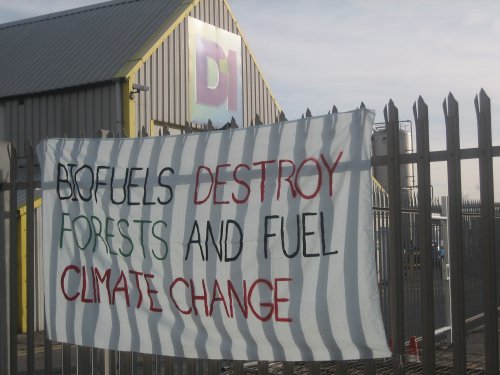
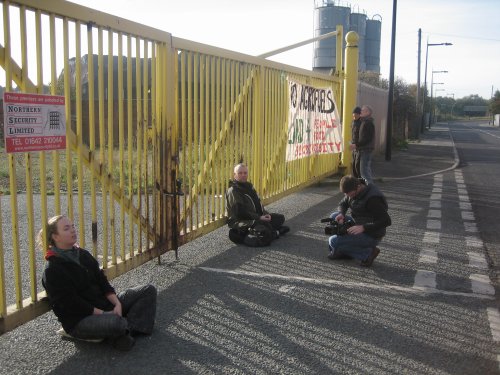
Blockade of D1 Oils – anti-agrofuel demo
Protestors from No Agrofuels UK blockaded DI oils refinery and offices this morning to raise awareness of the detrimental impact of agrofuels. The protest was timed to coincide with the national Biofuels Conference in Newark.
18 Protestors chained the 3 gates to the refinery shut and 2 protestors were D-locked to the main gates. No vehicles were able to enter or leave the site and all work appeared to have been stopped.
Several banners were tied over the gates including “No Agrofuels, Land 4 People, Food, Biodiversity” and “Climate Change Profiteers”
Agrofuels (fuels produced from purposely and intensively grown crops) are not the green solution. They result in deforestation of tropical rainforests and burning of peatlands which increase carbon in the atmosphere. Studies have shown that when you include energy used to grow and produce the fuels including chemical production and transportation they use more energy then oil based fuels.
Agrofuels also cause food insecurity by reducing land availbale to grow food and increasing food prices. They result in land dispossession as people in Africa, Asia and South America are forced off their land to enable crops to be grown for the fuel of Europe and the USA. In Colombia there have been human rights abuses to gain control of the land.
D1 is one of the biggest traders worldwide of palm oil and oil seed rape. They have interests in India, Indonesia, China, South Africa, Zambia, Swaziland, El Salvador and are soon planning to get into Brazil and several otehr African countries. They are directly responsible for land dispossession, food insecurity and increasing poverty, they are not the providing the solution to our climate crisis, the only solution to climate change is a reduction in energy rather then exploiting the biodiversity, people and land of the Global South.
For more info see: www.biofuelwatch.org.uk
——————————————
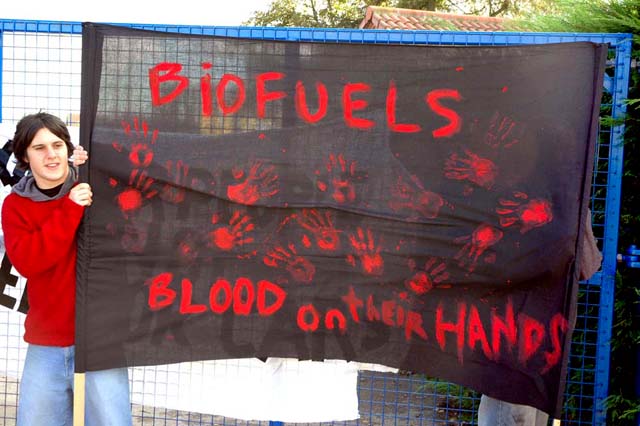
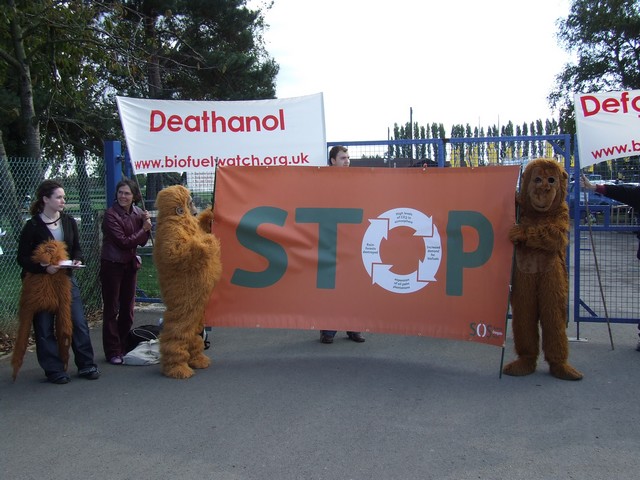
Banner Protest outside Biodiesel Expo in Newark
About 40 protesters held a banner protest outside the Biodiesel Expo in Newark, Europe’s largest biofuel conference this year. Participants of the conference include BP, Virgin and D1 Oils, a biofuel company headed by former Shell CEO Lord Oxburgh which is acquiring rights over large areas of land in India and southern Africa. Protesters highlighted the devastating impact which the industry is having on global warming, rainforests, local communities in the global South and food security.
——
PRESS RELEASE
Newark : 40 Protestors call for food for people, not cars
Over 40 environmentalists protested outside the ‘Biodiesel Expo’ today, Wednesday 17th October, at Newark Showground. The protest was to raise awareness of the damage that massive and rapid biofuels development is having on the climate, people, food security and forests.
The protest comes just the day after World Food Day October 16th when the UN Food and Agroculture organization (FAO) highlighted the impacts of biofuels of food security around the world.
The United Nations Special Rapporteur on the Right to Food, Jean Ziegler, is so concerned that he has warned that rapid biofuel development is a total disaster for those who are starving. He will call for an international five-year ban on producing biofuels to combat soaring food prices in the UN General Assembly on October 25th. (see below).
Deepak Rughani from biofuelwatch says “The UN FAO is very concerned about biofuels. They have said that they ‘are gravely concerned that biofuels will bring hunger in their wake’. A battle is being created between food and fuel that will leave the poor and hungry in developing countries at the mercy of rapidly rising prices for food, land and water. The EU and the UK urgently need a moratorium of biofuels to make sure that we don’t push millions into starvation. We have protested today to support the call in the UN and demand the UK government stops the mad rush to biofuels”.
biofuelwatch, who are campaigning for EU moratorium on large-scale biofuel production and imports into the EU, say that from April 2008 UK consumers will have no choice about having to buy biofuels at the pump. The biofuels available will be blended from many difference sources across the globe depending on commodity market prices.
From April, consumers will not be able to avoid buying biofuel that may be accelerating destruction of tropical forests, increasing their carbon emissions, causing human rights abuses, and taking land from vital food production.
Information:
The United Nations Special Rapporteur on the Right to Food is to demand an international five-year ban on producing biofuels to combat soaring food prices at the United Nations General Assembly on 25th October. http://tinyurl.com/2ltgwd
The entire text of a report to the UN General Assembly from United Nations Special Rapporteur on the Right to Food, Jean Zeigler, highlighting the risks to millions from biofuels is attached to this Press release.
Links to World Food Day press from around the world
Jamaica – Food prices set to rise – Tufton:
http://www.jamaica-gleaner.com/gleaner/20071016/business/business1.html
Biofuels highlighted in Colombia :
http://tech.groups.yahoo.com/group/biofuelwatch/message/1157
New Zealand: Food Prices Driven by Biofuels
http://tech.groups.yahoo.com/group/biofuelwatch/message/1149
Worldwide Women’s Energy issue :: Feed People, Not Cars
http://tech.groups.yahoo.com/group/biofuelwatch/message/1146
Biofuels and world hunger
http://tech.groups.yahoo.com/group/biofuelwatch/message/1145
Contacts:
Andrew Boswell, Biofuelwatch , UK : T: +44-1603-613798 M: +44-7787127881 (at the protest)
E: andrew.boswell[at]yahoo.co.uk
Deepak Rughani, Biofuelwatch , UK : +44–7931-636337 (at the protest)
info@biofuelwatch.org.uk
http://www.biofuelwatch.org.uk