
 December 13th, 2008
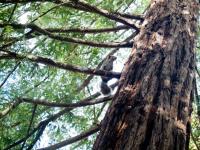
Santa Cruz, CA — Over four hundred days ago, a handful of activists climbed up into the trees on Science Hill as a symbol of resistance to the university’s plan to destroy 120 acres of campus forest. For the past 13 months, the tree sit has drawn attention to UCSC’s reckless plan to develop upper campus without regard for the welfare of one of Santa Cruz’s last wild ecosystems.
At approximately 8 AM this morning, the tree sit drew to a close as police seized control of Science Hill, arresting one Tree Sitter. Later, a tree cutting service hired by the university cut down a grove of 100 year old redwood trees to make way for construction of a new Bioscience building.
The three clusters of redwoods which have now been clearcut were inhabited since November 7, 2007, when over 500 students, alumni, and community members rallied in opposition to the University’s “Long Range Development Plan”. The Tree Sit and the University entered mediation to find a solution to this conflict, but the University was unwilling to modify any of their plans, despite the devastating effect that upper campus development will have on the Santa Cruz ecosystem. Precious watershed regions, unique manzanita groves and hundred-year old redwood forests will be destroyed by the University’s development of the wild lands just north of campus. The homes of such rare native animals as the burrowing owl and the endangered red-legged frog will be irreparably damaged.
The Tree Sit tactic was employed due to the University’s failure to meaningfully address the concerns of Santa Cruz city and county officials, community members, environmentalists and UCSC faculty and students. Instead of acting upon the concerns of the thousands of people who have voiced opposition to increased University construction, UCSC has spent tens of thousands of taxpayer dollars to hire riot police to intimidate community members who oppose their plans.
The end of the Tree Sit is not the end of resistance to the Long Range Development Plan. The determination and integrity that sustained the 13 month occupation will continue to incite action against the Long Range Development Plan. The diverse communities that united to oppose the destruction of upper campus are renewed in their commitment to resistance.
………
One Year Anniversary Celebration at the UCSC Tree-Sit
………
Police Officers Pepper Spray People on Science Hill
………
Struggle on Science Hill.
Nov 7 Noontime – a group of students protesting the UCSC’s Long Range Development Plan (LRPD) struggled with police while bringing food and water to a group of about five old-style activists who, using mountain climbing gear, had placed themselves and several wooden platforms inside the upper reaches of several redwood trees.
The march, and chaos.
The police had arrived on the scene early that day and had cordoned off the area on science hill just outside the Science and Engineering Library with tape, plastic fencing, and portable metal barriers.
However, the protest turned ugly when the march circled the enclosure. One protestor speaking with a police officer took a step too close, was told to step back, and was pushed forward by the crowd.
One of the protestors, Jane Olivera, retold what happened next. She had been walking around the enclosure at the front of the march when she saw her friend Robin Speaking with someone who wasn’t part of the protest.
“I came around just to hang out with him and then he moved in a little bit and the cop said ‘ no, no you can‘t do that,’ and then there was a crown of people that followed him as he moved in a little bit, and then he moved in a lot more, and then before I knew it there was a cop on him. They had jumped on him, and tackled him to the floor, and I don‘t like it when my friends get arrested, and so I jumped in because he was using force. He was holding his hands and he was hitting him so I ran in and said ‘no, you can‘t do that‘ and before I knew it one cop threw me to the floor. I flew,” she said. “I had just moved in a little bit. After I had moved in they just got on top of me and started hitting me.”
Olivera sustained multiple bruises and a scratch on her left arm, was arrested, ticketed, and then released on the scene along with the rest of the protestors. No one was hospitalized.
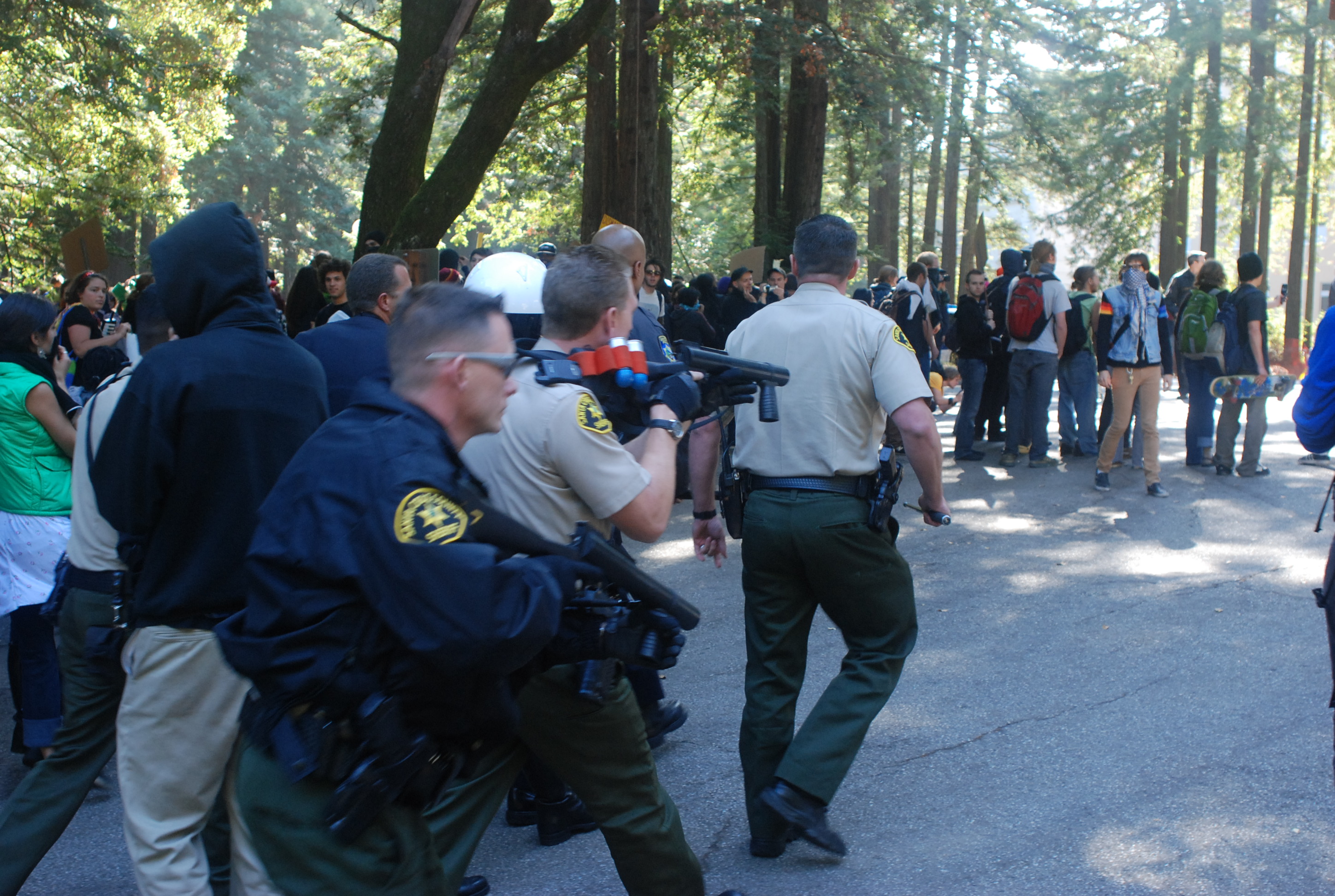
Along with the arrests an indeterminate number of students received blows from batons around the arms and head and were hit with pepper spray. Students pulled down fences and climbed across, the police stepped back while spraying, clubbing, and pushing.
Almost an equal number of students ran towards the fences and away from them. One girl stood rooted to the ground while the metal grate was being lifted by police and pulled away by students.
Later reinforcements arrived in about six to eight squad cars with what appeared to be tear gas and armor. When the officers who were armed were asked about their weapons they did not respond. These officers formed a line across the middle of the grove where they remained for several hours.
Students then read the entirety of ‘The Lorax’ using a megaphone, shouted at the police, and helped bring supplies to the trees where the sitters hoisted up water, food, and blankets.
Olivera and other protesters were released by police officers only a little after the reading of the Lorax. She was scratched and shaken.
“A lot of my friends are organizers and I just don‘t think that development is really a good idea because we can‘t support the number of students we have now and the development is going to stress the water table, the town – there are a lot of reasons outside the trees that makes this not a good idea,” Olivera said. “I don‘t want to go to school inside a cement block.”
The development plan.
The LRDP was approved unanimously by the UC regents in on September 28 ‘06 who had originally drafted the plan three years earlier in 2003. The plan makes way for the development of 120 acres of upper campus, the possible destruction or relocation of the UC trailer park, the addition of 4,500 new students, and the construction of a biomedical sciences facility on what is now a grove of second growth redwood trees.
The district supervisor Mardi Wormhoudt, and the members of the Coalition for Limiting Campus Expansion (CLUE) have been fighting the LRDP. To do this Wormhoudt drafted measures I and J, which made the University responsible for complying with the Local Agency Formation Commission’s (LAFco) guidelines before the City extends water and sewer service to the university, which would, in effect inhibit University growth by preventing the toilets from flushing in whatever buildings the University makes if the guidelines aren’t met. Currently CLUE is engaged in a legal battle over the proposed construction as well.
Jennifer Charles is a UCSC alumna, and the media contact for the protest. She said that campus expansion would decrease the quality of the education that students receive.
“This comes at a time when UCSC is increasing enrollment but really decreasing the quality of education. They’re putting a lot of money towards expansion,” she said. “but not a lot of money for the programs that students need.”
Charles said that the nonexistent ethnic studies program and the now nonexistent journalism minor were two good examples.
“Those are programs that students really want to see. Instead the University is expanding things like the facility planned to be on this site. It‘s an 80 million dollar facility for research that includes live animal testing. It includes no classroom space. The entire building will be used by graduate students and researchers which will probably be funded by outside corporations. And as we‘ve seen at other universities when private corporations are funding research at public insititutions they want control over research.”
Charles said that the LRDP would change the university from a small liberal arts college into a massive science college which would annihilate the feel of UCSC.
“We don‘t want to be UCLI or UCLA or even UC Berkely,” said Charles. “We want to be UC Santa Cruz. We certainly don‘t want to be the UC of the Silicon Valley.”
Tree people.
After the violence, after the chanting, and after the reading of the Lorax the police left. Supplies were hoisted up into the trees. The sitters have climbed the trees and are now living in the branches around science hill.
One of the tree sitters wearing a sweatshirt with a hood and a camouflaged mask came down and refused to give his name or reveal his face. He referred to himself only as Malachi.
Malachi said that the sitters’ voices had not been heard. He said that he and the other tree sitters were going to remain suspended above the ground for as long as it took to change the LRDP “to accommodate all of upper campus and not just corporate interests.”
“We just need support,” said Malachi. “If people want to come up and sit for a few days then they can do that. If they want to come and bring food – day or night – just tell them you‘ve got some food and they‘ll lower a line.”
According to the organizers the tree sitters need blankets, buckets (the ten gallon kind with lids,) portable stoves, and food.
………
Original occupation of the site:
Standoff with Police as Activists occupy redwoods to oppose UCSC Expansion
Early Wednesday morning, activists opposed to UCSC’s Long Range Development Plan (LRDP) launched a tree-sit in redwoods near Science Hill. UCSC plans to develop the occupied site into a new Biomedical Sciences Facility.
Contact: Jennifer Charles
(831) 430-6791
LRDPaction.media [at] gmail.com
Press Release
Standoff with Police as Activists occupy redwoods to oppose UCSC Expansion
UCSC Students launch tree-sit at site of controversial Biomedical Sciences building.
Nov. 7, 2007 Santa Cruz, CA Early Wednesday morning, activists opposed to UCSC’s Long Range Development Plan (LRDP) launched a tree-sit in redwoods near Science Hill. UCSC plans to develop the occupied site into a new Biomedical Sciences Facility.
One person was arrested by UC police early in the morning. Police surrounded the site, where at least 4 activists were 50 feet up redwood trees. A scheduled rally and march that began at 11am drew hundreds of supporters to the site. A tense standoff with police commenced, as supporters attempted to get close enough to the trees to send up supplies. Police pepper sprayed the crowd and at least four people were arrested.
The Biomedical Sciences facility would be the first project under the University’s plan to develop 120 acres of forest in order to accommodate 4,500 new students. The Biomedical Sciences building will have no allotted classroom space, despite student complaints about overcrowded class sizes. But it will have room for live animal experimentation, which includes such practices as food/air deprivation, infection, and non-anesthetized surgery, according to campus guidelines (http://carc.ucsc.edu).
This building, which will house biotechnology and nanotechnology research, is exemplary of how the new LRDP marks a clear shift from UCSC’s commitment to undergraduate, liberal arts education to the more lucrative programs funded by large corporations. Following the trend of privatizing public universities, students are paying more for education and receiving less. Students are calling for more funding for humanities and arts, including the creation of an Ethnic Studies department. Meanwhile, the UC is cutting faculty, increasing enrollment and ignoring the concerns of students.
Critics say the planned addition of 4,500 full-time students is irresponsible given the existing shortage of resources. They cite overcrowded classrooms, overworked teaching assistants and dissatisfied faculty as signs that the UCSC has already exceeded its capacity. In addition, the Environmental Impact Report (EIR) accompanying the LRDP does not bind the UC to mitigate the impacts of growth. The LRDP calls for the development of 120 acres of forest. Environmentalists say that the current development plans will significantly damage unique ecosystems, including Moore Creek, the Jordan Gulch wildlife corridor and the Campus Natural Reserve seep zone. Again, UCSC refuses any binding language requiring them mitigate the effects of development on impacted habitats.
Students, faculty, city council, community members, and environmentalists all expressed concerns about the impact of expansion during the planning process and were disregarded by the University. The group of individuals who are occupying the trees believe that action is needed to oppose UCSC’s destructive plans before construction begins on any of the LRDP buildings.