

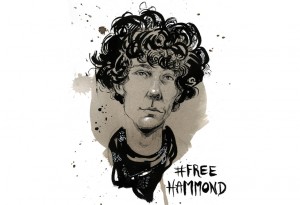
Jeremy Hammond sketched by Molly Crabapple
I’m finding this post hard to type; my fingers are trembling, my pulse is racing. I’m furious. Just minutes ago hacktivist Jeremy Hammond learned his fate in a Manhattan federal court. Ten years in prison, for taking part in a hack that revealed some of the shadiest aspects of the corporate intelligence industry.
The 28-year-old pleaded guilty earlier this year to participating in the Anonymous hack of the private intelligence firm Strategic Forecasting (Stratfor). Hammond, a longtime Chicago political activist, garnered no personal financial gain from the hack; he has consistently maintained that he acted in what he believed to be the public interest. The revelations of the Stratfor hack uphold his claim: It is indeed in the public interest to know that Dow Chemicals paid a private security firm to follow and low-level harass individuals fighting for recognition and restitution for the Bhopal disaster; it is of public interest too that the Coca Cola company employed Stratfor to spy on PETA activists, that the Department of Homeland Security used the firm to spy on Occupy activities. These details all came out of the Stratfor hack. Our context is such that the intelligence firm’s activity is supported and upheld by the law, Hammond’s work to reveal it is punished with a ten year sentence.
Hammond admitted guilt to a crime; he has already served 18 months in federal detention, much of the time in solitary confinement. But whether Hammond’s acts were legal or not should not be conflated with whether or not they are ethical. This country would be a darker place even than it is today were its history not peppered with people willing to act outside of what is legal in service of what is right. It’s worth stressing too that the law that Hammond is being punished for breaking falls under the outdated and dangerously sprawling Computer Fraud and Abuses Act (CFAA) — the same legislation, enacted in 1986, that threatened to put Aaron Swartz in prison for decades before the young technologist took his own life. At his sentencing Friday, Hammond read a statement (please read here in full), explaining why he chose to act outside legal confines in hacking Stratfor and other corporations:
Could I have achieved the same goals through legal means? I have tried everything from voting petitions to peaceful protest and have found that those in power do not want the truth to be exposed. When we speak truth to power we are ignored at best and brutally suppressed at worst. We are confronting a power structure that does not respect its own system of checks and balances, never mind the rights of it’s own citizens or the international community.
… While in prison I have seen for myself the ugly reality of how the criminal justice system destroys the lives of the millions of people held captive behind bars. The experience solidified my opposition to repressive forms of power and the importance of standing up for what you believe.
Hammond’s fight is part of a larger “epistemic war”, as philosopher Peter Ludlow has put it. There is an ideological battle underway between those who seek to control information — and therefore the very truths available to the public — and those who seek to share it and create and informed and empowered public. The stakes, as Chelsea Manning and now Hammond have learned, are high. ” I had to ask myself, if Chelsea Manning fell into the abysmal nightmare of prison fighting for the truth, could I in good conscience do any less, if I was able? I thought the best way to demonstrate solidarity was to continue the work of exposing and confronting corruption,” Hammond said today.
Yes, the hacktivist broke the law; he has admitted as much for some months from within a prison cell. But if there was some doubt as to the ideological valance to Hammond’s punishment, consider that hackers who pleaded guilty to involvement in the very same hack but were charged on British soil received sentences of no more than 30 months, most of which is to be served on probation. Hammond’s 120 month sentence is a chilling messages of the lengths the U.S. government will take to crush dissent and punish challenges to the corporatist surveillance state.
“I am aware that I could get as many as 10 years, but I hope that I do not, as I believe there is so much work to be done,” said Hammond — and ten years he has received. There is so much work to be done.