
 Despite the European Food Safety Authority and of course Monsanto declaring MON 810 maize to be safe, Germany and France in Spring of this year banned the cultivation of this genetically modified crop. It was the only GM crop permitted in Germany. There are very active opposition movements in both countries – ripping up GM crops both at night and by day, occupying fields were it was due to be planted and other wide-scale protests.
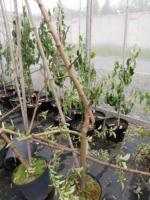
In June in Germany, two hundred and seventy apple trees on a trial site owned by the Institute for Breeding Research on Horticultural and Fruit Crops of the Julius Kühn Institute (JKI) in Dresden-Pillnitz were destroyed by unknown intruders. Most of the trees were genetically modified plants being grown in tubs in a special safety tent under field-like conditions. It is the first time that protesters have destroyed plants that were not being grown in the field.
According to a press release by the JKI, the tent fabric was cut open and all of the trees, which were about seven years old, were either snapped by hand or cut with pruning shears above the graft. The institute estimates the cost of the damage to be around EUR 700 000. Around ten years of research work has been destroyed.
Meanwhile, in Spain 80,000 hectares of GM maize are grown, mostly in Zaragoza and Catalonia. Thousands of people took to the streets this Spring to protest against Spain being the GM dustbin of Europe.
The UK government continues to spout recycled (from 10 years ago) industry nonsense claims about feeding the world, solving climate change and generally saving humanity. Scottish and Welsh politicians remain opposed to GM however.
In the UK BASF – who have been trying to grow GM potatoes over the last couple of years – didn’t bother this year. There have been critical reports over their antibiotic-marker GM potatoes, and the company is preparing itself for a hostile takeover bid. More info: decision not to plant this year | takeover threat
However, there are claims that a trial was grown in secret, and a Welsh GM industry-funded farmer continues to try to provoke through claiming to grow GM.
In April in Poland, anti-GM campaigners from GMO-Free Poland went on hunger strike for 3 weeks, wringing a minor concession out of the government.
Protest in India against GM corn led to a large number of arrests, with 35 arrested in other protests there against GM rice.
And on 19th August 2009 in Iceland, genetically-modified barley, which was being grown for experimental purposes in Gunnarsholt, south Iceland, by start-up company ORF Liftaekni, was damaged by a group of activists in the early hours of Wednesday. There will be no harvest this fall. The CEO said: “For a small company like ours, which is struggling in the difficult innovation environment, this is a serious matter.” The group of activists, which calls itself Illgresi (Weed), sent an anonymous email to the media, claiming responsibility for the sabotage.